

FprEN 46-2
(Main)Wood preservatives - Determination of the preventive action against recently hatched larvae of Hylotrupes bajulus (Linnaeus) - Part 2: Ovicidal effect (Laboratory method)
- Abstract
This document specifies a method for the determination of the preventive action of a wood preservative against eggs of Hylotrupes bajulus (Linnaeus) when the preservative is applied as a surface treatment to wood.
This method is applicable to:
- water-insoluble chemicals which are being studied as active insecticides,
- organic formulations, as supplied or as prepared in the laboratory by dilution of concentrates,
- organic water-dispersible formulations as supplied or as prepared in the laboratory by dilution of concentrates, or
- water-soluble materials, for example salts.
The method is applicable whether or not the test specimens have been subjected to appropriate ageing procedures.
- Status
- Not Published
- Publication Date
- 01-Dec-2026
- Technical Committee
- CEN/TC 38 - Durability of wood and derived materials
- Drafting Committee
- CEN/TC 38/WG 24 - Insect testing - (beetles - termites)
- Current Stage
- 5060 - Closure of Vote - Formal Approval
- Start Date
- 24-Sep-2026
- Due Date
- 03-Feb-2027
- Completion Date
- 24-Sep-2026

FprEN 46-2 is a draft European Standard from the European Committee for Standardization (CEN) for a laboratory method to determine the ovicidal effect of a wood preservative applied as a surface treatment to wood against eggs of Hylotrupes bajulus (Linnaeus). It is written for preservative suppliers, test laboratories and wood-protection specialists who need to assess how a treated wood surface affects egg hatch and, when needed, the survival of newly hatched larvae.
What does FprEN 46-2 specify?
FprEN 46-2 specifies how to prepare treated wood specimens, expose them to freshly mated Hylotrupes bajulus females, and judge the preventive action on egg hatch. The method applies to several preservative types, and it can be used on specimens with or without prior ageing.
The document is organized into clauses 1 to 10, covering scope, normative references, terms and definitions, principle, test materials, sampling, test specimens, procedure, expression of results and test report. It also includes four informative annexes that support practical work in the laboratory.
| Annex | What it covers |
|---|---|
| Annex A | Example of a test report |
| Annex B | Technique for culturing Hylotrupes bajulus |
| Annex C | Differentiation of heartwood and sapwood in Pinus species |
| Annex D | Environmental, health and safety precautions in the chemical/biological laboratory |
What are the key requirements of FprEN 46-2?
Test principle and linked larval check
FprEN 46-2 uses treated wood panels exposed to freshly mated Hylotrupes bajulus females, then checks whether eggs hatch on the treated surface. If the ovicidal effect is not sufficient, the same formulation is also checked for larval mortality by using EN 46-1.
In practice, this means the user does not stop at egg hatch alone when the result is unclear. The standard links ovicidal performance to the follow-up larval test so that surface treatments can be judged more completely.
Test materials and environmental conditions
FprEN 46-2 requires live female insects, suitable preservatives or reagents, and controlled chambers for culturing, conditioning and testing. The document gives target temperatures and relative humidity ranges for each chamber, and it specifies practical items such as Petri dishes, weights, glass plates, pipettes or brushes, imaging facilities and suitable treatment vessels.
This matters because insect response and preservative uptake depend on stable laboratory conditions. The standard also distinguishes between paraffin wax and other sealants depending on whether water or an organic solvent is the continuous phase.
Sampling and wood specimens
FprEN 46-2 requires a representative preservative sample and points to standard sampling practice for bulk supplies. The reference wood species is Scots pine (Pinus sylvestris Linnaeus), and the wood must be sound, mainly sapwood, and prepared to the specified size and grain orientation.
This is important because specimen quality affects both preservative penetration and insect behaviour. The standard also sets minimum specimen numbers for treated samples, untreated controls and solvent or diluent controls, so the test has enough replication to support a reliable result.
Preparation, sealing and treatment
FprEN 46-2 sets out how to condition specimens before sealing, how to seal the faces according to the treatment method, and how to apply the preservative by brushing, pipette or dipping. It also requires fresh preparation of treatment solutions and explains how to determine the applied amount or retained mass for each specimen.
For the user, this means the treatment step must match the intended use of the product and be measured carefully enough to calculate retention. If dipping is used, the method requires attention to immersion time, weighing and the possibility of rejecting specimens with abnormal retention.
Drying, ageing and exposure to insects
FprEN 46-2 requires post-treatment conditioning, with longer conditioning for slow-drying products if needed, and it allows ageing according to EN 73 or EN 84 when that is part of the test plan. After conditioning, the treated face is exposed in Petri dishes to egg-laying females for seven days, with repeat exposure if too few eggs are laid.
This step is where the actual biological challenge happens. The standard also includes a check for possible repellent action if females avoid the treated specimen and then lay eggs on untreated wood.
Validity, results and reporting
FprEN 46-2 states a validity requirement based on survival of larvae in the untreated control specimens, and where used, the solvent or diluent control specimens. Results are recorded as egg mortality, tunnelling control and total mortality, and the test report must capture the preservative identity, application method, wood species, ageing, exposure dates, results and any deviations from the method.
That reporting structure matters for comparison between laboratories and for later technical review. Annex A gives an example of the report format, which is useful when building an internal test record or commissioning a contract test.
What terms does FprEN 46-2 define?
- Representative sample - a sample whose physical or chemical characteristics match the volumetric average of the full material being sampled.
- Supplier - the person or company that provides the wood preservative sample for testing.
- Ovicidal action - the ability of a preservative-treated wood surface to prevent eggs from producing viable larvae.
- Tunnelling control - the follow-up check that records whether newly hatched larvae can bore into treated wood and survive.
- Total mortality - the combined mortality outcome calculated from egg mortality and larval mortality.
- Conditioning chamber - the controlled environment used to bring specimens to the required temperature and humidity before or after treatment.
- Scots pine (Pinus sylvestris Linnaeus) - the reference wood species used for the standard test specimens.
Who uses FprEN 46-2?
FprEN 46-2 is used by wood preservative manufacturers, formulation developers, and testing laboratories that evaluate surface treatments for timber. It is also relevant to quality managers, technical buyers and regulatory or product development teams that need comparable laboratory evidence for preventive performance against Hylotrupes bajulus.
In practice, users apply it when comparing concentrations, treatment methods or formulation types, or when checking whether ageing changes performance. The standard is also useful for laboratories that culture Hylotrupes bajulus, prepare test wood, or write formal test reports for clients.
What changed in FprEN 46-2 from the previous edition?
FprEN 46-2 will supersede EN 46-2:2016. The foreword states these technical changes:
- sealing-face specifications for specimens treated with solutions where an organic solvent is the continuous phase were generalized;
- temperature and humidity requirements were aligned with other insect test standards;
- imaging facilities for non-destructive recording of internal tunnels were generalized;
- storage limitations for wood used to make test specimens were deleted;
- dipping specifications were generalized and aligned with other insect standards.
The foreword also notes that earlier valid test results, and tests already started before publication of the new version, are considered valid.
Which standards are used with FprEN 46-2?
- EN 46-1 - gives the companion laboratory method for the larvicidal part of the assessment when egg hatch is not enough to judge performance.
- EN 73 - provides the evaporative ageing procedure for treated wood before biological testing.
- EN 84 - provides the leaching procedure for treated wood before biological testing.
- EN ISO 835 - specifies graduated pipettes used for liquid application.
- EN ISO 3696 - specifies the water quality required for laboratory use in the method.
What does the FprEN 46-2 document contain?
FprEN 46-2 contains a full laboratory workflow, from specimen selection and preparation to result recording and reporting. It includes detailed instructions for sealing, treatment by brushing, pipette or dipping, post-treatment conditioning, exposure of specimens to insects, and recording egg hatch and larval mortality.
The informative annexes add practical support for reporting, culturing Hylotrupes bajulus, distinguishing heartwood from sapwood in Pinus species, and applying environmental, health and safety precautions. Annex B is especially useful for laboratories that rear insects in-house, while Annex C helps when wood identity needs to be checked during specimen preparation.
Relations
- Effective Date
- 12-Apr-2023
Get Certified
Connect with accredited certification bodies for this standard

ECOCERT
Organic and sustainability certification.

Eurofins Food Testing Global
Global leader in food, environment, and pharmaceutical product testing.

Intertek Bangladesh
Intertek certification and testing services in Bangladesh.
Sponsored listings
Frequently Asked Questions
FprEN 46-2 is a draft published by the European Committee for Standardization (CEN). Its full title is "Wood preservatives - Determination of the preventive action against recently hatched larvae of Hylotrupes bajulus (Linnaeus) - Part 2: Ovicidal effect (Laboratory method)". This standard covers: This document specifies a method for the determination of the preventive action of a wood preservative against eggs of Hylotrupes bajulus (Linnaeus) when the preservative is applied as a surface treatment to wood. This method is applicable to: - water-insoluble chemicals which are being studied as active insecticides, - organic formulations, as supplied or as prepared in the laboratory by dilution of concentrates, - organic water-dispersible formulations as supplied or as prepared in the laboratory by dilution of concentrates, or - water-soluble materials, for example salts. The method is applicable whether or not the test specimens have been subjected to appropriate ageing procedures.
This document specifies a method for the determination of the preventive action of a wood preservative against eggs of Hylotrupes bajulus (Linnaeus) when the preservative is applied as a surface treatment to wood. This method is applicable to: - water-insoluble chemicals which are being studied as active insecticides, - organic formulations, as supplied or as prepared in the laboratory by dilution of concentrates, - organic water-dispersible formulations as supplied or as prepared in the laboratory by dilution of concentrates, or - water-soluble materials, for example salts. The method is applicable whether or not the test specimens have been subjected to appropriate ageing procedures.
FprEN 46-2 is classified under the following ICS (International Classification for Standards) categories: 71.100.50 - Wood-protecting chemicals. The ICS classification helps identify the subject area and facilitates finding related standards.
FprEN 46-2 has the following relationships with other standards: It is inter standard links to EN 46-2:2016. Understanding these relationships helps ensure you are using the most current and applicable version of the standard.
FprEN 46-2 is available in PDF format for immediate download after purchase. The document can be added to your cart and obtained through the secure checkout process. Digital delivery ensures instant access to the complete standard document.
Standards Content (Sample)
SLOVENSKI STANDARD
oSIST prEN 46-2:2025
01-december-2025
Biocidni proizvodi za zaščito lesa - Ugotavljanje preventivnega delovanja proti
hišnemu kozličku Hylotrupes bajulus (Linnaeus) - 2. del: Ovicidni učinek
(laboratorijska metoda)
Wood preservatives - Determination of the preventive action against recently hatched
larvae of Hylotrupes bajulus (Linnaeus) - Part 2: Ovicidal effect (Laboratory method)
Holzschutzmittel - Bestimmung der vorbeugenden Wirkung gegenüber frisch
geschlüpften Larven von Hylotrupes bajulus (Linnaeus) - Teil 2: Ovizide Wirkung
(Laboratoriumsverfahren)
Produits de préservation du bois - Détermination de l'action préventive contre les larves
récemment écloses d'Hylotrupes bajulus (Linnaeus) - Partie 2 : Effet ovicide (Méthode
de laboratoire)
Ta slovenski standard je istoveten z: prEN 46-2
ICS:
71.100.50 Kemikalije za zaščito lesa Wood-protecting chemicals
oSIST prEN 46-2:2025 en,fr,de
2003-01.Slovenski inštitut za standardizacijo. Razmnoževanje celote ali delov tega standarda ni dovoljeno.
oSIST prEN 46-2:2025
oSIST prEN 46-2:2025
DRAFT
EUROPEAN STANDARD
prEN 46-2
NORME EUROPÉENNE
EUROPÄISCHE NORM
October 2025
ICS 71.100.50 Will supersede EN 46-2:2016
English Version
Wood preservatives - Determination of the preventive
action against recently hatched larvae of Hylotrupes
bajulus (Linnaeus) - Part 2: Ovicidal effect (Laboratory
method)
Produits de préservation du bois - Détermination de Holzschutzmittel - Bestimmung der vorbeugenden
l'action préventive contre les larves récemment écloses Wirkung gegenüber frisch geschlüpften Larven von
d'Hylotrupes bajulus (Linnaeus) - Partie 2 : Effet ovicide Hylotrupes bajulus (Linnaeus) - Teil 2: Ovizide Wirkung
(Méthode de laboratoire) (Laboratoriumsverfahren)
This draft European Standard is submitted to CEN members for enquiry. It has been drawn up by the Technical Committee
CEN/TC 38.
If this draft becomes a European Standard, CEN members are bound to comply with the CEN/CENELEC Internal Regulations
which stipulate the conditions for giving this European Standard the status of a national standard without any alteration.
This draft European Standard was established by CEN in three official versions (English, French, German). A version in any other
language made by translation under the responsibility of a CEN member into its own language and notified to the CEN-CENELEC
Management Centre has the same status as the official versions.
CEN members are the national standards bodies of Austria, Belgium, Bulgaria, Croatia, Cyprus, Czech Republic, Denmark, Estonia,
Finland, France, Germany, Greece, Hungary, Iceland, Ireland, Italy, Latvia, Lithuania, Luxembourg, Malta, Netherlands, Norway,
Poland, Portugal, Republic of North Macedonia, Romania, Serbia, Slovakia, Slovenia, Spain, Sweden, Switzerland, Türkiye and
United Kingdom.
Recipients of this draft are invited to submit, with their comments, notification of any relevant patent rights of which they are
aware and to provide supporting documentation.
Warning : This document is not a European Standard. It is distributed for review and comments. It is subject to change without
notice and shall not be referred to as a European Standard.
EUROPEAN COMMITTEE FOR STANDARDIZATION
COMITÉ EUROPÉEN DE NORMALISATIO N
EUROPÄISCHES KOMITEE FÜR NORMUN G
CEN-CENELEC Management Centre: Rue de la Science 23, B-1040 Brussels
© 2025 CEN All rights of exploitation in any form and by any means reserved Ref. No. prEN 46-2:2025 E
worldwide for CEN national Members.
oSIST prEN 46-2:2025
prEN 46-2:2025 (E)
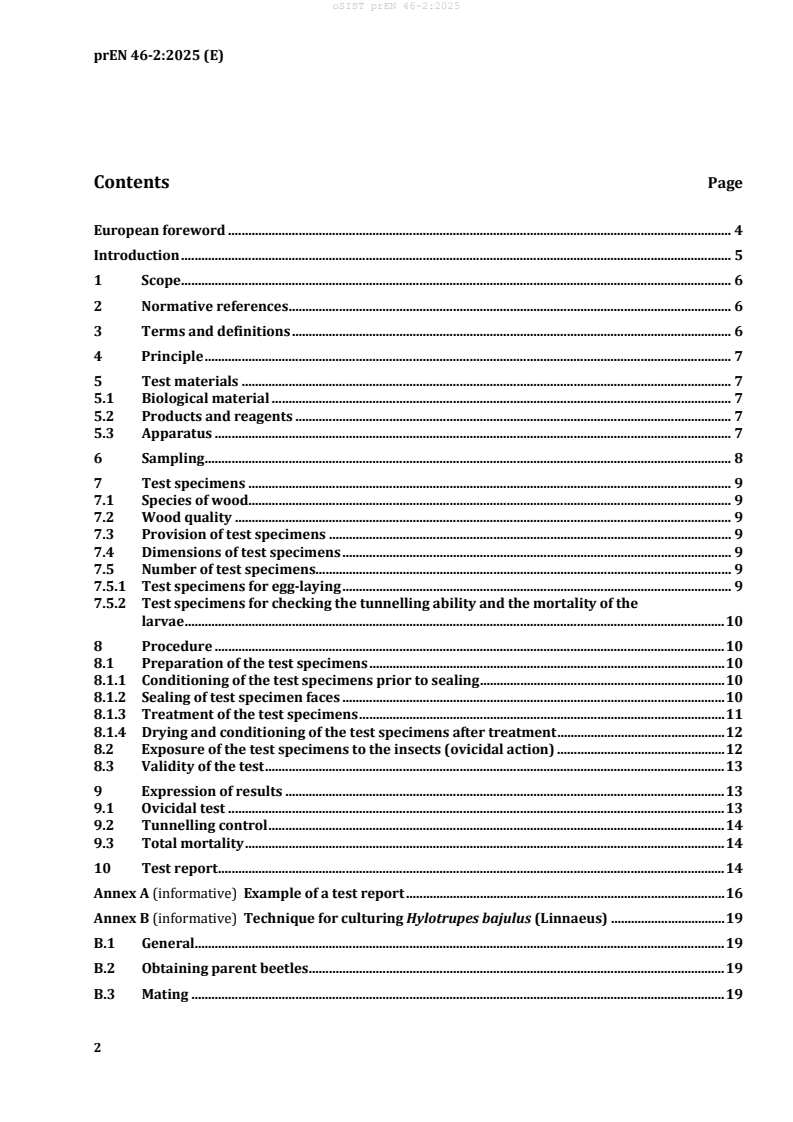
Contents Page
European foreword . 4
Introduction . 5
1 Scope . 6
2 Normative references . 6
3 Terms and definitions . 6
4 Principle . 7
5 Test materials . 7
5.1 Biological material . 7
5.2 Products and reagents . 7
5.3 Apparatus . 7
6 Sampling . 8
7 Test specimens . 9
7.1 Species of wood. 9
7.2 Wood quality . 9
7.3 Provision of test specimens . 9
7.4 Dimensions of test specimens . 9
7.5 Number of test specimens. 9
7.5.1 Test specimens for egg-laying . 9
7.5.2 Test specimens for checking the tunnelling ability and the mortality of the
larvae . 10
8 Procedure . 10
8.1 Preparation of the test specimens . 10
8.1.1 Conditioning of the test specimens prior to sealing . 10
8.1.2 Sealing of test specimen faces . 10
8.1.3 Treatment of the test specimens . 11
8.1.4 Drying and conditioning of the test specimens after treatment . 12
8.2 Exposure of the test specimens to the insects (ovicidal action) . 12
8.3 Validity of the test . 13
9 Expression of results . 13
9.1 Ovicidal test . 13
9.2 Tunnelling control . 14
9.3 Total mortality . 14
10 Test report . 14
Annex A (informative) Example of a test report . 16
Annex B (informative) Technique for culturing Hylotrupes bajulus (Linnaeus) . 19
B.1 General . 19
B.2 Obtaining parent beetles . 19
B.3 Mating . 19
oSIST prEN 46-2:2025
prEN 46-2:2024 (E)
B.4 Egg-Iaying . 19
B.5 Hatching of eggs . 20
B.6 Larval development . 20
B.7 Enemies and parasites . 21
Annex C (informative) Differentiation of heartwood and sapwood in Pinus species . 22
C.1 Principle . 22
C.2 Reagents . 22
C.3 Apparatus . 22
C.4 Procedure . 22
Annex D (informative) Environmental, health and safety precautions within
chemical/biological laboratory . 23
Bibliography . 24
oSIST prEN 46-2:2025
prEN 46-2:2025 (E)
European foreword
This document (prEN 46-2:2025) has been prepared by Technical Committee CEN/TC 38
“Biological durability of wood and wood-based products”, the secretariat of which is held by SIS.
This document is currently submitted to the CEN Enquiry.
This document will supersede EN 46-2:2016.
Significant technical differences between this document and EN 46-2:2016 are as follows:
a) specifications for sealing faces of test specimens to be treated with solutions in which an
organic solvent is the continuous phase were generalized (5.2.2);
b) requirements for temperature and humidity were aligned with other insect test standards
(5.3.1; 5.3.4; B5; B6);
c) imaging facilities for non-destructive recordings of insect tunnels inside test specimens
were generalized (5.3.11);
d) storage limitations for wood from which test specimens are to be made were deleted (7.2);
e) specifications for dipping (8.1.3.3) were generalized and aligned with other insect
standards.
NOTE Test results obtained according to earlier versions of this document or when the tests had
started before this version of EN 46-2 was published are considered as valid.
The standard EN 46 is composed of two parts:
— EN 46-1, Wood preservatives ― Determination of the preventive action against recently
hatched larvae of Hylotrupes bajulus (Linnaeus) ― Part 1: Application by surface treatment
(laboratory method)
— EN 46-2, Wood preservatives ― Determination of the preventive action against recently
hatched larvae of Hylotrupes bajulus (Linnaeus) ― Part 2: Ovicidal effect (laboratory method)
EN 46 consists of two parts to enable preventive action of wood preservatives, against recently
hatched larvae of Hylotrupes bajulus, which are intended to be applied by surface treatment; Part
1 is required to determine the larvicidal effect of preservatives and Part 2 is required to
determine the ovicidal action of the preservatives after egg-laying of young females.
oSIST prEN 46-2:2025
prEN 46-2:2024 (E)
Introduction
This document describes a laboratory method of test which gives a basis for the assessment of
the preventive action of a wood preservative, when applied as a surface treatment for timber,
against eggs of Hylotrupes bajulus.
In combination with EN 46-1 it provides a means of checking whether larvae may hatch from
eggs laid on the treated wood surface and whether they are capable of boring through the
treated surface and of surviving in the untreated part of the wood.
This document provides information for the sealing of all but one lateral face when specimens
are to be treated by dipping.
When products which are very active at very low concentration are used, it is very important to
take suitable precautions to isolate and separate, as far as possible, operations involving
chemical products, other products, treated wood, laboratory apparatus and clothing. Suitable
precautions should include the use of separate rooms, areas within rooms, extraction facilities,
conditioning chambers and special training for personnel (see also Annex D for environmental,
health and safety precautions).
oSIST prEN 46-2:2025
prEN 46-2:2025 (E)
1 Scope
This document specifies a method for the determination of the preventive action of a wood
preservative against eggs of Hylotrupes bajulus (Linnaeus) when the preservative is applied as a
surface treatment to wood.
This method is applicable to:
— water-insoluble chemicals which are being studied as active insecticides;
— organic formulations, as supplied or as prepared in the laboratory by dilution of
concentrates;
— organic water-dispersible formulations as supplied or as prepared in the laboratory by
dilution of concentrates; or
— water-soluble materials, for example salts.
The method is applicable whether or not the test specimens have been subjected to appropriate
ageing procedures.
2 Normative references
The following documents, in whole or in part, are normatively referenced in this document and
are indispensable for its application. For dated references, only the edition cited applies. For
undated references, the latest edition of the referenced document (including any amendments)
applies.
EN 46-1, Wood preservatives — Determination of the preventive action against recently hatched
larvae of Hylotrupes bajulus (Linnaeus) — Part 1: Application by surface treatment (Laboratory
method)
EN 73, Durability of wood and wood-based products — Accelerated ageing of treated wood prior to
biological testing — Evaporative ageing procedure
EN 84, Durability of wood and wood-based products — Accelerated ageing of treated wood prior to
biological testing — Leaching procedure
EN ISO 835, Laboratory glassware — Graduated pipettes (ISO 835)
EN ISO 3696, Water for analytical laboratory use — Specification and test methods (ISO 3696)
3 Terms and definitions
For the purposes of this document, the following terms and definitions apply.
3.1
representative sample
sample having its physical and/or chemical characteristics identical to the volumetric average
characteristics of the total volume being sampled
oSIST prEN 46-2:2025
prEN 46-2:2024 (E)
3.2
supplier
sponsor of the test (person or company providing the sample of wood preservative to be tested)
4 Principle
In this laboratory method treated wood panels are exposed to freshly mated Hylotrupes bajulus
females. The hatching ability of the larvae on the treated timber is examined. When the ovicidal
action is insufficient, the mortality of the hatched larvae on or in wood treated with the same
formulation is also established according to EN 46-1.
5 Test materials
5.1 Biological material
5.1.1 Hylotrupes bajulus (Linnaeus) females.
5.1.2 Source of females
The insects shall preferably be obtained from cultures reared as e. g. described in Annex B.
Use only sound and lively insects.
5.2 Products and reagents
5.2.1 Paraffin wax, for fixing the glass plate in all cases and for sealing the end faces as well as
all relevant other faces of test specimens to be treated with solutions in all cases in which water
is the continuous phase (see 8.1.2.1 and 8.1.2.2).
NOTE Paraffin wax with a setting point of approx. 52 °C to 54 °C has been found to be suitable.
5.2.2 Sealant, for sealing the end faces and all relevant other faces of test specimens to be
treated with solutions in all cases in which an organic solvent is the continuous phase (see
8.1.2.1 and 8.1.2.3). The sealant must be resistant to penetration by the wood preservative under
test and the respective solvent. The sealant must not act repellent or insecticidal in the test
specimen.
NOTE Gelatine or two to three coats of a two-component epoxy varnish with a drying step between
each coat has been found to be suitable.
5.2.3 Water, complying with grade 3 of EN ISO 3696 shall be used.
5.2.4 Solvent or diluent, a volatile liquid that will dissolve or dilute the preservative but does
not leave a residue in the wood at the end of the post-treatment conditioning period that has a
toxic effect on the insects.
CAUTION — Do not use benzene or other solvents which pose a health risk.
5.3 Apparatus
5.3.1 Culturing chamber, with air circulation, and controlled at (26 ± 2) °C and at relative
humidity (75 ± 5) %.
oSIST prEN 46-2:2025
prEN 46-2:2025 (E)
5.3.2 Conditioning chamber, well ventilated and controlled at (20 ± 2) °C and at relative
humidity (65 ± 5) %.
The conditioning of test specimens may be carried out in the laboratory work area (see 5.3.3)
provided that this has the conditions specified for the conditioning chamber (see 5.3.2).
5.3.3 Laboratory work area, well ventilated, where treatment of the test specimens is carried
out.
CAUTION — It is essential to follow safety procedures for handling flammable and toxic
materials. Avoid excessive exposure of operators to solvents or their vapours.
5.3.4 Testing chamber, ventilated and air-conditioned, controlled at (22 ± 2) °C and at
relative humidity between (75 ± 5) %.
5.3.5 Petri dishes of glass or polyvinylchloride (PVC), diameter ca. 9 cm for mating the insects
and for egg-laying.
5.3.6 Weights, to provide ballast for the test specimens.
The weights shall not react with any materials with which they come into contact during the test.
5.3.7 Safety equipment, protective clothing, protective gloves appropriate for the test
product and the test solvent, to ensure the safety of the operator.
5.3.8 Glass plates, (48 ± 1) mm long and (25 ± 1) mm wide, intended to provide a lateral slit
on the test specimens.
5.3.9 Ordinary laboratory equipment, including a balance capable of weighing to an
accuracy of 0,01 g and equipment for applying a liquid product by brushing or by pipette.
5.3.10 Pipette, specified in EN ISO 835 shall be used, or brush.
5.3.11 Imaging facilities e. g. X-ray apparatus, or any other device that offers good images
(2D), of internal tunnels caused by small larvae.
5.3.12 Treatment vessels of a material that does not react with the preservative under test, for
example of glass for organic products and of polyethylene for salts containing fluorine.
6 Sampling
The sample of preservative shall be representative of the product to be tested. Samples shall be
stored and handled in accordance with any written recommendations from the supplier.
For the sampling of preservatives from bulk supplies, the procedure given in EN 212 should be
used.
oSIST prEN 46-2:2025
prEN 46-2:2024 (E)
7 Test specimens
7.1 Species of wood
)
The reference species is Scots pine (Pinus sylvestris Linnaeus) .
Additional tests may be carried out using other species but, if so, this shall be stated in the test
report.
7.2 Wood quality
The wood shall be free from visible cracks, stain, decay, insect damage and other defects. The
wood shall not have been water-stored, floated, chemically treated or steamed. The wood shall
originate from trees preferably felled in winter. The trees shall be cut immediately after felling
and the timber rapidly air-dried or kiln dried at temperatures below 60 °C.
The wood shall be exclusively sapwood containing little resin and having between 2,5 to and 8
annual rings per 10 mm. The proportion of latewood in the annual rings shall not exceed 30 % of
the whole.
It is recommended to use test specimens of similar growth rate within a single test.
)
7.3 Provision of test specimens
Prepare planed strips having a cross-section of (25 ± 0,5) mm × (15 ± 0,5) mm removing a
minimum of 2 mm from any surfaces exposed during drying. The longitudinal faces shall be
parallel to the direction of the grain. The annual rings shall have a contact angle of 45° ± 15° to
the broad faces. Make transverse cuts, neatly to give sharp edges and a fine-sawn finish to the
end-grain surfaces, to give test specimens (50 ± 0,5) mm long.
The test specimens shall originate from a minimum of three trees or shall be taken at random
from a stock originally of more than 500 test specimens.
7.4 Dimensions of test specimens
The dimensions of each test specimen after reaching equilibrium in the conditioning chamber
(5.3.2) shall be (50 ± 0,5) mm × (25 ± 0,5) mm × (15 ± 0,5) mm.
Mark each test specimen so that it can be identified throughout the test.
7.5 Number of test specimens
7.5.1 Test specimens for egg-laying
a) Six treated test specimens (no more than two originating from the same tree unless taken at
random from a stock of more than 500) for each preservative, each concentration and each
duration of treatment;
1)
In southern European countries the pine species most frequently infested by Hylotrupes bajulus may be used as an
alternative, provided that the suitability of the species for use in the tests specified in this standard has been
demonstrated in all aspects (development of larvae, resistance of impregnation, etc.).
2)
For special tests, test specimens may be obtained according to a given series. As a result, it may be preferable to
take test specimens from pretreated strips. Where pretreated strips are used details should be included in the test
report.
oSIST prEN 46-2:2025
prEN 46-2:2025 (E)
b) three untreated control test specimens (each originating from a different tree unless taken
at random from a stock of more than 500) for a complete test of any given preservative;
c) three control test specimens treated with the solvent or diluent (5.2.3 or 5.2.4) (each
originating from a different tree unless taken at random from a stock of more than 500) if a
solvent or diluent (including water) is used.
Control test specimens under c) may be omitted if the solvent or diluents is water of drinking
quality.
When dipping is to be used (8.1.3.3) it is advisable to treat more than the specified number of
test specimens so that, after weighing, any test specimens with abnormally high or low
retentions can be rejected from the batch.
To gain further information on a formulation, the manufacturer may find it useful to test a
version of the preservative where the active ingredient(s) has been removed.
7.5.2 Test specimens for checking the tunnelling ability and the mortality of the larvae
In addition to the test specimens for egg-laying at least six test specimens shall be prepared for
each preservative concentration and retention for checking the tunnelling
...