


EN 17908:2023
(Main)Algae and algae products - Methods of sampling and analysis - Determination of total lipids content using the Ryckebosch-Foubert method
Algae and algae products - Methods of sampling and analysis - Determination of total lipids content using the Ryckebosch-Foubert method
This document specifies a laboratory method for the determination of the total lipid content in micro- and macroalgae by the Ryckebosch-Foubert method.
Algen und algenbasierte Produkte oder Zwischenprodukte - Verfahren zur Probenahme und Analyse - Bestimmung von Gesamtlipiden mit der Ryckebosch-Foubert-Methode
Dieses Dokument legt ein Laborverfahren zur Bestimmung des Gesamtlipidgehalts in Mikro- und Makroalgen mit der Ryckebosch-Foubert-Methode fest.
Algues et produits d'algues - Méthodes d'échantillonnage et d'analyse - Détermination de la teneur en lipides totaux à l'aide de la méthode de Ryckebosch-Foubert
Le présent document spécifie une méthode de laboratoire permettant de déterminer la teneur en lipides totaux des micro- et macroalgues par la méthode de Ryckebosch-Foubert.
Alge in izdelki iz alg - Metode vzorčenja in analize - Določevanje skupnih lipidov z metodo Ryckebosch-Foubert
Ta dokument določa laboratorijsko metodo za ugotavljanje skupnih lipidov v mirko- in makroalgah z metodo Ryckebosch-Foubert.
General Information
- Status
- Published
- Publication Date
- 05-Dec-2023
- Withdrawal Date
- 24-Jan-2023
- Technical Committee
- CEN/TC 454 - Algae and algae products
- Drafting Committee
- CEN/TC 454 - Algae and algae products
- Current Stage
- 6060 - Definitive text made available (DAV) - Publishing
- Start Date
- 06-Dec-2023
- Due Date
- 30-Aug-2022
- Completion Date
- 06-Dec-2023
Relations
- Effective Date
- 28-Jan-2026
Overview
EN 17908:2023 (CEN) specifies a laboratory method - the Ryckebosch‑Foubert method - for the determination of total lipid content in microalgae and macroalgae. The standard defines sample handling recommendations, two extraction procedures (with and without cell disruption), required apparatus and reagents, and the gravimetric determination of total lipids after solvent removal. It is intended as a reference method to improve comparability of lipid data across laboratories and support algae value chains (food, feed, biofuel, cosmetics, bioproducts).
Key topics and requirements
- Scope: Total lipids in dried, homogenized algal biomass (expressed as mg/g dry weight).
- Extraction principle: Lipids are extracted using chloroform/methanol (1:1 v/v), followed by aqueous counter‑extraction to remove non‑lipids; two consecutive extractions are recommended. Solvent removal and gravimetric weighing yield total lipid content.
- Two procedures:
- 8.2 Without cell disruption (default for most species). Example first extraction: ≈100 mg sample, add 4 mL methanol + 2 mL chloroform, 0.4 mL water, vortex, then 2 mL chloroform + 2 mL water, centrifuge at 450 g for 10 min.
- 8.3 With cell disruption (use when rigid cell walls or high-lipid cultures require bead beating). Labs must report bead beater specifications because equipment affects results.
- Apparatus: rotary evaporator, centrifuge, vortex, analytical balance (readability 0.01 mg), bead beater (if used).
- Reagents: chloroform (≥99.0%), methanol (≥99.0%), chloroform/methanol (1:1), anhydrous sodium sulfate, demineralized water.
- Quality control: triplicate test portions, reporting mean and standard deviation; interlaboratory reproducibility is addressed (Annex A).
- Safety/chemistry note: Annex B discusses chloroform use and possible replacement options (e.g., dichloromethane), with practical guidance.
Applications and users
EN 17908:2023 is practical for:
- Analytical and quality control laboratories analyzing algal biomass lipid content for research, process development and product specification.
- Algae producers and biorefineries assessing feedstock suitability for biofuel, food, feed, cosmetic and biopolymer applications.
- Academics validating new extraction methods against a standardized reference method.
- Regulatory and certification bodies requiring harmonized lipid measurement for commercial claims.
Keywords: EN 17908:2023, Ryckebosch‑Foubert, total lipids, algae analysis, lipid extraction, chloroform/methanol, microalgae, macroalgae, gravimetric determination.
Related standards
- EN 17399 - Terms and definitions for algae and algae products (normative reference).
- EN 17605:2022 - Recommended sampling and sample handling adaptations referenced for sample grinding, transport (dry ice) and storage (−80 °C / freeze‑drying).

Get Certified
Connect with accredited certification bodies for this standard

BSI Group
BSI (British Standards Institution) is the business standards company that helps organizations make excellence a habit.

Bureau Veritas
Bureau Veritas is a world leader in laboratory testing, inspection and certification services.

DNV
DNV is an independent assurance and risk management provider.
Sponsored listings
Frequently Asked Questions
EN 17908:2023 is a standard published by the European Committee for Standardization (CEN). Its full title is "Algae and algae products - Methods of sampling and analysis - Determination of total lipids content using the Ryckebosch-Foubert method". This standard covers: This document specifies a laboratory method for the determination of the total lipid content in micro- and macroalgae by the Ryckebosch-Foubert method.
This document specifies a laboratory method for the determination of the total lipid content in micro- and macroalgae by the Ryckebosch-Foubert method.
EN 17908:2023 is classified under the following ICS (International Classification for Standards) categories: 13.020.55 - Biobased products. The ICS classification helps identify the subject area and facilitates finding related standards.
EN 17908:2023 has the following relationships with other standards: It is inter standard links to EN 17399:2024. Understanding these relationships helps ensure you are using the most current and applicable version of the standard.
EN 17908:2023 is associated with the following European legislation: Standardization Mandates: M/547. When a standard is cited in the Official Journal of the European Union, products manufactured in conformity with it benefit from a presumption of conformity with the essential requirements of the corresponding EU directive or regulation.
EN 17908:2023 is available in PDF format for immediate download after purchase. The document can be added to your cart and obtained through the secure checkout process. Digital delivery ensures instant access to the complete standard document.
Standards Content (Sample)
SLOVENSKI STANDARD
01-februar-2024
Alge in izdelki iz alg - Metode vzorčenja in analize - Določevanje skupnih lipidov z
metodo Ryckebosch-Foubert
Algae and algae products - Methods of sampling and analysis - Determination of total
lipids content using the Ryckebosch-Foubert method
Algen und algenbasierte Produkte oder Zwischenprodukte - Methoden zur
Probeentnahme und Analyse - Bestimmung von Gesamtlipiden mit der Ryckebosch-
Foubert Methode
Algues et produits à base d'algues - Méthodes d'échantillonnage et d'analyse -
Détermination de la teneur en lipides totaux à l'aide de la méthode de Ryckebosch-
Foubert
Ta slovenski standard je istoveten z: EN 17908:2023
ICS:
13.020.55 Biološki izdelki Biobased products
2003-01.Slovenski inštitut za standardizacijo. Razmnoževanje celote ali delov tega standarda ni dovoljeno.
EN 17908
EUROPEAN STANDARD
NORME EUROPÉENNE
December 2023
EUROPÄISCHE NORM
ICS 13.020.55
English Version
Algae and algae products - Methods of sampling and
analysis - Determination of total lipids content using the
Ryckebosch-Foubert method
Algues et produits d'algues - Méthodes Algen und algenbasierte Produkte oder
d'échantillonnage et d'analyse - Détermination de la Zwischenprodukte - Verfahren zur Probenahme und
teneur en lipides totaux à l'aide de la méthode de Analyse - Bestimmung von Gesamtlipiden mit der
Ryckebosch-Foubert Ryckebosch-Foubert-Methode
This European Standard was approved by CEN on 6 November 2023.
CEN members are bound to comply with the CEN/CENELEC Internal Regulations which stipulate the conditions for giving this
European Standard the status of a national standard without any alteration. Up-to-date lists and bibliographical references
concerning such national standards may be obtained on application to the CEN-CENELEC Management Centre or to any CEN
member.
This European Standard exists in three official versions (English, French, German). A version in any other language made by
translation under the responsibility of a CEN member into its own language and notified to the CEN-CENELEC Management
Centre has the same status as the official versions.
CEN members are the national standards bodies of Austria, Belgium, Bulgaria, Croatia, Cyprus, Czech Republic, Denmark, Estonia,
Finland, France, Germany, Greece, Hungary, Iceland, Ireland, Italy, Latvia, Lithuania, Luxembourg, Malta, Netherlands, Norway,
Poland, Portugal, Republic of North Macedonia, Romania, Serbia, Slovakia, Slovenia, Spain, Sweden, Switzerland, Türkiye and
United Kingdom.
EUROPEAN COMMITTEE FOR STANDARDIZATION
COMITÉ EUROPÉEN DE NORMALISATION
EUROPÄISCHES KOMITEE FÜR NORMUNG
CEN-CENELEC Management Centre: Rue de la Science 23, B-1040 Brussels
© 2023 CEN All rights of exploitation in any form and by any means reserved Ref. No. EN 17908:2023 E
worldwide for CEN national Members.
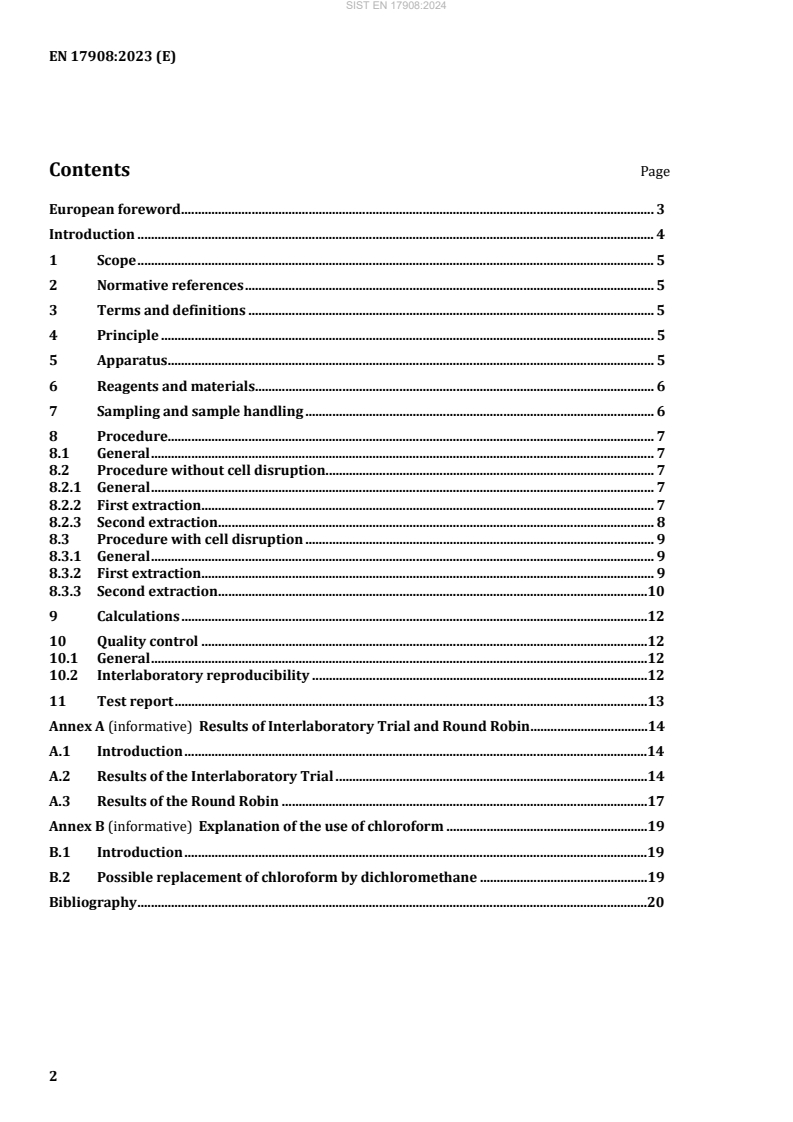
Contents Page
European foreword . 3
Introduction . 4
1 Scope . 5
2 Normative references . 5
3 Terms and definitions . 5
4 Principle . 5
5 Apparatus . 5
6 Reagents and materials . 6
7 Sampling and sample handling . 6
8 Procedure. 7
8.1 General . 7
8.2 Procedure without cell disruption . 7
8.2.1 General . 7
8.2.2 First extraction . 7
8.2.3 Second extraction . 8
8.3 Procedure with cell disruption . 9
8.3.1 General . 9
8.3.2 First extraction . 9
8.3.3 Second extraction .10
9 Calculations .12
10 Quality control .12
10.1 General .12
10.2 Interlaboratory reproducibility .12
11 Test report .13
Annex A (informative) Results of Interlaboratory Trial and Round Robin .14
A.1 Introduction .14
A.2 Results of the Interlaboratory Trial .14
A.3 Results of the Round Robin .17
Annex B (informative) Explanation of the use of chloroform .19
B.1 Introduction .19
B.2 Possible replacement of chloroform by dichloromethane .19
Bibliography .20
European foreword
This document (EN 17908:2023) has been prepared by Technical Committee CEN/TC 454 “Algae and
algae products”, the secretariat of which is held by NEN.
This European Standard shall be given the status of a national standard, either by publication of an
identical text or by endorsement, at the latest by June 2024, and conflicting national standards shall be
withdrawn at the latest by June 2024.
Attention is drawn to the possibility that some of the elements of this document may be the subject of
patent rights. CEN shall not be held responsible for identifying any or all such patent rights.
This document has been prepared under a standardization request addressed to CEN by the European
Commission. The Standing Committee of the EFTA States subsequently approves these requests for its
Member States.
Any feedback and questions on this document should be directed to the users’ national standards body.
A complete listing of these bodies can be found on the CEN website.
According to the CEN-CENELEC Internal Regulations, the national standards organisations of the
following countries are bound to implement this European Standard: Austria, Belgium, Bulgaria, Croatia,
Cyprus, Czech Republic, Denmark, Estonia, Finland, France, Germany, Greece, Hungary, Iceland, Ireland,
Italy, Latvia, Lithuania, Luxembourg, Malta, Netherlands, Norway, Poland, Portugal, Republic of North
Macedonia, Romania, Serbia, Slovakia, Slovenia, Spain, Sweden, Switzerland, Türkiye and the United
Kingdom.
Introduction
General
The European Committee for Standardization (CEN) was requested by the European Commission (EC) to
draft European standards or European standardization deliverables to support the implementation of
Article 3 of Directive 2009/28/EC for algae and algae-based products or intermediates.
This request, presented as Mandate M/547 , also contributes to the Communication on “Innovating for
Sustainable Growth: A Bio Economy for Europe”.
The former working group CEN Technical Board Working Group 218 “Algae”, was created in 2016 to
develop a work programme as part of this Mandate. The technical committee CEN/TC 454 'Algae and
algae products' was established to carry out the work programme that will prepare a series of standards.
The interest in algae and algae-based products or intermediates has increased significantly in Europe as
a valuable source including but not limited to, carbohydrates, proteins, lipids, and several pigments.
These materials are suitable for use in a wide range of applications from food and feed purposes to other
sectors, such as textiles, cosmetics, biopolymers, biofuel and fertilizer/biostimulants. Standardization
was identified as having an important role in promoting the use of algae and algae products.
The work of CEN/TC 454 should improve the reliability of the supply chain, thereby improving the
confidence of industry and consumers in algae, which include macroalgae, microalgae, cyanobacteria,
Labyrinthulomycetes, algae-based products or intermediates and will promote and support
commercialization of the European algae industry.
Considerations in relation to the method
There is an objective among the algae community to have an accepted standardized method for the
determination of total lipids in algae. There are other methods for the determination of total lipid content
currently utilized in specific areas, like food and feed, and non-food and non-feed applications, each one
producing consistent results when used in one laboratory, but many times not consistent between
different methods or laboratories.
The aim of this document is to define one suitable laboratory method of analysis for the determination of
total lipids in algae. This method could also be used as a reference method for the validation of other
applied methods. The Ryckebosch-Foubert method determines the total lipid content in micro- and
macroalgae. This method has a lower reproducibility when applied to algae with lower lipid content.
Available at https://ec.europa.eu/growth/tools-databases/mandates/index.cfm?fuseaction=refSearch.search#
1 Scope
This document specifies a laboratory method for the determination of the total lipid content in micro-
and macroalgae by the Ryckebosch-Foubert method.
2 Normative references
The following documents are referred to in the text in such a way that some or all of their content
constitutes requirements of this document. For dated references, only the edition cited applies. For
undated references, the latest edition of the referenced document (including any amendments) applies.
EN 17399, Algae and algae products — Terms and definitions
3 Terms and definitions
For the purposes of this document, the terms and definitions given in EN 17399 and the following apply.
ISO and IEC maintain terminology databases for use in standardization at the following addresses:
— ISO Online browsing platform: available at https://www.iso.org/obp
— IEC Electropedia: available at https://www.electropedia.org/
3.1
total lipid content
all lipid substances extracted from the test portion under the operating conditions specified, expressed
in mg/gram relative to dry weight
4 Principle
The lipids in dried and homogenized algal biomass are extracted with chloroform/methanol (see
Annex B). Afterwards a counter extraction with water is performed to remove the non-lipids. Two
consecutive extractions of two phases each are performed, as has been optimized as described in
Annex A. After removal of the solvents, the amount of total lipids is determined gravimetrically.
5 Apparatus
5.1 Rotary evaporator, including a vacuum pump with an adjustable vacuum level
5.2 Centrifuge, at room temperature
5.3 Vortex
5.4 Analytical balance, with a readability of 0,01 mg
5.5 Bead beater (only in case procedure 8.3 is used)
Different bead beaters and/or different cells can lead to different results. Therefore, when using
procedure 8.3, the specifications of the bead beater and cell used shall be indicated in the report.
6 Reagents and materials
®2
6.1 Pyrex screw capped tubes, 10 ml (one unit per test portion) or comparable glassware ®
6.2 Pyrex screw capped tubes, 20 ml (one unit per test portion) or comparable glassware
6.3 Funnels, (one unit per test portion)
6.4 Filter paper of 180 μm, (one unit per test portion), e.g. of Whatman, type nr. 1
6.5 Pasteur pipettes, 2 ml (one unit per test portion), e.g. a Soda-lime glass, non-sterile pipette with a
total length of 145 mm
6.6 Round-bottom flasks, useable for analytical balance (not above the maximum mass) for the rotary
evaporator system (one unit pertest portion), at the temperature of the balance (to avoid weighing error)
6.7 Micropipettes
6.8 Chloroform (with a purity not less than a volume fraction of 99,0 %
6.9 Methanol (with a purity not less than a volume fraction of 99,0 %
6.10 Chloroform/methanol (1/1 by volume)
6.11 Anhydrous sodium sulphate
6.12 Demineralized water
7 Sampling and sample handling
Sampling and sample handling is not part of the method specified in this document. A recommended
sample handling procedure is given in EN 17605:2022 with the following adaptations/additions:
— fine grinding shall be conducted as defined in 3.13 in EN 17605:2022;
— transport shall be performed on dry ice;
— storage shall be at −80 °C. Also, macro-algae need to be freeze-dried.
Extensive storage times of the test sample should be avoided. In case this could not be avoided, the test
sample should be freeze-dried again before usage.
Three test portions from the test sample shall be analysed as to be able to calculate the mean and standard
deviation.
2 ®
Pyrex is an example of a suitable product available commercially. This information is given for the convenience
of users of this document and does not constitute an endorsement by CEN of this product.
8 Procedure
8.1 General
Some algae, cultivated under specific culture conditions, can have a high lipid content and/or a rigid cell
envelope that makes that cell disruption is required prior to the extraction. Procedure 8.3 has been
established for these cases. For a species or culture condition that has not been analysed before, both
procedures 8.2 and 8.3 shall be performed and the results compared. In this case, first perform both
procedure (8.2 without cell disruption and 8.3 with cell disruption) and compare the results. In case the
total lipid content using procedure 8.3 is significantly (Level of significance: 0,01) higher than that using
procedure 8.2, continue to use procedure 8.3 for that sample, otherwise stick to 8.2.
It is not appropriate to always incorporate this cell disruption step as for most samples it is not necessary
and even leads to lower values (due to loss on beads) and more variability in the results. It also implies
that special instrumentation should be available in the lab.
For all standard algae, cultivated under standard cultivation conditions, no cell disruption step is
necessary to extract all the lipids and procedure 8.2 shall be used.
8.2 Procedure without cell disruption
8.2.1 General
The procedure without cell disruption shall be conducted through the following steps. The complete
procedure, except for the weighing, should be conducted under the fumehood.
8.2.2 First extraction ®
a) Weigh a test portion of approximately 100 mg of the test sample in a Pyrex screw capped tube of
minimum 10 ml (i.e. weight test portion). Record the weight to the nearest 0,01 mg (or 0,1 mg
depending on the readability of your analytical balance);
b) Add 4 ml of methanol followed by 2 ml of chloroform;
c) Add 0,4 ml demineralized water;
d) Vortex at least 30 s until the different layers are mixed well; ®
e) Add 2 ml of chloroform followed by 2 ml of demineralized water (10 ml Pyrex tube is now totally
filled);
f) Vortex at least 30 s until the different layers are mixed well;
g) Centrifuge the tube at 450 g for 10 min;
h) After centrifugation two solvent phases are formed (often separated by the biomass pellet): remove
the upper layer with a Pasteur pipette to a waste container;
NOTE This layer is waste and contains sugars, proteins and minerals. ®
i) Transfer the lower layer to a 20 ml Pyrex screw capped tube using a Pasteur pipette. For each test
portion another Pasteur pipette shall be used. This pipette should be kept in the 20 ml tube for the
second extraction;
It is recommended to tilt the tube about 45°. By doing this, the pellet will move and some space will
be available to move the Pasteur pipette along the biomass pellet without touching it. It is possible
that the pellet breaks in smaller parts during tilting, which is not a problem. ®
j) Leave the pellet in the 10 ml Pyrex tube;
Add 4 ml of chloroform/methanol (1/1 by volume) to this pellet;
k) Vortex at least 30 s until the different layers are mixed well;
l) Centrifuge the tube at 450 g for 10 min; ®
m) After centrifugation, only one phase is observed. Transfer this solvent layer to the same 20 ml Pyrex
tube as before with the same Pasteur pipette as before.
8.2.3 Second extraction
Repeat step 8.2.2 a) from the first extraction on the same remaining biomass pellet. (Do not weigh new
biomass). Then continue with the following steps:
a) Add 4 ml of methanol followed by 2 ml of chloroform;
b) Vortex at least 30 s until the different layers are mixed well; ®
c) Add 2 ml of chloroform followed by 2 ml of water (10 ml Pyrex tube is now totally filled);
d) Vortex at least 30 s until the different layers are mixed well;
e) Centrifuge the tube at 450 g for 10 min;
f) After centrifugation two solvent phases are formed: remove the upper layer with a Pasteur pipette
to a waste container; ®
g) Transfer the lower layer to the same 20 ml Pyrex tube as before with the same Pasteur pipette that
is still in the tube. After this step, the pipette can be thrown away; ®
h) Leave the pellet in the 10 ml Pyrex tube;
i) Add 4 ml of chloroform/methanol (1/1 by volume) to this pellet;
j) Vortex at least 30 s until the different layers are mixed well;
k) Weigh the round-bottom flask (previously dried at 103 °C in the oven and then cooled to room
temperature) on the analytical balance to the nearest 0,01 mg (i.e. weight empty flask) (or 0,1 mg
depending on the readability of your analytical balance);
l) Equip the round-bottom flask with a funnel and filter paper nr. 1. Add 5 g of sodium sulphate in the
filter paper;
It is very important that no sodium sulphate powder comes in the flask, otherwise the total lipid
content will be overestimated. The presence of crystals after drying is an indication that sodium
sulphate has been spilled into the flask. If this occurs, the method shall be started over with a new
sample. Extra caution is recommended. ®
m) Filter the solvent from the 20 ml Pyrex tube through the filter paper with sodium sulphate layer to
remove remaining water; ®
n) Do the same with the solvent from the 10 ml Pyrex tube which contains only 1 solvent layer after
re-extraction and the pellet. When filtering the solvent through the filter paper, the pellet can also
end up in the filter paper. This is not a problem;
o) After filtering, when the 10 ml and 20 ml tubes are empty, the tubes and filter paper are rinsed
carefully with chloroform/methanol
...
Questions, Comments and Discussion
Ask us and Technical Secretary will try to provide an answer. You can facilitate discussion about the standard in here.
Loading comments...