


EN ISO 19085-12:2024
(Main)Woodworking machines - Safety - Part 12: Tenoning-profiling machines (ISO 19085-12:2024)
Woodworking machines - Safety - Part 12: Tenoning-profiling machines (ISO 19085-12:2024)
This document specifies the safety requirements and measures for manually loaded and unloaded
— single-end tenoning machines with a manual feed sliding table,
— single-end tenoning machines with a mechanical feed sliding table,
— single-end tenoning-profiling machines with mechanical feed,
— double-end tenoning-profiling machines with mechanical feed, also designed to be automatically either loaded or unloaded, or both, and
— angular systems for tenoning and profiling with mechanical feed
with maximum workpiece height capacity of 200 mm for single-end machines and 500 mm for double-end machines, capable of continuous production use, altogether referred to as “machines”.
This document deals with all significant hazards, hazardous situations and events as listed in Annex A, relevant to machines, when operated, adjusted and maintained as intended and under the conditions foreseen by the manufacturer including reasonably foreseeable misuse. Also, transport, assembly, dismantling, disabling and scrapping phases have been taken into account.
The machines are designed to process in one pass one end or two sides, either opposite or perpendicular to each other, of workpieces made of
a) solid wood, and
b) materials with similar physical characteristics to wood (see ISO 19085-1:2021, 3.2); and
c) only the machines with mechanical feed, made of
d) fibre-cement,
e) rock wool and glass wool,
f) gypsum,
g) plasterboard,
h) matrix engineered mineral boards, silicate boards and sulfate boards,
i) composite materials with core consisting of polyurethane or mineral material laminated with light alloy,
j) polymer-matrix composite materials and reinforced thermoplastic, thermoset and elastomeric materials,
k) aluminium light alloy profiles, and
l) composite boards made from the materials listed above.
This document is also applicable to machines fitted with one or more of the following devices or additional working units, whose hazards have been dealt with:
— sanding units;
— fixed or movable workpiece support;
— automatic tool changing;
— automatic workpiece returner;
— glass bead saw unit;
— hinge recessing unit;
— boring unit;
— dynamic processing unit;
— sawing unit installed out of the integral enclosure, between machine halves in double-end machines;
— foiling unit;
— coating unit;
— grooving unit with a milling tool installed out of the integral enclosure, between machine halves;
— brushing unit;
— gluing unit;
— sealing unit;
— dowels inserting unit;
— tongues inserting unit;
— inkjet marking unit;
— laser marking unit;
— labelling unit;
— workpiece back-up device (device that is either anti-chipping or anti-splintering, or both);
— quick tool changing system;
— post-formed edge pre-cutting unit;
— additional workpiece support (at either infeed or outfeed, or both);
— parallel infeed device on single-end machines;
— transversal infeed device on single-end machines;
— intermediate workpiece support on double-end machines;
— automatic infeed device;
— feed chain with dogs.
This document does not deal with any hazards related to:
a) systems for automatic loading and unloading of the workpiece to a single machine other than automatic workpiece returner;
b) single machine being used in combination with any other machine (as part
Holzbearbeitungsmaschinen - Sicherheit - Teil 12: Zapfenschneid- und Schlitzmaschinen/Profiliermaschinen (ISO 19085-12:2024)
Dieses Dokument stellt Sicherheitsanforderungen und Maßnahmen zur Verfügung für stationäre, manuell be- und entladene:
- einseitige Zapfenschneid- und Schlitzmaschinen mit handbetätigtem Vorschubtisch;
- einseitige Zapfenschneid- und Schlitzmaschinen mit mechanischem Vorschubtisch;
- einseitige Zapfenschneid- und Schlitzmaschinen und/oder Profiliermaschinen mit mechanischem Vorschub;
- doppelseitige Zapfenschneid- und Schlitzmaschinen und/oder Profiliermaschinen mit mechanischem Vorschub, auch wenn sie für automatische Beschickung/Entnahme gestaltet sind;
- Winkelanlagen für das Zapfenschneiden/Schlitzen und Profilieren mit mechanischem Vorschub,
mit Handbeschickung und -entnahme und einer größten Werkstückhöhenkapazität von 200 mm für einseitige Maschinen und 500 mm für doppelseitige Maschinen, nachfolgend als „Maschinen“ bezeichnet.
Es behandelt alle im Abschnitt 4 aufgeführten signifikanten Gefährdungen, Gefährdungssituationen und Gefährdungsereignisse, die auf die Maschinen zutreffen, wenn sie bestimmungsgemäß und entsprechend den vorhersehbaren Bedingungen des Herstellers verwendet, eingestellt und gewartet werden, einschließlich der vernünftigerweise vorhersehbaren Fehlanwendung. Ferner wurden Transport, Zusammenbau, Demontage, Rückbau und Verschrottung berücksichtigt.
ANMERKUNG Hinsichtlich zutreffender, aber nicht signifikanter Gefährdungen, z. B. scharfe Kanten des Maschinengestells, siehe ISO 12100:2010.
Die Maschinen sind so gestaltet, dass sie in einem Durchgang einseitig oder zweiseitig, entweder gegenüberliegend oder senkrecht zueinander, Werkstücke aus
1) Massivholz;
2) Werkstoffen mit ähnlichen physikalischen Eigenschaften wie Holz (siehe ISO 19085-1:2017, 3.2);
3) Faserzement-, Stein-/Glaswolle-, Gips-, Gipskartonplatten, nur bei Maschinen mit mechanischem Vorschub
bearbeiten können.
Es gilt auch für Maschinen, die mit einem oder mehreren der folgenden zusätzlichen Arbeitsaggregate ausgestattet sind, deren Gefährdungen berücksichtigt wurden:
- Schleifaggregate;
- feststehende oder bewegliche Werkstückauflagen;
- automatischer Werkzeugwechsel;
- automatische Werkstück-Rückführung;
- Glasleistensägeaggregat;
- Beschlageinlass-Fräsaggregat;
- Postforming-Aggregat;
- Bohraggregat;
- dynamisches Bearbeitungsaggregat;
- außerhalb der Teilkapselung installiertes Sägeaggregat, das bei doppelseitigen Maschinen zwischen den Maschinenhälften angeordnet ist;
- Aggregat zum Folieren;
- Aggregat zum Beschichten;
- Nutaggregat mit Fräswerkzeugen, das außerhalb der Teilkapselung zwischen den Maschinenhälften angeordnet ist;
- Aggregat zum Bürsten;
- Aggregat zum Beleimen;
- Aggregat zum Versiegeln;
- Aggregat zum Dübelsetzen;
- Aggregat zum Einsetzen von Federn;
- Aggregat zum Beschriften mittels Inkjetdruck;
- Aggregat zum Beschriften mittels Laser;
- Aggregat zum Kennzeichnen;
- Werkstückgegenhalter (Splitterreißschutz);
- Werkzeug-Schnellwechselsystem.
Dieses Dokument behandelt keine Gefährdungen im Zusammenhang mit:
a) Systemen zum automatischen Beschicken und Entnehmen des Werkstücks an einer einzelnen Maschine, ausgenommen die automatische Werkstück-Rückführung;
b) Einzelmaschinen, die in Kombination mit irgendeiner anderen Maschine (als Teil einer Linie) verwendet werden;
c) der Verwendung von Werkzeugen, ausgenommen Sägeblätter oder Fräswerkzeuge zum Nuten, die bei doppelseitigen Maschinen zwischen den Maschinenhälften außerhalb der Teilkapselung angeordnet sind;
d) der Verwendung von Werkzeugen, die über die Teilkapselung hervorstehen;
e) den chemischen Eigenschaften von Faserzement-, Stein-/Glaswolle-, Gips-, Gipskartonplatten und deren Stäuben.
Es gilt nicht für Maschinen, die zur bestimmungsgemäßen Verwendung in potentiell explosiven Atmosphären vorgesehen sind oder Maschinen, die vor seinem Ausgabedatum hergestellt werden.
Machines à bois - Sécurité - Partie 12: Machines à tenonner-profiler (ISO 19085-12:2024)
Le présent document donne les exigences et mesures de sécurité pour les machines fixes, à chargement et déchargement manuels:
— tenonneuses simples à table mobile à avance manuelle;
— tenonneuses simples à table mobile à avance mécanisée;
— machines à tenonner et/ou profiler simples à avance mécanisée;
— machines à tenonner et/ou profiler doubles à avance mécanisée, également conçues pour être chargées/déchargées automatiquement;
— systèmes angulaires pour tenonnage et profilage à avance mécanisée;
ayant une capacité de hauteur de pièce maximale de 200 mm pour les machines simples et de 500 mm pour les machines doubles, ci-après désignées «machines».
Il traite de tous les phénomènes dangereux, situations et événements dangereux significatifs, tels qu'énumérés à l'Article 4, applicables aux machines lorsqu'elles sont utilisées, réglées et entretenues comme prévu et dans les conditions prévues par le fabricant, incluant une mauvaise utilisation raisonnablement prévisible. Les phases de transport, d'assemblage, de démontage, de mise hors service et de mise au rebut sont également prises en compte.
NOTE Pour les phénomènes dangereux pertinents mais non significatifs, par exemple, les arêtes vives du bâti de la machine, voir l'ISO 12100:2010.
Les machines sont conçues pour usiner en une seule passe une extrémité ou deux chants, soit opposés, soit perpendiculaires l'un à l'autre, de pièces constituées de:
1) bois massif;
2) matériaux ayant des caractéristiques physiques similaires à celles du bois (voir l'ISO 19085-1:2017, 3.2);
3) fibre-ciment, laine de roche/verre, plâtre, plaque de plâtre, uniquement avec des machines à avance mécanisée.
Il est également applicable aux machines équipées d'une ou plusieurs des unités de travail supplémentaires suivantes, dont les phénomènes dangereux ont été traités:
— unités de ponçage;
— support de pièce fixe ou mobile;
— changement automatique d'outil;
— dispositif de retour automatique de la pièce;
— unité de sciage de parclose;
— unité de mortaisage;
— unité de précoupe de chant postformé;
— unité d'alésage;
— unité dynamique;
— unité de sciage installée à l'extérieur de l'enceinte intégrée, entre les demi-machines dans les machines doubles;
— unité de placage;
— unité d'enrobage;
— unité de rainurage avec outil de fraisage installée à l'extérieur de l'enceinte intégrée, entre les demi-machines;
— unité de brossage;
— unité de collage;
— unité de scellement;
— unité d'insertion de chevilles;
— unité d'insertion de languettes;
— unité de marquage par jet d'encre;
— unité de marquage par laser;
— unité d'étiquetage;
— dispositif de protection de la pièce (dispositif anti-écaillage/anti-flâches);
— système de changement rapide d'outil.
Le présent document ne traite pas des phénomènes dangereux relatifs:
a) aux systèmes de chargement et déchargement automatiques de la pièce d'une machine simple autres qu'un dispositif de retour automatique de la pièce;
b) à une machine simple utilisée en combinaison avec toute autre machine (comme partie d'une ligne);
c) à l'utilisation d'outils autres que des lames de scie ou des outils de fraisage pour le rainurage, installés entre des demi-machines et à l'extérieur de l'enceinte intégrée dans des ma
Lesnoobdelovalni stroji - Varnost - 12. del: Stroji za izdelovanje čepov in utorov/profilni stroji (ISO 19085-12:2024)
1.1 Ta dokument določa varnostne zahteve in ukrepe za ročno naložene in razložene:
– enostranske stroje za izdelovanje čepov in utorov z drsno mizo za ročno podajanje;
– enostranske stroje za izdelovanje čepov in utorov z drsno mizo za mehansko podajanje;
– enostranske stroje za izdelovanje čepov in utorov ter profilov z mehanskim podajanjem;
– dvostranske stroje za izdelovanje čepov in utorov ter profilov z mehanskim podajanjem, zasnovane tudi s funkcijo samodejnega podajanja ali odvzemanja ali obojim; ter
– kotne sisteme za izdelovanje čepov in utorov ter profilov z mehanskim podajanjem,
z maksimalno višino obdelovanca 200 mm za enostranske stroje in 500 mm za dvostranske stroje, ki jih je mogoče uporabljati za neprekinjeno proizvodnjo (v nadaljevanju »stroji«).
1.2 Ta dokument obravnava vse večje nevarnosti, nevarne situacije in dogodke iz dodatka A v zvezi s stroji, kadar se ti uporabljajo, prilagajajo in vzdržujejo v skladu s svojim namenom ter pod pogoji, ki jih je predvidel proizvajalec, vključno z razumno predvideno nepravilno uporabo. Upoštevane so bile tudi faze transporta, sestavljanja, razstavljanja in razrezovanja stroja.
1.3 Stroji so namenjeni obdelavi enega konca ali obeh koncev (nameščenih nasproti ali pravokotno eden na drugega) obdelovancev iz:
a) masivnega lesa; in
b) materialov, ki imajo podobne fizične lastnosti kot les (glej standard ISO 19085-1:2021, točka 3.2); ter samo za stroje z mehanskim podajalnikom, izdelanim iz
c) vlaknatega cementa;
d) mineralne in steklene volne;
e) mavca;
f) mavčne plošče;
g) mineralnih plošč z matrično strukturo, silikatnih in sulfatnih plošč;
h) kompozitnih materialov z jedrom iz poliuretana ali mineralnih materialov, prevlečenih z lahko zlitino;
i) kompozitnih materialov s polimerno matrico in ojačanih termoplastičnih/termoreaktivnih/elastomernih materialov;
j) profilov iz lahke aluminijeve zlitine;
k) kompozitnih plošč iz zgoraj navedenih materialov.
1.4 Ta dokument se uporablja tudi za stroje, ki so opremljeni z eno ali več naslednjimi napravami oziroma dodatnimi delovnimi enotami, katerih nevarnosti so bile obravnavane:
– enote za brušenje;
– pritrjena ali gibljiva podpora obdelovanca;
– samodejna menjava orodja;
– avtomatski vračalnik obdelovancev;
– rezalna enota za steklene kroglice;
– enota za vstavljanje tečajev;
– enota za izstruževanje;
– enota za dinamično obdelavo;
– enota za žaganje, nameščena zunaj integriranega ohišja, med obema deloma pri dvostranskih strojih;
– enota za zaključno obdelavo s folijo;
– enota za premazovanje;
– enota za podrezovanje s frezalom, nameščena zunaj integriranega ohišja, med obema deloma stroja;
– enota za krtačenje;
– enota za lepljenje;
– enota za tesnjenje;
– enota za vstavljanje moznikov;
– enota za vstavljanje zatičev;
– enota za označevanje z brizganjem;
– enota za lasersko označevanje;
– enota za etiketiranje;
– varnostna naprava za obdelovance (naprava, ki preprečuje drobljenje ali cepljenje ali oboje);
– sistem za hitro menjavo orodja;
– enota za predhodno rezanje zaokroženih robov;
– dodatna podpora obdelovanca (na dovajalni in/ali odvajalni strani);
– naprava za vzporedno dovajanje na enostranskih strojih;
– naprava za prečno dovajanje na enostranskih strojih;
– vmesna podpora obdelovanca na dvostranskih strojih;
– naprava za samodejno podajanje;
– dovajalna veriga z zaskočnimi elementi.
1.5 Ta dokument ne obravnava nevarnosti v zvezi z naslednjim:
a) sistemi za samodejno nalaganje in razlaganje obdelovanca na posamezen stroj, razen avtomatskega vračalnika obdelovancev;
b) kombinirana uporaba posameznega stroja in drugih strojev (kot del proizvodnje);
c) uporaba orodij, razen rezil ali orodij za izstruževanje ali frezal za podrezovanje, nameščenih med obema deloma in zunaj integriranega ohišja pri dvostranskih strojih;
d) uporaba orodij, ki molijo iz integriranega ohišja;
e) kemične lastnosti vseh materialov, navedenih v točkah od 1.3 c) do i), in njihov prah.
1.6 T
General Information
Relations
Overview
EN ISO 19085-12:2024 (identical to EN ISO 19085-12:2024 / ISO 19085-12:2024) specifies safety requirements for tenoning and profiling woodworking machines. It applies to manually loaded or mechanically fed single-end and double-end tenoning/profiling machines and angular systems intended for continuous production. The standard addresses significant hazards during normal use, adjustment, maintenance and foreseeable misuse, and it also covers transport, assembly, dismantling, disabling and scrapping phases.
Key scope points:
- Machines covered: single-end tenoning (manual/mechanical feed), single-end tenoning‑profiling (mechanical feed), double-end tenoning‑profiling (mechanical feed), and angular systems with mechanical feed.
- Workpiece height limits: 200 mm (single-end) and 500 mm (double-end).
- Materials processed: solid wood, wood-like materials (per ISO 19085-1:2021), and-where mechanical feed is used-various mineral, composite and light-alloy materials listed in the standard.
- Includes many integrated/auxiliary units (sanding, boring, gluing, laser/inkjet marking, automatic tool change, foiling, foiling, etc.).
- Exclusions: systems for automatic loading/unloading to a single machine (beyond automatic workpiece returner) and single machines permanently combined with other machines.
Keywords: EN ISO 19085-12:2024, tenoning-profiling machines, woodworking machine safety, ISO 19085-12, safety requirements.
Key Topics and Technical Requirements
- Control systems and ergonomics: safety and reliability of controls, start/stop functions, mode selection and manual reset.
- Protection against mechanical hazards: guard design (fixed and interlocking), tool design and fixation, stability, break-up prevention, ejection risks and run‑down/braking requirements.
- Power and energy safety: electrical and non-electrical energy supply failure handling, isolation, and safe stopping.
- Monitoring and safety functions: standstill detection, speed monitoring, time delays and safe stopping categories including emergency stop.
- Specific device integration: requirements for machines fitted with sanding units, hinge recessing units, marking units (laser/inkjet), glue/inserting units, feed chains and more.
- Documentation and marking: operator information, warnings, instructions and Annex-based hazard listings (Annex A).
Practical Applications & Who Uses This Standard
- Machine manufacturers: design and certify tenoning/profiling machines to meet safety and regulatory expectations.
- Safety engineers / CE compliance teams: demonstrate conformity with machinery directives (relationship to Directive 2006/42/EC is provided).
- Plant managers & purchasing: specify safe equipment for production lines handling wood and analogous materials.
- Testing laboratories and notified bodies: evaluate machine safety, guards, controls and integrated units.
- Operators and maintenance staff: follow required procedures for safe operation, adjustment and servicing.
Related Standards
- ISO 19085-1:2021 (general terms and safety principles for woodworking machines)
- Other parts of the ISO/EN 19085 series covering specific woodworking machine types and harmonized safety requirements.
This standard is essential for ensuring safe tenoning‑profiling machine design, compliance with European machinery directives and minimizing mechanical and operational risks in woodworking production.
Frequently Asked Questions
EN ISO 19085-12:2024 is a standard published by the European Committee for Standardization (CEN). Its full title is "Woodworking machines - Safety - Part 12: Tenoning-profiling machines (ISO 19085-12:2024)". This standard covers: This document specifies the safety requirements and measures for manually loaded and unloaded — single-end tenoning machines with a manual feed sliding table, — single-end tenoning machines with a mechanical feed sliding table, — single-end tenoning-profiling machines with mechanical feed, — double-end tenoning-profiling machines with mechanical feed, also designed to be automatically either loaded or unloaded, or both, and — angular systems for tenoning and profiling with mechanical feed with maximum workpiece height capacity of 200 mm for single-end machines and 500 mm for double-end machines, capable of continuous production use, altogether referred to as “machines”. This document deals with all significant hazards, hazardous situations and events as listed in Annex A, relevant to machines, when operated, adjusted and maintained as intended and under the conditions foreseen by the manufacturer including reasonably foreseeable misuse. Also, transport, assembly, dismantling, disabling and scrapping phases have been taken into account. The machines are designed to process in one pass one end or two sides, either opposite or perpendicular to each other, of workpieces made of a) solid wood, and b) materials with similar physical characteristics to wood (see ISO 19085-1:2021, 3.2); and c) only the machines with mechanical feed, made of d) fibre-cement, e) rock wool and glass wool, f) gypsum, g) plasterboard, h) matrix engineered mineral boards, silicate boards and sulfate boards, i) composite materials with core consisting of polyurethane or mineral material laminated with light alloy, j) polymer-matrix composite materials and reinforced thermoplastic, thermoset and elastomeric materials, k) aluminium light alloy profiles, and l) composite boards made from the materials listed above. This document is also applicable to machines fitted with one or more of the following devices or additional working units, whose hazards have been dealt with: — sanding units; — fixed or movable workpiece support; — automatic tool changing; — automatic workpiece returner; — glass bead saw unit; — hinge recessing unit; — boring unit; — dynamic processing unit; — sawing unit installed out of the integral enclosure, between machine halves in double-end machines; — foiling unit; — coating unit; — grooving unit with a milling tool installed out of the integral enclosure, between machine halves; — brushing unit; — gluing unit; — sealing unit; — dowels inserting unit; — tongues inserting unit; — inkjet marking unit; — laser marking unit; — labelling unit; — workpiece back-up device (device that is either anti-chipping or anti-splintering, or both); — quick tool changing system; — post-formed edge pre-cutting unit; — additional workpiece support (at either infeed or outfeed, or both); — parallel infeed device on single-end machines; — transversal infeed device on single-end machines; — intermediate workpiece support on double-end machines; — automatic infeed device; — feed chain with dogs. This document does not deal with any hazards related to: a) systems for automatic loading and unloading of the workpiece to a single machine other than automatic workpiece returner; b) single machine being used in combination with any other machine (as part
This document specifies the safety requirements and measures for manually loaded and unloaded — single-end tenoning machines with a manual feed sliding table, — single-end tenoning machines with a mechanical feed sliding table, — single-end tenoning-profiling machines with mechanical feed, — double-end tenoning-profiling machines with mechanical feed, also designed to be automatically either loaded or unloaded, or both, and — angular systems for tenoning and profiling with mechanical feed with maximum workpiece height capacity of 200 mm for single-end machines and 500 mm for double-end machines, capable of continuous production use, altogether referred to as “machines”. This document deals with all significant hazards, hazardous situations and events as listed in Annex A, relevant to machines, when operated, adjusted and maintained as intended and under the conditions foreseen by the manufacturer including reasonably foreseeable misuse. Also, transport, assembly, dismantling, disabling and scrapping phases have been taken into account. The machines are designed to process in one pass one end or two sides, either opposite or perpendicular to each other, of workpieces made of a) solid wood, and b) materials with similar physical characteristics to wood (see ISO 19085-1:2021, 3.2); and c) only the machines with mechanical feed, made of d) fibre-cement, e) rock wool and glass wool, f) gypsum, g) plasterboard, h) matrix engineered mineral boards, silicate boards and sulfate boards, i) composite materials with core consisting of polyurethane or mineral material laminated with light alloy, j) polymer-matrix composite materials and reinforced thermoplastic, thermoset and elastomeric materials, k) aluminium light alloy profiles, and l) composite boards made from the materials listed above. This document is also applicable to machines fitted with one or more of the following devices or additional working units, whose hazards have been dealt with: — sanding units; — fixed or movable workpiece support; — automatic tool changing; — automatic workpiece returner; — glass bead saw unit; — hinge recessing unit; — boring unit; — dynamic processing unit; — sawing unit installed out of the integral enclosure, between machine halves in double-end machines; — foiling unit; — coating unit; — grooving unit with a milling tool installed out of the integral enclosure, between machine halves; — brushing unit; — gluing unit; — sealing unit; — dowels inserting unit; — tongues inserting unit; — inkjet marking unit; — laser marking unit; — labelling unit; — workpiece back-up device (device that is either anti-chipping or anti-splintering, or both); — quick tool changing system; — post-formed edge pre-cutting unit; — additional workpiece support (at either infeed or outfeed, or both); — parallel infeed device on single-end machines; — transversal infeed device on single-end machines; — intermediate workpiece support on double-end machines; — automatic infeed device; — feed chain with dogs. This document does not deal with any hazards related to: a) systems for automatic loading and unloading of the workpiece to a single machine other than automatic workpiece returner; b) single machine being used in combination with any other machine (as part
EN ISO 19085-12:2024 is classified under the following ICS (International Classification for Standards) categories: 13.110 - Safety of machinery; 79.120.10 - Woodworking machines. The ICS classification helps identify the subject area and facilitates finding related standards.
EN ISO 19085-12:2024 has the following relationships with other standards: It is inter standard links to EN ISO 19085-12:2021/A11:2023, EN ISO 19085-12:2021. Understanding these relationships helps ensure you are using the most current and applicable version of the standard.
EN ISO 19085-12:2024 is associated with the following European legislation: EU Directives/Regulations: 2006/42/EC; Standardization Mandates: M/396. When a standard is cited in the Official Journal of the European Union, products manufactured in conformity with it benefit from a presumption of conformity with the essential requirements of the corresponding EU directive or regulation.
You can purchase EN ISO 19085-12:2024 directly from iTeh Standards. The document is available in PDF format and is delivered instantly after payment. Add the standard to your cart and complete the secure checkout process. iTeh Standards is an authorized distributor of CEN standards.
Standards Content (Sample)
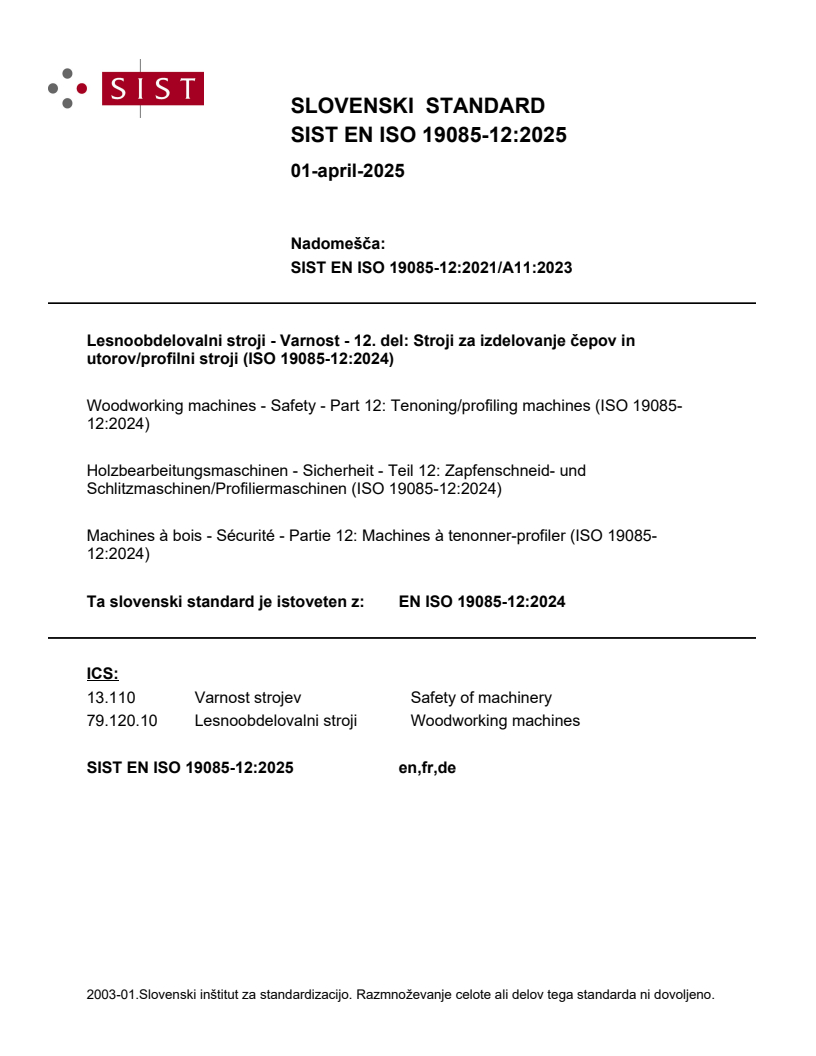
SLOVENSKI STANDARD
01-april-2025
Nadomešča:
SIST EN ISO 19085-12:2021/A11:2023
Lesnoobdelovalni stroji - Varnost - 12. del: Stroji za izdelovanje čepov in
utorov/profilni stroji (ISO 19085-12:2024)
Woodworking machines - Safety - Part 12: Tenoning/profiling machines (ISO 19085-
12:2024)
Holzbearbeitungsmaschinen - Sicherheit - Teil 12: Zapfenschneid- und
Schlitzmaschinen/Profiliermaschinen (ISO 19085-12:2024)
Machines à bois - Sécurité - Partie 12: Machines à tenonner-profiler (ISO 19085-
12:2024)
Ta slovenski standard je istoveten z: EN ISO 19085-12:2024
ICS:
13.110 Varnost strojev Safety of machinery
79.120.10 Lesnoobdelovalni stroji Woodworking machines
2003-01.Slovenski inštitut za standardizacijo. Razmnoževanje celote ali delov tega standarda ni dovoljeno.
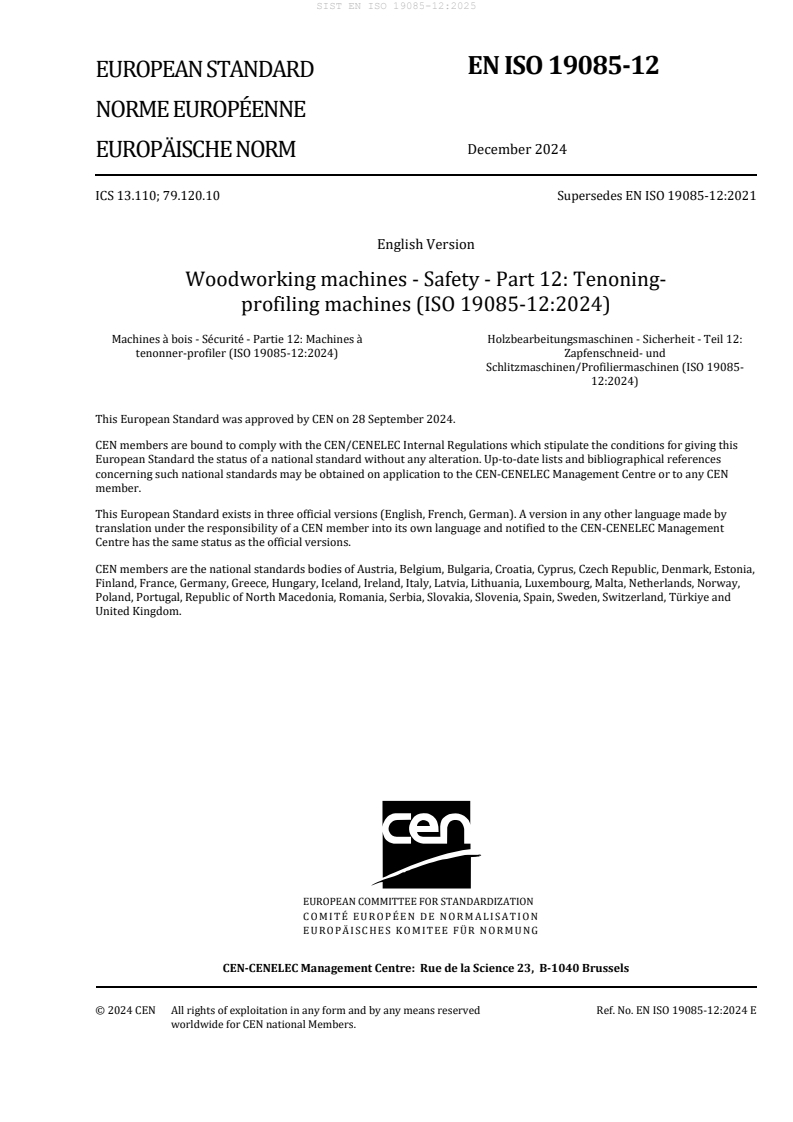
EN ISO 19085-12
EUROPEAN STANDARD
NORME EUROPÉENNE
December 2024
EUROPÄISCHE NORM
ICS 13.110; 79.120.10 Supersedes EN ISO 19085-12:2021
English Version
Woodworking machines - Safety - Part 12: Tenoning-
profiling machines (ISO 19085-12:2024)
Machines à bois - Sécurité - Partie 12: Machines à Holzbearbeitungsmaschinen - Sicherheit - Teil 12:
tenonner-profiler (ISO 19085-12:2024) Zapfenschneid- und
Schlitzmaschinen/Profiliermaschinen (ISO 19085-
12:2024)
This European Standard was approved by CEN on 28 September 2024.
CEN members are bound to comply with the CEN/CENELEC Internal Regulations which stipulate the conditions for giving this
European Standard the status of a national standard without any alteration. Up-to-date lists and bibliographical references
concerning such national standards may be obtained on application to the CEN-CENELEC Management Centre or to any CEN
member.
This European Standard exists in three official versions (English, French, German). A version in any other language made by
translation under the responsibility of a CEN member into its own language and notified to the CEN-CENELEC Management
Centre has the same status as the official versions.
CEN members are the national standards bodies of Austria, Belgium, Bulgaria, Croatia, Cyprus, Czech Republic, Denmark, Estonia,
Finland, France, Germany, Greece, Hungary, Iceland, Ireland, Italy, Latvia, Lithuania, Luxembourg, Malta, Netherlands, Norway,
Poland, Portugal, Republic of North Macedonia, Romania, Serbia, Slovakia, Slovenia, Spain, Sweden, Switzerland, Türkiye and
United Kingdom.
EUROPEAN COMMITTEE FOR STANDARDIZATION
COMITÉ EUROPÉEN DE NORMALISATION
EUROPÄISCHES KOMITEE FÜR NORMUNG
CEN-CENELEC Management Centre: Rue de la Science 23, B-1040 Brussels
© 2024 CEN All rights of exploitation in any form and by any means reserved Ref. No. EN ISO 19085-12:2024 E
worldwide for CEN national Members.
Contents Page
European foreword . 3
Annex ZA (informative) Relationship between this European Standard and the essential
requirements of Directive 2006/42/EC aimed to be covered . 4
European foreword
This document (EN ISO 19085-12:2024) has been prepared by Technical Committee ISO/TC 39
"Machine tools" in collaboration with Technical Committee CEN/TC 142 “Woodworking machines -
Safety” the secretariat of which is held by UNI.
This European Standard shall be given the status of a national standard, either by publication of an
identical text or by endorsement, at the latest by June 2025, and conflicting national standards shall be
withdrawn at the latest by June 2025.
Attention is drawn to the possibility that some of the elements of this document may be the subject of
patent rights. CEN shall not be held responsible for identifying any or all such patent rights.
This document supersedes EN ISO 19085-12:2021.
This document has been prepared under a standardization request addressed to CEN by the European
Commission. The Standing Committee of the EFTA States subsequently approves these requests for its
Member States.
For the relationship with EU Legislation, see informative Annex ZA, which is an integral part of this
document.
Any feedback and questions on this document should be directed to the users’ national standards
body/national committee. A complete listing of these bodies can be found on the CEN website.
According to the CEN-CENELEC Internal Regulations, the national standards organizations of the
following countries are bound to implement this European Standard: Austria, Belgium, Bulgaria,
Croatia, Cyprus, Czech Republic, Denmark, Estonia, Finland, France, Germany, Greece, Hungary, Iceland,
Ireland, Italy, Latvia, Lithuania, Luxembourg, Malta, Netherlands, Norway, Poland, Portugal, Republic of
North Macedonia, Romania, Serbia, Slovakia, Slovenia, Spain, Sweden, Switzerland, Türkiye and the
United Kingdom.
Endorsement notice
The text of ISO 19085-12:2024 has been approved by CEN as EN ISO 19085-12:2024 without any
modification.
Annex ZA
(informative)
Relationship between this European Standard and the essential
requirements of Directive 2006/42/EC aimed to be covered
This European Standard has been prepared under a Commission’s standardization request “M/396
Mandate to CEN and CENELEC for Standardisation in the field of machinery” to provide one voluntary
means of conforming to essential requirements of Directive 2006/42/EC of the European Parliament
and of the Council of 17 May 2006 on machinery, and amending Directive 95/16/EC (recast).
Once this standard is cited in the Official Journal of the European Union under that Directive,
compliance with the normative clauses of this standard given in Table ZA.1 confers, within the limits of
the scope of this standard, a presumption of conformity with the corresponding essential requirements
of that Directive and associated EFTA regulations.
Table ZA.1 — Correspondence between this European Standard and Annex I of Directive
2006/42/EC
The relevant Essential Requirements of Directive Clause(s)/subclause(s) Remarks/Note
2006/42/EC of this EN s
1.1.2 Principles of safety integration
a) fitted for its function Clauses 4, 5, 6, 7
c) intended use and reasonably foreseeable misuse Clauses 4, 5, 6, 7
d) constraints in use Clauses 4, 5, 6, 7
1.1.3 Materials and products 6.3, 6.16
1.1.4 Lighting 6.6, 7.3.1
1.1.5 Design of machinery to facilitate its handling 6.5, 7.3
1.1.6 Ergonomics 6.5
1.2.1 Safety and reliability of control systems 4.1, 4.3, 6.7, 6.8
1.2.2 Control devices 4.2, 4.3, 4.4, 4.6, 4.7
1.2.3 Starting 4.3
1.2.4 Stopping 4.4, 4.5, 5.4
1.2.5 Selection of control or operating mode 4.6
1.2.6 Failure of the power supply 4.8, 6.7, 6.8, 6.16
1.3.1 Risk of loss of stability 5.1, 7.3
1.3.2 Risk of break-up during operation 4.3, 5.2, 5.3, 5.9, 6.14, 7.3
1.3.3 Risks due to falling or ejected objects 5.2, 5.3, 5.5, 5.8, 5.9, 7.3
1.3.6 Risks relating to variations in the operating 4.6, 4.7, 5.6
conditions
1.3.7 Risks related to moving parts 5.5, 5.6, 5.7, 5.8, 7.3
1.3.8 Choice of protection against risks related to moving 5.6, 5.7, 5.8
parts
1.3.9 Risk of uncontrolled movements 4.1, 4.3, 4.5, 4.8, 5.4
1.4.1 General requirements 5.9
1.4.2.1 Fixed guards 5.5.1
1.4.2.2 Interlocking movable guards 5.5.2
1.4.3 Special requirements for protective devices 5.5.3, 5.5.5, 5.5.6
1.5.1 Electricity supply 6.4, 6.13
1.5.2 Static electricity 6.11
1.5.3 Energy supply other than electricity 6.7, 6.8
1.5.4 Errors of fitting 6.12
1.5.5 Extreme temperatures 6.16
1.5.6 Fire 6.1
1.5.8 Noise 6.2, Annex F
1.5.11 External radiation 6.9
1.5.12 Laser equipment 6.10
1.5.13 Emission of hazardous materials and substances 6.3, 6.17
1.6.1 Machinery maintenance 6.14, 7.3
1.6.2 Access to operating position and servicing points 6.14, 7.3
1.6.3 Isolation of energy sources 6.13, 7.3
1.6.4 Operator intervention 6.14, 7.3
1.6.5 Cleaning of internal parts 6.14, 7.3
1.7.1 Information and warnings on the machinery 6.10, 7.1, 7.2
1.7.2 Warning of residual risks 6.10, 7.1
1.7.3 Marking of machinery 7.2
1.7.4 Instructions 6.10, 7.3, Annex F
2.3 Machinery for working wood and analogous
materials
a) guiding 5.1, 5.10
b) ejection 5.9, 7.3
c) brake 4.5, 5.4
d) accidental tool contact 5.6, 7.3
WARNING 1 — Presumption of conformity stays valid only as long as a reference to this European
Standard is maintained in the list published in the Official Journal of the European Union. Users of this
standard should consult frequently the latest list published in the Official Journal of the European
Union.
WARNING 2 — Other Union legislation may be applicable to the product(s) falling within the scope of
this standard.
International
Standard
ISO 19085-12
Second edition
Woodworking machines — Safety —
2024-11
Part 12:
Tenoning-profiling machines
Machines à bois — Sécurité —
Partie 12: Machines à tenonner-profiler
Reference number
ISO 19085-12:2024(en) © ISO 2024
ISO 19085-12:2024(en)
© ISO 2024
All rights reserved. Unless otherwise specified, or required in the context of its implementation, no part of this publication may
be reproduced or utilized otherwise in any form or by any means, electronic or mechanical, including photocopying, or posting on
the internet or an intranet, without prior written permission. Permission can be requested from either ISO at the address below
or ISO’s member body in the country of the requester.
ISO copyright office
CP 401 • Ch. de Blandonnet 8
CH-1214 Vernier, Geneva
Phone: +41 22 749 01 11
Email: copyright@iso.org
Website: www.iso.org
Published in Switzerland
ii
ISO 19085-12:2024(en)
Contents Page
Foreword .vi
Introduction .vii
1 Scope . 1
2 Normative references . 3
3 Terms and definitions . 3
4 Safety requirements and measures for controls .16
4.1 Safety and reliability of control systems.16
4.2 Control devices .16
4.2.1 General .17
4.2.2 Single-end tenoning machines with a manual feed sliding table .17
4.2.3 Single-end tenoning machines with a mechanical feed sliding table .17
4.2.4 Single-end tenoning-profiling machines with mechanical feed .17
4.2.5 Double-end tenoning-profiling machines with mechanical feed .17
4.2.6 Angular systems for tenoning and profiling with mechanical feed .17
4.3 Start .18
4.3.1 Direct start .18
4.3.2 Start via control power-on .18
4.3.3 Laser marking unit .18
4.4 Safe stops .18
4.4.1 General .18
4.4.2 Normal stop .19
4.4.3 Operational stop .19
4.4.4 Emergency stop .19
4.5 Braking function of tools .19
4.6 Mode selection .19
4.6.1 Manual adjustments mode for tools and other processing units (MODE 2) .19
4.6.2 Feed chains greasing mode (MODE 3) .19
4.7 Tool speed changing . 20
4.7.1 Speed changing by shifting the belts on the pulleys . 20
4.7.2 Speed changing by incremental speed change motor . 20
4.7.3 Infinitely variable speed by frequency inverter . 20
4.8 Failure of any power supply . 20
4.9 Manual reset control .21
4.10 Standstill detection and monitoring .21
4.11 Machine moving parts speed monitoring.21
4.12 Time delay.21
4.13 Teleservice .21
5 Safety requirements and measures for protection against mechanical hazards .21
5.1 Stability .21
5.2 Risk of break-up during operation .21
5.3 Tool and tool fixing design .21
5.3.1 General .21
5.3.2 Spindle locking . 22
5.3.3 Circular saw blade fixing device . 22
5.3.4 Flange dimensions for circular saw blades . 22
5.3.5 Spindle rings. 22
5.4 Braking . 22
5.4.1 Braking of tools . 22
5.4.2 Maximum run-down time . 22
5.4.3 Brake release . 23
5.5 Safeguards . 23
5.5.1 Fixed guards . 23
5.5.2 Interlocking moveable guards . 23
iii
ISO 19085-12:2024(en)
5.5.3 Hold-to-run control . 23
5.5.4 Two hand control . 23
5.5.5 Electro-sensitive protective equipment (ESPE) . 23
5.5.6 Pressure sensitive protective equipment (PSPE) . 23
5.5.7 Enabling control . 23
5.6 Prevention of access to hazardous moving parts . 23
5.6.1 Single-end tenoning machines with a manual feed sliding table . 23
5.6.2 Single-end tenoning machines with a mechanical feed sliding table .24
5.6.3 Single-end tenoning-profiling machines with mechanical feed . 25
5.6.4 Double-end tenoning-profiling machines with mechanical feed .27
5.6.5 Angular systems for tenoning and profiling with mechanical feed . 30
5.6.6 Guarding of drives .31
5.6.7 Guarding of the chain or feed mechanisms .31
5.7 Impact hazard . 33
5.8 Clamping devices . 33
5.8.1 Single-end tenoning machines with sliding table . 34
5.8.2 Machines other than single-end tenoning machines with sliding table . 34
5.9 Measures against ejection . 34
5.9.1 General . 34
5.9.2 Guards materials and characteristics . 34
5.9.3 Devices to minimize the possibility or effect of ejection or kickback . 35
5.10 Workpiece support and guides . 36
5.10.1 Single-end tenoning machines with sliding table . 36
5.10.2 Single-end tenoning-profiling machines with mechanical feed . 36
5.10.3 Double-end tenoning-profiling machines with mechanical feed .37
5.10.4 Angular systems for tenoning and profiling with mechanical feed .37
5.10.5 Automatic workpiece returner .37
5.10.6 Parallel infeed device . 38
5.10.7 Transversal infeed device . 39
5.10.8 Automatic infeed device . 39
5.10.9 Additional workpiece support at the outfeed . 40
6 Safety requirements and measures for protection against other hazards . 41
6.1 Fire .41
6.2 Noise .41
6.2.1 Noise reduction at the design stage .41
6.2.2 Noise emission measurement and declaration .41
6.3 Emission of chips and dust .41
6.4 Electricity .41
6.5 Ergonomics and handling .41
6.6 Lighting .42
6.7 Pneumatics .42
6.8 Hydraulics .42
6.9 Electromagnetic compatibility.42
6.10 Laser .42
6.11 Static electricity.42
6.12 Errors of fitting .42
6.13 Isolation .42
6.14 Maintenance .42
6.15 Relevant but not significant hazards .42
6.16 Extreme temperatures .43
6.17 Substances .43
7 Information for use .43
7.1 Warning devices .43
7.2 Marking .43
7.2.1 General .43
7.2.2 Additional markings .43
7.3 Instruction handbook. 44
7.3.1 General . 44
iv
ISO 19085-12:2024(en)
7.3.2 Additional information . 44
Annex A (informative) List of significant hazards .46
Annex B (informative) Performance levels required .48
Annex C (informative) Stability test .50
Annex D (normative) Test for braking function . 51
Annex E (normative) Impact test for guards . .52
Annex F (normative) Noise test code . .53
Bibliography .62
v
ISO 19085-12:2024(en)
Foreword
ISO (the International Organization for Standardization) is a worldwide federation of national standards
bodies (ISO member bodies). The work of preparing International Standards is normally carried out through
ISO technical committees. Each member body interested in a subject for which a technical committee
has been established has the right to be represented on that committee. International organizations,
governmental and non-governmental, in liaison with ISO, also take part in the work. ISO collaborates closely
with the International Electrotechnical Commission (IEC) on all matters of electrotechnical standardization.
The procedures used to develop this document and those intended for its further maintenance are described
in the ISO/IEC Directives, Part 1. In particular, the different approval criteria needed for the different types
of ISO document should be noted. This document was drafted in accordance with the editorial rules of the
ISO/IEC Directives, Part 2 (see www.iso.org/directives).
ISO draws attention to the possibility that the implementation of this document may involve the use of (a)
patent(s). ISO takes no position concerning the evidence, validity or applicability of any claimed patent
rights in respect thereof. As of the date of publication of this document, ISO had not received notice of (a)
patent(s) which may be required to implement this document. However, implementers are cautioned that
this may not represent the latest information, which may be obtained from the patent database available at
www.iso.org/patents. ISO shall not be held responsible for identifying any or all such patent rights.
Any trade name used in this document is information given for the convenience of users and does not
constitute an endorsement.
For an explanation of the voluntary nature of standards, the meaning of ISO specific terms and expressions
related to conformity assessment, as well as information about ISO's adherence to the World Trade
Organization (WTO) principles in the Technical Barriers to Trade (TBT), see www.iso.org/iso/foreword.html.
This document was prepared by Technical Committee ISO/TC 39, Machine tools, Subcommittee SC 4,
Woodworking machines, in collaboration with the European Committee for Standardization (CEN) Technical
Committee CEN/TC 142, Woodworking machines – Safety, in accordance with the Agreement on technical
cooperation between ISO and CEN (Vienna Agreement).
This second edition cancels and replaces the first edition (ISO 19085-12:2021), which has been technically
revised. The main changes are as follows:
— the Scope has been revised to specify that machines are intended for continuous production use, and
other workable materials have been added;
— the list of significant hazards has been moved to the new Annex A;
— the feed chains greasing mode (MODE 3) has been added in 4.6.2;
— subclause 6.2 has been updated and a new full noise test code has been added in Annex F;
— optional workpiece supporting devices have been added to the Scope, Clause 3 and 5.10.6 to 5.10.9.
A list of all parts in the ISO 19085 series can be found on the ISO website.
Any feedback or questions on this document should be directed to the user’s national standards body. A
complete listing of these bodies can be found at www.iso.org/members.html.
vi
ISO 19085-12:2024(en)
Introduction
The ISO 19085 series provides technical safety requirements for the design and construction of
woodworking machinery, as well as for the content of the relevant instruction handbook. It concerns
designers, manufacturers, suppliers and importers of the machines specified in the Scope.
This document is a type-C standard as stated in ISO 12100:2010.
This document is of relevance, in particular, for the following stakeholder groups representing the market
players with regard to machinery safety:
— machine manufacturers (small, medium and large enterprises);
— health and safety bodies (regulators, accident prevention organisations, market surveillance etc.).
Others can be affected by the level of machinery safety achieved with the means of the document by the
above-mentioned stakeholder groups:
— machine users/employers (small, medium and large enterprises);
— machine users/employees (e.g. trade unions, organizations for people with special needs);
— service providers, e.g. for maintenance (small, medium and large enterprises);
— consumers (in case of machinery intended for use by consumers).
The above-mentioned stakeholder groups have been given the possibility to participate at the drafting
process of this document.
The machinery concerned and the extent to which hazards, hazardous situations or hazardous events are
covered are indicated in the Scope of this document.
When requirements of this type-C standard are different from those which are stated in type-A or type-B
standards, the requirements of this type-C standard take precedence over the requirements of the other
standards for machines that have been designed and built according to the requirements of this type-C
standard.
The full set of requirements for a particular type of woodworking machine are those given in the part of
ISO 19085 applicable to that type, together with the relevant requirements from ISO 19085-1:2021, to the
extent specified in the Scope of the applicable part of the ISO 19085 series.
As far as possible, the safety requirements of parts of the ISO 19085 series refer to the relevant subclauses
of ISO 19085-1:2021. Each part contains replacements and additions to the common requirements given in
ISO 19085-1:2021.
All parts of the ISO 19085 series have the same structure, so that reference to ISO 19085-1:2021 is made
always and only from and to the same subclause number at the last indent level.
Clauses 1 to 3 are specific to each part and, therefore, are distinct from ISO 19085-1:2021, Clauses 1 to 3.
For Clauses 4 to 7 and the annexes, each subclause in ISO 19085-1:2021 is cited as either:
— confirmed as a whole;
— confirmed with additions;
— excluded entirely; or
— replaced with specific text.
This is indicated by one of the following possible statements:
— “ISO 19085-1:2021, [subclause/Annex], applies”;
vii
ISO 19085-12:2024(en)
— “ISO 19085-1:2021, [subclause/Annex], applies with the following additions.” or “ISO 19085-1:2021,
[subclause/Annex], applies with the following additions, subdivided into further specific subclauses.”;
— “ISO 19085-1:2021, [subclause/Annex], does not apply.”;
— “ISO 19085-1:2021, [subclause/Annex], is replaced by the following text.” or “ISO 19085-1:2021,
[subclause/Annex], is replaced by the following text, subdivided into further specific subclauses.”.
Other subclauses and annexes specific to this document are indicated by the introductory sentence:
“Subclause/Annex specific to this document.”.
viii
International Standard ISO 19085-12:2024(en)
Woodworking machines — Safety —
Part 12:
Tenoning-profiling machines
1 Scope
1.1 This document specifies the safety requirements and measures for manually loaded and unloaded
— single-end tenoning machines with a manual feed sliding table,
— single-end tenoning machines with a mechanical feed sliding table,
— single-end tenoning-profiling machines with mechanical feed,
— double-end tenoning-profiling machines with mechanical feed, also designed to be automatically either
loaded or unloaded, or both, and
— angular systems for tenoning and profiling with mechanical feed
with maximum workpiece height capacity of 200 mm for single-end machines and 500 mm for double-end
machines, capable of continuous production use, altogether referred to as “machines”.
1.2 This document deals with all significant hazards, hazardous situations and events as listed in Annex A,
relevant to machines, when operated, adjusted and maintained as intended and under the conditions foreseen
by the manufacturer including reasonably foreseeable misuse. Also, transport, assembly, dismantling,
disabling and scrapping phases have been taken into account.
1.3 The machines are designed to process in one pass one end or two sides, either opposite or perpendicular
to each other, of workpieces made of
a) solid wood, and
b) materials with similar physical characteristics to wood (see ISO 19085-1:2021, 3.2); and
only the machines with mechanical feed, made of
c) fibre-cement,
d) rock wool and glass wool,
e) gypsum,
f) plasterboard,
g) matrix engineered mineral boards, silicate boards and sulfate boards,
h) composite materials with core consisting of polyurethane or mineral material laminated with light alloy,
i) polymer-matrix composite materials and reinforced thermoplastic, thermoset and elastomeric
materials,
j) aluminium light alloy profiles, and
k) composite boards made from the materials listed above.
ISO 19085-12:2024(en)
1.4 This document is also applicable to machines fitted with one or more of the following devices or
additional working units, whose hazards have been dealt with:
— sanding units;
— fixed or movable workpiece support;
— automatic tool changing;
— automatic workpiece returner;
— glass bead saw unit;
— hinge recessing unit;
— boring unit;
— dynamic processing unit;
— sawing unit installed out of the integral enclosure, between machine halves in double-end machines;
— foiling unit;
— coating unit;
— grooving unit with a milling tool installed out of the integral enclosure, between machine halves;
— brushing unit;
— gluing unit;
— sealing unit;
— dowels inserting unit;
— tongues inserting unit;
— inkjet marking unit;
— laser marking unit;
— labelling unit;
— workpiece back-up device (device that is either anti-chipping or anti-splintering, or both);
— quick tool changing system;
— post-formed edge pre-cutting unit;
— additional workpiece support (at either infeed or outfeed, or both);
— parallel infeed device on single-end machines;
— transversal infeed device on single-end machines;
— intermediate workpiece support on double-end machines;
— automatic infeed device;
— feed chain with dogs.
1.5 This document does not deal with any hazards related to:
a) systems for automatic loading and unloading of the workpiece to a single machine other than automatic
workpiece returner;
ISO 19085-12:2024(en)
b) single machine being used in combination with any other machine (as part of a line);
c) use of tools, other than saw blades or boring tools or milling tools for grooving, installed between
machine halves and out of the integral enclosure in double-end machines;
d) use of tools protruding out of the integral enclosure;
e) chemical characteristics of all materials listed in 1.3 c) to i) and their dust.
1.6 This document is not applicable to machines intended for use in potentially explosive atmosphere nor
to machines
...
EN ISO 19085-12:2024は、木材加工機械の安全性に関する標準として非常に重要な文書です。この標準は、手動および機械式フィードのテノニン・プロファイリングマシンに関連するさまざまな安全要件を明確に定義しています。具体的には、単端テノニン機械、二端テノニン・プロファイリング機械、角度システムといった多様な機械の安全性の範囲をカバーしています。 この標準の強みは、最大200mmのワークピース高さ容量を持つ単端機械と500mmを持つ二端機械の両方に対応している点です。また、作業中や調整、メンテナンス時に関連するすべての重要な危険要因、危険な状況、事故を扱い、製造業者が設定した意図された条件のもとで操作される際のリスクを十分に考慮しています。 さらに、この文書は様々な材料に対応しており、固体木材に加え、木材に類似した物理特性を持つ材料や複合材料の処理が可能な機械を対象としています。これにより、テノニン・プロファイリング機械の利用範囲が広がり、ユーザーが多様なニーズに応じた作業を行えるようになります。 また、標準は機械に組み込まれる可能性のある追加の作業ユニットや装置についても考慮しています。サンディングユニットや自動工具交換装置などの安全要件が明記されているため、これらの機械システムの使用において安全性が高まります。 EN ISO 19085-12:2024は、木材加工業界における安全基準としての重要性を持っており、機械の設計や運用に関わる全ての関係者にとって必須の文書です。ユーザーはこの標準を参考にすることで、日常の業務における安全性の強化を図ることができるでしょう。
표준 EN ISO 19085-12:2024는 목재 가공 기계의 안전성을 규명하기 위한 포괄적인 문서로, 특히 단일 엔드 및 이중 엔드 텐오닝-프로파일링 기계에 대한 안전 요구사항을 정의하고 있습니다. 이 문서는 수동 또는 기계 피드를 사용하는 다양한 기계의 안전성을 보장하기 위한 명확한 기준을 제시하며, 특히 최대 작업물 높이 용량 200mm 및 500mm인 기계의 지속적인 생산 사용을 지원합니다. 이 표준의 강점 중 하나는 기계의 조작, 조정, 유지보수를 염두에 두고 모든 주요 위험 요소와 위험한 상황을 포괄적으로 다룬 것입니다. Annex A에 명시된 위험 사항들을 중심으로 기계가 설계된 목적에 맞게 사용될 때 발생할 수 있는 가능성 있는 위험을 사전에 예방할 수 있는 조치를 안내합니다. 또한, 기계의 운반, 조립, 해체 및 폐기 과정 또한 고려되어 있으며, 이는 사용자와 작업자의 안전을 제고하는 데 중대한 기여를 합니다. EN ISO 19085-12:2024는 고체 목재뿐만 아니라 유사한 물리적 특성을 가진 다양한 재료에 대한 작업을 지원하며, 기계 피드를 갖춘 경우 섬유 시멘트, 암석 양모, 유리 양모 등과 같은 재료도 처리할 수 있습니다. 이는 다양한 산업 환경에서의 적용성을 높이며, 다양한 작업 요구에 부합할 수 있도록 합니다. 또한, 이 표준은 기계에 부착된 추가 장치 및 작업 유닛과 관련된 위험을 다루고 있어, 사용자가 특정 가공 요구에 맞는 다양한 장비를 동시에 사용할 수 있도록 합니다. 예를 들어, 샌딩 유닛, 자동 공구 교환 시스템, 레이저 마킹 유닛 등 다양한 첨단 기능이 포함되어 사용자에게 보다 안전하고 효율적인 작업 환경을 제공합니다. 결론적으로, EN ISO 19085-12:2024는 목재 가공 기계의 안전성을 강화하기 위한 핵심 표준으로, 기계의 설계와 운용에 있어 필수적인 요소를 고려하여 산업 전반에 걸쳐 안전한 작업 환경을 창출하는데 기여합니다.
The EN ISO 19085-12:2024 standard encompasses comprehensive safety requirements and measures specifically tailored for various types of tenoning and profiling machines. Its scope systematically details the operational safety parameters for manually and mechanically loaded machines, ensuring that safety standards are met during the operation, adjustment, and maintenance of these woodworking machines. The standard's strength lies in its attention to a wide array of significant hazards and hazardous situations outlined in Annex A, which include reasonable misuse scenarios as well as the lifecycle phases of the machines, from assembly to scrapping. This standard is particularly relevant for manufacturers and operators within the woodworking industry, as it addresses not only single-end and double-end tenoning machines but also encompasses angular systems for tenoning and profiling. By setting maximum workpiece height capacities, it provides clear guidelines for machine capabilities, thus facilitating safer production environments. The inclusion of machines that process materials beyond traditional solid wood, such as fibre-cement and various composite materials, reflects its applicability in diverse manufacturing settings. Moreover, the document allows for integration with multiple auxiliary devices and working units, thereby enhancing operational flexibility while ensuring that associated hazards are adequately managed. This versatility is a significant asset for manufacturers striving to innovate without compromising on safety. The standard's detailed approach to addressing a variety of operational setups makes it a cornerstone for safety in woodworking machinery. Overall, the EN ISO 19085-12:2024 standard serves as a vital resource in establishing factory safety protocols, minimizing risk, and promoting compliance within the industry, ultimately ensuring that practitioners can operate tenoning and profiling machines securely and efficiently.
Das Dokument EN ISO 19085-12:2024 bietet einen umfassenden Rahmen für die Sicherheitsanforderungen und Maßnahmen, die bei der Verwendung von Tenonier- und Profiliermaschinen zu beachten sind. Die Norm bezieht sich speziell auf manuell und mechanisch zu beladende Maschinen, einschließlich einfacher und doppelter Tenonier- und Profiliermaschinen, sowie auf Maschinen mit unterschiedlichen mechanischen Fütterungen. Ein wesentliches Merkmal der Norm ist ihre detaillierte Behandlung aller relevanten Gefahren und risikobehafteten Situationen, die im Anhang A aufgeführt sind. Dies schließt den Betrieb, die Anpassung und Wartung der Maschinen unter den vom Hersteller vorgesehenen Bedingungen ein. Zudem werden auch Transport, Montage, Demontage, Deaktivierung und das Recycling der Maschinen berücksichtigt, was die umfassende Sicherheit und Anwenderfreundlichkeit unterstützt. Ein weiterer Stärkenfaktor betrifft den breiten Anwendungsbereich der Maschinen, der sich nicht nur auf Massivholz, sondern auch auf eine Vielzahl von Materialien erstreckt, die ähnliche physikalische Eigenschaften wie Holz aufweisen. Dazu gehören Verbundwerkstoffe sowie spezifische Materialien wie Faserzement und Mineralwerkstoffe. Diese Vielseitigkeit macht die Norm besonders relevant für Hersteller und Betreiber in der Holzverarbeitungsindustrie, die auf unterschiedliche Materialien angewiesen sind. Zusätzlich regelt die Norm auch die Sicherheitsaspekte für Maschinen, die mit verschiedenen Zusatzgeräten und Arbeitsstationen ausgestattet sind, wie z.B. Schleif- und Bohrmaschinen, automatische Werkzeugwechsler und Markierungseinheiten. Durch diese umfassende Abdeckung wird sichergestellt, dass auch Maschinen mit komplexeren Bearbeitungsprozessen sicher betrieben werden können. Die maximale Werkstückhöhe von 200 mm für Einstechmaschinen und 500 mm für doppelseitige Maschinen, die in dieser Norm festgelegt ist, zeigt die Eignung für kontinuierlichen Produktionsgebrauch und die Flexibilität im Einsatz. Dies stellt sicher, dass die Maschinen sowohl für einfache als auch für anspruchsvollere Anwendungen geeignet sind. Insgesamt hebt sich die EN ISO 19085-12:2024 durch ihre gründliche Analyse von Gefahren und umfassenden Regelungen zu Sicherheitsmaßnahmen hervor, was sie zu einer unverzichtbaren Richtlinie für die Sicherheit in der Holzverarbeitung macht.
La norme EN ISO 19085-12:2024, intitulée "Machines à travailler le bois - Sécurité - Partie 12 : Machines à tenonner et à profiler", est un document fondamental pour assurer la sécurité dans l'industrie du travail du bois. Son champ d'application couvre spécifiquement les machines à tenonner à chargement manuel et automatique, y compris les machines à profiler assemblées. Cette norme se révèle particulièrement pertinente pour les utilisateurs, car elle fournit des exigences de sécurité précises pour une large gamme de machines conçues pour traiter des pièces en bois et des matériaux aux caractéristiques physiques similaires. Les forces principales de cette norme résident dans son traitement exhaustif des dangers significatifs associés à l’utilisation des machines, y compris les phases de transport, d'assemblage et de mise hors service. En consultant l'annexe A, les parties prenantes peuvent identifier les situations dangereuses spécifiques à prendre en compte lors de l'exploitation, de l'ajustement et de l'entretien de ces machines. Cette approche proactive favorise un environnement de travail plus sûr. De plus, la norme aborde la capacité de traitement en une seule étape des machines, qu'il s'agisse de processing d'une face ou de deux faces, ce qui souligne son adaptabilité aux différentes applications industrielles. Les matériaux variés énumérés, allant du bois massif aux composites avancés, démontrent la polyvalence de ces machines dans des processus de fabrication modernes. L'application aux dispositifs supplémentaires tels que les unités de ponçage, les systèmes de changement d'outils automatiques, et les unités de collage, renforce l'importance de cette norme dans un cadre de production continue, garantissant que toutes les machines intégrant ces technologies respectent des critères de sécurité rigoureux. En conclusion, la norme EN ISO 19085-12:2024 est une ressource essentielle pour l’industrie du bois, offrant une structure de sécurité solide pour les machines à tenonner et à profiler, tout en s'assurant que tous les aspects de l'utilisation, de la maintenance et de la sécurité sont couverts de manière exhaustive.
Questions, Comments and Discussion
Ask us and Technical Secretary will try to provide an answer. You can facilitate discussion about the standard in here.
Loading comments...