

EN 1235:1995/A1:2003
(Amendment)Solid fertilizers - Test sieving
- Abstract
Provision of meaningful interpretation of the results of sieve analysis of solid fertilizers.
- Status
- Published
- Publication Date
- 22-Apr-2003
- Withdrawal Date
- 30-Oct-2003
- Technical Committee
- CEN/TC 260 - Fertilizers and liming materials
- Drafting Committee
- CEN/TC 260/WG 2 - Physical properties of fertilizers
- Current Stage
- 6060 - Definitive text made available (DAV) - Publishing
- Start Date
- 23-Apr-2003
- Completion Date
- 23-Apr-2003

Overview
EN 1235:1995/A1:2003 is a European standard established by CEN that provides metodologies for test sieving of solid fertilizers. This standard focuses on delivering consistent and meaningful interpretation of sieve analysis data, crucial for assessing the particle size distribution of solid fertilizer products. It supports quality control and regulatory compliance within the fertilizer industry by specifying how to evaluate and define particle size fractions accurately.
The amendment A1 modifies the original EN 1235:1995, clarifying methods for interpretation of results and enhancing the statistical treatment of data to better support decision-making during fertilizer production and quality assessment.
Key Topics
Test Sieving Procedure
The standard outlines how to perform test sieving on solid fertilizers using a series of standardized sieves with defined aperture sizes. It describes how to collect and express mass fractions retained on each sieve.Size Distribution Determination
EN 1235 defines procedures to calculate the mass fraction retained on each sieve and on the receiver, enabling the construction of particle size distribution curves.Cumulative Undersize Calculation
The cumulative undersize represents the percentage of material passing through each sieve and is critical for understanding overall particle size distribution.Mass Median Diameter (d₅₀)
The standard introduces the calculation of the mass median diameter, the sieve aperture at which 50% of the sample’s mass is smaller and 50% larger. This is essential for characterizing fertilizer granule size.Granulometric Spread and Granulometric Spread Index (GSI)
These parameters quantify the particle size variation around the median size, providing deeper insights into the uniformity and quality of fertilizer granules.Graphical Interpretation
EN 1235 recommends plotting cumulative distribution curves, either manually or with computer software, to visually interpret particle size data. This approach facilitates practical assessment without complex statistical modeling.
Applications
Quality Control in Fertilizer Production
Manufacturers use this standard to verify that solid fertilizers meet specified particle size criteria, which affects handling, storage, and effectiveness of nutrient delivery.Regulatory Compliance
Laboratories and regulatory bodies apply EN 1235 to ensure fertilizers conform to national and European particle size regulations, promoting fair trading and environmental safety.Product Development
Fertilizer producers can apply the standardized sieving and analytical methods to optimize granule size distribution for enhanced dissolution rates and agronomic performance.Research and Testing
Academic and industrial research rely on this standard for reproducible and standardized particle size analyses in fertilizer formulation studies and comparative product evaluations.
Related Standards
- EN 13039 - Fertilizer sampling
- EN 13266 - Determination of particle size distribution by sieve analysis for fertilizers
- ISO 13577 - Fertilizer quality control test methods
- CEN/TC 260 - Fertilizers and liming materials standards committee-oversees development of fertilizer-related standards including sieving and quality assessment.
By consistently applying EN 1235:1995/A1:2003, stakeholders in the fertilizer supply chain can achieve reliable test results, optimize product characteristics, and comply with stringent industry requirements. This enhances product value and contributes to sustainable agricultural practices through appropriate fertilizer pellet sizing.
Relations
- Effective Date
- 22-Dec-2008
Get Certified
Connect with accredited certification bodies for this standard

Control Union Certifications
Global certification for agriculture and sustainability.

ECOCERT
Organic and sustainability certification.

FSC International
Forest Stewardship Council certification.
Sponsored listings
Frequently Asked Questions
EN 1235:1995/A1:2003 is a amendment published by the European Committee for Standardization (CEN). Its full title is "Solid fertilizers - Test sieving". This standard covers: Provision of meaningful interpretation of the results of sieve analysis of solid fertilizers.
Provision of meaningful interpretation of the results of sieve analysis of solid fertilizers.
EN 1235:1995/A1:2003 is classified under the following ICS (International Classification for Standards) categories: 65.080 - Fertilizers. The ICS classification helps identify the subject area and facilitates finding related standards.
EN 1235:1995/A1:2003 has the following relationships with other standards: It is inter standard links to EN 1235:1995. Understanding these relationships helps ensure you are using the most current and applicable version of the standard.
EN 1235:1995/A1:2003 is available in PDF format for immediate download after purchase. The document can be added to your cart and obtained through the secure checkout process. Digital delivery ensures instant access to the complete standard document.
Standards Content (Sample)
SLOVENSKI STANDARD
01-oktober-2003
Trdna gnojila - Sejalni preskus
Solid fertilizers - Test sieving
Feste Düngemittel - Siebanalyse
Engrais solides - Tamisage de contrôle
Ta slovenski standard je istoveten z: EN 1235:1995/A1:2003
ICS:
65.080 Gnojila Fertilizers
2003-01.Slovenski inštitut za standardizacijo. Razmnoževanje celote ali delov tega standarda ni dovoljeno.
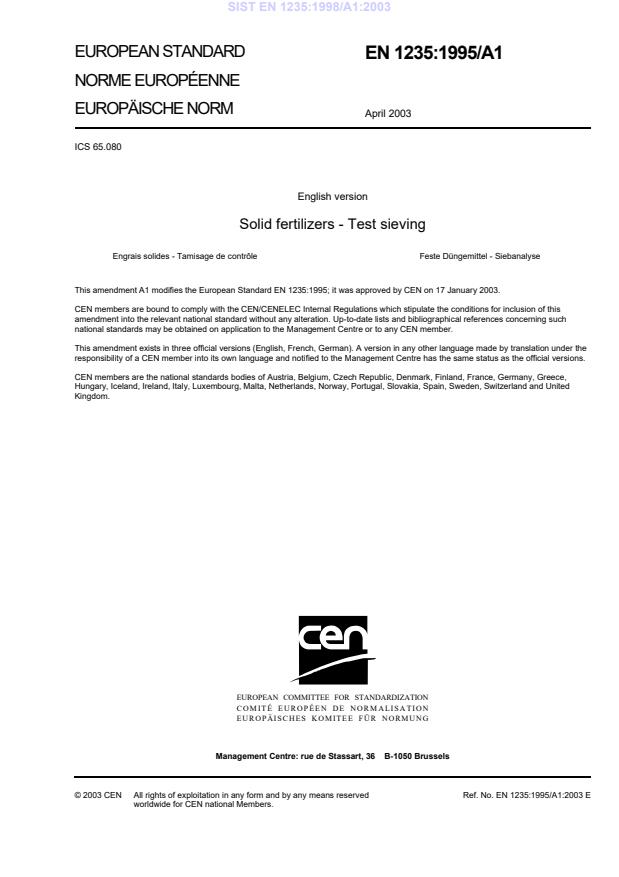
EUROPEAN STANDARD
EN 1235:1995/A1
NORME EUROPÉENNE
EUROPÄISCHE NORM
April 2003
ICS 65.080
English version
Solid fertilizers - Test sieving
Engrais solides - Tamisage de contrôle Feste Düngemittel - Siebanalyse
This amendment A1 modifies the European Standard EN 1235:1995; it was approved by CEN on 17 January 2003.
CEN members are bound to comply with the CEN/CENELEC Internal Regulations which stipulate the conditions for inclusion of this
amendment into the relevant national standard without any alteration. Up-to-date lists and bibliographical references concerning such
national standards may be obtained on application to the Management Centre or to any CEN member.
This amendment exists in three official versions (English, French, German). A version in any other language made by translation under the
responsibility of a CEN member into its own language and notified to the Management Centre has the same status as the official versions.
CEN members are the national standards bodies of Austria, Belgium, Czech Republic, Denmark, Finland, France, Germany, Greece,
Hungary, Iceland, Ireland, Italy, Luxembourg, Malta, Netherlands, Norway, Portugal, Slovakia, Spain, Sweden, Switzerland and United
Kingdom.
EUROPEAN COMMITTEE FOR STANDARDIZATION
COMITÉ EUROPÉEN DE NORMALISATION
EUROPÄISCHES KOMITEE FÜR NORMUNG
Management Centre: rue de Stassart, 36 B-1050 Brussels
© 2003 CEN All rights of exploitation in any form and by any means reserved Ref. No. EN 1235:1995/A1:2003 E
worldwide for CEN national Members.
Foreword
This document (EN 1235:1995/A1:2003) has been prepared by the Technical Committee CEN/TC 260 "Fertilizers
and liming materials", the secretariat of which is held by DIN.
This European Standard shall be given the status of a national standard, either by publication of an identical text or
by endorsement, at the latest by October 2003, and conflicting national standards shall be withdrawn at the latest
by October 2003.
According to the CEN/CENELEC Internal Regulations, the national standards organizations of the following
countries are bound to implement this European Standard: Austria, Belgium, Czech Republic, Denmark, Finland,
France, Germany, Greece, Hungary, Iceland, Ireland, Italy, Luxembourg, Malta, Netherlands, Norway, Portugal,
Slovakia, Spain, Sweden, Switzerland and the United Kingdom.
Clause 1
Replace "Annex ZA gives further information on the expression of the results of test sieving" with "Annex ZA gives
guidance on the interpretation of sieving test data".
Replace the existing annex ZA (informative) with the following text:
Annex ZA
(informative)
Interpretation of sieving test data
ZA.1 Determination of the size distribution
In the following, index sieve numbers n increase with increasing sieve aperture and index refers to the receiver.
The material retained on receiver, x , and each of the individual sieves, x , given as mass fraction in percent, can
0 n
be obtained from equation (ZA.1):
m
n
x =·100 (ZA.1)
n
m
t
where
m is the mass retained on sieve n, in grams;
n
m is the total mass of the test sample, in grams (m = m + m + .m).
o 1
t t i
ZA.2 Definition of the cumulative undersize
The cumulative undersize c , given as mass fraction in percent, is defined by equation (ZA.2):
n
n-1
c x (ZA.2)
=
∑
n i
i=0
where
c is the cumulative undersize for sieve n, given as mass fraction in percent;
n
x is the mass fraction in percent retained on sieve i.
i
ZA.3 Definition and determination of the mass median diameter d
The mass median diameter, d is the theoretical sieve opening of such size that 50 % of the particles, by mass,
50,
are larger and 50 % are smaller.
The mass median diameter, d , in millimetres, can be obtained by equation (ZA.3):
(50-c )
n
d = z +·(z-z ) (ZA.3)
50 n n+1 n
(c-c )
n +1 n
where
z is the nominal sieve aperture size for which the cumulative undersize is nearest but below 50 % (mass
n
fraction), in millimetres;
z is the nominal sieve aperture size for which the cumulative undersize is nearest but above 50 % (mass
n+1
fraction), in millimetres;
c is the cumulative undersize for sieve n, expressed as a mass fraction in percent;
n
c is the cumulative undersize for sieve n+1, expressed as a mass fraction in percent.
n+1
z -z should be of minimum value using appropriate sieves from the allowed sieve series.
n+1 n
This calculation of d assumes that there is a linear relationship between sieve sizes z and z
...