


EN 405:2001
(Main)Respiratory protective devices - Valved filtering half masks to protect against gases or gases and particles - Requirements, testing, marking
Respiratory protective devices - Valved filtering half masks to protect against gases or gases and particles - Requirements, testing, marking
This European Standard specifies the performance requirements, test methods and marking requirements for valved filtering half masks incorporating either gas or combined filters as respiratory protective devices except for escape purposes. It does not cover gas filtering half masks which do not have valves or are fitted only with exhalation valves. It does not cover devices designed for use in circumstances where there is or might be an oxygen deficiency (oxygen less than a volume fraction of 17 %).
Laboratory and practical performance tests are included for the assessment of compliance with the requirements.
Atemschutzgeräte - Filtrierende Halbmasken mit Ventilen zum Schutz gegen Gase oder Gase und Partikeln - Anforderungen, Prüfung, Kennzeichnung
Diese Europäische Norm legt Leistungsanforderungen, Prüfverfahren und Anforderungen an die Kennzeichnung für filtrierende Halbmasken mit Ventilen, die entweder Gasfilter oder Kombinationsfilter enthalten, als Atemschutzgeräte, außer für Fluchtzwecke, fest. Sie gilt nicht für gasfiltrierende Halbmasken, die keine Ventile haben oder nur mit Ausatemventilen ausgerüstet sind. Sie gilt nicht für Geräte, die zum Einsatz unter Umständen bestimmt sind, bei denen Sauerstoff-Mangel (Sauerstoff weniger als ein Volumenanteil von 17 %) gegeben ist oder sein kann.
Laborprüfungen und praktische Leistungsprüfungen sind enthalten, um die Übereinstimmung mit den Anforderungen feststellen zu können.
Appareils de protection respiratoire - Demi-masques filtrants à soupapes contre les gaz ou contre les gaz et les particules - Exigences, essais, marquage
La présente Norme Européenne spécifie les exigences de performance, les méthodes d'essais et les exigences de marquage applicables aux demi-masques filtrants pourvus de soupapes et de filtres antigaz ou de filtres combinés, utilisés comme appareils de protection respiratoire, sauf pour l'évacuation. Elle ne s'applique pas aux demi-masques filtrants antigaz dépourvus de soupapes ou uniquement pourvus de soupapes expiratoires. Elle ne s'applique pas non plus aux appareils conçus pour être utilisés dans des situations où il y a ou pourrait y avoir un défaut d'oxygène (teneur en oxygène inférieure à 17 % en volume).
Elle contient des essais pratiques de performance et des essais de laboratoire pour s'assurer de la conformité avec les spécifications.
Oprema za varovanje dihal - Polobrazna maska z ventili za varovanje pred plini ali plini in delci - Zahteve, preskušanje, označevanje
General Information
- Status
- Withdrawn
- Publication Date
- 11-Dec-2001
- Withdrawal Date
- 05-May-2009
- Technical Committee
- CEN/TC 79 - Respiratory protective devices
- Drafting Committee
- CEN/TC 79/SC 3 - Facepieces
- Current Stage
- 9960 - Withdrawal effective - Withdrawal
- Start Date
- 06-May-2009
- Completion Date
- 06-May-2009
Relations
- Effective Date
- 22-Dec-2008
- Effective Date
- 19-Jan-2023
- Effective Date
- 28-Jan-2026

Get Certified
Connect with accredited certification bodies for this standard

NSF International
Global independent organization facilitating standards development and certification.

CIS Institut d.o.o.
Personal Protective Equipment (PPE) certification body. Notified Body NB-2890 for EU Regulation 2016/425 PPE.

Kiwa BDA Testing
Building and construction product certification.
Sponsored listings
Frequently Asked Questions
EN 405:2001 is a standard published by the European Committee for Standardization (CEN). Its full title is "Respiratory protective devices - Valved filtering half masks to protect against gases or gases and particles - Requirements, testing, marking". This standard covers: This European Standard specifies the performance requirements, test methods and marking requirements for valved filtering half masks incorporating either gas or combined filters as respiratory protective devices except for escape purposes. It does not cover gas filtering half masks which do not have valves or are fitted only with exhalation valves. It does not cover devices designed for use in circumstances where there is or might be an oxygen deficiency (oxygen less than a volume fraction of 17 %). Laboratory and practical performance tests are included for the assessment of compliance with the requirements.
This European Standard specifies the performance requirements, test methods and marking requirements for valved filtering half masks incorporating either gas or combined filters as respiratory protective devices except for escape purposes. It does not cover gas filtering half masks which do not have valves or are fitted only with exhalation valves. It does not cover devices designed for use in circumstances where there is or might be an oxygen deficiency (oxygen less than a volume fraction of 17 %). Laboratory and practical performance tests are included for the assessment of compliance with the requirements.
EN 405:2001 is classified under the following ICS (International Classification for Standards) categories: 13.340.30 - Respiratory protective devices. The ICS classification helps identify the subject area and facilitates finding related standards.
EN 405:2001 has the following relationships with other standards: It is inter standard links to EN 405:1992, EN 405:2001+A1:2009, EN 132:1998. Understanding these relationships helps ensure you are using the most current and applicable version of the standard.
EN 405:2001 is associated with the following European legislation: EU Directives/Regulations: 89/686/EEC; Standardization Mandates: M/BC/CEN/88/7. When a standard is cited in the Official Journal of the European Union, products manufactured in conformity with it benefit from a presumption of conformity with the essential requirements of the corresponding EU directive or regulation.
EN 405:2001 is available in PDF format for immediate download after purchase. The document can be added to your cart and obtained through the secure checkout process. Digital delivery ensures instant access to the complete standard document.
Standards Content (Sample)
2003-01.Slovenski inštitut za standardizacijo. Razmnoževanje celote ali delov tega standarda ni dovoljeno.Respiratory protective devices - Valved filtering half masks to protect against gases or gases and particles - Requirements, testing, markingAppareils de protection respiratoire - Demi-masques filtrants a soupapes contre les gaz ou contre les gaz et les particules - Exigences, essais, marquageAtemschutzgeräte - Filtrierende Halbmasken mit Ventilen zum Schutz gegen Gase oder Gase und Partikeln - Anforderungen, Prüfung, Kennzeichnung13.340.30Varovalne dihalne napraveRespiratory protective devicesICS:SIST EN 405:2002enTa slovenski standard je istoveten z:EN 405:200101-junij-2002SIST EN 405:2002SLOVENSKI
STANDARDSIST EN 405:19961DGRPHãþD
EUROPEAN STANDARDNORME EUROPÉENNEEUROPÄISCHE NORMEN 405December 2001ICS 13.340.30Supersedes EN 405:1992English versionRespiratory protective devices - Valved filtering half masks toprotect against gases or gases and particles - Requirements,testing, markingAppareils de protection respiratoire - Demi-masquesfiltrants à soupapes contre les gaz ou contre les gaz et lesparticules - Exigences, essais, marquageAtemschutzgeräte - Filtrierende Halbmasken mit Ventilenzum Schutz gegen Gase oder Gase und Partikeln -Anforderungen, Prüfung, KennzeichnungThis European Standard was approved by CEN on 8 November 2001.CEN members are bound to comply with the CEN/CENELEC Internal Regulations which stipulate the conditions for giving this EuropeanStandard the status of a national standard without any alteration. Up-to-date lists and bibliographical references concerning such nationalstandards may be obtained on application to the Management Centre or to any CEN member.This European Standard exists in three official versions (English, French, German). A version in any other language made by translationunder the responsibility of a CEN member into its own language and notified to the Management Centre has the same status as the officialversions.CEN members are the national standards bodies of Austria, Belgium, Czech Republic, Denmark, Finland, France, Germany, Greece,Iceland, Ireland, Italy, Luxembourg, Netherlands, Norway, Portugal, Spain, Sweden, Switzerland and United Kingdom.EUROPEAN COMMITTEE FOR STANDARDIZATIONCOMITÉ EUROPÉEN DE NORMALISATIONEUROPÄISCHES KOMITEE FÜR NORMUNGManagement Centre: rue de Stassart, 36
B-1050 Brussels© 2001 CENAll rights of exploitation in any form and by any means reservedworldwide for CEN national Members.Ref. No. EN 405:2001 E
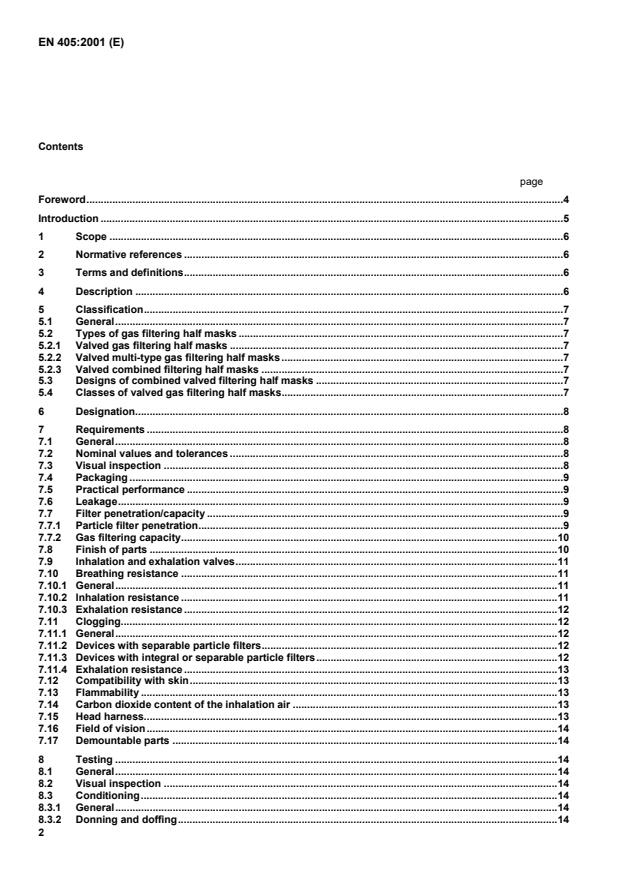
Marking.40Annex ZA (informative)
Clauses of this European Standard addressing essential requirements or otherprovisions of EU Directives.41Bibliography.42
Materials used shall be suitable to withstand handling and wear over the period for which the valved filteringhalf mask is designed to be used.Testing shall be done in accordance with 8.4.After undergoing the treatment described in 8.3.2 and 8.3.3 none of the devices shall collapse or shall havesuffered mechanical failure of the facepiece body or straps.7.1.2
Any material of the filter media or any gaseous products that may be released by the airflow through thefilter shall not be known to constitute a hazard or nuisance for the wearer.Testing shall be done in accordance with 8.2.7.1.3
Where the device can be used for more than a single shift (single-use), the materials used shall withstandthe cleaning and disinfecting agents recommended by the manufacturer.Testing shall be done in accordance with Table 6 and 8.2.7.2 Nominal values and tolerancesUnless otherwise specified, the values stated in this European Standard are expressed as nominal values. Exceptfor temperature limits, values which are not stated as maxima or minima shall be subject to a limit deviation of± 5 %. Unless otherwise specified, the ambient temperature for testing shall be from 16 °C to 32 °C, and thetemperature limits shall be subject to a limit deviation of ± 1 °C.7.3 Visual inspectionThe visual inspection shall also include the marking and information supplied by the manufacturer.
5 exercise periods) shall be not greater than 5 %.In addition, at least 8 out of the 10 individual wearer arithmetic means of measured values (10 subjects) for theinward leakage, averaged over all exercise periods shall be not greater than 2 %.Testing shall be done in accordance with 8.5.7.7 Filter penetration/capacity7.7.1 Particle filter penetrationFor all devices the penetration of the particle filter of the valved filtering half mask, whether with integral orseparable filters, shall meet the requirements given in Table 1.Table 1 — Particle filter penetrationClassificationMaximum initial penetration of test aerosols at 95 l/minSodium chloride%Paraffin oil%FFGasP12020FFGasP266FFGasP311This requirement shall be met before and after conditioning procedures specified in 8.3.3.
When tested in accordance with 8.6 the devices shall meet the requirements given in Table 2 for minimumbreakthrough times for FFGas1 and/or FFGas2 devices and/or the requirements of EN 371 or EN 372 asappropriate.Table 2 — Gas filtering capacityClassificationTest agentTest gasconcentration in airBreakthroughconcentrationMinimumbreakthroughtime% byvolumemg/lml/m3minFFA1Cyclohexane (C6H12)0,13,51070FFB1Chlorine (Cl2)0,13,00,520Hydrogen sulfide (H2S)0,11,41040Hydrogen cyanide(HCN)0,11,110a25FFE1Sulfur dioxide (SO2)0,12,7520FFK1Ammonia (NH3)0,10,72550FFA2Cyclohexane (C6H12)0,517,51035FFB2Chlorine (Cl2)0,515,00,520Hydrogen sulfide (H2S)0,57,11040Hydrogen cyanide(HCN)0,55,610a25FFE2Sulfur dioxide (SO2)0,513,3520FFK2Ammonia (NH3)0,53,52540NOTE
The minimum breakthrough time is intended only for laboratory tests under standardizedconditions. It does not give an indication of the possible service time in practical use. Possible service timescan differ from the breakthrough times determined according to this European Standard in both directionspositive or negative depending on the conditions of use.a C2N2 may sometimes be present in the effluent air. The total concentration of (C2N2 + HCN)shall not exceed 10 ml/m3.7.7.2.2
Where a device is a combination of types, it shall meet the requirements of each type separately.7.7.2.3
Test requirements shall apply to the capacity of the complete device.7.8 Finish of partsParts of the device likely to come into contact with the wearer shall have no sharp edges or burrs.Testing shall be done in accordance with 8.2.
Inhalation valve(s) and exhalation valve(s) shall function correctly in all orientations.Testing shall be done in accordance with 8.9.7.9.2
Exhalation valve(s) shall be protected against or be resistant to dirt and mechanical damage. They may beshrouded or may include any other device that may be necessary to comply with 7.6.Testing shall be done in accordance with 8.2.7.9.3
Exhalation valve(s) shall continue to operate correctly after a continuous exhalation flow of 300 l/min over aperiod of 30 s.Testing shall be done in accordance with 8.9.7.9.4
The exhalation valve housing shall show no signs of damage or of being loosened.Testing shall be done in accordance with 8.10.7.10 Breathing resistance7.10.1 GeneralThe breathing resistances of the various classes of valved gas and combined filtering half masks shall meet therequirements of 7.10.2 and 7.10.3.7.10.2 Inhalation resistance7.10.2.1 Valved gas filtering half masksWhen tested in accordance with 8.9 the inhalation resistance shall meet the requirements given in Table 3.Table 3 — Inhalation resistance: valved gas filtering half masksClassificationMaximum inhalation resistancembar30 l/min95 l/minFFGas11,04,0FFGas21,45,6FFAX1,45,6FFSX1,45,67.10.2.2 Valved combined filtering half masksWhen tested in accordance with 8.9, the inhalation resistance of all devices, whether with separable or integralparticle filters, shall meet the requirements given in Table 4.
The head harness shall be designed so that the valved filtering half mask can be donned and removedeasily.
The head harness shall be adjustable or self-adjusting and shall be sufficiently robust to hold the valvedfiltering half mask firmly in position and be capable of maintaining inward leakage requirements for the device.Testing shall be done in accordance with 8.4 and 8.5.7.16 Field of visionThe field of vision is acceptable if determined so in practical performance tests.Testing shall be done in accordance with 8.4.7.17 Demountable partsAll demountable parts (if fitted) shall be readily connected and secured, where possible by hand.Testing shall be done in accordance with 8.2 and 8.4.8 Testing8.1 GeneralAll samples shall fulfill all requirements.Before performing tests involving human subjects account should be taken of any national regulations concerningthe medical history, examination or supervision of the test subjects.NOTEFor summary of testing see Table 6.8.2 Visual inspectionThe visual inspection shall be carried out where appropriate by the test station prior to laboratory or practicalperformance tests.8.3 Conditioning8.3.1 GeneralWhere conditioning is required before subsequent testing the procedures used shall be one or more of thosedescribed in 8.3.2, 8.3.3, 8.3.4 as specified in Table 6.Devices shall be removed from their packaging but still be sealed.8.3.2 Donning and doffingThe wearers shall fit the valved filtering half mask in accordance with the manufacturer's information and thenremove it.8.3.3 TemperatureThe valved filtering half masks as received shall be exposed to the following thermal cycle:a) for 24 h to a dry atmosphere at (70
3) °C;b) for 24 h to a temperature of (–30
3) °C
0,2) m for 5 min;b) Crawling on the level with headroom of (0,70
0,05) m for 5 min;c) Filling a small basket (see Figure 2, approximate volume = 8 l) with chippings or other suitable material from ahopper which stands 1,5 m high and has an opening at the bottom to allow the contents to be shovelled outand a further opening at the top where the basket full of chippings shall be returned. The subject shall stoop orkneel (as desired) and fill the basket with chippings. The test subject shall then lift the basket and empty thecontents back into the hopper. This shall be done 20 times in 10 min.8.5 Inward Leakage8.5.1 GeneralA total of 10 samples shall be tested: five in the state as received and five after temperature conditioning inaccordance with 8.3.3.The samples, depending upon design, can require modification in order to ensure that the measurements taken,are those corresponding to faceseal leakage. This is done by modifying the test sample (as per examples providedin 8.5.6) to ensure that any contribution to inward leakage, attributable to filter penetration, will be negligible.The test arrangement and the test procedure are common to both test agents.8.5.2 PrincipleA test subject wearing a device conditioned as specified, walks at a specified speed on a horizontal treadmillsurrounded by an atmosphere containing a known concentration of a test agent. The percentage inward leakage ofthe test agent into the breathing zone is measured.Two methods are specified, namely, one using sodium chloride and the other sulphur hexafluoride. The generalprinciple of the test is the same.Dilution of the test atmosphere by clean air emanating from the device under test does not affect the accuracy ofthe measurement of leakage because of the large volume and continuous replacement of the test atmosphere.8.5.3 Apparatus8.5.3.1 EnclosureAn enclosure shall be positioned over a treadmill and shall be capable of being charged with the test agent, whichpreferably enters the top of the enclosure via a duct and flow distributor and shall be directed downwards over thehead of the test subject. The concentration of the test agent inside the effective working volume shall be checked toensure it is homogeneous. The enclosure shall be large enough to permit walking on the treadmill withoutinterference.The air velocity through the enclosure measured close to the test subject's head, with the test subject standingcentrally on the treadmill shall be 0,1 m/s to 0,2 m/s.The design of the enclosure shall be such that the device worn by the test subject can be supplied if necessary withbreathable air (free of the test agent).It is important that the attachment of the hose supplying clean air does not affect the fit of the device on the testsubject nor should its fitting replace any seals incorporated in the device under test. If necessary the hose can besupported.
The test subjects shall be asked to read the manufacturer's fitting instructions and if necessary shall beshown how to fit the device correctly in accordance with the fitting instructions. If more than one size of device isavailable, the test subjects shall be asked to select the size deemed by them to be the most appropriate.8.5.7.2
The test subjects shall be informed that if they wish to adjust the device during the test they may do so.However, if this is done the relevant section of the test shall be repeated having allowed the system to re-settle.8.5.7.3
After fitting the device the test subject shall be asked "Does the device fit?". If the answer is "Yes", the testshall be continued. If the answer is "No", the test subject shall be taken off the panel, and replaced with anothertest subject and the fact reported.8.5.7.4
It shall be ensured that the test subjects have no indication of the results as the test proceeds.8.5.7.5
It shall be ensured that the test atmosphere is OFF.8.5.7.6
The test subject shall be placed in the enclosure. The sampling probe shall be connected up. The testsubject shall walk at 6 km/h for 2 min. The concentration of the test agent shall be measured inside the device toestablish the background level.8.5.7.7
It shall be waited until a stable reading is obtained.8.5.7.8
The test atmosphere shall be turned ON.8.5.7.9
The test subject shall be instructed to continue to walk for a further 2 min or until the test atmosphere hasstabilized.8.5.7.10
Whilst still walking the test subject shall perform the following exercises:a) walking wi
...
Questions, Comments and Discussion
Ask us and Technical Secretary will try to provide an answer. You can facilitate discussion about the standard in here.
Loading comments...