


prEN 13650
(Main)Soil improvers and growing media - Digestion by aqua regia for subsequent determination of elements
General Information
- Abstract
This document specifies a method for the digestion of soil improvers and growing media using an aqua regia digestion.
Materials containing more than about 28 % (m/m) organic matter will require treatment with additional nitric acid. With high solute concentrations in extract solutions, spectral interferences and background enhancement should be expected.
- Status
- Not Published
- Publication Date
- 06-Jan-2027
- Technical Committee
- CEN/TC 223 - Soil improvers and growing media
- Drafting Committee
- CEN/TC 223/WG 4 - Analytical methods
- Current Stage
- 4599 - Dispatch of FV draft to CMC - Finalization for Vote
- Start Date
- 27-Jul-2026
- Due Date
- 12-Oct-2024
- Completion Date
- 27-Jul-2026
- Mandate
- M/XXX - M/XXX

Overview
prEN 13650:2025 is a European draft standard developed by CEN/TC 223, specifying a method for the digestion of soil improvers and growing media using aqua regia. This procedure enables the subsequent determination of elemental content in soil amendments and growing substrates. Designed as a supersession of EN 13650:2001, this document introduces updated heating procedures and broadens the scope to include liming and preformed materials.
The aqua regia digestion method helps mineralize organic matter and dissolve mineral components from samples, facilitating accurate chemical analysis. Recognizing limitations in complete element recovery, the method is considered fit for purpose in various agricultural and environmental applications.
Key Topics
Scope and Material Types
Covers soil improvers, growing media, liming materials, and related substrates. Suitable for materials with varying organic content, with specific procedures for those exceeding 28 % organic matter.Digestion Principle
Digestion involves mineralization of organic and mineral components via aqua regia, a mixture of hydrochloric acid (HCl) and nitric acid (HNO3), facilitating the release of target elements for analysis.Heating Procedures
- Method A: Reflux heating at approximately 120 minutes under controlled conditions.
- Method B: Heating using a temperature-controlled heating block at ~105 °C for 120 minutes.
Sample Preparation
Samples are processed to reduce particle size below 0.5 mm and moisture content is determined in accordance with related standards. Sample integrity is emphasized for representativity and accuracy.Reagents and Apparatus
Utilizes analytical-grade acids with strict blank testing for contamination control. Requires temperature-resistant digestion vessels (quartz or borosilicate glass), reflux condensers, and precise heating devices.Safety Considerations
Due to the use of corrosive and toxic acids, procedures must be conducted in fume hoods with trained personnel. Special care to avoid explosive intermediates, especially for samples high in organic content.Validation and Performance
Validation follows ISO 5725-2 guidelines, ensuring accuracy and repeatability. The method accounts for spectral interferences in high solute conditions.
Applications
Agricultural Testing
Enables determination of elemental composition in fertilizers, soil improvers, and growing media to assess nutrient content and soil amendment effectiveness.Environmental Monitoring
Supports chemical characterization of substrates used for biowaste treatment, sludge amendments, and other environmental soil applications.Quality Control
Laboratories use the digestion method for routine quality assessment of soil products, ensuring they meet regulatory and market standards.Research and Development
Provides a standardized approach for researchers studying nutrient dynamics and material properties in agricultural substrates.
Related Standards
CEN/TS 17732:2022 – Terminology for soil improvers and growing media, ensuring uniform language in testing and analysis.
EN 12579:2024 – Sampling procedures for soil improvers and growing media to guarantee representative test samples.
prEN 13039:2025 – Determination of organic content and ash in soil improvers and growing media, necessary for assessing digestion sample organic load.
prEN 13040-1:2025 – Sample preparation guidelines for chemical and physical testing, including moisture and dry matter content determination.
Keywords: prEN 13650, aqua regia digestion, soil improvers, growing media, element determination, soil amendment analysis, reflux digestion, heating block digestion, CEN standard, agricultural testing, environmental monitoring.
Relations
- Effective Date
- 28-Jan-2026
- Effective Date
- 28-Jan-2026
- Effective Date
- 28-Jan-2026
- Effective Date
- 28-Jan-2026
- Effective Date
- 28-Jan-2026
- Effective Date
- 28-Jan-2026
- Effective Date
- 28-Jan-2026
- Effective Date
- 28-Jan-2026
- Effective Date
- 28-Jan-2026
- Effective Date
- 28-Jan-2026
- Effective Date
- 08-May-2019
Get Certified
Connect with accredited certification bodies for this standard

Control Union Certifications
Global certification for agriculture and sustainability.

ECOCERT
Organic and sustainability certification.

FSC International
Forest Stewardship Council certification.
Sponsored listings
Frequently Asked Questions
prEN 13650 is a draft published by the European Committee for Standardization (CEN). Its full title is "Soil improvers and growing media - Digestion by aqua regia for subsequent determination of elements". This standard covers: This document specifies a method for the digestion of soil improvers and growing media using an aqua regia digestion. Materials containing more than about 28 % (m/m) organic matter will require treatment with additional nitric acid. With high solute concentrations in extract solutions, spectral interferences and background enhancement should be expected.
This document specifies a method for the digestion of soil improvers and growing media using an aqua regia digestion. Materials containing more than about 28 % (m/m) organic matter will require treatment with additional nitric acid. With high solute concentrations in extract solutions, spectral interferences and background enhancement should be expected.
prEN 13650 is classified under the following ICS (International Classification for Standards) categories: 65.080 - Fertilizers. The ICS classification helps identify the subject area and facilitates finding related standards.
prEN 13650 has the following relationships with other standards: It is inter standard links to EN ISO 18589-5:2021, EN ISO 19581:2025, EN ISO 11665-6:2020, EN ISO 13161:2020, EN ISO 22125-2:2019, EN ISO 13165-3:2024, EN ISO 23548:2025, EN ISO 18589-1:2021, EN ISO 13163:2022, EN ISO 11665-5:2020, EN 13650:2001. Understanding these relationships helps ensure you are using the most current and applicable version of the standard.
prEN 13650 is associated with the following European legislation: EU Directives/Regulations: 2019/1009; Standardization Mandates: M/564, M/564 AMD 1, M/564 AMD 2, M/XXX. When a standard is cited in the Official Journal of the European Union, products manufactured in conformity with it benefit from a presumption of conformity with the essential requirements of the corresponding EU directive or regulation.
prEN 13650 is available in PDF format for immediate download after purchase. The document can be added to your cart and obtained through the secure checkout process. Digital delivery ensures instant access to the complete standard document.
Standards Content (Sample)
SLOVENSKI STANDARD
01-december-2025
Izboljševalci tal in rastni substrati - Razklop z zlatotopko za določanje elementov
Soil improvers and growing media - Digestion by aqua regia for subsequent
determination of elements
Bodenverbesserungsmittel und Kultursubstrate - Aufschluss mit Königswasser zur
anschließenden Bestimmung der Elemente
Amendements du sol et supports de culture - Digestion à l’eau régale pour le dosage
ultérieur des éléments
Ta slovenski standard je istoveten z: prEN 13650
ICS:
65.080 Gnojila Fertilizers
2003-01.Slovenski inštitut za standardizacijo. Razmnoževanje celote ali delov tega standarda ni dovoljeno.
DRAFT
EUROPEAN STANDARD
NORME EUROPÉENNE
EUROPÄISCHE NORM
October 2025
ICS 65.080 Will supersede EN 13650:2001
English Version
Soil improvers and growing media - Digestion by aqua
regia for subsequent determination of elements
Amendements du sol et supports de culture - Digestion Bodenverbesserungsmittel und Kultursubstrate -
à l'eau régale pour le dosage ultérieur des éléments Aufschluss mit Königswasser zur anschließenden
Bestimmung der Elemente
This draft European Standard is submitted to CEN members for enquiry. It has been drawn up by the Technical Committee
CEN/TC 223.
If this draft becomes a European Standard, CEN members are bound to comply with the CEN/CENELEC Internal Regulations
which stipulate the conditions for giving this European Standard the status of a national standard without any alteration.
This draft European Standard was established by CEN in three official versions (English, French, German). A version in any other
language made by translation under the responsibility of a CEN member into its own language and notified to the CEN-CENELEC
Management Centre has the same status as the official versions.
CEN members are the national standards bodies of Austria, Belgium, Bulgaria, Croatia, Cyprus, Czech Republic, Denmark, Estonia,
Finland, France, Germany, Greece, Hungary, Iceland, Ireland, Italy, Latvia, Lithuania, Luxembourg, Malta, Netherlands, Norway,
Poland, Portugal, Republic of North Macedonia, Romania, Serbia, Slovakia, Slovenia, Spain, Sweden, Switzerland, Türkiye and
United Kingdom.
Recipients of this draft are invited to submit, with their comments, notification of any relevant patent rights of which they are
aware and to provide supporting documentation.
Warning : This document is not a European Standard. It is distributed for review and comments. It is subject to change without
notice and shall not be referred to as a European Standard.
EUROPEAN COMMITTEE FOR STANDARDIZATION
COMITÉ EUROPÉEN DE NORMALISATION
EUROPÄISCHES KOMITEE FÜR NORMUNG
CEN-CENELEC Management Centre: Rue de la Science 23, B-1040 Brussels
© 2025 CEN All rights of exploitation in any form and by any means reserved Ref. No. prEN 13650:2025 E
worldwide for CEN national Members.
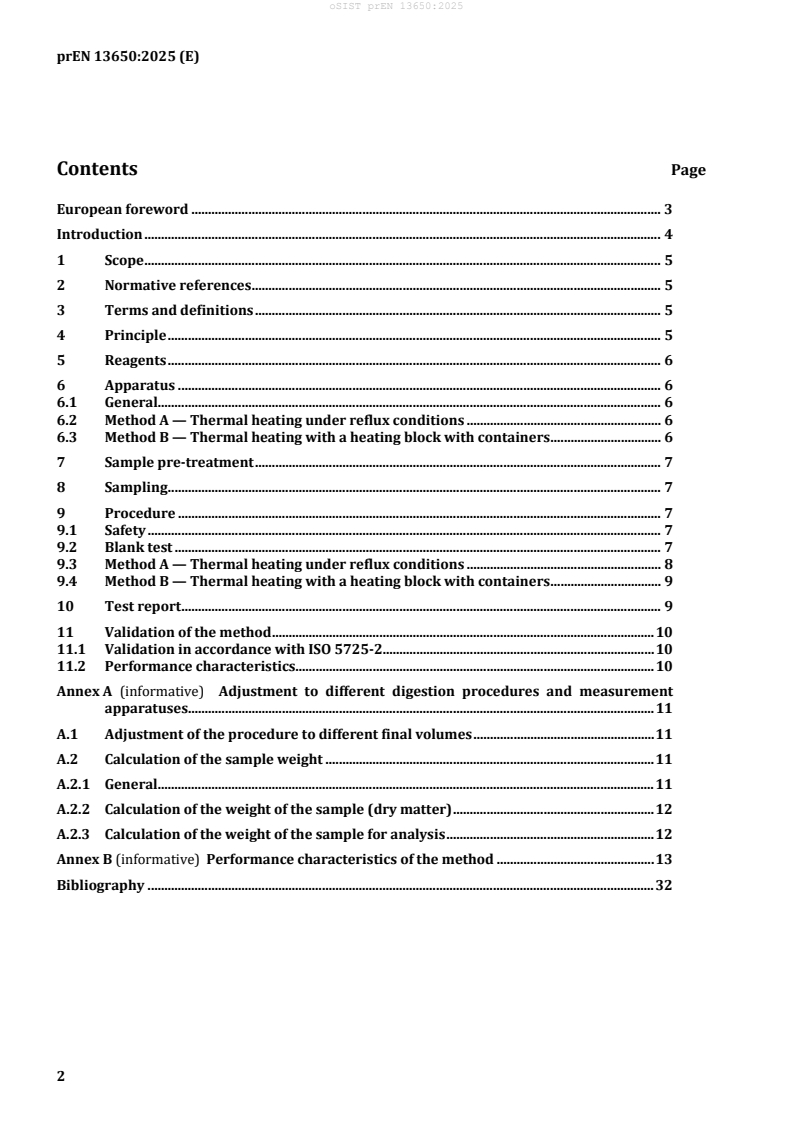
Contents Page
European foreword . 3
Introduction . 4
1 Scope . 5
2 Normative references . 5
3 Terms and definitions . 5
4 Principle . 5
5 Reagents . 6
6 Apparatus . 6
6.1 General. 6
6.2 Method A — Thermal heating under reflux conditions . 6
6.3 Method B — Thermal heating with a heating block with containers . 6
7 Sample pre-treatment . 7
8 Sampling . 7
9 Procedure . 7
9.1 Safety . 7
9.2 Blank test . 7
9.3 Method A — Thermal heating under reflux conditions . 8
9.4 Method B — Thermal heating with a heating block with containers . 9
10 Test report . 9
11 Validation of the method . 10
11.1 Validation in accordance with ISO 5725-2. 10
11.2 Performance characteristics. 10
Annex A (informative) Adjustment to different digestion procedures and measurement
apparatuses . 11
A.1 Adjustment of the procedure to different final volumes . 11
A.2 Calculation of the sample weight . 11
A.2.1 General. 11
A.2.2 Calculation of the weight of the sample (dry matter) . 12
A.2.3 Calculation of the weight of the sample for analysis . 12
Annex B (informative) Performance characteristics of the method . 13
Bibliography . 32
European foreword
This document (prEN 13650:2025) has been prepared by Technical Committee CEN/TC 223 “Soil
improvers and growing media”, the secretariat of which is held by NEN.
This document is currently submitted to CEN Enquiry.
This document will supersede EN 13650:2001.
— the heating block procedure has been added to the reflux digestion procedure;
— the scope has been expanded including liming materials and preformed materials.
This document has been prepared under a standardization request addressed to CEN by the European
Commission. The Standing Committee of the EFTA States subsequently approves these requests for its
Member States.
Introduction
Aqua regia is applied to digest different matrices for the subsequent determination of many elements.
For example, a multi-matrix standard for aqua regia digestion of soil, treated biowaste, sludge and waste
was prepared by CEN/TC 444 “Environmental characterization of solid matrices”. CEN/TC 260
“Fertilizers and liming materials” published a standard with a similar procedure for organic and organo-
mineral fertilizers.
It is known that the digestion of soil improvers or growing media with aqua regia will not necessarily
lead to complete element recoveries and that the extract from a test sample may not reflect the total
concentrations of the target analytes. However, for most applications the result obtained based upon
digestion methods specified in this document are considered to be fit for the intended purpose.
1 Scope
This document specifies a method for the digestion of soil improvers and growing media using an aqua
regia digestion.
Materials containing more than about 28 % (m/m) organic matter will require treatment with additional
nitric acid. With high solute concentrations in extract solutions, spectral interferences and background
enhancement can be expected.
2 Normative references
The following documents are referred to in the text in such a way that some or all of their content
constitutes requirements of this document. For dated references, only the edition cited applies. For
undated references, the latest edition of the referenced document (including any amendments) applies.
CEN/TS 17732:2022, Soil improvers and growing media — Terminology
EN 12579:2024, Soil improvers and growing media — Sampling
prEN 13039:2025, Soil improvers and growing media — Determination of organic content and ash
prEN 13040-1:2025, Soil improvers and growing media — Sample preparation — Part 1: Sample
preparation for chemical and physical tests, determination of dry matter content, moisture content and
laboratory bulk density
3 Terms and definitions
For the purposes of this document, the terms and definitions given in CEN/TS 17732:2022 and the
following apply.
3.1
aqua regia
digestion solution obtained by mixing 1 volume of nitric acid (mass fraction of 65 % to 70 %) and
3 volumes of hydrochloric acid (mass fraction of 35 % to 37 %)
3.2
digestion
mineralization of the organic matter of a sample and dissolution of its mineral part, more or less
completely, when reacting with a reagent mixture
4 Principle
A test portion is digested with aqua regia according to one of the following heating procedures:
— Method A: reflux for 120 min ± 10 min, followed by filtration/centrifugation;
— Method B: heating block at 105 °C ± 5 °C for 120 min + 10 min, followed by filtration/centrifugation.
5 Reagents
5.1 General
Use only acids and reagents of recognized analytical grade to avoid high blank values for subsequent
analytical measurements. Use a test blank solution throughout the procedure applying all steps with the
same amount of acids, but without a sample.
5.2 Water, having an electrical conductivity not higher than 0,2 mS/cm at 25 °C, free of the elements
to be determined.
5.3 Hydrochloric acid, c(HCl) = 12 mol/l; ρ ≈ 1,18 g/ml; 37 % mass/volume.
5.4 Nitric acid, c(HNO ) = 15 mol/l; ρ ≈ 1,42 g/ml; not less than 65 % mass/volume.
5.5 Nitric acid, c(HNO ) = 0,5 mol/l. Dilute 35 ml nitric acid (5.4) to 1 l with water (5.2).
5.6 Antifoaming agent, e.g. n-dodecane (C H ) or n-octanol (C H O) are suitable.
12 26 8 18
6 Apparatus
6.1 General
Usual laboratory apparatus. All glassware and plastics ware shall be adequately cleaned and stored to
avoid any contamination.
Depending upon the concentration of the element of interest, particular care should be exercised with
respect to the effective cleaning of the vessels.
6.2 Method A — Thermal heating under reflux conditions
6.2.1 Digestion vessel, temperature-resistant and capable of containing the mixture of sample and
digest solution, for example a quartz vessel. The digestion vessel shall have a volume of at least 5 times
of the volume of the aqua regia used. The inner wall of the vessel shall be inert and shall not release
substances to the digest in excess of the purity requirements of the subsequent analysis.
Silica or borosilicate glass vessels may be used instead of quartz vessels.
It may be necessary to periodically clean the digestion vessels with a suitable surfactant to remove
persistent deposits.
6.2.2 Reflux condenser, adaptable to the digestion vessel (6.2.1).
6.2.3 Absorption vessel, volatile species trap, in an open digestion system capable of trapping one or
more volatile measurement species, adaptable to the reflux condenser (6.2.2).
6.2.4 Heating device, for example a heating mantle, thermostatic controlled, or an aluminium block
thermostat.
6.3 Method B — Thermal heating with a heating block with containers
6.3.1 Digestion tube, 50 ml plastic tube, temperature-resistant and capable of containing the mixture
of sample and digest solution, with a screw cap from e.g. polypropylene.
The part of the tube not being heated and the screw cap function as a condenser but are not really a reflux
system. The material of the tube and screw cap need to be tested to be sure that release of elements of
interest does not take place. Other materials and vessels with other volumes than mentioned above are
allowed to be used if suitability has been proven.
6.3.2 Temperature controlled heating block, heating block able to heat the tube(s) to a temperature
of 105 °C ± 5 °C.
6.4 Sample containers, plastics and glass containers are both suitable.
6.5 Filter paper, usually with a pore size of 0,45 µm and resistant to the diluted aqua regia final
digestion solution.
6.6 Volumetric flasks, usually of nominal capacity of 50 ml or 100 ml.
6.7 Analytical balance, with an accuracy of 1 mg or better.
6.8 Boiling aids, anti-bumping granules or glass beads, diameter 2 mm to 3 mm, acid washed.
7 Sample pre-treatment
Prepare the solid sample by reducing the particle size below 0,5 mm in accordance with Clause 10 of
prEN 13040-1:2025. The residual moisture content in the analysed sample is determined in accordance
with prEN 13040-1:2025, Clause 11, using 10 g of sample.
Prepare the liquid samples in accordance with Clause 9 of prEN 13040-1:2025. Liquid samples may be
digested as such or after drying at 70 °C. The (residual) moisture content in the analysed sample is
determined in accordance with prEN 13040-1:2025, Clause 11, using 10 g of sample.
8 Sampling
Sampling is not part of the method specified in this document. Follow EN 12579:2024 dealing with soil
improvers and growing media. It is important that the laboratory receives a sample that is representative
of the product under consideration. The sample should not have been damaged or changed during
transport or storage.
9 Procedure
9.1 Safety
WARNING — Persons using this document should be familiar with usual laboratory practice. Some of the
reagents used in this document are highly corrosive and very toxic. Safety precautions are absolutely
necessary.
All procedures should be performed in a fume hood or in closed force-ventilated equipment. By the use
of strong oxidising reagents, the formation of explosive organic intermediates is possible, especially when
dealing with samples with a high organic content. Avoid contact with the chemicals and the gaseous
reaction products.
IMPORTANT — It is absolutely essential that tests conducted according to this document be carried out
by suitably trained staff.
9.2 Blank test
Carry out a reagent blank test digestion in parallel with the determination, using the same procedure and
the same quantities of all the reagents as in the determination, but omitting the test portion. The
laboratory shall define acceptable limits.
NOTE The measurement of a blank is introduced to determine the contribution of the extracting solution,
glassware, digestion tube and filter paper used to the measured value.
9.3 Method A — Thermal heating under reflux conditions
This procedure may be used for all samples of soil improvers and growing media if a sufficiently sensitive
method for determination is used. For some liquid samples with a low dry matter content, a higher intake
volume or a pre-concentration step may be necessary (see Annex A). Pre-concentration may be carried
out by heating an amount of liquid sample to approximately 70 °C to evaporate excessive water. The pre-
concentration factor shall be taken into account in the final calculations.
Weigh approximately 1 g to 3 g, to the nearest 0,001 g of the test sample, and transfer to the digestion
vessel (6.2.1). In case of dry samples moisten the test portion with about 0,5 ml to 1,0 ml water (5.2). Add
while mixing, 21,0 ml ± 0,1 ml of hydrochloric acid (5.3) followed by 7,0 ml ± 0,1 ml of nitric acid (5.4),
drop by drop if necessary to reduce foaming. Connect the reflux condenser (6.2.2) to the digestion vessel
(6.2.1). Fill the absorption vessel (6.2.3) with approximately 15 ml nitric acid (5.5). Connect the
absorption vessel to the reflux condenser and let stand at room temperature until any effervescence
almost ceases to allow for slow oxidation of the organic matter in the sample.
The time of standing at room temperature can have an influence on the digestion rate of aqua regia. For
consistency, it is recommended to start heating as soon as possible after the first strong reaction has
ceased.
NOTE It is common practice to add hydrochloric acid directly to the reaction vessel, followed by the nitric acid,
and to assume that the aqua regia forms in the reaction vessel. However, problems have been encountered with
materials rich in carbonates, where a substantial portion of the hydrochloric acid has been consumed before the
nitric acid can be added. Under such circumstances, the correct formation of aqua regia is doubtful.
The amount of aqua regia is sufficient only for oxidation of about 0,85 g of organic matter (corresponding
to about 0,5 g of organic carbon). If there is any doubt about the amount of organic matter present, carry
out a determination according to prEN 13039:2025. If there is more than 0,85 g of organic matter in the
test sample reduce the quantity of sample analysed or proceed as follows.
Allow the first reaction with aqua regia to subside. Then add an extra 1 ml of nitric acid (5.4) only to every
0,17 g of organic matter above 0,85 g. Do not add more than 10 ml of nitric acid at any time and allow any
reaction to subside before proceeding further.
Add a few roughened glass beads (6.8) and connect the digestion vessel (6.2.1) to the heating device
(6.2.4). Raise the temperature of the reaction mixture slowly until reflux conditions are reached and
maintain for 2 h ensuring that the condensation zone is lower than 1/3 of the height of the condenser,
then allow to cool. Add the content of the absorption vessel to the digestion vessel via the reflux
condenser, rinsing both the absorption vessel and condenser with further 10 ml of diluted nitric acid
(5.5).
Transfer quantitatively the solution content of the digestion vessel into a suitable sized volumetric flask
and add water (5.2) to the volume mark.
Alternatively, another procedure may be applied, such that the adjustment to volume with the solid
residue still present shall be carried out immediately after digestion.
If the measurement solution contains particles due to precipitation which may clog nebulizers or
interfere with an injection of the sample into the instrument, the sample may be centrifuged, allowed to
settle, or filtered (6.5).
The extracts are suitable for analysis using prEN 18259:2025 and prEN 18258:2025.
9.4 Method B — Thermal heating with a heating block with containers
This procedure may be used for all samples of soil improvers and growing media if a sufficiently sensitive
method for determination is used. For some liquid samples with a low dry matter content, a higher intake
volume or a pre-concentration step may be necessary (see Annex A). Pre-concentration may be carried
out by heating an amount of liquid sample to approximately 70 °C to evaporate excessive water. The pre-
concentration factor shall be taken into account in the final calculations.
Weigh an amount of not more than 2 g of the test portion (typically 0,5 g to 1 g of dry sample), to the
nearest 0,001 g, and transfer to the digestion vessel (6.3.1). In case of dry samples moisten the test
portion with a few drops of water (5.2). Add 12,0 ml + 0,1 ml hydrochloric acid (5.3) followed by
4,0 ml + 0,1 ml nitric acid (5.4). Let stand at room temperature until any effervescence almost ceases to
allow for slow oxidation of the organic matter in the sample.
The amount of aqua regia is sufficient only for oxidation of about 0,50 g of organic matter (corresponding
to about 0,3 g of organic carbon). If there is any doubt about the amount of organic matter present, carry
·
out a determination according to prEN 13039:2025 If there is more than 0,50 g of organic matter in the
test sample reduce the quantity of sample analysed or proceed as follows.
Allow the first reaction with aqua regia to subside. Then add an extra 1 ml of nitric acid (5.4) only to every
0,17 g of organic matter above 0,50 g. Do not add more than 10 ml of nitric acid at any time and allow any
reaction to subside before proceeding further.
NOTE For some elements, e.g. chromium, the additional volume of HNO is essential in order to have a sufficient
recovery upon digestion.
The time of standing at room temperature can have an influence on the digestion rate of aqua regia. For
consistency, it is recommended to start heating as soon as possible after the first strong reaction has
ceased.
Loosely screw on the tube cap (not very tight!) and place the digestion vessel on the heating block (6.3.2)
and slowly increase the temperature to the boiling point. Keep the temperature on the boiling point
during 120 min + 10 min.
Let the vessel cool down to room temperature and fill up with water (5.2) to the volume mark.
If a non-graduated digestion tube is used, transfer quantitatively the solution into a suitable sized
volumetric flask and add water (5.2) to the volume mark.
Alternatively, another procedure may be applied, such that the adjustment to volume with the solid
residue still present shall be carried out immediately after digestion.
If the measurement solution contains particles due to precipitation which may clog nebulizers or
interfere with an injection of the sample into the instrument, the sample may be centrifuged or filtered
(6.5).
The extracts are suitable for analysis using prEN 18259:2025 and prEN 18258:2025.
10 Test report
The test report may be prepared separately or in conjunction with the test report of the subsequent
analytical method.
The test report shall include the following information:
a) the digestion method used, together with a reference to this document (including its year of
publication);
b) a complete identification of the sample;
c) all the analytical methods used;
d) the results of the determination expressed as mass/mass on dry matter basis;
e) any details not specified in this document, or which are optional, as well as any other factor which
may have affected the results.
11 Validation of the method
11.1 Validation in accordance with ISO 5725-2
This standardized reference method was validated in accordance with ISO 5725-2 [2]. All relevant data
were reported in an interlaboratory study report, which has been published [6].
11.2 Performance characteristics
The performance characteristics (reproducibility and repeatability) of the method were determined in
an interlaboratory study. All data are given in Annex B. The method has been validated for seven different
matrices, as listed in Tables B.1 to B.19.
Annex A
(informative)
Adjustment to different digestion procedures and measurement
apparatuses
A.1 Adjustment of the procedure to different final volumes
Volumetric flasks or graduated plastic tubes for 150 ml, 100 ml or 50 ml may be used for the final volume
adjustment. Table A.1 gives recalculated parameters for the different final volumes.
Table A.1 — Recalculated parameters for different final volumes
V V V m V
F HNO3 HCl DM max
ml ml ml g ml
150 7 21 1,5 to 3 6
100 4,7 14 1 to 2 4
50 2,3 7 0,5 to 1 2
VF – final volume of a volumetric flask or a graduated plastic tube
m – weight of the sample recalculated
...