

CEN/TS 17711:2022
(Main)Plant biostimulants - Detection of Vibrio spp.
- Abstract
This document specifies a horizontal method for the detection of enteropathogenic Vibrio spp., which causes human illness in or via the intestinal tract [1]. The species detectable by the methods specified include Vibrio parahaemolyticus, Vibrio cholerae and Vibrio vulnificus.
It is applicable to the following:
— microbial plant biostimulants.
NOTE 1 The World Health Organization (WHO) has identified that V. parahaemolyticus, V. cholerae and V. vulnificus are the major contaminants of Vibrio spp. [1].
NOTE 2 For confirmation, it is possible to use PCR tests; in this case the laboratory validates the procedure and data generated.
- Status
- Withdrawn
- Publication Date
- 22-Mar-2022
- Withdrawal Date
- 06-Oct-2026
- Technical Committee
- CEN/TC 455 - Plant Biostimulants and Agricultural Micro-Organisms
- Drafting Committee
- CEN/TC 455/WG 3 - Pathogenic and non-pathogenic microorganisms
- Current Stage
- 9960 - Withdrawal effective - Withdrawal
- Start Date
- 27-Nov-2024
- Completion Date
- 07-Oct-2026

Relations
- Effective Date
- 15-Feb-2023
Get Certified
Connect with accredited certification bodies for this standard

Control Union Certifications
Global certification for agriculture and sustainability.

ECOCERT
Organic and sustainability certification.

FSC International
Forest Stewardship Council certification.
Sponsored listings
Frequently Asked Questions
CEN/TS 17711:2022 is a technical specification published by the European Committee for Standardization (CEN). Its full title is "Plant biostimulants - Detection of Vibrio spp.". This standard covers: This document specifies a horizontal method for the detection of enteropathogenic Vibrio spp., which causes human illness in or via the intestinal tract [1]. The species detectable by the methods specified include Vibrio parahaemolyticus, Vibrio cholerae and Vibrio vulnificus. It is applicable to the following: — microbial plant biostimulants. NOTE 1 The World Health Organization (WHO) has identified that V. parahaemolyticus, V. cholerae and V. vulnificus are the major contaminants of Vibrio spp. [1]. NOTE 2 For confirmation, it is possible to use PCR tests; in this case the laboratory validates the procedure and data generated.
This document specifies a horizontal method for the detection of enteropathogenic Vibrio spp., which causes human illness in or via the intestinal tract [1]. The species detectable by the methods specified include Vibrio parahaemolyticus, Vibrio cholerae and Vibrio vulnificus. It is applicable to the following: — microbial plant biostimulants. NOTE 1 The World Health Organization (WHO) has identified that V. parahaemolyticus, V. cholerae and V. vulnificus are the major contaminants of Vibrio spp. [1]. NOTE 2 For confirmation, it is possible to use PCR tests; in this case the laboratory validates the procedure and data generated.
CEN/TS 17711:2022 is classified under the following ICS (International Classification for Standards) categories: 65.080 - Fertilizers. The ICS classification helps identify the subject area and facilitates finding related standards.
CEN/TS 17711:2022 has the following relationships with other standards: It is inter standard links to EN 17711:2024. Understanding these relationships helps ensure you are using the most current and applicable version of the standard.
CEN/TS 17711:2022 is associated with the following European legislation: EU Directives/Regulations: 2019/1009; Standardization Mandates: M/564. When a standard is cited in the Official Journal of the European Union, products manufactured in conformity with it benefit from a presumption of conformity with the essential requirements of the corresponding EU directive or regulation.
CEN/TS 17711:2022 is available in PDF format for immediate download after purchase. The document can be added to your cart and obtained through the secure checkout process. Digital delivery ensures instant access to the complete standard document.
Standards Content (Sample)
SLOVENSKI STANDARD
01-februar-2023
Rastlinski biostimulanti - Ugotavljanje prisotnosti Vibrio spp.
Plant biostimulants - Detection of Vibrio spp
Pflanzen-Biostimulanzien - Nachweis von Vibrio spp.
Biostimulants des végétaux - Recherche des espèces de Vibrio
Ta slovenski standard je istoveten z: CEN/TS 17711:2022
ICS:
65.080 Gnojila Fertilizers
2003-01.Slovenski inštitut za standardizacijo. Razmnoževanje celote ali delov tega standarda ni dovoljeno.
CEN/TS 17711
TECHNICAL SPECIFICATION
SPÉCIFICATION TECHNIQUE
March 2022
TECHNISCHE SPEZIFIKATION
ICS 65.080
English Version
Plant biostimulants - Detection of Vibrio spp.
Biostimulants des végétaux - Recherche des espèces de Pflanzen-Biostimulanzien - Nachweis von Vibrio spp.
Vibrio
This Technical Specification (CEN/TS) was approved by CEN on 3 January 2022 for provisional application.
The period of validity of this CEN/TS is limited initially to three years. After two years the members of CEN will be requested to
submit their comments, particularly on the question whether the CEN/TS can be converted into a European Standard.
CEN members are required to announce the existence of this CEN/TS in the same way as for an EN and to make the CEN/TS
available promptly at national level in an appropriate form. It is permissible to keep conflicting national standards in force (in
parallel to the CEN/TS) until the final decision about the possible conversion of the CEN/TS into an EN is reached.
CEN members are the national standards bodies of Austria, Belgium, Bulgaria, Croatia, Cyprus, Czech Republic, Denmark, Estonia,
Finland, France, Germany, Greece, Hungary, Iceland, Ireland, Italy, Latvia, Lithuania, Luxembourg, Malta, Netherlands, Norway,
Poland, Portugal, Republic of North Macedonia, Romania, Serbia, Slovakia, Slovenia, Spain, Sweden, Switzerland, Turkey and
United Kingdom.
EUROPEAN COMMITTEE FOR STANDARDIZATION
COMITÉ EUROPÉEN DE NORMALISATIO N
EUROPÄISCHES KOMITEE FÜR NORMUN G
CEN-CENELEC Management Centre: Rue de la Science 23, B-1040 Brussels
© 2022 CEN All rights of exploitation in any form and by any means reserved Ref. No. CEN/TS 17711:2022 E
worldwide for CEN national Members.
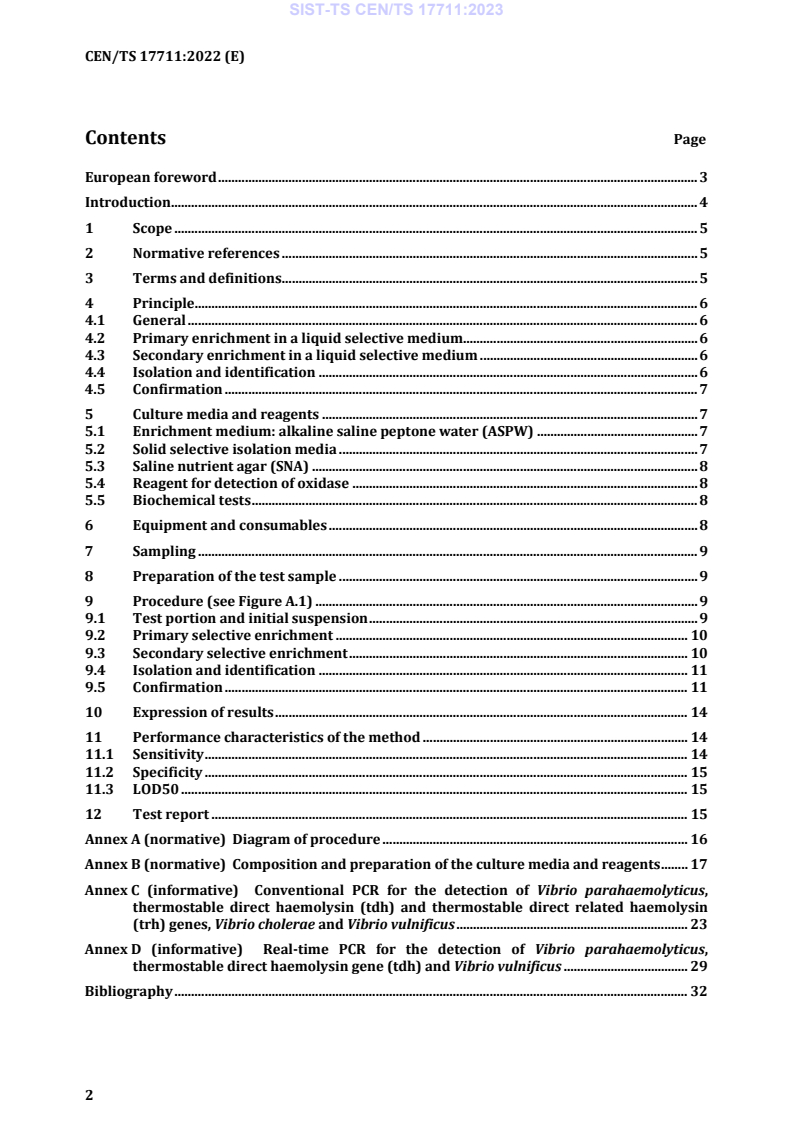
Contents Page
European foreword . 3
Introduction . 4
1 Scope . 5
2 Normative references . 5
3 Terms and definitions . 5
4 Principle. 6
4.1 General . 6
4.2 Primary enrichment in a liquid selective medium. 6
4.3 Secondary enrichment in a liquid selective medium . 6
4.4 Isolation and identification . 6
4.5 Confirmation . 7
5 Culture media and reagents . 7
5.1 Enrichment medium: alkaline saline peptone water (ASPW) . 7
5.2 Solid selective isolation media . 7
5.3 Saline nutrient agar (SNA) . 8
5.4 Reagent for detection of oxidase . 8
5.5 Biochemical tests . 8
6 Equipment and consumables . 8
7 Sampling . 9
8 Preparation of the test sample . 9
9 Procedure (see Figure A.1) . 9
9.1 Test portion and initial suspension . 9
9.2 Primary selective enrichment . 10
9.3 Secondary selective enrichment . 10
9.4 Isolation and identification . 11
9.5 Confirmation . 11
10 Expression of results . 14
11 Performance characteristics of the method . 14
11.1 Sensitivity . 14
11.2 Specificity . 15
11.3 LOD50 . 15
12 Test report . 15
Annex A (normative) Diagram of procedure . 16
Annex B (normative) Composition and preparation of the culture media and reagents . 17
Annex C (informative) Conventional PCR for the detection of Vibrio parahaemolyticus,
thermostable direct haemolysin (tdh) and thermostable direct related haemolysin
(trh) genes, Vibrio cholerae and Vibrio vulnificus . 23
Annex D (informative) Real-time PCR for the detection of Vibrio parahaemolyticus,
thermostable direct haemolysin gene (tdh) and Vibrio vulnificus . 29
Bibliography . 32
European foreword
This document (CEN/TS 17711:2022) has been prepared by Technical Committee CEN/TC 455
“Plant biostimulants”, the secretariat of which is held by AFNOR.
Attention is drawn to the possibility that some of the elements of this document may be the subject
of patent rights. CEN shall not be held responsible for identifying any or all such patent rights.
This document has been prepared under a Standardization Request given to CEN by the European
Commission and the European Free Trade Association.
Any feedback and questions on this document should be directed to the users’ national standards
body. A complete listing of these bodies can be found on the CEN website.
According to the CEN/CENELEC Internal Regulations, the national standards organisations of the
following countries are bound to announce this Technical Specification: Austria, Belgium,
Bulgaria, Croatia, Cyprus, Czech Republic, Denmark, Estonia, Finland, France, Germany, Greece,
Hungary, Iceland, Ireland, Italy, Latvia, Lithuania, Luxembourg, Malta, Netherlands, Norway,
Poland, Portugal, Republic of North Macedonia, Romania, Serbia, Slovakia, Slovenia, Spain,
Sweden, Switzerland, Turkey and the United Kingdom.
Introduction
This document was prepared by the experts of CEN/TC 455 “Plant Biostimulants”. The European
Committee for Standardization (CEN) was requested by the European Commission (EC) to draft
European standards or European standardization deliverables to support the implementation of
Regulation (EU) 2019/1009 of 5 June 2019 laying down rules on the making available on the
market of EU fertilizing products (“FPR” or “Fertilising Products Regulation”).
This standardization request, presented as M/564, also contributes to the Communication on
“Innovating for Sustainable Growth: A Bio economy for Europe”. The Working Group 5 “Labelling
and denominations”, was created to develop a work program as part of this Request. The technical
committee CEN/TC 455 “Plant Biostimulants” was established to carry out the work program that
will prepare a series of standards. The interest in biostimulants has increased significantly in
Europe as a valuable tool to use in agriculture. Standardization was identified as having an
important role in order to promote the use of biostimulants. The work of CEN/TC 455 seeks to
improve the reliability of the supply chain, thereby improving the confidence of farmers, industry,
and consumers in biostimulants, and will promote and support commercialisation of the
European biostimulant industry.
Because of the large variety of Plant Biostimulant products, the horizontal method described in
this document may not be appropriate in every detail for certain products. In this case, different
methods, which are specific to these products may be used if absolutely necessary for justified
technical reasons. Nevertheless, every attempt will be made to apply this horizontal method as far
as possible.
The harmonization of test methods cannot be immediate and, for certain groups of products,
International Standards and/or national standards may already exist that do not comply with this
horizontal method. It is hoped that when such standards are reviewed they will be changed to
comply with this document so that eventually the only remaining departures from this horizontal
method will be those necessary for well-established technical reasons.
WARNING — Persons using this document should be familiar with normal laboratory practice.
This document does not purport to address all of the safety problems, if any, associated with its
use. It is the responsibility of the user to establish appropriate safety and health practices and to
ensure compliance with any national regulatory conditions.
IMPORTANT — It is absolutely essential that tests conducted in accordance with this document
be carried out by suitably trained staff.
1 Scope
This document specifies a horizontal method for the detection of enteropathogenic Vibrio spp.,
which causes human illness in or via the intestinal tract [1]. The species detectable by the methods
specified include Vibrio parahaemolyticus, Vibrio cholerae and Vibrio vulnificus.
It is applicable to the following:
— microbial plant biostimulants.
NOTE 1 The World Health Organization (WHO) has identified that V. parahaemolyticus, V. cholerae and
V. vulnificus are the major contaminants of Vibrio spp. [1].
NOTE 2 For confirmation, it is possible to use PCR tests; in this case the laboratory validates the
procedure and data generated.
2 Normative references
The following documents are referred to in the text in such a way that some or all of their content
constitutes requirements of this document. For dated references, only the edition cited applies.
For undated references, the latest edition of the referenced document (including any
amendments) applies.
CEN/TS 17702-1, Plant biostimulants — Sampling and sample preparation — Part 1: Sampling
CEN/TS 17724, Plant biostimulants — Terminology
EN ISO 7218:2007, Microbiology of food and animal feeding stuffs — General requirements and
guidance for microbiological examinations (ISO 7218:2007)
EN ISO 11133:2014, Microbiology of food, animal feed and water — Preparation, production,
storage and performance testing of culture media (ISO 11133:2014)
EN ISO 3696:1995, Water for analytical laboratory use — Specification and test methods (ISO
3696:1987)
3 Terms and definitions
For the purposes of this document, the terms and definitions given in CEN/TS 17724 and the
following apply.
3.1
potentially enteropathogenic Vibrio spp
microorganism which forms typical colonies on solid selective media and which possesses the
described biochemical or molecular characteristics when the test is performed in accordance with
this document
Note 1 to entry: This document describes specific procedures for V. parahaemolyticus, V. cholerae and V.
vulnificus.
As amended by EN ISO 7218:2007/A1:2013.
As amended by EN ISO 11133:2014/A1:2018 and EN ISO 11133:2014/A2:2020.
3.2
detection of potentially enteropathogenic Vibrio spp
determination of the presence or absence of potentially enteropathogenic Vibrio spp. (3.1) (V.
parahaemolyticus, V. cholerae and V. vulnificus) in a determined quantity of product, when the test
is performed in accordance with this document
4 Principle
4.1 General
The detection of potentially enteropathogenic Vibrio spp. (V. parahaemolyticus, V. cholerae and V.
vulnificus) requires four successive phases, as shown in the procedure diagram in Annex A.
Recovery of certain Vibrio spp. can be improved by the use of different incubation temperatures
depending upon the target species or state of the matrix. In liquid products, recovery of V.
parahaemolyticus and V. cholerae is enhanced by enrichment at 41,5 °C and the recovery of V.
vulnificus is enhanced by enrichment at 37 °C. Whereas in solid products, for V. vulnificus, V.
parahaemolyticus and V. cholerae recovery is enhanced by enrichment at 37 °C.
If detection of V. parahaemolyticus, V. cholerae and V. vulnificus is required, all specified incubation
temperatures should be used. If detection of V. parahaemolyticus, V. cholerae and V. vulnificus
together is not required, the specific procedure(s) may be selected according to the species being
sought. Such a selection should be clearly specified in the test report.
V. parahaemolyticus, V. cholerae and V. vulnificus can be present in small numbers and are often
accompanied by a much larger number of other microorganisms belonging to the Vibrionaceae
family or to other families.
4.2 Primary enrichment in a liquid selective medium
Inoculation of the test portion in the primary enrichment medium alkaline saline peptone water
(ASPW) (5.1) at ambient temperature, followed by incubation at 41,5 °C for 6 h and/or 37 °C for
6 h. The incubation conditions are determined by the target species and product state.
For detection of all target species in solid products, primary enrichment should be at 37 °C.
For detection of V. vulnificus in all products, primary enrichment should be at 37 °C.
For detection of V. parahaemolyticus and/or V. cholerae only, in liquid products, primary
enrichment should be at 41,5 °C.
4.3 Secondary enrichment in a liquid selective medium
Inoculation of the second enrichment medium (ASPW) with the cultures obtained in 4.2.
Incubation of inoculated enrichment medium at 41,5 °C for 18 h and/or 37 °C for 18 h.
For detection of V. vulnificus in all products, secondary enrichment should be at 37 °C.
For detection of V. parahaemolyticus and/or V. cholerae only, in all products, secondary
enrichment should be at 41,5 °C.
4.4 Isolation and identification
From the cultures obtained in 4.2 and in 4.3, inoculation of two solid selective media:
— thiosulfate citrate bile and sucrose agar (TCBS) medium (5.2.1);
— another appropriate solid selective medium (left to the choice of the laboratory), such as
chromogenic agar, complementary to the TCBS medium (5.2.2).
Incubation of the TCBS medium at 37 °C, then examination after 24 h. Incubation of the second
selective medium according to the manufacturer’s recommendations.
4.5 Confirmation
Presumptive colonies of V. parahaemolyticus, V. cholerae and V. vulnificus isolated in 4.4 are
subcultured and confirmed by means of appropriate biochemical test. The PCR test is also possible
to use for confirmation; the PCR methods are suggested in Annexes C and D, but the laboratory
must validate the procedure and data generated.
5 Culture media and reagents
For general laboratory practice, refer to EN ISO 7218:2007.
For clarity of the text, details of the composition of culture media and reagents and their
preparation are described in Annex B.
For performance testing of culture media, refer to EN ISO 11133:2014.
5.1 Enrichment medium: alkaline saline peptone water (ASPW)
As specified in B.3.
5.2 Solid selective isolation media
5.2.1 First medium: thiosulphate, citrate, bile and sucrose agar medium (TCBS)
As specified in B.4. See Table 1 for performance testing data.
Table 1 — Performance testing of thiosulphate, citrate, bile and sucrose agar medium
(TCBS)
Method of Characteristic
a e
Function Incubation Control strains WDCM Criteria
control reactions
b
37 °C ± 1 °C for Vibrio Qualitative Good Green colonies
24 h ± 3 h parahaemolyticus growth (2) (sucrose
negative)
Productivity
b
37 °C ± 1 °C for Vibrio furnissii Qualitative Good Yellow
24 h ± 3 h growth (2) colonies
(sucrose
positive)
00012,
Total
37 °C ± 1 °C for
c d
Selectivity Qualitative —
Escherichia coli inhibition
24 h ± 3 h
00013 or
(0)
a
World Data Centre for Microorganisms (WDCM) strain catalogue available at http://refs.wdcm.org
b
Strain to be used as a minimum (see EN ISO 11133:2014).
c
Some national restrictions and directions can require the use of a different E. coli serovar. Make reference to national
requirements relating to the choice of E. coli serovars.
d
Strain free of choice; one of the strains shall be used as a minimum (see EN ISO 11133:2014).
e
Growth is categorized as 0: no growth, 1: weak growth (partial inhibition), and 2: good growth (see
EN ISO 11133:2014).
5.2.2 Second medium
The selection of the second medium is left to the choice of the test laboratory. Preparation of the
medium should be strictly according to the manufacturer’s instructions.
5.3 Saline nutrient agar (SNA)
As specified in B.5.
5.4 Reagent for detection of oxidase
As specified in B.6.
5.5 Biochemical tests
5.5.1 L-lysine decarboxylase saline medium (LDC)
As specified in B.7.
5.5.2 Arginine dihydrolase saline medium (ADH)
As specified in B.8.
5.5.3 Reagent for detection of β-galactosidase
As specified in B.9.
5.5.4 Saline medium for detection of indole
As specified in B.10.
5.5.5 Saline peptone water
As specified in B.11.
5.5.6 Sodium chloride solution
As specified in B.12.
6 Equipment and consumables
Disposable equipment is acceptable in the same way as reusable glassware, if the specifications
are similar.
Ordinary microbiology laboratory equipment as specified in EN ISO 7218:2007, and in particular
the following.
6.1 Refrigerator, adjustable to 5 °C ± 3,0 °C.
6.2 Incubator, adjustable to 37 °C ± 1,0 °C.
6.3 Incubator, adjustable to 41,5 °C ± 1,0 °C.
6.4 Freezer, adjustable to < −15 °C.
6.5 Micro-centrifuge tubes, with a capacity of 1,5 ml and 2,0 ml.
6.6 Micro-centrifuge, for reaction tubes with a capacity of 1,5 ml and 2,0 ml and capable of
running at 10 000 g.
6.7 Heating block capable of operating at 95 °C ± 2,0 °C or equivalent.
6.8 Vortex.
6.9 Graduated pipettes and pipette filter tips, for volumes between 1 µl and 1 000 µl.
6.10 Magnetic stirrer with a magnetic stirring bar.
6.11 Stomacher apparatus.
7 Sampling
It is important that the laboratory receives a truly representative sample which has not been
damaged or modified during transport and storage.
Sampling does not form part of the method specified in this document. See the International
Standard specific to the relevant product. If a specific document does not exist, it is recommended
that the relevant parties reach agreement on this subject.
8 Preparation of the test sample
Prepare the test sample in accordance with CEN/TS 17702-1 and/or the document concerning
the product to be examined. If a specific document does not exist, it is recommended that the
relevant parties reach agreement on this subject.
9 Procedure (see Figure A.1)
9.1 Test portion and initial suspension
This document has been validated for test portions of up to 25 g or 25 ml. A smaller test portion
may be used without the need for additional validation/verification provided that the same ratio
between (pre-) enrichment broth and test portion is maintained. A larger test portion than that
initially validated may be used if a validation/verification study has shown that there are no
adverse effects on the detection of Vibrio spp.
NOTE Validation can be conducted in accordance with the appropriate document of EN ISO 16140 (all
parts). Verification for pooling samples can be conducted in accordance with the protocol described in
EN ISO 6887-1:2017, Annex C.
For the preparation of the initial suspensions, use the first enrichment medium (ASPW) specified
in 5.1.
Prepare initial suspension with a representative test portion in according to the following
procedure taking into consideration the different formulations of biostimulants based products.
a) Liquid – water based and liquid – oil based formulations:
Take test portions (25 g or 25 ml) and homogenize in 225 ml of enrichment medium at room
temperature in a flask and homogenize with a magnetic stirrer at half speed for 10 minutes
or more, until the distribution is optimal.
b) Solid (WP or WDG) formulations:
Take test portions (25 g or 25 ml) and homogenize in 225 ml of enrichment medium at room
temperature in a sterile bag using stomacher apparatus for 2 minutes at highest speed.
c) Solid –pellets, granules, microgranules (slow release) formulations:
Take test portions (25 g or 25 ml) and homogenize in 225 ml of enrichment medium at room
temperature in a sterile bag with stomacher apparatus for 2 minutes at highest speed, until
the dispersion is optimal. If required, repeat this operation twice.
In the case of large quantities (greater than 25 g or 25 ml), the ASPW should be warmed to
37 °C ± 1 °C and/or 41,5 °C ± 1 °C (4.2) before inoculation with the test portion.
In order to reduce the amount of examination work, where more than one 25 g or 25 ml test
portion stemming from a determined batch is to be examined, and where proof is available
indicating that a mixture (gathering together the test portions) does not modify the results
concerning this product in particular, the test portions may be mixed. For example, if 10 test
portions of 25 g or 25 ml are to be examined, it is possible to combine these 10 units in order to
obtain a composite sample of 250 g or 250 ml and to add 2,25 l of enrichment medium.
Cell counts of Vibrio spp. potentially decline significantly on storage at refrigeration temperatures.
Storage of samples and, to a lesser extent, of suspensions at such temperatures should be avoided
where possible and should otherwise be kept to a minimum.
9.2 Primary selective enrichment
Incubate the initial suspensions (9.1) at 41,5 °C ± 1 °C and/or 37 °C ± 1 °C for 6 h ± 1 h according
to Table 2.
Table 2 — Primary incubation and target species/product state
Target Vibrio spp. in liquid product formulations
Vibrio
Incubation temperature Vibrio cholerae Vibrio vulnificus
parahaemolyticus
41,5 °C ± 1 °C
✓ ✓
37 °C ± 1 °C
✓
Target Vibrio spp. in solid dried product formulations
Vibrio
Incubation temperature Vibrio cholerae Vibrio vulnificus
parahaemolyticus
41,5 °C ± 1 °C
37 °C ± 1 °C ✓ ✓ ✓
9.3 Secondary selective enrichment
Transfer 1 ml of the culture obtained in 9.2 taken from the surface into a tube containing 10 ml of
ASPW (5.1). It is recommended that the sample is not agitated before taking the aliquot.
Incubate the ASPW at 41,5 °C ± 1 °C and/or 37 °C ± 1 °C for 18 h ± 1 h according to Table 3.
NOTE Cultures and/or boiled broths obtained in 9.3 can be screened using PCR also.
Table 3 — Secondary incubation and target species/product state
Target Vibrio spp. in all product states
Incubation Vibrio Vibrio Vibrio
temperature parahaemolyticus cholerae vulnificus
41,5 °C ± 1 °C
✓ ✓
37 °C ± 1 °C
✓
9.4 Isolation and identification
From the cultures obtained in the ASPW (9.2 and 9.3), inoculate with a 1 μl sampling loop the
surface of a TCBS agar plate (5.2.1), so as to permit the development of well-isolated colonies.
Proceed likewise with the chosen second selective isolation medium (5.2.2) using a fresh sampling
loop.
Invert the agar plates:
— for TCBS agar plates, incubate at 37 °C ± 1 °C for 24 h ± 3 h;
— for the second isolation medium, incubate according to the manufacturer’s instructions.
After incubation, examine the TCBS and second selective medium for the presence of typical
colonies of presumptive pathogenic Vibrio spp. Mark their position on the bottom of the plates.
On TCBS agar V. parahaemolyticus, V. vulnificus, and V. cholerae exhibit different typical colony
morphologies:
— typical colonies of V. parahaemolyticus and V. vulnificus are smooth, green (negative sucrose)
and of 2 mm to 3 mm in diameter;
— typical colonies of V. cholerae are smooth, yellow (positive sucrose) and of 1 mm to 2 mm in
diameter.
For the second selective medium, examine for the presence of colonies, which, according to their
characteristics, may be considered as possible isolates of V. parahaemolyticus, V. vulnificus, and/or
V. cholerae.
NOTE 1 Recognition of colonies of Vibrio spp. is largely a question of experience and their appearance
can sometimes vary, not only from one species to another, but also from one batch of culture medium to
another.
NOTE 2 For enhanced recovery of V. vulnificus, medium containing derivatives of cellobiose-polymyxin
B-colistin and cellobiose-colistin has been shown to be effective [3].
9.5 Confirmation
9.5.1 General
Using this document, V. parahaemolyticus, V. vulnificus, and V. cholerae can be confirmed by
biochemical approaches. Confirmation may be carried out at the end user laboratory or by a
specialist reference laboratory. Other Vibrio spp. may be isolated using this document. For
confirmation using PCR tests, the laboratory must validate the procedure and data generated; see
Annexes C and D.
If shown to be reliable, commercially available biochemical test kits may be used to identify Vibrio
to the species level provided they are inoculated with a suspension of the bacteria to be identified
in a sufficiently saline medium or dilution fluid, and as long as the database or identification table
for the product has been based on reactions obtained using similar media to those described in
this document. These kits shall be used in accordance with the manufacturer’s instructions.
If shown to be reliable, commercially available molecular detection kits may be used to identify
Vibrio to the species level. These kits shall be used in accordance with the manufacturer’s
instructions.
9.5.2 Selection of colonies for confirmation and preparation of pure cultures
For confirmation, subculture from each selective medium (9.4) at least one well isolated colony
considered to be typical or similar to each of the potentially pathogenic Vibrio spp. sought. If the
result of the first isolated colony tested is negative, a further four well isolated colonies should be
tested.
In samples where it is considered important to optimize the detection of potentially pathogenic V.
parahaemolyticus, it is recommended that at least five and, where possible, all colonies exhibiting
typical V. parahaemolyticus colony morphology are sub-cultured for downstream testing.
Inoculate the colonies selected onto the surface of plates of saline nutrient agar (SNA) (5.3) or
suitable medium of the laboratory’s choice to obtain isolated colonies. Incubate at 37 °C ± 1 °C for
24 h ± 3 h.
9.5.3 Tests for presumptive identification
9.5.3.1 Oxidase test
Using a sampling loop, platinum iridium straight wire or glass rod, take a portion of the pure
culture from the saline nutrient agar (9.5.2) and streak onto the filter paper moistened with
oxidase reagent (5.4) or use a commercially available test, following the manufacturer’s
instructions.
Neither a nickel-chromium sampling loop nor a metallic wire shall be used. Nickel or chrome wire
sampling loops can give false-positive results, and should be avoided.
9.5.3.2 Microscopic examination (optional)
For each pure culture obtained in 9.4, test according to a) and b).
a) Prepare a film for Gram staining; see EN ISO 7218. After staining, examine for morphology
and the Gram reaction using a microscope and record the results.
b) Inoculate a tube of ASPW (5.1). Incubate at 37 °C ± 1 °C for 1 h to 6 h. Deposit a drop of the
culture onto a clean slide, cover with a cover slip and examine for the motility under the
microscope. Note the cultures showing a positive result for motility.
9.5.3.3 Selection of the cultures
For confirmation, retain the oxidase-positive colonies.
For confirmation, also retain Gram-negative colonies which give a positive result in the motility
test (if examined).
9.5.4 Biochemical confirmation
9.5.4.1 General
Using an inoculation loop, inoculate the media indicated in 9.5.4.2 to 9.5.4.6 with each of the
cultures obtained from the colonies retained in 9.5.2.
9.5.4.2 L-lysine decarboxylase saline medium (5.5.1)
Inoculate the liquid medium just below the surface. Add about 1 ml of sterile mineral oil on the
top of the medium.
Incubate at 37 °C ± 1 °C for 24 h ± 3 h.
Turbidity and a violet colour after incubation indicate a positive reaction (bacterial growth and
decarboxylation of the L-lysine). A yellow colour indicates a negative reaction.
9.5.4.3 Arginine dihydrolase saline medium (5.5.2)
Inoculate the liquid medium just below the surface. Add about 1 ml of sterile mineral oil on the
top of the medium.
Incubate at 37 °C ± 1 °C for 24 h ± 3 h.
Turbidity and a violet colour after incubation indicate a positive reaction (bacterial growth and
dihydrolation of arginine). A yellow colour indicates a negative reaction.
9.5.4.4 Detection of β-galactosidase (5.5.3)
Inoculate the presumptive colony into a tube containing 0,25 ml of sodium chloride solution
(5.5.6).
Add one drop of toluene and shake the tube.
Place the tube in the incubator (6.2) set at 37 °C ± 1 °C and leave to stand for approximately 5 min.
Add 0,25 ml of the reagent for the detection of β-galactosidase and mix.
Replace the tube in the water bath set at 37 °C ± 1 °C, leave to stand for 24 h ± 3 h, examining it
from time to time.
A yellow colour indicates a positive reaction (presence of β-galactosidase). The reaction is often
visible after 20 min. Absence of colouring after 24 h indicates a negative reaction.
If ready-to-use paper disks (5.5.3) are used, follow the manufacturer’s instructions.
9.5.4.5 Detection of indole (5.5.4)
Inoculate a tube containing 5 ml of the tryptophan saline medium with the presumptive colony.
Incubate at 37 °C ± 1 °C for 24 h ± 3 h. After incubation, add 1 ml of Kovacs reagent (5.5.4).
The formation of a red ring indicates a positive reaction (formation of indole). A yellow-brown
ring indicates a negative reaction.
9.5.4.6 Halotolerance test (5.5.5)
Produce a series of saline peptone waters with increasing salt (NaCl) concentration: 0 %, 6 % and
10 % (5.5.5).
Inoculate each of the tubes (5.5.5) with the presumptive colony.
Incubate at 37 °C ± 1 °C for 24 h ± 3 h.
Observation of turbidity indicates that the bacterium can grow at the concentration of sodium
chloride present in the tube of saline peptone water.
9.5.4.7 Interpretation of biochemical tests
V. parahaemolyticus, V. cholerae and V. vulnificus generally give the reactions indicated in Table 4.
Table 4 — Interpretation of biochemical tests
Vibrio Vibrio parahaemolyticus Vibrio
Test
a a a
cholerae vulnificus
Oxidase + + +
LDC + + +
ADH – – –
ONPG hydrolysis + – +
Production of
+ + +
indole
Growth in peptone water with:
0 % NaCl + – –
6 % NaCl – + +
10 % NaCl – – –
a
The sign + denotes 76 % to 89 % positive reactions.
NOTE 1 The reactions given in Table 4 are a guide to the identification of the listed species. Additional
phenotypic tests can be required to fully distinguish these species from each other and from non-pathogenic
Vibrio spp.
NOTE 2 There are some rare instances where V. parahaemolyticus strains are positive for ONPG
hydrolysis. Additional phenotypic and/or molecular tests can be required to fully distinguish these strains
from each other and from non-pathogenic Vibrio spp.
9.5.4.8 Step by step confirmation (optional)
Both V. cholerae and V. parahaemolyticus have different salinity tolerances. With the cultures that
are selected in 9.5.3.3, undertake tests for growth in 10 % saline peptone water (5.5.5) and
arginine dihydrolase (5.5.2). Continue with the other confirmation tests on any colonies that do
not show growth in 10 % saline peptone water and which give a negative arginine dihydrolase
reaction.
It is preferable to subculture onto saline nutrient agar (5.3) at the same time in order to make sure
that the “no growth” in the 10 % saline peptone water is not due to a dead culture.
10 Expression of results
Depending on the interpretation of results, indicate that potentially enteropathogenic Vibrio spp.
is detected or not detected in a test portion of 25 grams or 25 ml of product, specifying the name
of the relevant species and any pathogenicity characteristics if they have been tested.
11 Performance characteristics of the method
11.1 Sensitivity
The sensitivity is defined as the number of samples found positive divided by the number of
samples tested at a given level of contamination. The results are thus dependent on the level of
contamination of the sample.
11.2 Specificity
The specificity is defined as the number of samples found negative divided by the number of blank
samples tested.
11.3 LOD50
The LOD50 is the concentration (CFU/sample) for which the probability of detection is 50 %.
12 Test report
The test report shall specify:
— a title, e.g. “Test Report”;
— the name and address of the laboratory, and the location where the test was carried out, if
different from the address of the laboratory;
— unique identification of the test report (such as the serial number) and on each page an
identification in order to ensure that the page is recognized as a part of the test report and a
clear identification of the end of the test report;
— the reference of this document, i.e. CEN/TS 17711 including its year of publication;
— all details necessary to identify the sample/product under test (manufacturer, product
designation, batch number, etc., all information necessary for the complete identification of
the sample);
— date and location of sampling, sampling procedure, sampling operator if known, and details
of any environmental conditions during sampling that may affect the interpretation of the test
result(s);
— date when the analysis was started and finished;
— any deviation with respect to the enrichment medium or the incubation conditions used;
— all operating details not specified in this document or regarded as optional, together with any
detail for a complete traceability or any incident which may have influenced the results;
— the results obtained, and in particular if the pathogenicity markers of the isolated strains were
confirmed;
— whether a positive result has been obtained when using an isolation medium (5.2.2) not
specified in this document;
— the name(s), function(s) and signature(s) or equivalent identification of person(s)
authorizing the test report;
— where relevant, a statement to the effect that the result(s) relate only to the items tested;
— where relevant, a statement of compliance/non-compliance with requirements and/or
specifications.
Annex A
(normative)
Diagram of procedure
Figure A.1 — Diagram of procedure for the detection of enteropathogenic V.
parahaemolyticus, V. cholerae and V. vulnificus
Annex B
(normative)
Composition and preparation of the culture media and reagents
B.1 Introduction
The preparation and performance of culture media is a fundamental step to ensure the integrity
of microbiological examination.
When ready-to-use media are used, the manufacturers of this available media should have a
quality programme that ensure the quality of the media they supply, according to
EN ISO 11133:2014. Under these conditions, the user/laboratory not need to run additional
testing on such media, but shall ensure the storage condition according to the ones recommended
by the manufacturer.
For diluents and media prepared by the user/laboratory directly from commercially available
dehydrated formulations and/or from basic individual components, the performance of these
diluents/media should be evaluated according to EN ISO 11133:2014.
If antimicrobial compounds are known to be present in the formulation of the sample to be tested,
the use of neutralizing in the diluent/broth is recommended.
B.2 Water
According to EN ISO 11133:2014, 4.3.3, for the following preparation use only deionised or
distilled water or produced by reverse osmosis or of equivalent quality (Grade
3 EN ISO 3696:1995), free from substances likely to inhibit or influence the growth of the
microorganisms under the test conditions, e.g. traces of chlorine, traces of ammonia and traces of
metal ions. The conductivity of the water should be checked before use.
Microbial contamination should not exceed 10 colony forming units (CFU)/ml and preferably
below 10 CFU/ml.
B.3 Alkaline saline peptone water (ASPW)
B.3.1 Composition
Peptone 20,0 g
Sodium chloride 20,0 g
Water 1 000 ml
B.3.2 Preparation
Dissolve the components in the water, by heating if necessary.
If necessary, adjust the pH so that, after sterilization, it is 8,6 ± 0,2 at 25 °C.
Dispense the medium, in quantities required for the examination.
Sterilize in an autoclave set at 121 °C for 15 min.
B.4 Thiosulfate citrate bile and sucrose agar (TCBS)
B.4.1 Composition
Peptone 10,0 g
Yeast extract 5,0 g
Sodium citrate 10,0 g
Sodium thiosulfate 10,0 g
Iron (III) citrate 1,0 g
Sodium chloride 10,0 g
Dried bovine bile 8,0 g
Sucrose 20,0 g
Bromothymol blue 0,04 g
Thymol blue 0,04 g
Agar-agar
8,0 g to 18,0 g
Water 1 000 ml
B.4.2 Preparation
Dissolve the components or the complete dehydrated medium in the water, by bringing to the
boil.
Adjust the pH, if necessary, so that it is 8,6 ± 0,2 at 25 °C.
Do not autoclave.
B.4.3 Preparation of the agar dishes
Dispense 15 ml to 20 ml of the medium, cooled down to approximately 50 °C, into sterile Petri
dishes and leave to solidify.
B.5 Saline nutrient agar (SNA)
B.5.1 Composition
Meat extract 5,0 g
Peptone 3,0 g
Sodium chloride 10,0 g
Agar-agar
8 g to 18 g
Water 1 000 ml
B.5.2 Preparation
Dissolve the dehydrated components or the complete dehydrated medium in the water, by heating
if necessary.
Adjust the pH so that, after sterilization, it is 7,2 ± 0,2 at 25 °C.
Transfer the medium into containers of appropriate capacity.
Depending of the gel strength of the agar-agar.
Depending on the gel strength of the agar-agar.
Sterilize in an autoclave set at 121 °C for 15 min.
B.5.3 Preparation of the agar dishes
Dispense 15 ml to 20 ml of the medium, cooled down to approximately 50 °C, into sterile Petri
dishes and leave to solidify.
Just prior to use, carefully dry the dishes of agar medium (preferably after having removed the
lids and inverted the dishes), in an incubator (6.2) until the agar surface is dry.
B.5.4 Preparation of slants of saline nutrient agar
Dispense approximately 10 ml of the medium, cooled down to approximately 50 °C, into tubes of
appropriate capacity.
Leave to settle and solidify in an inclined position.
B.6 Reagent for detection of oxidase
B.6.1 Composition
N,N, N’, N’-Tetramethyl-p-phenylenediamine dihydrochloride 1,0 g
Water 100 ml
B.6.2 Preparation
Dissolve the components in the cold water immediately before use.
B.7 L-lysine decarboxylase saline medium (LDC)
B.7.1 Composition
L-lysine monohydrochloride 5,0 g
Yeast extract 3,0 g
Glucose 1,0 g
Bromocresol purple 0,015 g
Sodium chloride 10,0 g
Water 1 000 ml
B.7.2 Preparation
Dissolve the components in the water, by heating if necessary.
If necessary, adjust the pH to 6,8 ± 0,2 at 25 °C after sterilization.
Dispense the medium, in volumes of 2 ml to 5 ml into narrow tubes.
Sterilize in an autoclave set at 121 °C for 15 min.
B.8 Arginine dihydrolase saline medium (ADH)
B.8.1 Composition
Arginine monohydrochloride 5,0 g
Yeast extract 3,0 g
Glucose 1,0 g
Bromocresol purple 0,015 g
Sodium chloride 10,0 g
Water 1 000 ml
B.8.2 Preparation
Dissolve the components in the water, by heating if necessary.
If necessary, adjust the pH to 6,8 ± 0,2 at 25 °C after sterilization.
Dispense the medium in volume of 2 m
...