

prEN 40000-10
(Main)Essential cybersecurity requirements for products - Part 10: Products with digital elements used in identity management systems and privileged access management software and hardware, including authentication and access control readers, including biometric readers
- Abstract
This project aims at covering the line 16 of the standardisation request and will provide:
• General description of the Product with digital elements belonging to that category and the product and/or components such Product with digital elements may integrate, including – amongst other:
o detailed description of that product category using in:
Identity management systems hardware and software are products with digital elements that provide mechanisms for identity lifecycle management, such as identity provisioning, maintenance, authentication, authorisation and deprovisioning, and including associated metadata.
Privileged access management hardware and software are products with digital elements that authenticate and authorise users or devices, granting or denying access to digital resources or to physical locations.
This category includes but is not limited to products (hardware, software and communication protocol) with digital elements that have the core functionality of either or both identity management and privileged access management; authentication and access control readers; biometric readers; single sign-on software; federated identity management software, protection and safety management (such as access control, intrusion alarm, CCTV and fire safety systems) and multi-factor authentication software.
o Intended product purpose and reasonably foreseeable use in the above categories;
o Identification of the various types of Products with digital elements;
o Delineation and interplay with the following other categories of Product with digital elements (identified by their line in the standardization request):
line 17
line 18
line 20
line 24
line 28
line 29
line 32
line 35
line 37
line 38
line 39
line 41
• Description of their life cycle;
• Relevance of cybersecurity essential requirements including the cybersecurity assessment requirements;
• Definition of applicable risk profiles to be considered for these Product with digital elements;
• Applicable cybersecurity requirements ensuring fulfillment of the essential requirements for each risk profile;
• Applicable cybersecurity assessment requirements for each risk profile.
A base document is provided
• Defining the risk profiles;
• Identifying initial cybersecurity security requirements.
- Status
- Not Published
- Publication Date
- 28-Mar-2027
- Technical Committee
- CEN/TC 224 - Personal identification and related personal devices with secure element, systems, operations and privacy in a multi sectorial environment
- Drafting Committee
- CEN/TC 224/WG 17 - Protection Profiles in the context of SSCD
- Current Stage
- 4060 - Closure of enquiry - Enquiry
- Start Date
- 13-Aug-2026
- Due Date
- 23-Aug-2026
- Completion Date
- 23-Aug-2026
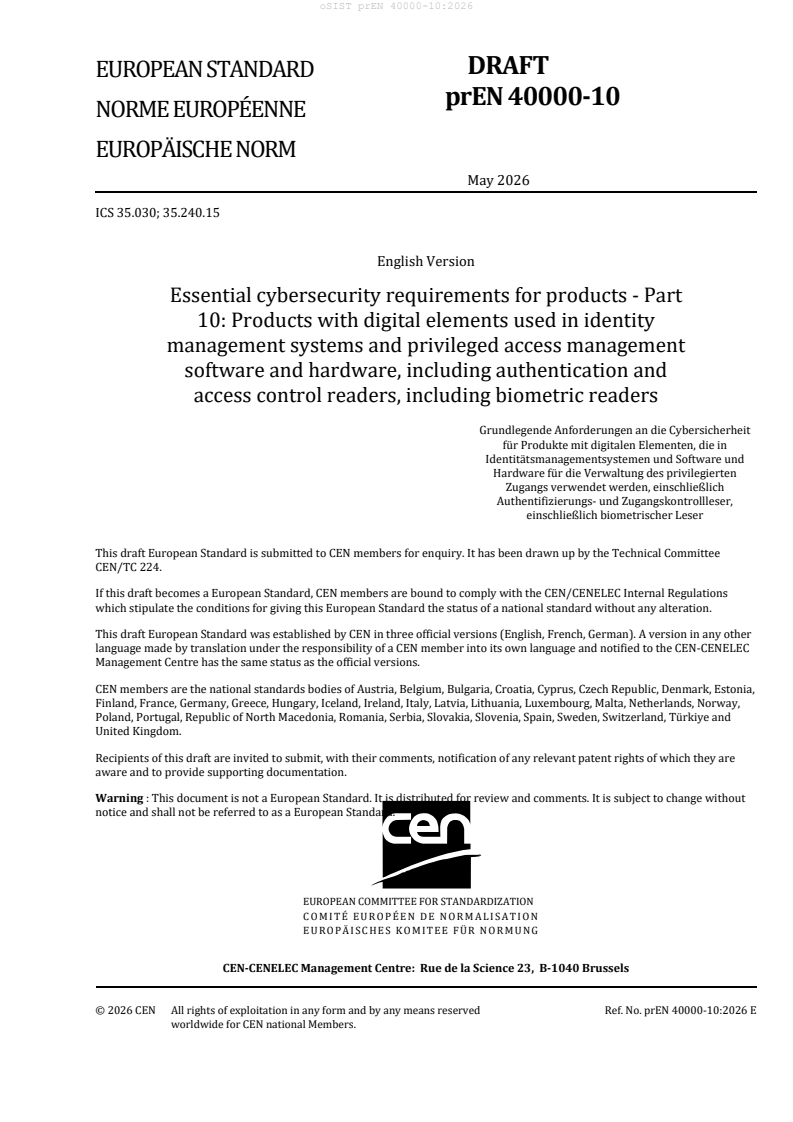

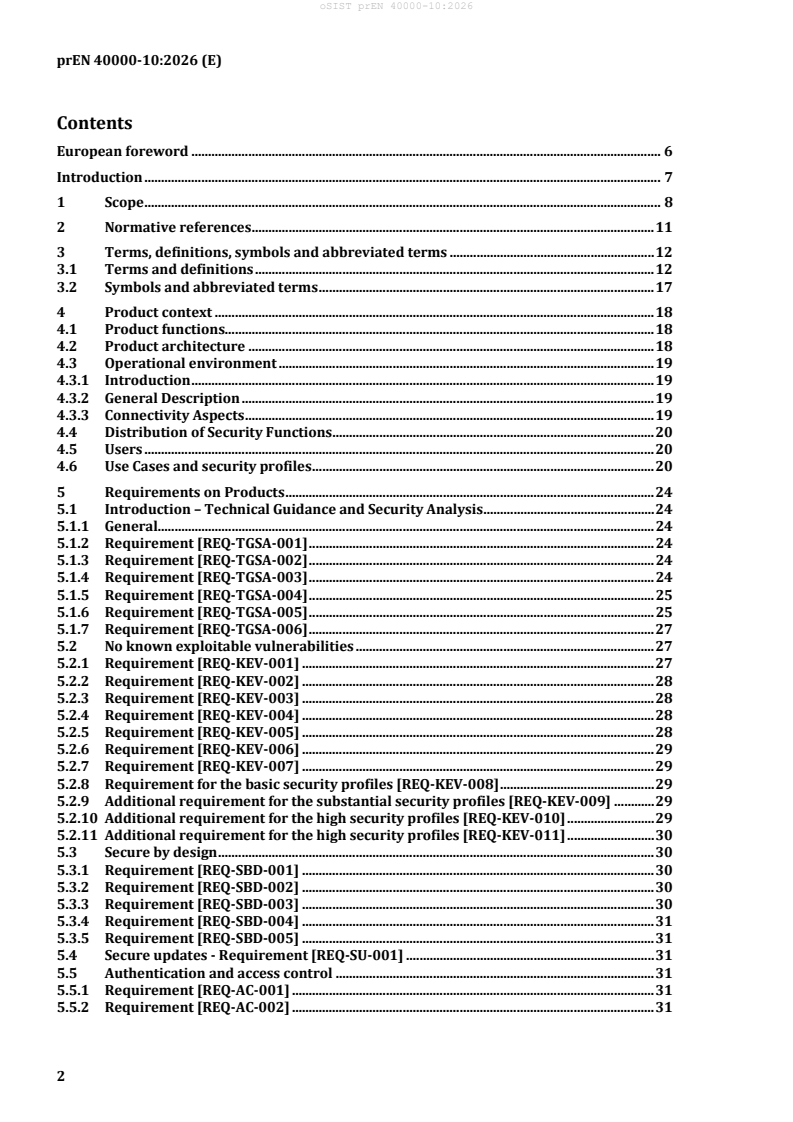
prEN 40000-10 is a draft European Standard from CEN on essential cybersecurity requirements for products with digital elements used in identity management systems and privileged access management software and hardware, including authentication and access control readers and biometric readers. It specifies the product context, security profiles, cybersecurity requirements and assessment rules for manufacturers, integrators, assessors and buyers who need to judge identity, authentication and access-control products.
What does prEN 40000-10 specify?
prEN 40000-10 specifies cybersecurity requirements and associated assessment requirements for products that provide identity management, authentication, authorization, access control or privileged access management. In practice, it is aimed at products whose primary or supporting function is to create, manage, verify, enforce or monitor identities and access rights for natural persons, legal persons, devices or systems.
The scope includes identity lifecycle functions such as registration, provisioning, maintenance, suspension, revocation and deletion, as well as access control functions for digital resources and physical locations. It also includes privileged access management for IT or OT systems and sensitive information, and it explicitly covers product types such as authentication and access control readers, biometric readers, single sign-on software, federated identity management software, one-time password software, hardware authentication devices, and multi-factor authentication software.
The document also names product families that are in scope when their main or supporting role relates to identity and access control, including identity wallets, EUDI Wallet, EU Business Wallet, crypto asset Wallet, digital travel credential, biometric databases, enrolment stations, access control systems, anti-intrusion systems, CCTV, fire safety systems and smart lock products.
Products outside the scope are other important and critical products covered by harmonised standards under the cited standardisation request, such as chip, Embedded OS, Applets, PKI products, cybersecurity products such as VPN and SIEM, and default-classified products such as anti-fire detector products.
| Annex | What it covers |
|---|---|
| C | General architecture and subsystems of a physical access control system (PACS) |
| D | General architecture and subsystems of an Identity Management System (IDMS) |
| F | Security problem definition, rationale, operating environment, assets, threats and security functions |
| G | Product interfaces |
| H | Product communication protocols |
| I | Attacks rating methodology |
| J | Proposed document structure for cryptographic specifications |
| K | Cryptography |
| R | Additional requirements and assessment provisions for remote data processing solutions (RDPS) |
What are the key requirements of prEN 40000-10?
prEN 40000-10 is built around a product-context approach: the manufacturer must describe the product, its architecture, its operational environment, who uses it, and the use cases and security profiles that apply. That matters because identity and access products behave very differently when they are used by a person, a legal person, a system or a physical object, and the document ties requirements to those situations.
Product context and use cases
Clause 4 defines the product functions, architecture, operational environment and distribution of security functions. It also defines user categories and maps representative use cases to security profiles. In practice, this means a vendor must state how the product is used, where security functions sit, and whether a scenario falls under a lower or higher security profile such as SP-2 or SP-3.
Security analysis and known vulnerabilities
Clause 5.1 requires technical guidance and security analysis based on intended purpose and reasonably foreseeable use. Clause 5.2 addresses no known exploitable vulnerabilities, with additional profile-based requirements. Annex I supports this by using an attack-potential method based on factors such as elapsed time, expertise, knowledge of the product, window of opportunity and equipment. For a reader, this means the product must be assessed not only for features, but also for how hard it would be to attack in the real deployment context.
Secure-by-design controls
Clause 5.3 groups the secure-by-design requirements, including controls on authentication and access control, integrity and confidentiality, data minimisation, availability protection, impact minimisation, attack-surface reduction, exploitation mitigation, logging and monitoring, and data removal and transparency. In practical terms, the product is expected to limit exposure, protect sensitive data, record relevant events, and reduce the damage caused if something goes wrong.
Secure updates and vulnerability handling
Clause 5.4 requires a secure update mechanism, including integrity checking and rollback. Clause 5.14 covers vulnerability handling. For operators, this means the product must support safe patching and a defined response to vulnerabilities without breaking the identity or access service.
Cryptography and cryptographic agility
Annex K covers state-of-the-art cryptography and crypto agility, while Annex J gives a structure for documenting key architecture, cryptographic dependencies and the link between security functions and cryptographic mechanisms. This is important because identity and access products often depend on cryptography for authentication, protected sessions, signing, credential handling and device trust.
Assessment and evidence
Clause 6 explains how conformity assessment is done against Clause 5 requirements. It uses Inspection, Analysis, Demonstration and Test (IADT) as the assessment methods, and it requires objective, repeatable evidence. Clause 6 also defines the evidence package around product characterisation, scope, risk and applicability, threat coverage, architecture, cryptography, software composition, test environment, configuration, preconditions, tools, guidance documents and execution evidence. That helps buyers and assessors compare products against the same evidence structure.
Remote data processing solutions
Annex R applies when one or more product functions rely on remote data processing solutions (RDPS). It treats the local product and the RDPS as a combined trust boundary, and it adds requirements for authentication, authorization, integrity, confidentiality, validation and availability across the product-RDPS interface. This matters for cloud-backed identity services and other products that delegate part of their function to remote services.
What terms does prEN 40000-10 define?
- Product with digital elements - A software or hardware product and its remote data processing solutions, including components placed on the market separately.
- Intended purpose - The use the manufacturer assigns to the product, including the conditions and context described in supplied information and technical documentation.
- Reasonably foreseeable use - A use that is not the intended purpose, but is likely to happen through normal human behaviour or technical interaction.
- Security profile - A set of security requirements chosen for a specific level of risk associated with a product with digital elements.
- Security analysis - The process used to understand a risk and determine its level.
- Attack potential - The effort needed to exploit a vulnerability in a product with digital elements.
- Remote data processing - Data processing performed at a distance, under the manufacturer’s design or responsibility, without which the product would not perform one of its functions.
- Use case - A typical usage scenario made from an environment, a user category and a product feature.
Who uses prEN 40000-10?
Manufacturers and developers use prEN 40000-10 to define the product boundary, document use cases, choose the right security profile and design secure identity or access functions. That includes suppliers of identity management systems, privileged access management software, authentication readers, biometric readers, wallets, access control systems and related hardware and software.
Security engineers, product assurance teams and conformity assessment bodies use it to plan and perform assessments, including interface testing, protocol review, attack-potential rating and evidence collection. The document is also relevant to integrators and operators who deploy products in corporate identity systems, physical access control, enrolment stations, building protection systems, border-control scenarios and other authentication or authorization environments.
Buyers, quality managers and procurement teams use it to check whether a product is designed for the intended deployment, whether it supports secure updates, logging, vulnerability handling and cryptography, and whether the supplier has documented the right interfaces, protocols and assessment evidence.
Which standards are used with prEN 40000-10?
- prEN 40000-1-3:2025 - The normative reference for vulnerability handling.
- EN ISO/IEC 15408 series and EN ISO/IEC 18045:2023 - Used in Annex I as the basis for the attack-potential and AVA_VAN methodology.
- EN ISO/IEC 27005:2024 and EN ISO/IEC 27000:2020 - Cited in the defined terms for risk, security analysis and the core security properties of confidentiality, integrity and availability.
What does the prEN 40000-10 document contain?
Clause 4 contains product context material, including product functions, architecture, operational environment, users and use cases. Clause 5 contains the normative cybersecurity requirements, grouped from technical guidance and known vulnerabilities through secure design, updates, access control, confidentiality, data minimisation, logging, transparency and vulnerability handling.
Clause 6 sets out the conformity assessment method and the evidence structure. It uses tables for assessment preparation and evidence tags, and it explains how IADT is applied to requirements in Clause 5. Annex C and Annex D describe the typical architectures of PACS and IDMS, while Annex F frames the security problem, assets, threats and security functions.
Annex G gives representative product interfaces, and Annex H gives representative communication protocols, both tied to conformity requirements. Annex I provides the attack-rating method and its scoring factors. Annex J gives a suggested structure for cryptographic specifications, Annex K covers cryptography requirements, and Annex R adds a full additional framework for products that depend on remote data processing solutions.
Get Certified
Connect with accredited certification bodies for this standard

BSI Group
BSI (British Standards Institution) is the business standards company that helps organizations make excellence a habit.

Bureau Veritas
Bureau Veritas is a world leader in laboratory testing, inspection and certification services.

DNV
DNV is an independent assurance and risk management provider.
Sponsored listings
Frequently Asked Questions
prEN 40000-10 is a draft published by the European Committee for Standardization (CEN). Its full title is "Essential cybersecurity requirements for products - Part 10: Products with digital elements used in identity management systems and privileged access management software and hardware, including authentication and access control readers, including biometric readers". This standard covers: This project aims at covering the line 16 of the standardisation request and will provide: • General description of the Product with digital elements belonging to that category and the product and/or components such Product with digital elements may integrate, including – amongst other: o detailed description of that product category using in: Identity management systems hardware and software are products with digital elements that provide mechanisms for identity lifecycle management, such as identity provisioning, maintenance, authentication, authorisation and deprovisioning, and including associated metadata. Privileged access management hardware and software are products with digital elements that authenticate and authorise users or devices, granting or denying access to digital resources or to physical locations. This category includes but is not limited to products (hardware, software and communication protocol) with digital elements that have the core functionality of either or both identity management and privileged access management; authentication and access control readers; biometric readers; single sign-on software; federated identity management software, protection and safety management (such as access control, intrusion alarm, CCTV and fire safety systems) and multi-factor authentication software. o Intended product purpose and reasonably foreseeable use in the above categories; o Identification of the various types of Products with digital elements; o Delineation and interplay with the following other categories of Product with digital elements (identified by their line in the standardization request): line 17 line 18 line 20 line 24 line 28 line 29 line 32 line 35 line 37 line 38 line 39 line 41 • Description of their life cycle; • Relevance of cybersecurity essential requirements including the cybersecurity assessment requirements; • Definition of applicable risk profiles to be considered for these Product with digital elements; • Applicable cybersecurity requirements ensuring fulfillment of the essential requirements for each risk profile; • Applicable cybersecurity assessment requirements for each risk profile. A base document is provided • Defining the risk profiles; • Identifying initial cybersecurity security requirements.
This project aims at covering the line 16 of the standardisation request and will provide: • General description of the Product with digital elements belonging to that category and the product and/or components such Product with digital elements may integrate, including – amongst other: o detailed description of that product category using in: Identity management systems hardware and software are products with digital elements that provide mechanisms for identity lifecycle management, such as identity provisioning, maintenance, authentication, authorisation and deprovisioning, and including associated metadata. Privileged access management hardware and software are products with digital elements that authenticate and authorise users or devices, granting or denying access to digital resources or to physical locations. This category includes but is not limited to products (hardware, software and communication protocol) with digital elements that have the core functionality of either or both identity management and privileged access management; authentication and access control readers; biometric readers; single sign-on software; federated identity management software, protection and safety management (such as access control, intrusion alarm, CCTV and fire safety systems) and multi-factor authentication software. o Intended product purpose and reasonably foreseeable use in the above categories; o Identification of the various types of Products with digital elements; o Delineation and interplay with the following other categories of Product with digital elements (identified by their line in the standardization request): line 17 line 18 line 20 line 24 line 28 line 29 line 32 line 35 line 37 line 38 line 39 line 41 • Description of their life cycle; • Relevance of cybersecurity essential requirements including the cybersecurity assessment requirements; • Definition of applicable risk profiles to be considered for these Product with digital elements; • Applicable cybersecurity requirements ensuring fulfillment of the essential requirements for each risk profile; • Applicable cybersecurity assessment requirements for each risk profile. A base document is provided • Defining the risk profiles; • Identifying initial cybersecurity security requirements.
prEN 40000-10 is classified under the following ICS (International Classification for Standards) categories: 35.030 - IT Security; 35.240.15 - Identification cards. Chip cards. Biometrics. The ICS classification helps identify the subject area and facilitates finding related standards.
prEN 40000-10 is associated with the following European legislation: EU Directives/Regulations: 2024/2847; Standardization Mandates: M/606. When a standard is cited in the Official Journal of the European Union, products manufactured in conformity with it benefit from a presumption of conformity with the essential requirements of the corresponding EU directive or regulation.
prEN 40000-10 is available in PDF format for immediate download after purchase. The document can be added to your cart and obtained through the secure checkout process. Digital delivery ensures instant access to the complete standard document.
Standards Content (Sample)
Contents
- Introduction
- 1 Scope
- 2 Normative references
- 3 Terms, definitions, symbols and abbreviated terms
- 3.1 Terms and definitions
- 3.1.1 asset
- 3.1.2 authenticity
- 3.1.3 availability
- 3.1.4 confidentiality
- 3.1.5 integrity
- 3.1.6 likelihood
- 3.1.7 remediation
- 3.1.8 residual risk
- 3.1.9 product with digital elements
- 3.1.10 hardware
- 3.1.11 software
- 3.1.12 intended purpose
- 3.1.13 embedded software
- 3.1.14 hardware product with digital elements
- 3.1.15 software product with digital elements
- 3.1.16 electronic information system
- 3.1.17 risk assessment
- 3.1.18 security analysis
- 3.1.19 security profile
- 3.1.20 use case
- 3.1.21 categorisation
- 3.1.22 requirement
- 3.1.23 cybersecurity risk
- 3.1.24 significant cybersecurity risk
- 3.1.25 attack potential
- 3.1.26 attacks rating methodology
- 3.1.27 protocol
- 3.1.28 remote data processing
- 3.1.29 interface
- 3.1.30 reasonably foreseeable use
- 3.1.31 product boundary
- 3.1.32 operational environment
- 3.1.33 assumption
- 3.1.34 firmware
- 3.1.35 core functionality
- 3.1.36 credential
- 3.1.37 cryptographic algorithm
- 3.2 Symbols and abbreviated terms
- 4 Product context
- 4.1 Product functions
- 4.2 Product architecture
- 4.3 Operational environment
- 4.4 Distribution of Security Functions
- 4.5 Users
- 4.6 Use Cases and security profiles
- 5 Requirements on Products
- 5.1 Introduction – Technical Guidance and Security Analysis
- 5.2 No known exploitable vulnerabilities
- 5.3 Secure by design
- 5.4 Secure updates - Requirement [REQ-SU-001]
- 5.5 Authentication and access control
- 5.6 Integrity and Confidentiality
- 5.7 Data minimisation
- 5.8 Availability protection
- 5.9 Impact minimisation
- 5.10 Minimisation of attack surfaces
- 5.11 Exploitation mitigation mechanisms
- 5.12 Logging and monitoring
- 5.13 Data removal and transparency
- 5.14 Vulnerability handling
- 6 Conformity assessment against the normative requirements
- 6.1 Introduction
- 1. Assessment Reference: Identifies the exact requirement ID(s) and related clauses that the
- 3. Assessment Preparation: Describes the test environment, preconditions, tools, and product
- 4. Assessment Activities: Lists the concrete review, testing, and observation steps to be
- 6.2 Conformity assessment against the normative requirements
- 2. Each identified known exploitable vulnerability is mitigated by appropriate technical or
- Annex A
- Annex B
- Annex C
- Annex D
- Annex E
- Annex F
- Annex G
- Annex H
Introduction
This document has been prepared in response to a standardisation request issued by the European Commission in support of the implementation of Regulation (EU) 2024/2847 (Cyber Resilience Act, CRA). The Cyber Resilience Act establishes horizontal cybersecurity requirements for products, including requirements for the design, development and production of such products, as well as obligations for economic operators throughout the lifecycle of those products. In particular, it lays down essential cybersecurity requirements and conformity assessment procedures to ensure a high level of cybersecurity within the Union.
This document specifies cybersecurity requirements and associated assessment provisions for identity management systems that qualify as products and are classified as important products (Class 1) in accordance with Commission Implementing Regulation (EU) 2025/2392. The purpose of this document is to support manufacturers, conformity assessment bodies and other relevant stakeholders in demonstrating conformity with the essential cybersecurity requirements set out in Annex I of the Cyber Resilience Act for the category of products covered by its scope. This document follows a risk-based approach, taking into account the specific characteristics, intended use, and threat landscape applicable to identity management systems, including authentication, authorisation, identity lifecycle management and access control functionalities. It defines relevant risk profiles and maps them to corresponding cybersecurity requirements and assessment methods.
oSIST prEN 40000-10:2026 prEN 40000-10:2026 (E)
1 Scope
This document specifies cybersecurity requirements and associated assessment requirements for identity management systems that qualify as products within the meaning of Regulation (EU) 2024/2847. Such products are classified as important products (class 1) according to the implementing regulation Commission Implementing Regulation (EU) 2025/2392.
Identity management systems are products that provide mechanisms for authentication or authorisation and that may also provide mechanisms for the lifecycle management of identity credentials of natural persons, legal persons, devices or systems, such as identity registration, provisioning, maintenance, deregistration.
These systems include access management systems that control access of natural persons, legal persons, devices or systems to digital resources or physical locations. Privileged access management software is an access management system that controls and monitors access rights to IT or OT systems and sensitive information within an organisation, including systems enforcing differentiated access control policies for privileged users. This category includes but is not limited to authentication and access control readers, biometric readers, single sign-on software, federated identity management software, one-time password software, hardware authentication devices such as transaction authentication number (TAN) generators, authentication software and multi-factor authentication software. This document covers:
- general description of the product belonging to that category and the product and/or components such product with digital elements;
- description of their use case;
- security analysis;
- definition of applicable risk profiles to be considered for these product with digital elements;
- applicable cybersecurity requirements for each risk profile;
- applicable cybersecurity assessment and test requirements for each risk profile. Products within the scope of this document:
The following non-exhaustive categories of products are within the scope of this document where their primary or supporting function relates to identity management, authentication, authorisation, or logical and physical access control to natural persons, legal persons, devices or systems. Logical and Physical Identity lifecycle management Products for:
- identity registration and enrolment;
- credential issuance, provisioning and activation;
- credential maintenance, suspension, revocation and deletion;
- identity wallets and digital credential containers;
- EUDI Wallet, EU Business Wallet;
- crypto asset Wallet;
- digital travel credential;
- middleware enabling the use, validation or verification of identity credentials;
oSIST prEN 40000-10:2026 prEN 40000-10:2026 (E) - national or sectorial identity registries implemented as products; - biometric databases; - enrolment stations; - digital transaction control components; - mobile driving license; - electronic identification products, including systems supporting digital product passport. Logical and Physical Authentication Products for:
- authentication software;
- multi-factor authentication (MFA) systems;
- two-factor authentication (2FA) systems;
- one-time password (OTP) software and hardware tokens;
- online authentication tokens;
- hardware authentication devices;
- single sign-on (SSO) systems;
- federated identity management systems;
- authentication and access control readers;
- biometric readers;
- presentation attack detection (PAD) software;
- identity attack detection (IAD) software;
- biometric matching software;
- automatic border control product;
- entry/exist product;
- ESTIA application.
Logical and Physical Biometric identity management Products for:
- capture biometric data for enrolment purposes;
- perform biometric verification or identification;
- biometric matching;
- remote data processing system of biometric reference data;
- incorporate artificial intelligence components for biometric recognition, verification, identification or fraud detection.
Logical and Physical Access management Products for:
- logical access control systems;
oSIST prEN 40000-10:2026 prEN 40000-10:2026 (E) - physical access control systems; - access control readers and local control units; - access control supervision and monitoring software; - access management supervision systems; - anti-intrusion systems; - CCTV; - smart lock.
Logical and Physical Privileged access management - control and monitor access rights of privileged users; - enforce differentiated access control policies; - manage privileged credentials; - monitor, record and audit privileged sessions; - protect access to critical IT or OT systems and sensitive information. Product not in the scope of this document:
All other important and critical products that are covered by harmonised standards as per the standardisation request Mandate M/606 2025-02-03 such as:
- chip, Embedded OS, Applets;
- PKI products;
- cyber security products needed for securing IT infrastructures (VPN, SIEM….);
- all products that are classified as default such as the anti-fire detectors products.
oSIST prEN 40000-10:2026 prEN 40000-10:2026 (E)
2 Normative references
The following documents are referred to in the text in such a way that some or all of their content constitutes requirements of this document. For dated references, only the edition cited applies. For undated references, the latest edition of the referenced document (including any amendments) applies. prEN 40000-1-3:2025, Cybersecurity requirements for products with digital elements - Part 1-3:
Vulnerability Handling
oSIST prEN 40000-10:2026 prEN 40000-10:2026 (E)
3 Terms, definitions, symbols and abbreviated terms
3.1 Terms and definitions
For the purposes of this document, the following terms and definitions apply. ISO and IEC maintain terminology databases for use in standardisation at the following addresses:
- ISO Online browsing platform: available at https://www.iso.org/obp/
- IEC Electropedia: available at https://www.electropedia.org/
3.1.1 asset
anything that has value to an individual, an organization or a government [SOURCE: ISO/IEC 27035-3:2020, 3.1]
3.1.2 authenticity
property that an entity is what it claims to be [SOURCE: EN ISO/IEC 27000:2020, 3.6]
3.1.3 availability
property of being accessible and usable on demand by an authorized entity [SOURCE: EN ISO/IEC 27000:2020, 3.7]
3.1.4 confidentiality
property that information is not made available or disclosed to unauthorized individuals, entities, or processes [SOURCE: EN ISO/IEC 27000:2020, 3.10]
3.1.5 integrity
property of accuracy and completeness [SOURCE: EN ISO/IEC 27000:2020, 3.36]
3.1.6 likelihood
chance of something happening Note 1 to entry: In risk management terminology, the word “likelihood” is used to refer to the chance of something happening, whether defined, measured or determined objectively or subjectively, qualitatively or quantitatively, and described using general terms or mathematically (such as a probability or a frequency over a given time period).
Note 2 to entry: The English term “likelihood” does not have a direct equivalent in some languages; instead, the equivalent of the term “probability” is often used. However, in English, “probability” is often narrowly interpreted as a mathematical term. Therefore, in risk management terminology, “likelihood” is used with the intent that it should have the same broad interpretation as the term “probability” has in many languages other than English. [SOURCE: ISO 31000:2018, 3.7]
oSIST prEN 40000-10:2026 prEN 40000-10:2026 (E)
3.1.7 remediation
change made to a product or service to remove or mitigate a vulnerability Note 1 to entry: A remediation typically takes the form of a binary file replacement, configuration change, or source code patch and recompile. Different terms used for “remediation” include patch, fix, update, hotfix, and upgrade. Mitigations are also called workarounds or countermeasures. [SOURCE: EN ISO/IEC 29147:2020, 3.7]
3.1.8 residual risk
cybersecurity risk remaining after risk treatment [SOURCE: EN ISO/IEC 27000:2020, 3.57]
3.1.9 product with digital elements
(hereinafter called “product”) software or hardware product and its remote data processing solutions, including software or hardware components being placed on the market separately [SOURCE: CRA, Article 3(1)]
3.1.10 hardware
physical electronic information system, or parts thereof capable of processing, storing or transmitting digital data [SOURCE: CRA, Article 3(5)]
3.1.11 software
part of an electronic information system which consists of computer code [SOURCE: CRA, Article 3(4)]
3.1.12 intended purpose
use for which a product with digital elements is intended by the manufacturer, including the specific context and conditions of use, as specified in the information supplied by the manufacturer in the instructions for use, promotional or sales materials and statements, as well as in the technical documentation [SOURCE: CRA, Article 3(23)]
3.1.13 embedded software
software product with digital elements loaded in a hardware Product with digital element, and in which it is executed
Note 1 to entry: an embedded software is a sub part of a hardware Product with digital elements
3.1.14 hardware product with digital elements
product with digital elements that have the shape of a hardware Note 1 to entry: hardware Product with digital elements are tangible
Note 2 to entry: a hardware Product with digital element can be the environment on which a software Product with digital element is executed and optionally loaded.
oSIST prEN 40000-10:2026 prEN 40000-10:2026 (E)
3.1.15 software product with digital elements
sequence or set of instructions in a programming language which can be executed on a hardware and/or a software environment
Note 1 to entry: Software product with digital elements are intangible.
Note 2 to entry: A set of data is not a software product with digital elements.
Note 3 to entry: The hardware environment is a hardware product with digital elements, and the software environment is a software product with digital elements.
Note 4 to entry: A software product with digital elements is not necessarily loaded in the hardware or software environment on which it is executed.
Note 5 to entry: A software product with digital elements loaded in a hardware product with digital elements and in which it is executed is an embedded software. The combination of both is another hardware product with digital elements and is thus tangible
3.1.16 electronic information system
system including electrical or electronic equipment, capable of processing, storing or transmitting digital data [SOURCE: CRA, Article 3(7)]
3.1.17 risk assessment
overall process of risk identification, risk analysis and risk evaluation
[SOURCE: ISO 31073:2022, 3.3.8]
3.1.18 security analysis
process used to understand the nature of a risk and to determine the level of risk
[SOURCE: EN ISO/IEC 27005:2024, 3.2.5]
3.1.19 security profile
set of security requirements defined to address a specific level of risk associated with a product with digital elements
3.1.20 use case
combination of an environment, a user category and a product feature, used to describe a typical usage scenario.
3.1.21 categorisation
process of assigning a product with digital elements to a defined category, hardware or software based on its primary characteristics and intended function
oSIST prEN 40000-10:2026 prEN 40000-10:2026 (E)
3.1.22 requirement
need or expectation that is stated, generally implied or obligatory
Note 1 to entry: “Generally implied” means that it is custom or common practice for the organization and interested parties that the need or expectation under consideration is implied.
[SOURCE: ISO 24518:2015, 3.1.3]
3.1.23 cybersecurity risk
potential for loss or disruption caused by an incident and is to be expressed as a combination of the magnitude of such loss or disruption and the likelihood of occurrence of the incident [SOURCE: CRA, Article 3(37)]
3.1.24 significant cybersecurity risk
cybersecurity risk which, based on its technical characteristics, can be assumed to have a high likelihood of an incident that could lead to a severe negative impact, including by causing considerable material or non-material loss or disruption [SOURCE: CRA, Article 3(38)]
3.1.25 attack potential
measure of the effort needed to exploit a vulnerability in a Product with digital elements
Note 1 to entry: The attack potential usually decreases over time, as expertise, knowledge and capabilities of attacker willing to exploit that vulnerability increases.
[SOURCE: EN ISO/IEC 15408-1:2023, 3.8]
3.1.26 attacks rating methodology
methodology quantifying the attack potential of a vulnerability
Note 1 to entry: Common Criteria methodology as defined in EN ISO/IEC 15408 (series) and EN ISO/IEC 18045:2023 proposes a methodology considering the difficulty to (1) identify and (2) exploit a vulnerability.
3.1.27 protocol
set of rules and conventions for the exchange of information between peer entities within a layer
[SOURCE: EN ISO/IEC 7498-1:1995, 3.3.23]
3.1.28 remote data processing
data processing at a distance for which the software is designed and developed by the manufacturer, or under the responsibility of the manufacturer, and the absence of which would prevent the Product with digital elements from performing one of its functions
[SOURCE: CRA, Article 3(2)]
oSIST prEN 40000-10:2026 prEN 40000-10:2026 (E)
3.1.29 interface
shared boundary between two functional units, defined by various characteristics pertaining to the functions, physical interconnections, signal exchanges, and other characteristics of the units, as appropriate [SOURCE: ISO/IEC 2382:2015]
3.1.30 reasonably foreseeable use
use that is not necessarily the Intended purpose supplied by the manufacturer in the instructions for use, promotional or sales materials and statements, as well as in the technical documentation, but which is likely to result from reasonably foreseeable human behaviour or technical operations or interactions
[SOURCE: CRA, Article 3(24)]
3.1.31 product boundary
conceptual interface between a product with digital elements and its environment
[SOURCE: ISO/IEC/IEEE 24748-7000:2022, 3.1.65 – “system” has been replaced with “Product with digital elements”]
3.1.32 operational environment
environment in which the product with digital elements is operated, i.e. the system of which it is part, the location where it is placed, the persons operating and using it and the entities communicating with it
[SOURCE: ISO 13491-1:2024, 3.15 – “secure cryptographic device” has been replaced with “Product with digital elements”]
3.1.33 assumption
condition that is accepted as true
[SOURCE: ISO/TR 19669:2017, 3.3]
3.1.34 firmware
ordered set of instructions and associated data stored in a way that is functionally independent of main storage, usually in a ROM
[SOURCE: ISO/IEC 2382:2015, 2121279]
3.1.35 core functionality
capabilities of the various computational, user interface, input, output, data management, and other features provided by a product
3.1.36 credential
evidence or testimonials that support a claim of identity or assertion of an attribute and usually are intended to be used more than once
[SOURCE: NIST - CNSSI 4009-2015]
oSIST prEN 40000-10:2026 prEN 40000-10:2026 (E)
3.1.37 cryptographic algorithm
sequence of instructions based on mathematical properties to protect confidentiality, integrity or authenticity against attacks
Note 1 to entry: Cryptographic algorithms describe cryptographic protocols/schemes/constructors/ atomic primitives such as TLS/ Symmetric Entity Authentication Schemes/AES-128 as part of a CMAC/AES-256
3.2 Symbols and abbreviated terms
ACL Access Control List AEAD Authenticated Encryption with Associated Data API Application Programming Interface APN Access Point Name BLE Bluetooth Low Energy CAM Centralised Access Management CI/CD Continuous Integration/Continuous Delivery CVE Common Vulnerabilities and Exposures CWE Common Weakness Enumeration DR Disaster Recovery EBIOS RM is the method for assessing and treating digital risks published by National Cybersecurity Agency of France (ANSSI) with the support of Club EBIOS EUDI EUropean Digital Identity wallet HTTP Hyper-Text Transfer Protocol IDMS IDentity Management Systems IP Internet Protocol ISMS Information Security Management System MFA Multi-Factor Authentication NFC Near Field Communication ONVIF Open Network Video Interface Forum OSDP Open Supervised Device Protocol PAD Presentation Attacks Detection PCAP Packet CAPture PIN Personal Identification Number PKI Public-Key Infrastructure PoC Proof of Concept RBAC Role-Based Access Control RDPS Remote Data Processing Solution RTSP Real-Time Streaming Protocol SAST/DAST Static/Dynamic Application Security Testing SBOM Software Bill Of Materials SIEM Security Information and Event Management SIM Subscriber Identity Module SLA Service Level Agreement SMS Short Message Service SOAR Security Orchestration, Automation and Response SoD Segregation of Duties SSCP Smart and Secure Communication Protocol SSDLC Secure Software Development Life Cycle STRIDE Spoofing, Tampering, Repudiation, Information disclosure, Denial of service, and Elevation of privilege TLS Transport Layer Security UID Unique Identifier
oSIST prEN 40000-10:2026 prEN 40000-10:2026 (E)
...