

prEN 14163
(Main)Petroleum and natural gas industries - Pipeline transportation systems - Welding of pipelines (ISO 13847:2013, modified)
- Abstract
This document specifies requirements for the petroleum, petrochemical and natural gas industries, for producing and inspecting girth, branch and fillet welds in the pipeline part of pipeline transportation systems which meet the requirements of ISO 13623:2017 or equivalent.
NOTE 1 ISO 13847:2013 refers to the requirements of ISO 13623:2009 or equivalent. At the time of publication of this document, ISO 13623:2009 is superseded by ISO 13623:2017 and reference is made to this edition of ISO 13623 throughout this document. ISO 13623 is modified adopted as EN 14161 to exclude on-land supply systems used by the European gas supply industry from the input of gas into the on-land transmission network up to the inlet connection of gas appliances.
This document is applicable to the requirements for welding of carbon and low-alloy steel pipes, and includes guidance for the welding of corrosion-resistant alloy (CRA) and CRA-clad pipelines in Annex A. Application is restricted to pipes with a diameter of 20 mm or more and a wall thickness of 3 mm or more, a specified minimum yield strength of 555 MPa or less, and which are designed not to exceed permissible equivalent stresses as defined in ISO 13623:2017 or equivalent. It is also applicable to welding into pipelines of items such as spools, risers, launchers/receivers, fittings, flanges and pup pieces to pipeline valves. On-land supply systems used by the European gas supply industry from the input of gas into the on-land transmission network up to the inlet connection of gas appliances are excluded from the scope of this document.
Guidance for special welding applications is provided in:
- Annex B for hyperbaric welding;
- Annex C for brazing and aluminothermic welding of anode leads;
- Annex D for branch and fillet welding on in-service pipelines.
The welding processes covered are shielded metal arc welding (SMAW), gas tungsten arc welding (GTAW), gas metal arc welding (GMAW), gas-shielded flux-cored arc welding (GSFCAW), self-shielded flux-cored arc welding (SSFCAW) and submerged arc welding (SAW).
This document is not applicable to flash girth welding, resistance welding, solid-phase welding or other one-shot welding processes, nor to longitudinal welds in pipe or fittings or to the welding of process piping outside the scope of ISO 13623:2017.
NOTE 2 Additional requirements might be necessary for the welding of pipeline for particular pipeline operating conditions, for pipelines with a specified yield strength exceeding 555 MPa and for pipelines designed to permissible strain criteria. These can include limitations on maximum hardness or strength, minimum impact toughness values, crack tip-opening displacement, all weld metal tensile testing or bend testing, thermal stress relief, or others. Where appropriate, it is advisable that these additional requirements be added to the requirements of this document in a project-specific supplement.
NOTE 3 Annex E specifies additional requirements for the welding of onshore gas supply systems applicable only when located in European member states. Annex F specifies additional requirements for the welding of gas distribution systems applicable only when located in European member states. It is the responsibility of the company to specify the normative applicability of these annexes.
- Status
- Not Published
- Publication Date
- 06-Feb-2023
- Current Stage
- 4098 - Decision to abandon - Enquiry
- Start Date
- 23-Mar-2026
- Completion Date
- 07-Oct-2026

Overview
prEN 14163:2021 is a modified adoption of ISO 13847:2013 developed by the European Committee for Standardization (CEN) focusing on the welding of pipelines in the petroleum, petrochemical, and natural gas industries. This standard applies to pipeline transportation systems that comply with ISO 13623:2017 or equivalent. It sets out the specifications for producing and inspecting girth, branch, and fillet welds on pipelines made primarily from carbon and low-alloy steels, with additional guidance for corrosion-resistant alloy (CRA) welds.
The scope includes pipelines with diameters of 20 mm or more and wall thicknesses of at least 3 mm, designed with a specified minimum yield strength up to 555 MPa. The standard also covers associated pipeline components such as spools, risers, launchers, receivers, fittings, flanges, and pipeline valves. Notably, it excludes on-land supply systems in European gas distribution networks from the input up to the inlet connection of gas appliances.
Key Topics
Welding Processes Covered
- Shielded Metal Arc Welding (SMAW)
- Gas Tungsten Arc Welding (GTAW)
- Gas Metal Arc Welding (GMAW)
- Gas-Shielded Flux-Cored Arc Welding (GSFCAW)
- Self-Shielded Flux-Cored Arc Welding (SSFCAW)
- Submerged Arc Welding (SAW)
Excluded Welding Methods
- Flash Girth Welding
- Resistance Welding
- Solid-Phase Welding
- Longitudinal Welds in Pipes and Fittings
Annex Guidance for Special Welding Applications
- Annex A: Welding of Corrosion-Resistant Alloy (CRA) and CRA-clad Pipelines
- Annex B: Hyperbaric Welding
- Annex C: Brazing and Aluminothermic Welding of Anode Leads
- Annex D: Branch and Fillet Welding on In-Service Pipelines
- Annex E & F: Additional Requirements for European Onshore Gas Supply and Distribution Systems
Inspection and Testing Requirements
- Non-destructive Testing (NDT) including radiographic, ultrasonic, magnetic particle, and liquid penetrant testing
- Destructive Testing for weld qualification such as tensile and bend testing
- Welding Procedure Specification (WPS) qualification and welder approvals
Weld Production and Documentation
- Guidelines on equipment, preheating, arc strikes, welding positions, and shielding gases
- Requirements for post-weld heat treatment and weld records
Material and Design Limitations
- Applicable to carbon and low-alloy steels within specified strength limits
- Emphasis on compliance with permissible equivalent stresses as defined in ISO 13623:2017
Applications
prEN 14163 serves as a comprehensive framework for welding activities in pipeline transportation systems within the petroleum and natural gas sectors. Key applications include:
Pipeline Construction and Maintenance
Ensuring the structural integrity and reliability of pipeline girth welds, branch connections, and associated fittings.Welding Quality Assurance
Standardizing welding procedures and welder qualifications to achieve consistent and defect-free welds in pipelines operating under various conditions.Inspection and Testing
Implementing rigorous inspection protocols including NDT and destructive testing to detect and address weld defects early in the fabrication process.Corrosion-Resistant Alloy Pipelines
Specialized guidelines for welding pipelines that require corrosion resistance, critical in harsh or chemically aggressive environments.European Gas Supply Infrastructure
Supporting compliance with specific regional requirements in gas transmission and distribution networks, particularly within European member states.
Related Standards
ISO 13623:2017 - Petroleum and natural gas industries - Pipeline transportation systems - This forms the primary design framework referenced and modified within prEN 14163 for pipeline transport systems.
ISO 13847:2013 - The base standard adapted in prEN 14163 for pipeline welding practices and procedures, originally referencing ISO 13623:2009 but updated to align with the 2017 edition.
EN 14161 - Modifies ISO 13623 to exclude on-land supply systems; complements welding standards for pipelines used in the European gas supply industry.
Standards on Welding Processes and NDT Methods - Various standards govern welding equipment, NDT procedures, and material testing contributing to the overall compliance environment for pipeline welding in the industry.
By adhering to prEN 14163, companies in the petroleum and natural gas sectors can achieve high-quality, safe, and reliable pipeline transportation welding outcomes tailored to meet rigorous international and European criteria. This standard offers detailed guidance from welding procedure development to production and testing, ensuring pipelines meet the demanding operational and safety requirements of modern energy infrastructure.
Relations
- Effective Date
- 18-Jan-2023
Get Certified
Connect with accredited certification bodies for this standard

DVS-ZERT GmbH
German welding certification society.

Element Materials Technology
Materials testing and product certification.
ABS Group Brazil
ABS Group certification services in Brazil.
Sponsored listings
Frequently Asked Questions
prEN 14163 is a draft published by the European Committee for Standardization (CEN). Its full title is "Petroleum and natural gas industries - Pipeline transportation systems - Welding of pipelines (ISO 13847:2013, modified)". This standard covers: This document specifies requirements for the petroleum, petrochemical and natural gas industries, for producing and inspecting girth, branch and fillet welds in the pipeline part of pipeline transportation systems which meet the requirements of ISO 13623:2017 or equivalent. NOTE 1 ISO 13847:2013 refers to the requirements of ISO 13623:2009 or equivalent. At the time of publication of this document, ISO 13623:2009 is superseded by ISO 13623:2017 and reference is made to this edition of ISO 13623 throughout this document. ISO 13623 is modified adopted as EN 14161 to exclude on-land supply systems used by the European gas supply industry from the input of gas into the on-land transmission network up to the inlet connection of gas appliances. This document is applicable to the requirements for welding of carbon and low-alloy steel pipes, and includes guidance for the welding of corrosion-resistant alloy (CRA) and CRA-clad pipelines in Annex A. Application is restricted to pipes with a diameter of 20 mm or more and a wall thickness of 3 mm or more, a specified minimum yield strength of 555 MPa or less, and which are designed not to exceed permissible equivalent stresses as defined in ISO 13623:2017 or equivalent. It is also applicable to welding into pipelines of items such as spools, risers, launchers/receivers, fittings, flanges and pup pieces to pipeline valves. On-land supply systems used by the European gas supply industry from the input of gas into the on-land transmission network up to the inlet connection of gas appliances are excluded from the scope of this document. Guidance for special welding applications is provided in: - Annex B for hyperbaric welding; - Annex C for brazing and aluminothermic welding of anode leads; - Annex D for branch and fillet welding on in-service pipelines. The welding processes covered are shielded metal arc welding (SMAW), gas tungsten arc welding (GTAW), gas metal arc welding (GMAW), gas-shielded flux-cored arc welding (GSFCAW), self-shielded flux-cored arc welding (SSFCAW) and submerged arc welding (SAW). This document is not applicable to flash girth welding, resistance welding, solid-phase welding or other one-shot welding processes, nor to longitudinal welds in pipe or fittings or to the welding of process piping outside the scope of ISO 13623:2017. NOTE 2 Additional requirements might be necessary for the welding of pipeline for particular pipeline operating conditions, for pipelines with a specified yield strength exceeding 555 MPa and for pipelines designed to permissible strain criteria. These can include limitations on maximum hardness or strength, minimum impact toughness values, crack tip-opening displacement, all weld metal tensile testing or bend testing, thermal stress relief, or others. Where appropriate, it is advisable that these additional requirements be added to the requirements of this document in a project-specific supplement. NOTE 3 Annex E specifies additional requirements for the welding of onshore gas supply systems applicable only when located in European member states. Annex F specifies additional requirements for the welding of gas distribution systems applicable only when located in European member states. It is the responsibility of the company to specify the normative applicability of these annexes.
This document specifies requirements for the petroleum, petrochemical and natural gas industries, for producing and inspecting girth, branch and fillet welds in the pipeline part of pipeline transportation systems which meet the requirements of ISO 13623:2017 or equivalent. NOTE 1 ISO 13847:2013 refers to the requirements of ISO 13623:2009 or equivalent. At the time of publication of this document, ISO 13623:2009 is superseded by ISO 13623:2017 and reference is made to this edition of ISO 13623 throughout this document. ISO 13623 is modified adopted as EN 14161 to exclude on-land supply systems used by the European gas supply industry from the input of gas into the on-land transmission network up to the inlet connection of gas appliances. This document is applicable to the requirements for welding of carbon and low-alloy steel pipes, and includes guidance for the welding of corrosion-resistant alloy (CRA) and CRA-clad pipelines in Annex A. Application is restricted to pipes with a diameter of 20 mm or more and a wall thickness of 3 mm or more, a specified minimum yield strength of 555 MPa or less, and which are designed not to exceed permissible equivalent stresses as defined in ISO 13623:2017 or equivalent. It is also applicable to welding into pipelines of items such as spools, risers, launchers/receivers, fittings, flanges and pup pieces to pipeline valves. On-land supply systems used by the European gas supply industry from the input of gas into the on-land transmission network up to the inlet connection of gas appliances are excluded from the scope of this document. Guidance for special welding applications is provided in: - Annex B for hyperbaric welding; - Annex C for brazing and aluminothermic welding of anode leads; - Annex D for branch and fillet welding on in-service pipelines. The welding processes covered are shielded metal arc welding (SMAW), gas tungsten arc welding (GTAW), gas metal arc welding (GMAW), gas-shielded flux-cored arc welding (GSFCAW), self-shielded flux-cored arc welding (SSFCAW) and submerged arc welding (SAW). This document is not applicable to flash girth welding, resistance welding, solid-phase welding or other one-shot welding processes, nor to longitudinal welds in pipe or fittings or to the welding of process piping outside the scope of ISO 13623:2017. NOTE 2 Additional requirements might be necessary for the welding of pipeline for particular pipeline operating conditions, for pipelines with a specified yield strength exceeding 555 MPa and for pipelines designed to permissible strain criteria. These can include limitations on maximum hardness or strength, minimum impact toughness values, crack tip-opening displacement, all weld metal tensile testing or bend testing, thermal stress relief, or others. Where appropriate, it is advisable that these additional requirements be added to the requirements of this document in a project-specific supplement. NOTE 3 Annex E specifies additional requirements for the welding of onshore gas supply systems applicable only when located in European member states. Annex F specifies additional requirements for the welding of gas distribution systems applicable only when located in European member states. It is the responsibility of the company to specify the normative applicability of these annexes.
prEN 14163 is classified under the following ICS (International Classification for Standards) categories: 25.160.10 - Welding processes; 75.200 - Petroleum products and natural gas handling equipment. The ICS classification helps identify the subject area and facilitates finding related standards.
prEN 14163 has the following relationships with other standards: It is inter standard links to EN 14163:2001. Understanding these relationships helps ensure you are using the most current and applicable version of the standard.
prEN 14163 is available in PDF format for immediate download after purchase. The document can be added to your cart and obtained through the secure checkout process. Digital delivery ensures instant access to the complete standard document.
Standards Content (Sample)
SLOVENSKI STANDARD
01-september-2021
Industrija za predelavo nafte in zemeljskega plina - Transportni cevovodni sistemi
- Varjenje cevovodov (ISO 13847:2013, spremenjen)
Petroleum and natural gas industries - Pipeline transportation systems - Welding of
pipelines (ISO 13847:2013, modified)
Erdöl- und Erdgasindustrie - Pipeline-Transportsysteme - Schweißen von Pipelines (ISO
13847:2013, modifiziert)
Industries du pétrole et du gaz naturel - Systèmes de transport par conduites - Soudage
des conduites (ISO 13847:2013 modifiée)
Ta slovenski standard je istoveten z: prEN 14163
ICS:
25.160.10 Varilni postopki in varjenje Welding processes
75.200 Oprema za skladiščenje Petroleum products and
nafte, naftnih proizvodov in natural gas handling
zemeljskega plina equipment
2003-01.Slovenski inštitut za standardizacijo. Razmnoževanje celote ali delov tega standarda ni dovoljeno.
DRAFT
EUROPEAN STANDARD
NORME EUROPÉENNE
EUROPÄISCHE NORM
July 2021
ICS 25.160.10; 75.200 Will supersede EN 14163:2001
English Version
Petroleum and natural gas industries - Pipeline
transportation systems - Welding of pipelines (ISO
13847:2013, modified)
Industries du pétrole et du gaz naturel - Systèmes de Erdöl- und Erdgasindustrie - Pipeline-
transport par conduites - Soudage des conduites (ISO Transportsysteme - Schweißen von Pipelines (ISO
13847:2013 modifiée) 13847:2013, modifiziert)
This draft European Standard is submitted to CEN members for enquiry. It has been drawn up by the Technical Committee
CEN/TC 12.
If this draft becomes a European Standard, CEN members are bound to comply with the CEN/CENELEC Internal Regulations
which stipulate the conditions for giving this European Standard the status of a national standard without any alteration.
This draft European Standard was established by CEN in three official versions (English, French, German). A version in any other
language made by translation under the responsibility of a CEN member into its own language and notified to the CEN-CENELEC
Management Centre has the same status as the official versions.
CEN members are the national standards bodies of Austria, Belgium, Bulgaria, Croatia, Cyprus, Czech Republic, Denmark, Estonia,
Finland, France, Germany, Greece, Hungary, Iceland, Ireland, Italy, Latvia, Lithuania, Luxembourg, Malta, Netherlands, Norway,
Poland, Portugal, Republic of North Macedonia, Romania, Serbia, Slovakia, Slovenia, Spain, Sweden, Switzerland, Turkey and
United Kingdom.
Recipients of this draft are invited to submit, with their comments, notification of any relevant patent rights of which they are
aware and to provide supporting documentation.
Warning : This document is not a European Standard. It is distributed for review and comments. It is subject to change without
notice and shall not be referred to as a European Standard.
EUROPEAN COMMITTEE FOR STANDARDIZATION
COMITÉ EUROPÉEN DE NORMALISATION
EUROPÄISCHES KOMITEE FÜR NORMUNG
CEN-CENELEC Management Centre: Rue de la Science 23, B-1040 Brussels
© 2021 CEN All rights of exploitation in any form and by any means reserved Ref. No. prEN 14163:2021 E
worldwide for CEN national Members.
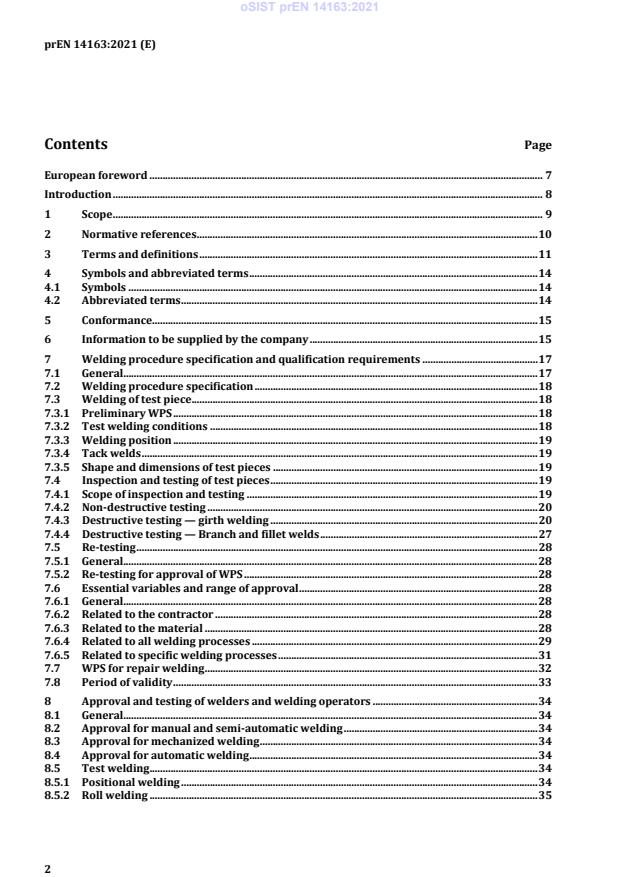
Contents Page
European foreword . 7
Introduction . 8
1 Scope . 9
2 Normative references . 10
3 Terms and definitions . 11
4 Symbols and abbreviated terms . 14
4.1 Symbols . 14
4.2 Abbreviated terms . 14
5 Conformance . 15
6 Information to be supplied by the company . 15
7 Welding procedure specification and qualification requirements . 17
7.1 General. 17
7.2 Welding procedure specification . 18
7.3 Welding of test piece . 18
7.3.1 Preliminary WPS . 18
7.3.2 Test welding conditions . 18
7.3.3 Welding position . 19
7.3.4 Tack welds . 19
7.3.5 Shape and dimensions of test pieces . 19
7.4 Inspection and testing of test pieces . 19
7.4.1 Scope of inspection and testing . 19
7.4.2 Non-destructive testing . 20
7.4.3 Destructive testing — girth welding . 20
7.4.4 Destructive testing — Branch and fillet welds . 27
7.5 Re-testing . 28
7.5.1 General. 28
7.5.2 Re-testing for approval of WPS . 28
7.6 Essential variables and range of approval . 28
7.6.1 General. 28
7.6.2 Related to the contractor . 28
7.6.3 Related to the material . 28
7.6.4 Related to all welding processes . 29
7.6.5 Related to specific welding processes . 31
7.7 WPS for repair welding . 32
7.8 Period of validity . 33
8 Approval and testing of welders and welding operators . 34
8.1 General. 34
8.2 Approval for manual and semi-automatic welding . 34
8.3 Approval for mechanized welding . 34
8.4 Approval for automatic welding . 34
8.5 Test welding . 34
8.5.1 Positional welding . 34
8.5.2 Roll welding . 35
8.6 Inspection and testing of test welds. 35
8.6.1 Non-destructive testing . 35
8.6.2 Destructive testing . 35
8.7 Re-testing . 36
8.8 Range of approval . 36
8.9 Records . 37
8.10 Period of validity. 37
9 Production welding . 37
9.1 General . 37
9.2 Equipment . 37
9.3 Working clearance . 38
9.4 Weather conditions. 38
9.5 Pipe end preparation . 38
9.6 Support . 38
9.7 Line-up . 38
9.8 Tack welding . 39
9.9 Earthing or grounding . 39
9.10 Electrodes and filler materials . 39
9.11 Shielding gases . 40
9.12 Preheating . 40
9.13 Arc strikes . 40
9.14 Backing . 41
9.15 Internal weld bead . 41
9.16 Weld metal deposition . 41
9.16.1 Girth welding . 41
9.16.2 Other welding. 41
9.17 Weld cleaning and peening . 41
9.18 Partially completed welds . 41
9.19 Post-weld heat treatment . 42
9.19.1 General . 42
9.19.2 Methods of heat treatment . 42
9.19.3 Post-weld heat-treatment procedure . 42
9.20 Pipe and weld record . 43
10 Non-destructive testing . 43
10.1 General . 43
10.2 NDT personnel . 43
10.3 NDT procedure approval . 43
10.4 Visual examination . 43
10.5 Radiographic testing . 44
10.5.1 Technique . 44
10.5.2 Procedure . 44
10.5.3 Procedure approval testing . 45
10.5.4 Information on radiograph . 45
10.5.5 Weld coverage . 45
10.5.6 Intensifying screens . 45
10.5.7 Radiographic density . 46
10.5.8 Film storage . 46
10.5.9 Radiographic images obscured by buckle-detector cable . 46
10.6 Ultrasonic testing . 46
10.6.1 Procedure . 46
10.6.2 Equipment . 46
10.6.3 Calibration and construction of reference curve . 46
10.6.4 Manual ultrasonic testing . 47
10.6.5 Mechanized testing . 47
10.6.6 Evaluation of indications . 47
10.7 Magnetic particle testing . 47
10.8 Liquid penetrant testing . 48
10.9 NDT report. 48
11 Acceptance criteria for non-destructive testing . 48
11.1 General. 48
11.2 Right of rejection . 49
11.3 Visual testing . 49
11.3.1 Weld profile . 49
11.3.2 Undercut . 49
11.4 Radiographic testing . 49
11.4.1 Lack of penetration . 49
11.4.2 Lack of fusion . 49
11.4.3 Root concavity . 50
11.4.4 Burn-through . 50
11.4.5 Inclusions . 50
11.4.6 Porosity . 51
11.4.7 Cracks . 51
11.4.8 Undercut . 51
11.4.9 Accumulation of discontinuities . 51
11.5 Ultrasonic testing . 52
11.5.1 General. 52
11.5.2 Spherical porosity . 52
11.5.3 Linear indications . 52
11.6 Surface testing . 52
11.6.1 Classification of indications . 52
11.6.2 Acceptance criteria. 52
11.7 Discontinuities in pipe or fittings . 53
11.8 Acceptance criteria — ECA . 53
12 Repair and removal of defects . 53
12.1 General. 53
12.2 Authorization for repair . 53
12.3 Multiple repairs . 53
12.4 Defect removal and preparation for repair . 53
13 Documentation . 54
Annex A (informative) Special requirements for welding of CRA pipelines and CRA-clad
steel pipelines . 55
A.1 General. 55
A.2 Specification and approval of welding procedure . 55
A.3 Production welding . 55
A.4 Procedure for non-destructive testing . 56
A.5 Acceptance criteria for non-destructive testing . 56
A.6 Repair and removal of defects . 56
Annex B (informative) Hyperbaric welding . 57
B.1 General. 57
B.2 WPS approval . 57
B.3 Welder approval. 57
B.4 Production welding . 58
B.5 Inspection and testing . 58
Annex C (informative) Recommendations for brazing and aluminothermic welding of
anode leads . 59
C.1 Joining technique . 59
C.2 Specification and approval of procedure . 59
C.2.1 General . 59
C.2.2 Copper penetration measurement . 59
C.2.3 Hardness survey . 59
Annex D (informative) Branch and fillet welding on in-service pipelines . 60
D.1 General . 60
D.2 General recommendations . 60
D.3 Specification, testing and approval of WPS . 61
D.3.1 Procedure specification . 61
D.3.2 Essential variables . 61
D.3.3 Welding of test pieces . 61
D.3.4 Inspection and testing of test pieces . 61
D.4 Testing and approval of welders . 65
D.5 Production welding . 65
D.5.1 Safety . 65
D.5.2 Inspection of in-service pipe . 65
D.5.3 Use of approved WPS and welders . 65
D.5.4 Supervision . 65
D.5.5 Weld testing . 66
Annex E (informative) Welding of European onshore natural gas transmission pipelines . 67
E.1 General . 67
E.2 Weld quality. 67
E.3 Non-destructive inspection of the weld joint . 68
E.3.1 General . 68
E.3.2 Non-destructive testing . 69
E.3.3 Time of inspection . 70
E.3.4 Destructive testing of production welds . 70
Annex F (informative) Welding of gas distribution systems in Europe . 72
F.1 General . 72
F.2 Approving of welders and welding operators . 72
F.3 Production welding . 72
F.4 Joint preparation . 72
F.5 Non-destructive inspection of the weld joint . 73
Annex G (normative) Automatic ultrasonic testing of girth welds . 74
G.1 General . 74
G.2 AUT system requirements . 74
G.3 Procedure . 74
G.4 Qualification of AUT system . 75
G.4.1 Calibration blocks. 75
G.4.2 Specific requirements for use with workmanship acceptance criteria . 75
G.4.3 Specific requirements for use with acceptance criteria determined by ECA . 75
G.5 Validity . 76
G.6 Operator qualification . 76
G.7 Acceptance criteria for AUT . 77
G.7.1 Workmanship criteria . 77
G.7.2 ECA criteria . 78
Annex H (informative) Examples of NDT reports . 79
Annex I (informative) Time of flight diffraction technique (ToFD) . 83
I.1 General. 83
I.2 Additional and substitutional requirements to ISO 10863:2020 . 83
I.2.1 Addition to ISO 10863:2020, Clause 1 (Scope) . 83
I.2.2 Addition to ISO 10863:2020, Clause 3 (Terms and definitions) . 83
I.2.3 Addition to ISO 10863:2020, Clause 5 (Testing levels) . 85
I.2.4 Addition to ISO 10863:2020, 7.2.2 (Ultrasonic probes). 85
rd
I.2.5 Substitution of ISO 10863:2020, Clause 11 (Weld testing), 3 paragraph . 85
I.2.6 Substitution of ISO 10863:2020, 12.6 (Definition and determination of length and
height) . 85
Bibliography . 90
European foreword
This document (prEN 14163:2021) has been prepared by Technical Committee CEN/TC 12 “Materials,
equipment and offshore structures for petroleum, petrochemical and natural gas industries”, the
secretariat of which is held by NEN and CYS.
This document is currently submitted to the CEN Enquiry.
This document will supersede EN 14163:2001.
The text of ISO 13847:2013 has been adopted by CEN/TC 12 with some modifications to exclude the
aspects that are covered by CEN/TC 234 “Gas infrastructure”. These modifications are indicated by a
vertical line in the left margin of the text [note: currently indicated with ‘track changes’].
Introduction
Users of this document are advised that further or differing requirements might be needed for
individual applications, using alternative engineering solutions, particularly where there is innovative
or developing technology. Where an alternative is offered, it is advisable that the manufacturer
identifies any variations from this document and provides details.
This second edition cancels and replaces the first edition (ISO 13847:2000), which has been technically
revised. The following annexes have been added compared with the first edition:
— branch and filet welding on in-service pipelines (Annex D);
— welding of European onshore natural gas transmission pipelines (Annex E);
— welding of gas distribution systems in Europe (Annex F);
— automatic ultrasonic testing of girth welds (Annex G);
— time of flight diffraction techniques (Annex I).
ISO 13847:2013, developed within ISO/TC 67/SC 2, has been adopted as EN 14163:202X (ISO
13847:2013, modified).
The scope of ISO/TC 67/SC 2 is pipeline transportation systems for the petroleum and natural gas
industries without exclusions. However, in CEN the scopes of CEN/TC 12 and CEN/TC 234 overlapped
until 1995. This scope overlap caused problems for the parallel procedure for the above-mentioned
item. The conflict in scope was resolved when both the CEN Technical Committees concerns and the
CEN Technical Board decided to amend the scope of CEN/TC 12 by explicitly excluding “on-land supply
systems used by the gas supply industry excluding gas infrastructure from the input of gas into the on-
shore transmission network up to the inlet connection of gas appliances”.
1 Scope
This document specifies requirements for the petroleum, petrochemical and natural gas industries, for
producing and inspecting girth, branch and fillet welds in the pipeline part of pipeline transportation
systems which meet the requirements of ISO 13623:2017 or equivalent.
NOTE 1 ISO 13847:2013 refers to the requirements of ISO 13623:2009 or equivalent. At the time of publication
of this document, ISO 13623:2009 is superseded by ISO 13623:2017 and reference is made to this edition of
ISO 13623 throughout this document. ISO 13623 is modified adopted as EN 14161 to exclude on-land supply
systems used by the European gas supply industry from the input of gas into the on-land transmission network up
to the inlet connection of gas appliances.
This document is applicable to the requirements for welding of carbon and low-alloy steel pipes, and
includes guidance for the welding of corrosion-resistant alloy (CRA) and CRA-clad pipelines in Annex A.
Application is restricted to pipes with a diameter of 20 mm or more and a wall thickness of 3 mm or
more, a specified minimum yield strength of 555 MPa or less, and which are designed not to exceed
permissible equivalent stresses as defined in ISO 13623:2017 or equivalent. It is also applicable to
welding into pipelines of items such as spools, risers, launchers/receivers, fittings, flanges and pup
pieces to pipeline valves. On-land supply systems used by the European gas supply industry from the
input of gas into the on-land transmission network up to the inlet connection of gas appliances are
excluded from the scope of this document.
Guidance for special welding applications is provided in:
— Annex B for hyperbaric welding;
— Annex C for brazing and aluminothermic welding of anode leads;
— Annex D for branch and fillet welding on in-service pipelines.
The welding processes covered are shielded metal arc welding (SMAW), gas tungsten arc welding
(GTAW), gas metal arc welding (GMAW), gas-shielded flux-cored arc welding (GSFCAW), self-shielded
flux-cored arc welding (SSFCAW) and submerged arc welding (SAW).
This document is not applicable to flash girth welding, resistance welding, solid-phase welding or other
one-shot welding processes, nor to longitudinal welds in pipe or fittings or to the welding of process
piping outside the scope of ISO 13623:2017.
NOTE 2 Additional requirements might be necessary for the welding of pipeline for particular pipeline
operating conditions, for pipelines with a specified yield strength exceeding 555 MPa and for pipelines designed to
permissible strain criteria. These can include limitations on maximum hardness or strength, minimum impact
toughness values, crack tip-opening displacement, all weld metal tensile testing or bend testing, thermal stress
relief, or others. Where appropriate, it is advisable that these additional requirements be added to the
requirements of this document in a project-specific supplement.
NOTE 3 Annex E specifies additional requirements for the welding of onshore gas supply systems applicable
only when located in European member states. Annex F specifies additional requirements for the welding of gas
distribution systems applicable only when located in European member states. It is the responsibility of the
company to specify the normative applicability of these annexes.
2 Normative references
The following documents are referred to in the text in such a way that some or all of their content
constitutes requirements of this document. For dated references, only the edition cited applies. For
undated references, the latest edition of the referenced document (including any amendments) applies.
ISO 148-1, Metallic materials — Charpy pendulum impact test — Part 1: Test method
ISO 857-1, Welding and allied processes — Vocabulary — Part 1: Metal welding processes
ISO 3183, Petroleum and natural gas industries — Steel pipe for pipeline transportation systems
ISO 3834 (all parts), Quality requirements for fusion welding of metallic materials
ISO 4136, Destructive tests on welds in metallic materials — Transverse tensile test
ISO 5173, Destructive tests on welds in metallic materials — Bend tests
ISO 5178, Destructive tests on welds in metallic materials — Longitudinal tensile test on weld metal in
fusion welded joints
ISO 6507-1, Metallic materials — Vickers hardness test — Part 1: Test method
ISO 6520-1, Welding and allied processes — Classification of geometric imperfections in metallic
materials — Part 1: Fusion welding
ISO 6947, Welding and allied processes — Welding positions
ISO 9015-1, Destructive tests on welds in metallic materials — Hardness testing — Part 1: Hardness test
on arc welded joints
ISO 9712, Non-destructive testing — Qualification and certification of NDT personnel
ISO 10474, Steel and steel products — Inspection documents
ISO 10863:2020, Non-destructive testing of welds — Ultrasonic testing — Use of time-of-flight diffraction
technique (TOFD)
ISO 13588, Non-destructive testing of welds — Ultrasonic testing — Use of automated phased array
technology
ISO 13623:2017, Petroleum and natural gas industries — Pipeline transportation systems
ISO 13916, Welding — Guidance on the measurement of preheating temperature, interpass temperature
and preheat maintenance temperature
ISO 14175, Welding consumables — Gases and gas mixtures for fusion welding and allied processes
ISO 14732, Welding personnel — Qualification testing of welding operators and weld setters for
...