

EN 1568-2:2008
(Main)Fire extinguishing media - Foam concentrates - Part 2: Specification for high expansion foam concentrates for surface application to water-immiscible liquids
- Abstract
This document specifies requirements for chemical and physical properties, and minimum performance requirements of high expansion foams suitable for surface application to water-immiscible liquids. Requirements are also given for marking.
NOTE Some concentrates conforming to this part of EN 1568 can also conforms to other parts and therefore can also be suitable for application as low and/or medium expansion foams.
- Status
- Withdrawn
- Publication Date
- 04-Mar-2008
- Withdrawal Date
- 06-Oct-2026
- Technical Committee
- CEN/TC 191 - Fixed firefighting systems
- Drafting Committee
- CEN/TC 191/WG 3 - Fire extinguishing media - Foam
- Current Stage
- 9960 - Withdrawal effective - Withdrawal
- Start Date
- 28-Feb-2018
- Completion Date
- 07-Oct-2026

Relations
- Effective Date
- 22-Dec-2008
- Effective Date
- 07-Mar-2018
- Refers
ISO 304:1985 - Surface active agents — Determination of surface tension by drawing up liquid films - Effective Date
- 25-Aug-2026
- Effective Date
- 25-Aug-2026
- Effective Date
- 28-Jan-2026
- Effective Date
- 28-Jan-2026
- Effective Date
- 28-Jan-2026
- Effective Date
- 28-Jan-2026
- Effective Date
- 28-Jan-2026
- Effective Date
- 28-Jan-2026
- Effective Date
- 09-Feb-2026
- Effective Date
- 28-Jan-2026
- Effective Date
- 28-Jan-2026
- Effective Date
- 28-Jan-2026
- Effective Date
- 08-Jun-2022
Get Certified
Connect with accredited certification bodies for this standard

CIS Institut d.o.o.
Personal Protective Equipment (PPE) certification body. Notified Body NB-2890 for EU Regulation 2016/425 PPE.

Kiwa BDA Testing
Building and construction product certification.
Kmetijski inštitut Slovenije
Agricultural Institute of Slovenia. Soil testing, plant health, agricultural product analysis.
Sponsored listings
Frequently Asked Questions
EN 1568-2:2008 is a standard published by the European Committee for Standardization (CEN). Its full title is "Fire extinguishing media - Foam concentrates - Part 2: Specification for high expansion foam concentrates for surface application to water-immiscible liquids". This standard covers: This document specifies requirements for chemical and physical properties, and minimum performance requirements of high expansion foams suitable for surface application to water-immiscible liquids. Requirements are also given for marking. NOTE Some concentrates conforming to this part of EN 1568 can also conforms to other parts and therefore can also be suitable for application as low and/or medium expansion foams.
This document specifies requirements for chemical and physical properties, and minimum performance requirements of high expansion foams suitable for surface application to water-immiscible liquids. Requirements are also given for marking. NOTE Some concentrates conforming to this part of EN 1568 can also conforms to other parts and therefore can also be suitable for application as low and/or medium expansion foams.
EN 1568-2:2008 is classified under the following ICS (International Classification for Standards) categories: 13.220.10 - Fire-fighting. The ICS classification helps identify the subject area and facilitates finding related standards.
EN 1568-2:2008 has the following relationships with other standards: It is inter standard links to EN 1568-2:2000, EN 1568-2:2018, ISO 304:1985, ISO 3310-1:2000, EN 15316-4-5:2007, EN ISO 3696:1995, EN ISO 3219-1:2021, EN 1715-4:1997, EN ISO 3104:2023, EN ISO 3219-2:2021, EN 61400-4:2013, EN ISO 12922:2020, EN 16712-4:2018, EN ISO 12922:2012, EN 1568-2:2008/AC:2010. Understanding these relationships helps ensure you are using the most current and applicable version of the standard.
EN 1568-2:2008 is associated with the following European legislation: EU Directives/Regulations: 305/2011, 89/106/EEC. When a standard is cited in the Official Journal of the European Union, products manufactured in conformity with it benefit from a presumption of conformity with the essential requirements of the corresponding EU directive or regulation.
EN 1568-2:2008 is available in PDF format for immediate download after purchase. The document can be added to your cart and obtained through the secure checkout process. Digital delivery ensures instant access to the complete standard document.
Standards Content (Sample)
2003-01.Slovenski inštitut za standardizacijo. Razmnoževanje celote ali delov tega standarda ni dovoljeno.Fire extinguishing media - Foam concentrates - Part 2: Specification for high expansion foam concentrates for surface application to water-immiscible liquidsAgents extincteurs - Emulseurs - Partie 2: Spécifications pour les émulseurs haut foisonnement destinés a une application a la surface des liquides n'ayant pas d'affinité pour l'eauFeuerlöschmittel - Schaummittel - Teil 2: Anforderungen an Schaummittel zur Erzeugung von Leichtschaum zum Aufgeben auf nicht-polare Flüssigkeiten13.220.10Gašenje požaraFire-fightingICS:SIST EN 1568-2:2008en,fr,deTa slovenski standard je istoveten z:EN 1568-2:200801-julij-2008SIST EN 1568-2:2008SLOVENSKI
STANDARDSIST EN 1568-2:20011DGRPHãþD
EUROPEAN STANDARDNORME EUROPÉENNEEUROPÄISCHE NORMEN 1568-2March 2008ICS 13.220.10Supersedes EN 1568-2:2000
English VersionFire extinguishing media - Foam concentrates - Part 2:Specification for high expansion foam concentrates for surfaceapplication to water-immiscible liquidsAgents extincteurs - Emulseurs - Partie 2: Spécificationspour les émulseurs haut foisonnement destinés à uneapplication à la surface de liquides n'ayant pas d'affinitépour l'eauFeuerlöschmittel - Schaummittel - Teil 2: Anforderungen anSchaummittel zur Erzeugung von Leichtschaum zumAufgeben auf nicht-polare (mit Wasser nicht mischbare)FlüssigkeitenThis European Standard was approved by CEN on 5 January 2008.CEN members are bound to comply with the CEN/CENELEC Internal Regulations which stipulate the conditions for giving this EuropeanStandard the status of a national standard without any alteration. Up-to-date lists and bibliographical references concerning such nationalstandards may be obtained on application to the CEN Management Centre or to any CEN member.This European Standard exists in three official versions (English, French, German). A version in any other language made by translationunder the responsibility of a CEN member into its own language and notified to the CEN Management Centre has the same status as theofficial versions.CEN members are the national standards bodies of Austria, Belgium, Bulgaria, Cyprus, Czech Republic, Denmark, Estonia, Finland,France, Germany, Greece, Hungary, Iceland, Ireland, Italy, Latvia, Lithuania, Luxembourg, Malta, Netherlands, Norway, Poland, Portugal,Romania, Slovakia, Slovenia, Spain, Sweden, Switzerland and United Kingdom.EUROPEAN COMMITTEE FOR STANDARDIZATIONCOMITÉ EUROPÉEN DE NORMALISATIONEUROPÄISCHES KOMITEE FÜR NORMUNGManagement Centre: rue de Stassart, 36
B-1050 Brussels© 2008 CENAll rights of exploitation in any form and by any means reservedworldwide for CEN national Members.Ref. No. EN 1568-2:2008: E
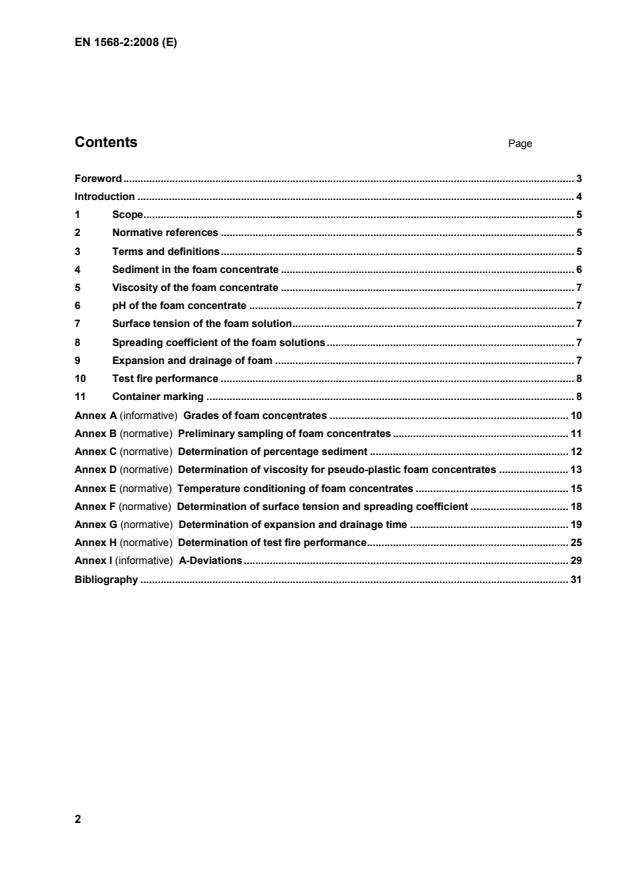
Grades of foam concentrates.10 Annex B (normative)
Preliminary sampling of foam concentrates.11 Annex C (normative)
Determination of percentage sediment.12 Annex D (normative)
Determination of viscosity for pseudo-plastic foam concentrates.13 Annex E (normative)
Temperature conditioning of foam concentrates.15 Annex F (normative)
Determination of surface tension and spreading coefficient.18 Annex G (normative)
Determination of expansion and drainage time.19 Annex H (normative)
Determination of test fire performance.25 Annex I (informative)
A-Deviations.29 Bibliography.31
Part 1: Specifications for halon 1211 and halon 1301 (ISO 7201-1:1989) EN 27201-2, Fire protection — Fire extinguishing media — Halogenated hydrocarbons —
Part 2: Code of practice for safe handling and transfer procedures (ISO 7201-2:1991) EN 615, Fire protection — Fire extinguishing media — Specification for powders (other than Class D powders)
This standard is Part 2 of EN 1568 which has the general title "Fire extinguishing media — Foam concentrates". The other parts are: Part 1: Specification for medium expansion foam concentrates for surface application to water-immiscible liquids. Part 3: Specification for low expansion foam concentrates for surface application to water-immiscible liquids. Part 4: Specification for low expansion foam concentrates for surface application to water-miscible liquids. As fire fighting foams are chemical agents or chemical preparations EC Directives 1967/548/EEC, 1999/45/EEC, Regulation (EC) 1907/2006 (REACH) and 2006/60/EEC apply and should be taken into account. According to the CEN/CENELEC Internal Regulations, the national standards organizations of the following countries are bound to implement this European Standard: Austria, Belgium, Bulgaria, Cyprus, Czech Republic, Denmark, Estonia, Finland, France, Germany, Greece, Hungary, Iceland, Ireland, Italy, Latvia, Lithuania, Luxembourg, Malta, Netherlands, Norway, Poland, Portugal, Romania, Slovakia, Slovenia, Spain, Sweden, Switzerland and the United Kingdom.
expansion value expansion ratio ratio of the volume of foam to the volume of the foam solution from which it was made 3.3 low expansion foam foam which has an expansion ratio less than 20 3.4 medium expansion foam foam which has an expansion ratio greater than or equal to 20 but less than 200 3.5 high expansion foam foam which has an expansion ratio greater than or equal to 200
5.2 Pseudo-plastic foam concentrates The viscosity of the foam concentrate shall be determined in accordance with Annex D. If the viscosity at the lowest temperature for use is greater than or equal to 120 mPa.s at 375 s-1, the container shall be marked in accordance with Clause 11 m).
6 pH of the foam concentrate The pH of the foam concentrate sampled in accordance with Annex B shall be not less than 6,0 and not more than 9,5 at (20 ± 1) °C. 7 Surface tension of the foam solution The surface tension (determined in accordance with F.2.1) of the foam solutions prepared using top and bottom half-samples (see E.4) of the foam concentrate sampled in accordance with Annex B and conditioned in accordance with Annex E shall be not less than 0,95 times and not more than 1,05 times the surface tension of the foam solution prepared using the sampled foam concentrate.
8 Spreading coefficient of the foam solutions NOTE The spreading coefficient indicates the possibility of film-forming, but it does not measure its quality. Certain properties of film-forming foams are not defined are note defined by this standard. 8.1 Before temperature conditioning The foam solution prepared using the concentrate, if it is claimed by the supplier to be "aqueous film-forming", sampled in accordance with Annex B shall have a positive spreading coefficient over cyclohexane when tested in accordance with F.2.2. 8.2 After temperature conditioning The foam solution prepared using top and bottom half-samples, see E.4, of the foam concentrate, if it is claimed by the supplier to be "aqueous film-forming", sampled in accordance with Annex B and conditioned in accordance with Annex E, shall have a positive spreading coefficient over cyclohexane when tested in accordance with F.2.2. 9 Expansion and drainage of foam 9.1 Before temperature conditioning The foam produced from the foam solution prepared from the foam concentrate sampled in accordance with Annex B, at the supplier’s recommended concentration with potable water shall be tested in
Grades of foam concentrates Foam concentrates are graded as follows: a) protein foam concentrates (P): these are liquids derived from hydrolysed protein materials; b) fluoroprotein foam concentrates (FP): these are protein concentrates with added fluorinated surface active agents; c) synthetic foam concentrates (S): these are based upon mixtures of hydrocarbon surface-active agents and can contain fluorinated surface-active agents with additional stabilizers; d) alcohol resistant foam concentrates (AR): these can be suitable for use on hydrocarbon fuels, and additionally are resistant to breakdown when applied to the surface of water-miscible liquid fuels. Some alcohol resistant foam concentrates can precipitate a polymeric membrane on the surface of alcohol; e) aqueous film-forming foam concentrates (AFFF): these are generally based on mixtures of hydrocarbon surfactants and fluorinated surface active agents and have the ability to form an aqueous film on the surface of some hydrocarbon fuels; f) film-forming fluoroprotein foam concentrates (FFFP): these are fluoroprotein foam concentrates which have the ability to form an aqueous film on the surface of some hydrocarbon fuels.
Preliminary sampling of foam concentrates The samples for testing shall be delivered by the supplier in completely filled sealable containers. The samples for testing shall be taken and delivered by the supplier using a method which will provide a representative sample of the foam concentrate to be tested. NOTE Nominal 25-litre containers are convenient.
Determination of percentage sediment NOTE See Clause 4. C.1 Sampling Use a sample prepared in accordance with Annex B. Place approximately 1 l of the sample in a suitable container of nominal capacity sufficient to provide an ullage of 5 % to 10 % of the container volume. Seal the container. Ensure that any sediment is dispersed by agitating the sample container. Take two samples, testing one immediately at a temperature of (20
...