

EN 74-2:2008
(Main)Couplers, spigot pins and baseplates for use in falsework and scaffolds - Part 2: Special couplers - Requirements and test procedures
- Abstract
EN 74 2 specifies:
- materials;
- design requirements;
- specified values for resistances and stiffnesses which a coupler has to achieve under test;
- test procedures and assessment;
for the following special couplers:
- screw or wedge half couplers, sleeve couplers with shear studs, right angle reduction couplers and swivel reduction couplers.
It gives recommendations for on going production control.
These couplers are for use principally in temporary works. Each coupler is able to be fixed to at least one side to one 48,3 mm diameter steel or aluminium tube. For the other side of reduction couplers, this standard defines requirements for the diameter and wall thickness of tubes.
For testing, screw couplers are tightened with a torque of 50 Nm and wedge couplers are tightened with a 500 g hammer until the jarring blow.
Other special half couplers such as half couplers attached by riveting, used mainly for members of prefabricated scaffolds, are outside the scope of this European Standard.
NOTE Some information on design using special couplers is given in Annex B.
- Status
- Withdrawn
- Publication Date
- 16-Sep-2008
- Withdrawal Date
- 06-Oct-2026
- Technical Committee
- CEN/TC 53 - Temporary works equipment
- Drafting Committee
- CEN/TC 53/WG 3 - Tubes and fittings
- Current Stage
- 9960 - Withdrawal effective - Withdrawal
- Start Date
- 30-Mar-2022
- Completion Date
- 07-Oct-2026


Relations
- Effective Date
- 06-Apr-2022
- Effective Date
- 28-Jan-2026
- Effective Date
- 28-Jan-2026
- Effective Date
- 28-Jan-2026
- Effective Date
- 28-Jan-2026
- Effective Date
- 28-Jan-2026
- Effective Date
- 28-Jan-2026
Get Certified
Connect with accredited certification bodies for this standard

DIBt (Deutsches Institut für Bautechnik)
German Institute for Building Technology.
DIN CERTCO
DIN Group product certification.

Aboma Certification B.V.
Specialized in construction, metal, and transport sectors.
Sponsored listings
Frequently Asked Questions
EN 74-2:2008 is a standard published by the European Committee for Standardization (CEN). Its full title is "Couplers, spigot pins and baseplates for use in falsework and scaffolds - Part 2: Special couplers - Requirements and test procedures". This standard covers: EN 74 2 specifies: - materials; - design requirements; - specified values for resistances and stiffnesses which a coupler has to achieve under test; - test procedures and assessment; for the following special couplers: - screw or wedge half couplers, sleeve couplers with shear studs, right angle reduction couplers and swivel reduction couplers. It gives recommendations for on going production control. These couplers are for use principally in temporary works. Each coupler is able to be fixed to at least one side to one 48,3 mm diameter steel or aluminium tube. For the other side of reduction couplers, this standard defines requirements for the diameter and wall thickness of tubes. For testing, screw couplers are tightened with a torque of 50 Nm and wedge couplers are tightened with a 500 g hammer until the jarring blow. Other special half couplers such as half couplers attached by riveting, used mainly for members of prefabricated scaffolds, are outside the scope of this European Standard. NOTE Some information on design using special couplers is given in Annex B.
EN 74 2 specifies: - materials; - design requirements; - specified values for resistances and stiffnesses which a coupler has to achieve under test; - test procedures and assessment; for the following special couplers: - screw or wedge half couplers, sleeve couplers with shear studs, right angle reduction couplers and swivel reduction couplers. It gives recommendations for on going production control. These couplers are for use principally in temporary works. Each coupler is able to be fixed to at least one side to one 48,3 mm diameter steel or aluminium tube. For the other side of reduction couplers, this standard defines requirements for the diameter and wall thickness of tubes. For testing, screw couplers are tightened with a torque of 50 Nm and wedge couplers are tightened with a 500 g hammer until the jarring blow. Other special half couplers such as half couplers attached by riveting, used mainly for members of prefabricated scaffolds, are outside the scope of this European Standard. NOTE Some information on design using special couplers is given in Annex B.
EN 74-2:2008 is classified under the following ICS (International Classification for Standards) categories: 91.220 - Construction equipment. The ICS classification helps identify the subject area and facilitates finding related standards.
EN 74-2:2008 has the following relationships with other standards: It is inter standard links to EN 74-2:2022, EN ISO 898-1:1999, EN 1090-2:2008, EN 12811-1:2003, EN 74-1:2005, EN 12811-3:2002, EN 12811-2:2004. Understanding these relationships helps ensure you are using the most current and applicable version of the standard.
EN 74-2:2008 is available in PDF format for immediate download after purchase. The document can be added to your cart and obtained through the secure checkout process. Digital delivery ensures instant access to the complete standard document.
Standards Content (Sample)
2003-01.Slovenski inštitut za standardizacijo. Razmnoževanje celote ali delov tega standarda ni dovoljeno.Kupplungen, Zentrierbolzen und Fußplatten für Arbeitsgerüste und Traggerüste - Spezialkupplungen - Teil 2: Anforderungen und PrüfverfahrenRaccords, goujons d'assemblage et semelles pour étaiements et échafaudages - Partie 2: Raccords spéciaux - Exigences et modes opératoires d'essaiCouplers, spigot pins and baseplates for use in falsework and scaffolds - Part 2: Special couplers - Requirements and test procedures91.220Gradbena opremaConstruction equipmentICS:Ta slovenski standard je istoveten z:EN 74-2:2008SIST EN 74-2:2008en01-december-2008SIST EN 74-2:2008SLOVENSKI
STANDARD
EUROPEAN STANDARDNORME EUROPÉENNEEUROPÄISCHE NORMEN 74-2September 2008ICS 91.220 English VersionCouplers, spigot pins and baseplates for use in falsework andscaffolds - Part 2: Special couplers - Requirements and testproceduresRaccords, goujons d'assemblage et semelles pourétaiements et échafaudages - Partie 2: Raccords spéciaux- Exigences et modes opératoires d'essaiKupplungen, Zentrierbolzen und Fußplatten fürArbeitsgerüste und Traggerüste - Spezialkupplungen - Teil2: Anforderungen und PrüfverfahrenThis European Standard was approved by CEN on 9 August 2008.CEN members are bound to comply with the CEN/CENELEC Internal Regulations which stipulate the conditions for giving this EuropeanStandard the status of a national standard without any alteration. Up-to-date lists and bibliographical references concerning such nationalstandards may be obtained on application to the CEN Management Centre or to any CEN member.This European Standard exists in three official versions (English, French, German). A version in any other language made by translationunder the responsibility of a CEN member into its own language and notified to the CEN Management Centre has the same status as theofficial versions.CEN members are the national standards bodies of Austria, Belgium, Bulgaria, Cyprus, Czech Republic, Denmark, Estonia, Finland,France, Germany, Greece, Hungary, Iceland, Ireland, Italy, Latvia, Lithuania, Luxembourg, Malta, Netherlands, Norway, Poland, Portugal,Romania, Slovakia, Slovenia, Spain, Sweden, Switzerland and United Kingdom.EUROPEAN COMMITTEE FOR STANDARDIZATIONCOMITÉ EUROPÉEN DE NORMALISATIONEUROPÄISCHES KOMITEE FÜR NORMUNGManagement Centre: rue de Stassart, 36
B-1050 Brussels© 2008 CENAll rights of exploitation in any form and by any means reservedworldwide for CEN national Members.Ref. No. EN 74-2:2008: ESIST EN 74-2:2008
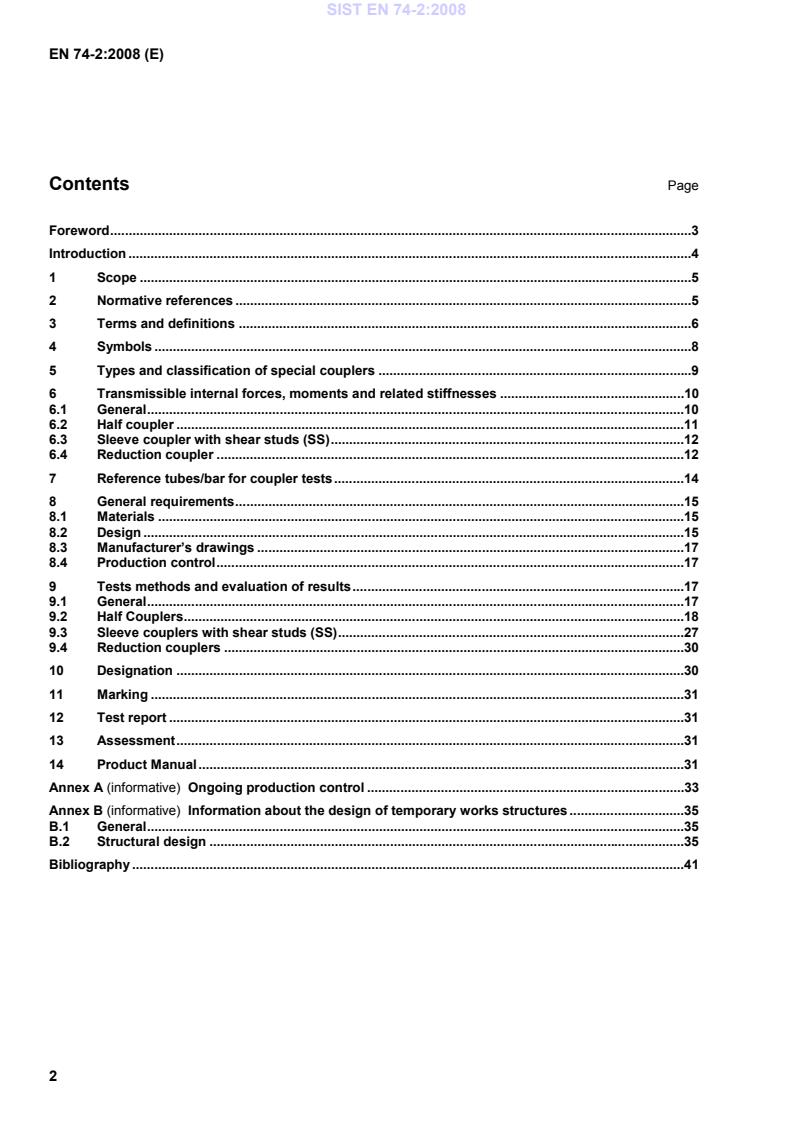
Ongoing production control.33 Annex B (informative)
Information about the design of temporary works structures.35 B.1 General.35 B.2 Structural design.35 Bibliography.41
screw or wedge half couplers, sleeve couplers with shear studs, right angle reduction couplers and swivel reduction couplers. It gives recommendations for on-going production control. These couplers are for use principally in temporary works. Each coupler is able to be fixed to at least one side to one 48,3 mm diameter steel or aluminium tube. For the other side of reduction couplers, this standard specifies requirements for the diameter and wall thickness of tubes. For testing, screw couplers are tightened with a torque of 50 Nm and wedge couplers are tightened with a 500 g hammer until the jarring blow. Other special half couplers such as half couplers attached by riveting, used mainly for members of prefabricated scaffolds, are outside the scope of this European Standard. NOTE Information on design using special couplers is given in Annex B. 2 Normative references The following referenced documents are indispensable for the application of this document. For dated references, only the edition cited applies. For undated references, the latest edition of the referenced document (including any amendments) applies. EN 74-1:2005, Couplers, spigot pins and baseplates for use in falsework and scaffolds — Part 1: Couplers for tubes — Requirements and test procedures EN 1090-2:2008, Execution of steel structures and aluminium structures — Part 2: Technical requirements for steel structures EN 12811-1:2003, Temporary works equipment — Part 1: Scaffolds — Performance requirements and general design EN 12811-2:2004, Temporary works equipment — Part 2: Information on materials EN 12811-3:2002, Temporary works equipment — Part 3: Load testing EN ISO 898-1:1999, Mechanical properties of fasteners made of carbon steel and alloy steel — Part 1: Bolts, screws and studs (ISO 898-1:1999) SIST EN 74-2:2008
Key
a profile of welding Figure 1 — Half coupler connected by welding (HW) SIST EN 74-2:2008
Key
a profile of welding t thickness of the head of welded-in threaded element 1 welded-in threaded element (bolt, screw, stud, threaded rod) Figure 2 — Half coupler for connection with a welded in threaded element (HT) 3.2 sleeve coupler with shear studs (SS) coupler for connecting 48,3 mm tubes end to end by means of a pair of shear studs on each side engaging with two predetermined holes in each tube NOTE See Figure 3. Where required, a manufacturer may specify the use of a loose spigot (not shown on Figure 3).
Figure 3 — Sleeve coupler with shear studs (SS) SIST EN 74-2:2008
Figure 4 — Reduction coupler as swivel coupler (RS) 4 Symbols For the purpose of this European Standard, the following symbols apply: ck
characteristic stiffness of a longitudinal spring; Fs slipping force in kN; Ff failure force in kN; Fp pull apart force in kN; Fq share force in kN; MB bending moment in kNm; c3(1),MB bending stiffness in kNm/rad; Fs,c specified value for slipping force in kN; Ff,c specified value for failure force in kN; Fp,c specified value for pull apart force in kN; SIST EN 74-2:2008
specified value for bending stiffness in kNm/rad;
displacement in millimetres of the transverse tube under load relative to a tube or solid bar in rotational tests; ûi displacement in millimetres of a coupler under load relative to a tube or solid bar; û10 indentation in millimetres; P test load in kN; Pind test load for indentation in kN; Pf,ult ultimate failure force in kN; Pp,ult ultimate pull apart force in kN; Pq,ult ultimate share force in kN; 3 specified angle of rotation of a coupler in degrees. 5 Types and classification of special couplers The types of special couplers are listed in Table 1. The classification is given in Table 2. SIST EN 74-2:2008
Table 1 — Types of couplers Type Identification Arrangement HW Connection of a tube to a member with a coupler directly welded to the member
Half coupler HT Connection of a tube to a member with a coupler which incorporates a welded in threaded element Sleeve coupler with shear studs SS Tubes connected end to end coaxially using holes in the tubes and studs
Right angle RR Tube of 48,3 mm diameter connected to a tube of another diameter at a right angle
Reduction coupler Swivel RS Tube of 48,3 mm diameter connected to a tube of another diameter at any angle
Table 2 — Classification of couplers Class Type of coupler A B unclassified Half coupler v v — Sleeve coupler with shear studs — — v Reduction coupler
— — v
6 Transmissible internal forces, moments and related stiffnesses 6.1 General In general a connection between two members is able to transmit three internal forces and three moments at right angle. There are related stiffnesses. The connection of a tube to another member by a threaded element fixed half coupler (HT) or by weldable half coupler (HW) is designed to transmit three forces. Additionally, a Class B half coupler connected by a welded-in threaded element (HT) is designed to transmit one bending moment and a Class B screw weldable half coupler (HW) is designed to transmit two bending moments as listed in Table 3. A sleeve coupler with shear studs (SS) is designed to transmit one force and one bending moment as listed in Table 4. A right angle reduction coupler (RR) is designed to transmit three forces at right angle in three directions as listed in Table 5. A swivel reduction coupler (RS) is designed to transmit one force as listed in Table 6. NOTE The influence of the moments resulting from eccentricities of the connection is considered in the test. SIST EN 74-2:2008
Bending moment MB,y — v v v Bending stiffness cϕ,MB,x — v — — Connection stiffness Bending stiffness cϕ,MB,y — v v v v Structural parameters are specified in Table 8.
Key x,y
direction of principal axis
Figure 5 — Forces and moments for a half coupler SIST EN 74-2:2008
Figure 6 — Forces and moments for a sleeve coupler with shear studs (SS) 6.4 Reduction coupler Tables 5 and 6 show the structural parameters specified. Table 5 — Structural parameters for a right angle reduction coupler type (RR) Tube Structural parameter see Figure 7 Unclassified Slipping force Fs,1 v 1
Diameter 48,3 mm Failure force Ff,1 v Slipping force Fs,2 v 2
Diameter different from 48,3 mm Failure force Ff,2 v
Pull-apart force Fp v v Structural parameters are specified in Table 8. SIST EN 74-2:2008
Key 1 tube 1 48,3 mm outside diameter 2 tube 2 of a different outside diameter Figure 7 — Forces for a right angle reduction coupler
Table 6 — Structural parameters for a swivel reduction coupler type (RS) Tube Structural parameter (see Figure 8) Unclassified Slipping force Fs,1 v 1
Diameter 48,3 mm Failure force Ff,1 v Slipping force Fs,2 v 2
Diameter different from 48,3 mm Failure force Ff,2 v v Structural parameters are specified in Table 8.
Key 1 tube 1 48,3 mm outside diameter 2 tube 2 of a different outside diameter Figure 8 — Forces for a swivel reduction coupler (RS) 7 Reference tubes/bar for coupler tests For the purpose of testing, reference tubes and solid bars with a diameter of 48,3 mm shall be in accordance with EN 74-1. The tubes used for testing reduction couplers with diameters other than 48,3 mm shall be in accordance with Table 7, in which the diameters may have a deviation of ± 0,5 mm. Table 7 — Steel reference tubes RTR(n) for reduction couplers other than 48,3 mm outside diameter Steel reference n Outside diameter
(mm) Wall thickness
(mm) Wall thickness tolerance (including finishing) (mm) Yield stress
(N/mm²) 1 38,0 2 42,4 3 60,3 3,2 4 63,5 4,0 RTR(n) 5 76,1 4,5 +0,1 -0,2 235 ≤ ReH ≤ 265
Ff,c 9.2.3 Pf,ult 14,0 kN 20,0 kN — Pull-apart force
Fp,c 9.2.4 Pp,ult 20,0 kN 30,0 kN — Pind = 4,7 kN ≤ 1,5 mm — — Indentation ∆10 9.2.7 Pind = 6,67 kN — ≤ 1,5 mm — Shear force
Fq,c 9.2.5 Pq,ult 14,0 kN 20,0 kN — cϕ1,MB,y,c MB/1,65 = 0,48 kNm — 15,0 kNm/rad — Bending stiffness on steel tube cϕ2,MB,y,c MB = 0,8 kNm — 6,0 kNm/rad — cϕ1,MB,y,c MB/1,65 = 0,48 kNm — 13,0 kNm/rad — Bending stiffness on aluminium tube cϕ,2,MB,y,c MB = 0,8 kNm — 5,0 kNm/rad — Half coupler (HW,HT) Bending moment MB,y,c 2MB — 1,6 kNm — cϕ1,MB,x,c MB/1,65 = 0,48 kNm — 15,0 kNm/rad — Only for screw coupler (HW) Bending stiffness on steel tube cϕ2,MB,x,c 9.2.6 MB = 0,8 kNm — 6,0 kNm/rad — cϕ1,MB,x,c MB/1,65 = 0,48 kNm — 13,0 kNm/rad — Bending stiffness on aluminium tube cϕ2,MB,x,c MB = 0,8 kNm — 5,0 kNm/rad —
Bending moment
MB,x,c
2MB — 1,6 kNm — Failure force Ff,c 9.3.1 Pf,ult — — 40,0 kN Sleeve coupler with shear studs (SS) Bending moment MB,c 9.3.2 ∆4 ≤ 5 mm — — 1,4 kNm ∆1 ≤ 7 mm — — 7,0 kN Slipping force Fs,c 9.4.2 1 ≤ ∆2 ≤ 2 mm — — 10,0 kN Failure force Ff,c 9.4.2 Pf,ult — — 20,0 kN Pull apart force Fp,c 9.4.3 Pp,ult — — 20,0 kN Right angle reduction coupler (RR) Indentation ∆10 9.4.4 Pind = 6,67 kN — — ≤ 1,5 mm SIST EN 74-2:2008
— 5 — — Slipping force Fs 10 10 — — — — Failure force Ff — — — — — 5a Pull-apart force Fp — — — — — 5a Right angle reduction coupler (RR) Indentation 5 — 5 — — — Slipping force Fs 10 10 — — — — Failure force Ff — — — — — 5a Swivel reduction coupler (RS) Indentation 5 — 5 — — — NOTE For reference tubes, see Table 7 and Clause 5 of EN 74-1:2005. a If RB is not available a tube with the same outside diameter may be used. 9.2 Half Couplers 9.2.1 General If a coupler can be used both as a weldable half coupler (HW) (without a welded-i
...