


EN 13938-3:2025
(Main)Explosives for civil uses - Propellants and rocket propellants - Part 3: Verification of deflagration to detonation transition of solid gun propellants
Explosives for civil uses - Propellants and rocket propellants - Part 3: Verification of deflagration to detonation transition of solid gun propellants
This document specifies a method to determine the tendency of a propellant to undergo transition from deflagration to detonation (DDT). It applies to propellants of a grain size up to 8 mm. This method does not apply to black powder and rocket propellant.
NOTE 1 Due to the nature of the shape of grains (heterogeneous), the combustion of the rocket propellant can cause a crack of the grain causing an explosion of the rocket motor.
NOTE 2 Black powders properties differ significantly from propellant and explosives because black powders are capable of maintaining stable combustion at high velocities without experiencing deflagration - detonation transition.
Explosivstoffe für zivile Zwecke - Treibladungspulver und Raketentreibstoffe - Teil 3: Bestimmung des Überganges der Deflagration in die Detonation
Dieses Dokument legt ein Verfahren für die Bestimmung der Neigung eines Treibmittels, von der Deflagration in die Detonation überzugehen (DTT, en: transition from deflagration to detonation), fest. Es gilt für Treibladungspulver mit einer Korngröße bis zu 8 mm. Dieses Verfahren gilt nicht für Schwarzpulver und Raketentreibstoff.
ANMERKUNG 1 Aufgrund der natürlichen Form der Körner (heterogen) können bei der Verbrennung von Raketentreibstoff Risse im Korn entstehen, die eine Explosion des Raketenantriebsmittels zur Folge haben.
ANMERKUNG 2 Die Eigenschaften von Schwarzpulver unterscheiden sich deutlich von den Eigenschaften des Treibladungspulvers und der Explosivstoffe, da Schwarzpulver in der Lage ist, eine stabile Verbrennung bei hohen Geschwindigkeiten aufrechtzuerhalten, ohne dass es zu einem Übergang der Deflagration in die Detonation kommt.
Explosifs à usage civil - Poudres propulsives et propergols pour propulseurs - Partie 3 : Vérification du passage de la déflagration à la détonation des poudres pour armes
Le présent document spécifie une méthode d'essai permettant de vérifier la transition entre la déflagration et la détonation des poudres pour armes.
Le présent document s'applique aux poudres pour armes constituées de particules d'une taille ≤ 8 mm.
Le présent document ne s'applique ni à la poudre noire, ni aux propergols solides pour propulseurs, ni aux galettes.
Eksplozivi za civilno uporabo - Pogonska (smodniki) in raketna goriva - 3. del: Preverjanje prehoda iz deflagracije v detonacijo pri trdnih pogonskih gorivih za topove
General Information
- Status
- Published
- Publication Date
- 30-Sep-2025
- Technical Committee
- CEN/TC 321 - Explosives for civil uses
- Drafting Committee
- CEN/TC 321/WG 6 - Explosives and propellants
- Current Stage
- 6060 - Definitive text made available (DAV) - Publishing
- Start Date
- 01-Oct-2025
- Due Date
- 05-Apr-2022
- Completion Date
- 01-Oct-2025
Relations
- Effective Date
- 18-Jan-2023
Overview
EN 13938-3:2025 is the latest European Standard issued by CEN that specifies a crucial test method for verifying the tendency of solid gun propellants to transition from deflagration to detonation (DDT). This part 3 of the EN 13938 series exclusively applies to solid gun propellants with a particle size up to 8 mm and explicitly excludes black powder, solid rocket propellants, and powder cakes due to their differing combustion behaviors. The standard outlines the controlled procedure for testing propellants under confinement to ensure safe and predictable combustion characteristics critical in civil explosive applications.
Key Topics
Scope and Applicability
Focuses on solid gun propellants for civil uses, providing guidelines to test propellants up to 8 mm grain size. Not applicable to black powder or solid rocket propellants, highlighting the unique combustion dynamics studied.Deflagration to Detonation Transition (DDT)
The core principle involves igniting a propellant charge inside a confined steel tube. The rapid gas expansion accelerates the burning front, potentially triggering a detonation. The test identifies this transition by analyzing compression marks on a lead witness plate.Test Apparatus Requirements
Specifies precise materials, dimensions, and assembly for:- Seamless steel tubes (minimum 235 MPa yield strength)
- Cast iron screw caps for containment
- High-purity lead witness plates for detecting detonation compression
- Nickel-chromium hot wires for ignition
- Inert rods, fill plates, and measuring devices to ensure accuracy and repeatability
Test Procedure
Details sample preparation, including conditioning, steel tube loading, use of hot wires for ignition, and measurement of the length before detonation (LBD), which quantifies the propensity of the propellant to DDT. Two tests per sample are mandated, with specific criteria for test termination if LBD is below 50 mm.Result Interpretation
Test outcomes are expressed as "pass" or "fail" based on the length before detonation measurements, providing a definitive safety indicator.
Applications
EN 13938-3:2025 supports:
Quality and Safety Assurance in Propellant Manufacturing
Manufacturers of solid gun propellants use this standard to verify that their products resist premature detonation, thus ensuring performance reliability and user safety.Regulatory Compliance
Aligns with European directives on explosives for civil use, enabling compliance with legal frameworks regulating market availability and supervision of explosive materials.Research and Development
Enables technical evaluation during formulation and testing of new propellant mixtures to balance combustion efficiency and detonation risk.Test Laboratories and Certification Bodies
Provides a repeatable, standardized method for accrediting propellants' safe deflagration behavior, supporting certifications and quality control.
Related Standards
EN 13938 Series
Part 1 covers vocabulary, and Parts 2 and onwards address other aspects of propellant testing and classification relevant to civil explosives.EN 13857-1:2025
Glossary of terms related to explosives and pyrotechnics, ensuring consistent terminology across standards.EN 10027-1:2016
Steel designation systems essential for selecting appropriate materials for apparatus construction.EN ISO/IEC 17025:2017
International standard for testing laboratory competence, relevant for laboratories implementing the EN 13938-3 test method.
Keywords: EN 13938-3:2025, solid gun propellants, deflagration to detonation transition, DDT verification, civil explosives standard, propellant testing method, European standard for explosives, witness plate compression, ignition test apparatus, propellant safety compliance, CEN explosives standards.

Frequently Asked Questions
EN 13938-3:2025 is a standard published by the European Committee for Standardization (CEN). Its full title is "Explosives for civil uses - Propellants and rocket propellants - Part 3: Verification of deflagration to detonation transition of solid gun propellants". This standard covers: This document specifies a method to determine the tendency of a propellant to undergo transition from deflagration to detonation (DDT). It applies to propellants of a grain size up to 8 mm. This method does not apply to black powder and rocket propellant. NOTE 1 Due to the nature of the shape of grains (heterogeneous), the combustion of the rocket propellant can cause a crack of the grain causing an explosion of the rocket motor. NOTE 2 Black powders properties differ significantly from propellant and explosives because black powders are capable of maintaining stable combustion at high velocities without experiencing deflagration - detonation transition.
This document specifies a method to determine the tendency of a propellant to undergo transition from deflagration to detonation (DDT). It applies to propellants of a grain size up to 8 mm. This method does not apply to black powder and rocket propellant. NOTE 1 Due to the nature of the shape of grains (heterogeneous), the combustion of the rocket propellant can cause a crack of the grain causing an explosion of the rocket motor. NOTE 2 Black powders properties differ significantly from propellant and explosives because black powders are capable of maintaining stable combustion at high velocities without experiencing deflagration - detonation transition.
EN 13938-3:2025 is classified under the following ICS (International Classification for Standards) categories: 71.100.30 - Explosives. Pyrotechnics and fireworks. The ICS classification helps identify the subject area and facilitates finding related standards.
EN 13938-3:2025 has the following relationships with other standards: It is inter standard links to EN 13938-3:2003. Understanding these relationships helps ensure you are using the most current and applicable version of the standard.
EN 13938-3:2025 is associated with the following European legislation: EU Directives/Regulations: 2014/28/EU; Standardization Mandates: M/055, M/562. When a standard is cited in the Official Journal of the European Union, products manufactured in conformity with it benefit from a presumption of conformity with the essential requirements of the corresponding EU directive or regulation.
You can purchase EN 13938-3:2025 directly from iTeh Standards. The document is available in PDF format and is delivered instantly after payment. Add the standard to your cart and complete the secure checkout process. iTeh Standards is an authorized distributor of CEN standards.
Standards Content (Sample)
SLOVENSKI STANDARD
01-december-2025
Eksplozivi za civilno uporabo - Pogonska (smodniki) in raketna goriva - 3. del:
Preverjanje prehoda iz deflagracije v detonacijo pri trdnih pogonskih gorivih za
topove
Explosives for civil uses - Propellants and rocket propellants - Part 3: Verification of
deflagration to detonation transition of solid gun propellants
Explosivstoffe für zivile Zwecke - Treibladungspulver und Raketentreibstoffe - Teil 3:
Bestimmung des Überganges der Deflagration in die Detonation
Explosifs à usage civil - Poudres propulsives et propergols pour propulseurs - Partie 3 :
Vérification du passage de la déflagration à la détonation des poudres pour armes
Ta slovenski standard je istoveten z: EN 13938-3:2025
ICS:
71.100.30 Eksplozivi. Pirotehnika in Explosives. Pyrotechnics and
ognjemeti fireworks
2003-01.Slovenski inštitut za standardizacijo. Razmnoževanje celote ali delov tega standarda ni dovoljeno.
EN 13938-3
EUROPEAN STANDARD
NORME EUROPÉENNE
October 2025
EUROPÄISCHE NORM
ICS 71.100.30 Supersedes EN 13938-3:2003
English Version
Explosives for civil uses - Propellants and rocket
propellants - Part 3: Verification of deflagration to
detonation transition of solid gun propellants
Explosifs à usage civil - Poudres propulsives et Explosivstoffe für zivile Zwecke - Treibladungspulver
propergols pour propulseurs - Partie 3 : Vérification du und Raketentreibstoffe - Teil 3: Bestimmung des
passage de la déflagration à la détonation des poudres Überganges der Deflagration in die Detonation
pour armes
This European Standard was approved by CEN on 29 September 2025.
CEN members are bound to comply with the CEN/CENELEC Internal Regulations which stipulate the conditions for giving this
European Standard the status of a national standard without any alteration. Up-to-date lists and bibliographical references
concerning such national standards may be obtained on application to the CEN-CENELEC Management Centre or to any CEN
member.
This European Standard exists in three official versions (English, French, German). A version in any other language made by
translation under the responsibility of a CEN member into its own language and notified to the CEN-CENELEC Management
Centre has the same status as the official versions.
CEN members are the national standards bodies of Austria, Belgium, Bulgaria, Croatia, Cyprus, Czech Republic, Denmark, Estonia,
Finland, France, Germany, Greece, Hungary, Iceland, Ireland, Italy, Latvia, Lithuania, Luxembourg, Malta, Netherlands, Norway,
Poland, Portugal, Republic of North Macedonia, Romania, Serbia, Slovakia, Slovenia, Spain, Sweden, Switzerland, Türkiye and
United Kingdom.
EUROPEAN COMMITTEE FOR STANDARDIZATION
COMITÉ EUROPÉEN DE NORMALISATION
EUROPÄISCHES KOMITEE FÜR NORMUNG
CEN-CENELEC Management Centre: Rue de la Science 23, B-1040 Brussels
© 2025 CEN All rights of exploitation in any form and by any means reserved Ref. No. EN 13938-3:2025 E
worldwide for CEN national Members.
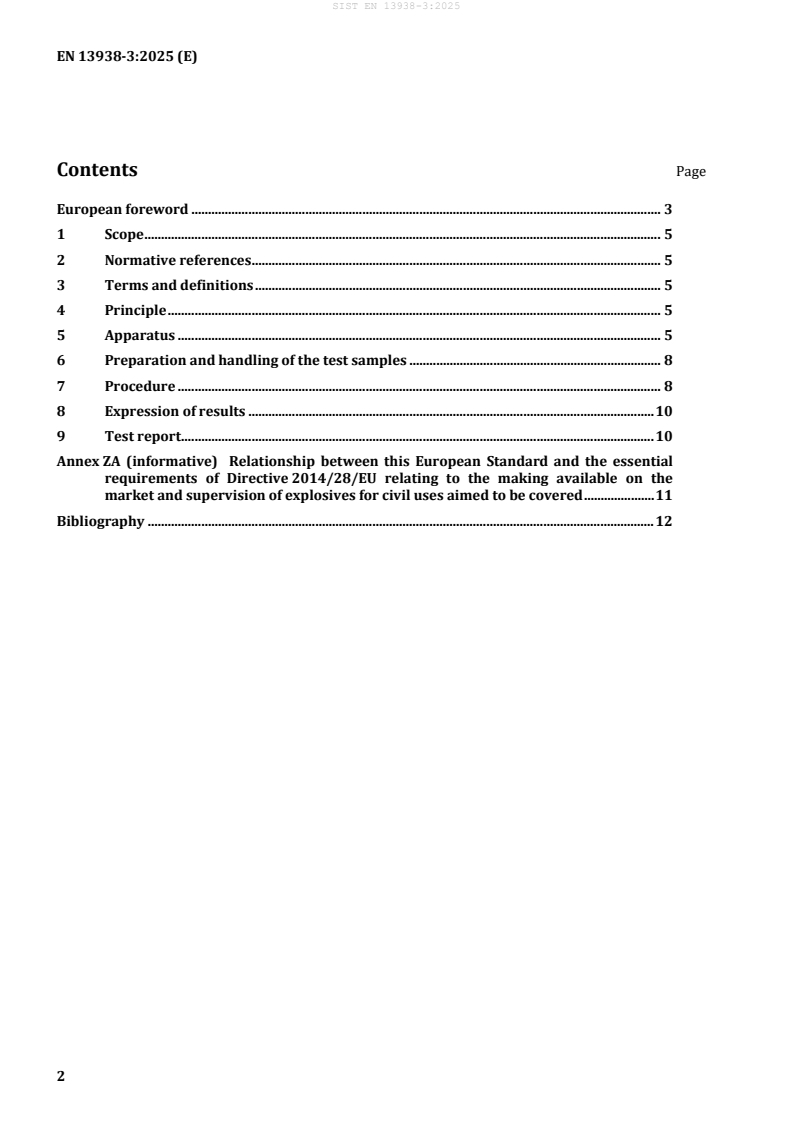
Contents Page
European foreword . 3
1 Scope . 5
2 Normative references . 5
3 Terms and definitions . 5
4 Principle . 5
5 Apparatus . 5
6 Preparation and handling of the test samples . 8
7 Procedure . 8
8 Expression of results . 10
9 Test report . 10
Annex ZA (informative) Relationship between this European Standard and the essential
requirements of Directive 2014/28/EU relating to the making available on the
market and supervision of explosives for civil uses aimed to be covered . 11
Bibliography . 12
European foreword
This document (EN 13938-3:2025) has been prepared by Technical Committee CEN/TC 321 “Explosives
for civil uses”, the secretariat of which is held by UNE.
This European Standard shall be given the status of a national standard, either by publication of an
identical text or by endorsement, at the latest by April 2025, and conflicting national standards shall be
withdrawn at the latest by month year April 2025.
Attention is drawn to the possibility that some of the elements of this document may be the subject of
patent rights. CEN shall not be held responsible for identifying any or all such patent rights.
This document supersedes EN 13938-3:2003.
a) the document title has been changed from “Part 3: Determination of deflagration to detonation
transition” to “Part 3: Verification of deflagration to detonation transition of solid gun propellants”;
b) in the Scope it has been clarified that the document only applies to solid gun propellants;
c) the normative references have been updated;
d) the Clause 4 “Principle” has been added;
e) the Clause “Apparatus” has been revised and further detailed – Figure 2 has been removed;
f) the Clause 6 “Preparation of test sample” now contains the specifications of the former Clause 5 “Test
sample”;
g) the Clause “Procedure” together with former Figure 3 have been revised - the assembly of the steel
tube and the determination of the length before detonation have been further clarified;
h) the Clause 8 “Expression of results” has been added;
i) the Clause “Test report” does no longer require conformity with EN ISO/IEC 17025 and the
information to be provided has been revised in accordance with the revised procedure;
j) the former Annex A “Range of applicability of the test method” has been removed;
k) the Annex ZA has been updated;
l) the Bibliography has been added and lists, e.g. EN ISO/IEC 17025:2017.
This document has been prepared under a standardization request addressed to CEN by the European
Commission. The Standing Committee of the EFTA States subsequently approves these requests for its
Member States.
For the relationship with EU Legislation, see informative Annex ZA, which is an integral part of this
document.
A list of all parts in the EN 13938 series, published under the general title Explosives for civil uses —
Propellants and rocket propellants, can be found on the CEN website.
Any feedback and questions on this document should be directed to the users’ national standards body.
A complete listing of these bodies can be found on the CEN website.
According to the CEN-CENELEC Internal Regulations, the national standards organisations of the
following countries are bound to implement this European Standard: Austria, Belgium, Bulgaria, Croatia,
Cyprus, Czech Republic, Denmark, Estonia, Finland, France, Germany, Greece, Hungary, Iceland, Ireland,
Italy, Latvia, Lithuania, Luxembourg, Malta, Netherlands, Norway, Poland, Portugal, Republic of North
Macedonia, Romania, Serbia, Slovakia, Slovenia, Spain, Sweden, Switzerland, Türkiye and the United
Kingdom.
1 Scope
This document specifies a test method for the verification of the transition from deflagration to
detonation of solid gun propellants.
This document applies to solid gun propellants with a particle size of ≤ 8 mm.
This document does not apply to black powder, solid rocket propellants or powder cakes.
2 Normative references
The following documents are referred to in the text in such a way that some or all of their content
constitutes requirements of this document. For dated references, only the edition cited applies. For
undated references, the latest edition of the referenced document (including any amendments) applies.
EN 10027-1:2016, Designation systems for steels - Part 1: Steel names
EN 13857-1:2025, Explosives for civil uses — Part 1: Vocabulary
3 Terms and definitions
For the purposes of this document, the terms and definitions given in EN 13857-1:2025 apply.
ISO and IEC maintain terminology databases for use in standardization at the following addresses:
• ISO Online browsing platform: available at https://www.iso.org/obp
• IEC Electropedia: available at https://www.electropedia.org/
4 Principle
Solid gun propellants shall not detonate but deflagrate; in order to ensure this, the tendency of a solid
gun propellant to undergo the transition from deflagration to detonation is tested under confinement. A
charge of a solid gun propellant inside a steel tube is ignited; due to the rapid generation of gases by the
deflagrating propellant, the pressure is increased, and the burning front is accelerated so that it can reach
a detonation condition. The transition from deflagration to detonation is shown by characteristic
compression marks on a witness plate. The length before detonation is determined and used as indicator
of the tendency of the solid gun propellant to undergo deflagration to detonation transition (DDT).
5 Apparatus
5.1 Steel tube, that shall be seamless and shall be made from a steel for pressure purposes in
accordance with EN 10027-1:2016, Table 2, and a minimum yield strength of 235 MPa, with an external
+5
diameter of (48,3 ± 0,5) mm, a thickness of (4,0 ± 0,6) mm and a length of 1200 mm. The steel tube
shall be either threaded at both ends or threaded only at one end and closed at the other end, e.g. by a
welded steel plate.
5.2 Screw cap(s), made from cast iron, to be screwed on the open end(s) of the tube (5.1) in order to
close it. It shall be possibl
...
Questions, Comments and Discussion
Ask us and Technical Secretary will try to provide an answer. You can facilitate discussion about the standard in here.
Loading comments...