

EN 196-8:2010
(Main)Methods of testing cement - Part 8: Heat of hydration - Solution method
- Abstract
This European Standard describes a method of determining the heat of hydration of cements by means of solution calorimetry, also known as the solution method. The heat of hydration is expressed in joules per gram of cement.
This standard is applicable to cements and hydraulic binders whatever their chemical composition.
NOTE 1 Another procedure, called the semi-adiabatic method, is described in EN 196-9. Either procedure can be used independently.
NOTE 2 It has been demonstrated that the best correlation between the two methods is obtained at seven days for the solution method (EN 196-8) compared with 41 h for the semi-adiabatic method (EN 196-9).
- Status
- Published
- Publication Date
- 23-Mar-2010
- Withdrawal Date
- 29-Sep-2010
- Technical Committee
- CEN/TC 51 - Cement and building limes
- Drafting Committee
- CEN/TC 51/WG 15 - Revision of methods of testing cement
- Current Stage
- 9093 - Decision to confirm - Review Enquiry
- Start Date
- 14-Jun-2022
- Completion Date
- 07-Oct-2026

Overview
EN 196-8:2010 - Methods of testing cement - Part 8: Heat of hydration - Solution method (CEN) specifies a laboratory solution calorimetry procedure to determine the heat of hydration of cements and hydraulic binders. Results are reported in joules per gram (J/g) of cement. The method measures the difference between the heat of solution of anhydrous and hydrated cement samples under standardized conditions.
Key topics and technical requirements
- Scope: Applicable to cements and hydraulic binders regardless of chemical composition.
- Principle: Heat of hydration Hi = Qa − Qi, where Qa is the heat of solution of anhydrous cement and Qi that of cement hydrated for a defined period (e.g., 7 days).
- Standardized hydration conditions:
- Water/cement ratio: 0.40
- Neat cement paste (no additives)
- Storage temperature during hydration: 20.0 ± 0.2 °C
- Acid mixture: Analytical-quality acid mixture using hydrofluoric acid (HF) and nitric acid (HNO3) (document gives exact proportions). IMPORTANT: HF is highly corrosive and requires strict safety precautions.
- Calorimeter and apparatus:
- Insulated dissolution vessel (e.g., Dewar-type) with stirrer and accurate thermometer (Beckmann thermometers or thermistors/platinum resistance thermometers).
- Calorimeter characteristics to be determined: thermal capacity (C) and thermal leakage coefficient (K) via calibration.
- Calibration uses ignited zinc oxide (ZnO) dissolved in the acid mixture; procedures for sample handling, timing and temperature averaging are specified.
- Sample preparation:
- Anhydrous cement stored dry and homogenized; metallic iron removed.
- Hydrated cement prepared by mixing 100.0 g cement with 40.0 g water for 3 minutes and curing in sealed vials at 20.0 °C.
- Precision: The standard includes repeatability and reproducibility information and guidance on reporting results.
Applications and users
- Quality control in cement production to monitor reactivity and consistency.
- R&D and product development to compare binder formulations and additives.
- Construction materials laboratories performing standardized cement testing.
- Regulatory and certification bodies assessing compliance with performance requirements.
- Useful for assessing early and longer-term hydration energetics (noting best correlation with semi-adiabatic methods at seven days for this solution method).
Related standards
- EN 196-9: Heat of hydration - Semi-adiabatic method (alternative procedure; either method may be used independently).
- EN 197-1: Cement - Composition and specifications (normative reference in EN 196-8).
- Other parts of EN 196 series (strength, setting times, fineness, sampling).
Keywords: EN 196-8:2010, heat of hydration, solution calorimetry, cement testing, calorimeter calibration, joules per gram, CEN, EN 196.
Relations
- Effective Date
- 27-Mar-2010
- Effective Date
- 28-Jan-2026
- Effective Date
- 28-Jan-2026
- Effective Date
- 28-Jan-2026
- Effective Date
- 28-Jan-2026
- Effective Date
- 28-Jan-2026
- Referred By
EN 15743:2010 - Supersulfated cement - Composition, specifications and conformity criteria - Effective Date
- 28-Jan-2026
- Effective Date
- 28-Jan-2026
- Effective Date
- 28-Jan-2026
- Effective Date
- 28-Jan-2026
- Referred By
EN 15743:2010+A1:2015 - Supersulfated cement - Composition, specifications and conformity criteria - Effective Date
- 28-Jan-2026
- Referred By
EN ISO 11591:2011 - Small craft, engine-driven - Field of vision from helm position (ISO 11591:2011) - Effective Date
- 28-Jan-2026
- Effective Date
- 28-Jan-2026
Get Certified
Connect with accredited certification bodies for this standard

DIBt (Deutsches Institut für Bautechnik)
German Institute for Building Technology.
DIN CERTCO
DIN Group product certification.

Aboma Certification B.V.
Specialized in construction, metal, and transport sectors.
Sponsored listings
Frequently Asked Questions
EN 196-8:2010 is a standard published by the European Committee for Standardization (CEN). Its full title is "Methods of testing cement - Part 8: Heat of hydration - Solution method". This standard covers: This European Standard describes a method of determining the heat of hydration of cements by means of solution calorimetry, also known as the solution method. The heat of hydration is expressed in joules per gram of cement. This standard is applicable to cements and hydraulic binders whatever their chemical composition. NOTE 1 Another procedure, called the semi-adiabatic method, is described in EN 196-9. Either procedure can be used independently. NOTE 2 It has been demonstrated that the best correlation between the two methods is obtained at seven days for the solution method (EN 196-8) compared with 41 h for the semi-adiabatic method (EN 196-9).
This European Standard describes a method of determining the heat of hydration of cements by means of solution calorimetry, also known as the solution method. The heat of hydration is expressed in joules per gram of cement. This standard is applicable to cements and hydraulic binders whatever their chemical composition. NOTE 1 Another procedure, called the semi-adiabatic method, is described in EN 196-9. Either procedure can be used independently. NOTE 2 It has been demonstrated that the best correlation between the two methods is obtained at seven days for the solution method (EN 196-8) compared with 41 h for the semi-adiabatic method (EN 196-9).
EN 196-8:2010 is classified under the following ICS (International Classification for Standards) categories: 91.100.10 - Cement. Gypsum. Lime. Mortar. The ICS classification helps identify the subject area and facilitates finding related standards.
EN 196-8:2010 has the following relationships with other standards: It is inter standard links to EN 196-8:2003, EN 197-1:2000, EN 14216:2015, EN 197-1:2011, EN ISO 10240:2004, EN ISO 6185-3:2014, EN 15743:2010, EN 14679:2005, EN ISO 6185-3:2001, EN 14216:2004, EN 15743:2010+A1:2015, EN ISO 11591:2011, EN ISO 6185-3:2018. Understanding these relationships helps ensure you are using the most current and applicable version of the standard.
EN 196-8:2010 is associated with the following European legislation: EU Directives/Regulations: 305/2011, 89/106/EEC; Standardization Mandates: M/114. When a standard is cited in the Official Journal of the European Union, products manufactured in conformity with it benefit from a presumption of conformity with the essential requirements of the corresponding EU directive or regulation.
EN 196-8:2010 is available in PDF format for immediate download after purchase. The document can be added to your cart and obtained through the secure checkout process. Digital delivery ensures instant access to the complete standard document.
Standards Content (Sample)
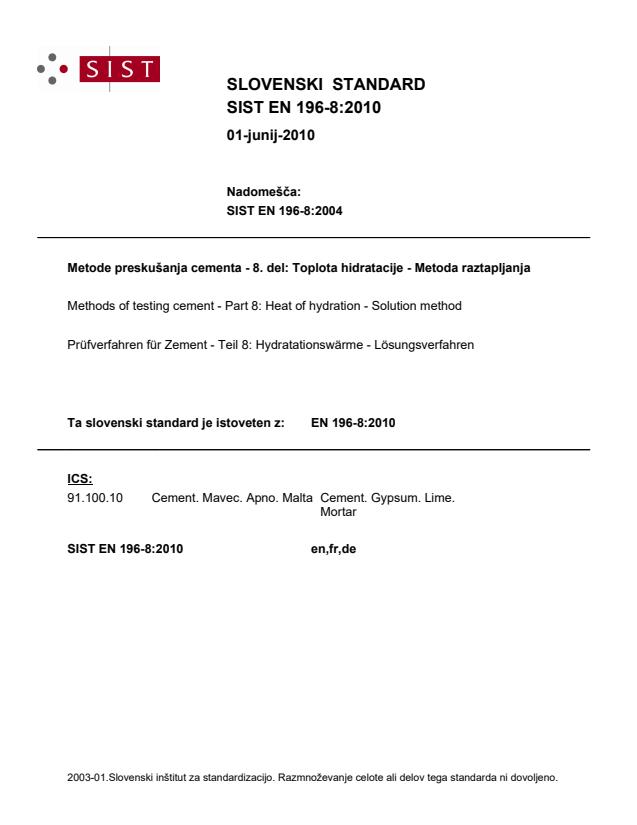
2003-01.Slovenski inštitut za standardizacijo. Razmnoževanje celote ali delov tega standarda ni dovoljeno.Metode preskušanja cementa - 8. del: Toplota hidratacije - Metoda raztapljanjaPrüfverfahren für Zement - Teil 8: Hydratationswärme - LösungsverfahrenMethods of testing cement - Part 8: Heat of hydration - Solution method91.100.10Cement. Mavec. Apno. MaltaCement. Gypsum. Lime. MortarICS:Ta slovenski standard je istoveten z:EN 196-8:2010SIST EN 196-8:2010en,fr,de01-junij-2010SIST EN 196-8:2010SLOVENSKI
STANDARDSIST EN 196-8:20041DGRPHãþD
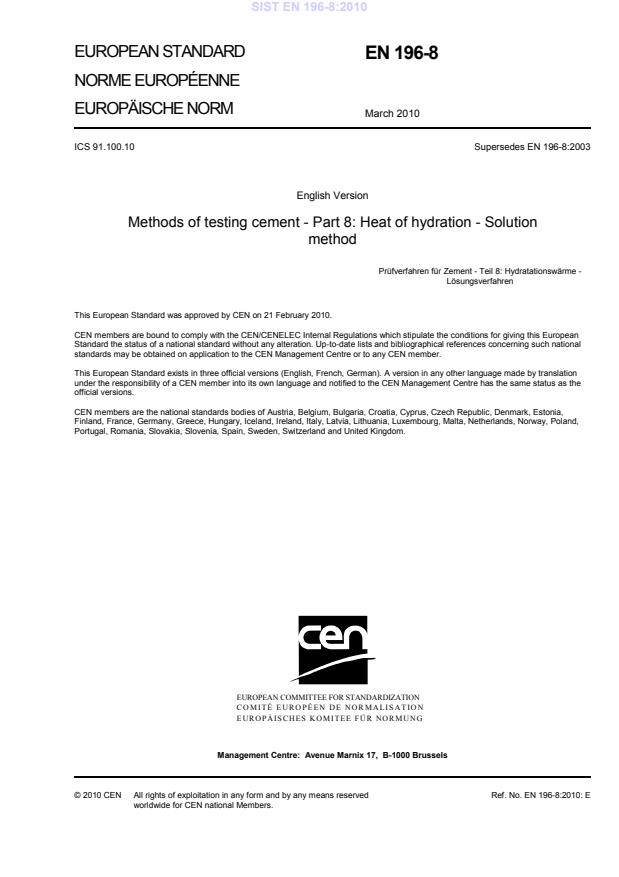
EUROPEAN STANDARD NORME EUROPÉENNE EUROPÄISCHE NORM
EN 196-8
March 2010 ICS 91.100.10 Supersedes EN 196-8:2003English Version
Methods of testing cement - Part 8: Heat of hydration - Solution method
Prüfverfahren für Zement - Teil 8: Hydratationswärme - Lösungsverfahren This European Standard was approved by CEN on 21 February 2010.
CEN members are bound to comply with the CEN/CENELEC Internal Regulations which stipulate the conditions for giving this European Standard the status of a national standard without any alteration. Up-to-date lists and bibliographical references concerning such national standards may be obtained on application to the CEN Management Centre or to any CEN member.
This European Standard exists in three official versions (English, French, German). A version in any other language made by translation under the responsibility of a CEN member into its own language and notified to the CEN Management Centre has the same status as the official versions.
CEN members are the national standards bodies of Austria, Belgium, Bulgaria, Croatia, Cyprus, Czech Republic, Denmark, Estonia, Finland, France, Germany, Greece, Hungary, Iceland, Ireland, Italy, Latvia, Lithuania, Luxembourg, Malta, Netherlands, Norway, Poland, Portugal, Romania, Slovakia, Slovenia, Spain, Sweden, Switzerland and United Kingdom.
EUROPEAN COMMITTEE FOR STANDARDIZATION
COMITÉ EUROPÉEN DE NORMALISATION EUROPÄISCHES KOMITEE FÜR NORMUNG
Management Centre:
Avenue Marnix 17,
B-1000 Brussels © 2010 CEN All rights of exploitation in any form and by any means reserved worldwide for CEN national Members. Ref. No. EN 196-8:2010: ESIST EN 196-8:2010
...