

FprEN 13040-2
(Main)Soil improvers and growing media - Sample preparation - Part 2: Sample preparation for microbiological examination
- Abstract
This document specifies the general requirements for the preparation of samples, initial suspensions and further dilutions prior to microbiological examinations of soil improvers and growing media. This method is applicable especially for sample preparation prior to microbiological examinations of e.g. Escherichia coli (E. coli), Salmonella spp. and enterococci.
If a laboratory receives a material/product that is not listed in Annex B but has external characteristics (i.e. hardness, fibrous nature, particle size) like one of the materials/products listed in Annex B, then the procedural steps for sample preparation (pre-treatment, treatment and dilution) are carried out in the same way as listed for the material/product which has comparable external characteristics.
Any special diluents or practices required for particular materials or microorganisms in specific standard methods take priority over the general requirements listed in this document.
- Status
- Not Published
- Publication Date
- 09-Feb-2027
- Technical Committee
- CEN/TC 223 - Soil improvers and growing media
- Current Stage
- 5060 - Closure of Vote - Formal Approval
- Start Date
- 12-Nov-2026
- Due Date
- 26-Mar-2026
- Completion Date
- 26-Mar-2026

FprEN 13040-2 is a CEN draft European Standard for preparing samples of soil improvers and growing media for microbiological examination. It specifies how laboratories prepare test portions, initial suspensions and further dilutions for examinations such as Escherichia coli (E. coli), Salmonella spp. and enterococci.
The document is aimed at laboratories that need a repeatable way to prepare these materials before detection or enumeration. It helps users handle different product forms, keep samples representative, and choose the right dilution or enrichment approach for the planned microbiological test.
What does FprEN 13040-2 specify?
FprEN 13040-2 specifies the general requirements for sample preparation before microbiological examination of soil improvers and growing media. It covers the preparation of the test portion, the initial suspension and any further dilutions.
The standard also sets out how to treat materials with similar external characteristics to those listed in Annex B, and it gives priority to special diluents or practices required by specific test methods.
The document is organized into clauses 1 to 8, plus two annexes.
| Annex | What it covers |
|---|---|
| Annex A | Culture media and reagents |
| Annex B | Examples of product types and the proposed sample-preparation steps |
What are the key requirements of FprEN 13040-2?
FprEN 13040-2 focuses on representative sampling, aseptic handling, controlled dilution, and different workflows for detection and enumeration. In practice, the laboratory must choose the preparation route that matches the microorganism target and the product form.
Representative test portion - Clause 4 requires a thoroughly homogenized sample before a representative test portion is removed. This matters because the microbiological result depends on taking material that reflects the whole sample, not just an easy-to-reach part.
Detection versus enumeration - Clause 4 separates preparation for detection from preparation for enumeration. For detection, the suspension is prepared for first enrichment; for enumeration, the initial suspension is prepared and then diluted further so colonies can be counted after incubation.
Aseptic handling and transport - Clause 7 and 8.1 require samples to be protected from contamination and deterioration during transport, storage and opening. Samples are stored at 5 °C ± 3 °C, not frozen, and are recommended for examination within 72 h, so the microbiome does not change before testing.
Initial suspension conditions - Clause 8.2 requires diluents close to room temperature, with attention to pH effects. For bog peat, Sphagnum, alkaline composts and high-mineral blended products, the initial suspension pH is checked and corrected to between 6 and 8.
Salmonella detection - Clause 8.2.2 uses a 25 g test portion, or 25 ml for liquids, with 225 ml of tempered peptone water or double buffered peptone water. For swelling products, more diluent may be needed so the sample is fully covered and can be homogenized properly.
E. coli and enterococci enumeration - Clause 8.2.3 uses 20 g, or 20 ml for liquids, or 10 g for very light, homogeneous materials, with the matching pre-warmed diluent. The laboratory may increase the ratio for swelling or coarse materials, and it must record extra diluent so the final count is calculated correctly.
Further decimal dilutions - Clause 8.3 describes serial dilution by transferring 1.00 ml into 9.00 ml of sterile diluent, or a larger measured volume when needed. This keeps the dilution series suitable for plating and counting, while avoiding cross-contamination from the pipette.
What terms does FprEN 13040-2 define?
FprEN 13040-2 uses terms from EN 12579, prEN 17732 and its own Clause 3 definitions.
- Laboratory sample - For microbiological testing, this is each separate segment sample intended for laboratory testing.
- Test sample - A sample prepared from the laboratory sample, from which test portions are taken.
- Test portion - The amount of material actually used for the test and observations.
- Initial suspension - The primary dilution made by treating the test portion with, normally, a nine-fold quantity of diluent.
- Further dilution - A dilution series made from the initial suspension to obtain a countable range for enumeration.
- Buffered peptone water (BPW) - A buffered diluent named in Annex A and used for sample preparation, including Salmonella detection.
- Double buffered peptone water - A stronger buffered variant used where extra buffering is helpful.
Who uses FprEN 13040-2?
FprEN 13040-2 is used by microbiology laboratories, quality control laboratories, and technical staff working with soil improvers and growing media. It is relevant to producers, test houses and buyers who need microbiological examination of products such as composts, peat-based materials, growing media, bark products and similar materials.
It is especially useful when a laboratory must decide how to size-reduce, homogenize, dilute or enrich a sample before testing for Salmonella, E. coli or enterococci.
Which standards are used with FprEN 13040-2?
FprEN 13040-2 refers to several companion documents.
- EN 12579 - Used for sampling soil improvers and growing media before microbiological examination.
- EN ISO 7218 - Provides general microbiological laboratory requirements and guidance used for reagents, equipment and routine practice.
- prEN 17732 - Supplies terminology for soil improvers and growing media.
- EN ISO 11133 - Pointed to for preparation, production, storage and performance testing of culture media.
The European foreword also places FprEN 13040-2 in the EN 13040 series, alongside Part 1 on chemical and physical tests.
What does the FprEN 13040-2 document contain?
FprEN 13040-2 contains the procedure, equipment, reagents and product examples needed to prepare samples for microbiological testing. Annex A gives the culture media and reagents, including the compositions and preparation notes for phosphate buffer and buffered peptone water.
Annex B is especially practical because it matches product types with recommended pre-treatment, treatment and dilution ratios. It covers materials such as bark, compost, peat, expanded clay, coconut products, pre-shaped growing media, liquids and mixed growing media, so the laboratory can choose a preparation approach that fits the material’s physical form.
The main body also includes a warning on laboratory safety, guidance on sample storage, and figure-based overviews of qualitative and quantitative workflows. These elements support routine testing, method selection and consistent laboratory practice.
Get Certified
Connect with accredited certification bodies for this standard

Control Union Certifications
Global certification for agriculture and sustainability.

ECOCERT
Organic and sustainability certification.

FSC International
Forest Stewardship Council certification.
Sponsored listings
Frequently Asked Questions
FprEN 13040-2 is a draft published by the European Committee for Standardization (CEN). Its full title is "Soil improvers and growing media - Sample preparation - Part 2: Sample preparation for microbiological examination". This standard covers: This document specifies the general requirements for the preparation of samples, initial suspensions and further dilutions prior to microbiological examinations of soil improvers and growing media. This method is applicable especially for sample preparation prior to microbiological examinations of e.g. Escherichia coli (E. coli), Salmonella spp. and enterococci. If a laboratory receives a material/product that is not listed in Annex B but has external characteristics (i.e. hardness, fibrous nature, particle size) like one of the materials/products listed in Annex B, then the procedural steps for sample preparation (pre-treatment, treatment and dilution) are carried out in the same way as listed for the material/product which has comparable external characteristics. Any special diluents or practices required for particular materials or microorganisms in specific standard methods take priority over the general requirements listed in this document.
This document specifies the general requirements for the preparation of samples, initial suspensions and further dilutions prior to microbiological examinations of soil improvers and growing media. This method is applicable especially for sample preparation prior to microbiological examinations of e.g. Escherichia coli (E. coli), Salmonella spp. and enterococci. If a laboratory receives a material/product that is not listed in Annex B but has external characteristics (i.e. hardness, fibrous nature, particle size) like one of the materials/products listed in Annex B, then the procedural steps for sample preparation (pre-treatment, treatment and dilution) are carried out in the same way as listed for the material/product which has comparable external characteristics. Any special diluents or practices required for particular materials or microorganisms in specific standard methods take priority over the general requirements listed in this document.
FprEN 13040-2 is classified under the following ICS (International Classification for Standards) categories: 65.080 - Fertilizers. The ICS classification helps identify the subject area and facilitates finding related standards.
FprEN 13040-2 is associated with the following European legislation: EU Directives/Regulations: 2019/1009; Standardization Mandates: M/564, M/564 Amd 1, M/564 Amd 2. When a standard is cited in the Official Journal of the European Union, products manufactured in conformity with it benefit from a presumption of conformity with the essential requirements of the corresponding EU directive or regulation.
FprEN 13040-2 is available in PDF format for immediate download after purchase. The document can be added to your cart and obtained through the secure checkout process. Digital delivery ensures instant access to the complete standard document.
Standards Content (Sample)
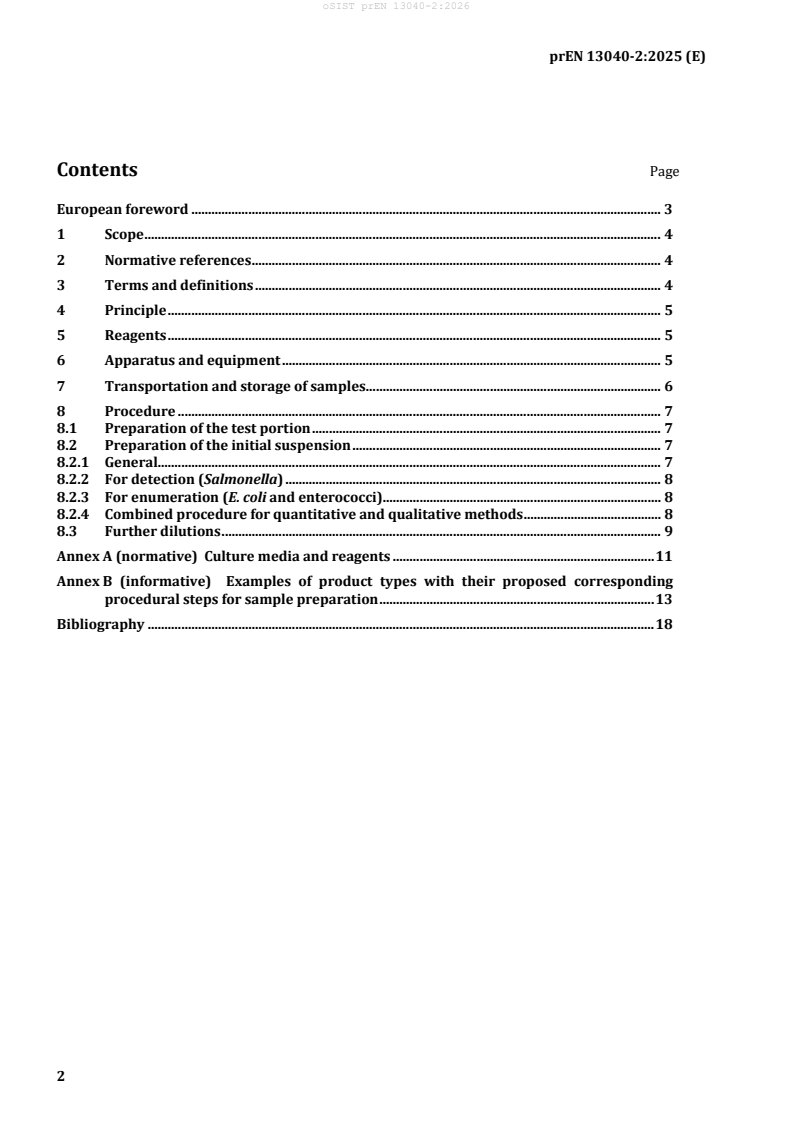
Contents
- 1 Scope
- 2 Normative references
- 3 Terms and definitions
- 3.1 laboratory sample
- 3.2 test sample
- 3.3 test portion
- 3.4 initial suspension
- 3.5 further dilution
- 4 Principle
- 5 Reagents
- 6 Apparatus and equipment
- 7 Transportation and storage of samples
- 8 Procedure
- 8.1 Preparation of the test portion
- 8.2 Preparation of the initial suspension
- 8.3 Further dilutions
- Annex A
- Annex B
- Bibliography
1 Scope
This document specifies the general requirements for the preparation of samples, initial suspensions and further dilutions prior to microbiological examinations of soil improvers and growing media. This method is intended especially for sample preparation prior to microbiological examinations of e.g. Escherichia coli (E. coli), Salmonella spp. and enterococci.
If a laboratory receives a material/product that is not listed in Annex B but has external characteristics (i.e. hardness, fibrous nature, particle size) like one of the materials/products listed in Annex B, then the procedural steps for sample preparation (pre-treatment, treatment and dilution) are carried out in the same way as listed for the material/product which has comparable external characteristics. Any special diluents or practices required for particular materials or microorganisms in specific standard methods take priority over the general requirements listed in this document.
2 Normative references
The following documents are referred to in the text in such a way that some or all of their content constitutes requirements of this document. For dated references, only the edition cited applies. For undated references, the latest edition of the referenced document (including any amendments) applies. EN 12579, Soil improvers and growing media - Sampling EN ISO 7218, Microbiology of the food chain - General requirements and guidance for microbiological examinations (ISO 7218)
prEN 17732, Soil improvers and growing media - Terminology
3 Terms and definitions
For the purposes of this document, the terms and definitions given in EN 12579, prEN 17732 and the following apply.
ISO and IEC maintain terminology databases for use in standardization at the following addresses:
- ISO Online browsing platform: available at https://www.iso.org/obp/
- IEC Electropedia: available at https://www.electropedia.org/
3.1 laboratory sample
in relation to chemical and physical testing, a final sample intended for laboratory testing and in relation to microbiological testing, each separate segment sample intended for laboratory testing
3.2 test sample
sample prepared from the laboratory sample (3.1) and from which test portions (3.3) are taken Note 1 to entry: A test sample is only necessary when the laboratory sample is used for multiple analysis (e.g. microbiological and chemical analysis). When multiple analyses are performed (e.g. microbiological and chemical analysis), appropriately sized test sample needs to be taken first for microbiological analysis in order to avoid contamination. The remaining test sample material shall be stored in a cool place for possible subsequent analyses. The remaining laboratory sample is thereafter passed on for chemical analyses, if necessary.
Under preparation. Stage at time of publication: prEN 17732:2025.
oSIST prEN 13040-2:2026 prEN 13040-2:2025 (E)
3.3 test portion
quantity of material drawn from the test sample or directly from the laboratory sample and on which the tests and observations are actually carried out
3.4 initial suspension
primary dilution obtained after the test portion (3.2) has been treated with, normally, a nine-fold quantity of diluent Note 1 to entry: A closer ratio between the diluent and the quantity of material is often not recommended because of possible inhibiting influences of the matrix.
3.5 further dilution
suspension or solution obtained by mixing a measured volume of the initial suspension (3.4) with an x- fold volume of diluent and by repeating this operation with further dilutions until a dilution series is obtained that is suitable for the inoculation of culture media Note 1 to entry: Normally ten-fold dilutions are used to yield a decimal dilution series, but other ratios may be required for specific purposes.
4 Principle
Sample preparation prior to microbiologal examination consists of two consecutive steps, for which the second step depends on the intent of the subsequent microbiological examination, meaning enumeration or detection.
1) Removal of a representative test portion (3.3) out of the test sample (3.2) or laboratory sample (3.1) after thorough homogenisation 2) Addition of the homogenic test portion to the dilution or enrichment medium and homogenisation 2a) For detection: Preparation of a suspension for the first enrichment in a way to obtain an as uniform as possible distribution of microorganisms contained in the test portion 2b) For enumeration: Preparation of an initial suspension in a way to obtain an as uniform as possible distribution of microorganisms contained in the test portion. Preparation, if necessary, of further dilutions in order to reduce the number of microorganisms per unit volume to allow counting of colonies on enumeration plates after incubation
5 Reagents
Follow current laboratory practices in accordance with standards comparable to EN ISO 7218. The composition of culture media and reagents and their preparation are specified in Annex A. For performance testing of culture media, it is advised to follow the procedures of EN ISO 11133.
6 Apparatus and equipment
Disposable equipment is an acceptable alternative to reusable glassware if it has suitable specifications. The usual microbiological laboratory equipment (see EN ISO 7218) and, in particular, the following shall be used.
6.1 Apparatus for dry sterilization (oven) or wet sterilization (autoclave).
oSIST prEN 13040-2:2026 prEN 13040-2:2025 (E) 6.2 Equipment for size reduction; apparatuses (aseptic) may include:
- scissors;
- tweezers;
- spoons;
- scalpels;
- knives;
- hammers (used with a sterile bag around the sample);
- saws;
- spatulas;
- mortar and pestle.
6.3 Homogenization devices; apparatuses (aseptic) may include:
- a magnetic stirrer with vessels and stirring bars ;
- orbital shaker, with bottles (glass beads may be used in the case of viscous or thick materials);
- peristaltic blender (paddle blender), with sterile plastic bags, preferable with a filter;
- vortex mixer (for dilutions).
6.4 Other laboratory equipment; may include:
- pipettes or pipettor and sterile tips, to dispense 1 ml to 10 ml with tips (with large opening if necessary);
- scales and gravimetric dilution controllers, capable of weighing to 1 % of the mass;
- aseptic containers (bowls, wide-mouth containers, developing tray) for homogenization of the laboratory sample.
7 Transportation and storage of samples
Sampling is not part of the method specified in this document. EN 12579 shall be followed for sampling soil improvers and growing media for microbiological examination. It is important that the laboratory receives a sample that is representative of the product under consideration. The sample shall not have been damaged or changed during transport or storage.
The samples as submitted to the laboratory, shall be stored and treated so that they shall not undergo any further decomposition, physical damage, hydration or dehydration. Samples shall be stored at 5 °C ± 3 °C, but not frozen.
It is recommended to examine the samples within 72 h after reception as the microbiome can change over time.
oSIST prEN 13040-2:2026 prEN 13040-2:2025 (E)
8 Procedure
8.1 Preparation of the test portion
WARNING — In order to safeguard the health of laboratory personnel, it is essential that the procedures described in this document are only undertaken in properly equipped laboratories, under the supervision of a skilled microbiologist, and that great care is taken in the disposal of all incubated materials. Persons using this document shall be familiar with normal laboratory practice. This document does not purport to address all of the safety aspects, if any, associated with its use. It is the responsibility of the user to establish appropriate safety and health practices.
All operations before and after opening the packaged material shall be carried out under aseptic conditions, to avoid any external contamination.
The types of packaged materials sent to the laboratory can be in flexible packaging. This shall be removed or opened aseptically.
NOTE There is no need to disinfect the packaging if the contents can be removed aseptically after opening without any risk of external contamination.
Before taking the test portion, the sample material of the laboratory sample or test sample shall be thoroughly homogenized so that representative sampling is possible. Liquid samples should be homogenized by shaking the container or stirring with an aseptic object. If possible, solid samples should be mixed in the packaging with an aseptic device. If this is not possible, the laboratory sample shall be transferred to an aseptic container (bowl, developing tray) and mixed. Remove any incidental pieces (e.g. stones, glass, plastic pieces) aseptically. The following special features shall be used:
- For pre-shaped materials (e.g. mineral wool slabs, plugs): The test portion (3.3) is taken directly from the material, without “reconstitution” by addition of water.
- For solid rigid materials (e.g. compost, bark): Solid materials shall be reduced in size to obtain a representative test portion (3.3) under aseptic conditions (6.1). The dimension of the pieces shall not exceed approximately 2 cm in all dimensions.
...