

EN 1870-9:2000+A1:2009
(Main + Amendment)Safety of woodworking machines - Circular sawing machines - Part 9: Double blade circular sawing machines for cross-cutting with integrated feed and with manual loading and/or unloading
- Abstract
This document deals with the significant hazards, hazardous situations and events as listed in Clause 4 which are relevant to double blade circular sawing machines for cross-cutting with integrated feed and with manual loading and/or unloading, hereinafter referred to as 'machines', designed to cut solid wood, chipboard, fibreboard, plywood and also these materials when covered with plastic edging and/or plastic/light alloy laminate.
This European Standard does not apply to:
- machines for cross cutting logs;
- double blade up-cutting cross-cut sawing machines.
For Computer Numerically Controlled (CNC) machines, this European Standard does not cover the hazards related to Electromagnetic Compatibility (EMC).
This European Standard is primarily directed at machines which are manufactured after the date of issue of this European Standard.
- Status
- Withdrawn
- Publication Date
- 08-Sep-2009
- Withdrawal Date
- 04-Sep-2012
- Technical Committee
- CEN/TC 142 - Woodworking machines - Safety
- Drafting Committee
- CEN/TC 142/WG 4 - Circular sawing machines
- Current Stage
- 9960 - Withdrawal effective - Withdrawal
- Start Date
- 05-Sep-2012
- Completion Date
- 05-Sep-2012
- Directive
- 2006/42/EC - Directive 2006/42/EC of the European Parliament and of the Council of 17 May 2006 on machinery, and amending Directive 95/16/EC (recast)OJ Ref: C, C 309 OJ Date: 18-Dec-2009


Relations
- Effective Date
- 19-Jan-2023
- Effective Date
- 18-Jan-2023
- Effective Date
- 17-Jul-2010
Get Certified
Connect with accredited certification bodies for this standard

Gozdarski inštitut Slovenije
Slovenian Forestry Institute. Forest management certification support, timber testing.
Sponsored listings
Frequently Asked Questions
EN 1870-9:2000+A1:2009 is a standard published by the European Committee for Standardization (CEN). Its full title is "Safety of woodworking machines - Circular sawing machines - Part 9: Double blade circular sawing machines for cross-cutting with integrated feed and with manual loading and/or unloading". This standard covers: This document deals with the significant hazards, hazardous situations and events as listed in Clause 4 which are relevant to double blade circular sawing machines for cross-cutting with integrated feed and with manual loading and/or unloading, hereinafter referred to as 'machines', designed to cut solid wood, chipboard, fibreboard, plywood and also these materials when covered with plastic edging and/or plastic/light alloy laminate. This European Standard does not apply to: - machines for cross cutting logs; - double blade up-cutting cross-cut sawing machines. For Computer Numerically Controlled (CNC) machines, this European Standard does not cover the hazards related to Electromagnetic Compatibility (EMC). This European Standard is primarily directed at machines which are manufactured after the date of issue of this European Standard.
This document deals with the significant hazards, hazardous situations and events as listed in Clause 4 which are relevant to double blade circular sawing machines for cross-cutting with integrated feed and with manual loading and/or unloading, hereinafter referred to as 'machines', designed to cut solid wood, chipboard, fibreboard, plywood and also these materials when covered with plastic edging and/or plastic/light alloy laminate. This European Standard does not apply to: - machines for cross cutting logs; - double blade up-cutting cross-cut sawing machines. For Computer Numerically Controlled (CNC) machines, this European Standard does not cover the hazards related to Electromagnetic Compatibility (EMC). This European Standard is primarily directed at machines which are manufactured after the date of issue of this European Standard.
EN 1870-9:2000+A1:2009 is classified under the following ICS (International Classification for Standards) categories: 79.120.10 - Woodworking machines. The ICS classification helps identify the subject area and facilitates finding related standards.
EN 1870-9:2000+A1:2009 has the following relationships with other standards: It is inter standard links to EN 1870-9:2000/prA1, EN 1870-9:2000, EN 1870-9:2012. Understanding these relationships helps ensure you are using the most current and applicable version of the standard.
EN 1870-9:2000+A1:2009 is associated with the following European legislation: EU Directives/Regulations: 2006/42/EC, 98/37/EC; Standardization Mandates: M/079, M/396. When a standard is cited in the Official Journal of the European Union, products manufactured in conformity with it benefit from a presumption of conformity with the essential requirements of the corresponding EU directive or regulation.
EN 1870-9:2000+A1:2009 is available in PDF format for immediate download after purchase. The document can be added to your cart and obtained through the secure checkout process. Digital delivery ensures instant access to the complete standard document.
Standards Content (Sample)
2003-01.Slovenski inštitut za standardizacijo. Razmnoževanje celote ali delov tega standarda ni dovoljeno.Sicherheit von Holzbearbeitungsmaschinen - Kreissägemaschinen - Teil 9: Doppelgehrungskreissägemaschinen mit mechanischem Vorschub und Handbeschickung und/oder HandentnahmeSécurité des machines pour le travail du bois - Machines à scier circulaires - Partie 9: Machines à scier à deux lames de scie circulaires, pour tronçonnage, à avance mécanisée et à chargement et/ou déchargement manuelsSafety of woodworking machines - Circular sawing machines - Part 9: Double blade circular sawing machines for cross-cutting with integrated feed and with manual loading and/or unloading79.120.10Lesnoobdelovalni strojiWoodworking machines25.080.60Strojne žageSawing machinesICS:Ta slovenski standard je istoveten z:EN 1870-9:2000+A1:2009SIST EN 1870-9:2000+A1:2009en01-november-2009SIST EN 1870-9:2000+A1:2009SLOVENSKI
STANDARD
EUROPEAN STANDARD NORME EUROPÉENNE EUROPÄISCHE NORM
EN 1870-9:2000+A1
September 2009 ICS 79.120.10 Supersedes EN 1870-9:2000English Version
Safety of woodworking machines - Circular sawing machines - Part 9: Double blade circular sawing machines for cross-cutting with integrated feed and with manual loading and/or unloading
Sécurité des machines pour le travail du bois - Machines à scier circulaires - Partie 9: Machines à scier à deux lames de scie circulaires, pour tronçonnage, à avance mécanisée et à chargement et/ou déchargement manuels
Sicherheit von Holzbearbeitungsmaschinen - Kreissägemaschinen - Teil 9: Doppelgehrungskreissägemaschinen mit mechanischem Vorschub und Handbeschickung und/oder HandentnahmeThis European Standard was approved by CEN on 1st March 2000 and includes Amendment 1 approved by CEN on 6 August 2009.
CEN members are bound to comply with the CEN/CENELEC Internal Regulations which stipulate the conditions for giving this European Standard the status of a national standard without any alteration. Up-to-date lists and bibliographical references concerning such national standards may be obtained on application to the CEN Management Centre or to any CEN member.
This European Standard exists in three official versions (English, French, German). A version in any other language made by translation under the responsibility of a CEN member into its own language and notified to the CEN Management Centre has the same status as the official versions.
CEN members are the national standards bodies of Austria, Belgium, Bulgaria, Cyprus, Czech Republic, Denmark, Estonia, Finland, France, Germany, Greece, Hungary, Iceland, Ireland, Italy, Latvia, Lithuania, Luxembourg, Malta, Netherlands, Norway, Poland, Portugal, Romania, Slovakia, Slovenia, Spain, Sweden, Switzerland and United Kingdom.
EUROPEAN COMMITTEE FOR STANDARDIZATION
COMITÉ EUROPÉEN DE NORMALISATION EUROPÄISCHES KOMITEE FÜR NORMUNG
Management Centre:
Avenue Marnix 17,
B-1000 Brussels © 2009 CEN All rights of exploitation in any form and by any means reserved worldwide for CEN national Members. Ref. No. EN 1870-9:2000+A1:2009: ESIST EN 1870-9:2000+A1:2009
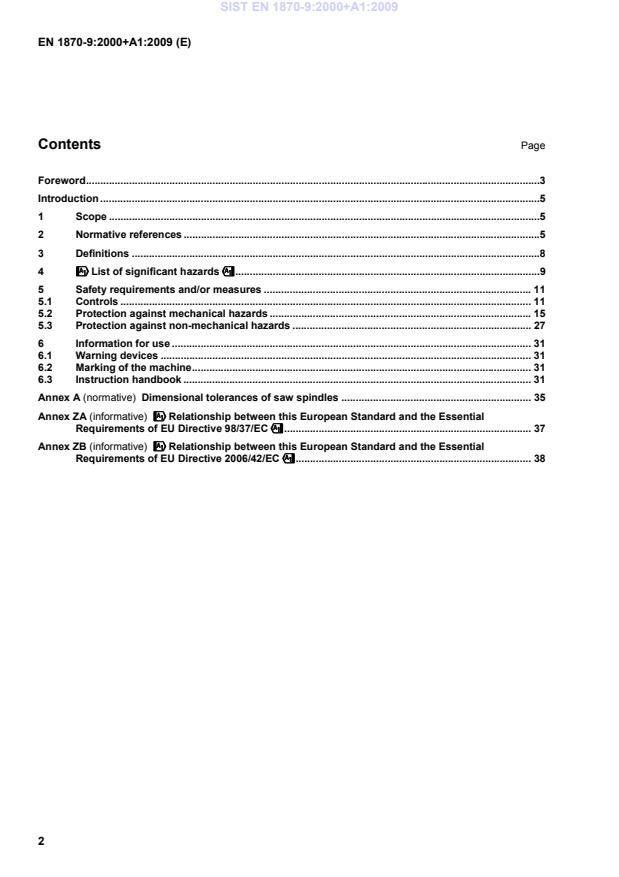
Dimensional tolerances of saw spindles . 35Annex ZA (informative)
!!!!Relationship between this European Standard and the Essential Requirements of EU Directive 98/37/EC"""" . 37Annex ZB (informative)
!!!!Relationship between this European Standard and the Essential Requirements of EU Directive 2006/42/EC"""" . 38 SIST EN 1870-9:2000+A1:2009
1 Scope !This document deals with all significant hazards, hazardous situations and events as listed in Clause 4 which are relevant to double blade circular sawing machines for cross-cutting with integrated feed and with manual loading and/or unloading, hereinafter referred to as 'machines', designed to cut solid wood, chipboard, fibreboard, plywood and also these materials when covered with plastic edging and/or plastic/light alloy laminate." This European Standard does not apply to: machines for cross cutting logs; double blade up-cutting cross-cut sawing machines. !deleted text" For Computer Numerically Controlled (CNC) machines, this European Standard does not cover the hazards related to Electromagnetic Compatibility (EMC). This European Standard is primarily directed at machines which are manufactured after the date of issue of this European Standard. 2 Normative references !The following referenced documents are indispensable for the application of this document. For dated references, only the edition cited applies. For undated references, the latest edition of the referenced document (including any amendments) applies. " !deleted text" EN 574:1996, Safety of machinery — Two hand control devices — Functional aspects — Principles for design !EN 614-1:2006, Safety of machinery — Ergonomic design principles — Part 1: Terminology and general principles" SIST EN 1870-9:2000+A1:2009
EN 60529:1991, Degrees of protection provided by enclosures (IP Code) !(IEC 60529:1989)" !EN 60825-1:2007, Safety of laser products — Part 1: Equipment classification and requirements (IEC 60825-1:2007) " !EN 60947-4-1:2001, Low-voltage switchgear and controlgear — Part 4-1: Contactors and motor-starters — Electromechanical contactors and motor-starters (IEC 60947-4-1:2000) " !EN 60947-5-1:2004", Low voltage switchgear and control gear — Part 5-1: Control circuit devices and switching elements — Electromechanical control circuit devices !(IEC 60947-5-1:2003)" !EN 61310-1:2008, Safety of machinery — Indication, marking and actuation — Part 1: Requirements for visual, acoustic and tactile signals (IEC 61310-1:2007) " SIST EN 1870-9:2000+A1:2009
!EN ISO 11204:1995", Acoustics — Noise emitted by machinery and equipment — Measurement of emission sound pressure levels at a work station and at other specified positions — Method requiring environmental corrections (ISO 11204:1995) EN ISO 11688-1:1998, Acoustics — Recommended practice for the design of low noise machinery and equipment — Part 1: Planning (ISO/TR 11688-1:1995) !EN ISO 12100-1:2003, Safety of machinery — Basic concepts, general principles for design — Part 1: Basic terminology and methodology (ISO 12100-1:2003) EN ISO 12100-2:2003, Safety of machinery — Basic concepts, general principles for design — Part 2: Technical principles (ISO 12100-2:2003)" !EN ISO 13849-1:2008, Safety of machinery — Safety-related parts of control systems — Part 1: General principles for design (ISO 13849-1:2006) " !EN ISO 13850:2008, Safety of machinery — Emergency stop — Principles for design (ISO 13850:2006)" !EN ISO 13857:2008, Safety of machinery — Safety distances to prevent hazard zones being reached by upper and lower limbs (ISO 13857:2008) " !deleted text" ISO 7960:1995, Airborne noise emitted by machine tools — Operating conditions for woodworking machines !HD 21.1 S4:2002, Cables of rated voltages up to and including 450/750 V and having thermoplastic insulation — Part 1: General requirements" SIST EN 1870-9:2000+A1:2009
The cutting stroke can be downwards or horizontal. One or both sawing units can be adjusted horizontally and may be canted or pivoted 3.3 semi-automatic double blade circular sawing machine for cross-cutting a machine where the saw units have integrated feed which is initiated manually and the workpiece is positioned manually or by means of a positioning mechanism for cutting to length. The cutting stroke can be downwards or horizontal 3.4 automatic double blade circular sawing machine for cross-cutting a machine where the saw units have integrated feed which is initiated automatically. The workpiece is manually loaded and/or unloaded and automatically positioned for cutting to pre-selected lengths. The cutting stroke can be downwards or horizontal 3.5 machine actuator a power mechanism used to effect motion of the machine 3.6 integrated feed a feed mechanism for the workpiece or tool which is integrated with the machine and where the workpiece or machine element with incorporated tool are held and controlled mechanically during machining operation 3.7 cutting area of the sawblade the area of the sawblade which can be involved in the cutting process 3.8 non-cutting area of the sawblade the area of the sawblade where the sawblade is not be involved in the cutting process 3.9 ejection the unexpected movement of the workpiece or parts of it or part of the machine from the machine during processing 3.10 run-down time the time elapsed from the actuation of the stop control device up to spindle standstill SIST EN 1870-9:2000+A1:2009
i.e. for which there is no intermediate loading device to receive and transfer the workpiece from the operator to the integrated feed 3.12 manual unloading of power fed machines the operation during which the workpiece is removed by the operator directly from the machine outfeed; i.e. for which there is no intermediate unloading device to receive and transfer the workpiece from the machine outfeed to the operator 3.13 !!!!information from the supplier"""" statements, sales literature, leaflets or other, where a manufacturer (supplier) declares either the characteristics or the compliance of the material or product to a relevant standard 4 !!!!List of significant hazards"""" !This clause contains all significant hazards, hazardous situations and events (see EN 1050:1996) as far as they are dealt with in this document, identified by risk assessment as significant for the machines as defined in the scope and which require action to eliminate or reduce the risk. This document deals with these significant hazards by defining safety requirements and/or measures or by reference to relevant standards. These hazards are listed in Table 1 in accordance with Annex A of EN 1050:1996. Table 1 — List of significant hazards
No Hazards, hazardous situations and hazardous events EN ISO 12100 Relevant sub-clause of this document
Part 1: 2003 Part 2: 2003
1 Mechanical hazards related to: - machine parts or workpieces:
a) shape; 4.2 4.2.1, 4.2.2, 5 5.2.3, 5.2.7, 5.2.8
b) relative location; 5.1.2, 5.1.3, 5.2.6, 5.2.7, 5.2.8
d) mass and velocity (kinetic energy of elements in controlled or uncontrolled motion); 5.2.7
e) mechanical strength. 5.2.2, 5.2.3, 5.2.6
- accumulation of energy inside the machinery: g) liquids and gases under pressure; 4.2 4.10, 5.5.4 5.3.7, 5.3.8 1.1 Crushing hazard 4.2.1
5.2.7, 5.2.8 1.2 Shearing hazard 5.2.7, 5.2.8 SIST EN 1870-9:2000+A1:2009
5.2.2, 5.2.3, 5.2.7, 1.4 Entanglement hazard 5.2.7 1.5 Drawing-in or trapping hazard 5.2.7 1.9 High pressure fluid injection or ejection hazard 5.3.7, 5.3.8 2 Electrical hazards due to: 2.1 Contact of persons with live parts (direct contact) 4.3 4.9, 5.5.4 5.3.4, 5.3.15, 5.3.16 2.2 Contact of persons with parts which have become live under faulty conditions (indirect contact) 4.3 4.9 5.3.4, 5.3.15, 5.3.16 4 Hazards generated by noise, resulting in: 4.1 Hearing loss (deafness), other physiological disorders (loss of balance, loss of awareness) 4.5 4.2.2, 5 5.3.2 4.2 Interference with speech communication, acoustic signals.
5.3.2 6 Hazards generated by radiation 6.5 Lasers 4.7
5.3.12 7 Hazards generated by materials and substances (and their constituent elements) processed or used by the machinery 7.1 Hazards from contact with or inhalation of harmful fluids and dusts 4.8 4.3b, 4.4
5.3.3 7.2 Fire hazard 4.8 4.4
5.3.1, 5.3.3 8 Hazards generated by neglecting ergonomic principles in machinery design related to: 8.1 Unhealthy postures or excessive effort 4.9 4.7, 4.8.2, 4.11.12, 5.5.5, 5.5.6 5.1.2 8.2 Hand-arm or foot-leg anatomy 4.9 4.8.3
5.1.2 8.4 Local lighting
4.8.6 6.3 8.6 Human error, human behaviour
4.8, 4.11.8, 4.11.10, 5.5.2, 6 6.3 8.7 Design, location or identification of manual controls
4.8.7, 4.11.8 5.1.2 8.8 Design or location of visual display units
4.8.8, 6.2 5.1.2 9 Combination of hazards 4.11
5.1.7 10 Unexpected start up, unexpected overrun/overspeed (or any similar malfunction) from: 10.1 Failure/disorder of the control system
4.11, 5.5.4
5.1.1 10.2 Restoration of energy supply after an interruption
4.11.4
5.1.8, 5.1.9, 5.3.7, 5.3.8 SIST EN 1870-9:2000+A1:2009
4.11.11 5.1.1, 5.3.4 10.6 Errors made by the operator (due to mismatch of machinery with human characteristics and abilities, see 8.6) 4.9 4.8, 4.11.8, 4.11.10, 5.5.2, 6 5.1.1, 5.3.5,
6.3 11 Impossibility of stopping the machine in the best possible conditions
4.11.1, 4.11.3, 5.5.2
5.1.2, 5.1.4, 5.1.5 13 Failure of the power supply
4.11.1, 4.11.4 5.1.8 14 Failure of the control circuit
4.11, 5.5.4
5.1.1 15 Errors of fitting 4.9
4.7, 6.5
5.2.3 16 Break-up during operation 4.2.2 4.3 5.2.2 17 Falling or ejected objects or fluids 4.2.2 4.3, 4.10
5.2.2, 5.2.3, 5.2.5, 5.2.6, 5.2.8 18 Loss of stability / overturning of machinery 4.2.2 5.2.6
5.2.1 " 5 Safety requirements and/or measures For guidance in connection with risk reduction by design, see !4.1 of EN ISO 12100-2:2003", and in addition:
5.1 Controls 5.1.1 Safety and reliability of control systems For the purposes of this European Standard a safety related control system is one from and including the initial manual control or position detector to the point of input to the final actuator or element e.g. motor. The safety related control systems of this machine are those for: starting (see 5.1.3), normal stopping (see 5.1.4), emergency stop (see 5.1.5), interlocking (see 5.1.3, 5.2.7.2, 5.2.7.6), interlocking with guard locking (see 5.2.7.1, 5.2.7.2, 5.2.7.4, 5.2.7.6), clamping (see 5.2.8), the braking system (see 5.2.4), two-hand control (see 5.2.7.1), hold to run control (see 5.2.7.3), SIST EN 1870-9:2000+A1:2009
!EN ISO 13849-1:2008" if the time delay device is designed for at least one million actuations. Verification: By checking the relevant drawings and/or circuit diagrams !and" inspection of the machine !deleted text". !NOTE For components characteristics the information from the component supplier can be useful. " 5.1.2 Position of controls
See 10.1.1 of !EN 60204-1:2006" and in addition: Where the machine is fitted with a two-hand control device it shall be: a) situated at the front of the machine; b) below the workpiece support; c) at a minimum height above floor level of
750 mm; d) such that where the maximum distance between the saw units is ≥ 2,5 m it is capable of being located central between the saw units ± 300 mm for each adjusted position and not less than 300 mm from the closest position of a sawblade. Where the control for the clamps is separate from the two hand control it shall be within 400 mm measured horizontally to the two hand control. According to the size of machine, one or more emergency stops (see 5.1.5) shall be positioned: e) within 1,0 m of the loading position; f) within 1,0 m of the unloading position; g) at the main control panel; h) within 500 mm of the two hand control (where provided); i) within 3,0 m of the saw unit. Verification: By checking the relevant drawings and/or circuit diagrams, inspection and relevant functional testing on the machine. 5.1.3 Starting See !4.11 of EN ISO 12100-2:2003" and 9.2.5.2 of !EN 60204-1:2006" and in addition: For the purpose of this European Standard "all the safeguards in place and functional" is achieved by the interlocking arrangements described in 5.2.7 and 5.2.8 and "operation" means rotation and/or powered adjustment of any saw spindle and/or powered movement of any workpiece holding and feeding device and/or any machine element in which a sawblade is mounted. The exceptions described in 9.2.5.2 of !EN 60204-1:2006" are not relevant. For semi-automatic machines the cutting stroke shall only be capable of being started with a manually operated control device after sawblade rotation and clamping have been initiated. For all machines the cutting stroke shall only be capable of being started after sawblade rotation and clamping have been initiated and when: SIST EN 1870-9:2000+A1:2009
When actuated the emergency stop shall disconnect power from all machine actuators and actuate the brake (if provided). When initiated the stopping sequence shall be: a) initiate the return stroke of the saw unit; b) remove power to the workpiece clamping device; c) cut power to saw spindle motors and initiate the brakes (if provided); d) when braking sequence is complete, cut power to the brakes (if electrical brake is provided). SIST EN 1870-9:2000+A1:2009
Table 2 — Characteristics of light alloy sawblade guards Ultimate tensile strength N mm-2 Minimum thickness mm 180 5 240 4 300 3
!NOTE For the ultimate tensile strength a confirmation from the manufacturer of the material can be useful"" 5.2.3 Tool holder and tool design 5.2.3.1 Spindle locking When it is necessary to hold a spindle stationary for tool changing, a spindle holding device shall be provided, e.g. this may be a double spanner arrangement, or an integral locking bar to each saw unit to be inserted through the spindles. These bars shall be a minimum diameter of 8 mm and be made from steel with an ultimate tensile strength of at least 350 N mm-2. Locking bars shall prevent spindles from rotating if a spindle drive motor is inadvertently switched on. Verification: By checking the relevant drawings, inspection, measurement !deleted text" and relevant functional testing of the machine. Alternatively on machines with locking bars, by the following test: After starting the spindle drive motor and with the locking bar in place the spindle shall remain stationary. !NOTE For the ultimate tensile strength a confirmation from the manufacturer of the material can be useful. " 5.2.3.2 Tool fixing device Saw flanges (or in the case of flush mounted sawblades - a flange) shall be provided. For sawblades up to 450 mm diameter the diameter of both flanges (or flange for flush mounting) shall be at least D/4 (where D = the diameter of the largest sawblade for which the machine is designed). For sawblades with a diameter greater than 450 mm, the diameter of the flanges (or flange for flush mounting) shall be at least D/6, but not less than 115 mm. For flanges other than those for flush mounted sawblades the clamping surface at the outside part of flange shall be at least 5 mm in width and recessed to the centre (see figure 1). Where two flanges, for each saw spindle, are provided, both outside diameters shall be within a tolerance of ± 1 mm. Precautions shall be taken to ensure that the sawblades do not come loose during start-up, running, run-down or braking, e.g. by using a positive connection between the spindle and the sawblade, or by using a positive connection between the front flange and the saw spindle. Saw spindles shall be manufactured in accordance with the tolerances given in Annex A. Verification: By checking the relevant drawings, measurement and inspection of the machine.
Figure 1 — Saw flange detail at the clamping surface 5.2.4 Braking 5.2.4.1 Semi-automatic machines An automatic brake shall be provided for the saw spindles where the unbraked run-down time is more than
10 s. The braked run-down time shall be less than 10 s. Reverse current electrical braking shall not be used. Verification: For the determination of unbraked run-down time and braked run-down time, if relevant, see the appropriate test below. 5.2.4.2 Automatic machines An automatic brake shall be provided for the saw spindles where the unbraked run-down time is more than 40 s. The braked run-down time shall be less than 40 s. Reverse current electrical braking shall not be used. Verification: for the determination of unbraked run-down time and braking time, if relevant, see the appropriate test below. 5.2.4.3 Conditions for all tests The spindle units shall be set in accordance with the manufacturer’s instructions (e.g. belt tension). When selecting the speed and the sawblades, conditions shall be chosen which create the greatest kinetic energy for which the machine is designed. Warm up the spindle units for at least 15 min by running the machine under no load before beginning the test. SIST EN 1870-9:2000+A1:2009
An additional centre workpiece support between the two saw units shall be fitted where the maximum distance between the workpiece supports of the saw units exceeds 2 m (see figure 2). If there is a possibility of contact between a workpiece support and a sawblade, this part of the workpiece support shall be made of wood, light alloy or plastic. SIST EN 1870-9:2000+A1:2009
Figure 2 — Workpiece supports
5.2.6.2 Workpiece guides Each saw unit shall be provided with a fence on both sides of each saw line. If there is a possibility of contact between the fence and the sawblade, this part of the fence shall be made of wood, light alloy or plastic. Verification: By checking the relevant drawings, measurement, inspection and relevant functional testing on the machine. 5.2.7 Prevention of access to moving parts 5.2.7.1 Guarding of the sawblades on down-cutting machines The non-cutting area of the sawblades shall be guarded with a fixed guard to the lowest point on the periphery of the saw flange. Where access is required for sawblade changing, the access component shall only be capable of opening with the aid of a tool and shall remain integral with the machine when open, e.g. hinged. The guard shall not remain in place without its fixing. Access to the sawblades in the cutting area shall be prevented by either: a) a self closing guard on both sides of the saw teeth which extends beyond the periphery of the sawblade (see figure 3a)) in accordance with the dimensions given in figure 4a) and which opens when it makes contact with the workpiece or the fence. The guard shall lie on the workpiece or the fence during cutting to afford maximum protection; or b) a self closing guard which covers at least the periphery of the sawblade and both sides of the saw teeth (see figures 3a) and 3b)) in accordance with the dimensions in figure 4b). This guard shall be completely closed in the rest position and shall progressively open and be fully open when the sawblade is at its lowest position for which the machine is designed. Both types of guard shall be locked in the fully closed position when the saw unit is in the rest position.
Both types of guard shall permit the changing of the sawblade without removing the guard from the machine. 1 Adjustable centre support 2 Pivoting adjustment (when
provided) 3 Adjustable saw unit 4 Sawblade 5 Roller table (option) SIST EN 1870-9:2000+A1:2009
Figure 3 a) — Self closing guard in accordance with the requirements of 5.2.7.1a) SIST EN 1870-9:2000+A1:2009
Figure 3 b) — Self closing guard in accordance with the requirements of 5.2.7.1b) SIST EN 1870-9:2000+A1:2009
Figure 3 c) — Guard lowered and partially open Figure 3 — Guarding the cutting area of the sawblade
Figure 4 a) — Guard in accordance with the requirements of 5.2.7.1a) SIST EN 1870-9:2000+A1:2009
Figure 4 b) — Guard in accordance with the requirements of 5.2.7.1b) 1 Guard 2 Sawblade Figure 4 — Dimensions of self closing guards In addition on automatic machines access to the sawblades during the cutting stroke shall be prevented either: c) with fixed guards, any openings in which shall be so designed that the safety distances of table 4 of !EN ISO 13857:2008" are fulfilled. Any access door shall be interlocked with guard locking and the door shall remain closed until the sawblades have returned to the rest position; or
d) by the provision of pressure sensitive mats in accordance with the requirements of at least type 2 of EN 1760-1:1997 which shall be operative over a distance of at least 1,3 m measured horizontally to the nearest position of the sawblades and the return of the sawblades to the rest position shall be within 1 s after the activation of the pressure sensitive mats; or e) by the provision of an active opto-electronic protective device (light beam) in accordance with the requirements of at least type 2 of !CLC/TS 61496-2:2006" positioned at a distance of at least 1,3 m measured horizontally to the nearest position of the sawblades. It shall have 2 horizontal beams, one at 400 mm from the floor level and one at 900 mm from the floor level. The return o
...