

CEN/TR 12333:2021
(Main)Fertilizers - Crushing strength determination on fertilizers grains
- Abstract
This document is applicable to crushing strength measurement as applied to grains of fertilizer obtained in prilling or wet-granulation process. Compacted or crystalline materials were not considered.
- Status
- Published
- Publication Date
- 01-Jun-2021
- Technical Committee
- CEN/TC 260 - Fertilizers and liming materials
- Drafting Committee
- CEN/TC 260/WG 1 - Sampling
- Current Stage
- 6060 - Definitive text made available (DAV) - Publishing
- Start Date
- 02-Jun-2021
- Due Date
- 29-Sep-2021
- Completion Date
- 02-Jun-2021


Overview
CEN/TR 12333:2021 - Fertilizers: Crushing strength determination on fertilizer grains is a CEN Technical Report that documents methods, an international ring test and statistical evaluation for measuring the crushing strength (force required to destroy a grain) of fertilizer granules produced by prilling or wet granulation. Compacted or crystalline fertilizers are explicitly excluded. The report consolidates test procedure elements (apparatus, sample preparation, measurement and reporting) and presents interlaboratory results showing large variability that precluded establishing a fully normalized standard method.
Key topics and technical requirements
- Scope and definitions
- Applies to prilled and wet-granulated fertilizer grains (grain size example used: 2.8 mm).
- Defines crushing strength as the force necessary to destroy an individual grain.
- Apparatus and measurement principles
- Notes both constant load and constant speed apparatus are used; direction of force can be vertical or horizontal.
- Lists representative instruments used in the ring test (e.g., Alvetron, Ceast, Erweka) and compression speed ranges.
- Sample preparation
- Typical protocol in the ring test: several hundreds of grains supplied to laboratories (e.g., ≥250) with sieving to select grain size and packaging to prevent moisture/physical damage.
- Procedure and reporting
- Follow instrument manufacturer instructions; measure grains one-by-one and report environmental conditions (temperature, relative humidity), compression speed and apparatus type.
- Statistical analysis
- Uses ISO 5725 principles (repeatability and reproducibility) and normal/log-normal distribution tests (Kolmogorov-Smirnov, Shapiro-Wilk), Grubbs outlier test, t-tests for group comparisons.
- Results showed high repeatability (r) and reproducibility (R) relative to mean values for tested fertilizers, indicating poor interlaboratory agreement.
- Conclusion
- The 1992 ring test data (reported in the 2021 TR) revealed large variability likely due to anisotropic internal grain structure and environmental sensitivity (moisture, humidity, temperature). Consequently, methods used could not reliably distinguish product quality at 95% significance and were not recommended as a standardized routine test.
Applications - who uses this and why
- Fertilizer manufacturers - for internal quality control, R&D on granule mechanical properties and production optimization.
- Testing laboratories - to understand measurement variables and to structure test reports (include temp, RH, compression speed, apparatus).
- Instrument manufacturers - for development and validation of crushing strength testers and to document method limitations.
- Researchers and standard bodies - to assess reproducibility issues, design improved interlaboratory studies, or develop alternative measurement approaches.
Related standards
- ISO 565 (test sieves) - for grain size selection.
- ISO 5725 series (precision of measurement methods) - referenced for statistical evaluation.
Keywords: CEN/TR 12333:2021, crushing strength, fertilizer grains, prilling, wet-granulation, repeatability, reproducibility, interlaboratory test, fertilizer quality control.
Relations
- Effective Date
- 09-Jun-2021
- Effective Date
- 25-Aug-2026
- Effective Date
- 25-Aug-2026
- Effective Date
- 28-Jan-2026
- Effective Date
- 28-Jan-2026
Get Certified
Connect with accredited certification bodies for this standard

Control Union Certifications
Global certification for agriculture and sustainability.

ECOCERT
Organic and sustainability certification.

FSC International
Forest Stewardship Council certification.
Sponsored listings
Frequently Asked Questions
CEN/TR 12333:2021 is a technical report published by the European Committee for Standardization (CEN). Its full title is "Fertilizers - Crushing strength determination on fertilizers grains". This standard covers: This document is applicable to crushing strength measurement as applied to grains of fertilizer obtained in prilling or wet-granulation process. Compacted or crystalline materials were not considered.
This document is applicable to crushing strength measurement as applied to grains of fertilizer obtained in prilling or wet-granulation process. Compacted or crystalline materials were not considered.
CEN/TR 12333:2021 is classified under the following ICS (International Classification for Standards) categories: 65.080 - Fertilizers. The ICS classification helps identify the subject area and facilitates finding related standards.
CEN/TR 12333:2021 has the following relationships with other standards: It is inter standard links to CR 12333:1996, ISO 565:1990, ISO 5725:1986, EN ISO 5080:1999, EN 12503-2:2001. Understanding these relationships helps ensure you are using the most current and applicable version of the standard.
CEN/TR 12333:2021 is available in PDF format for immediate download after purchase. The document can be added to your cart and obtained through the secure checkout process. Digital delivery ensures instant access to the complete standard document.
Standards Content (Sample)
SLOVENSKI STANDARD
01-november-2021
Nadomešča:
SIST CR 12333:1999
Gnojila - Določanje odpornosti granul gnojil proti drobljenju
Fertilizers - Crushing strength determination on fertilizers grains
Düngemittel - Bestimmung der Kornfestigkeit auf Düngemittelkörnern
Engrais - Détermination de la résistance à l'écrasement des engrais
Ta slovenski standard je istoveten z: CEN/TR 12333:2021
ICS:
65.080 Gnojila Fertilizers
2003-01.Slovenski inštitut za standardizacijo. Razmnoževanje celote ali delov tega standarda ni dovoljeno.
CEN/TR 12333
TECHNICAL REPORT
RAPPORT TECHNIQUE
June 2021
TECHNISCHER BERICHT
ICS 65.080 Supersedes CR 12333:1996
English Version
Fertilizers - Crushing strength determination on fertilizers
grains
Engrais - Détermination de la résistance à l'écrasement Düngemittel - Bestimmung der Kornfestigkeit auf
des engrais Düngemittelkörnern
This Technical Report was approved by CEN on 23 May 2021. It has been drawn up by the Technical Committee CEN/TC 260.
CEN members are the national standards bodies of Austria, Belgium, Bulgaria, Croatia, Cyprus, Czech Republic, Denmark, Estonia,
Finland, France, Germany, Greece, Hungary, Iceland, Ireland, Italy, Latvia, Lithuania, Luxembourg, Malta, Netherlands, Norway,
Poland, Portugal, Republic of North Macedonia, Romania, Serbia, Slovakia, Slovenia, Spain, Sweden, Switzerland, Turkey and
United Kingdom.
EUROPEAN COMMITTEE FOR STANDARDIZATION
COMITÉ EUROPÉEN DE NORMALISATION
EUROPÄISCHES KOMITEE FÜR NORMUNG
CEN-CENELEC Management Centre: Rue de la Science 23, B-1040 Brussels
© 2021 CEN All rights of exploitation in any form and by any means reserved Ref. No. CEN/TR 12333:2021 E
worldwide for CEN national Members.
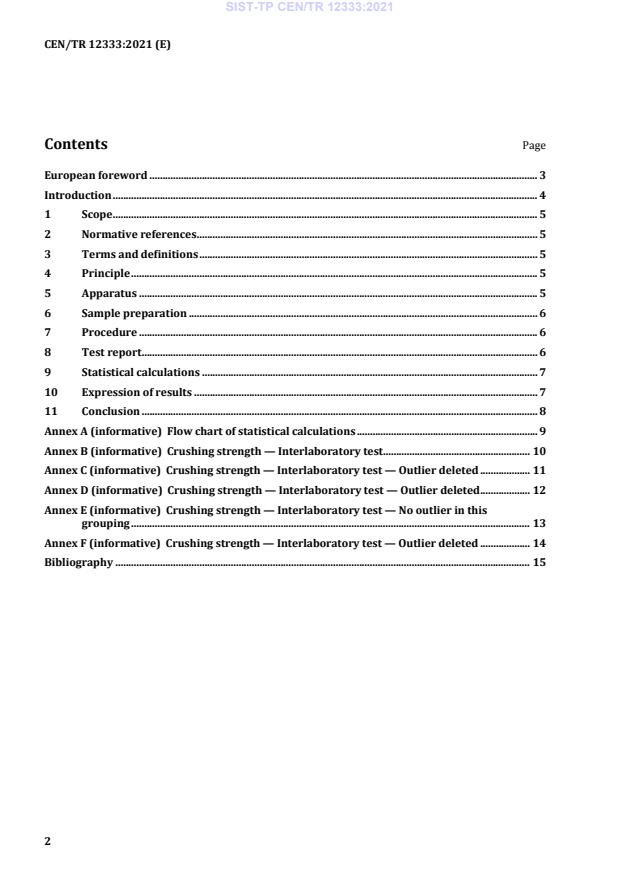
Contents Page
European foreword . 3
Introduction . 4
1 Scope . 5
2 Normative references . 5
3 Terms and definitions . 5
4 Principle . 5
5 Apparatus . 5
6 Sample preparation . 6
7 Procedure . 6
8 Test report . 6
9 Statistical calculations . 7
10 Expression of results . 7
11 Conclusion . 8
Annex A (informative) Flow chart of statistical calculations . 9
Annex B (informative) Crushing strength — Interlaboratory test. 10
Annex C (informative) Crushing strength — Interlaboratory test — Outlier deleted . 11
Annex D (informative) Crushing strength — Interlaboratory test — Outlier deleted . 12
Annex E (informative) Crushing strength — Interlaboratory test — No outlier in this
grouping . 13
Annex F (informative) Crushing strength — Interlaboratory test — Outlier deleted . 14
Bibliography . 15
European foreword
This document (CEN/TR 12333:2021) has been prepared by Technical Committee CEN/TC 260
“Fertilizers and liming materials”, the secretariat of which is held by DIN.
Attention is drawn to the possibility that some of the elements of this document may be the subject of
patent rights. CEN shall not be held responsible for identifying any or all such patent rights.
This document supersedes CR 12333:1996.
Significant changes between this document and CR 12333:1996 are as follows:
a) 24/8/8, 13/13/21 and 0/10/20 changed to NPK 24+8+8, NPK 13+13+21 and PK 10+20,
respectively;
b) adaption to current principles and rules for structure and drafting.
The present report arises from work done by CEN/TC 260/WG 2 under the work item “Crushing strength
determination” with the view of producing a European Standard.
Unfortunately, after several ring tests, results appeared to be so randomly distributed that a statistically
significant interpretation showing good reproducibility and repeatability could not be obtained.
Tests on correlation have also shown that no significant correlation as to the causes of the dispersion of
the results could be obtained within the proposed time scale and probably not without expending too
much effort, time and money.
Therefore, since the results obtained may be added to those of past publications in the literature,
CEN/TC 260 decided the results obtained should not be ignored by the scientific community.
Introduction
The resistance to crushing (crushing strength) of fertilizer is an important property used in quality
control of fertilizer production. It influences the storage and handling as well as spreading properties of
fertilizer.
However, crushing strength of fertilizer grains is not a constant property stricto sensu. Crushing strength
is significantly influenced by the content of free water in the fertilizer, humidifying and drying during
storage, as well as by temperature changes. Time dependent processes in the grain and bulk during the
lifetime of the grains may also affect the crushing strength.
Nevertheless, there are several “in house” methods used for the measurement of crushing strength of
fertilizer grains which give different results. There is also a need for a standardized method.
This document reports the results of the international ring test, organized by CEN/TC 260/WG 2
(physical properties), carried out 1992, with the purpose of standardizing the measurement technique of
crushing strength.
1 Scope
This document is applicable to crushing strength measurement as applied to grains of fertilizer obtained
in prilling or wet-granulation process. Compacted or crystalline materials were not considered.
2 Normative references
The following documents are referred to in the text in such a way that some or all of their content
constitutes requirements of this document. For dated references, only the edition cited applies. For
undated references, the latest edition of the referenced document (including any amendments) applies.
ISO 565:1990, Test sieves — Metal wire cloth, perforated metal plate and electroformed sheet — Nominal
sizes of openings
ISO 5725:1986, Precision of test methods — Determination of repeatability and reproducibility for a
standard test method by inter-laboratory tests
3 Terms and definitions
For the purposes of this document, the following terms and definitions apply.
ISO and IEC maintain terminological databases for use in standardization at the following addresses:
— ISO Online browsing platform: available at https://www.iso.org/obp
— IEC Electropedia: available at https://www.electropedia.org/
3.1
crushing strength of grains
force necessary to destroy the grain as such
4 Principle
The measurement of the force applied for the destruction of the grains may be carried out by constant
load or constant speed.
NOTE Not all manufacturers of apparatus can give information about the principle (constant speed or constant
load) used.
It is not known which of the first “peak” or maximum of force applicable on the grain is measured.
The grains undergoing the measurement were of the same size.
5 Apparatus
5.1 Sieves
The sieve is in accordance with ISO 565:1990 for the grain size chosen. In this ring test, the grain size was
2,8 mm (retained in the mesh of the sieve).
ISO 5725:1986 has been withdrawn and replaced by the ISO 5725 (series) released between 1994 and 1998.
5.2 Crushing strength measuring apparatus
In this ring test, the following apparatus as given in Table 1 were used:
Table 1
Compression speed
mm/min Direction
low high
Alvetron 10 vertical
Dinamometro Ceast 5, 10, 20 vertical
Erweka THB 28 8 38, 48, 55 horizontal
Forcemeter 10 vertical
lnstrou 4502 10 55 vertical
Matec Accuforce II 10 vertical
Mecmesin 10 55 vertical
Salter EFG-2 10 55 vertical
To investigate the influence of compression speed and/or direction of the crushing force applied, in this
ring test both low and/or high compression speed were allowed in both directions: horizontally and
vertically.
6 Sample preparation
The ring test included products with high and low elasticity. The following products or formulations have
been chosen:
Urea; AN; NPK 24+8+8; NPK 13+13+21; PK 10+20.
The test was taken with 5 × 25 = 125 grains of each formula. The grain size was d = 2,8 mm (in order to
be retained in the mesh of the sieve).
To carry ou
...