


EN 1061:1996
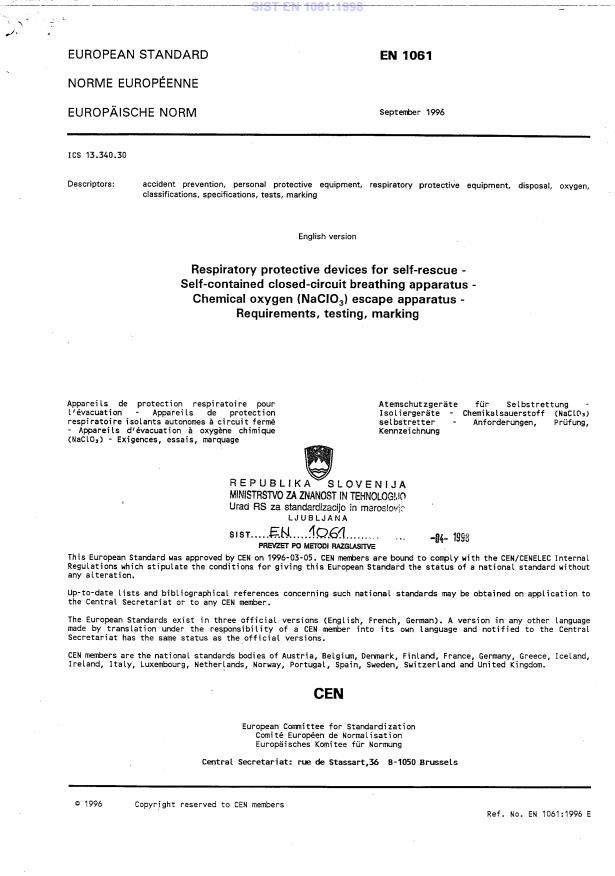
(Main)Respiratory protective devices for self-rescue - Self-contained closed-circuit breathing apparatus - Chemical oxygen (NaClO3) escape apparatus - Requirements, testing, marking
Respiratory protective devices for self-rescue - Self-contained closed-circuit breathing apparatus - Chemical oxygen (NaClO3) escape apparatus - Requirements, testing, marking
This European Standard specifies minimum requirements for self-contained closed-circuit breathing apparatus, chemical oxygen (sodium chlorate, NaCl03) type, for self-rescue (in short: chemical oxygen (NaCl03) escape apparatus). This European Standard does not apply to apparatus for work and rescue and not to diving apparatus. Laboratory and practical performance tests are included for the assessment of compliance with the requirements.
Atemschutzgeräte für Selbstrettung - Isoliergeräte - Chemikalsauerstoff (NaClO3) selbstretter - Anforderungen, Prüfung, Kennzeichnung
Diese Europäische Norm gilt für Isoliergeräte für Selbstrettung auf der Basis von Natriumchlorat (NaClO3) (kurz: Chemikalsauerstoff(NAClO3)selbst- retter). Diese Norm gilt nicht für Geräte für Arbeit und Rettung und nicht für Tauchgeräte. Sie legt Mindestanforderungen für Chemikalsauerstoff (NaClO3)selbstretter fest. Laborprüfungen und praktische Leistungsprüfungen sind enthalten, um die Übereinstimmung mit den Anforderungen feststellen zu können.
Appareils de protection respiratoire pour l'évacuation - Appareils de protection respiratoire isolants autonomes à circuit fermé - Appareils d'évacuation à oxygène chimique (NaClO3) - Exigences, essais, marquage
La présente norme européenne concerne les appareils de protection respiratoire isolants autonomes à circuit fermé, à oxygène chimique (chlorate de sodium, NaClO3), pour l'évacuation (en abrégé: appareils d'évacuation à oxygène chimique(NaClO3). La présente norme ne s'applique ni aux appareils de protection pour le travail et le sauvetage, ni aux appareils de plongée. Elle prescrit les exigences minimales requises des appareils d'évacuation à oxygène chimique (NaClO3). Elle contient des essais en laboratoire et des essais pratiques de performance pour s'assurer de la conformité avec les exigences.
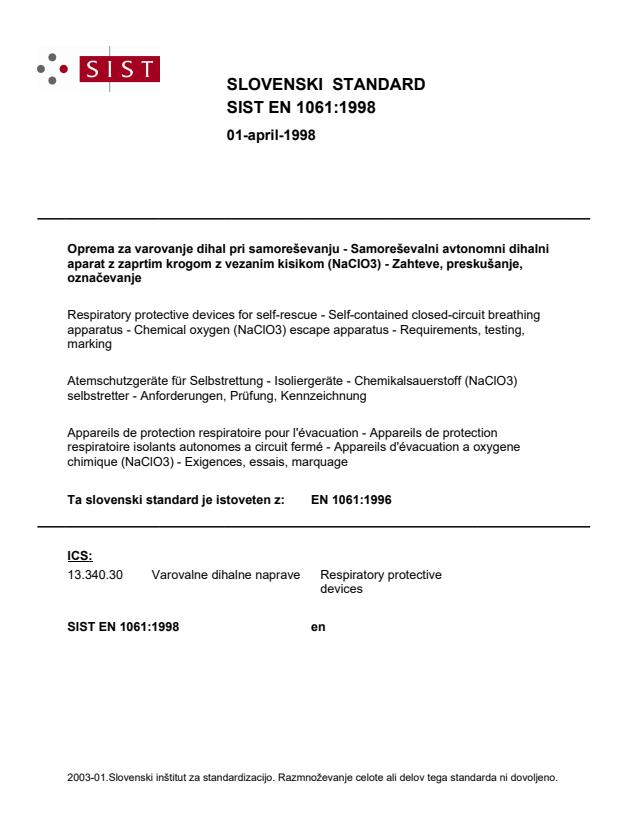
Oprema za varovanje dihal pri samoreševanju - Samoreševalni avtonomni dihalni aparat z zaprtim krogom z vezanim kisikom (NaClO3) - Zahteve, preskušanje, označevanje
General Information
- Status
- Withdrawn
- Publication Date
- 17-Sep-1996
- Withdrawal Date
- 19-Nov-2002
- Technical Committee
- CEN/TC 79 - Respiratory protective devices
- Drafting Committee
- CEN/TC 79/SC 6 - Self-contained breathing apparatus
- Current Stage
- 9960 - Withdrawal effective - Withdrawal
- Start Date
- 20-Nov-2002
- Completion Date
- 20-Nov-2002
Relations
- Effective Date
- 22-Dec-2008
- Effective Date
- 28-Jan-2026

Get Certified
Connect with accredited certification bodies for this standard
NSF International
Global independent organization facilitating standards development and certification.

CIS Institut d.o.o.
Personal Protective Equipment (PPE) certification body. Notified Body NB-2890 for EU Regulation 2016/425 PPE.

Kiwa BDA Testing
Building and construction product certification.
Sponsored listings
Frequently Asked Questions
EN 1061:1996 is a standard published by the European Committee for Standardization (CEN). Its full title is "Respiratory protective devices for self-rescue - Self-contained closed-circuit breathing apparatus - Chemical oxygen (NaClO3) escape apparatus - Requirements, testing, marking". This standard covers: This European Standard specifies minimum requirements for self-contained closed-circuit breathing apparatus, chemical oxygen (sodium chlorate, NaCl03) type, for self-rescue (in short: chemical oxygen (NaCl03) escape apparatus). This European Standard does not apply to apparatus for work and rescue and not to diving apparatus. Laboratory and practical performance tests are included for the assessment of compliance with the requirements.
This European Standard specifies minimum requirements for self-contained closed-circuit breathing apparatus, chemical oxygen (sodium chlorate, NaCl03) type, for self-rescue (in short: chemical oxygen (NaCl03) escape apparatus). This European Standard does not apply to apparatus for work and rescue and not to diving apparatus. Laboratory and practical performance tests are included for the assessment of compliance with the requirements.
EN 1061:1996 is classified under the following ICS (International Classification for Standards) categories: 13.340.30 - Respiratory protective devices. The ICS classification helps identify the subject area and facilitates finding related standards.
EN 1061:1996 has the following relationships with other standards: It is inter standard links to EN 13794:2002, EN 132:1998. Understanding these relationships helps ensure you are using the most current and applicable version of the standard.
EN 1061:1996 is associated with the following European legislation: EU Directives/Regulations: 89/686/EEC; Standardization Mandates: M/031. When a standard is cited in the Official Journal of the European Union, products manufactured in conformity with it benefit from a presumption of conformity with the essential requirements of the corresponding EU directive or regulation.
EN 1061:1996 is available in PDF format for immediate download after purchase. The document can be added to your cart and obtained through the secure checkout process. Digital delivery ensures instant access to the complete standard document.
Standards Content (Sample)
2003-01.Slovenski inštitut za standardizacijo. Razmnoževanje celote ali delov tega standarda ni dovoljeno.VNXãDQMHR]QDþHYDQMHAtemschutzgeräte für Selbstrettung - Isoliergeräte - Chemikalsauerstoff (NaClO3) selbstretter - Anforderungen, Prüfung, KennzeichnungAppareils de protection respiratoire pour l'évacuation - Appareils de protection respiratoire isolants autonomes a circuit fermé - Appareils d'évacuation a oxygene chimique (NaClO3) - Exigences, essais, marquageRespiratory protective devices for self-rescue - Self-contained closed-circuit breathing apparatus - Chemical oxygen (NaClO3) escape apparatus - Requirements, testing, marking13.340.30Varovalne dihalne napraveRespiratory protective devicesICS:Ta slovenski standard je istoveten z:EN 1061:1996SIST EN 1061:1998en01-april-1998SIST EN 1061:1998SLOVENSKI
STANDARD
S
...
Questions, Comments and Discussion
Ask us and Technical Secretary will try to provide an answer. You can facilitate discussion about the standard in here.
Loading comments...