


EN 14675:2015
(Main)Chemical disinfectants and antiseptics - Quantitative suspension test for the evaluation of virucidal activity of chemical disinfectants and antiseptics used in the veterinary area - Test method and requirements (Phase 2, step 1)
Chemical disinfectants and antiseptics - Quantitative suspension test for the evaluation of virucidal activity of chemical disinfectants and antiseptics used in the veterinary area - Test method and requirements (Phase 2, step 1)
This European Standard specifies a test method and the minimum requirements for virucidal activity of chemical disinfectant and antiseptic products that form a homogeneous, physically stable preparation when diluted with hard water or - in the case of ready-to-use-products - with water. Products can only be tested at a concentration of 80 % or less as some dilution is always produced by adding the test organisms and interfering substance.
This European Standard applies to products that are used in the veterinary area, i.e. in the breeding, husbandry, production, transport and disposal of all animals except when in the food chain following death and entry to the processing industry.
NOTE 1 The method described is intended to determine the virucidal activity of commercial formulations or active substances under the conditions in which they are used.
NOTE 2 This method corresponds to a phase 2 step 1.
Chemische Desinfektionsmittel und Antiseptika - Quantitativer Suspensionsversuch zur Bestimmung der viruziden Wirkung chemischer Desinfektionsmittel und Antiseptika für den Veterinärbereich - Prüfverfahren und Anforderungen (Phase 2, Stufe 1)
Diese Europäische Norm legt ein Prüfverfahren und die Mindestanforderungen an die viruzide Wirkung von chemischen Desinfektionsmitteln und Antiseptika fest, die bei Verdünnung mit Wasser standardisierter Härte oder - bei der Verwendung von gebrauchsfertigen Produkten - mit Wasser eine homogene, physikalisch stabile Zubereitung bilden. Die Produkte können nur bei einer Konzentration von 80 % oder darunter geprüft werden, da durch die Zugabe der Prüforganismen und der Belastungssubstanz immer eine Verdünnung hervorgerufen wird.
Diese Europäische Norm gilt für Produkte, die im Veterinärbereich eingesetzt werden, d. h. bei der Aufzucht, Haltung, Produktion, beim Transport und bei der Tierkörperbeseitigung aller Tierarten mit Ausnahme der Bereiche, in denen Tiere direkt nach der Tötung als Nahrungsmittel verwendet oder der weiterverarbeitenden Industrie zugeführt werden.
ANMERKUNG 1 Das beschriebene Verfahren ist zur Bestimmung der viruziden Wirkung von im Handel erhältlichen Zubereitungen oder aktiven Substanzen unter Anwendungsbedingungen vorgesehen.
ANMERKUNG 2 Das Verfahren entspricht der Phase 2, Stufe 1.
Antiseptiques et désinfectants chimiques - Essai quantitatif de suspension pour l'évaluation de l'activité virucide des antiseptiques et des désinfectants chimiques utilisés dans le domaine vétérinaire - Méthode d'essai et prescriptions (phase 2, étape 1)
La présente Norme européenne décrit une méthode d'essai et les prescriptions minimales relatives à l'activité virucide des produits antiseptiques et désinfectants chimiques qui forment une préparation homogène et physiquement stable lorsqu’ils sont dilués avec de l'eau dure ou - dans le cas de produits prêts à l'emploi - avec de l'eau. Les produits ne peuvent être soumis à essai qu'à une concentration inférieure ou égale à 80 % car il se produit toujours une certaine dilution du fait de l’addition des organismes d'essai et de la substance interférente.
La présente Norme européenne s'applique aux produits utilisés dans le domaine vétérinaire, c'est-à-dire dans la sélection, l'élevage, la production, le transport et l'élimination de tous les animaux, sauf dans la chaîne alimentaire à la suite de leur mort et de leur entrée dans l’industrie de transformation.
NOTE 1 La méthode décrite a pour objet de déterminer l'activité virucide de formulations commerciales ou de substances actives dans leurs conditions d'emploi.
NOTE 2 Cette méthode correspond à un essai de phase 2, étape 1.
Kemična razkužila in antiseptiki - Kvantitativni suspenzijski preskus za vrednotenje virucidnega delovanja kemičnih razkužil in antiseptikov v veterini - Preskusna metoda in zahteve (faza 2, stopnja 1)
General Information
- Status
- Published
- Publication Date
- 21-Apr-2015
- Technical Committee
- CEN/TC 216 - Chemical disinfectants and antiseptics
- Drafting Committee
- CEN/TC 216/WG 2 - Veterinary use
- Current Stage
- 9093 - Decision to confirm - Review Enquiry
- Start Date
- 03-Dec-2020
- Completion Date
- 14-Apr-2025
Relations
- Effective Date
- 29-Apr-2015
Overview
EN 14675:2015 - Chemical disinfectants and antiseptics: Quantitative suspension test for the evaluation of virucidal activity used in the veterinary area (Phase 2, step 1) - is a CEN European Standard that defines a laboratory suspension test and the minimum performance requirements for claiming virucidal activity of chemical disinfectants and antiseptics intended for veterinary use. The standard covers commercial formulations and active substances (ready-to-use or diluted with hard water) and specifies test conditions, controls and result expression for reliable, comparable virucidal claims.
Key topics and technical requirements
- Scope: Products used in breeding, husbandry, production, transport and disposal of animals (excludes carcasses entering food-processing chain).
- Test organism: Bovine enterovirus Type 1 (ECBO, ATCC VR‑2481) is the model virus for the Picornavirus group.
- Performance criterion: Minimum ≥ 4 log10 reduction in virus titre under the test conditions.
- Product concentration: Products may be tested as supplied or diluted, but test concentration must be ≤ 80% (some dilution is inevitable).
- Obligatory test conditions: 10 °C ±1 °C and 30 min ±10 s, with defined interfering substances (low soiling: 3.0 g/L bovine albumin; high soiling: 10 g/L bovine albumin + 10 g/L yeast extract).
- Additional conditions: Optional temperatures (4 °C, 20 °C, 40 °C) and contact times (1 min, 5 min, 60 min) to reflect practical use.
- Method outline: Quantitative suspension test - product + virus + interfering substance → exposure → immediate suppression (e.g., dilution in ice‑cold medium or filtration) → titration by TCID50 or plaque assay (PFU); infectivity calculated (Spearman–Kärber) and compared to control.
- Controls and checks: Cytotoxicity, reference inactivation test (e.g., formalin), detoxification (molecular sieving), method verification and reporting requirements.
Practical applications and users
Who uses EN 14675:2015:
- Manufacturers and formulators of chemical disinfectants and antiseptics for veterinary markets (product development and claims substantiation).
- Accredited testing laboratories performing virucidal efficacy testing and validation.
- Regulatory bodies and certification organizations assessing label claims and approvals.
- Biosecurity officers, veterinary services, farm managers and animal transport companies seeking products validated for virucidal activity under relevant conditions.
Practical uses:
- Support for product registration, labelling and technical data sheets.
- Guidance to set recommended contact times, concentrations and use scenarios for veterinary disinfection.
- Standardised method for inter-laboratory comparison and quality control.
Related standards
- EN 14885 - Application framework for European standards for chemical disinfectants and antiseptics.
- EN 14675:2015 supersedes EN 14675:2006 and corresponds to Phase 2, step 1 virucidal testing.
Keywords: EN 14675:2015, virucidal activity, quantitative suspension test, veterinary disinfectants, ECBO, TCID50, PFU, contact time, hard water, phase 2 step 1.

Frequently Asked Questions
EN 14675:2015 is a standard published by the European Committee for Standardization (CEN). Its full title is "Chemical disinfectants and antiseptics - Quantitative suspension test for the evaluation of virucidal activity of chemical disinfectants and antiseptics used in the veterinary area - Test method and requirements (Phase 2, step 1)". This standard covers: This European Standard specifies a test method and the minimum requirements for virucidal activity of chemical disinfectant and antiseptic products that form a homogeneous, physically stable preparation when diluted with hard water or - in the case of ready-to-use-products - with water. Products can only be tested at a concentration of 80 % or less as some dilution is always produced by adding the test organisms and interfering substance. This European Standard applies to products that are used in the veterinary area, i.e. in the breeding, husbandry, production, transport and disposal of all animals except when in the food chain following death and entry to the processing industry. NOTE 1 The method described is intended to determine the virucidal activity of commercial formulations or active substances under the conditions in which they are used. NOTE 2 This method corresponds to a phase 2 step 1.
This European Standard specifies a test method and the minimum requirements for virucidal activity of chemical disinfectant and antiseptic products that form a homogeneous, physically stable preparation when diluted with hard water or - in the case of ready-to-use-products - with water. Products can only be tested at a concentration of 80 % or less as some dilution is always produced by adding the test organisms and interfering substance. This European Standard applies to products that are used in the veterinary area, i.e. in the breeding, husbandry, production, transport and disposal of all animals except when in the food chain following death and entry to the processing industry. NOTE 1 The method described is intended to determine the virucidal activity of commercial formulations or active substances under the conditions in which they are used. NOTE 2 This method corresponds to a phase 2 step 1.
EN 14675:2015 is classified under the following ICS (International Classification for Standards) categories: 71.100.35 - Chemicals for industrial and domestic disinfection purposes. The ICS classification helps identify the subject area and facilitates finding related standards.
EN 14675:2015 has the following relationships with other standards: It is inter standard links to EN 14675:2006. Understanding these relationships helps ensure you are using the most current and applicable version of the standard.
You can purchase EN 14675:2015 directly from iTeh Standards. The document is available in PDF format and is delivered instantly after payment. Add the standard to your cart and complete the secure checkout process. iTeh Standards is an authorized distributor of CEN standards.
Standards Content (Sample)
2003-01.Slovenski inštitut za standardizacijo. Razmnoževanje celote ali delov tega standarda ni dovoljeno.Chemische Desinfektionsmittel und Antiseptika - Quantitativer Suspensionsversuch zur Bestimmung der viruziden Wirkung chemischer Desinfektionsmittel und Antiseptika für den Veterinärbereich - Prüfverfahren und Anforderungen (Phase 2, Stufe 1)Antiseptiques et désinfectants chimiques - Essai quantitatif de suspension pour l'évaluation de l'activité virucide des antiseptiques et des désinfectants chimiques utilisés dans le domaine vétérinaire - Méthodes d'essai et prescriptions - (Phase 2, étape 1)Chemical disinfectants and antiseptics - Quantitative suspension test for the evaluation of virucidal activity of chemical disinfectants and antiseptics used in the veterinary area - Test method and requirements (phase 2, step 1)11.220VeterinarstvoVeterinary medicine11.080.20Dezinfektanti in antiseptikiDisinfectants and antisepticsICS:Ta slovenski standard je istoveten z:EN 14675:2015SIST EN 14675:2015en,fr,de01-julij-2015SIST EN 14675:2015SLOVENSKI
STANDARDSIST EN 14675:20061DGRPHãþD
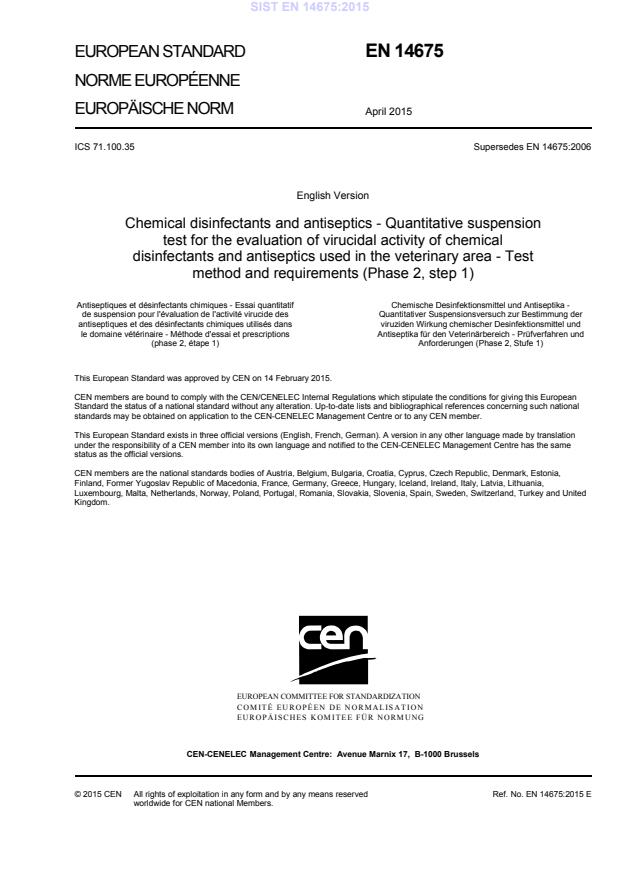
EUROPEAN STANDARD NORME EUROPÉENNE EUROPÄISCHE NORM
EN 14675
April 2015 ICS 71.100.35 Supersedes EN 14675:2006English Version
Chemical disinfectants and antiseptics - Quantitative suspension test for the evaluation of virucidal activity of chemical disinfectants and antiseptics used in the veterinary area - Test method and requirements (Phase 2, step 1)
Antiseptiques et désinfectants chimiques - Essai quantitatif de suspension pour l'évaluation de l'activité virucide des antiseptiques et des désinfectants chimiques utilisés dans le domaine vétérinaire - Méthode d'essai et prescriptions (phase 2, étape 1)
Chemische Desinfektionsmittel und Antiseptika - Quantitativer Suspensionsversuch zur Bestimmung der viruziden Wirkung chemischer Desinfektionsmittel und Antiseptika für den Veterinärbereich - Prüfverfahren und Anforderungen (Phase 2, Stufe 1) This European Standard was approved by CEN on 14 February 2015.
CEN members are bound to comply with the CEN/CENELEC Internal Regulations which stipulate the conditions for giving this European Standard the status of a national standard without any alteration. Up-to-date lists and bibliographical references concerning such national standards may be obtained on application to the CEN-CENELEC Management Centre or to any CEN member.
This European Standard exists in three official versions (English, French, German). A version in any other language made by translation under the responsibility of a CEN member into its own language and notified to the CEN-CENELEC Management Centre has the same status as the official versions.
CEN members are the national standards bodies of Austria, Belgium, Bulgaria, Croatia, Cyprus, Czech Republic, Denmark, Estonia, Finland, Former Yugoslav Republic of Macedonia, France, Germany, Greece, Hungary, Iceland, Ireland, Italy, Latvia, Lithuania, Luxembourg, Malta, Netherlands, Norway, Poland, Portugal, Romania, Slovakia, Slovenia, Spain, Sweden, Switzerland, Turkey and United Kingdom.
EUROPEAN COMMITTEE FOR STANDARDIZATION
COMITÉ EUROPÉEN DE NORMALISATION EUROPÄISCHES KOMITEE FÜR NORMUNG
CEN-CENELEC Management Centre:
Avenue Marnix 17,
B-1000 Brussels © 2015 CEN All rights of exploitation in any form and by any means reserved worldwide for CEN national Members. Ref. No. EN 14675:2015 ESIST EN 14675:2015
Referenced strains of national collections . 23 Annex B (normative)
Cytotoxicity, reference inactivation test, test virus titration and detoxification of test mixtures . 24 B.1 Cytotoxicity caused by product solutions . 24 B.2 Reference inactivation test . 24 SIST EN 14675:2015
Calculation of the viral infectivity titre . 28 C.1 Quantal tests - Example of TCID50 determination by the Spearman-Kärber method . 28 C.2 Plaque test . 28 Annex D (informative)
Example of a typical test report . 30 Annex E (informative)
Presentation of test results of one active concentration . 32 Bibliography . 34
PFU number of infectious virus particles per unit volume (ml) 3.3 reference test for virus inactivation test with a defined reagent (e.g. formalin) instead of a product for the internal control of the test Note 1 to entry: Results of reference virus inactivation test should be within limits for validating the method. 3.4 reference virus suspension virus suspension of a defined virus strain which is not passaged more than 10 times, is maintained in national culture collection centres and kept in small volumes (less than 1 ml) at a temperature of -70°C or preferably at about -196 °C under liquid nitrogen Note 1 to entry: Stock virus suspensions are prepared from reference virus suspensions. SIST EN 14675:2015
TCID50 viral dose that induces a cytopathic effect (CPE) (3.8) in 50 % of inoculated cell culture 3.8 viral cytopathic effect
CPE morphological alteration of cells and/or their destruction as a consequence of virus multiplication 3.9 viral plaque area of lysis formed in a cell monolayer under semisolid medium due to infection by and multiplication of a single infectious virus particle 3.10 virus titre amount of infectious virus per unit volume present in a cell culture lysate or in a solution 4 Requirements The product when diluted with hard water (5.2.2.3) or – in the case of ready-to-use products – with water (5.2.2.2) and tested in accordance with Table 1 and Clause 5 shall demonstrate at least a lg reduction in virus titre of 4. It is possible to test also the product as delivered (highest test concentration is 80 %). Table 1 — Obligatory and additional test conditions
Obligatory conditions Additional conditions Test organism Bovine enterovirus Type 1 (ECBO)
Test temperature a 10 °C 4 °C, 20 °C or 40 °C Contact time b 30 min 1 min, 5 min and 60 min Interfering substance–low level soiling c 3,0 g/l bovine albumin
Interfering substance-high level soiling c 10 g/l bovine albumin plus 10 g/l yeast extract
a
Allowed deviation ± 1 °C. b
The allowed deviation for each chosen contact time is ± 10 sf except for ≤1 min for which it is ± 5 s. c
To be chosen according to practical applications. SIST EN 14675:2015
1) ATCC VR-248, is a strain supplied by the American Type Culture Collections. This information is given for the convenience of users of this European Standard and does not constitute an endorsement by CEN of the product named. A corresponding strain supplied by other culture collections may be used if they can be shown to lead to the same results. SIST EN 14675:2015
2) This information is given for the convenience of users of this European Standard and does not constitute an endorsement by CEN of the products named. Corresponding products supplied by other manufacturers may be used if they can be shown to lead to the same results. SIST EN 14675:2015
in water (5.2.2.2) 1 000 ml Preparation Make up solution to 1 l with water (5.2.2.2) [omitting the sodium bicarbonate and antibiotics (5.2.2.5 and 5.2.2.6)]. Filter through a membrane filter (0,22 m pore size) using positive pressure. Add 76,2 ml 7,5 % sodium bicarbonate solution in water (5.2.2.2) and 5 ml antibiotics (5.2.2.5) to the sterile filtrate. Dispense aseptically into 50 ml aliquots and store at - 20 °C. For use add 50 ml of thawed ATV 10 × concentrate to 450 ml of water (5.2.2.2). The working strength solution contains trypsin 0,05 %, versene 0,02 %, pH = 7,8. 5.2.2.7 Dulbecco’s Phosphate Buffered Saline pH 7,2 – 7,4 (PBS) Sodium chloride (NaCl) 8,00 g Potassium dihydrogen phosphate (KH2PO4) 0,12 g Disodium hydrogen phosphate anhydrous (Na2HPO4) 0,91 g Potassium chloride (KCl) 0,2 g Water (5.2.2.2) to 1 000 ml SIST EN 14675:2015
per litre of 10x medium C 10 ml D 10 ml E 10 ml d) In a separate flask containing 160 ml of water (5.2.2.2), 2 g anhydrous calcium chloride are dissolved and then added to the pool with vigorous shaking. e) 200 ml of Solution A are added to the pool and the volume is brought to approximately 950 ml with water (5.2.2.2); the mixture can be held in the refrigerator (5.3.2.16) overnight. f) The total volume is brought to exactly 1 000 ml with water (5.2.2.2) and the solution is sterilized by membrane filtration [5.3.2.1 c)]. This 10x medium is stored at 4 °C. 5.2.2.12 Preparation of 1X Eagle MEM For use, the 10x medium is diluted to 1x with sterile water (5.2.2.2), and 1 % of the 3 % glutamine solution (5.2.2.10, f) and 2,5 % of an 8,8 % sodium bicarbonate solution in water (sterilized by membrane filtration) are added. a)
A growth medium for cell multiplication is supplemented with 10 % FCS. Add 10 parts of FCS (5.2.2.13) to 90 parts of MEM. b)
A maintenance medium to maintain the cell culture metabolism without stimulation of cell proliferation is supplemented with 2 % FCS. Add 2 parts of FCS (5.2.2.13) to 98 parts of MEM. 5.2.2.13 Foetal calf serum (FCS) FCS shall be certified free of viruses and mycoplasma. Extraneous viruses and mycoplasma may interfere with cell and virus growth resulting in false results. SIST EN 14675:2015
m pore size. 5.3.2.2 Water baths, capable of being controlled at 4 °C ± 1 °C and 10 °C ± 1 °C and at additional temperatures ± 1 °C (5.5.1). 5.3.2.3 CO2 incubator, (95 % air, 5 % CO2), capable of being controlled at either 36 °C ± 1 °C or 37 °C ± 1 °C. 5.3.2.4 pH-meter, having an inaccuracy of calibration of no more than ± 0,1 pH units at 20 °C ± 1 °C. 5.3.2.5 Inverted microscope, for reading cell cultures microscopically. 5.3.2.6 Stopwatch. 5.3.2.7 Shakers a) Electromechanical agitator, e.g. Vortex® mixer4) b) Mechanical shaker
3) Disposable sterile equipment is an acceptable alternative to reusable glassware. 4) Vortex ® is an example of a suitable product available commercially. This information is given for the convenience of users of this European Standard and does not constitute an endorsement by CEN of this product. SIST EN 14675:2015
5) This information is given for the convenience of users of this European Standard and does not constitute an endorsement by CEN of this product. Corresponding products supplied by other manufacturers may be used if they can be shown to lead to the same results. SIST EN 14675:2015
...
SIST EN 14675:2015 표준은 화학 소독제 및 방부제의 바이러스 사멸 활성 평가를 위한 정량적 보류 시험 방법을 지정하고 있습니다. 이 표준의 주요 초점은 동물 관련 환경에서 사용되는 화학 소독제 및 방부제의 효과적인 사용을 보장하는 것입니다. 이 표준은 희석이 필요한 경우 안정되고 균일한 혼합물이 형성되는 제품에 대한 최소 요구 사항을 설정합니다. 특히, 80% 이하의 농도에서 테스트를 수행해야 하며, 이는 테스트 유기체와 간섭 물질을 추가할 경우 항상 희석이 발생하기 때문입니다. 이 엄격한 요구 사항은 제품의 실제 사용 조건을 반영하여 제작되었으므로, 상업적 포뮬레이션 또는 활성 물질의 유효성을 보다 정확하게 평가할 수 있습니다. 또한, 이 표준은 동물 번식, 사육, 생산, 운송 및 처리와 같은 다양한 분야에서의 안전하고 효과적인 소독제 사용을 규제하는 데 있어 필수적입니다. 이는 동물 건강 관리와 관련된 활발한 활동에 직접적인 영향을 미치며, 바이러스 전파를 방지하는 데 중요한 역할을 합니다. SIST EN 14675:2015는 동물용 화학 소독제의 권장 테스트 방법을 제공함으로써, 산업계와 학계 모두에 활용될 수 있는 강력한 기준을 마련하고 있습니다. 이를 통해 동물 건강을 보호하고, 관련 제품의 품질을 보장하는 데 기여할 수 있습니다. 이 표준의 유용성과 적합성은 동물 관련 산업에서의 실제적인 응용을 통해 더욱 강조됩니다.
SIST EN 14675:2015は、獣医学分野における化学消毒剤および殺菌剤のウイルス除去活性を評価するための定量的懸濁試験の標準を提供する文書です。この欧州標準は、硬水で希釈した際に均一で物理的に安定した調製物を形成する消毒剤および殺菌剤製品の試験方法と最低要件を明確に定義しています。この標準の範囲は、すべての動物の飼育、運搬、廃棄などの獣医分野に特有な用途に関連しており、生成された製品は、商業的フォーミュレーションや活性物質のウイルス除去活性を評価するための信頼性の高い基準を提供します。 この標準の強みは、テスト対象の製品が使用される条件を考慮している点にあります。具体的には、ウイルス除去活性がどのように実際の使用状況に影響を与えるかを明らかにし、製品の性能を現実的な条件下で評価する能力を持っています。このため、獣医学の実務者が選択する際の明確な指針となり得ます。また、試験される製品は、濃度80%以下である必要があり、これは試験生物や阻害物質を追加することによる希釈を考慮した結果です。 さらに、この標準は、フェーズ2ステップ1に対応しており、獣医学分野における化学消毒剤や殺菌剤の評価方法としての国際的な整合性をもたらします。これにより、製品が市場に出回る際の安全性と効果が保証され、業界全体における信頼を高める役割を果たします。 総じて、SIST EN 14675:2015は、獣医学分野におけるウイルス対策を強化するための重要な基準であり、その強みと関連性は、製品の安全な使用と効果的な評価を可能にします。
La norme EN 14675:2015 se concentre sur l'évaluation de l'activité virucide des désinfectants et antiseptiques chimiques spécifiquement destinés à l'usage vétérinaire. Son champ d'application est clairement défini, englobant les produits utilisés dans l'élevage, la gestion, la production, le transport et l'élimination d'animaux, excepté lors de leur entrée dans la chaîne alimentaire après la mort. L'une des principales forces de cette norme est sa méthodologie qui exige que les produits testés forment une préparation homogène et physiquement stable lors de leur dilution avec de l'eau dure ou, pour les produits prêts à l'emploi, avec de l'eau. Ce développement garantit non seulement la cohérence des résultats, mais aussi la pertinence des conditions de test dans lesquelles les produits sont réellement utilisés. De plus, en spécifiant que les tests ne peuvent s'effectuer qu'à des concentrations de 80 % ou moins, la norme prend en compte les interactions potentielles entre les organismes testés et les substances interférentes. La norme EN 14675:2015 se révèle donc particulièrement pertinente pour le secteur vétérinaire, car elle permet de déterminer de manière fiable l'activité virucide des formulations commerciales ou des substances actives dans des conditions d'utilisation concrètes. Cette approche pragmatique assure non seulement la sécurité et l'efficacité des produits, mais contribue aussi à la santé publique animale en minimisant les risques de propagation des virus. Ce cadre normatif représente une avancée significative pour les acteurs de l'industrie vétérinaire, leur fournissant des outils standardisés pour évaluer la virucidé de leurs produits.
Die Norm EN 14675:2015 stellt einen wichtigen Rahmen für die Bewertung der viruzidalen Aktivität chemischer Desinfektionsmittel und Antiseptika im veterinärmedizinischen Bereich dar. Der Geltungsbereich dieser Norm bezieht sich auf die Testmethoden und Mindestanforderungen, die notwendig sind, um die Wirksamkeit von Produkten zu bestätigen, die in der Zucht, Haltung, Produktion, dem Transport und der Entsorgung von Tieren eingesetzt werden. Besonders hervorzuheben ist, dass die Norm den Testen von Produkten unter realistischen Bedingungen dient, die der tatsächlichen Anwendung entsprechen. Stärke der Norm liegt in ihrer spezifischen Ausrichtung auf Produkte, die eine homogene und physikalisch stabile Zubereitung bilden, wenn sie mit hartem Wasser oder im Falle von gebrauchsfertigen Produkten mit Wasser verdünnt werden. Die Berücksichtigung der Verdünnung auf maximal 80 % ist besonders wichtig, um die Realitätsnähe der Testergebnisse zu gewährleisten, was für die tiermedizinische Praxis unerlässlich ist. Die Relevanz dieser Norm wird durch die Tatsache unterstrichen, dass sie eine standardisierte Methode zur Messung der Effektivität von chemischen Desinfektionsmitteln schafft, die entscheidend ist, um die Gesundheit von Tieren und die Sicherheit in der Veterinärmedizin zu gewährleisten. Die Norm ist darauf ausgelegt, die viruzidale Aktivität kommerzieller Formulierungen oder aktiver Substanzen zu ermitteln, was sie zu einem unverzichtbaren Dokument für Hersteller und Anwender von Desinfektionsmitteln im veterinärmedizinischen Bereich macht. Insgesamt bietet die EN 14675:2015 eine fundierte und zielgerichtete Grundlage für die Bewertung und den Einsatz von chemischen Desinfektionsmitteln und Antiseptika, die in der Tierhaltung essenziell sind, und trägt dazu bei, die Gesundheitsstandards in der Veterinärmedizin zu erhöhen.
The EN 14675:2015 standard outlines critical protocols for evaluating the virucidal activity of chemical disinfectants and antiseptics specifically within the veterinary sector. A significant strength of this standard lies in its clear specification of a quantitative suspension test method, providing a robust framework for assessing the effectiveness of disinfectants against viruses that may pose health risks to animals. The scope emphasizes that the standard applies to a diverse range of products utilized in veterinary practices, such as breeding, husbandry, and the transport of animals, ensuring comprehensive coverage of various applications. Furthermore, the stipulation that testing must occur at a concentration of 80% or less is particularly relevant, as it mirrors real-world conditions in which these disinfectants are employed, thus enhancing the applicability and reliability of test results. Another advantage of EN 14675:2015 is its structured approach, delineating minimum requirements essential for validating the virucidal potency of products. This makes it an indispensable reference for manufacturers in the veterinary field, as it not only supports compliance with regulatory measures but also promotes the development of safer and more effective chemical formulations. Moreover, the standard's note on its correspondence to Phase 2, Step 1 underscores its importance as part of a broader framework for assessing virucidal efficacy, signaling its role in advancing veterinary hygiene and biosecurity. Overall, the EN 14675:2015 standard stands out as a pertinent and authoritative guideline that enhances the quality assurance of chemical disinfectants and antiseptics within the veterinary domain.
Questions, Comments and Discussion
Ask us and Technical Secretary will try to provide an answer. You can facilitate discussion about the standard in here.
Loading comments...