

EN 15597-2:2019
(Main)Winter maintenance equipment - Spreading and spraying machines - Part 2: Requirements for distribution and their test
General Information
- Abstract
This document gives the possibility to certify a model of vehicle-mounted or (trailer) dragged spreading machines for winter service with standard parameters, leaving the possibility to the manufacturer to evolve in performances. At the same time, information is given on the minimum content required for operating manuals.
This document is valid for machines which are used to spread the following media:
- not pre-wetted spreading agent (solid spreading agent);
- pre-wetted spreading agent;
- liquid spreading agent (brine).
The following points are not covered by this document:
- requirements for registration and approval;
- requirements made by automobile manufacturers;
- requirements on EN 15518 3.
- Status
- Published
- Publication Date
- 03-Dec-2019
- Withdrawal Date
- 29-Jun-2020
- Technical Committee
- CEN/TC 337 - Winter maintenance and road service area maintenance equipment
- Drafting Committee
- CEN/TC 337/WG 1 - Winter maintenance equipment
- Current Stage
- 9060 - Closure of 2 Year Review Enquiry - Review Enquiry
- Start Date
- 04-Jun-2025
- Completion Date
- 04-Jun-2025

Overview
EN 15597-2:2019, published by CEN, sets out requirements for distribution and testing of vehicle-mounted or trailer-dragged spreading and spraying machines used in winter road maintenance. It enables certification of spreader models (solid, pre-wetted and liquid/brine systems) using standard test parameters while allowing manufacturers to improve performance. The standard describes minimum content for operating manuals, defines test materials (two reference salts and brine), and specifies a combined static and dynamic test regime to verify dosage accuracy and spreading pattern quality.
Key topics and technical requirements
- Scope of media covered: not pre‑wetted solid agents, pre‑wetted solids, and liquid de‑icers (brine).
- Certification approach: qualification of a machine model via both static tests (stationary dosage verification) and dynamic tests (on‑road spreading pattern and repeatability).
- Test materials: reference salts with defined granulometry and moisture classes (Salt 1 and Salt 2) and brine concentration specified between 20–23% NaCl by weight; suppliers must provide material certificates and retained samples.
- Test geometry and measurement: definition of measurement areas, outer/inner strips, spacing areas and test runs to calculate effective average dosage, strip dosages and mathematical averages for repeatability.
- Allowed adjustments during testing: only dosage, spreading width, symmetry, simulated speed and pre‑wet on/off may be changed during qualification; other changes require restarting tests.
- Documentation: Annex A lists components that affect spreading parameters; Annex B provides an example static test report format. Operating manuals must at minimum contain the information required for safe and reproducible operation.
- Limitations: EN 15597-2 does not cover vehicle registration/approval, automobile manufacturer requirements, or replace requirements in EN 15518-3.
Applications - who uses this standard
- Manufacturers of spreaders and sprayers - to design, validate and certify models for market acceptance.
- Testing institutes and certification bodies - to perform repeatable static and dynamic tests and issue technical certificates.
- Road authorities and procurement teams - to specify verified equipment performance (dosage accuracy and distribution quality) in tenders and asset standards.
- Maintenance fleet operators - to understand operational limits, test conditions, and required documentation for correct use and calibration.
Related standards
- EN 15597-1:2019 - General requirements and definitions for spreading machines
- EN 15144 - Terminology for winter maintenance
- EN 15431 - Power systems and controls for winter service equipment
- EN ISO 13473-1 - Pavement texture characterization
- EN 15518-3 - (not covered by this document; see EN 15597-2 exclusions)
Keywords: EN 15597-2:2019, winter maintenance equipment, spreading machines, gritting machines, sprayers, distribution requirements, static test, dynamic test, brine, test materials, certification.
Relations
- Effective Date
- 11-Dec-2019
- Effective Date
- 28-Jan-2026
- Effective Date
- 28-Jan-2026
- Effective Date
- 28-Jan-2026
- Effective Date
- 28-Jan-2026
Get Certified
Connect with accredited certification bodies for this standard

CIS Institut d.o.o.
Personal Protective Equipment (PPE) certification body. Notified Body NB-2890 for EU Regulation 2016/425 PPE.

Kiwa BDA Testing
Building and construction product certification.
Kmetijski inštitut Slovenije
Agricultural Institute of Slovenia. Soil testing, plant health, agricultural product analysis.
Sponsored listings
Frequently Asked Questions
EN 15597-2:2019 is a standard published by the European Committee for Standardization (CEN). Its full title is "Winter maintenance equipment - Spreading and spraying machines - Part 2: Requirements for distribution and their test". This standard covers: This document gives the possibility to certify a model of vehicle-mounted or (trailer) dragged spreading machines for winter service with standard parameters, leaving the possibility to the manufacturer to evolve in performances. At the same time, information is given on the minimum content required for operating manuals. This document is valid for machines which are used to spread the following media: - not pre-wetted spreading agent (solid spreading agent); - pre-wetted spreading agent; - liquid spreading agent (brine). The following points are not covered by this document: - requirements for registration and approval; - requirements made by automobile manufacturers; - requirements on EN 15518 3.
This document gives the possibility to certify a model of vehicle-mounted or (trailer) dragged spreading machines for winter service with standard parameters, leaving the possibility to the manufacturer to evolve in performances. At the same time, information is given on the minimum content required for operating manuals. This document is valid for machines which are used to spread the following media: - not pre-wetted spreading agent (solid spreading agent); - pre-wetted spreading agent; - liquid spreading agent (brine). The following points are not covered by this document: - requirements for registration and approval; - requirements made by automobile manufacturers; - requirements on EN 15518 3.
EN 15597-2:2019 is classified under the following ICS (International Classification for Standards) categories: 13.030.40 - Installations and equipment for waste disposal and treatment. The ICS classification helps identify the subject area and facilitates finding related standards.
EN 15597-2:2019 has the following relationships with other standards: It is inter standard links to CEN/TS 15597-2:2012, EN 15597-1:2020, EN 15144:2007, EN 15431:2008, EN ISO 13473-1:2019. Understanding these relationships helps ensure you are using the most current and applicable version of the standard.
EN 15597-2:2019 is available in PDF format for immediate download after purchase. The document can be added to your cart and obtained through the secure checkout process. Digital delivery ensures instant access to the complete standard document.
Standards Content (Sample)
SLOVENSKI STANDARD
01-februar-2020
Nadomešča:
SIST-TS CEN/TS 15597-2:2012
Oprema za zimsko vzdrževanje - Posipalniki in škropilniki - 2. del: Zahteve za
raztros in njihovo preskušanje
Winter maintenance equipment - Spreading and spraying machines - Part 2:
Requirements for distribution and their test
Winterdienstausrüstung - Streumaschinen - Teil 2: Anforderungen an die
Streustoffverteilung und deren Prüfung
Équipement de viabilité hivernale - Épandeuses - Partie 2: Exigences relatives à la
distribution et essai
Ta slovenski standard je istoveten z: EN 15597-2:2019
ICS:
43.160 Vozila za posebne namene Special purpose vehicles
2003-01.Slovenski inštitut za standardizacijo. Razmnoževanje celote ali delov tega standarda ni dovoljeno.
EN 15597-2
EUROPEAN STANDARD
NORME EUROPÉENNE
December 2019
EUROPÄISCHE NORM
ICS 13.030.40 Supersedes CEN/TS 15597-2:2012
English Version
Winter maintenance equipment - Spreading and spraying
machines - Part 2: Requirements for distribution and their
test
Équipement de viabilité hivernale - Épandeuses - Winterdienstausrüstung - Streumaschinen - Teil 2:
Partie 2 : Prescriptions relatives à la distribution et Anforderungen an die Streustoffverteilung und deren
essai Prüfung
This European Standard was approved by CEN on 2 September 2019.
CEN members are bound to comply with the CEN/CENELEC Internal Regulations which stipulate the conditions for giving this
European Standard the status of a national standard without any alteration. Up-to-date lists and bibliographical references
concerning such national standards may be obtained on application to the CEN-CENELEC Management Centre or to any CEN
member.
This European Standard exists in three official versions (English, French, German). A version in any other language made by
translation under the responsibility of a CEN member into its own language and notified to the CEN-CENELEC Management
Centre has the same status as the official versions.
CEN members are the national standards bodies of Austria, Belgium, Bulgaria, Croatia, Cyprus, Czech Republic, Denmark, Estonia,
Finland, France, Germany, Greece, Hungary, Iceland, Ireland, Italy, Latvia, Lithuania, Luxembourg, Malta, Netherlands, Norway,
Poland, Portugal, Republic of North Macedonia, Romania, Serbia, Slovakia, Slovenia, Spain, Sweden, Switzerland, Turkey and
United Kingdom.
EUROPEAN COMMITTEE FOR STANDARDIZATION
COMITÉ EUROPÉEN DE NORMALISATION
EUROPÄISCHES KOMITEE FÜR NORMUNG
CEN-CENELEC Management Centre: Rue de la Science 23, B-1040 Brussels
© 2019 CEN All rights of exploitation in any form and by any means reserved Ref. No. EN 15597-2:2019 E
worldwide for CEN national Members.
Contents Page
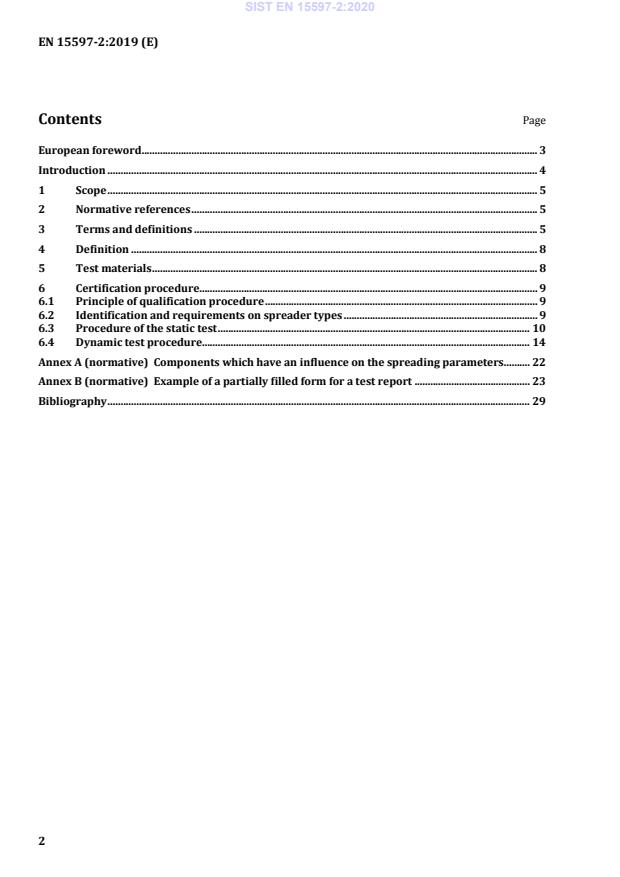
European foreword . 3
Introduction . 4
1 Scope . 5
2 Normative references . 5
3 Terms and definitions . 5
4 Definition . 8
5 Test materials . 8
6 Certification procedure . 9
6.1 Principle of qualification procedure . 9
6.2 Identification and requirements on spreader types . 9
6.3 Procedure of the static test . 10
6.4 Dynamic test procedure. 14
Annex A (normative) Components which have an influence on the spreading parameters. 22
Annex B (normative) Example of a partially filled form for a test report . 23
Bibliography . 29
European foreword
This document (EN 15597-2:2019) has been prepared by Technical Committee CEN/TC 337 “Road
operation equipment and products”, the secretariat of which is held by AFNOR.
This European Standard shall be given the status of a national standard, either by publication of an
identical text or by endorsement, at the latest by June 2020, and conflicting national standards shall be
withdrawn at the latest by June 2020.
Attention is drawn to the possibility that some of the elements of this document may be the subject of
patent rights. CEN shall not be held responsible for identifying any or all such patent rights.
This document supersedes CEN/TS 15597-2:2012, which has been technically revised.
The main following changes were introduced:
— update of the normative references and of the Bibliography;
— deletion of Table 1 and Table 2 (defined working ranges of the different types of machinery) for
spreader type definition, this is reported in EN 15597-1;
— inclusion of the determination and characteristics of test materials for salt 1 and salt 2 (Clause 5);
— addition of a new test for the starting behavior;
— simplification of the static tests;
— modification of Figure 1 to Figure 4 and deletion of Figures 5 to 8;
— adaptation of the test points to the changes in the working ranges of the spreader types;
— inclusion of Annex B as an example for a static test report.
EN 15597, Winter maintenance equipment - Spreading and spraying machines, is composed of the
following parts:
— Part 1: General requirements and definitions;
— Part 2: Requirements for distribution and their test.
According to the CEN-CENELEC Internal Regulations, the national standards organisations of the
following countries are bound to implement this European Standard: Austria, Belgium, Bulgaria,
Croatia, Cyprus, Czech Republic, Denmark, Estonia, Finland, France, Germany, Greece, Hungary, Iceland,
Ireland, Italy, Latvia, Lithuania, Luxembourg, Malta, Netherlands, Norway, Poland, Portugal, Republic of
North Macedonia, Romania, Serbia, Slovakia, Slovenia, Spain, Sweden, Switzerland, Turkey and the
United Kingdom.
Introduction
This document is meant to assess the demands made on mobile spreading and spraying machines
operated in traffic.
For simplicity, in this document all machines are called “spreaders” also for liquid agent spraying.
Spreading machines (spreaders/gritters) are meant to be operated in such way that homogeneous
distribution of spreading media is given within the set spreading dosage, width and spreading pattern
track.
The static and dynamic test procedure has the task to test functionality and accuracy of the spreader.
With dynamic testing, the task is also to test the spreading pattern as much as possible under real
conditions. Therefore, the dynamic test is done with trucks driving realistic speeds.
To ensure the repeatability of the results and to limit the expenditure, the tests for the certification are
not done with all possible spreading agents and all possible parameters of the operational area of the
spreader. The salt for the test is limited to three defined test materials, also the brine is defined
(see Clause 5), and the dynamic tests are not done with the highest possible driving speeds. This does
not mean that the spreaders do not work with other materials or higher speeds. If the spreader is bound
to operate with other materials and/or higher speed, this is meant to be tested and adjusted
individually by the customer. Especially when driving at higher speeds, the influences of the driving
turbulences and the truck configuration upon which the spreader is mounted become very strong so
that it makes no sense to test this for the certification independent of the special truck.
1 Scope
This document gives the possibility to certify a model of vehicle-mounted or (trailer) dragged spreading
machines for winter service with standard parameters, leaving the possibility to the manufacturer to
evolve in performances. At the same time, information is given on the minimum content required for
operating manuals.
This document is valid for machines which are used to spread the following media:
— not pre-wetted spreading agent (solid spreading agent);
— pre-wetted spreading agent;
— liquid spreading agent (brine).
The following points are not covered by this document:
— requirements for registration and approval;
— requirements made by automobile manufacturers;
— requirements on EN 15518-3.
2 Normative references
The following documents are referred to in the text in such a way that some or all of their content
constitutes requirements of this document. For dated references, only the edition cited applies. For
undated references, the latest edition of the referenced document (including any amendments) applies.
EN 15144, Winter maintenance equipment — Terminology — Terms for winter maintenance
EN 15431, Winter and road service area maintenance equipments — Power system and related controls
— Interchangeability and performance requirements
EN 15597-1:2020, Winter maintenance equipment — Spreading machines (gritting machines) — Part 1:
General requirements and definitions for spreading machines
EN ISO 13473-1, Characterization of pavement texture by use of surface profiles — Part 1: Determination
of mean profile depth (ISO 13473-1)
3 Terms and definitions
For the purposes of this document, the terms and definitions given in EN 15144 and the following apply.
ISO and IEC maintain terminological databases for use in standardization at the following addresses:
• IEC Electropedia: available at http://www.electropedia.org/
• ISO Online browsing platform: available at https://www.iso.org/obp
3.1
machine model
machine model that includes a spreader of thawing media for road maintenance and its control box.
3.2
spreader type
machine able to spread thawing and/or abrasive spreading material on the traffic area
3.3
sprayer
machine able to spray liquid de-icing material on the traffic area
3.4
test material
specific sodium-chloride (NaCl) substance or brine for verification purposes of spreading capability
Note 1 to entry: See Clause 5.
3.5
test
test realized with different spreading parameters (dosage, spreading width and vehicle speed), for a
machine model, a test spreading agent and a spreader type
3.6
test run
single drive over the test field with adjustments
Note 1 to entry: These adjustments need to be according to Tables 10, 11 and 12.
3.7
qualification
qualification of a machine model that states the conformity to the requirements defined in this standard
Note 1 to entry: The check of the respect of these requirements is realized after a series of static and dynamic
tests defined for a type of spreader and a test thawing media.
3.8
test report
document in which the whole conditions and test results for a qualification are recorded
Note 1 to entry: Examples of test reports can be found in Annex B, Tables B.1 to B.4.
3.9
technical certificate
technical certificate that is set for a qualified machine model
Note 1 to entry: If several qualifications of the same model are realized with different couples “test
material/spreader type”, the whole test results of the different qualifications will be reported on the same
technical certificate.
3.10
test area
prepared section where specific conditions for dynamic test are required
Note 1 to entry: See Figure 4.
3.11
outer strip
part of the total collecting area, and two strips of 1 m width each side (left and right) out of the
measurement area
3.12
measurement area
area, in the dynamic test, corresponding to the defined spreading length multiplied by the set
theoretical spreading width
3.13
total collecting area strip
measurement area plus the two outer strips
3.14
spacing area
area between two total collecting area strips and has a length of minimum 2,5 m, maximum 4,0 m, in
this area the thawing material is not to be collected
3.15
last strip
outer strip with a width of 1 m right and left within the specified theoretical spread
3.16
second last strip
last outer strip but one with a width of 1 m on the right and left within the specified theoretical width
Note 1 to entry: Only for spreading width of 8 m and/or more than 30 km/h of spreading speed.
3.17
inner strip
other strips adjacent to strips as described in 3.12 and 3.13 with a width of 1 m within the specified
theoretical spread
3.18
in-driving area
area inside the test area, before the first total collecting area strips, minimum length 15 m
3.19
out-driving area
area inside the test area, after the last total collecting area strips, minimum length 15 m
3.20
effective average dosage
ratio of the total amount collected divided by the measurement area, in g/m
3.21
theoretical dosage
value set on the control box in g/m
3.22
theoretical total amount
theoretical dosage multiplied by the measurement area
3.23
total amount
complete mass collected on a total collecting area
3.24
effective dosage in a strip
total amount of test material collected in this strip, divided by the strip surface area
3.25
mathematic average dosage
average of the effective average dosage of the two best out of three test runs in dynamic test
3.26
dosage percentage
relation between the effective dosage in a strip and the effective average dosage
4 Definition
The table reference for different types of spreader is shown in EN 15597-1:2020, 4.1.
5 Test materials
The materials used in Europe for winter maintenance are very different. The sodium chloride (NaCl)
has different granulometry according to the mine or production type, the humidity of these products is
very variable too. For this reason the test shall be done with one or more reference salts with the
characteristic shown in Tables 1 and 2.
Table 1 — Characteristics of the test material – Salt 1
Moisture (weight %) Dry (max. 0,6) Semi-dry (max. 2,0)
Sieve analysis (test sieve) Weight % passing test sieve
0,125 mm 2 — 6
0,8 mm 6 — 24
1,6 mm 26 — 60
3,15 mm 80 — 90
6,3 mm 100
Table 2 — Characteristic of the test material – Salt 2
Moisture (weight %) Wet (max. 3,5)
Sieve analysis (test sieve) Weight % passing test sieve
0,125 mm < 5
0,8 mm > 95
2,0 mm 100
The characteristics of the delivered test material shall be guaranteed and verified by the salt supplier.
An official certificate of material delivered by material supplier shall be attached to the test report. A
simple of salt used for test shall be collected and stored in the Institute with the test documentation.
The de-icing material shall be stored protected from atmospheric moisture agent, in order to keep the
original characteristic during storage period.
The concentration of sodium chloride in the brine for pre-wetting or liquid spraying shall be between
20 % and 23 % by weight. This analysis shall be done prior each test.
The measured results shall be corrected according to the real NaCl content in the spreading material.
Each machine can be tested with one or more salts and different humidity, as shown in Tables 1 and 2,
in the certificate the type of salt used for test shall be reported.
6 Certification procedure
6.1 Principle of qualification procedure
The qualification procedure of the spreaders includes two tests types, one static and one dynamic. The
static test enables to check the right quantity, it is realized without moving the spreader. The dynamic
test enables checking the quality of spreading and spraying pattern, it is realized driving the spreader
vehicle during spreading operation on a test area.
According to the type of spreader tested, the qualification procedure sets the functioning parameters of
the machine. These spreading parameters are different for the static and dynamic tests.
Each spreader type, in order to be qualified, shall meet the requirements of the two tests (static and
dynamic).
During a qualification, it is only allowed to change the settings of spreading width, dosage, symmetry,
simulated speed, pre-wet on/off. In case of changing other parameters the whole test procedure shall be
restarted.
It is allowed to make pre-tests in order to be able to choose and test different settings. These tests will
not be taken as qualification tests. The manufacturer shall declare clearly after the pre-tests that he
wants to start with the qualification test procedure. Then only those test runs after this declaration will
count for official qualification and the qualification test requirements become valid.
6.2 Identification and requirements on spreader types
A spreader type includes a spreader and a control box. The spreader and the control box shall be
identified in the manufacturer’s production (for instance: model number), and shall respect
EN 15597-1.
The modification of the components influencing the spreading performances defined in Annex A
involves the definition of a new machine model, a new procedure of qualification shall be realized for
this new model.
Table 3 — Required test related to spreader types
Spreader type Status of spreading agent
not pre-wetted pre-wetted liquid
spreading agent
spreading agent spreading agent
Spreader for not pre-
X
wetted spreading agent
Spreader for pre-wetted
X X
spreading agent
Spreader for pre-wetted
X X X
and liquid spreading agent
Spreader for liquid
X
spreading agent
The certificate will have one sentence reporting the test related to the spreader type passed as shown in
Table 3.
For the same model, the manufacturer can do different qualifications with different “test
material/spreader type”.
6.3 Procedure of the static test
6.3.1 General
The static test consists to verify, with weighing, the precision and regularity of test material flow and
right quantity. It is realized without moving the spreader, consequently vehicle speeds shall be
simulated.
— The spreader shall conform to EN 15597-1 (general technical information).
— For the spreaders having an auxiliary engine, the manufacturer's advices shall be respected.
— For the spreaders driven by the vehicle hydraulics, EN 15431 shall be applied (respect of the engine
nominal speed).
— For the spreaders driven by the pump mounted on wheel, an independent system will have to
ensure the pump rotation at the speed needed by the test.
— For the spreaders driven by the pump flanged on a vehicle wheel, an independent system will have
to ensure the pump rotation needed by the test, applying a theoretical diameter of the vehicle tire
of 1 m.
For spreaders working with pre-wetted thawing media, the tests shall be done collecting the two media
concurrently but in separate bins (disconnection of injection pipes of the brine). If the nozzle influence
the flow, shall remain mounted on the pipe during the test.
For spreaders working with liquid, the test shall be done collecting liquid of the spraying devices (e.g.
nozzles) related to the spraying width.
The requirements on the methods and equipment are described in 6.3.3.
6.3.2 Description of static qualification tests per spreader type
Tables 4 to 9 show the tests series which have to be realized for each spreader type with different
spreading parameters in order to qualify a spreader type with a test material.
Table 4 — Spreading parameters A type for not pre-wetted or pre-wetted spreading agent
No. Dosage Spreading width Spreading speed Theoretical
delivery
2 m km/h kg/min
g/m
1 5 6 20 10
2 10 6 40 40
3 30 6 40 120
Table 5 — Spreading parameters B type for not pre-wetted or pre-wetted spreading agent
No. Theoretical
Dosage Spreading width Spreading speed
delivery
m km/h kg/min
g/m
1 10 6 10 10
2 10 8 60 80
3 30 8 60 240
Table 6 — Spreading parameters C type for not pre-wetted or pre-wetted spreading agent
No. Dosage Spreading Spreading Theoretical
width speed delivery
m km/h kg/min
g/m
1 10 6 10 10
2 30 6 30 90
3 30 12 50 300 Only pre-wetted
Table 7 — Spraying parameters A type for only liquid spreading agent
No. Dosage Spreading width Spreading speed Theoretical
delivery
2 m km/h kg/min
g/m
1 20 3 15 15
2 40 3 20 40
3 20 6 40 80
Table 8 — Spraying parameters B1 type for only liquid spreading agent
No. Theoretical
Dosage Spreading width Spreading speed
delivery
m km/h kg/min
g/m
1 20 4 20 26,6
2 40 8 30 160
3 40 12 60 480
Table 9 — Spraying parameters B2 type for only liquid spreading agent
No. Dosage Spreading width Spreading speed Theoretical
delivery
2 m km/h kg/min
g/m
1 20 4 20 26,6
2 70 8 30 280
3 50 12 60 600
For spreader types for solid thawing media the test shall be realized with not pre-wetted and pre-
wetted salt (if the machine has this option). The tests with pre-wetted salt will be realized with
...