

EN 882:2026
(Main)Chemicals used for treatment of water intended for human consumption - Sodium aluminate
- Abstract
This document is applicable to sodium aluminate used for treatment of water intended for human consumption. It describes the characteristics and specifies the requirements of sodium aluminate and refers to the corresponding analytical methods. It gives information for its use in water treatment. It also specifies the rules relating to safe handling (Annex B) and describes the use of sodium aluminate (Annex A).
- Status
- Not Published
- Publication Date
- 15-Dec-2026
- Technical Committee
- CEN/TC 164 - Water supply
- Drafting Committee
- CEN/TC 164/WG 9 - Drinking water treatment
- Current Stage
- 6055 - CEN Ratification completed (DOR) - Publishing
- Start Date
- 16-Nov-2026
- Due Date
- 13-Jan-2027
- Completion Date
- 13-Jan-2027

EN 882:2026 is a European Standard from CEN for sodium aluminate used in the treatment of water intended for human consumption. It specifies the product's characteristics and purity requirements, points to the analytical methods to use, and gives information on its use, safe handling, storage, transport and labelling.
What does EN 882:2026 specify?
EN 882:2026 applies to sodium aluminate used in treating water intended for human consumption. It sets out how the product is identified, what properties and purity criteria it must meet, and how it is sampled, analysed, labelled, transported, stored and handled.
The document is organized around the product description, purity criteria, test methods and logistics. It then adds two annexes: one with general information on sodium aluminate and one with safety rules.
| Annex | What it covers |
|---|---|
| Annex A | General information on sodium aluminate, including origin, manufacture, quality and use |
| Annex B | General rules relating to safety, including safe handling and emergency procedures |
What are the key requirements of EN 882:2026?
EN 882:2026 focuses on product identity, purity control and safe use in water treatment. In practice, it tells suppliers what to declare, what to test, and how to package and manage the chemical so it can be used in drinking water treatment systems.
Product identification and physical description
EN 882:2026 identifies sodium aluminate by its chemical names, synonym, molecular information and registry references. It also recognises that the product is supplied either as solids or as solutions, with different physical forms and properties.
This matters because buyers and operators need to match the ordered grade to the delivery form and the dosing system. The document also describes appearance, density, solubility, viscosity, melting or crystallization behaviour and other physical characteristics that affect pumping, dilution and storage.
Chemical behaviour in use
EN 882:2026 describes sodium aluminate as a highly alkaline product whose solutions can hydrolyse and form aluminium hydroxide precipitate when diluted or neutralized. It also notes that aluminium solubility depends on pH and that the product should be used within a suitable pH range.
This is important in plant operation because overdilution or the wrong pH can change how the product behaves in the treatment process. The document also notes that dissolved sodium aluminate can partially precipitate calcium in drinking water.
Purity criteria and product quality
EN 882:2026 sets minimum purity requirements for the commercial product and groups products into three types in the chemical parameter table. It controls the active matter content against the manufacturer's declared value and places limits on impurities and trace metals commonly associated with manufacture and raw materials.
For practice, this means a supplier must demonstrate that the delivered product matches the declared strength and stays within the stated impurity profile. Users should also check national regulations and consider raw water quality, dose and any other additives when deciding whether the product grade is suitable.
Impurities and chemical parameters
EN 882:2026 controls impurities such as iron and insoluble matter, and chemical parameters including arsenic, cadmium, chromium, mercury, nickel, lead, antimony and selenium. The standard uses different limits for the three product types.
This helps water suppliers judge whether a grade is acceptable for drinking water treatment and whether it may add unwanted trace substances to the treated water. Annex A supports that decision by showing the expected impact of the different types on trace metal content at typical doses.
Sampling and analytical methods
EN 882:2026 requires sampling and analysis to use the relevant methods in EN 1302. That gives a single referenced method family for checking product quality and compliance.
For the reader, this means acceptance testing and routine quality control are not left to ad hoc laboratory practice. The same analytical framework is used for sampling and for measuring the controlled parameters.
Labelling, transport and storage
EN 882:2026 requires suitable packaging or corrosion-resistant tanks, and it says delivery systems must not contaminate the product. It also sets labelling, transport classification, marking and storage expectations for both solid and liquid forms.
This matters because sodium aluminate is corrosive and can be regulated as a dangerous good depending on its composition. The label information includes the product name, supplier details and a statement that it complies with EN 882, while the transport section links the product to the relevant dangerous goods rules for road, rail, sea and air.
Use and safety information
EN 882:2026 gives use guidance in Annex A and safety rules in Annex B. Annex A describes the product as a coagulant and flocculant, the usual dosing approach, the need for turbulence at the point of addition and the main secondary effects such as increased pH and alkalinity.
Annex B requires current safety instructions from the supplier and gives emergency actions for contact, inhalation, ingestion, spills and fire. In practice, this supports plant risk assessments, operator training and spill-response planning.
What terms does EN 882:2026 define?
- Sodium aluminate - the water-treatment chemical covered by the standard, supplied as a solid or a solution.
- Active matter - the aluminium content used to express the strength of the commercial product.
- Commercial product - the product as supplied to the user, before dilution or dosing.
- Coagulant - a treatment chemical used to destabilize suspended matter so it can be removed.
- Flocculant - a chemical that helps fine particles combine into larger flocs for settling or filtration.
- extended safety data sheet (eSDS) - the safety document that should carry the precautionary statements for the substance.
- European Agreement concerning the international carriage of Dangerous goods by Road (ADR) - the road transport rule set used when the product is subject to dangerous goods transport requirements.
- International Maritime Dangerous Goods Code (IMDG) - the sea transport code referenced for shipping the product by sea.
Who uses EN 882:2026?
EN 882:2026 is used by drinking water utilities, water treatment plant operators, chemical suppliers, manufacturers, laboratories and procurement teams. It supports product specification, incoming inspection, quality control, dosing design, transport planning and safety documentation.
Quality managers and buyers use it to define what to request from suppliers and what to check on delivery. Laboratory staff use it with EN 1302 for sampling and analysis. Operators use it to understand dosing behaviour, storage needs and the safety precautions linked to a corrosive alkaline product.
What changed in EN 882:2026 from the previous edition?
EN 882:2026 supersedes EN 882:2016. The change stated in the document is an update of the information related to the Drinking Water Directive.
Which standards are used with EN 882:2026?
- EN 1302 - provides the analytical methods for sampling and analysis used by this standard.
What does the EN 882:2026 document contain?
EN 882:2026 contains a product description section with identification data, commercial form and physical and chemical properties. It also includes purity criteria with impurity and chemical-parameter tables, plus a viscosity table for solutions.
The document includes practical sections on sampling, analysis, labelling, transport, marking and storage. Annex A adds origin, manufacture, quality and use information, including trace-metal impact tables for different product types. Annex B gives safety instructions and emergency procedures for accidents, spillage and fire.
Relations
- Effective Date
- 19-Jan-2023
Get Certified
Connect with accredited certification bodies for this standard

ECOCERT
Organic and sustainability certification.

Eurofins Food Testing Global
Global leader in food, environment, and pharmaceutical product testing.

Intertek Bangladesh
Intertek certification and testing services in Bangladesh.
Sponsored listings
Frequently Asked Questions
EN 882:2026 is a draft published by the European Committee for Standardization (CEN). Its full title is "Chemicals used for treatment of water intended for human consumption - Sodium aluminate". This standard covers: This document is applicable to sodium aluminate used for treatment of water intended for human consumption. It describes the characteristics and specifies the requirements of sodium aluminate and refers to the corresponding analytical methods. It gives information for its use in water treatment. It also specifies the rules relating to safe handling (Annex B) and describes the use of sodium aluminate (Annex A).
This document is applicable to sodium aluminate used for treatment of water intended for human consumption. It describes the characteristics and specifies the requirements of sodium aluminate and refers to the corresponding analytical methods. It gives information for its use in water treatment. It also specifies the rules relating to safe handling (Annex B) and describes the use of sodium aluminate (Annex A).
EN 882:2026 is classified under the following ICS (International Classification for Standards) categories: 71.100.80 - Chemicals for purification of water. The ICS classification helps identify the subject area and facilitates finding related standards.
EN 882:2026 has the following relationships with other standards: It is inter standard links to EN 882:2016. Understanding these relationships helps ensure you are using the most current and applicable version of the standard.
EN 882:2026 is available in PDF format for immediate download after purchase. The document can be added to your cart and obtained through the secure checkout process. Digital delivery ensures instant access to the complete standard document.
Standards Content (Sample)
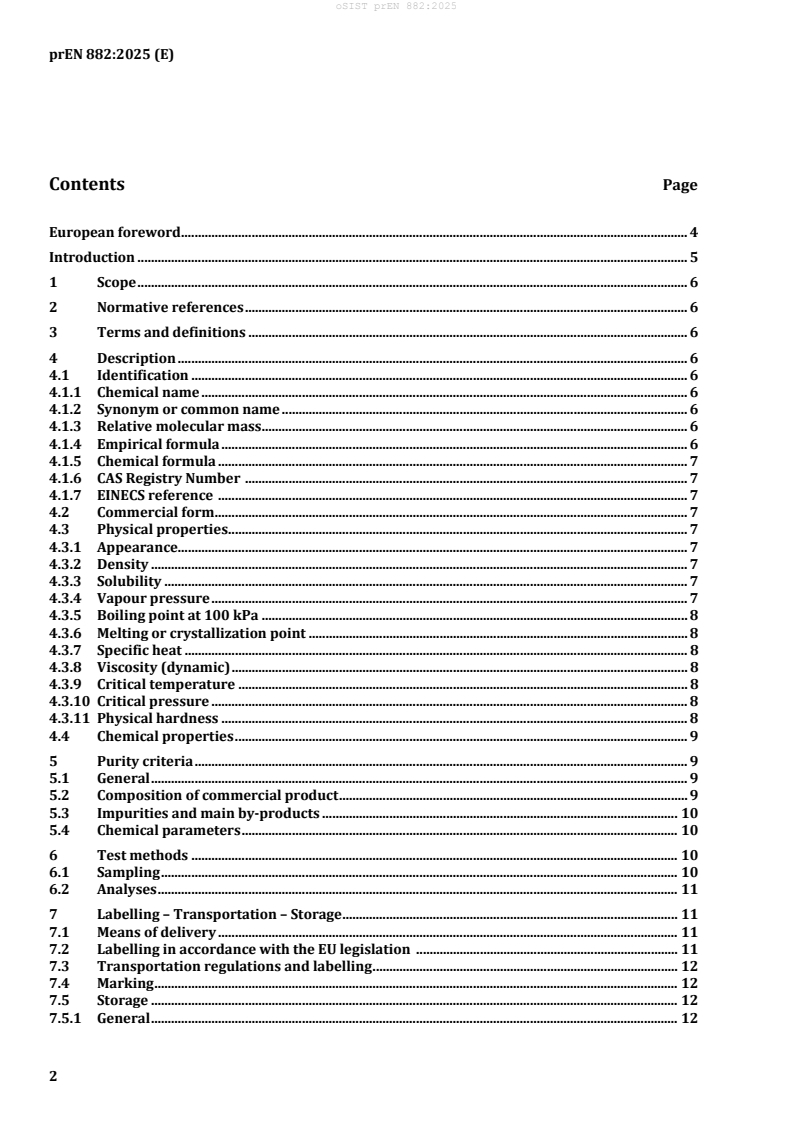
Contents
- Introduction
- 1 Scope
- 2 Normative references
- 3 Terms and definitions
- 4 Description
- 4.1 Identification
- 4.2 Commercial form
- 4.3 Physical properties
- 4.4 Chemical properties
- 5 Purity criteria
- 5.1 General
- 5.2 Composition of commercial product
- 5.3 Impurities and main by-products
- 5.4 Chemical parameters
- 6 Test methods
- 6.1 Sampling
- 6.2 Analyses
- 7 Labelling – Transportation – Storage
- 7.1 Means of delivery
- 7.2 Labelling in accordance with the EU legislation
- 7.3 Transportation regulations and labelling
- 7.4 Marking
- 7.5 Storage
- Annex A
- Annex B
- Bibliography
Introduction
In respect of potential adverse effects on the quality of water intended for human consumption, caused by the product covered by this document:
a) this document provides no information as to whether the product may be used without restriction in any of the Member States of the EU or EFTA; b) it should be noted that, while awaiting the adoption of verifiable European criteria, existing national regulations concerning the use and/or the characteristics of this product remain in force. NOTE Conformity with this document does not confer or imply acceptance or approval of the product in any of the Member States of the EU or EFTA. The use of the product covered by this document is subject to regulation or control by National Authorities.
oSIST prEN 882:2025 prEN 882:2025 (E)
1 Scope
This document is applicable to sodium aluminate used for treatment of water intended for human consumption. It describes the characteristics and specifies the requirements of sodium aluminate and refers to the corresponding analytical methods. It gives information for its use in water treatment. It also determines the rules relating to safe handling (Annex B) and use of sodium aluminate (Annex A).
2 Normative references
The following documents, in whole or in part, are normatively referenced in this document and are indispensable for its application. For dated references, only the edition cited applies. For undated references, the latest edition of the referenced document (including any amendments) applies. EN 1302, Chemicals used for treatment of water intended for human consumption — Aluminium-based coagulants — Analytical methods
3 Terms and definitions
No terms and definitions are listed in this document.
ISO and IEC maintain terminology databases for use in standardization at the following addresses:
- ISO Online browsing platform: available at https://www.iso.org/obp
- IEC Electropedia: available at https://www.electropedia.org/
4 Description
4.1 Identification
4.1.1 Chemical name
Aluminium sodium oxide Aluminium sodium dioxide Aluminium sodium tetrahydroxide
4.1.2 Synonym or common name
Sodium aluminate
4.1.3 Relative molecular mass
82 for NaAlO .
4.1.4 Empirical formula
a) NaAlO .
b) NaAlO 0,1 Na O⋅nH O (n varies from 0,3 to 0,4).
2 2 2
oSIST prEN 882:2025 prEN 882:2025 (E)
4.1.5 Chemical formula
NaAlO .
NaAlO 0,1 Na O⋅nH O (n varies from 0,3 to 0,4).
2 2 2 1)
4.1.6 CAS Registry Number
1302-42-7 12251-53-5 2)
4.1.7 EINECS reference
215-100-1 235-487-0
4.2 Commercial form
Sodium aluminate is available as solids (powder or granules) or solutions.
4.3 Physical properties
4.3.1 Appearance
The product is a white powder or granules or colourless to yellow liquid.
4.3.2 Density
The absolute density of solids products is 2,35 g/cm .
3 3 The tamped bulk density (powder) is between 1 g/cm to 1,2 g/cm (depends on grain size). The density of solutions is 1,5 g/ml for a solution containing 10 % of active matter, expressed as mass fraction of aluminium in the product (10 % Al).
4.3.3 Solubility
Sodium aluminate is soluble in water to yield solutions of up to 12,7 % Al at 20 °C (concentration higher than 400 g/l).
NOTE Depending on temperature and degree of dilution, solutions of sodium aluminate can hydrolyse and form a precipitate.
4.3.4 Vapour pressure
- Solid not applicable.
- Solution not known.
1) Chemical Abtracts Service Registry Number.
2) European inventory of Existing Commercial chemicals Substances.
oSIST prEN 882:2025 prEN 882:2025 (E) 3)
4.3.5 Boiling point at 100 kPa
- Solid not applicable.
- Solution not known.
4.3.6 Melting or crystallization point
- Solid melting point: approximately 1 650 °C.
- Solution typical values for crystallization point range between -15 °C and -25 °C.
4.3.7 Specific heat
Not known
4.3.8 Viscosity (dynamic)
Typical values of dynamic viscosity for sodium aluminate solutions, containing 10 % Al and 12,7 % Al are given in Table 1.
Table 1 — Viscosity Temperature Viscosity °C mPa⋅s 10 % Al 12,7 % Al -5 1 250 15 000 0 650 7 000 5 360 2 850 10 200 1 650 15 140 900 20 120 560
4.3.9 Critical temperature
Not applicable
4.3.10 Critical pressure
Not applicable
4.3.11 Physical hardness
- Solid not known
- Solution not applicable
3) 100 kPa = 1 bar
oSIST prEN 882:2025 prEN 882:2025 (E)
4.4 Chemical properties
Sodium aluminate solutions are highly alkaline. Their solutions hydrolyse and form a precipitate of aluminium hydroxide when diluted beyond a particular level or neutralized. Since aluminium compounds are amphoteric in nature, the solubility of aluminium depends on the pH value and it is advised to use the product within an appropriate pH range. When dissolved in drinking water, calcium is partially precipitated with aluminium hydroxide.
5 Purity criteria
5.1 General
This document specifies the minimum purity requirements for sodium aluminate used for the treatment of water intended for human consumption. Limits are given for impurities commonly present in the product. Depending on the raw material and the manufacturing process other impurities may be present and, if so, this shall be notified to the user and when necessary to relevant authorities. Users of this product should check the national regulations in order to clarify whether it is of appropriate purity for treatment of water intended for human consumption, taking into account raw water quality, required dosage, contents of other impurities and additives used in the product not stated in this document.
Limits have been given for impurities and chemical parameters where these are likely to be present in significant quantities from the current production process and raw materials. If the production process or raw materials leads to significant quantities of impurities, by-products or additives being present, this shall be notified to the user.
...