


EN 13832-3:2018
(Main)Footwear protecting against chemicals - Part 3: Requirements for prolonged contact with chemicals
Footwear protecting against chemicals - Part 3: Requirements for prolonged contact with chemicals
This European Standard specifies requirements for footwear intended to protect the wearer from a prolonged continuous contact (more than 1 hour) with specific chemicals.
Degradation and permeation by chemicals are addressed in this standard. Other requirements are covered by reference to EN ISO 20345, 20346 or 20347 as appropriate.
Schuhe zum Schutz gegen Chemikalien - Teil 3: Anforderungen für anhaltenden Kontakt mit Chemikalien
Diese Europäische Norm legt Anforderungen an Schuhwerk fest, das für den Schutz des Trägers vor anhaltendem, durchgehendem Kontakt (länger als 1 h) mit spezifischen Chemikalien vorgesehen ist.
Materialermüdung und Durchdringung durch Chemikalien werden in dieser Norm behandelt. Andere Anforderungen sind durch Verweisung auf EN ISO 20345, EN ISO 20346 bzw. EN ISO 20347, sofern zutreffend, abgedeckt.
Chaussure protégeant contre les produits chimiques - Partie 3 : Exigences pour les contacts prolongés avec les produits chimiques
La présente Norme européenne spécifie les exigences relatives aux chaussures destinées à protéger l’utilisateur d’un contact continu prolongé (plus d’une heure) avec des produits chimiques spécifiques.
La dégradation par des produits chimiques et la perméation de produits chimiques sont traitées dans la présente norme. D’autres exigences sont couvertes par une référence à l’EN ISO 20345, 20346 ou 20347, selon le cas.
Obutev za varovanje pred kemikalijami - 3. del: Zahteve za podaljšan stik s kemikalijami
Ta evropski standard določa zahteve za obutev, namenjeno za zaščito uporabnika pred podaljšanim neprekinjenim stikom (več kot 1 uro) s specifičnimi kemikalijami.
V tem standardu sta obravnavana razgradnja in prepustnost kemikalij. Druge zahteve so zajete s sklicevanjem na standarde EN ISO 20345, 20346 ali 20347, kot je ustrezno.
General Information
- Status
- Published
- Publication Date
- 27-Nov-2018
- Withdrawal Date
- 30-May-2019
- Technical Committee
- CEN/TC 161 - Foot and leg protectors
- Current Stage
- 9092 - Decision on results of review/2YR ENQ - revise - Review Enquiry
- Start Date
- 04-Jun-2024
- Completion Date
- 11-Feb-2026
Relations
- Effective Date
- 08-Jun-2022
- Effective Date
- 28-Jan-2026
- Effective Date
- 28-Jan-2026
- Effective Date
- 28-Jan-2026
- Effective Date
- 28-Jan-2026
- Refers
EN ISO 20344:2011 - Personal protective equipment - Test methods for footwear (ISO 20344:2011) - Effective Date
- 28-Jan-2026
- Refers
EN 13832-1:2018 - Footwear protecting against chemicals - Part 1: Terminology and test methods - Effective Date
- 28-Jan-2026
- Referred By
EN ISO 20347:2022 - Personal protective equipment - Occupational footwear (ISO 20347:2021) - Effective Date
- 28-Jan-2026
- Effective Date
- 28-Jan-2026
- Effective Date
- 28-Jan-2026
- Effective Date
- 28-Jan-2026
- Effective Date
- 31-Jan-2024
Overview
EN 13832-3:2018 - "Footwear protecting against chemicals - Part 3: Requirements for prolonged contact with chemicals" (CEN) specifies performance requirements and test methods for footwear designed to protect the wearer from continuous or intermittent chemical contact for more than one hour. The standard addresses degradation and permeation by chemicals and references general footwear safety requirements in EN ISO 20345, EN ISO 20346 or EN ISO 20347 as appropriate.
Key topics and requirements
Scope and classification
- Applies to footwear intended for prolonged contact (>1 hour) with specific chemicals.
- Design formats allowed: Designs C, D or E (e.g., ankle, knee and extended boots).
- Typical classification used: Class II (all-rubber or all-polymeric footwear).
Chemical testing
- At least three test chemicals must be selected from the standard’s table (examples include methanol, acetone, toluene, sodium hydroxide, sulphuric acid, hydrofluoric acid).
- Degradation testing: materials (upper and sole) are exposed per EN 13832-1:2018 procedures with a 24 h degradation period; physical properties (tear, hardness, elongation) are evaluated after exposure.
- Permeation testing: breakthrough times are measured and mapped to permeation performance levels (levels correspond to defined time ranges from a few hours up to >32 h as specified in the standard and EN 13832-1).
Additional requirements
- Basic PPE requirements (construction, slip resistance, toe protection options, insocks) are referenced to EN ISO 20345 / 20346 / 20347.
- Marking, user instructions and labelling requirements are detailed (including listing of chemicals claimed).
- The standard includes an informative annex on slip resistance and aligns with PPE Regulation EU 2016/425.
Applications and users
- Practical uses:
- Selection and testing of protective footwear for chemical plants, laboratories, maintenance, cleaning operations, emergency response, petrochemical and pharmaceutical environments where prolonged chemical contact is possible.
- Primary users:
- Footwear manufacturers, product designers and R&D teams.
- Test laboratories, conformity assessment bodies and notified bodies.
- Safety managers, procurement specialists and compliance officers responsible for PPE selection and documentation.
Related standards
- EN 13832-1:2018 - Terminology and test methods
- EN 13832-2 - Requirements for limited contact with chemicals
- EN ISO 20345 / EN ISO 20346 / EN ISO 20347 - General safety/protective footwear standards
- EN 16523-1 - Reference for permeation testing methods
EN 13832-3:2018 is essential when specifying or certifying footwear for prolonged chemical exposure and ensures consistent assessment of degradation, permeation, marking and user information for compliance with EU PPE rules.


Get Certified
Connect with accredited certification bodies for this standard

NSF International
Global independent organization facilitating standards development and certification.

CIS Institut d.o.o.
Personal Protective Equipment (PPE) certification body. Notified Body NB-2890 for EU Regulation 2016/425 PPE.

Kiwa BDA Testing
Building and construction product certification.
Sponsored listings
Frequently Asked Questions
EN 13832-3:2018 is a standard published by the European Committee for Standardization (CEN). Its full title is "Footwear protecting against chemicals - Part 3: Requirements for prolonged contact with chemicals". This standard covers: This European Standard specifies requirements for footwear intended to protect the wearer from a prolonged continuous contact (more than 1 hour) with specific chemicals. Degradation and permeation by chemicals are addressed in this standard. Other requirements are covered by reference to EN ISO 20345, 20346 or 20347 as appropriate.
This European Standard specifies requirements for footwear intended to protect the wearer from a prolonged continuous contact (more than 1 hour) with specific chemicals. Degradation and permeation by chemicals are addressed in this standard. Other requirements are covered by reference to EN ISO 20345, 20346 or 20347 as appropriate.
EN 13832-3:2018 is classified under the following ICS (International Classification for Standards) categories: 13.340.50 - Leg and foot protection. The ICS classification helps identify the subject area and facilitates finding related standards.
EN 13832-3:2018 has the following relationships with other standards: It is inter standard links to EN 13832-3:2006, EN ISO 20347:2012, EN ISO 868:2003, EN ISO 20345:2011, EN ISO 20346:2014, EN ISO 20344:2011, EN 13832-1:2018, EN ISO 20347:2022, EN ISO 20345:2022, EN 13832-2:2018, EN ISO 20346:2022, prEN 13832-3. Understanding these relationships helps ensure you are using the most current and applicable version of the standard.
EN 13832-3:2018 is associated with the following European legislation: EU Directives/Regulations: 2016/425, 89/686/EEC; Standardization Mandates: M/031. When a standard is cited in the Official Journal of the European Union, products manufactured in conformity with it benefit from a presumption of conformity with the essential requirements of the corresponding EU directive or regulation.
EN 13832-3:2018 is available in PDF format for immediate download after purchase. The document can be added to your cart and obtained through the secure checkout process. Digital delivery ensures instant access to the complete standard document.
Standards Content (Sample)
2003-01.Slovenski inštitut za standardizacijo. Razmnoževanje celote ali delov tega standarda ni dovoljeno.Obutev za varovanje pred kemikalijami - 3. del: Zahteve za podaljšan stik s kemikalijamiSchuhe zum Schutz gegen Chemikalien - Teil 3: Anforderungen für anhaltenden Kontakt mit ChemikalienChaussure protégeant contre les produits chimiques - Partie 3 : Exigences pour les contacts prolongés avec les produits chimiquesFootwear protecting against chemicals - Part 3: Requirements for prolonged contact with chemicals13.340.50Varovanje nog in stopalLeg and foot protectionICS:Ta slovenski standard je istoveten z:EN 13832-3:2018SIST EN 13832-3:2019en,fr,de01-februar-2019SIST EN 13832-3:2019SLOVENSKI
STANDARDSIST EN 13832-3:20061DGRPHãþD
EUROPEAN STANDARD NORME EUROPÉENNE EUROPÄISCHE NORM
EN 13832-3
November
t r s z ICS
s uä u v rä w r Supersedes EN
s u z u tæ uã t r r xEnglish Version
Footwear protecting against chemicals æ Part
uã Requirements for prolonged contact with chemicals Chaussure protégeant contre les produits chimiques æ Partie
u ã Exigences pour les contacts prolongés avec les produits chimiques
Schuhe zum Schutz gegen Chemikalien æ Teil
uã Anforderungen für anhaltenden Kontakt mit Chemikalien This European Standard was approved by CEN on
t z May
t r s zä
egulations which stipulate the conditions for giving this European Standard the status of a national standard without any alterationä Upætoædate lists and bibliographical references concerning such national standards may be obtained on application to the CENæCENELEC Management Centre or to any CEN memberä
translation under the responsibility of a CEN member into its own language and notified to the CENæCENELEC Management Centre has the same status as the official versionsä
CEN members are the national standards bodies of Austriaá Belgiumá Bulgariaá Croatiaá Cyprusá Czech Republicá Denmarká Estoniaá Finlandá Former Yugoslav Republic of Macedoniaá Franceá Germanyá Greeceá Hungaryá Icelandá Irelandá Italyá Latviaá Lithuaniaá Luxembourgá Maltaá Netherlandsá Norwayá Polandá Portugalá Romaniaá Serbiaá Slovakiaá Sloveniaá Spainá Swedená Switzerlandá Turkey and United Kingdomä
EUROPEAN COMMITTEE FOR STANDARDIZATION COMITÉ EUROPÉEN DE NORMALISATION EUROPÄISCHES KOMITEE FÜR NORMUNG
CEN-CENELEC Management Centre:
Rue de la Science 23,
B-1040 Brussels
t r s z CEN All rights of exploitation in any form and by any means reserved worldwide for CEN national Membersä Refä Noä EN
s u z u tæ uã t r s z ESIST EN 13832-3:2019
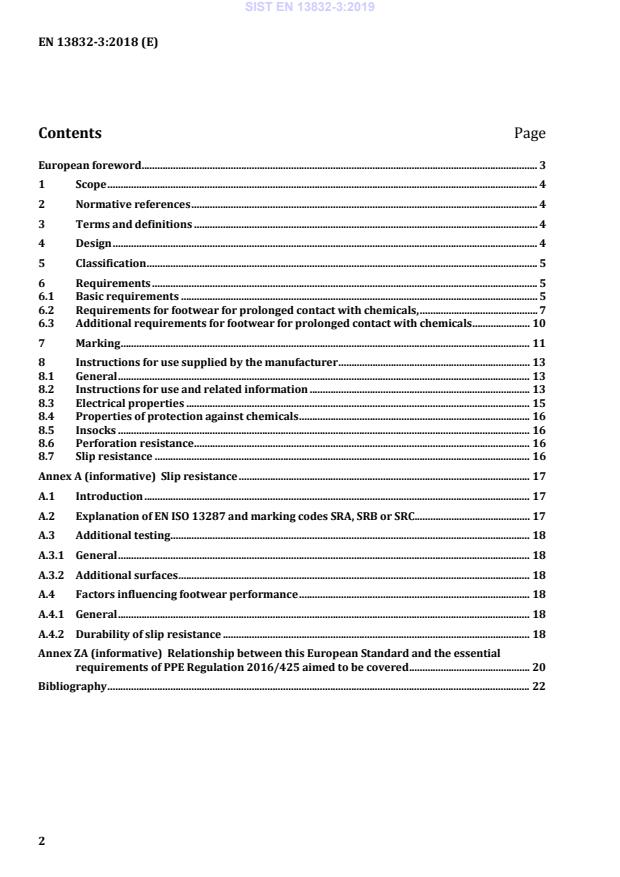
Slip resistance . 17 A.1 Introduction . 17 A.2 Explanation of EN ISO 13287 and marking codes SRA, SRB or SRC. 17 A.3 Additional testing . 18 A.3.1 General . 18 A.3.2 Additional surfaces . 18 A.4 Factors influencing footwear performance . 18 A.4.1 General . 18 A.4.2 Durability of slip resistance . 18 Annex ZA (informative)
Relationship between this European Standard and the essential requirements of PPE Regulation 2016/425 aimed to be covered . 20 Bibliography . 22 SIST EN 13832-3:2019
EN ISO 20346:2014, Personal protective equipment - Protective footwear (ISO 20346:2014) EN ISO 20347:2012, Personal protective equipment - Occupational footwear (ISO 20347:2012) 3 Terms and definitions For the purposes of this document, the terms and definitions given in EN 13832-1:2018, EN ISO 20345:2011 and the following apply. ISO and IEC maintain terminological databases for use in standardization at the following addresses:
IEC Electropedia: available at http://www.electropedia.org/
ISO Online browsing platform: available at http://www.iso.org/obp 3.1 footwear for prolonged contact with chemicals footwear intended to protect the wearer from continuous or intermittent contact with chemicals for more than one hour 4 Design For footwear for prolonged contact with chemicals, only designs C, D or E in Figure 1 shall be used. SIST EN 13832-3:2019
Key 1 Variable extension that can be adapted to the wearer C Half knee boot A Low shoe D Knee height boot B Ankle boot E Thigh boot NOTE Design E is a knee-height boot (design D) equipped with a thin impermeable material that extends the upper and that can be cut to adapt the boot to the wearer. Figure 1 — Designs of footwear 5 Classification Footwear for prolonged contact with chemicals shall be classified in accordance with Table 1. Table 1 — Classification of footwear Classification Description II All-rubber (i.e. entirely vulcanised) and all-polymeric footwear (i.e. entirely moulded) See Clause 4 of EN ISO 20345:2011, EN ISO 20346:2014 and EN ISO 20347:2012 6 Requirements 6.1 Basic requirements Footwear for prolonged contact with chemicals shall conform to the requirements specified in Table 2. Footwear for prolonged contact with chemicals may or may not include a toe cap. The choice shall be made from one of the three columns (EN ISO 20345:2011, EN ISO 20346:2014 or EN ISO 20347:2012) in Table 2. SIST EN 13832-3:2019
4 and 5 X Height of upper 5.2.2 5.2.2 5.2.2
X Specific ergonomic features 5.3.4 5.3.4 5.3.3
X Leakproofness 5.3.3 5.3.3 5.3.2
X Seat region Designs C and D (Figure 1) 5.2.3 5.2.3 5.2.3
X Design E (Figure 1) 5.2.3 5.2.3 5.2.3
X Whole footwear Sole performance Construction 5.3.1.1 5.3.1.1 5.3.1.1
Slip resistance 5.3.5 5.3.5 5.3.4
X Toe Protection General 5.3.2.1 5.3.2.1
X Toe cap length 5.3.2.2 5.3.2.2
X Impact resistance 5.3.2.3 5.3.2.3
X Compression resistance 5.3.2.4 5.3.2.4
X Toecap behaviour 5.3.2.5 5.3.2.5
X innocuousness
6.2.3
footwear for prolonged contact with chemicals
6.2.1 X Upper General 5.4.1 5.4.1 5.4.1
X Thickness 5.4.2 5.4.2 5.4.2
X Tensile properties 5.4.4 5.4.4 5.4.4
X hydrolysis 5.4.8 5.4.8 5.4.8
X Flexing resistance 5.4.5 5.4.5 5.4.5
X Insole/insocks See Table 3 Outsole Thickness 5.8.1 5.8.1 5.8.1
X Tear strength 5.8.2 5.8.2 5.8.2
X Abrasion resistance
6.2.2 X Flexing resistance 5.8.4 5.8.4 5.8.4
X hydrolysis 5.8.5 5.8.5 5.8.5
X Interlayer bond strength 5.8.6 5.8.6 5.8.6
O The applicability of a requirement to a particular classification is indicated in the table by the following. X
indicates that the requirement shall be met. In some cases the requirement relates only to particular materials within the classification, e.g. pH value of leather components. This does not mean that other materials are precluded from use. O
indicates that if the component part exists, the requirement shall be met. Note1 The absence of X or O indicates that no requirement is met. Note2 For class II footwear, it is usual to have no insole present. However, if a removable insock is used, Table 3 is applicable, only chromium VI and pH requirements are fulfilled for leather materials. Note3 Stockings covering the last before the moulding process are not considered as a lining. SIST EN 13832-3:2019
20346:2014/ EN ISO
20347:2012 Thickness 5.7.1 pH 5.7.2 Water absorption desorption 5.7.3 Abrasion 5.7.4.1 Chromium VI 5.7.5 Abrasion 5.7.4.2 1 No insole or if present not fulfilling the requirements Non-removable insock Insock X X X
X X 2 Insole present No insock Insole X X X X X
Seat sock present 3 Full insock,
non-removable Insock and insole together X
X
Insock
X
X X 4 Full insock, removable and water-permeableÕ Insole X X X X X
Insock
X
X X 5 Full insock, removable, not water-permeable Insole X X X X X
Insock
X X
X X NOTE For removable insocks see 8.5. X
indicates that the requirement shall be met. Õ indicates a water permeable insock which, when tested in accordance with EN ISO 20344:2011, 7.2, lets water through in 60 s or less.
Indicates those requirements that are only for leather. 6.2 Requirements for footwear for prolonged contact with chemicals, 6.2.1 Resistance of whole footwear 6.2.1.1 General At least 3 test chemicals shall be taken from the list given in Table 4. Other testing chemicals could be used depending on the application of the footwear. SIST EN 13832-3:2019
25 % 1336–21–6 Organic base P Hydrogen peroxide 30 % 7722–84–1 Peroxide Q isopropanol 67–63–0 Aliphatic alcohol R Sodium Hypochlorite
(13 ± 1)% (active chloride) 7681–52–9 hypochlorite S Hydrofluoric acid 40 % 7664–39–3 Inorganic mineral acid T Formaldehyde 37 % 50–00–0 Aldehyde Safety precautions — Person using this standard should be familiar with normal laboratory practice. This standard does not purport to address all the safety problems, if any, associated with its use. It is the responsibility of the user to apply established Health and Safety practices and to ensure compliance with the applicable regulations. Footwear for prolonged contact with chemicals shall fulfil the requirements given in Table5. Table 5 — Requirements on footwear for prolonged contact to chemicals Chemicals Degradation 24 h - 6.2.2 Permeation - 6.2.3 At least 3 chemicals of Table 4 X X SIST EN 13832-3:2019
Greater or equal to
6,4 kN/m for material with density greater than 0,9 g/cm3
Greater or equal to
4,0 kN/m for material with density smaller or equal to 0,9 g/cm3 Minimum:
30 shore A Maximum: (value before degradation + 10) shore A For class II Minimum 80 % of value before degradation for class II with a removable lining, Minimum 80 % of value before degradation 6.2.1.3 Permeation resistance Each permeation resistance result for footwear for prolonged contact with chemicals shall be classified according to Table 7, using the results as given in EN 13832-1:2018, 4.4 for the normalized breakthrough time. SIST EN 13832-3:2019
“more than 8h” 3 Between 24 and 32 h “More than 24h” 4 “More than 32h” 5 For each of the 3 chosen chemicals the permeation performance level 1 shall be reached. Nonhomogeneous results (situation described in EN 16523-1:2015, 8.5.1.4) are considered as failed. The testing chemical(s) shall be taken from the list of test chemicals in Table 4. Other testing chemicals could be used depending on the application of the footwear. The degradation and permeation shall be tested both with the same chemicals. 6.2.2 Outsole Wh
...
Questions, Comments and Discussion
Ask us and Technical Secretary will try to provide an answer. You can facilitate discussion about the standard in here.
Loading comments...