


FprCEN/TS 18212-3
(Main)Personal identification - Requirements for biometric products - Part 3: Functionality evaluation methodology
Personal identification - Requirements for biometric products - Part 3: Functionality evaluation methodology
The CEN/TS 18212 series specifies a generic framework for the establishment of requirements and their evaluation methodology for biometric products. The requirements depend on the biometric mode considered and are adapted to each scenario, through the definition of a variety of application profiles.
The CEN/TS 18212 series specifies the evaluation methodology, the individual tests and the application profiles (with their particular requirements).
This document specifies:
— The different kind of evaluations to be performed.
— The terms used during the description of the tests to be applied.
— The parameters used, whose values are defined by each application profile, for each of the individual tests.
— Test data used, and considerations dealing with personal data protection.
— How to perform technology evaluations.
— Execution flow for functionality scenario evaluations.
— Execution flow for attack resistance evaluations.
NOTE 1 Future parts of the CEN/TS series are planned to address the specifics of each biometric mode.
For each of these modalities, this document specifies application-independent tests, as well as a set of application profiles, that detail the applicable tests, the evaluation parameters and the passing criteria.
The CEN/TS 18212 series can be taken by any certification body and/or sector, to define and evaluate the requirements for their biometric products within their selected applications.
NOTE 2 National regulations and requirements can apply.
NOTE 3 Regarding biometrics for public sector applications, see also BSI TR-03121 [8] which can apply.
NOTE 4 For an overview of sectors addressed in the Cybersecurity Act, see Regulation (EU) 2019/881 [2].
Persönliche Identifikation - Anforderungen an biometrische Produkte - Teil 3: Methodik zur Beurteilung der Funktionalität
Identification personnelle - Exigences relatives aux produits biométriques - Partie 3 : Méthodologie d'évaluation de la fonctionnalité
Osebna identifikacija - Zahteve za biometrične izdelke - 3. del: Metodologija ocenjevanja funkcionalnosti
General Information
- Status
- Not Published
- Publication Date
- 19-May-2026
- Drafting Committee
- CEN/TC 224/WG 18 - Interoperability of biometric recorded data
- Current Stage
- 5060 - Closure of Vote - Formal Approval
- Start Date
- 12-Mar-2026
- Due Date
- 31-Dec-2025
- Completion Date
- 12-Mar-2026
Overview
FprCEN/TS 18212-3: Personal Identification - Requirements for Biometric Products - Part 3: Functionality Evaluation Methodology is a CEN technical specification that defines a general methodology for evaluating the functionality of biometric products. This standard is part of the broader CEN/TS 18212 series, which establishes a framework for defining and evaluating requirements for biometric systems. Part 3 focuses on practical methodologies for performing evaluations, specifying test types, evaluation parameters, use of test data, and considerations for personal data protection. The approach can be applied across different biometric modalities and application scenarios through clearly defined application profiles.
Key Topics
- Evaluation Methodology: FprCEN/TS 18212-3 outlines structured methods for testing biometric products, detailing both performance (functionality) and attack resistance evaluations.
- Application Profiles: Frameworks for different scenarios, allowing customization of test parameters for specific use-cases and biometric modalities.
- Terms and Parameters: Standardized terminologies and parameter definitions ensure clarity in testing procedures, such as defining ‘TEST’, ‘TRIAL’, ‘SUBJECT’, ‘PASS’, ‘FAIL’, and workflow limits (e.g., minimum trials, maximum errors).
- Data Handling and Privacy: Emphasizes the selection and management of test data, including the use of real or synthetic databases, with strict adherence to privacy and data protection laws (e.g., GDPR).
- Compatibility with International Standards: Aligns with ISO/IEC 19795 for biometric performance testing and ISO/IEC 30107 for presentation attack detection, ensuring global interoperability and recognition.
- Phased Evaluation Approach:
- Phase 2: Functional and performance evaluation against application profile requirements.
- Phase 3: Robustness evaluation against attack scenarios, including presentation attacks.
- Consideration for Machine Learning Systems: Provides supplemental guidelines for evaluating biometric systems built using machine learning or AI methods.
Applications
This standard is essential for a variety of stakeholders involved in biometric product development and deployment:
- Certification and Conformity Assessment: Provides a consistent basis for certification bodies and laboratories to evaluate biometric devices or solutions according to specific application needs.
- Public and Private Sector Deployments: Facilitates reliable, auditable personal identification methods for sectors such as banking, e-government, health care, and border control.
- Product Development and Procurement: Enables manufacturers, vendors, and procurement authorities to specify, test, and verify biometric system performance and security requirements.
- Alignment with Regulatory Requirements: Supports compliance with national and European regulations, including GDPR for data privacy and the EU Cybersecurity Act for different levels of assurance.
Related Standards
FprCEN/TS 18212-3 is designed to work in concert with several related standards for biometric testing and personal identification:
- FprCEN/TS 18212-1: General requirements and application profile definition
- FprCEN/TS 18212-2: Interoperability tests for biometric products
- ISO/IEC 19795 series: Biometric performance testing and reporting
- ISO/IEC 30107 series: Biometric presentation attack detection
- ISO/IEC 2382-37: Biometrics terminology
- ISO/IEC 17000 family: Conformity assessment standards
Other references include BSI TR-03121 for biometrics in the public sector and EU Regulation 2019/881 (Cybersecurity Act) for sectoral scope and levels of assurance.
This methodology standard serves as a robust foundation for evaluating biometric identification systems, ensuring consistent performance, security, and regulatory compliance across diverse applications. By following FprCEN/TS 18212-3, organizations can achieve greater confidence in biometric technology deployments and facilitate international trust and interoperability.

Get Certified
Connect with accredited certification bodies for this standard

BSI Group
BSI (British Standards Institution) is the business standards company that helps organizations make excellence a habit.

NYCE
Mexican standards and certification body.
Sponsored listings
Frequently Asked Questions
FprCEN/TS 18212-3 is a draft published by the European Committee for Standardization (CEN). Its full title is "Personal identification - Requirements for biometric products - Part 3: Functionality evaluation methodology". This standard covers: The CEN/TS 18212 series specifies a generic framework for the establishment of requirements and their evaluation methodology for biometric products. The requirements depend on the biometric mode considered and are adapted to each scenario, through the definition of a variety of application profiles. The CEN/TS 18212 series specifies the evaluation methodology, the individual tests and the application profiles (with their particular requirements). This document specifies: — The different kind of evaluations to be performed. — The terms used during the description of the tests to be applied. — The parameters used, whose values are defined by each application profile, for each of the individual tests. — Test data used, and considerations dealing with personal data protection. — How to perform technology evaluations. — Execution flow for functionality scenario evaluations. — Execution flow for attack resistance evaluations. NOTE 1 Future parts of the CEN/TS series are planned to address the specifics of each biometric mode. For each of these modalities, this document specifies application-independent tests, as well as a set of application profiles, that detail the applicable tests, the evaluation parameters and the passing criteria. The CEN/TS 18212 series can be taken by any certification body and/or sector, to define and evaluate the requirements for their biometric products within their selected applications. NOTE 2 National regulations and requirements can apply. NOTE 3 Regarding biometrics for public sector applications, see also BSI TR-03121 [8] which can apply. NOTE 4 For an overview of sectors addressed in the Cybersecurity Act, see Regulation (EU) 2019/881 [2].
The CEN/TS 18212 series specifies a generic framework for the establishment of requirements and their evaluation methodology for biometric products. The requirements depend on the biometric mode considered and are adapted to each scenario, through the definition of a variety of application profiles. The CEN/TS 18212 series specifies the evaluation methodology, the individual tests and the application profiles (with their particular requirements). This document specifies: — The different kind of evaluations to be performed. — The terms used during the description of the tests to be applied. — The parameters used, whose values are defined by each application profile, for each of the individual tests. — Test data used, and considerations dealing with personal data protection. — How to perform technology evaluations. — Execution flow for functionality scenario evaluations. — Execution flow for attack resistance evaluations. NOTE 1 Future parts of the CEN/TS series are planned to address the specifics of each biometric mode. For each of these modalities, this document specifies application-independent tests, as well as a set of application profiles, that detail the applicable tests, the evaluation parameters and the passing criteria. The CEN/TS 18212 series can be taken by any certification body and/or sector, to define and evaluate the requirements for their biometric products within their selected applications. NOTE 2 National regulations and requirements can apply. NOTE 3 Regarding biometrics for public sector applications, see also BSI TR-03121 [8] which can apply. NOTE 4 For an overview of sectors addressed in the Cybersecurity Act, see Regulation (EU) 2019/881 [2].
FprCEN/TS 18212-3 is classified under the following ICS (International Classification for Standards) categories: 35.240.15 - Identification cards. Chip cards. Biometrics. The ICS classification helps identify the subject area and facilitates finding related standards.
FprCEN/TS 18212-3 is available in PDF format for immediate download after purchase. The document can be added to your cart and obtained through the secure checkout process. Digital delivery ensures instant access to the complete standard document.
Standards Content (Sample)
SLOVENSKI STANDARD
01-marec-2026
Osebna identifikacija - Zahteve za biometrične izdelke - 3. del: Metodologija
ocenjevanja funkcionalnosti
Personal identification - Requirements for biometric products - Part 3: Functionality
evaluation methodology
Persönliche Identifikation - Anforderungen an biometrische Produkte - Teil 3: Methodik
zur Beurteilung der Funktionalität
Identification personnelle - Exigences relatives aux produits biométriques - Partie 3 :
Méthodologie d'évaluation de la fonctionnalité
Ta slovenski standard je istoveten z: FprCEN/TS 18212-3
ICS:
35.240.15 Identifikacijske kartice. Čipne Identification cards. Chip
kartice. Biometrija cards. Biometrics
2003-01.Slovenski inštitut za standardizacijo. Razmnoževanje celote ali delov tega standarda ni dovoljeno.
FINAL DRAFT
TECHNICAL SPECIFICATION
SPÉCIFICATION TECHNIQUE
TECHNISCHE SPEZIFIKATION
December 2025
ICS 35.240.15
English Version
Personal identification - Requirements for biometric
products - Part 3: Functionality evaluation methodology
Identification personnelle - Exigences relatives aux Persönliche Identifikation - Anforderungen an
produits biométriques - Partie 3 : Méthodologie biometrische Produkte - Teil 3: Methodik zur
d'évaluation de la fonctionnalité Beurteilung der Funktionalität
This draft Technical Specification is submitted to CEN members for Vote. It has been drawn up by the Technical Committee
CEN/TC 224.
CEN members are the national standards bodies of Austria, Belgium, Bulgaria, Croatia, Cyprus, Czech Republic, Denmark, Estonia,
Finland, France, Germany, Greece, Hungary, Iceland, Ireland, Italy, Latvia, Lithuania, Luxembourg, Malta, Netherlands, Norway,
Poland, Portugal, Republic of North Macedonia, Romania, Serbia, Slovakia, Slovenia, Spain, Sweden, Switzerland, Türkiye and
United Kingdom.
Recipients of this draft are invited to submit, with their comments, notification of any relevant patent rights of which they are
aware and to provide supporting documentation.
Warning : This document is not a Technical Specification. It is distributed for review and comments. It is subject to change
without notice and shall not be referred to as a Technical Specification.
EUROPEAN COMMITTEE FOR STANDARDIZATION
COMITÉ EUROPÉEN DE NORMALISATION
EUROPÄISCHES KOMITEE FÜR NORMUNG
CEN-CENELEC Management Centre: Rue de la Science 23, B-1040 Brussels
© 2025 CEN All rights of exploitation in any form and by any means reserved Ref. No. FprCEN/TS 18212-3:2025 E
worldwide for CEN national Members.
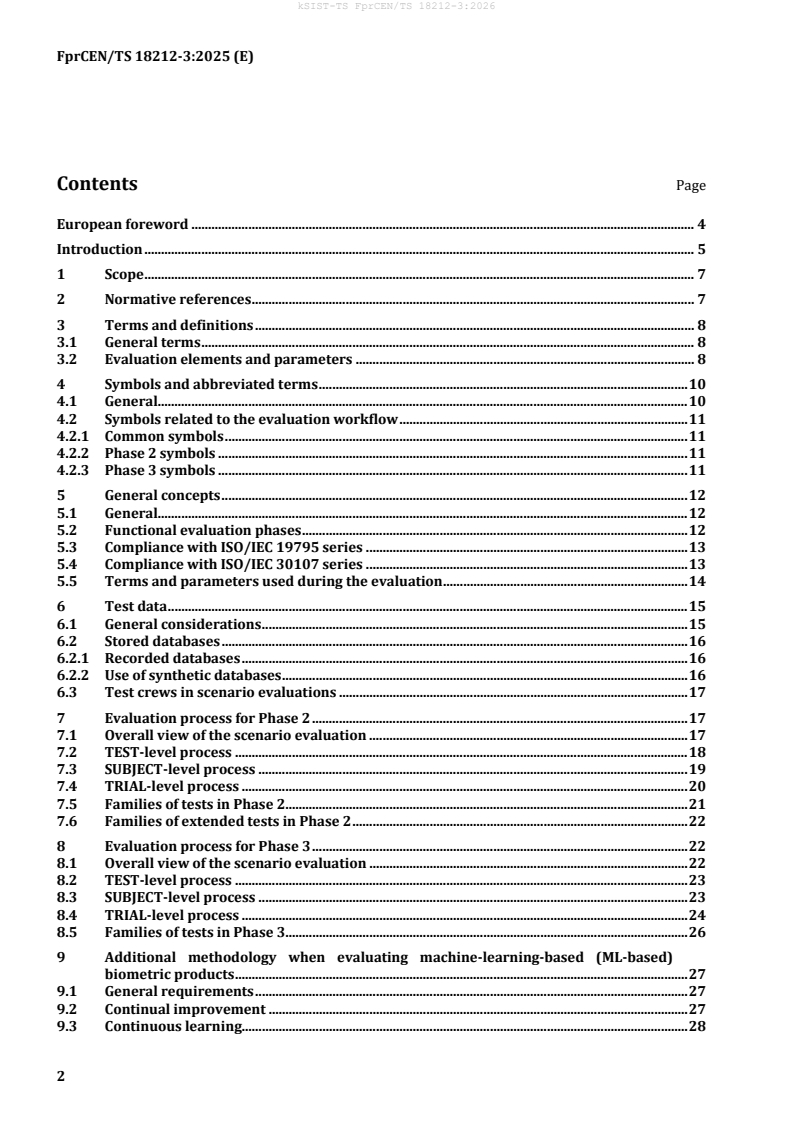
Contents Page
European foreword . 4
Introduction . 5
1 Scope . 7
2 Normative references . 7
3 Terms and definitions . 8
3.1 General terms . 8
3.2 Evaluation elements and parameters . 8
4 Symbols and abbreviated terms . 10
4.1 General. 10
4.2 Symbols related to the evaluation workflow . 11
4.2.1 Common symbols . 11
4.2.2 Phase 2 symbols . 11
4.2.3 Phase 3 symbols . 11
5 General concepts . 12
5.1 General. 12
5.2 Functional evaluation phases . 12
5.3 Compliance with ISO/IEC 19795 series . 13
5.4 Compliance with ISO/IEC 30107 series . 13
5.5 Terms and parameters used during the evaluation . 14
6 Test data . 15
6.1 General considerations . 15
6.2 Stored databases . 16
6.2.1 Recorded databases . 16
6.2.2 Use of synthetic databases . 16
6.3 Test crews in scenario evaluations . 17
7 Evaluation process for Phase 2 . 17
7.1 Overall view of the scenario evaluation . 17
7.2 TEST-level process . 18
7.3 SUBJECT-level process . 19
7.4 TRIAL-level process . 20
7.5 Families of tests in Phase 2. 21
7.6 Families of extended tests in Phase 2 . 22
8 Evaluation process for Phase 3 . 22
8.1 Overall view of the scenario evaluation . 22
8.2 TEST-level process . 23
8.3 SUBJECT-level process . 23
8.4 TRIAL-level process . 24
8.5 Families of tests in Phase 3. 26
9 Additional methodology when evaluating machine-learning-based (ML-based)
biometric products . 27
9.1 General requirements . 27
9.2 Continual improvement . 27
9.3 Continuous learning. 28
9.3.1 Introduction . 28
9.3.2 Evaluation time lapse and infrastructure . 28
9.3.3 Period between evaluations . 29
9.3.4 Evaluation procedure . 29
Bibliography . 30
European foreword
This document (FprCEN/TS 18212-3:2025) has been prepared by Technical Committee CEN/TC 224
“Personal identification and related personal devices with secure element, systems, operations and
privacy in a multi sectorial environment”, the secretariat of which is held by AFNOR.
This document is currently submitted to the Vote on TS.
Introduction
The use of remote services has increased significantly. This was boosted during 2020-2021, when many
service providers and administrations migrated most of their processes to online handling. Many online
services can now be found, such as opening of a bank account, claiming expenses, paying taxes, starting
legal actions, etc.
For all these services there is the need of identifying the persons claiming for that service, and doing it
in a comfortable, universal, reliable and auditable way. Even though some of those services, in some
countries, were deployed using public key infrastructures (PKIs), as recommended by eIDAS [9], this
approach was far away from being used by a significant part of the population.
Biometric recognition has been considered as a technology to solve the binding between the system and
the consumer. Adding biometric recognition to all kind of systems is a common practice nowadays.
In this context, service providers and administrations define their own requirements, select the
products and deploy the solution. On the other hand, manufacturers implement different solutions to
different customers, in order to fulfil each of those requirement sets. Both sides would benefit from
standards and regulations, on which to rely for the product definition.
Everybody benefits from having a common way of defining those requirements, and a detailed
evaluation methodology. These two items can be used by conformity assessment bodies or by business
owners, to create their own certification schemes for this kind of technology/products, by following
applicable standards.
NOTE ISO/IEC 17000 and related standards are examples of applicable conformity assessment standards.
This document is addressing this need for the case of biometric products, analysing and merging all
current works, and defining a detailed set of requirements, a biometric-mode-specific evaluation
methodology, and the passing criteria for different application profiles. This document has been
developed with consideration for GDPR [1] principles.
Application profiles (APs) are targeting the evaluation of a specific range of products using biometric
recognition. APs are the baseline for checking conformity with the CEN/TS 18212 series. Indeed, a
product manufacturer (PM), product vendor (PV) or sponsor can ask a conformity assessment body
(CAB) for the evaluation of a specific product to check its conformity according to the CEN/TS 18212
series and a specific AP at a certain level of assurance (basic, substantial or high).
The specifications given in this document are based on EN ISO/IEC 15408-1, ISO/IEC 19989-3 and
the ISO/IEC 17000 family of standards, including ISO/IEC 17007, EN ISO/IEC 17025
and EN ISO/IEC 17065. These standards specify processes dealing with evaluation and certification of
products and services, either related to their performance or to their security.
These objectives are reached by the development of a multipart Technical Specification (i.e. the
CEN/TS 18212 series) with the following structure:
— Parts 1-3: Defining the generic principles and methodologies, not requiring a biometric mode
specific approach.
In particular, these parts are:
— Part 1: General requirements and application profile definition;
— Part 2: Interoperability tests;
— Part 3: Functionality evaluation methodology.
— Parts 4-n: Planned future parts of the CEN/TS 18212 series, defining the particularities of each
biometric mode (e.g. specific tests, specific requirements) and containing a set of APs that establish
the test and requirements applicable for a specific application and context. Those APs will be
addressed in individual annexes, following the structure provided in FprCEN/TS 18212-1.
For example, these parts can be:
— Part 4: Fingerprint biometrics;
— Part 5: Face biometrics.
Phase 2 and Phase 3, in a biometric-mode-independent way.
1 Scope
The CEN/TS 18212 series specifies a generic framework for the establishment of requirements and
their evaluation methodology for biometric products. The requirements depend on the biometric mode
considered and are adapted to each scenario, through the definition of a variety of application profiles.
The CEN/TS 18212 series specifies the evaluation methodology, the individual tests and the application
profiles (with their particular requirements).
This document specifies:
— The different kind of evaluations to be performed.
— The terms used during the description of the tests to be applied.
— The parameters used, whose values are defined by each application profile, for each of the
individual tests.
— Test data used, and considerations dealing with personal data protection.
— How to perform technology evaluations.
— Execution flow for functionality scenario evaluations.
— Execution flow for attack resistance evaluations.
NOTE 1 Future parts of the CEN/TS series are planned to address the specifics of each biometric mode.
For each of these modalities, this document specifies application-independent tests, as well as a set of
application profiles, that detail the applicable tests, the evaluation parameters and the passing criteria.
The CEN/TS 18212 series can be taken by any certification body and/or sector, to define and evaluate
the requirements for their biometric products within their selected applications.
NOTE 2 National regulations and requirements can apply.
NOTE 3 Regarding biometrics for public sector applications, see also BSI TR-03121 [8] which can apply.
NOTE 4 For an overview of sectors addressed in the Cybersecurity Act, see Regulation (EU) 2019/881 [2].
2 Normative references
The following documents are referred to in the text in such a way that some or all of their content
constitutes requirements of this document. For dated references, only the edition cited applies. For
undated references, the latest edition of the referenced document (including any amendments) applies.
FprCEN/TS 18212-1, Requirements for biometric products — Part 1: General requirements and
application profile definition
ISO/IEC 19795 (all parts), Information technology — Biometric performance testing and reporting
ISO/IEC 2382-37, Information technology — Vocabulary — Part 37: Biometrics
ISO/IEC 30107 (all parts), Information technology — Biometric presentation attack detection
ISO/IEC 30108 (all parts), Biometrics — Identity attributes verification services
3 Terms and definitions
For the purposes of this document, the terms and definitions given in FprCEN/TS 18212-1, the
ISO/IEC 19795 series, ISO/IEC 30107 series, ISO/IEC 2382-37 and the following apply.
ISO and IEC maintain terminology databases for use in standardization at the following addresses:
— ISO Online browsing platform: available at https://www.iso.org/obp/
— IEC Electropedia: available at https://www.electropedia.org/
NOTE Certain terms, being common-use words, are used in capitals throughout the text to make it clear for
the reader that they are evaluation parameters, not regular terms.
3.1 General terms
3.1.1
biometric subsystem
set of modules that perform the biometric functions within the biometric product
Note 1 to entry: Examples of biometric functions are quality checking, pre-processing, comparison,
presentation attack detection methods.
3.2 Evaluation elements and parameters
3.2.1
ARTEFACT
artificial object or representation, that present a copy of the biometric characteristics of a SUBJECT
3.2.2
ATTACKER
person that attacks the system
EXAMPLE An imposter using an ARTEFACT for attempting a presentation attack
3.2.3
ATTEMPT
each of the individual interactions between the SUBJECT and the TOE within a TRIAL
3.2.4
ERROR
situation in which the TOE is not able to operate correctly, and therefore, is not able to accomplish a
result of the biometric comparison
EXAMPLE The TOE is not able to acquire a biometric sample from a bona-fide SUBJECT due to low quality
samples captured.
Note 1 to entry: In the case of a PAD TEST, an ERROR (once the maximum number of allowed ATTEMPTS has
been reached) can be considered as a NON-MATCH, as the ARTEFACT was not able to be properly captured.
3.2.5
FAIL
final result for TESTs which, within Phase 2, indicates that the TOE behaviour is not appropriate or,
within Phase 3, indicates that the attack has not been successful and, therefore, the TOE behaviour is
the correct one
3.2.6
MATCH
positive result of a biometric comparison during a TRIAL
EXAMPLE A bona-fide SUBJECT acceptance in a functional TEST.
Note 1 to entry: In the case of a PAD TEST, a MATCH is the non-desired result, as it indicates that the ARTEFACT
used was able to achieve a successful comparison.
3.2.7
NON-MATCH
negative result of a biometric comparison during a TRIAL
EXAMPLE A bona-fide SUBJECT rejection in a functional TEST.
3.2.8
OPERATOR
human being that, based on the TOE acquired data and result, takes the decision on whether the
transaction is valid or not
3.2.9
PASS
final result for TESTs which, within Phase 2, indicates that the TOE is presenting an appropriate
behaviour or, within Phase 3, indicates that the attack has been successful and, therefore, the TOE is
vulnerable
3.2.10
SERVER
computer-based equipment in which the TOE stores the acquired data during the biometric recognition
process
Note 1 to entry: Such data can be analysed later by an OPERATOR.
3.2.11
SETTING
execution context for a TRIAL within a TEST
Note 1 to entry: The SETTING can be the description of equipment to use, the way the SUBJECT has to interact
with the TOE, ambient conditions, ARTEFACTs to be used, etc. For each TEST, one or several SETTINGs have to be
specified.
3.2.12
SUBJECT
individual whose biometric data is intended to be enrolled or compared as part of the evaluation
Note 1 to entry: Traditionally, the SUBJECT is a USER, but in certain evaluations the SUBJECT would be a
combination of a USER and some additional property or element.
EXAMPLE 1 In the case of a videoconference system, where the TOE is being used with a USER and potentially
a variety of documents, the SUBJECT would be the combination of USER plus document.
EXAMPLE 2 In the case Phase 3 test, the SUBJECT is the combination of USER, ARTEFACT, and any other
relevant property.
3.2.13
TEST
action to evaluate the behaviour of the TOE for certain features
Note 1 to entry: One TEST is composed of several TRIALS, which involve several SUBJECTS and, probably,
several SETTINGs.
3.2.14
TEST_ERROR
situation in which, within a TEST, the TRIALs corresponding to a certain SUBJECT get over the limit
MAX_SUBJECT_ERRORS
3.2.15
TRIAL
each of the interactions between the SUBJECT and the TOE, during the TEST
Note 1 to entry: Depending on the TOE, each TRIAL may allow several ATTEMPTS.
EXAMPLE The TOE may ask the SUBJECT to repeat the biometric presentation due to acquisition errors. In
such a case, the new presentation would be considered as a new ATTEMPT within the same TRIAL.
3.2.16
USER
human being that takes part in a TRIAL
Note 1 to entry: Depending on the TEST, the USER could be a bona-fide SUBJECT or an ATTACKER, or it can
behave in one TRIAL as a bona-fide SUBJECT, and in another TRIAL as an ATTACKER.
4 Symbols and abbreviated terms
4.1 General
For the purposes of this document, the following symbols and abbreviations apply:
AP Application profile
CSA Cybersecurity Act [2]
eIDAS Electronic identification, authentication and trust services (see the eIDAS Regulation [9])
ETR Evaluation technical report
EU European Union / European
GDPR General Data Protection Regulation [1]
ID Identity
LoA Level of assurance
PAD Presentation attack detection (as described in ISO/IEC 30107-1)
TL Testing laboratory
TOE Target of evaluation
4.2 Symbols related to the evaluation workflow
4.2.1 Common symbols
The symbols listed here are constants to be used while explaining the evaluation process in both
Phase 2 (see Clause 7) and Phase 3 (see Clause 8). These constants shall be the limiting values for the
workflow of the evaluation.
— MAX_ATTEMPTS: Maximum number of ATTEMPTS allowed for a TRIAL, before resulting in an
ERROR for that TRIAL.
— MIN_SETTINGS: Minimum number of SETTINGS defined.
— MIN_SUBJECTS: Minimum number of SUBJECTS defined.
— MIN_TRIALS: Minimum number of TRIALS defined.
4.2.2 Phase 2 symbols
The symbols listed here are constants to be used while explaining the evaluation process only
in Phase 2 (see Clause 7). These constants shall be the limiting values for the workflow of the
evaluation.
— MAX_SETTING_NON_MATCHES: Maximum number of TRIALS, among all required for a SETTING
during a TEST, that provide a NON-MATCH result. When this number is reached, the TEST is
considered as FAIL for that SETTING. This is only applicable to Phase 2.
— MAX_SUBJECT_ERRORS: Maximum number of ERRORs allowed for the sum of all TRIALS for a
single SUBJECT, within a particular SETTING and TEST. This is only applicable to Phase 2.
— MAX_SUBJECTS_FAIL: Maximum number of SUBJECTs, for which TRIALS within a SETTING and
TEST have reached the limit of MAX_SUBJECT_NON_MATCHES. This is only applicable to Phase 2.
— MAX_SUBJECT_NON_MATCHES: Maximum number of TRIALS with a NON-MATCH result, allowed
for a single SUBJECT within one SETTING. This is only applicable to Phase 2.
— MAX_TEST_ERRORS: Maximum number of SUBJECTS, within a TEST, for which its TRIALS have
reached the limit given by MAX_SUBJECT_ERRORS. This is only applicable to Phases 2.
— MAX_TEST_NON_MATCHES: Maximum number of TRIALS, among all included in a TEST, with a
NON-MATCH result. If such number is reached, the TEST is considered as FAIL. This is only
applicable to Phase 2.
4.2.3 Phase 3 symbols
The symbols listed here are constants to be used while explaining the evaluation process only in
Phase 3 (Clause 8). These constants shall be the limiting values for the workflow of the evaluation. In a
Phase 3 TEST, a PASS result means that the TOE is vulnerable for that attack.
— MAX_SETTING_MATCHES: Maximum number of TRIALS, among all required for a SETTING during
a TEST, that provide a MATCH result. When this number is reached, the TEST is considered as a
PASS for that SETTING. This is only applicable to Phase 3.
— MAX_SUBJECT_MATCHES: Maximum number of TRIALS with a MATCH result, allowed for a single
SUBJECT within one SETTING. This is only applicable to Phase 3.
— MAX_SUBJECTS_PASS: Maximum number of SUBJECTs, for which TRIALS within a SETTING and
TEST have reached the limit of MAX_SUBJECT_MATCHES. This is only applicable to Phase 3.
— MAX_TEST_MATCHES: Maximum number of TRIALS, among all included in a TEST, with a MATCH
result. If such number is reached, the TEST is considered as a PASS. This is only applicable
to Phase 3.
5 General concepts
5.1 General
The evaluation of a biometric product is done through 3 phases, where Phase 1, detailed in
FprCEN/TS 18212-2, is focused on the interoperability aspects relevant to the TOE and the AP. But
Phases 2 and 3 are focused on evaluating the biometric functionality of the TOE, regarding performance
and suitability to the AP (Phase 2), and robustness against presentation attacks (Phase 3).
This document defines the basis for all the functional evaluation, i.e. the tasks to execute Phases 2 and 3.
This functional evaluation is based on the specifications provided by the ISO/IEC 19795 series and the
ISO/IEC 30107 series.
Future parts of the CEN/TS 18212 series are planned to specify the biometric mode-specific tests to be
executed, as well as a set of APs. Each of those APs determines the main characteristics of the TOE for
which the AP is applicable, as well as which are the applicable tests, and the acceptance criteria for each
of the tests, as well as for the overall functional evaluation.
In order to better understand the general testing methodology, Clause 5 revisits the evaluation phases
introduced in FprCEN/TS 18212-1, as well as the relationship with the ISO/IEC 19795 series and the
ISO/IEC 30107 series.
Test data shall be handled in accordance with Clause 6. The methodology for Phase 2 shall be according
to Clause 7, and the methodology for Phase 3 shall be according to Clause 8.
The additional methodology that shall be applied for those cases where the biometric subsystem of the
TOE has been developed using machine learning tools shall be according to Clause 9.
5.2 Functional evaluation phases
Within this conformity assessment methodology, the evaluation of the TOE shall be in accordance with
the phases defined in FprCEN/TS 18212-1. This document is focussed on the definition of Phases 2 and
3, which are expected to be executed in a sequential manner:
— Phase 2: TOE performance evaluation
— The main target of these TESTs is to verify the TOE behaviour according to what has been
declared by the product supplier. This is to be checked using the relevant SETTINGs for the AP
selected.
— In addition, this phase also defines extended tests which
— The main target of these TESTs is to learn about the TOE, as to be able to locate the
operating boundaries in using the TOE with bona-fide SUBJECTs.
— This knowledge can help evaluators to discover strategies to attack the TOE during Phase 3
tests.
— Results obtained shall be checked with the TOE documentation, as to check if the FAILed
tests are clearly excluded from the TOE usage.
— Phase 3: Vulnerability assessment
— The main target of these tests is to determine if the TOE is vulnerable to presentation attacks,
either Type 1 or Type 2 attacks (as defined in ISO/IEC 30107-1 and CEN/TS 18099).
— According to the AP, the evaluated attacks can be impostor attacks, concealer attacks or both.
NOTE The EU Cybersecurity Act (EUCSA, Regulation 2019/881 [2]) defines 3 levels of assurance (LoA),
named as Basic, Substantial and High.
— Under an LoA of “High”, any Phase 3 ATTEMPT resulting in a PASS shall declare a FAIL for the
biometric product to achieve an LoA of “High”. This shall be determined by analysing that the
attack is not exceeding the maximum attack potential for the TOE evaluation.
5.3 Compliance with ISO/IEC 19795 series
Phase 2 evaluates the performance and suitability of the TOE for the AP defined. The evaluation shall be
according to the ISO/IEC 19795 series.
The ISO/IEC 19795 series, under the general title “Information technology — Biometric performance
testing and reporting”, contains the following four more relevant parts:
— Part 1: Principles and framework;
— Part 2: Testing methodologies for technology and scenario evaluation;
— Part 3: Modality-specific testing;
— Part 9: Testing on mobile devices.
ISO/IEC 19795-9 shall be considered when the TOE is a mobile device. Relevant clauses from
ISO/IEC 19795-3 shall be considered in addition to the planned biometric-mode-specific parts of the
CEN/TS 18212 series. The evaluation principles and the basic testing methodology are specified in
ISO/IEC 19795-1 and ISO/IEC 19795-2.
Within these principles, three kinds of evaluations are specified:
— Technology evaluations: Where testing is carried out on a standardized corpus, ideally collected by
a “universal” sensor. This kind of evaluation is thought to be applied directly to the biometric
algorithm, and using a previously collected database.
— Scenario evaluations: Where testing is carried out on a complete system in an environment that
models a real-world target application of interest. The evaluation is performed using real subjects
(i.e. not a database), where the context in which the TOE is expected to be used is simulated at
the TL.
— Operational evaluations: Where testing is carried out when the TOE is deployed in the real
application, and the evaluation is being performed under its current operation.
Within the ISO/IEC 19795 series, operational evaluations are not considered. Most of the tests defined
are scenario-based tests, but some others use databases, approaching the concept of a technology
evaluation.
5.4 Compliance with ISO/IEC 30107 series
Phase 3 is focused on evaluating the robustness of the TOE under those relevant attacks. Most of those
attacks are presentation attacks, as defined in ISO/IEC 30107-1. For the evaluation of the capability of
presentation attack detection (PAD), ISO/IEC 30107-3 specifies the general methodology in a biometric
mode agnostic manner, specifying the basis for a more detailed and applicable methodology.
Therefore, PAD tests in Phase 3 shall use ISO/IEC 30107-3 as the initial specification of the evaluation.
Also, when reporting the results, ISO/IEC 30107-3 shall be followed. ISO/IEC 30107-3 define two main
philosophies for carrying out PAD evaluation. When the relevant AP requires a LoA “High” or
“Substantial”, the Common Criteria approach shall be used, which is detailed in ISO/IEC 30107-3.
5.5 Terms and parameters used during the evaluation
Most of biometr
...
Questions, Comments and Discussion
Ask us and Technical Secretary will try to provide an answer. You can facilitate discussion about the standard in here.
Loading comments...