


EN 13431:2004
(Main)Packaging - Requirements for packaging recoverable in the form of energy recovery, including specification of minimum inferior calorific value
Packaging - Requirements for packaging recoverable in the form of energy recovery, including specification of minimum inferior calorific value
This European Standard specifies the requirements for a packaging to be classified as recoverable in the form of energy and sets out procedures for assessment of conformity with those requirements. The scope is limited to factors under the control of the supplier.
This standard cannot by itself provide presumption of conformity. The procedure for applying this standard is contained in EN 13427.
Verpackung - Anforderungen an Verpackungen für die energetische Verwertung, einschließlich Spezifikation eines Mindestheizwertes
Emballage - Exigences relatives aux emballages valorisables énergétiquement, incluant la spécification d'une valeur calorifique inférieur minimale
Embalaža - Zahteve za embalažo, primerno za energetsko predelavo, vključno z določitvijo najnižje spodnje kurilne vrednosti
General Information
- Status
- Published
- Publication Date
- 20-Jul-2004
- Withdrawal Date
- 30-Jan-2005
- Technical Committee
- CEN/TC 261 - Packaging
- Drafting Committee
- CEN/TC 261/SC 4/WG 4 - Energy recovery
- Current Stage
- 9060 - Closure of 2 Year Review Enquiry - Review Enquiry
- Start Date
- 04-Jun-2025
- Completion Date
- 04-Jun-2025
Relations
- Effective Date
- 22-Dec-2008
Overview
EN 13431:2004 - Packaging - Requirements for packaging recoverable in the form of energy - defines how packaging is assessed and classified as energy recoverable. The standard specifies the concept of calorific gain and the minimum inferior calorific value (minimum net calorific value, qnet) required for packaging to be considered suitable for waste-to-energy recovery. Scope is limited to factors under the supplier’s control and the standard must be applied together with EN 13427; EN 13431 alone does not provide presumption of conformity.
Key topics and requirements
- Calorific gain concept: Packaging must release more energy on combustion than the energy required to heat post‑combustion products and excess air (Ha). Calorific gain is covered in normative Annex A.
- Minimum net calorific value: For a claim of energy recovery, qnet shall be ≥ 5 MJ/kg (Clause 5). Calculation can be by:
- Material data and formulas in Annex A/B, or
- Experimental determination using ISO 1928 (bomb calorimetric method).
- Reference combustion conditions: Annex A uses Directive 2000/76/EC parameters - adiabatic final temperature Ta = 850 °C, 6 % O2 excess, ambient T0 = 25 °C - to calculate Ha.
- Material notes:
- Packaging with >50% organic content (wood, paper, plastics) generally meets qnet ≥ 5 MJ/kg.
- Thin aluminium (typically ≤ 50 µm) contributes to qnet and is treated as energy‑recoverable; thicker aluminium (> 50 µm) is deemed non‑combustible.
- Some predominantly inorganic packagings (glass, rigid metal containers) are generally not energy recoverable.
- Assessment & conformity: Suppliers must prepare a written statement of compliance (Annex D guidance). Procedures for applying EN 13431 are specified in EN 13427.
Applications and who uses it
- Packaging manufacturers and designers assessing whether products are suitable for waste‑to‑energy recovery.
- Environmental compliance teams preparing declarations for the Packaging and Packaging Waste Directive (94/62/EC) requirements.
- Waste management and incineration operators evaluating feedstock calorific characteristics for energy recovery optimization.
- Regulatory bodies and conformity assessors verifying energy‑recoverability claims.
- Material suppliers providing calorific and ash data required for calculations.
Practical value
- Enables consistent, technical evaluation of packaging for energy recovery and supports lifecycle choices between prevention, reuse, recycling, and energy recovery.
- Provides calculation and test routes (ISO 1928, ISO 1171 for ash) to substantiate energy recoverability claims, helping suppliers demonstrate compliance with EU packaging requirements.
Related standards
- EN 13427 - Procedure for applying packaging standards (mandatory companion).
- EN 13428 - Requirements on substances/materials (prevention by source reduction).
- EN 13193 / EN 14182 - Packaging terminology.
- ISO 1928 - Net calorific value (bomb calorimeter).
- ISO 1171 - Ash determination.
- Directive references: 94/62/EC (Packaging & Packaging Waste) and 2000/76/EC (incineration of waste).
Keywords: EN 13431, packaging energy recovery, minimum net calorific value, calorific gain, waste-to-energy, packaging recoverable in the form of energy.



Frequently Asked Questions
EN 13431:2004 is a standard published by the European Committee for Standardization (CEN). Its full title is "Packaging - Requirements for packaging recoverable in the form of energy recovery, including specification of minimum inferior calorific value". This standard covers: This European Standard specifies the requirements for a packaging to be classified as recoverable in the form of energy and sets out procedures for assessment of conformity with those requirements. The scope is limited to factors under the control of the supplier. This standard cannot by itself provide presumption of conformity. The procedure for applying this standard is contained in EN 13427.
This European Standard specifies the requirements for a packaging to be classified as recoverable in the form of energy and sets out procedures for assessment of conformity with those requirements. The scope is limited to factors under the control of the supplier. This standard cannot by itself provide presumption of conformity. The procedure for applying this standard is contained in EN 13427.
EN 13431:2004 is classified under the following ICS (International Classification for Standards) categories: 13.030.99 - Other standards related to wastes; 55.020 - Packaging and distribution of goods in general. The ICS classification helps identify the subject area and facilitates finding related standards.
EN 13431:2004 has the following relationships with other standards: It is inter standard links to EN 13431:2000. Understanding these relationships helps ensure you are using the most current and applicable version of the standard.
EN 13431:2004 is associated with the following European legislation: EU Directives/Regulations: 94/62/EC; Standardization Mandates: M/317. When a standard is cited in the Official Journal of the European Union, products manufactured in conformity with it benefit from a presumption of conformity with the essential requirements of the corresponding EU directive or regulation.
You can purchase EN 13431:2004 directly from iTeh Standards. The document is available in PDF format and is delivered instantly after payment. Add the standard to your cart and complete the secure checkout process. iTeh Standards is an authorized distributor of CEN standards.
Standards Content (Sample)
2003-01.Slovenski inštitut za standardizacijo. Razmnoževanje celote ali delov tega standarda ni dovoljeno.Packaging - Requirements for packaging recoverable in the form of energy recovery, including specification of minimum inferior calorific valueEmballage - Exigences relatives aux emballages valorisables énergétiquement, incluant la spécification d'une valeur calorifique inférieur minimaleVerpackung - Anforderungen an Verpackungen für die energetische Verwertung, einschließlich Spezifikation eines MindestheizwertesTa slovenski standard je istoveten z:EN 13431:2004SIST EN 13431:2004en,fr,de55.020Pakiranje in distribucija blaga na splošnoPackaging and distribution of goods in general13.030.99Drugi standardi v zvezi z odpadkiOther standards related to wastesICS:SIST EN 13431:20011DGRPHãþDSLOVENSKI
STANDARDSIST EN 13431:200401-september-2004
EUROPEAN STANDARD NORME EUROPÉENNE EUROPÄISCHE NORM
EN 13431
July 2004 ICS 13.030.99; 55.020
Supersedes EN 13431:2000 English version
Packaging - Requirements for packaging recoverable in the form of energy recovery, including specification of minimum inferior calorific value
Emballage - Exigences relatives aux emballages valorisables énergétiquement, incluant la spécification d'une valeur calorifique inférieur minimale
Verpackung - Anforderungen an Verpackungen für die energetische Verwertung, einschließlich Spezifikation eines Mindestheizwertes This European Standard was approved by CEN on 5 May 2004.
CEN members are bound to comply with the CEN/CENELEC Internal Regulations which stipulate the conditions for giving this European Standard the status of a national standard without any alteration. Up-to-date lists and bibliographical references concerning such national standards may be obtained on application to the Central Secretariat or to any CEN member.
This European Standard exists in three official versions (English, French, German). A version in any other language made by translation under the responsibility of a CEN member into its own language and notified to the Central Secretariat has the same status as the official versions.
CEN members are the national standards bodies of Austria, Belgium, Cyprus, Czech Republic, Denmark, Estonia, Finland, France, Germany, Greece, Hungary, Iceland, Ireland, Italy, Latvia, Lithuania, Luxembourg, Malta, Netherlands, Norway, Poland, Portugal, Slovakia, Slovenia, Spain, Sweden, Switzerland and United Kingdom.
EUROPEAN COMMITTEE FOR STANDARDIZATION COMITÉ EUROPÉEN DE NORMALISATION EUROPÄISCHES KOMITEE FÜR NORMUNG
Management Centre: rue de Stassart, 36
B-1050 Brussels © 2004 CEN All rights of exploitation in any form and by any means reserved worldwide for CEN national Members. Ref. No. EN 13431:2004: E
Determination of Calorific Gain and specification of the theoretical minimum inferior calorific value (minimum net calorific value).8 Annex B (informative)
Derivation of a minimum inferior calorific value (minimum net calorific value) for packaging to allow optimisation of energy recovery in a real industrial system.10 Annex C (informative)
Substances and materials liable to have a negative influence on the energy recovery process and materials, combinations of materials or design of packaging liable to create problems during energy recovery.14 Annex D (informative)
Example of format for the statement of compliance with this document.15 Annex ZA (informative)
Relationship between this European Standard and the Essential Requirements of EU Directive 94/62/EC.16 Bibliography.17
packaging component part of packaging that can be separated by hand or by using simple physical means (from EN 13193) 3.8
packaging constituent part from which packaging or its components are made and which cannot be separated by hand or by using simple physical means (from EN 13193) 4 Specification of Minimum Inferior Calorific Value (Minimum Net Calorific Value) The theoretical minimum inferior calorific value (theoretical minimum net calorific value), qnet,min,theor., is material specific. It depends on the temperature and other conditions required by the combustion process. In this document it is identified as Ha and may be determined by the method described in Annex A. This Annex specifies the theoretical minimum inferior calorific value (minimum net calorific value) through the technical concept of calorific gain. The real minimum inferior calorific value (real minimum net calorific value), qnet,min,real, is set to allow optimisation of energy recovery in a real industrial system and is defined in Annex B. 5 Requirements To allow optimisation of energy recovery in a real industrial system, the theoretical calorific gain should be well above zero. To claim energy recovery qnet shall be equal to or greater than 5 MJ/kg. NOTE 1 Packaging composed of more than 50 % (by weight) of organic content, e.g. wood, cardboard, paper and other organic fibres, starch, plastics, provides calorific gain and meets the requirement of qnet equal to or greater than 5 MJ/kg. NOTE 2 A packaging consisting of more than 50 % by weight of inorganic constituents, e.g. inorganic fillers and layers, is recoverable in the form of energy, provided qnet is equal to or greater than 5 MJ/kg. NOTE 3 Thin gauge aluminium (typically up to 50 µm thick) contributes to qnet of the packaging and is deemed to be energy recoverable. Aluminium over 50 µm
is deemed to be not combustible. NOTE 4 A packaging consisting of more than 50 % by weight of inorganic components, e.g. glass or rigid metal containers with a plastic closure, is deemed to be not energy recoverable.
Determination of Calorific Gain and specification of the theoretical minimum inferior calorific value (minimum net calorific valu
...
SLOVENSKI STANDARD
01-september-2004
Nadomešča:
SIST EN 13431:2001
Embalaža - Zahteve za embalažo, primerno za energetsko predelavo, vključno z
določitvijo najnižje spodnje kurilne vrednosti
Packaging - Requirements for packaging recoverable in the form of energy recovery,
including specification of minimum inferior calorific value
Verpackung - Anforderungen an Verpackungen für die energetische Verwertung,
einschließlich Spezifikation eines Mindestheizwertes
Emballage - Exigences relatives aux emballages valorisables énergétiquement, incluant
la spécification d'une valeur calorifique inférieur minimale
Ta slovenski standard je istoveten z: EN 13431:2004
ICS:
13.030.99 Drugi standardi v zvezi z Other standards related to
odpadki wastes
55.020 Pakiranje in distribucija blaga Packaging and distribution of
na splošno goods in general
2003-01.Slovenski inštitut za standardizacijo. Razmnoževanje celote ali delov tega standarda ni dovoljeno.
EUROPEAN STANDARD
EN 13431
NORME EUROPÉENNE
EUROPÄISCHE NORM
July 2004
ICS 13.030.99; 55.020 Supersedes EN 13431:2000
English version
Packaging - Requirements for packaging recoverable in the form
of energy recovery, including specification of minimum inferior
calorific value
Emballage - Exigences relatives aux emballages Verpackung - Anforderungen an Verpackungen für die
valorisables énergétiquement, incluant la spécification energetische Verwertung, einschließlich Spezifikation eines
d'une valeur calorifique inférieur minimale Mindestheizwertes
This European Standard was approved by CEN on 5 May 2004.
CEN members are bound to comply with the CEN/CENELEC Internal Regulations which stipulate the conditions for giving this European
Standard the status of a national standard without any alteration. Up-to-date lists and bibliographical references concerning such national
standards may be obtained on application to the Central Secretariat or to any CEN member.
This European Standard exists in three official versions (English, French, German). A version in any other language made by translation
under the responsibility of a CEN member into its own language and notified to the Central Secretariat has the same status as the official
versions.
CEN members are the national standards bodies of Austria, Belgium, Cyprus, Czech Republic, Denmark, Estonia, Finland, France,
Germany, Greece, Hungary, Iceland, Ireland, Italy, Latvia, Lithuania, Luxembourg, Malta, Netherlands, Norway, Poland, Portugal, Slovakia,
Slovenia, Spain, Sweden, Switzerland and United Kingdom.
EUROPEAN COMMITTEE FOR STANDARDIZATION
COMITÉ EUROPÉEN DE NORMALISATION
EUROPÄISCHES KOMITEE FÜR NORMUNG
Management Centre: rue de Stassart, 36 B-1050 Brussels
© 2004 CEN All rights of exploitation in any form and by any means reserved Ref. No. EN 13431:2004: E
worldwide for CEN national Members.
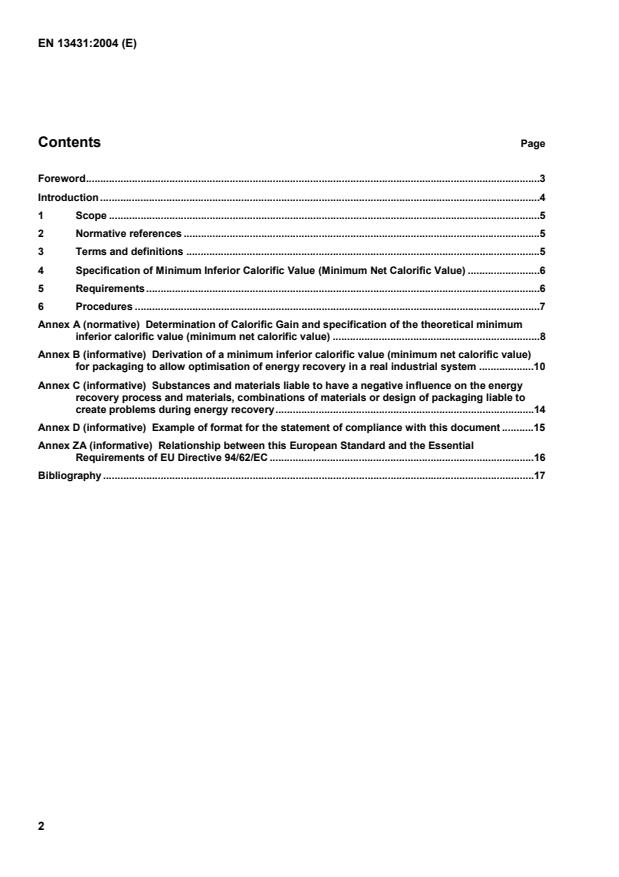
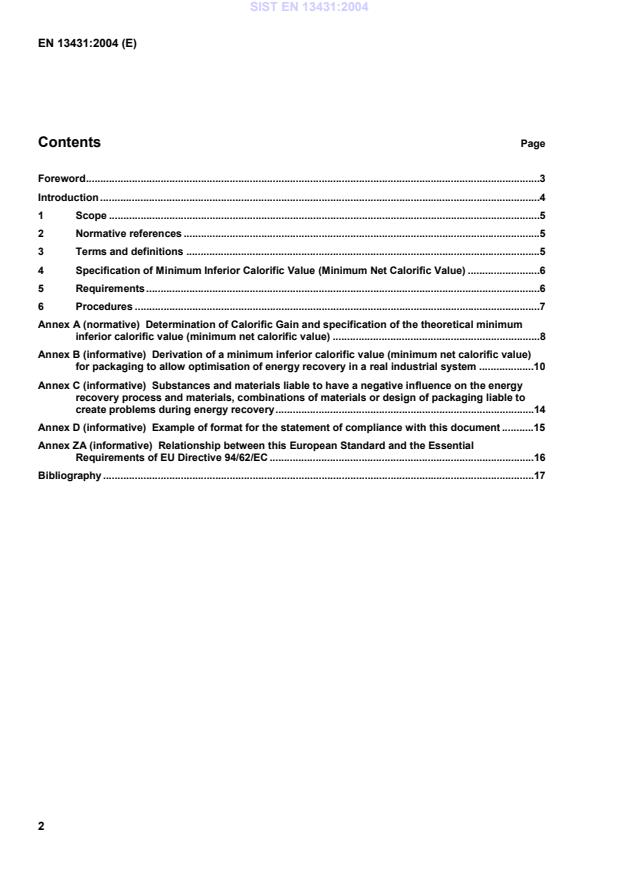
Contents Page
Foreword.3
Introduction .4
1 Scope .5
2 Normative references .5
3 Terms and definitions .5
4 Specification of Minimum Inferior Calorific Value (Minimum Net Calorific Value) .6
5 Requirements.6
6 Procedures .7
Annex A (normative) Determination of Calorific Gain and specification of the theoretical minimum
inferior calorific value (minimum net calorific value) .8
Annex B (informative) Derivation of a minimum inferior calorific value (minimum net calorific value)
for packaging to allow optimisation of energy recovery in a real industrial system .10
Annex C (informative) Substances and materials liable to have a negative influence on the energy
recovery process and materials, combinations of materials or design of packaging liable to
create problems during energy recovery.14
Annex D (informative) Example of format for the statement of compliance with this document .15
Annex ZA (informative) Relationship between this European Standard and the Essential
Requirements of EU Directive 94/62/EC .16
Bibliography .17
Foreword
This document (EN 13431:2004) has been prepared by Technical Committee CEN/TC 261 “Packaging”, the
secretariat of which is held by AFNOR.
This European Standard shall be given the status of a national standard, either by publication of an identical text or
by endorsement, at the latest by January 2005, and conflicting national standards shall be withdrawn at the latest
by January 2005.
This document supersedes EN 13431:2000.
This document has been prepared under two mandates given to CEN by the European Commission and the
European Free Trade Association, and supports the essential requirements of EU Directive(s).
For relationship with EU Directive(s), see informative Annex ZA, which is an integral part of this document.
This document forms one of a series of standards and reports prepared under mandates M 200 rev.3 and M/317
given to CEN by the European Commission and the European Free Trade Association to support the European
Council and Parliament Directive on Packaging and Packaging Waste [94/62/EC]. The procedure for applying this
document in conjunction with the other mandated standards and reports, is specified in EN 13427.
According to the CEN/CENELEC Internal Regulations, the national standards organizations of the following
countries are bound to implement this European Standard : Austria, Belgium, Cyprus, Czech Republic, Denmark,
Estonia, Finland, France, Germany, Greece, Hungary, Iceland, Ireland, Italy, Latvia, Lithuania, Luxembourg, Malta,
Netherlands, Norway, Poland, Portugal, Slovakia, Slovenia, Spain, Sweden, Switzerland and United Kingdom.
Introduction
The Directive on Packaging and Packaging Waste (94/62/EC) defines requirements for packaging to be considered
recoverable. This document amplifies these requirements with respect to energy recovery. The European Standard
EN 13427 provides a framework within which this and four other standards may be used together to support a
claim that a packaging is in compliance with the essential requirements for packaging to be placed on the market
as required by the Directive.
NOTE The Directive 94/62/EC is amended by European Parliament and Council Directive 2004/12/EC of 11 February 2004.
The purpose of packaging is the containment, protection, handling, delivery and presentation of products. Energy
recovery of used packaging is one of several recovery options within the overall life cycle of packaging. In order to
save resources and minimise waste, the whole system in which the packaging takes part should be optimised. This
includes prevention as well as reuse and recovery of packaging waste.
This document presents a framework for assessment to determine whether the requirements of this document have
been met. Its approach is similar to that of systems standards such as the EN ISO 9000 series or an environmental
management system such as EN ISO 14001.
Since packaging waste used for energy recovery substitutes for other fuels, total system optimisation includes
production of heat and/or power. This document defines and specifies the thermodynamic requirements for
packaging to allow the incineration with energy recovery of packaging waste, but does not consider the
transformation and use of the produced energy. Both packaging and recovery technologies are subject to
continuous improvement.
Annex A derives the theoretical concept of calorific gain. Annexes B and C set out supporting regulations as well as
conclusions reached during the preparation of the text. It is assumed that the heat generated during the
incineration process shall be recovered as far as practicable, but it is outside the Scope of this document to take
any standpoint on plant efficiency.
Requirements for substances and materials liable to have a negative influence on the energy recovery process are
specified in EN 13428. According to the discussion in Annex C, there is no need for further requirements.
Materials, combinations of materials or design of packaging liable to create problems during energy recovery are
discussed in Annex C. It is concluded that packaging design and combination of materials do not create problems
for the energy recovery process.
Annex D is an aid to prove compliance with the requirements.
1 Scope
This document specifies the requirements for a packaging to be classified as recoverable in the form of energy and
sets out procedures for assessment of conformity with those requirements. The scope is limited to factors under the
control of the supplier.
This document cannot by itself provide presumption of conformity. The procedure for applying this document is
contained in EN 13427.
2 Normative references
The following referenced documents are indispensable for the application of this document. For dated references,
only the edition cited applies. For undated references, the latest edition of the referenced document (including any
amendments) applies.
EN 13193, Packaging - Packaging and the Environment - Terminology.
EN 13427, Packaging - Requirements for the use of European Standards in the field of packaging and packaging
waste.
EN 13428, Packaging – Requirements specific to manufacturing and composition - Prevention by source reduction.
CR 13695-1, Packaging - Requirements for measuring and verifying the four heavy metals and other dangerous
substances present in packaging, and their release into the environment - Part 1: Requirements for measuring and
verifying the four heavy metals present in packaging.
CEN/TR 13695-2, Packaging - Requirements for measuring and verifying the four heavy metals and other
dangerous substances present in packaging, and their release into the environment - Part 2: Requirements for
measuring and verifying dangerous substances present in packaging, and their release into the environment.
EN 14182, Packaging - Terminology - Basic terms and definitions.
ISO 1171, Solid mineral fuels - Determination of ash.
ISO 1928, Solid mineral fuels - Determination of gross calorific value by the bomb calorimetric method, and
calculation of net calorific value.
Directive 2000/76/EC on the incineration of waste. Directive 2000/76/EC repeals Directive 94/67/EC from
December 28, 2005 also for old plants.
3 Terms and definitions
For the purposes of this document, the terms and definitions given in EN 13193, EN 13427, EN 14182 and the
following apply.
3.1
inferior calorific value (net calorific value), q
net
inferior calorific value is a term used in Mandate M 200 rev.3 for the net calorific value, which is defined in
ISO 1928 and measured at constant volume
3.2
required energy, H
a
energy necessary to adiabatically heat the post combustion substances of a material and excess air from ambient
temperature to a specified final temperature
3.3
calorific gain
positive difference between the energy released on combustion of a material and H
a
3.4
theoretical minimum inferior calorific value (theoretical minimum net calorific value), q
net, min,theor.
fraction of the energy released on combustion sufficient to adiabatically heat the post-combustion substances of a
material or product and excess air from a specified ambient temperature to a specified final temperature
3.5
available thermal energy
fraction of the energy released on combustion in a real industrial system which is transferred for example to the
steam cycle of a boiler, i.e. the total released energy minus the thermal losses
3.6
combustion
oxidation reaction covering both combustion of organic materials and oxidation of metals
3.7
packaging component
part of packaging that can be separated by hand or by using simple physical means (from EN 13193)
3.8
packaging constituent
part from which packaging or its components are made and which cannot be separated by hand or by using simple
physical means (from EN 13193)
4 Specification of Minimum Inferior Calorific Value (Minimum Net Calorific Value)
The theoretical minimum inferior calorific value (theoretical minimum net calorific value), q , is material
.
net,min,theor
specific. It depends on the temperature and other conditions required by the combustion process. In this document
it is identified as H and may be determined by the method described in Annex A. This Annex specifies the
a
theoretical minimum inferior calorific value (minimum net calorific value) through the technical concept of calorific
gain.
The real minimum inferior calorific value (real minimum net calorific value), q is set to allow optimisation of
,
net,min,real
energy recovery in a real industrial system and is defined in Annex B.
5 Requirements
To allow optimisation of energy recovery in a real industrial system, the theoretical calorific gain should be well
above zero. To claim energy recovery q shall be equal to or greater than 5 MJ/kg.
net
NOTE 1 Packaging composed of more than 50 % (by weight) of organic content, e.g. wood, cardboard, paper and other
organic fibres, starch, plastics, provides calorific gain and meets the requirement of q equal to or greater than 5 MJ/kg.
net
NOTE 2 A packaging consisting of more than 50 % by weight of inorganic constituents, e.g. inorganic fillers and layers, is
recoverable in the form of energy, provided q is equal to or greater than 5 MJ/kg.
net
NOTE 3 Thin gauge aluminium (typically up to 50 µm thick) contributes to q of the packaging and is deemed to be energy
net
recoverable. Aluminium over 50 µm is deemed to be not combustible.
NOTE 4 A packaging consisting of more than 50 % by weight of inorganic components, e.g. glass or rigid metal containers
with a plastic closure, is deemed to be not energy recoverable.
6 Procedures
6.1 Application
The application of this document to any particular packaging shall be as specified in EN 13427.
6.2 Assessment
Packaging may be assessed for recoverability in the form of energy by calculation from data given in Annex B or
use of the methodology in Annex A.
6.3 Claims of conformity
The supplier shall prepare a written statement of compliance with the requirements stated in Clause 5 as referred
to in EN 13427. Annex D may be used as guidance.
Annex A
(normative)
Determination of Calorific Gain and specification of the theoretical minimum
inferior calorific value (minimum net calorific value)
The determination of calorific gain is based on standard procedures for calculating the adiabatic final temperature
in combustion chemist
...
The EN 13431:2004 standard, titled "Packaging - Requirements for packaging recoverable in the form of energy recovery, including specification of minimum inferior calorific value," is a significant benchmark in the realm of sustainable packaging solutions. Its primary focus is on delineating the necessary criteria that a packaging material must meet to be classified as recoverable through energy recovery processes. The scope of this standard is clearly defined, emphasizing the aspects that lie within the supplier's control. This specification highlights the accountability of manufacturers while setting a clear framework for the assessment of conformity with the established requirements. By concentrating on factors that suppliers can influence, EN 13431:2004 promotes a practical approach toward implementing energy recovery solutions, thereby fostering responsibility within the packaging industry. One of the key strengths of this standard is its dual focus on both performance and sustainability. The inclusion of minimum inferior calorific value specifications ensures that the energy recovery process yields a consistent and quantifiable amount of energy, leading to a more efficient recovery operation. This technical specification not only aids in the standardization of energy recovery practices but also supports the broader goals of waste management and environmental conservation. Furthermore, the standard's explicit procedures for conformity assessment enhance its applicability and credibility. While it does not by itself provide presumption of conformity, it acts as a vital resource to determine compliance with energy recovery packaging requirements, thus facilitating better regulatory oversight and industry compliance. The relevance of EN 13431:2004 is especially pronounced in today’s context, where sustainable practices are increasingly prioritized. As industries strive to minimize their ecological footprints, standards like this underscore the importance of adopting packaging materials that can be effectively recovered for energy use. This positions the standard not merely as a verification tool, but as a fundamental resource for driving innovation and improvement in packaging design aimed at energy recovery. Overall, EN 13431:2004 serves as an essential framework for guiding the packaging industry towards energy-efficient practices, ultimately contributing to the establishment of a circular economy and encouraging a culture of sustainability within business operations.
La norme SIST EN 13431:2004 traite des exigences relatives à l'emballage récupérable sous forme de valorisation énergétique, en incluant la spécification d'une valeur calorifique inférieure minimale. Son domaine d'application est crucial, car elle établit des critères précis pour qu'un emballage soit classé comme récupérable. Cela renforce l'importance de la durabilité et de la gestion des déchets dans l'industrie de l'emballage. Parmi ses points forts, cette norme offre des directives claires sur les procédures d'évaluation de la conformité, garantissant que les emballages répondent à des spécifications minimales en matière de valeur calorifique. Cela non seulement aide les fabricants à concevoir des emballages plus durables, mais contribue également à promouvoir une économie circulaire en intégrant des pratiques de récupération de l'énergie. De plus, la portée de la norme est bien définie, se limitant aux facteurs contrôlables par le fournisseur, ce qui permet d'établir des standards réalistes et applicables dans l'industrie. La pertinence de la norme EN 13431:2004 est accentuée par son alignement avec les objectifs environnementaux européens, favorisant la valorisation des emballages en tant que source d'énergie. Cela est d'autant plus important à une époque où les préoccupations écologiques sont au cœur des stratégies d'entreprise. En fournissant un cadre pour la conformité, elle renforce la confiance du marché dans les pratiques d’emballage et leur impact environnemental.
SIST EN 13431:2004は、エネルギー回収形態で回収可能な包装に関する要件を規定する重要な欧州標準です。この標準は、包装がエネルギーとして回収可能と見なされるための基準を明確にすることを目的としています。具体的には、最低の下位発熱量の仕様も含まれており、包装材のエネルギー回収可能性を評価するための手順を規定しています。 この標準の強みは、包装の回収性を定義するための明確な要件を提供する点にあります。これにより、包装業界や廃棄物管理者は、エネルギー回収に向けた包装材の選定や評価において、一貫性を持った判断が可能となります。また、エネルギー回収の観点から、持続可能な資源利用を促進する重要な手段ともなります。 さらに、この標準は供給者の管理下にある要因に限定されているため、企業が自社の包装材料の遵守状況を明確に把握しやすくなっています。ただし、この標準自身が遵守の推定を提供するものではないことに留意が必要です。遵守のための具体的な手順は、EN 13427に含まれており、標準の適用を行う際には、これを参照することが求められます。 このように、SIST EN 13431:2004は、エネルギー回収を可能とする包装の基準を規定する上で、非常に重要な役割を果たしており、包装業界におけるエネルギー効率の向上と持続可能な発展に寄与することが期待されます。
Die Norm EN 13431:2004 legt spezifische Anforderungen für Verpackungen fest, die als energieerzeugend betrachtet werden, sowie Mindestvorgaben für den unteren Heizwert. Dies geschieht im Rahmen eines klar definierten Anwendungsbereichs, der sich auf die Faktoren konzentriert, die der Anbieter kontrollieren kann. Die Relevanz dieser Norm liegt in der Förderung von Recycling und der Maximierung der Energieausbeute aus Verpackungsabfällen, was im Kontext der zunehmend nachhaltigen Entwicklung von großer Bedeutung ist. Eine der Stärken dieser Norm ist die detaillierte Spezifikation der Anforderungen an die Verpackungen. Sie bietet eine klare Grundlage für Hersteller, um sicherzustellen, dass ihre Produkte den Vorgaben entsprechen, die für eine Rückgewinnung in Form von Energie notwendig sind. Dies ist besonders vorteilhaft für Unternehmen, die ihre Umweltbilanz verbessern und sich an europäische Richtlinien für Abfallmanagement und Ressourcennutzung anpassen möchten. Die Norm enthält auch Verfahren zur Überprüfung der Konformität, was ein weiterer wichtiger Aspekt ist. Dennoch wird darauf hingewiesen, dass die Norm nicht allein die Vermutung der Konformität gewährleistet. Hierbei müssen Unternehmen die entsprechenden Verfahren, die in der Norm EN 13427 beschrieben sind, beachten, um sicherzustellen, dass ihre Verpackungen gemäß den festgelegten Kriterien bewertet werden. Zusammenfassend bietet die SIST EN 13431:2004 einen umfassenden Rahmen für die Klassifizierung und Bewertung von Verpackungen hinsichtlich ihrer Energiegewinnungspotenziale. Ihre Stärken liegen in der klaren Strukturierung der Anforderungen und der Anleitung zur Konformitätsbewertung, was sie zu einem unverzichtbaren Werkzeug für die Industrie macht, sowohl im Hinblick auf regulatorische Anforderungen als auch auf die Verbesserung der nachhaltigen Praktiken in der Verpackungswirtschaft.
SIST EN 13431:2004 표준은 에너지 회수 가능 포장에 대한 요구 사항을 명확히 규정하고 있으며, 최소한의 하청 발열량에 대한 사양을 포함합니다. 이 표준은 포장재가 에너지 회수 가능으로 분류되기 위해 필요한 요구 사항과 등의 일치성을 평가하는 절차를 설정하고 있습니다. 이 표준의 강점은 공급자가 제어할 수 있는 요인에 한정된 범위를 제공하여, 포장재의 재활용 가능성을 명확히 제시한다는 점입니다. 이를 통해 기업들은 자사의 포장재가 에너지 회수 가능한지에 대한 기준을 이해하고, 적절하게 대응할 수 있습니다. 또한, EN 13431은 에너지 회수의 과정에서 고려해야 할 누적적인 환경적 영향을 최소화하는 데 기여할 수 있는 구조를 제공합니다. 재활용 및 에너지 회수의 중요성이 날로 커지는 현재 상황에서, SIST EN 13431:2004은 모든 산업 분야에서 포장 재료의 지속 가능성을 높이는 데 있어 필수적인 표준으로 여겨집니다. 이 표준을 통해 기업들은 더욱 책임감 있게 자원의 활용도를 높이고, 환경에 미치는 영향을 줄이며, 사회적 요구에 부응할 수 있는 기회를 가질 수 있습니다. 그러나 이 표준만으로는 준수의 확신을 제공할 수 없는 점은 주의할 필요가 있으며, EN 13427에서 제공하는 절차를 통해 이 표준의 적용에 필요한 세부 사항을 명확히 이해하고 실행해야 합니다. 이러한 점에서 SIST EN 13431:2004는 현대의 환경 규제와 쟁점에 부합하는 중요한 기준이 됩니다.
Questions, Comments and Discussion
Ask us and Technical Secretary will try to provide an answer. You can facilitate discussion about the standard in here.
Loading comments...