

EN 15347-3:2025
(Main)Plastics - Sorted plastics wastes - Part 3: Quality grades of sorted polypropylene (PP) wastes and specific test methods
- Abstract
This document specifies the quality grades for sorted polypropylene (PP) wastes as well as specific test methods laying out those properties for which the supplying party of the waste makes information available to the receiving party. Polypropylene waste quality grades are based on pre-determined sets of characteristics, taking into account sectorial and market specificities and related information needs and tests methods. The document provides for a division of information between “Required Data”, where a statement is required, and additional “Optional Data” as agreed between the supplying and receiving party.
This document does not apply to the general characterization addressed in EN 15347-1.
- Status
- Published
- Publication Date
- 27-May-2025
- Technical Committee
- CEN/TC 249 - Plastics
- Drafting Committee
- CEN/TC 249/WG 11 - Plastics recycling
- Current Stage
- 6060 - Definitive text made available (DAV) - Publishing
- Start Date
- 28-May-2025
- Due Date
- 16-May-2025
- Completion Date
- 28-May-2025

Overview
EN 15347-3:2025 (CEN) - "Plastics - Sorted plastics wastes - Part 3: Quality grades of sorted polypropylene (PP) wastes and specific test methods" defines harmonized quality grades and associated test methods for sorted polypropylene (PP) waste streams. It complements the general characterization in EN 15347-1:2024 by specifying which Required Data and Optional Data suppliers must or may provide to receiving parties. The standard covers common PP sources such as packaging and building & construction wastes and aims to streamline transactions, quality control and recycling operations across the EU.
Key topics
- Classification scheme: Suppliers provide statements of characteristics according to the applicable tables (packaging or construction streams) and are encouraged to include optional information for clarity.
- Required vs Optional Data: The standard separates mandatory batch descriptors (e.g., origin, PP content, presence of hazardous waste) from additional useful information (e.g., LDPE/LLDPE content, film fraction, mineral/ash content).
- Composition and impurities: Typical required characteristics include rigid/flexible PP content, HDPE and other polymer content, moisture, metals, paper/cardboard, PVC presence, food or medical contamination, and prohibited substances.
- Test methods and references: EN 15347-3:2025 references existing methods and documents such as EN 15347-1:2024, EN 17615, CEN/TR 15353, EN ISO 1043-1, and practical techniques (e.g., sampling + moisture analyser, NIR, ash content).
- Sector-specific focus: Separate tables and criteria address PP from household/commercial packaging and construction/demolition sources.
- Regulatory context: The document notes relevance to transboundary movements (Basel Convention and EU regulations) and environmental aspects in line with CEN guidance.
Applications
- Establishing clear waste specifications for sale/purchase of sorted PP bales, flakes or bulk shipments.
- Enabling recyclers to assess feedstock suitability for mechanical recycling or further sorting.
- Supporting quality control at sorting centres, material recovery facilities (MRFs) and pre-processing plants.
- Providing procurement and contracting language for waste suppliers, traders and waste management companies.
- Assisting regulators and conformity assessors in harmonized reporting of waste characteristics.
Who uses this standard
- Waste suppliers and collectors, sorting centre operators, recyclers and reprocessors
- Waste traders and procurement teams
- Standards writers, product manufacturers using recycled PP
- Environmental and compliance officers dealing with waste shipments and recycling obligations
Related standards
- EN 15347-1:2024 (General characterisation)
- CEN/TR 15353; EN 15342, EN 15343, EN 15344, EN 15345, EN 15346, EN 15348
- EN 18064, EN 18065, EN 18067; EN ISO 1043-1
Keywords: EN 15347-3:2025, sorted polypropylene, PP wastes, quality grades, test methods, plastics recycling, waste specification.
Relations
- Effective Date
- 28-Jan-2026
- Effective Date
- 28-Jan-2026
- Effective Date
- 28-Jan-2026
- Effective Date
- 28-Jan-2026
- Effective Date
- 28-Jan-2026
Get Certified
Connect with accredited certification bodies for this standard

DIN CERTCO
DIN Group product certification.
CIS Institut d.o.o.
Personal Protective Equipment (PPE) certification body. Notified Body NB-2890 for EU Regulation 2016/425 PPE.

Kiwa BDA Testing
Building and construction product certification.
Sponsored listings
Frequently Asked Questions
EN 15347-3:2025 is a standard published by the European Committee for Standardization (CEN). Its full title is "Plastics - Sorted plastics wastes - Part 3: Quality grades of sorted polypropylene (PP) wastes and specific test methods". This standard covers: This document specifies the quality grades for sorted polypropylene (PP) wastes as well as specific test methods laying out those properties for which the supplying party of the waste makes information available to the receiving party. Polypropylene waste quality grades are based on pre-determined sets of characteristics, taking into account sectorial and market specificities and related information needs and tests methods. The document provides for a division of information between “Required Data”, where a statement is required, and additional “Optional Data” as agreed between the supplying and receiving party. This document does not apply to the general characterization addressed in EN 15347-1.
This document specifies the quality grades for sorted polypropylene (PP) wastes as well as specific test methods laying out those properties for which the supplying party of the waste makes information available to the receiving party. Polypropylene waste quality grades are based on pre-determined sets of characteristics, taking into account sectorial and market specificities and related information needs and tests methods. The document provides for a division of information between “Required Data”, where a statement is required, and additional “Optional Data” as agreed between the supplying and receiving party. This document does not apply to the general characterization addressed in EN 15347-1.
EN 15347-3:2025 is classified under the following ICS (International Classification for Standards) categories: 13.030.50 - Recycling; 83.080.20 - Thermoplastic materials. The ICS classification helps identify the subject area and facilitates finding related standards.
EN 15347-3:2025 has the following relationships with other standards: It is inter standard links to EN 15347-1:2024, CEN/TR 15353:2007, EN 17615:2022, EN ISO 1043-1:2011, EN 18109:2025. Understanding these relationships helps ensure you are using the most current and applicable version of the standard.
EN 15347-3:2025 is associated with the following European legislation: Standardization Mandates: M/584. When a standard is cited in the Official Journal of the European Union, products manufactured in conformity with it benefit from a presumption of conformity with the essential requirements of the corresponding EU directive or regulation.
EN 15347-3:2025 is available in PDF format for immediate download after purchase. The document can be added to your cart and obtained through the secure checkout process. Digital delivery ensures instant access to the complete standard document.
Standards Content (Sample)
SLOVENSKI STANDARD
01-julij-2025
Polimerni materiali - Razvrščeni odpadki iz polimernih materialov - 3. del: Stopnje
kakovosti sortiranih polipropilenskih (PP) odpadkov in posebne preskusne
metode
Plastics - Sorted plastics wastes - Part 3: Quality grades of sorted Polypropylene (PP)
wastes and specific test methods
Kunststoffe - Sortierte Kunststoffabfälle - Teil 3: Qualitätsstufen von sortierten
Polypropylen(PP)-Abfällen und spezifische Prüfverfahren
Plastiques - Déchets de plastiques triés - Partie 3: Grades de qualité des déchets de
polypropylène (PP) triés et méthodes d’essai spécifiques
Ta slovenski standard je istoveten z: EN 15347-3:2025
ICS:
13.030.50 Recikliranje Recycling
83.080.20 Plastomeri Thermoplastic materials
2003-01.Slovenski inštitut za standardizacijo. Razmnoževanje celote ali delov tega standarda ni dovoljeno.
EN 15347-3
EUROPEAN STANDARD
NORME EUROPÉENNE
May 2025
EUROPÄISCHE NORM
ICS 13.030.50; 83.080.20
English Version
Plastics - Sorted plastics wastes - Part 3: Quality grades of
sorted polypropylene (PP) wastes and specific test
methods
Plastiques - Déchets de plastiques triés - Partie 3: Kunststoffe - Sortierte Kunststoffabfälle - Teil 3:
Grades de qualité des déchets de polypropylène (PP) Qualitätsstufen von sortierten Polypropylen(PP)-
triés et méthodes d'essai spécifiques Abfällen und spezifische Prüfverfahren
This European Standard was approved by CEN on 21 April 2025.
CEN members are bound to comply with the CEN/CENELEC Internal Regulations which stipulate the conditions for giving this
European Standard the status of a national standard without any alteration. Up-to-date lists and bibliographical references
concerning such national standards may be obtained on application to the CEN-CENELEC Management Centre or to any CEN
member.
This European Standard exists in three official versions (English, French, German). A version in any other language made by
translation under the responsibility of a CEN member into its own language and notified to the CEN-CENELEC Management
Centre has the same status as the official versions.
CEN members are the national standards bodies of Austria, Belgium, Bulgaria, Croatia, Cyprus, Czech Republic, Denmark, Estonia,
Finland, France, Germany, Greece, Hungary, Iceland, Ireland, Italy, Latvia, Lithuania, Luxembourg, Malta, Netherlands, Norway,
Poland, Portugal, Republic of North Macedonia, Romania, Serbia, Slovakia, Slovenia, Spain, Sweden, Switzerland, Türkiye and
United Kingdom.
EUROPEAN COMMITTEE FOR STANDARDIZATION
COMITÉ EUROPÉEN DE NORMALISATION
EUROPÄISCHES KOMITEE FÜR NORMUNG
CEN-CENELEC Management Centre: Rue de la Science 23, B-1040 Brussels
© 2025 CEN All rights of exploitation in any form and by any means reserved Ref. No. EN 15347-3:2025 E
worldwide for CEN national Members.
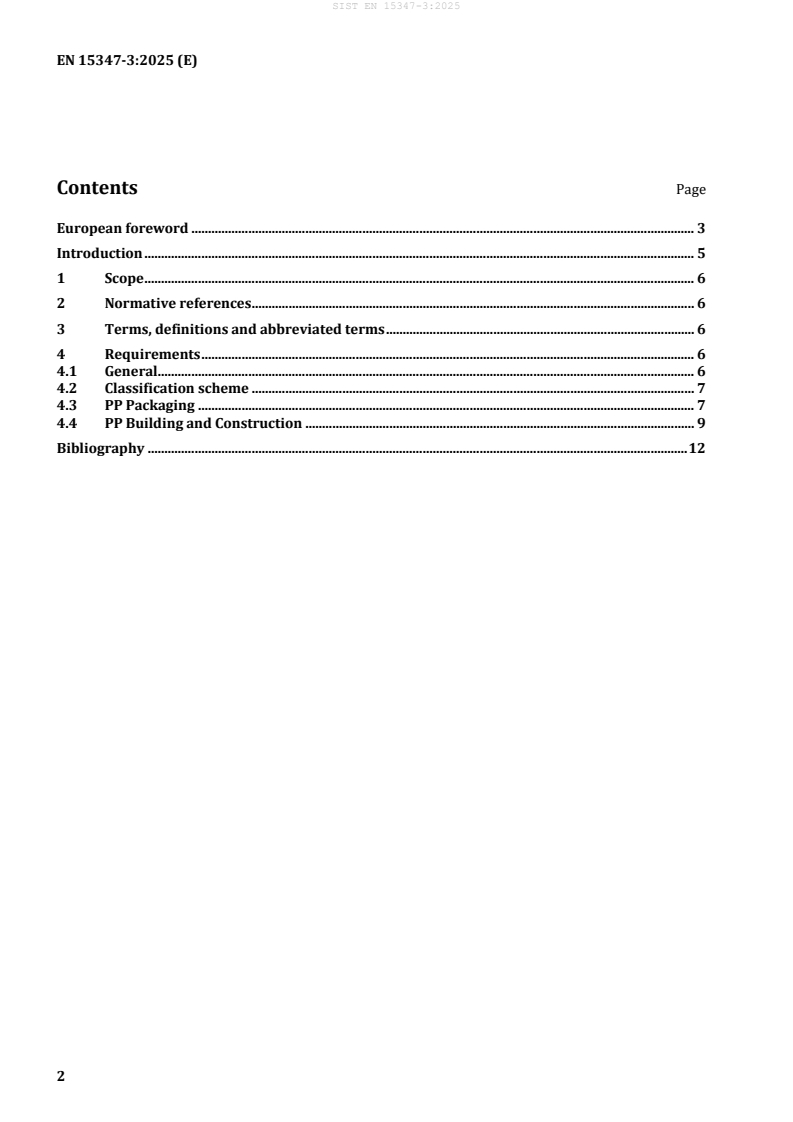
Contents Page
European foreword . 3
Introduction . 5
1 Scope . 6
2 Normative references . 6
3 Terms, definitions and abbreviated terms . 6
4 Requirements . 6
4.1 General. 6
4.2 Classification scheme . 7
4.3 PP Packaging . 7
4.4 PP Building and Construction . 9
Bibliography . 12
European foreword
This document (EN 15347-3:2025) has been prepared by Technical Committee CEN/TC 249 “Plastics”,
the secretariat of which is held by SIS.
This European Standard shall be given the status of a national standard, either by publication of an
identical text or by endorsement, at the latest by November 2025, and conflicting national standards shall
be withdrawn at the latest by November 2025.
Attention is drawn to the possibility that some of the elements of this document may be the subject of
patent rights. CEN shall not be held responsible for identifying any or all such patent rights.
This document is part of CEN publications on plastics recycling, listed as follows:
— EN 15342, Plastics — Recycled plastics — Characterization of polystyrene (PS) recyclates
— EN 15343, Plastics — Recycled plastics — Plastics recycling traceability and assessment of conformity
and recycled content
— EN 15344, Plastics — Recycled plastics — Characterization of polyethylene (PE) recyclates
— EN 15345, Plastics — Recycled plastics — Characterization of polypropylene (PP) recyclates
— EN 15346, Plastics — Recycled plastics — Characterization of poly(vinyl chloride) (PVC) recyclates
— EN 15347 (all parts), Plastics — Sorted plastics wastes
— EN 15348, Plastics — Recycled plastics — Characterization of poly(ethylene terephthalate) (PET)
recyclates
— EN 18064 (all parts), Plastics — Quality recommendations and basis for specifications for application
of plastic recyclates in products
— EN 18065, Plastics — Recycled plastics — Classification of recycled plastics based on Data Quality
Levels for use and (digital) trading
— EN 18067, Plastics — Recycled plastics — Characterization of acrylonitrile-butadiene-styrene (ABS)
recyclates
— CEN/TR 15353, Plastics — Recycled plastics — Guidelines for the development of standards for
recycled plastics
— CEN/TR 18160, Plastics recycling — Classification of plastic recyclates as post-consumer recyclates
(PCR) and post-industrial recyclates (PIR)
This document has been prepared under a standardization request addressed to CEN and CENELEC by
the European Commission. The Standing Committee of the EFTA States subsequently approves these
requests for its Member States.
Any feedback and questions on this document should be directed to the users’ national standards body.
A complete listing of these bodies can be found on the CEN website.
According to the CEN-CENELEC Internal Regulations, the national standards organisations of the
following countries are bound to implement this European Standard: Austria, Belgium, Bulgaria, Croatia,
Cyprus, Czech Republic, Denmark, Estonia, Finland, France, Germany, Greece, Hungary, Iceland, Ireland,
Italy, Latvia, Lithuania, Luxembourg, Malta, Netherlands, Norway, Poland, Portugal, Republic of North
Macedonia, Romania, Serbia, Slovakia, Slovenia, Spain, Sweden, Switzerland, Türkiye and the United
Kingdom.
Introduction
Polypropylene (PP) is used in a variety of applications, mainly for packaging, both flexible and rigid and
building and construction where it is used in applications such as pipes, roofing, or insulation. PP is also
used in toys and electronic and electrical equipment but as it comes mixed with other plastics, it is not in
the scope of this document.
The collection of PP household packaging takes place via separate collection – usually comingled with
other plastics and other materials such as aluminium and cardboard (depending on EU Member State)
that will be later sorted out in different recycling streams in a sorting centre prior reaching the recycler.
PP may be targeted on its own recycling stream, or it may be sorted out together with HDPE, being
separated at a later stage at the recycler.
Building and construction applications organize the collection of demolition waste via private schemes
that collect the waste and send it to the recycler directly.
PP plastic waste is characterized to determine the composition and quality of the batch. A clear and
harmonized waste specification facilitates a transaction between the supplier and customer and
establishes standard characteristics to monitor during any sorting or preparation of waste operations.
This document complements the general characterization of waste specified in EN 15347-1 and adds
additional clarification when it comes to the required and optional requirements of PP waste.
Characteristics are defined for products part of the packaging and construction and demolition sectors.
This document has been produced in accordance with the guidance produced by CEN on Environmental
Aspects and in accordance with CEN/TR 15353.
NOTE CEN/TR 15353 considers the general environmental aspects which are specific to the recycling process.
1 Scope
This document specifies the quality grades for sorted polypropylene (PP) wastes as well as specific test
methods laying out those properties for which the supplying party of the waste makes information
available to the receiving party. Polypropylene waste quality grades are based on pre-determined sets of
characteristics, taking into account sectorial and market specificities and related information needs and
tests methods. The document provides for a division of information between “Required Data”, where a
statement is required, and additional “Optional Data” as agreed between the supplying and receiving
party.
This document does not apply to the general characterization addressed in EN 15347-1.
2 Normative references
The following documents are referred to in the text in such a way that some or all of their content
constitutes requirements of this document. For dated references, only the edition cited applies. For
undated references, the latest edition of the referenced document (including any amendments) applies.
CEN/TR 15353, Plastics — Recycled plastics — Guidelines for the development of standards for recycled
plastics
EN 15347-1:2024, Plastics — Sorted plastics wastes — Part 1: General characterisation
EN 17615, Plastics — Environmental Aspects — Vocabulary
EN ISO 1043-1, Plastics — Symbols and abbreviated terms — Part 1: Basic polymers and their special
characteristics (ISO 1043-1)
3 Terms, definitions and abbreviated terms
For the purposes of this document, the terms and definitions given in EN 17615, EN 15347-1 and
CEN/TR 15353 apply. The abbreviated terms related to recyclates given in EN ISO 1043-1 apply.
ISO and IEC maintain terminology databases for use in standardization at the following addresses:
— ISO Online browsing platform: available at https://www.iso.org/obp
— IEC Electropedia: available at https://www.electropedia.org/
4 Requirements
4.1 General
The characteristics of a batch of PP sorted plastics waste to be provided to the customer by the supplier
are given in the tables below, and are divided into two types:
— required characteristics: needed to characterize the respective plastic wastes from the relevant
sector in general, and required for all batches of the respective sorted plastic waste;
— optional characteristics: Recommended additional information for the characterization of the
respective plastic wastes from the relevant sector.
NOTE In case of transboundary movement, reference can be made to the Basel convention (on transboundary
movement of wastes) and to relevant European regulations.
4.2 Classification scheme
The supplier of a batch of PP sorted plastics waste shall provide to the customer a statement of the
characteristics of the waste listed in Table 1 or 3 (depending on the waste stream processed). Providing
a statement of the characteristics of the waste specified in Table 2 or 4 (depending on the waste stream
processed) is also recommended.
4.3 PP Packaging
Table 1 — Required characteristics of sorted plastic wastes — PP Packaging
Characteristics Suitable statements/comments Methods/references
General information
Origin Indicate the secto
...