

EN 12899-1:2001
(Main)Fixed, vertical road traffic signs - Part 1: Fixed signs
- Abstract
This part of EN 12899:2001 specifies requirements for new fixed signs :
¾ non-retroreflective and retroreflective fixed signs ;
¾ non-retroreflective and retroreflective fixed signs when they are illuminated at night by external lighting luminaires ; and
¾ transilluminated signs.
The main intended use of fixed signs is for the instruction and guidance of road users on public and private land.
It defines performance limits and a range of performance classes for both sign assemblies without vertical supports and assemblies complete with vertical supports, as well as sign faces and supporting substrates, sign fixings and supports and external lighting luminaires.
Colorimetric and retroreflective properties as well as the luminance are specified. The retroreflective properties are in respect of materials based on the use of glass bead technology only. Structural requirements for signs and sign supports include performance under static and dynamic loading.
It also defines performance levels to be maintained after natural weathering exposure.
NOTE Where tests for extremely low temperatures are required they should be in accordance with the customer's requirements.
- Status
- Withdrawn
- Publication Date
- 11-Dec-2001
- Withdrawal Date
- 06-Nov-2007
- Technical Committee
- CEN/TC 226 - Road equipment
- Drafting Committee
- CEN/TC 226/WG 3 - Vertical signs
- Current Stage
- 9960 - Withdrawal effective - Withdrawal
- Start Date
- 07-Nov-2007
- Completion Date
- 07-Nov-2007

Relations
- Effective Date
- 22-Dec-2008
- Effective Date
- 28-Jan-2026
- Effective Date
- 28-Jan-2026
- Effective Date
- 28-Jan-2026
Get Certified
Connect with accredited certification bodies for this standard

Zavod za gradbeništvo Slovenije (ZAG) - Inšpekcija
ZAG inspection body for construction products, structures, and materials.
Sponsored listings
Frequently Asked Questions
EN 12899-1:2001 is a standard published by the European Committee for Standardization (CEN). Its full title is "Fixed, vertical road traffic signs - Part 1: Fixed signs". This standard covers: This part of EN 12899:2001 specifies requirements for new fixed signs : ¾ non-retroreflective and retroreflective fixed signs ; ¾ non-retroreflective and retroreflective fixed signs when they are illuminated at night by external lighting luminaires ; and ¾ transilluminated signs. The main intended use of fixed signs is for the instruction and guidance of road users on public and private land. It defines performance limits and a range of performance classes for both sign assemblies without vertical supports and assemblies complete with vertical supports, as well as sign faces and supporting substrates, sign fixings and supports and external lighting luminaires. Colorimetric and retroreflective properties as well as the luminance are specified. The retroreflective properties are in respect of materials based on the use of glass bead technology only. Structural requirements for signs and sign supports include performance under static and dynamic loading. It also defines performance levels to be maintained after natural weathering exposure. NOTE Where tests for extremely low temperatures are required they should be in accordance with the customer's requirements.
This part of EN 12899:2001 specifies requirements for new fixed signs : ¾ non-retroreflective and retroreflective fixed signs ; ¾ non-retroreflective and retroreflective fixed signs when they are illuminated at night by external lighting luminaires ; and ¾ transilluminated signs. The main intended use of fixed signs is for the instruction and guidance of road users on public and private land. It defines performance limits and a range of performance classes for both sign assemblies without vertical supports and assemblies complete with vertical supports, as well as sign faces and supporting substrates, sign fixings and supports and external lighting luminaires. Colorimetric and retroreflective properties as well as the luminance are specified. The retroreflective properties are in respect of materials based on the use of glass bead technology only. Structural requirements for signs and sign supports include performance under static and dynamic loading. It also defines performance levels to be maintained after natural weathering exposure. NOTE Where tests for extremely low temperatures are required they should be in accordance with the customer's requirements.
EN 12899-1:2001 is classified under the following ICS (International Classification for Standards) categories: 93.080.30 - Road equipment and installations. The ICS classification helps identify the subject area and facilitates finding related standards.
EN 12899-1:2001 has the following relationships with other standards: It is inter standard links to EN 12899-1:2007, EN 12966-3:2005, EN 12368:2006, EN 12966-2:2005. Understanding these relationships helps ensure you are using the most current and applicable version of the standard.
EN 12899-1:2001 is associated with the following European legislation: EU Directives/Regulations: 305/2011, 89/106/EEC; Standardization Mandates: M/111. When a standard is cited in the Official Journal of the European Union, products manufactured in conformity with it benefit from a presumption of conformity with the essential requirements of the corresponding EU directive or regulation.
EN 12899-1:2001 is available in PDF format for immediate download after purchase. The document can be added to your cart and obtained through the secure checkout process. Digital delivery ensures instant access to the complete standard document.
Standards Content (Sample)
2003-01.Slovenski inštitut za standardizacijo. Razmnoževanje celote ali delov tega standarda ni dovoljeno.Fixed, vertical road traffic signs - Part 1: Fixed signsFixed, vertical road traffic signs - Part 1: Fixed signsSignaux fixes de signalisation routiere verticale - Partie 1: Panneaux fixesOrtsfeste, vertikale Straßenverkehrszeichen - Teil 1: OrtsfesteVerkehrszeichenTa slovenski standard je istoveten z:EN 12899-1:2001SIST EN 12899-1:2002en93.080.30ICS:SLOVENSKI
STANDARDSIST EN 12899-1:200201-september-2002
EUROPEAN STANDARDNORME EUROPÉENNEEUROPÄISCHE NORMEN 12899-1December 2001ICS 93.080.30English versionFixed, vertical road traffic signs - Part 1: Fixed signsSignaux fixes de signalisation routière verticale - Partie 1:Panneaux fixesOrtsfeste, vertikale Straßenverkehrszeichen - Teil 1:Ortsfeste VerkehrszeichenThis European Standard was approved by CEN on 20 January 2001.CEN members are bound to comply with the CEN/CENELEC Internal Regulations which stipulate the conditions for giving this EuropeanStandard the status of a national standard without any alteration. Up-to-date lists and bibliographical references concerning such nationalstandards may be obtained on application to the Management Centre or to any CEN member.This European Standard exists in three official versions (English, French, German). A version in any other language made by translationunder the responsibility of a CEN member into its own language and notified to the Management Centre has the same status as the officialversions.CEN members are the national standards bodies of Austria, Belgium, Czech Republic, Denmark, Finland, France, Germany, Greece,Iceland, Ireland, Italy, Luxembourg, Netherlands, Norway, Portugal, Spain, Sweden, Switzerland and United Kingdom.EUROPEAN COMMITTEE FOR STANDARDIZATIONCOMITÉ EUROPÉEN DE NORMALISATIONEUROPÄISCHES KOMITEE FÜR NORMUNGManagement Centre: rue de Stassart, 36
B-1050 Brussels© 2001 CENAll rights of exploitation in any form and by any means reservedworldwide for CEN national Members.Ref. No. EN 12899-1:2001 E
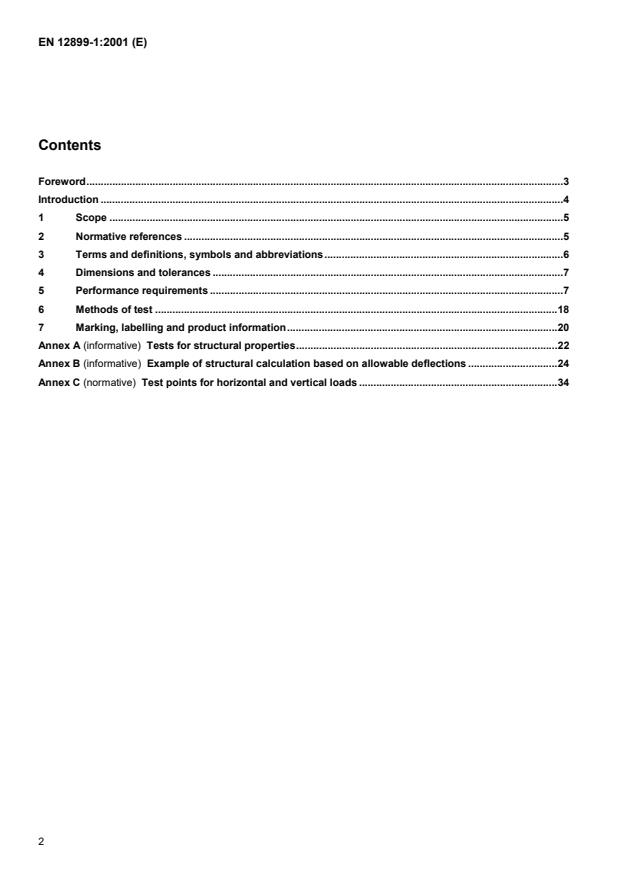
Tests for structural properties.22Annex B (informative)
Example of structural calculation based on allowable deflections.24Annex C (normative)
Test points for horizontal and vertical loads.34
or fibre optics ;c) variable message signs ;d) transilluminated retroreflective signs ;e) passive safety performance requirements of sign support structures against vehicle impact ;f) signs used for temporary purposes.2 Normative referencesThis European Standard incorporates by dated or undated reference, provisions from other publications. Thesenormative references are cited at the appropriate places in the text and the publications are listed hereafter. Fordated references, subsequent amendments to or revisions of any of these publications apply to this EuropeanStandard only when incorporated in it by amendment or revision. For undated references the latest edition of thepublication referred to applies (including amendments).EN 40-5, Lighting columns – Part 5 : Specification for steel lighting columns.EN 60529:1991, Degrees of protection provided by enclosures (IP code) (IEC 60529:1989).EN 12767, Passive safety of support structures for road equipment – Requirements and test methods.EN 60598-1:1990, Luminaires – Part 1 : Specification for general requirements and tests (IEC 60598-1:1996,modified).
ISO 877, Plastics - Methods of exposure to direct weathering, to weathering using glass - Filtered daylight, and tointensified weathering by daylight using Fresnel mirrors.ISO 1459, Metallic coatings – Protection against corrosion by hot dip galvanised – Guiding principles.ISO 1461, Hot dip galvanised coatings on fabricated iron and steel articles - Specifications and test methods.ISO 6272, Paints and varnishes - Falling-weight test.ISO 9227, Corrosion tests in artificial atmospheres - Salt spray tests.CIE 15.2, Colorimetry.CIE 17.4, International lighting vocabulary.CIE 39.2, Recommendations for surface colours for visual signalling.CIE 54, Retroreflection definition and measurement.CIE 74, Roadsigns.3 Terms and definitions, symbols and abbreviationsFor the purposes of this European Standard, the symbols and abbreviations given in ISO 4 apply. The photometricterms and definitions given in CIE 17.4 and the sign descriptions given in CIE 74 also apply, together with thefollowing :3.1fixed signsign which is intended to remain fixed in position and whose supports are usually set into the ground3.2protective edgefabrication intended to reinforce the edge of the sign and to reduce the severity of personal injury in the event ofbodily impact with the sign edge3.3substratematerial used to support the non-retroreflective and retroreflective sign face materials3.4standard shape sign facescircles, triangles, squares, diamonds and octagons containing legends in accordance with the provisions of theVienna Convention
Sign fixings shall also conform to 5.3.5.5.1.5 SupportsSupports shall conform to 5.3.1 to 5.3.5 and 5.3.8. Hollow supports shall be enclosed at the top to prevent moistureingress.5.1.6 External lighting luminairesExternal lighting luminaires shall conform to EN 60598-1 and to 5.3.8.The structural design shall include the whole structure consisting of housing, support and fixings. Lamps shall beprotected by a housing against rain, wind load and other adverse outdoor conditions. Luminaire housings andluminaire panels shall conform to 5.3.8.NOTELuminaires should be mounted so as not to obscure the driver’s view of the sign face.5.1.7 Sign housings for transilluminated signsSign housings for transilluminated signs shall conform to 5.3.8 and shall be designed to ensure reliable transfer ofall static and dynamic forces to the fixing and mounting structures. The walls of the housing shall be designed tosatisfy the static requirements. Corners shall be rounded. The design shall ensure that rainwater does not run offthe housing and down the sign face.5.1.8 Base compartmentsWhere electrical apparatus is to be housed in a sign post, the post shall be fitted with a base compartmentconforming to EN 40-5. Each base compartment shall be fitted with a secure lock and shall conform to 5.3.8.5.2 Visual performance5.2.1 Colour and luminance factor5.2.1.1 Daylight appearance of non-retroreflective signsWhen tested in accordance with the procedure specified in 6.4, the chromaticity and the luminance factor
shallconform to Table 3 or Table 4.
0,15Grey0,3500,3600,3000,3100,2900,3200,3400,3700,16
0,24Black0,3850,3550,3000,2700,2600,3100,3450,395 0,03Table 4 — Chromaticity and luminance factors
Class NR2 : Non-retroreflective signs1234ColourxyxyxyxyLuminance factorWhite0,3050,3150,3350,3450,3250,3550,2950,325 0,75Yellow0,4940,5050,4700,4800,4930,4570,5220,477 0,45Red0,7350,2650,7000,2500,6100,3400,6600,340 0,07Green0,2300,4400,2600,4400,2600,4700,2300,470 0,10Blue0,1400,1400,1600,1400,1600,1600,1400,160 0,05Brown0,4670,3860,4470,3860,4470,3660,4670,3660,04
0,15Grey0,3050,3150,3350,3450,3250,3550,2950,3250,16
0,24NOTEThe limits specified in Table 3, with the exception of brown and grey, are recommended in CIE 39.2 as surfacecolours for visual signalling and; when colours deteriorate beyond these chromaticity limits the signs may not be suitable for theintended purpose. The chromaticity limits specified in table 4 ensure a more uniform appearance and consistency in the colourof new signs which are installed at different times than the limits specified in Table 3. Colours conforming to the limits of Table 4may also be expected to take longer to deteriorate beyond the limits of Table 3.5.2.1.2 Daylight appearance of retroreflective signsWhen illuminated with CIE standard illuminant D 65 and measured with 45/0 geometry, the chromaticity and theluminance factor
shall conform to Table 5 or Table 6.
ß
0,07Brown0,4550,3970,5230,4290,4790,3730,5580,3940,03
ß
0,09Grey0,3500,3600,3000,3100,2850,3250,3350,3750,12
ß
0,18Table 6 — Chromaticity and luminance factors Class R2 : Retroreflective signs1234Luminance factorColourxyxyxyxyTable 8Table 9White0,3050,3150,3350,3450,3250,3550,2950,325 0,35 0,27Yellowsee Table 80,4940,5050,4700,4800,4930,4570,5220,477 0,27Yellowsee Table 90,4940,5050,4700,4800,5130,4370,5450,454 0,16Red0,7350,2650,7000,2500,6100,3400,6600,340 0,05 0,03Bluesee Table 80,1300,0860,1600,0860,1600,1200,1300,120 0,01Bluesee Table 90,1300,0900,1600,0900,1600,1400,1300,140 0,01Greensee Table 80,1100,4150,1500,4150,1500,4550,1100,455 0,04Greensee Table 90,1100,4150,1700,4150,1700,5000,1100,500 0,03Dark Green0,1900,5800,1900,5200,2300,5800,2300,5200,01
0,07Brown0,4550,3970,5230,4290,4790,3730,5580,3940,03
0,09Grey0,3050,3150,3350,3450,3250,3550,2950,3250,12
0,18NOTEThe limits specified in Table 5, with the exception of dark green, brown and grey, are recommended in CIE 39.2 assurface colours for visual signalling. When colours deteriorate beyond these chromaticity limits the signs may not be suitable forthe intended purpose. The chromaticity limits specified in Table 6 ensure a more uniform appearance and consistency in thecolour of new signs which are installed at different times than the limits specified in Table 5. Colours conforming to the limits oftable 6 may also be expected to take longer to deteriorate beyond the limits of table 5.
lx-1
m-2Geometry ofmeasurementsColour1 (2=0)WhiteYellowRedGreenDarkGreenBlueBrownOrangeGrey12'+52501704545202012100125+30150100252515118,56075+40110701512685,0295520'+51801202521141486590+3010070141211854050+409560131157320472+55310,50,50,20,21,52,5+302,51,50,40,30,3##11,2+401,51,00,30,20,2###0,7# indicates "Value greater than zero but not significant or applicable".5.2.3 Mean luminance of transilluminated signsTransilluminated signs shall conform to the requirements of Table 10 when measured in accordance with 6.5.
L
L
L
900Yellow30 L
L
L
900Red6
L
L
L
110Blue4
L
L
L
80Green8
L
L
L
180Dark Green4
L
L
L
80Brown4
L
L
L
805.2.4 Luminance contrast of transilluminated signs KThe luminance contrast of transilluminated signs, as determined by the ratio of the luminance of the contrast colourto the luminance of the colour, shall conform to the requirements of Table 11.Table 11 — Luminance contrast K of transilluminated signsColourBlueRedGreenDark GreenBrownContrastcolourWhiteWhiteWhiteWhite &YellowWhiteLuminancecontrast5
K
K
K
K
K
155.2.5 Uniformity of luminanceFor each colour of externally illuminated and transilluminated signs, the uniformity of luminance, determined by theratio of the lowest to the highest level measured at any part of the sign, shall conform to the requirements ofTable 12.Table 12 – Uniformity of luminanceClassMaximum ratioU11/10U21/6U31/35.3 Physical performance5.3.1 Structural performance - generalThe structural performance of signs and luminaires including their supports and fixings shall be calculated inaccordance with 6.6 or 6.7 respectively.The complete sign assembly shall withstand dead and live loading, multiplied by the appropriate safety factor.NOTE 1When calculation in accordance with 6.6 is deemed inappropriate, tests may be made in accordance with Annex A.An example of calculation is given in Annex B.NOTE 2In the case of signs mounted on large structures, for example sign gantries, the deflections to be calculated arethose between the sign or sign supports and the structure, not the deflection of the structure itself.
...