

EN 13320:2002
(Main)Surface active agents - Gas chromatographic trace determination of free ethylene oxide in ethoxylates
- Abstract
This European Standard specifies a test method for the determination of the content of free ethylene oxide in the range from 1 mg/kg to 100 mg/kg in polyglycols, ethoxylates of alcohols and alkylphenols and in fatty acid polyglycol esters.
- Status
- Published
- Publication Date
- 26-Feb-2002
- Withdrawal Date
- 30-Aug-2002
- Technical Committee
- CEN/TC 276 - Surface active agents
- Drafting Committee
- CEN/TC 276/WG 1 - Methods of analysis
- Current Stage
- 9093 - Decision to confirm - Review Enquiry
- Start Date
- 31-Oct-2024
- Completion Date
- 07-Oct-2026

Overview
EN 13320:2002 is a European Standard developed by CEN that defines a precise test method for determining the content of free ethylene oxide (EO) in surface active agents, specifically polyglycols, ethoxylates of alcohols and alkylphenols, and fatty acid polyglycol esters. The standard covers the quantitative trace determination of free ethylene oxide within the concentration range of 1 mg/kg to 100 mg/kg using gas chromatography with head-space sampling.
This method is vital for ensuring product safety and compliance in the manufacture and quality control of surfactants that include ethoxylated compounds, where residual free ethylene oxide can pose health and environmental hazards.
Key Topics
Scope and Applicability
Specifies a gas chromatographic method to detect and quantify free ethylene oxide in ethoxylates and related compounds essential for controlling residual EO in industrial products.Analytical Principle
Analysis is conducted by head-space gas chromatography (GC) with flame ionization detection (FID). Free ethylene oxide in the sample is measured using the standard addition method for accuracy.Reagents and Equipment
Requires high purity water, ethylene oxide standards, N,N-dimethylformamide, and other analytical-grade reagents. Essential equipment includes a capillary gas chromatograph equipped with a head-space sampler and a fused silica column coated with crosslinked dimethylpolysiloxane.Sample Preparation
Laboratory samples must be handled following ISO 607 guidance. Samples can be liquids, pastes, or solids that may require gentle warming to liquefy without exceeding 50 °C to avoid decomposition of EO.Calibration and Testing Procedures
Employs carefully prepared ethylene oxide standard solutions and calibration solutions for method validation. Test samples are prepared with and without standard additions in vials sealed for head-space GC analysis.Calculation and Expression of Results
The EO content (micrograms per gram) is computed based on chromatographic peak areas adjusted by sample weight and calibration factors. Results are averaged for reproducibility.Precision and Reliability
Includes repeatability and reproducibility limits validated by interlaboratory ring tests to assure method consistency across labs.Test Reporting Requirements
Mandates detailed reporting on sample identification, test conditions, GC settings if altered, observed EO levels, and any deviations or issues encountered during testing.
Applications
Surfactant Quality Control
Essential for manufacturers of surface active agents to monitor residual free ethylene oxide levels in products such as detergents, emulsifiers, and wetting agents.Safety Compliance
Helps ensure compliance with regulatory limits on ethylene oxide residues, minimizing health risks associated with EO exposure during product use or handling.Research and Development
Supports R&D activities aimed at optimizing ethoxylation processes and reducing residual EO in new or improved surfactant formulations.Environmental Monitoring
Enables monitoring of EO emissions and residues in environmental samples related to industrial surfactant production facilities.
Related Standards
EN ISO 3696 – Water for Analytical Laboratory Use: Specifies quality requirements for water used in analytical procedures critical to EN 13320.
ISO 607 – Surface Active Agents and Detergents: Deals with sample preparation and division methods relevant to surfactant analysis.
Additional CEN/TC 276 standards relating to surface active agents may complement the procedures and quality requirements outlined in EN 13320.
Keywords: EN 13320:2002, free ethylene oxide determination, ethoxylates analysis, gas chromatography, surface active agents, polyglycols, ethoxylates, residual ethylene oxide, standard addition method, GC-FID, head-space sampling, surfactant quality control, CEN standards, analytical chemistry, trace determination
Relations
- Effective Date
- 25-Aug-2026
- Effective Date
- 28-Jan-2026
- Effective Date
- 28-Jan-2026
Get Certified
Connect with accredited certification bodies for this standard

ECOCERT
Organic and sustainability certification.

Eurofins Food Testing Global
Global leader in food, environment, and pharmaceutical product testing.

Intertek Bangladesh
Intertek certification and testing services in Bangladesh.
Sponsored listings
Frequently Asked Questions
EN 13320:2002 is a standard published by the European Committee for Standardization (CEN). Its full title is "Surface active agents - Gas chromatographic trace determination of free ethylene oxide in ethoxylates". This standard covers: This European Standard specifies a test method for the determination of the content of free ethylene oxide in the range from 1 mg/kg to 100 mg/kg in polyglycols, ethoxylates of alcohols and alkylphenols and in fatty acid polyglycol esters.
This European Standard specifies a test method for the determination of the content of free ethylene oxide in the range from 1 mg/kg to 100 mg/kg in polyglycols, ethoxylates of alcohols and alkylphenols and in fatty acid polyglycol esters.
EN 13320:2002 is classified under the following ICS (International Classification for Standards) categories: 71.100.40 - Surface active agents. The ICS classification helps identify the subject area and facilitates finding related standards.
EN 13320:2002 has the following relationships with other standards: It is inter standard links to ISO 607:1980, EN ISO 3696:1995, EN 14960:2006. Understanding these relationships helps ensure you are using the most current and applicable version of the standard.
EN 13320:2002 is available in PDF format for immediate download after purchase. The document can be added to your cart and obtained through the secure checkout process. Digital delivery ensures instant access to the complete standard document.
Standards Content (Sample)
2003-01.Slovenski inštitut za standardizacijo. Razmnoževanje celote ali delov tega standarda ni dovoljeno.Grenzflächenaktive Stoffe - Gaschromatographische Spurenbestimmung von freiem Ethylenoxid in EthoxylatenAgents de surface - Détermination de traces d'oxyde d'éthylene libre dans les éthoxylats par chromatographie en phase gazeuseSurface active agents - Gas chromatographic trace determination of free ethylene oxide in ethoxylates71.100.40Površinsko aktivna sredstvaSurface active agentsICS:Ta slovenski standard je istoveten z:EN 13320:2002SIST EN 13320:2002en01-september-2002SIST EN 13320:2002SLOVENSKI
STANDARD
EUROPEAN STANDARDNORME EUROPÉENNEEUROPÄISCHE NORMEN 13320February 2002ICS 71.100.40English versionSurface active agents - Gas chromatographic tracedetermination of free ethylene oxide in ethoxylatesAgents de surface - Détermination de traces d'oxyded'éthylène libre dans les éthoxylats par chromatographie enphase gazeuseGrenzflächenaktive Stoffe - GaschromatographischeSpurenbestimmung von freiem Ethylenoxid in EthoxylatenThis European Standard was approved by CEN on 16 November 2001.CEN members are bound to comply with the CEN/CENELEC Internal Regulations which stipulate the conditions for giving this EuropeanStandard the status of a national standard without any alteration. Up-to-date lists and bibliographical references concerning such nationalstandards may be obtained on application to the Management Centre or to any CEN member.This European Standard exists in three official versions (English, French, German). A version in any other language made by translationunder the responsibility of a CEN member into its own language and notified to the Management Centre has the same status as the officialversions.CEN members are the national standards bodies of Austria, Belgium, Czech Republic, Denmark, Finland, France, Germany, Greece,Iceland, Ireland, Italy, Luxembourg, Malta, Netherlands, Norway, Portugal, Spain, Sweden, Switzerland and United Kingdom.EUROPEAN COMMITTEE FOR STANDARDIZATIONCOMITÉ EUROPÉEN DE NORMALISATIONEUROPÄISCHES KOMITEE FÜR NORMUNGManagement Centre: rue de Stassart, 36
B-1050 Brussels© 2002 CENAll rights of exploitation in any form and by any means reservedworldwide for CEN national Members.Ref. No. EN 13320:2002 ESIST EN 13320:2002
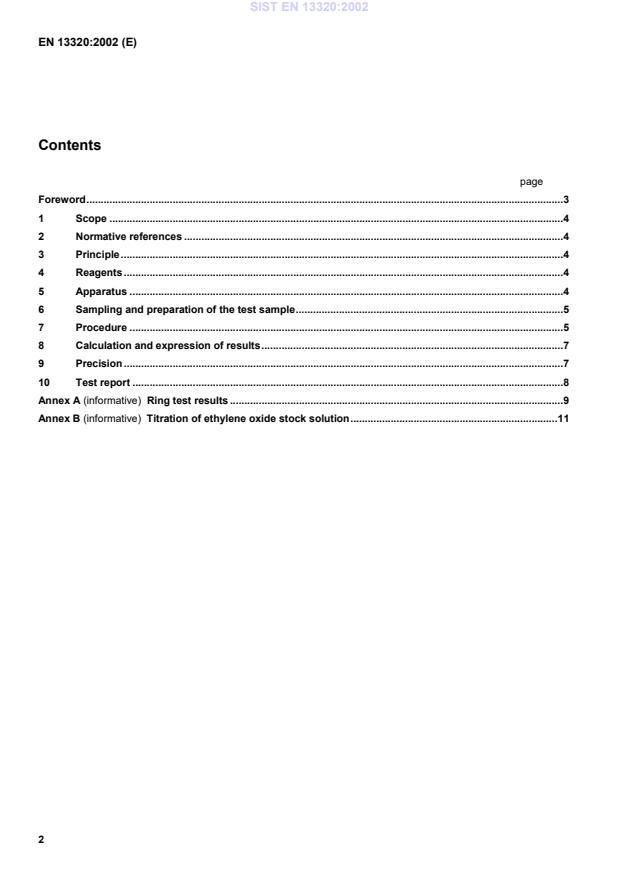
Ring test results.9Annex B (informative)
Titration of ethylene oxide stock solution.11SIST EN 13320:2002
99,5 %.4.3Ethylene oxide, C2H4O, dissolved in dichloromethane, vials containing 50 mg of ethylene oxide dissolvedin 1 ml of dichloromethane.4.4N,N-dimethylformamide, C3H7NO.5 ApparatusOrdinary laboratory apparatus and the following.5.1Capillary gas chromatograph, with flame ionisation detector (FID) and head-space sampling accessory. Theapparatus shall be equipped with a split system. The head-space sampling accessory shall be designed such thateach head-space bottle can be thermostated for a defined time.NOTESince ethylene oxide is easily decomposed by traces of impurities such as acids and transition metals, (catalyseddecomposition), a meticulously clean sampling accessory is necessary.5.2Fused silica capillary column, coating: crosslinked dimethylpolysiloxanes, column length 30 m, internaldiameter 0,25 mm, film thickness 1,0 .5.3Vials, closable by means of a septum, 20 ml, suitable for head-space sampling accessory.5.4Septums and aluminium caps, lined with aluminium or polytetrafluoroethylene (PTFE) for closing the vials.SIST EN 13320:2002
...