

CEN/TS 17812:2022
(Main)Determination of the acoustic properties of markings - The CPX measurement method
- Abstract
This document outlines a method to measure the typical external noise emission produced when tyres of passenger car roll over a structured road marking. The result is a measure for the noise perceived in the surroundings of the road, hence not for interior noise in the car.
This method can be used for three purposes:
- determination of initial acoustic properties of a road marking, yielding a noise label for a given system;
- testing of the acoustic conformity of a particular marking to the noise label determined during the determination of initial acoustic properties;
- monitoring of the acoustic properties in the course of its lifetime.
The test result allows the road owner to make an assessment of the risk of nuisance when s/he considers a particular road marking system for application on a road in a noise sensitive area, e.g. built up areas. The method is also applicable to measurements on milled rumble strips.
- Status
- Published
- Publication Date
- 12-Jul-2022
- Technical Committee
- CEN/TC 226 - Road equipment
- Drafting Committee
- CEN/TC 226/WG 2 - Horizontal road signs
- Current Stage
- 9093 - Decision to confirm - Review Enquiry
- Start Date
- 21-Aug-2026
- Completion Date
- 07-Oct-2026



Overview
CEN/TS 17812:2022 – Determination of the acoustic properties of markings – The CPX measurement method standardizes a method for measuring the external noise emissions produced when passenger car tyres roll over structured road markings. This approach uses the Close Proximity (CPX) method to quantify the noise perceived by the surroundings, focusing on the environment outside the vehicle, not interior cabin noise.
By providing a standardized measurement procedure, this technical specification enables road authorities, infrastructure managers, and product manufacturers to assess the potential nuisance or acceptability of road marking systems, particularly in noise-sensitive and built-up areas. The method is also applicable to measuring the acoustic properties of milled rumble strips.
Key Topics
- Measurement Principle: Utilizes the CPX method (EN ISO 11819-2:2017) with specialized tyres and microphones to capture tyre/road noise as the tyre rolls over the marking.
- Scope of Measurement:
- Measurement of external (environmental) noise only
- Applicability to both structured road markings and milled rumble strips
- Main Applications:
- Determining the initial acoustic properties of new road marking systems, generating a "noise label"
- Testing ongoing conformity of installed markings with their labeled acoustic properties
- Monitoring the acoustic properties of road markings over their service lifetime
- Test Site Requirements:
- Homogeneous, clean, and dry marking section at least 100 metres in length and 20 cm in width
- Markings must be tested on asphaltic or concrete surfaces in good repair
- Data and Reporting:
- Capturing both A-weighted and frequency spectrum sound levels
- Documenting environmental conditions and equipment used
- Safety Considerations:
- Mandatory safety procedures must be observed when conducting tests on live roads
Applications
- Urban Roads in Noise-Sensitive Zones: Helps road authorities assess and select road marking materials that minimize external noise impact near residential areas, schools, and hospitals.
- Product Development and Certification: Enables suppliers and manufacturers of road marking materials to benchmark products, certify performance, and meet regulatory requirements for acoustic properties.
- Maintenance Planning: Provides a tool for ongoing monitoring, aiding in decisions for maintenance, replacement, or compliance of road marking installations throughout their lifecycle.
- Comparative Noise Analysis: Supports comparative studies between standard and innovative marking systems, and between different types of pavement and marking configurations.
Related Standards
- EN ISO 11819-2:2017: Acoustics – Measurement of the influence of road surfaces on traffic noise – The close-proximity method (foundation of the CPX method described in CEN/TS 17812).
- ISO/TS 11819-3:2021: Specifies the reference tyres used in acoustic testing for reproducibility and standardization.
- EN ISO 13473-1:2019: Characterization of pavement texture by use of surface profiles – relevant for assessing pavement texture and macrotexture depth.
- EN 13036-1:2010: Measurement of pavement surface macrotexture depth using a volumetric patch technique.
- EN 1824:2020: Road marking materials – road trials, referenced for broader testing and evaluation framework.
Keywords: CEN/TS 17812:2022, acoustic properties, road markings, CPX measurement method, tyre/road noise, external noise emission, structured road markings, noise label, conformity testing, environmental noise, milled rumble strips, road infrastructure standards, acoustic monitoring, road equipment, noise-sensitive areas.
Relations
- Effective Date
- 11-Mar-2026
- Effective Date
- 11-Mar-2026
- Effective Date
- 28-Jan-2026
- Effective Date
- 28-Jan-2026
- Effective Date
- 28-Jan-2026
- Effective Date
- 28-Jan-2026
- Effective Date
- 28-Jan-2026
Get Certified
Connect with accredited certification bodies for this standard

BSMI (Bureau of Standards, Metrology and Inspection)
Taiwan's standards and inspection authority.
Zavod za gradbeništvo Slovenije (ZAG) - Inšpekcija
ZAG inspection body for construction products, structures, and materials.
Sponsored listings
Frequently Asked Questions
CEN/TS 17812:2022 is a technical specification published by the European Committee for Standardization (CEN). Its full title is "Determination of the acoustic properties of markings - The CPX measurement method". This standard covers: This document outlines a method to measure the typical external noise emission produced when tyres of passenger car roll over a structured road marking. The result is a measure for the noise perceived in the surroundings of the road, hence not for interior noise in the car. This method can be used for three purposes: - determination of initial acoustic properties of a road marking, yielding a noise label for a given system; - testing of the acoustic conformity of a particular marking to the noise label determined during the determination of initial acoustic properties; - monitoring of the acoustic properties in the course of its lifetime. The test result allows the road owner to make an assessment of the risk of nuisance when s/he considers a particular road marking system for application on a road in a noise sensitive area, e.g. built up areas. The method is also applicable to measurements on milled rumble strips.
This document outlines a method to measure the typical external noise emission produced when tyres of passenger car roll over a structured road marking. The result is a measure for the noise perceived in the surroundings of the road, hence not for interior noise in the car. This method can be used for three purposes: - determination of initial acoustic properties of a road marking, yielding a noise label for a given system; - testing of the acoustic conformity of a particular marking to the noise label determined during the determination of initial acoustic properties; - monitoring of the acoustic properties in the course of its lifetime. The test result allows the road owner to make an assessment of the risk of nuisance when s/he considers a particular road marking system for application on a road in a noise sensitive area, e.g. built up areas. The method is also applicable to measurements on milled rumble strips.
CEN/TS 17812:2022 is classified under the following ICS (International Classification for Standards) categories: 17.140.30 - Noise emitted by means of transport; 93.080.30 - Road equipment and installations. The ICS classification helps identify the subject area and facilitates finding related standards.
CEN/TS 17812:2022 has the following relationships with other standards: It is inter standard links to IEC 61672-1:2013, ISO/TS 11819-3:2021, EN 13036-1:2010, EN ISO 13473-1:2019, CR 1234:1993, EN ISO 11819-2:2017, prEN 18340. Understanding these relationships helps ensure you are using the most current and applicable version of the standard.
CEN/TS 17812:2022 is available in PDF format for immediate download after purchase. The document can be added to your cart and obtained through the secure checkout process. Digital delivery ensures instant access to the complete standard document.
Standards Content (Sample)
SLOVENSKI STANDARD
01-september-2022
Določanje akustičnih lastnosti oznak - Merilna metoda CPX
Determination of the acoustic properties of markings - The CPX measurement method
Messung der akustischen Eigenschaften von Markierungen - Das Nahfeldmessverfahren
Détermination des propriétés acoustiques de marquages - La méthode CPX
Ta slovenski standard je istoveten z: CEN/TS 17812:2022
ICS:
17.140.30 Emisija hrupa transportnih Noise emitted by means of
sredstev transport
93.080.30 Cestna oprema in pomožne Road equipment and
naprave installations
2003-01.Slovenski inštitut za standardizacijo. Razmnoževanje celote ali delov tega standarda ni dovoljeno.
CEN/TS 17812
TECHNICAL SPECIFICATION
SPÉCIFICATION TECHNIQUE
July 2022
TECHNISCHE SPEZIFIKATION
ICS 17.140.30; 93.080.30
English Version
Determination of the acoustic properties of markings - The
CPX measurement method
Détermination des propriétés acoustiques de Messung der akustischen Eigenschaften von
marquages - La méthode CPX Markierungen - Das Nahfeldmessverfahren
This Technical Specification (CEN/TS) was approved by CEN on 6 June 2022 for provisional application.
The period of validity of this CEN/TS is limited initially to three years. After two years the members of CEN will be requested to
submit their comments, particularly on the question whether the CEN/TS can be converted into a European Standard.
CEN members are required to announce the existence of this CEN/TS in the same way as for an EN and to make the CEN/TS
available promptly at national level in an appropriate form. It is permissible to keep conflicting national standards in force (in
parallel to the CEN/TS) until the final decision about the possible conversion of the CEN/TS into an EN is reached.
CEN members are the national standards bodies of Austria, Belgium, Bulgaria, Croatia, Cyprus, Czech Republic, Denmark, Estonia,
Finland, France, Germany, Greece, Hungary, Iceland, Ireland, Italy, Latvia, Lithuania, Luxembourg, Malta, Netherlands, Norway,
Poland, Portugal, Republic of North Macedonia, Romania, Serbia, Slovakia, Slovenia, Spain, Sweden, Switzerland, Turkey and
United Kingdom.
EUROPEAN COMMITTEE FOR STANDARDIZATION
COMITÉ EUROPÉEN DE NORMALISATION
EUROPÄISCHES KOMITEE FÜR NORMUNG
CEN-CENELEC Management Centre: Rue de la Science 23, B-1040 Brussels
© 2022 CEN All rights of exploitation in any form and by any means reserved Ref. No. CEN/TS 17812:2022 E
worldwide for CEN national Members.
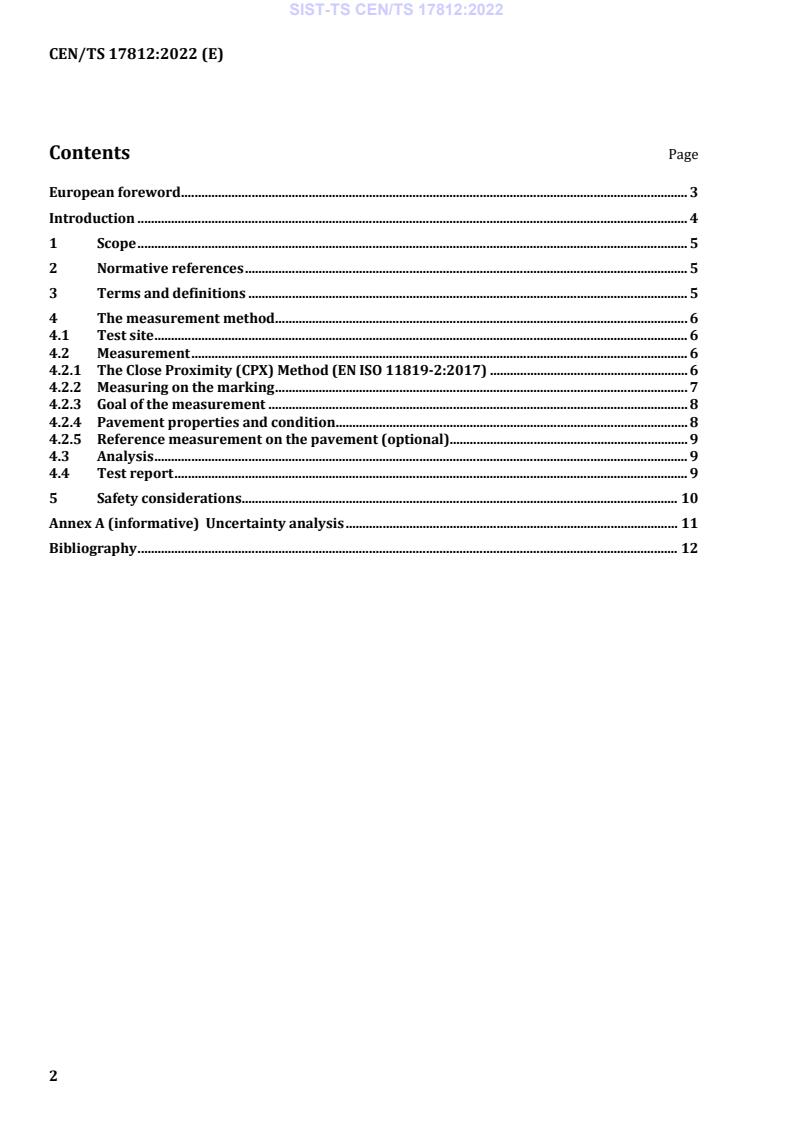
Contents Page
European foreword . 3
Introduction . 4
1 Scope . 5
2 Normative references . 5
3 Terms and definitions . 5
4 The measurement method . 6
4.1 Test site . 6
4.2 Measurement . 6
4.2.1 The Close Proximity (CPX) Method (EN ISO 11819-2:2017) . 6
4.2.2 Measuring on the marking . 7
4.2.3 Goal of the measurement . 8
4.2.4 Pavement properties and condition. 8
4.2.5 Reference measurement on the pavement (optional) . 9
4.3 Analysis . 9
4.4 Test report . 9
5 Safety considerations. 10
Annex A (informative) Uncertainty analysis . 11
Bibliography . 12
European foreword
This document (CEN/TS 17812:2022) has been prepared by Technical Committee CEN/TC 226 “Road
equipment”, the secretariat of which is held by AFNOR.
Attention is drawn to the possibility that some of the elements of this document may be the subject of
patent rights. CEN shall not be held responsible for identifying any or all such patent rights.
Any feedback and questions on this document should be directed to the users’ national standards body.
A complete listing of these bodies can be found on the CEN website.
According to the CEN/CENELEC Internal Regulations, the national standards organisations of the
following countries are bound to announce this Technical Specification: Austria, Belgium, Bulgaria,
Croatia, Cyprus, Czech Republic, Denmark, Estonia, Finland, France, Germany, Greece, Hungary, Iceland,
Ireland, Italy, Latvia, Lithuania, Luxembourg, Malta, Netherlands, Norway, Poland, Portugal, Republic of
North Macedonia, Romania, Serbia, Slovakia, Slovenia, Spain, Sweden, Switzerland, Turkey and the United
Kingdom.
Introduction
Structured road markings present one of several options to obtain an enhanced night time visibility
during rain or wetness. It is for this reason that they underwent a growing popularity in the last years.
Structured road markings can however also produce an increased noise emission during wheel passages,
which may be observed in the vehicle but also in the vicinity of the road. The sound increase inside the
car can be considered as a positive side effect, as it alarms the driver and may be very helpful for the
prevention of “doze off” traffic accidents. The sound increase perceived outside the car, however, may
have a positive aspect as it can warn people on the emergency lane about the approaching vehicle, but it
may as well annoy people living around.
It is desirable that a measurement method exists to assess the noise production of those road markings
during wheel passages which is representative, reproducible and generally applicable throughout
Europe. This document deals with a dedicated method which has been developed by the expert panel
“noise” of the CEN/TC 226/WG 2.
1 Scope
This document outlines a method to measure the typical external noise emission produced when tyres of
passenger car roll over a structured road marking. The result is a measure for the noise perceived in the
surroundings of the road, hence not for interior noise in the car.
This method can be used for three purposes:
— determination of initial acoustic properties of a road marking, yielding a noise label for a given
system;
— testing of the acoustic conformity of a particular marking to the noise label determined during the
determination of initial acoustic properties;
— monitoring of the acoustic properties in the course of its lifetime.
The test result allows the road owner to make an assessment of the risk of nuisance when s/he considers
a particular road marking system for application on a road in a noise sensitive area, e.g. built up areas.
The method is also applicable to measurements on milled rumble strips.
2 Normative references
The following documents are referred to in the text in such a way that some or all of their content
constitutes requirements of this document. For dated references, only the edition cited applies. For
undated references, the latest edition of the referenced document (including any amendments) applies.
EN ISO 11819-2:2017, Acoustics - Measurement of the influence of road surfaces on traffic noise - Part 2:
The close-proximity method (ISO 11819-2:2017)
ISO/TS 11819-3:2021, Acoustics — Measurement of the influence of road surfaces on traffic noise — Part 3:
Reference tyres
EN ISO 13473-1:2019, Characterization of pavement texture by use of surface profiles - Part 1:
Determination of mean profile depth (ISO 13473-1:2019, Corrected version 2021-06)
EN 13036-1:2010, Road and airfield surface characteristics - Test methods - Part 1: Measurement of
pavement surface macrotexture depth using a volumetric patch technique
IEC 61672-1, Electroacoustics — Sound level meters — Part 1: Specifications
3 Terms and definitions
For the purposes of this document, the following terms and definitions apply.
ISO and IEC maintain terminological databases for use in standardization at the following addresses:
— IEC Electropedia: available at https://www.electropedia.org/
— ISO Online browsing platform: available at https://www.iso.org/obp
3.1
L
eq
equivalent continuous sound level
sound level in decibels, having the same total sound energy as a fluctuating level, measured over the same
time interval, see IEC 61672-1
3.2
L
Aeq
equivalent continuous sound level calculated over the audible frequency range for humans (20 Hz –
20 kHz) with frequency weighting “A”, see IEC 61672-1
3.3
tyre P1
normalised tyre P1, representative for the average noise emission of car tyres, as defined in
ISO/TS 11819-3:2021
3.4
L
CPX P,V
sound level characterising the road surface under test, which is based on the tyre/road sound pressure
levels produced with tyre P1 at measurement speed v
4 The measurement method
4.1 Test site
An uninterrupted and straight road marking section should be selected with a length of at least 100 m
and a sufficient width. A visual inspection should ensure that the test section is homogeneous (both in
the direction parallel to the road axis as in the direction perpendicular to it), clean and dry. A measured
section does not contain transitions from one pavement to another. A width of 30 cm or more is
recommended. Minimum width is 20 cm.
4.2 Measurement
4.2.1 The Close Proximity (CPX) Method (EN ISO 11819-2:2017)
The Close Proximity method is a standardized and commonly used method for the evaluation of the
noisiness of paveme
...