


EN ISO 105-X04:1997
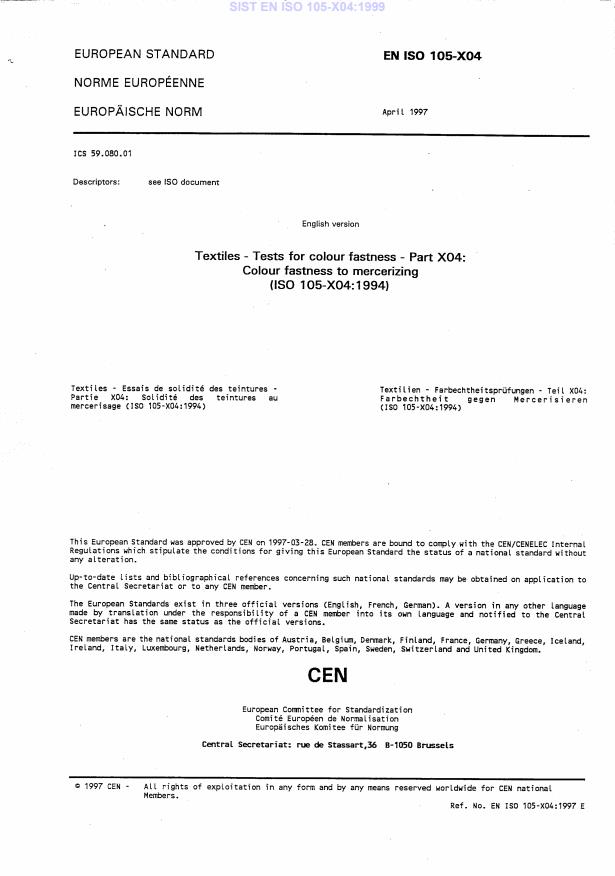
(Main)Textiles - Tests for colour fastness - Part X04: Colour fastness to mercerizing (ISO 105-X04:1994)
Textiles - Tests for colour fastness - Part X04: Colour fastness to mercerizing (ISO 105-X04:1994)
Describes a method for determining the resistance of the colour of textiles to the action of concentrated solutions of sodium hydroxide. The method is mainly applicable to cotton and to mixtures containing cotton. A specimen of the textile in contact with a specified adjacent fabric is treated with sodium hydroxide solution, rinsed, acidified, rinsed again, and dried. The change in colour of the specimen and the staining of the adjacent fabric are assessed with the grey scale.
Textilien - Farbechtheitsprüfungen - Teil X04: Farbechtheit gegen Mercerisieren (ISO 105-X04:1994)
Textiles - Essais de solidité des teintures - Partie X04: Solidité des teintures au mercerisage (ISO 105-X04:1994)
La présente partie de l'ISO 105 prescrit une méthode pour la détermination de la résistance des teintures sur les textiles à l'action des solutions concentrées d'hydroxyde de sodium utilisées pour le mercerisage. La méthode est applicable principalement au coton et aux mélanges contenant du coton.
Tekstilije - Preskušanje barvne obstojnosti - Del X04: Barvna obstojnost proti merceriziranju (ISO 105-X04:1994)
General Information
- Status
- Published
- Publication Date
- 22-Apr-1997
- Withdrawal Date
- 30-Oct-1997
- Technical Committee
- CEN/TC 248 - Textiles and textile products
- Drafting Committee
- CEN/TC 248/SC 3 - Chemical properties
- Current Stage
- 9093 - Decision to confirm - Review Enquiry
- Start Date
- 29-May-2007
- Completion Date
- 29-May-2007
Relations
- Effective Date
- 28-Jan-2026
- Effective Date
- 28-Jan-2026
- Effective Date
- 28-Jan-2026
- Effective Date
- 28-Jan-2026
- Effective Date
- 28-Jan-2026
Overview
EN ISO 105-X04:1997 is an international standard developed by the European Committee for Standardization (CEN) specifying a reliable method for evaluating the colour fastness of textiles to mercerizing. Mercerizing is a chemical finishing process primarily applied to cotton and cotton-containing textile blends using concentrated sodium hydroxide solutions to improve their appearance, strength, and affinity for dyes. This standard is crucial in the textile industry to ensure that dyed or printed cotton fabrics retain their intended color and quality after exposure to mercerizing treatments.
The procedure involves treating a textile sample in contact with a specified adjacent cotton fabric using sodium hydroxide solution, followed by rinsing, acidification, and drying. The degree of colour change in the original textile and staining on the adjacent fabric are evaluated using standardized grey scales. The standard helps maintain product consistency, safety, and consumer satisfaction throughout the textile supply chain.
Key Topics
- Colour Fastness Testing: EN ISO 105-X04:1997 focuses on assessing how well the colour of cotton textiles withstands exposure to concentrated sodium hydroxide, simulating the mercerizing process commonly used in fabric finishing.
- Applicable Materials: Primarily intended for cotton and cotton blends, but may be extended to other textiles containing cotton fibers.
- Testing Methodology:
- A test specimen is sewn to a cotton adjacent fabric and mounted in a frame.
- Treated with a sodium hydroxide solution, then rinsed, acidified, rinsed again, and air-dried.
- Colour change of the specimen and staining of the adjacent fabric are rated using grey scales.
- Standardization Benefits: This test ensures consistent evaluation across laboratories and manufacturers, supporting quality assurance for dyed textiles.
Applications
EN ISO 105-X04:1997 is widely used in:
- Textile Manufacturing: Essential for companies producing or finishing dyed cotton textiles to assure buyers of product durability and appearance even after mercerizing treatments.
- Quality Control: Enables textile and apparel producers to verify that their products meet required specifications for colour fastness, reducing waste and customer complaints.
- Textile Research and Development: Supports the development of new dyeing and finishing processes by providing a standard method to evaluate dye performance during mercerizing.
- Third-Party Testing and Certification: Accredited laboratories use this standard when providing independent test results for compliance and certification.
- Supply Chain Agreements: Reference in purchase or supply contracts to set clear quality expectations for colour retention in treated fabrics.
Related Standards
Several standards are closely associated with EN ISO 105-X04:1997, providing a comprehensive framework for textile testing:
- ISO 105-A01: General principles of colour fastness testing
- ISO 105-A02: Grey scale for assessing change in colour
- ISO 105-A03: Grey scale for assessing staining
- ISO 105-F: Standard adjacent fabrics for testing
- Other Parts of EN ISO 105 series: Covering various aspects of colour fastness, such as resistance to washing, light, perspiration, rubbing, and more
Conclusion:
By adhering to EN ISO 105-X04:1997, textile manufacturers, finishers, and laboratories ensure products meet stringent international requirements for colour fastness to mercerizing. Following this method strengthens product reliability, marketability, and customer satisfaction for cotton textiles globally.

Get Certified
Connect with accredited certification bodies for this standard

Control Union Certifications
Global certification for agriculture and sustainability.

Hohenstein Institut
Textile testing and certification.

Bureau Veritas Bangladesh
Bureau Veritas certification services in Bangladesh.
Sponsored listings
Frequently Asked Questions
EN ISO 105-X04:1997 is a standard published by the European Committee for Standardization (CEN). Its full title is "Textiles - Tests for colour fastness - Part X04: Colour fastness to mercerizing (ISO 105-X04:1994)". This standard covers: Describes a method for determining the resistance of the colour of textiles to the action of concentrated solutions of sodium hydroxide. The method is mainly applicable to cotton and to mixtures containing cotton. A specimen of the textile in contact with a specified adjacent fabric is treated with sodium hydroxide solution, rinsed, acidified, rinsed again, and dried. The change in colour of the specimen and the staining of the adjacent fabric are assessed with the grey scale.
Describes a method for determining the resistance of the colour of textiles to the action of concentrated solutions of sodium hydroxide. The method is mainly applicable to cotton and to mixtures containing cotton. A specimen of the textile in contact with a specified adjacent fabric is treated with sodium hydroxide solution, rinsed, acidified, rinsed again, and dried. The change in colour of the specimen and the staining of the adjacent fabric are assessed with the grey scale.
EN ISO 105-X04:1997 is classified under the following ICS (International Classification for Standards) categories: 59.080.01 - Textiles in general. The ICS classification helps identify the subject area and facilitates finding related standards.
EN ISO 105-X04:1997 has the following relationships with other standards: It is inter standard links to EN ISO 5579:2013, EN ISO 10893-6:2019, EN ISO 17636-1:2013, EN 340:2003, EN ISO 16371-2:2017. Understanding these relationships helps ensure you are using the most current and applicable version of the standard.
EN ISO 105-X04:1997 is available in PDF format for immediate download after purchase. The document can be added to your cart and obtained through the secure checkout process. Digital delivery ensures instant access to the complete standard document.
Standards Content (Sample)
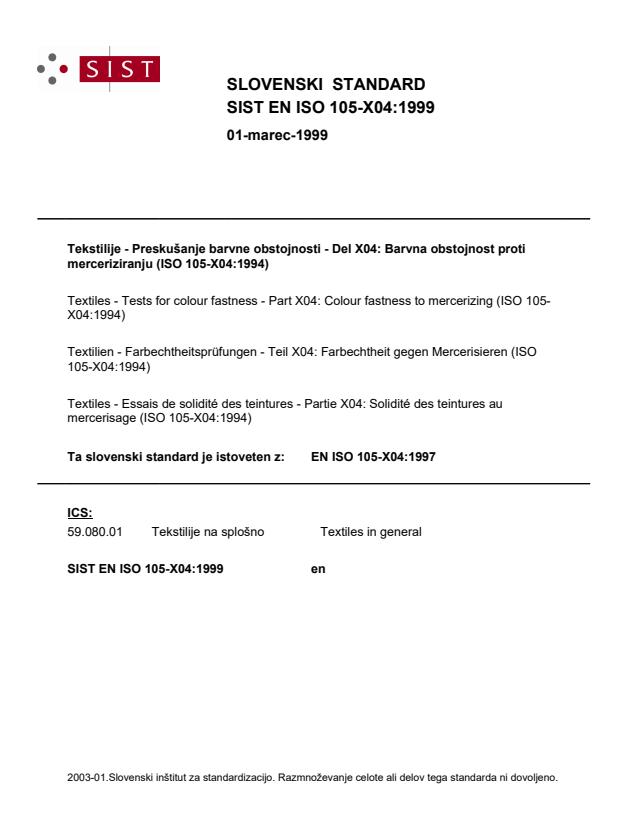
SLOVENSKI STANDARD
01-marec-1999
Tekstilije - Preskušanje barvne obstojnosti - Del X04: Barvna obstojnost proti
merceriziranju (ISO 105-X04:1994)
Textiles - Tests for colour fastness - Part X04: Colour fastness to mercerizing (ISO 105-
X04:1994)
Textilien - Farbechtheitsprüfungen - Teil X04: Farbechtheit gegen Mercerisieren (ISO
105-X04:1994)
Textiles - Essais de solidité des teintures - Partie X04: Solidité des teintures au
mercerisage (ISO 105-X04:1994)
Ta slovenski standard je istoveten z: EN ISO 105-X04:1997
ICS:
59.080.01 Tekstilije na splošno Textiles in general
2003-01.Slovenski inštitut za standardizacijo. Razmnoževanje celote ali delov tega standarda ni dovoljeno.
ISO
INTERNATIONAL
105-xo4
STANDARD
Fourth edition
1994-09-01
- Tests for colour fastness -
Textiles
Part X04:
Colour fastness to mercerizing
Essais de solidith des teintures -
Textiles -
Partie X04: Solidit6 des teintures au mercerisage
Reference number
ISO 105-X04: 1994(E)
ISO 105-X04:1994(E)
Foreword
ISO (the International Organization for Standardization) is a worldwide
federation of national Standards bodies (ISO member bodies). The work
of preparing International Standards is normally carried out through ISO
technical committees. Esch member body interested in a subject for
which a technical committee has been established has the right to be re-
presented on that committee. International organizations, governmental
and non-governmental, in liaison with ISO, also take part in the work. ISO
collaborates closely with the International Electrotechnical Commission
(1 EC) on all matters of electrotechnical standardization.
Draft International Standards adopted by the technical committees are
circulated to the member bodies for voting. Publication as an International
Standard requires approval by at least 75 % of the member bodies casting
a vote.
International Standard ISO 105-X04 was prepared by Technical Committee
ISODC 38, Textiles, Subcommittee SC 1, Tests for coloured textiles and
coloran ts.
This fourth edition cancels and replaces the third edition
(ISO 105-XO4:1987), of which it constitutes a minor revision.
ISO 105 was previously published in thirteen “Parts ”, each designated by
“Part A ”), with publication dates between 1978 and 1985.
a letter (e.g.
Esch part contained a series of “sections ”, each designated by the re-
spective patt letter and by a two-digit serial number (e.g. “Section AO1 “).
These sections are now being republished as separate documents, them-
but retaining their earlier alphanumeric desig-
selves designated “Parts”
nations. A complete list of these Parts is given in ISO 105-AOI.
0 ISO 1994
All rights reserved. Unless otherwise specified, no part of this publication may be reproduced
or utilized in any form or by any means, electronie or mechanical, including photocopying and
microfilm, without Permission in writing from the publisher.
International Organization for Standardization
Case Postale 56 l CH-l 211 Geneve 20 l Switzerland
Printed in Switzerland
ii
INTERNATIONAL STANDARD 0 ISO ISO 105-X04:1994(E)
Textiles - Tests for colour fastness -
Part X04:
Colour fastness to mercerizing
1 Scope 3 Principle
This part of ISO 105 specifies a method for deter-
3.1 A specimen of the textile in contact with a
mining the resistance of the colour of textiles to the
specified adjacent fabric is treated with sodium hy-
action of concentrated solutions of sodium hydroxide
droxide Solution, rinsed, acidified, rinsed again and
used in mercerizing. The method is mainly applicable
dried. The Change in colour of the specimen and the
to cotton and to mixtures containing cotton.
staining of the adjacent fabric are assessed by com-
parison with the grey scales.
2 Normative references
3.2 As completely resistant specimens may show
an apparent increase in depth of colour, these cannot
The following Standards contain provisions which,
be rated 5 (no Change) by the normal method of as-
through reference in this text, constitute provisions
sessment. In such cases, therefore, only the changes
of this part of ISO 105. At the time of publication, the
in hue and lightness tan be assessed using the grey
editions indicated were valid. All Standards are subject
scale, without consideration of the increase in depth,
to revision, and Parties to agreements based on this
and such assessments should be marked with an as-
...
Questions, Comments and Discussion
Ask us and Technical Secretary will try to provide an answer. You can facilitate discussion about the standard in here.
Loading comments...