

EN ISO 898-6:1995
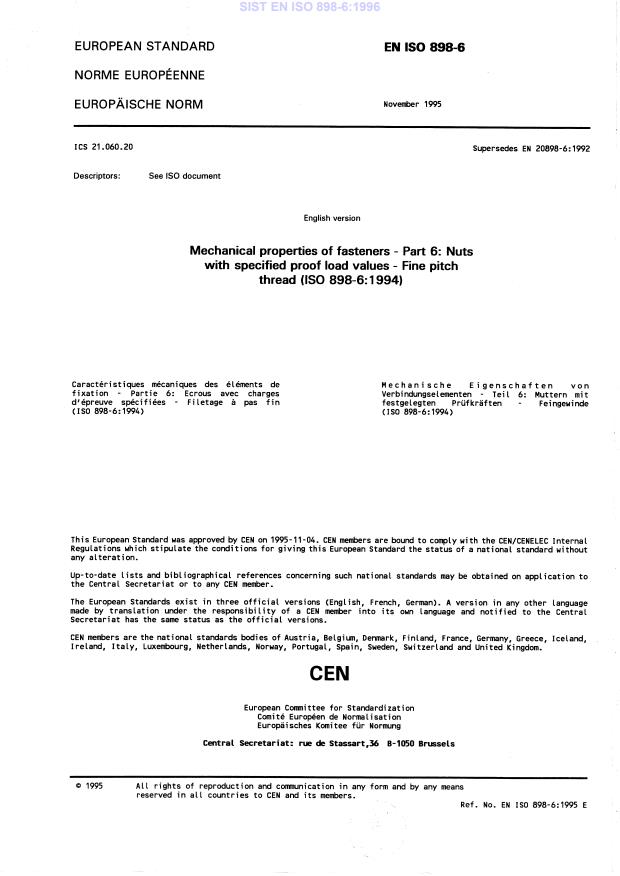
(Main)Mechanical properties of fasteners - Part 6: Nuts with specified proof load values - Fine pitch thread (ISO 898-6:1994)
- Abstract
Cancels and replaces the first edition (1988). Specifies the mechanical properties of nuts with specified proof load values when tested at an ambient temperature range of +10 °C to +35 °C. Applies to nuts with nominal thread diameters from 8 mm up to and including 39 mm, of triangular ISO thread, with diameter/pitch combinations in accordance with ISO 261, with thread tolerances 6H in accordance with ISO 965-1 and 965-2, with specific mechanical requirements, with widths across flats as specified in ISO 272, with nominal heights greater than or equal to 0,5d, made of carbon steel or alloy steel. Does not apply to nuts requiring special properties as weldability, prevailing torque performance, corrosion resistance, ability to withstand temperatures above +300 °C or below -50 °C.
- Status
- Withdrawn
- Publication Date
- 21-Nov-1995
- Withdrawal Date
- 14-Mar-2012
- Technical Committee
- CEN/TC 185 - Threaded and nonthreaded mechanical fasteners and accessories
- Current Stage
- 9960 - Withdrawal effective - Withdrawal
- Start Date
- 15-Mar-2012
- Completion Date
- 15-Mar-2012

Relations
- Effective Date
- 11-Apr-2012
- Referred By
EN 50052:2016 - High-voltage switchgear and controlgear - Gas-filled cast aluminium alloy enclosures - Effective Date
- 09-Feb-2026
- Effective Date
- 09-Feb-2026
Frequently Asked Questions
EN ISO 898-6:1995 is a standard published by the European Committee for Standardization (CEN). Its full title is "Mechanical properties of fasteners - Part 6: Nuts with specified proof load values - Fine pitch thread (ISO 898-6:1994)". This standard covers: Cancels and replaces the first edition (1988). Specifies the mechanical properties of nuts with specified proof load values when tested at an ambient temperature range of +10 °C to +35 °C. Applies to nuts with nominal thread diameters from 8 mm up to and including 39 mm, of triangular ISO thread, with diameter/pitch combinations in accordance with ISO 261, with thread tolerances 6H in accordance with ISO 965-1 and 965-2, with specific mechanical requirements, with widths across flats as specified in ISO 272, with nominal heights greater than or equal to 0,5d, made of carbon steel or alloy steel. Does not apply to nuts requiring special properties as weldability, prevailing torque performance, corrosion resistance, ability to withstand temperatures above +300 °C or below -50 °C.
Cancels and replaces the first edition (1988). Specifies the mechanical properties of nuts with specified proof load values when tested at an ambient temperature range of +10 °C to +35 °C. Applies to nuts with nominal thread diameters from 8 mm up to and including 39 mm, of triangular ISO thread, with diameter/pitch combinations in accordance with ISO 261, with thread tolerances 6H in accordance with ISO 965-1 and 965-2, with specific mechanical requirements, with widths across flats as specified in ISO 272, with nominal heights greater than or equal to 0,5d, made of carbon steel or alloy steel. Does not apply to nuts requiring special properties as weldability, prevailing torque performance, corrosion resistance, ability to withstand temperatures above +300 °C or below -50 °C.
EN ISO 898-6:1995 is classified under the following ICS (International Classification for Standards) categories: 21.060.20 - Nuts. The ICS classification helps identify the subject area and facilitates finding related standards.
EN ISO 898-6:1995 has the following relationships with other standards: It is inter standard links to EN ISO 898-2:2012, EN 50052:2016, EN 50064:2018. Understanding these relationships helps ensure you are using the most current and applicable version of the standard.
EN ISO 898-6:1995 is available in PDF format for immediate download after purchase. The document can be added to your cart and obtained through the secure checkout process. Digital delivery ensures instant access to the complete standard document.
Standards Content (Sample)
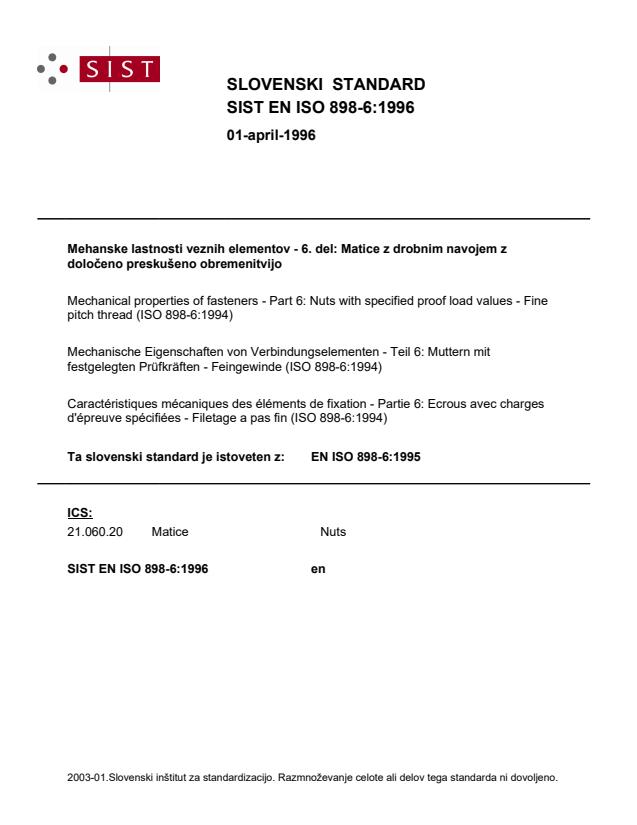
2003-01.Slovenski inštitut za standardizacijo. Razmnoževanje celote ali delov tega standarda ni dovoljeno.Mechanische Eigenschaften von Verbindungselementen - Teil 6: Muttern mit festgelegten Prüfkräften - Feingewinde (ISO 898-6:1994)Caractéristiques mécaniques des éléments de fixation - Partie 6: Ecrous avec charges d'épreuve spécifiées - Filetage a pas fin (ISO 898-6:1994)Mechanical properties of fasteners - Part 6: Nuts with specified proof load values - Fine pitch thread (ISO 898-6:1994)21.060.20MaticeNutsICS:Ta slovenski standard je istoveten z:EN ISO 898-6:1995SIST EN ISO 898-6:1996en01-april-1996SIST EN ISO 898-6:1996SLOVENSKI
STANDARD
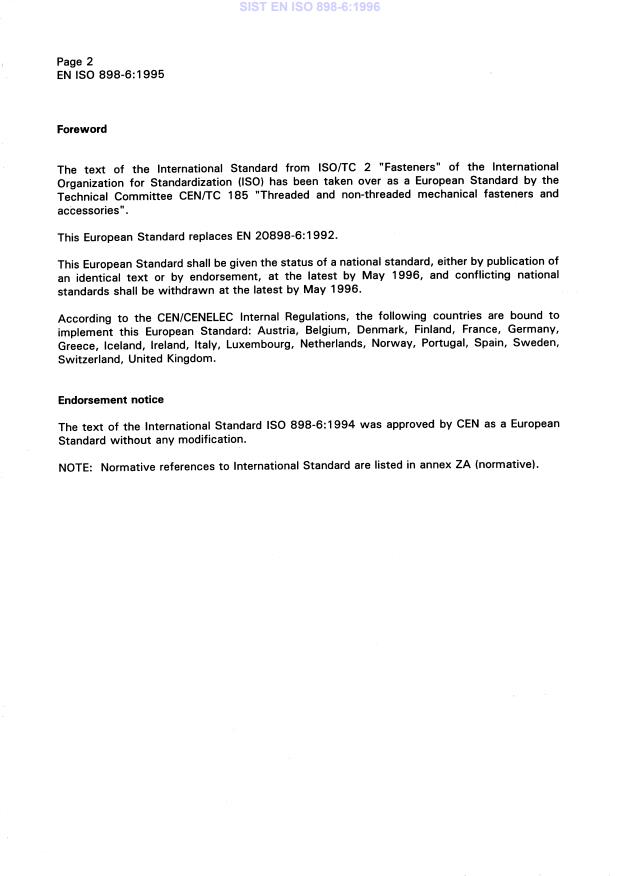
INTERNATIONAL STANDARD Is0 898-6 Second edition 1994-l 2-15 Mechanical properties of fasteners - Part 6: Nuts with specified proof load values - Fine pitch thread Caractkistiques mbcaniques des Mments de fixation - Partie 6: krous avec charges d’8preuve spkifikes - Filetage 2 pas fin Reference number IS0 898-6:1994(E) SIST EN ISO 898-6:1996
Foreword IS0 (the International Organization for Standardization) is a worldwide federation of national standards bodies (IS0 member bodies). The work of preparing International Standards is normally carried out through IS0 technical committees. Each member body interested in a subject for which a technical committee has been established has the right to be represented on that committee. International organizations, governmental and non-governmental, in liaison with ISO, also take part in the work. IS0 collaborates closely with the International Electrotechnical Commission (IEC) on all matters of electrotechnical standardization. Draft International Standards adopted by the technical committees are circulated to the member bodies for voting. Publication as an International Standard requires approval by at least 75 % of the member bodies casting a vote. International Standard IS0 898-6 was prepared by Technical Committee lSO/TC 2, Fasteners, Subcommittee SC 1, Mechanical properties of fasteners. This second edition cancels and replaces the first edition (IS0 898-6:1988), which has been technically revised. IS0 898 consists of the following parts, under the general title Mechanical properties of fasteners: - Part 1: Bolts, screws and studs - Part 2: Nuts with specified proof load values - Coarse thread - Part 5: Set screws and similar threaded fasteners not under tensile stresses - Part 6: Nuts with specified proof load values - Fine pitch thread - Part 7: Torsional test and minimum torques for bolts and screws with nominal diameters 1 mm to 10 mm 0 IS0 1994 All rights reserved. Unless otherwise specified, no part of this publication may be reproduced or utilized in any form or by any means, electronic or mechanical, including photocopying and microfilm, without permission in writing from the publisher. International Organization for Standardization Case Postale 56 l CH-1211 Geneve 20 l Switzerland Printed in Switzerland ii SIST EN ISO 898-6:1996
INTERNATIONAL STANDARD 0 IS0 IS0 898-6: 1994(E) Mechanical properties of fasteners - Part 6: Nuts with specified proof load values - Fine pitch thread 1 Scope This part of IS0 898 specifies the mechanical proper- ties of nuts with specified proof load values when tested at an ambient temperature range of + 10 “C to + 35 “C. Mechanical and physical properties will vary with respect to temperature and property class. Products conforming to the requirements of this part of IS0 898 are evaluated only at the ambient tem- perature range and may not retain the specified physical properties at higher and lower temperatures. At temperatures higher or lower than the ambient temperature range, a significant change in properties may occur. When fasteners are to be used above or below the ambient temperature range, it is the re- sponsibility of the user to ensure that the mechanical and physical properties are suitable for his particular service conditions. This part of IS0 898 applies to nuts - with nominal thread diameters, d, from 8 mm up to and including 39 mm (fine pitch thread); - of triangular IS0 thread and with diameters and pitches in accordance with IS0 68 and IS0 262 (fine pitch thread); - with diameter/pitch combinations in accordance with IS0 261 (fine pitch thread); - with thread tolerances 6H in accordance with IS0 965-l and 965-2 (see note 2); - with specific mechanical requirements; - with widths across flats as specified in IS0 272; - with nominal heights greater than or equal to 0,5d”; - made of carbon steel or alloy steel (see note 1 It does not apply to nuts requiring special proper such as - weldability; - corrosion resistance (see IS0 3506); - ability to withstand temperatures above or below - 50 “C. (However, see note 1. NOTES I Nuts made from free-cutting steel should no above + 250 “C. 1 . ties - prevailing torque performance (see IS0 2320); t300 "C be used 2 With thread tolerances other or larger than 6H, a de- crease in the stripping strength should be considered (see table I). I) In IS0 898:1988, the symbol D was used. 1 SIST EN ISO 898-6:1996
Table 1 - Reduction in thread strength Nominal thread diameter Test load, % d Thread tolerances mm 6H 7H 6G 8~ d< 16 100 96 97,5 16 0,8d (effective lengths of thread > 0,6d): Nuts of style I and style 2 Nuts with nominal heights 2 0,8d (effective lengths of thread 2 0,6d) are designated by a number to indi- cate the maximum appropriate property class of bolts with which they may be mated. Failure of threaded fasteners due to over-tightening can occur by bolt shank fracture or by stripping of the threads of the nut and/or bolt. Shank fracture is sud- den and therefore easily noticed. Stripping is gradual and therefore difficult to detect and this introduces the danger of partly failed fasteners being left in as- semblies. It would therefore be desirable to design threaded connections so that their mode of failure would al- ways be by shank fracture but, unfortunately, because of the many variables which govern stripping strength (nut and bolt material strengths, thread clearances, across-flats dimensions, etc.), nuts would have to be excessively thick to guarantee this mode in all cases. A bolt or screw of thread diameter 8 mm to 39 mm assembled with a nut of the appropriate property class, in accordance with table 2, is intended to pro- vide an assembly capable of being tightened to the bolt proof load without thread stripping occurring. 2) To be published. SIST EN ISO 898-6:1996
IS0 898-6:1994(E)- Table 2 - Designation system for nuts with nominal heights 2 0,8d I I Property class of nut ’ Mating bolts Nominal thread Property class diameter range Nuts style 1 style 2 Nominal thread diameter range 5 6 8 10 12 3.6; 4.6; 4.8 5.6; 5.8 6.8 8.8 10.9 12.9 mm d< 39 d< 39 d< 39 d< 39 d< 16 mm d< 39 d< 39 d< 39 d< 16 d< 16 d,< 39 d< 16 NOTE - In general, nuts of a higher property class can replace nuts of a lower property class. This is advisable for a bolt/nut assembly going into a stress higher than the yield stress or the stress under proof load of the bolt. However, should tightening beyond bolt proof load take place, the nut design is intended to ensure at least 10 % of the over-tightened assemblies fail through bolt breakage in order to warn the user that the installation practice is not appropriate. NOTE 3 For more detailed information on the strength of screw thread assemblies and for the styles of nuts, see IS0 898-2:1992, annex A. 3.2 Nuts with nominal heights > 0,5d and < 0,8d (effective heights of thread 2 0,4d and < 0,6d) Nuts with nominal heights 2 0,5d and -C 0,8d (effec- tive height of thread > 0,4d and < 0,6d) are desig- nated by a combination of two numbers: the second indicates the nominal stress under proof load on a hardened test mandrel, while the first indicates that the loadability of a bolt-nut assembly is reduced in comparison with the loadability on a hardened test mandrel and also in comparison with a bolt-nut as- sembly des
...