


EN 16139:2025
(Main)Furniture - Safety, strength and durability - Requirements and test methods for non-domestic seating
Furniture - Safety, strength and durability - Requirements and test methods for non-domestic seating
This document specifies requirements for the safety, strength and durability of all types of non-domestic seating intended to be used by adults with a weight of not more than 110 kg, including office visitor chairs.
This document does not apply to ranked seating, office work chairs, chairs for educational institutions, outdoor seating and to links for linked seating for which other European Standards exist. It does also not apply to work chairs for industrial use.
This document does not include requirements for the durability of upholstery materials, castors, reclining and tilting mechanisms and seat height adjustment mechanisms.
This document does not include requirements for the resistance to ageing, degradation and flammability.
This document does not include requirements for electrical safety.
Annex A (normative) contains test methods for finger entrapment and shear and compression.
Annex B (normative) contains a seat side-to-side durability test at D-G points.
Annex C (normative) contains a test method for Leg rest durability.
Annex D (normative) contains the determination of seat loading point for seating with suspended flexible material.
Annex E (informative) contains additional drop tests.
Annex F (informative) contains information on the level of test severity in relation to applications.
Annex G (informative) contains recommended dimensions for non-domestic chairs.
Annex H (informative) contains a rationale for single column seating.
Möbel - Sicherheit, Festigkeit und Dauerhaltbarkeit - Anforderungen und Prüfverfahren für Sitzmöbel für den Nicht-Wohnbereich
Dieses Dokument legt Anforderungen an die Sicherheit, Festigkeit und Dauerhaltbarkeit aller Arten von Sitzmöbel für den Nicht-Wohnbereich fest, die für die Benutzung durch Erwachsene mit einem Körpergewicht von nicht mehr als 110 kg bestimmt sind, einschließlich Büro-Besucherstühle.
Dieses Dokument ist nicht anwendbar für fest montiertes Reihengestühl, Büroarbeitsstühle, Stühle für Bildungseinrichtungen, Außensitzmöbel und Verbindungselemente für Reihenbestuhlung, für die andere Europäische Normen bestehen. Es ist auch nicht anwendbar für industriell genutzte Arbeitsstühle.
Dieses Dokument enthält keine Anforderungen an die Dauerhaltbarkeit von Polstermaterialien, Rollen, Neige- und Kippmechanismen sowie Höhenverstelleinrichtungen an Sitzen.
Dieses Dokument enthält keine Anforderungen an die Beständigkeit gegen Alterung, Qualitätsminderung und Brennbarkeit.
Dieses Dokument enthält keine Anforderungen an die elektrische Sicherheit.
Anhang A (normativ) enthält Verfahren zur Prüfung von Fang-, Scher- und Klemmstellen der Finger.
Anhang B (normativ) enthält ein Verfahren für die Prüfung der Dauerhaltbarkeit des Sitzes an den Punkten D und G bei Belastung von Seite zu Seite.
Anhang C (normativ) enthält ein Verfahren zur Prüfung der Dauerhaltbarkeit der Beinauflage.
Anhang D (normativ) enthält die Bestimmung des Belastungspunkts des Sitzes bei Sitzmöbeln mit aufgehängtem flexiblem Werkstoff.
Anhang E (informativ) enthält zusätzliche Fallprüfungen.
Anhang F (informativ) enthält Informationen zu Prüfstufen im Verhältnis zum Anwendungsbereich.
Anhang G (informativ) enthält empfohlene Maße für Stühle für den Nicht-Wohnbereich.
Anhang H (informativ) enthält eine Begründung für Sitzmöbel mit einzelner Tragsäule.
Mobilier - Sécurité, résistance et durabilité - Exigences et méthodes d'essai applicables aux sièges à usage non domestique
Le présent document spécifie les exigences relatives à la sécurité, à la résistance et à la durabilité de tous les types de sièges à usage non domestique destinés à être utilisés par des adultes d’un poids maximal de 110 kg, y compris les sièges visiteurs de bureau.
Le présent document ne s’applique pas aux sièges assemblés en rangées, aux sièges de travail de bureau, aux sièges pour établissements d’enseignement, aux sièges d’extérieur ou aux assemblages de sièges assemblés pour lesquels il existe d’autres Normes européennes. Il ne s’applique pas aux sièges de travail à usage industriel.
Ce document ne comprend aucune exigence concernant la durabilité des matériaux de rembourrage, des roulettes, des mécanismes d’inclinaison et de basculement ou des mécanismes de réglage de la hauteur du siège.
Le présent document ne stipule pas d’exigences pour la résistance au vieillissement, à la dégradation et à l’inflammabilité.
Le présent document n’inclut aucune exigence relative à la sécurité électrique.
L’Annexe A (normative) contient des méthodes d’essai de coincement des doigts, de cisaillement et de compression.
L’Annexe B (normative) contient un essai de durabilité d’un côté à l’autre de l’assise aux points D-G.
L’Annexe C (normative) contient une méthode d’essai pour la durabilité du repose-jambes.
L’Annexe D (normative) contient la détermination du point de charge de l’assise pour les sièges avec un matériau souple suspendu.
L’Annexe E (informative) contient des essais de chute supplémentaires.
L’Annexe F (informative) contient des informations sur le niveau de sévérité des essais en fonction des applications.
L’Annexe G (informative) contient les dimensions recommandées pour les sièges à usage non domestique.
L’Annexe H (informative) contient des justifications concernant les sièges à colonne unique.
Pohištvo - Trdnost, trajnost in varnost - Zahteve za sedežno pohištvo za javno uporabo
Ta dokument določa zahteve za varnost, trdnost in trajnost za vse vrste sedežnega pohištva za javno uporabo, namenjenega odraslim s težo, ki ne presega 110 kg, vključno s pisarniškimi stoli za obiskovalce. Ta dokument se ne uporablja za vrstne sedeže, pisarniške delovne sedeže, sedežno pohištvo za izobraževalne ustanove, zunanje sedežno pohištvo in povezave za povezano sedežno pohištvo, za katere obstajajo drugi evropski standardi. Ne uporablja se za delovne stole za industrijsko uporabo. Ta dokument ne vključuje zahtev za trajnost tapetniških materialov, kolesc, mehanizmov za sklapljanje in prilagajanje naklona ter mehanizmov za nastavitev višine sedeža. Ta dokument ne vključuje zahtev za odpornost proti staranju, razpadanju in vnetljivosti. Ta dokument ne vključuje zahtev za električno varnost. Dodatek A (normativni) vsebuje preskusne metode za ukleščenje prstov ter strižno in tlačno trdnost. Dodatek B (normativni) vsebuje preskus trajnosti sedeža od ene strani do druge v točkah D–G. Dodatek C (normativni) vsebuje preskusno metodo za trajnost naslonov za noge. Dodatek D (normativni) vsebuje določitev točke obremenitve sedeža za sedežno opremo z visečim prožnim materialom. Dodatek E (informativni) vsebuje dodatne preskuse s padcem. Dodatek F (informativni) vsebuje informacije o zahtevnosti preskusa v zvezi z uporabo. Dodatek G (informativni) vsebuje priporočene mere stolov za javno uporabo. Dodatek H (informativni) vsebuje utemeljitev za sedežno pohištvo, nameščeno okrog stebra.
General Information
- Status
- Published
- Publication Date
- 22-Jul-2025
- Technical Committee
- CEN/TC 207 - Furniture
- Current Stage
- 6060 - Definitive text made available (DAV) - Publishing
- Start Date
- 23-Jul-2025
- Due Date
- 23-Oct-2023
- Completion Date
- 23-Jul-2025
Relations
- Effective Date
- 30-Jul-2025
- Replaces
EN 16139:2013 - Furniture - Strength, durability and safety - Requirements for non-domestic seating - Effective Date
- 19-Jan-2023
Overview
EN 16139:2025 - published by CEN - sets requirements and test methods for the safety, strength and durability of non-domestic seating intended for adults up to 110 kg (including office visitor chairs). It replaces EN 16139:2013 and introduces new provisions such as definitions for single column seating, side-to-side durability tests and leg rest requirements. The standard excludes ranked seating, office work chairs, educational seating, outdoor seating, linked seating covered by other standards and industrial work chairs. It also does not cover electrical safety, resistance to ageing/flame, or durability of upholstery, castors and certain mechanisms.
Key topics and technical requirements
- Scope and exclusions: applies to a broad range of non-domestic chairs (visitor chairs, meeting seating) but explicitly excludes several specialised seating types.
- Safety design: requirements to minimise injury (rounded/chamfered edges, burr-free accessible parts, secure load-bearing components).
- Shear, compression and finger entrapment: normative test methods in Annex A for finger entrapment and shear/compression points.
- Strength and durability tests: general test methods referenced (including EN 1728:2012) and specific durability procedures.
- Stability and loading: stability testing (EN 1022 referenced) and determination of seat loading points, including Annex D for seating with suspended flexible material.
- Single column seating: new definition and side-to-side durability requirements with test method in Annex B; rationale in Annex H.
- Leg rest: new static and durability requirements with test procedure in Annex C (normative).
- Additional informative guidance: Annex E (drop tests), Annex F (test severity vs applications), Annex G (recommended dimensions).
Practical applications and users
- Manufacturers and product designers: to design and verify non-domestic chairs meet European safety and durability expectations.
- Test laboratories and certification bodies: to perform the normative test methods (finger entrapment, side-to-side durability, leg rest, etc.).
- Specifiers, procurement teams and facility managers: to define performance requirements for furniture in offices, meeting rooms, waiting areas and other non-domestic environments.
- Standards committees and compliance professionals: to align product documentation and testing with CEN requirements.
Related standards
- EN 1728:2012 - Seating test methods for strength and durability (referenced)
- EN 1022 - Determination of stability for seating
- EN 17684 (under preparation) - will address electrically operated furniture requirements
Keywords: EN 16139:2025, non-domestic seating, safety, strength, durability, test methods, CEN, single column seating, finger entrapment, seat side-to-side durability.

Frequently Asked Questions
EN 16139:2025 is a standard published by the European Committee for Standardization (CEN). Its full title is "Furniture - Safety, strength and durability - Requirements and test methods for non-domestic seating". This standard covers: This document specifies requirements for the safety, strength and durability of all types of non-domestic seating intended to be used by adults with a weight of not more than 110 kg, including office visitor chairs. This document does not apply to ranked seating, office work chairs, chairs for educational institutions, outdoor seating and to links for linked seating for which other European Standards exist. It does also not apply to work chairs for industrial use. This document does not include requirements for the durability of upholstery materials, castors, reclining and tilting mechanisms and seat height adjustment mechanisms. This document does not include requirements for the resistance to ageing, degradation and flammability. This document does not include requirements for electrical safety. Annex A (normative) contains test methods for finger entrapment and shear and compression. Annex B (normative) contains a seat side-to-side durability test at D-G points. Annex C (normative) contains a test method for Leg rest durability. Annex D (normative) contains the determination of seat loading point for seating with suspended flexible material. Annex E (informative) contains additional drop tests. Annex F (informative) contains information on the level of test severity in relation to applications. Annex G (informative) contains recommended dimensions for non-domestic chairs. Annex H (informative) contains a rationale for single column seating.
This document specifies requirements for the safety, strength and durability of all types of non-domestic seating intended to be used by adults with a weight of not more than 110 kg, including office visitor chairs. This document does not apply to ranked seating, office work chairs, chairs for educational institutions, outdoor seating and to links for linked seating for which other European Standards exist. It does also not apply to work chairs for industrial use. This document does not include requirements for the durability of upholstery materials, castors, reclining and tilting mechanisms and seat height adjustment mechanisms. This document does not include requirements for the resistance to ageing, degradation and flammability. This document does not include requirements for electrical safety. Annex A (normative) contains test methods for finger entrapment and shear and compression. Annex B (normative) contains a seat side-to-side durability test at D-G points. Annex C (normative) contains a test method for Leg rest durability. Annex D (normative) contains the determination of seat loading point for seating with suspended flexible material. Annex E (informative) contains additional drop tests. Annex F (informative) contains information on the level of test severity in relation to applications. Annex G (informative) contains recommended dimensions for non-domestic chairs. Annex H (informative) contains a rationale for single column seating.
EN 16139:2025 is classified under the following ICS (International Classification for Standards) categories: 97.140 - Furniture. The ICS classification helps identify the subject area and facilitates finding related standards.
EN 16139:2025 has the following relationships with other standards: It is inter standard links to EN 16139:2013/AC:2013, EN 16139:2013. Understanding these relationships helps ensure you are using the most current and applicable version of the standard.
You can purchase EN 16139:2025 directly from iTeh Standards. The document is available in PDF format and is delivered instantly after payment. Add the standard to your cart and complete the secure checkout process. iTeh Standards is an authorized distributor of CEN standards.
Standards Content (Sample)
SLOVENSKI STANDARD
01-oktober-2025
Nadomešča:
SIST EN 16139:2013
SIST EN 16139:2013/AC:2014
Pohištvo - Trdnost, trajnost in varnost - Zahteve za sedežno pohištvo za javno
uporabo
Furniture - Strength, durability and safety - Requirements for non-domestic seating
Möbel - Festigkeit, Dauerhaltbarkeit und Sicherheit - Anforderungen an Sitzmöbel für
den Nicht-Wohnbereich
Mobilier - Résistance, durabilité et sécurité - Exigences applicables aux sièges à usage
collectif
Ta slovenski standard je istoveten z: EN 16139:2025
ICS:
97.140 Pohištvo Furniture
2003-01.Slovenski inštitut za standardizacijo. Razmnoževanje celote ali delov tega standarda ni dovoljeno.
EN 16139
EUROPEAN STANDARD
NORME EUROPÉENNE
July 2025
EUROPÄISCHE NORM
ICS 97.140 Supersedes EN 16139:2013
English Version
Furniture - Safety, strength and durability - Requirements
and test methods for non-domestic seating
Mobilier - Sécurité, résistance et durabilité - Exigences Möbel - Sicherheit, Festigkeit und Dauerhaltbarkeit -
et méthodes d'essai applicables aux sièges à usage non Anforderungen und Prüfverfahren für Sitzmöbel für
domestique den Nicht-Wohnbereich
This European Standard was corrected and reissued by the CEN-CENELEC Management Centre on 30 July 2025.
This European Standard was approved by CEN on 7 April 2025.
CEN members are bound to comply with the CEN/CENELEC Internal Regulations which stipulate the conditions for giving this
European Standard the status of a national standard without any alteration. Up-to-date lists and bibliographical references
concerning such national standards may be obtained on application to the CEN-CENELEC Management Centre or to any CEN
member.
This European Standard exists in three official versions (English, French, German). A version in any other language made by
translation under the responsibility of a CEN member into its own language and notified to the CEN-CENELEC Management
Centre has the same status as the official versions.
CEN members are the national standards bodies of Austria, Belgium, Bulgaria, Croatia, Cyprus, Czech Republic, Denmark, Estonia,
Finland, France, Germany, Greece, Hungary, Iceland, Ireland, Italy, Latvia, Lithuania, Luxembourg, Malta, Netherlands, Norway,
Poland, Portugal, Republic of North Macedonia, Romania, Serbia, Slovakia, Slovenia, Spain, Sweden, Switzerland, Türkiye and
United Kingdom.
EUROPEAN COMMITTEE FOR STANDARDIZATION
COMITÉ EUROPÉEN DE NORMALISATIO N
EUROPÄISCHES KOMITEE FÜR NORMUN G
CEN-CENELEC Management Centre: Rue de la Science 23, B-1040 Brussels
© 2025 CEN All rights of exploitation in any form and by any means reserved Ref. No. EN 16139:2025 E
worldwide for CEN national Members.
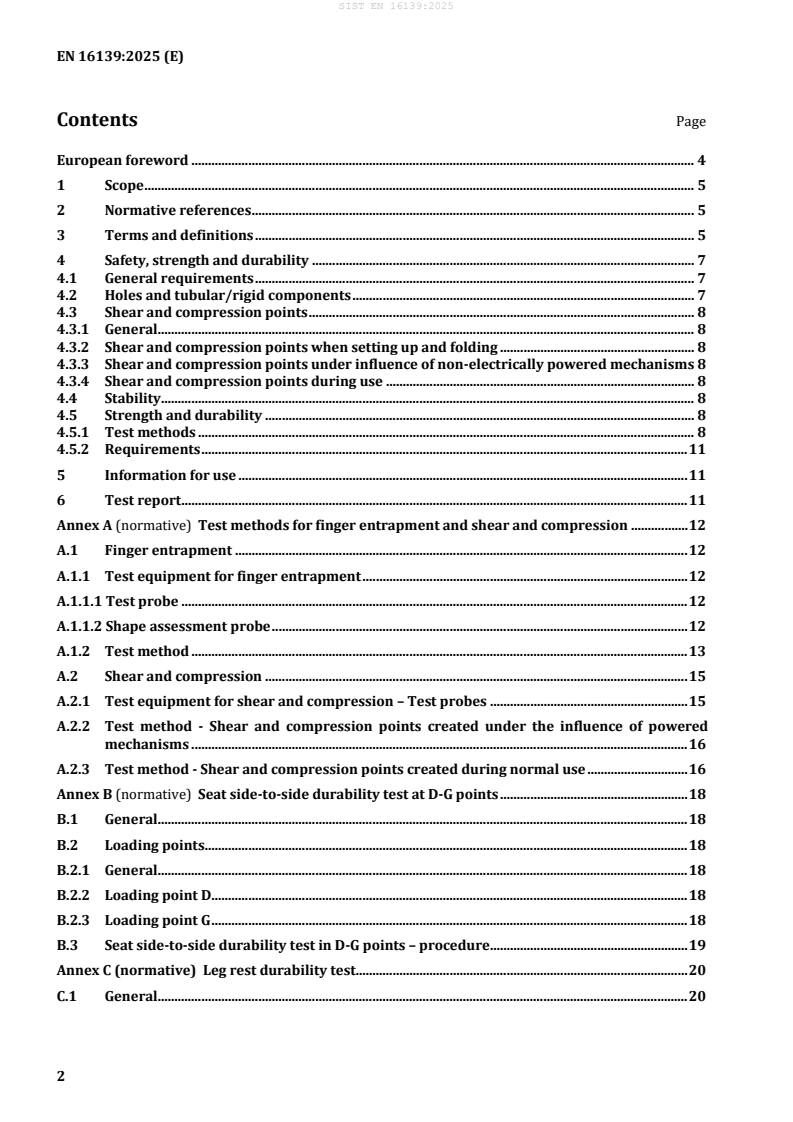
Contents Page
European foreword . 4
1 Scope . 5
2 Normative references . 5
3 Terms and definitions . 5
4 Safety, strength and durability . 7
4.1 General requirements . 7
4.2 Holes and tubular/rigid components . 7
4.3 Shear and compression points . 8
4.3.1 General. 8
4.3.2 Shear and compression points when setting up and folding . 8
4.3.3 Shear and compression points under influence of non-electrically powered mechanisms 8
4.3.4 Shear and compression points during use . 8
4.4 Stability . 8
4.5 Strength and durability . 8
4.5.1 Test methods . 8
4.5.2 Requirements . 11
5 Information for use . 11
6 Test report . 11
Annex A (normative) Test methods for finger entrapment and shear and compression . 12
A.1 Finger entrapment . 12
A.1.1 Test equipment for finger entrapment . 12
A.1.1.1 Test probe . 12
A.1.1.2 Shape assessment probe . 12
A.1.2 Test method . 13
A.2 Shear and compression . 15
A.2.1 Test equipment for shear and compression – Test probes . 15
A.2.2 Test method - Shear and compression points created under the influence of powered
mechanisms . 16
A.2.3 Test method - Shear and compression points created during normal use . 16
Annex B (normative) Seat side-to-side durability test at D-G points . 18
B.1 General. 18
B.2 Loading points . 18
B.2.1 General. 18
B.2.2 Loading point D. 18
B.2.3 Loading point G . 18
B.3 Seat side-to-side durability test in D-G points – procedure . 19
Annex C (normative) Leg rest durability test. 20
C.1 General. 20
C.2 Test method . 20
Annex D (normative) Determination of seat loading point for seating with suspended flexible
material . 23
Annex E (informative) Additional drop tests . 24
Annex F (informative) Test severity in relation to applications . 25
Annex G (informative) Recommended dimensions for non-domestic chairs . 26
Annex H (informative) Rationale for single column seating . 27
H.1 For term 3.7 Single column seating . 27
H.2 For Table 1, selection of applicability . 27
H.3 For Table 1, test 5. Arm rest sideways static load test EN 1728:2012, 6.10 . 27
H.4 For Table 1, test 10. Seat side-to-side durability test Annex . 27
H.5 For Table 1, test 14 and 15 (test not applicable for swivelling seating) . 27
H.6 For Table 1, test 16. Seat impact test EN 1728:2012, 6.24 . 28
Bibliography . 29
European foreword
This document (EN 16139:2025) has been prepared by Technical Committee CEN/TC 207 “Furniture”,
the secretariat of which is held by UNI.
This European Standard shall be given the status of a national standard, either by publication of an
identical text or by endorsement, at the latest by January 2026, and conflicting national standards shall
be withdrawn at the latest by January 2026.
Attention is drawn to the possibility that some of the elements of this document may be the subject of
patent rights. CEN shall not be held responsible for identifying any or all such patent rights.
This document will supersede EN 16139:2013.
a) introduction of definition and requirements for single column seating;
b) the order of the annexes has been changed, with the normative annexes being placed before the
informative;
c) changes to Annex C (informative) in terms of recommended dimensions;
d) introduction of “side to side” durability requirements for “single column seating” and “side to side”
test method in Annex B (normative);
e) new Annex H (informative) new rationale for “single column seating”;
f) new Annex A (normative) Test methods for finger entrapment and shear and compression;
g) removal of requirement for rolling resistance of unloaded chairs;
h) new introduction of “leg rest” static requirement;
i) new Annex C (normative) introduction of “leg rest” durability requirement with a “leg rest” test
method;
j) introduction of “backward fall test” requirement;
k) new Annex D (normative) Determination of seat loading point for seating with suspended flexible
material.
Any feedback and questions on this document should be directed to the users’ national standards body.
A complete listing of these bodies can be found on the CEN website.
According to the CEN-CENELEC Internal Regulations, the national standards organisations of the
following countries are bound to implement this European Standard: Austria, Belgium, Bulgaria, Croatia,
Cyprus, Czech Republic, Denmark, Estonia, Finland, France, Germany, Greece, Hungary, Iceland, Ireland,
Italy, Latvia, Lithuania, Luxembourg, Malta, Netherlands, Norway, Poland, Portugal, Republic of North
Macedonia, Romania, Serbia, Slovakia, Slovenia, Spain, Sweden, Switzerland, Türkiye and the United
Kingdom.
1 Scope
This document specifies requirements for the safety, strength and durability of all types of non-domestic
seating intended to be used by adults with a weight of not more than 110 kg, including office visitor chairs.
This document does not apply to ranked seating, office work chairs, chairs for educational institutions,
outdoor seating and to links for linked seating for which other European Standards exist. It does also not
apply to work chairs for industrial use.
This document does not include requirements for the durability of upholstery materials, castors, reclining
and tilting mechanisms and seat height adjustment mechanisms.
This document does not include requirements for the resistance to ageing, degradation and flammability.
This document does not include requirements for electrical safety.
Annex A (normative) contains test methods for finger entrapment and shear and compression.
Annex B (normative) contains a seat side-to-side durability test at D-G points.
Annex C (normative) contains a test method for Leg rest durability.
Annex D (normative) contains the determination of seat loading point for seating with suspended flexible
material.
Annex E (informative) contains additional drop tests.
Annex F (informative) contains information on the level of test severity in relation to applications.
Annex G (informative) contains recommended dimensions for non-domestic chairs.
Annex H (informative) contains a rationale for single column seating.
2 Normative references
The following documents are referred to in the text in such a way that some or all of their content
constitutes requirements of this document. For dated references, only the edition cited applies. For
undated references, the latest edition of the referenced document (including any amendments) applies.
EN 1022, Furniture — Seating — Determination of stability
EN 1728:2012, Furniture — Seating — Test methods for the determination of strength and durability
3 Terms and definitions
For the purposes of this document, the following terms and definitions apply.
ISO and IEC maintain terminology databases for use in standardization at the following addresses:
• IEC Electropedia: available at https://www.electropedia.org/
• ISO Online browsing platform: available at https://www.iso.org/obp
3.1
accessible part
part to which access can easily be gained by the user when the seating is in its intended configuration of
use and for which the probability of unintentional user contact is high
3.2
castors
assembly comprising a housing, one or more wheels and at least one axes
3.3
leg rest
extension of the seat area intended to support the legs of the sitter
Note 1 to entry: A leg rest may or may not be permanently attached to the seat. Some leg rests may not be
designed to support the load of the user.
3.4
footrest
component intended as an occasional support for the feet or to assist getting on and off an item of seating
Note 1 to entry: A footrest may be a part of the structure of the underframe of a chair or stool.
3.5
visitor chair
seating for one person used in the office environment additional to the office work chair
Note 1 to entry: It is used for meetings or collaborative work as well as for reading, writing, listening and waiting.
3.6
single column seating
item of seating whose upper part, which includes the seat, is mounted on a single support with a
dimension of up to 120 mm at its narrowest point
Note 1 to entry: This includes e.g. chairs with gas lifts and with or without swivel function.
3.7
median plane
vertical plane passing through the geometric centre of the seat, dividing the seat from side to side into
two equal parts
Note 1 to entry: See Figure 1.
Key
1 median plane
Figure 1 — Median plane
4 Safety, strength and durability
4.1 General requirements
The seating shall be designed so as to minimize the risk of injury to the user.
All parts of the seating with which the user comes into contact during intended use, shall be designed so
that physical injury and damage are avoided.
This requirement is met when:
a) edges and corners of the seating which are directly in contact with the user are rounded or
chamfered;
b) all other edges and corners accessible during intended use are free from burrs and/or sharp edges.
Movable and adjustable parts shall be designed so that injuries and inadvertent operation are avoided.
It shall not be possible for any load bearing part of the seating to come loose unintentionally.
For non-domestic chairs, see Annex G (Informative) that contains recommended dimensions for non-
domestic chairs.
4.2 Holes and tubular/rigid components
There shall be no holes in the ends of tubular components or holes in rigid components in accessible parts
between 8 mm and 12 mm, unless the depth of penetration is less than 10 mm. This requirement is
fulfilled if there is no hazard present when tested in accordance with A.1.
4.3 Shear and compression points
4.3.1 General
The requirements contained within 4.3.2, 4.3.3 and 4.3.4 do not apply to electrically operated furniture.
NOTE The requirements for electrically operated furniture will be provided in EN 17684 which is under
preparation.
4.3.2 Shear and compression points when setting up and folding
Unless 4.3.3 or 4.3.4 are applicable, shear and compression points that are created only during setting up
and folding are acceptable, because the user can be assumed to be in control of his/her movements and
to be able to cease applying the force immediately upon experiencing pain.
The edges of parts moving relative to each other and creating shear and compression points shall be as
specified in 4.1.
4.3.3 Shear and compression points under influence of non-electrically powered mechanisms
With the exception of operation of doors, flaps, lids and extension elements, there shall be no areas where
the distance between two accessible parts moving relative to each other can be less than 25 mm, and
more than 8 mm in any position during movement that could present a risk of injury to the user, created
by parts of the furniture operated by powered mechanisms, e.g. mechanical springs and gas lifts.
This requirement is fulfilled if there is no hazard present when tested in accordance with A.2.2.
NOTE Further guidance of the accessible parts is given in CEN/TR 17202.
4.3.4 Shear and compression points during use
With the exception of operation of doors, flaps, lids and extension elements, there shall be no areas where
the distance between two accessible parts moving relative to each other can be less than 18 mm, and
more than 8 mm in any position that could present a risk of injury to the user, created by loads applied
during normal use.
The loads used for durability tests within Table 1 are considered representative of normal use.
This requirement is fulfilled if there is no hazard present when tested in accordance with A.2.3.
4.4 Stability
The seating shall fulfil the relevant requirements of EN 1022 after having completed the relevant tests
listed in Table 1.
4.5 Strength and durability
4.5.1 Test methods
Seating shall be tested on the same sample for safety, strength and durability according to and in the
order given in Table 1 and in accordance with the test conditions contained in EN 1728:2012.
Seating with a seat and back made of one piece of flexible material suspended in the upper part of the
backrest and the front of the seat shall be tested according to Annex D. For this type of seating, only the
tests on seat shall be carried out.
The following tests described in Table 1 are considered to be relevant for safety.
Test No.: 1, 2, 4.1, 4.2, 6, 7.1, 7.2, 8, 9, 10, 11, 12, 13, 14, 15, 16.
Annex E (Informative) contains additional drop tests
The guidance for selecting level L1 or L2 with due respect for the end use of the product is given
in Annex F.
Annex H (Informative) contains a rationale for single column seating.
Table 1 — Safety, strength and durability tests
Level
Test Application Reference Test parameters
L1 L2
Seat static and EN 1728:2012,
1. All Seat: force, N 1 600 2 000
back static load 6.4
Back: force, N 560 700
a
test
(min. force, 410) (min. force, 410)
10 times
2. Seat front edge All EN 1728:2012, Force, N 1 300 1 600
a e
static load test 6.5
10 times
EN 1728:2012,
3. Vertical static load All Force, N 600 900
a b
on back 6.6
Seat load, N 1 300 1 800
10 times
4.1 Foot rest static All EN 1728:2012, Force, N 1 300 1 600
a d
load test 6.8
Minimum 750 750
seat force, N
Maximum 1600 2000
seat force, N
10 times
4.2 Leg rest static load All EN 1728:2012, Force, N 1 300 1 600
a
test 6.9
10 times
5. Arm rest sideways All EN 1728:2012, Force, N 400 900
a
static load test 6.10
10 times
6. Arm rest All EN 1728:2012, Force, N 750 900
downwards static 6.11
5 times
load test
7.1 Vertical upwards For seating EN 1728:2012, Seat force, N - 1 200
static load on arm which 6.13.1
Lift 10 times,
rests intended to
during ≥ 10 s
be moved
when
occupied
7.2 Vertical upwards Stacking EN 1728:2012, Specified load, kg Weight of 8 Weight o
...
Die Norm EN 16139:2025 stellt einen wichtigen Rahmen für die Sicherheit, Festigkeit und Dauerhaftigkeit von Mobiliar im Nichtwohnsektor dar, insbesondere für Sitzmöbel, die von Erwachsenen mit einem Gewicht von maximal 110 kg genutzt werden. Die klare Abgrenzung in der Norm, dass sie nicht für Reihenbestuhlung, Bürostühle, Sitzmöbel in Bildungseinrichtungen oder im Freien gilt, ist ein entscheidender Aspekt, der es ermöglicht, sich präzise auf die Anforderungen an Besucher- und andere nicht-wohnliche Sitzmöbel zu konzentrieren. Ein herausragendes Merkmal dieser Norm ist die umfassende Festlegung von Anforderungen und Prüfmethoden, die die Sicherheit der Benutzer gewährleisten. Die normativen Anhänge A bis D bieten spezifische Prüfmethoden, die sicherstellen, dass sowohl Fingerverklemmen als auch Scher- und Druckbelastungen umfassend getestet werden. Diese Tests tragen dazu bei, die konstruktive Integrität und Sicherheit der Möbel zu überprüfen und somit das Risiko von Verletzungen zu minimieren. Die Norm behandelt auch die Dauerhaftigkeit von Sitzmöbeln, indem sie in Annex B einen spezifischen Test für die Seitenbelastbarkeit präsentiert. Diese Prüfmethode ist besonders relevant, da sie eine realistische Bewertung der langfristigen Nutzung ermöglicht. Besonders hervorzuheben ist die informative Natur der angehängten Abschnitte, darunter Annex F, der Informationen zur Schwere der Prüfungen im Verhältnis zu den Anwendungen bereitstellt. Diese Informationen sind für Hersteller und Anwender gleichermaßen von Nutzen, da sie helfen, die Anforderungen besser zu verstehen und über die Norm hinaus eine informierte Entscheidung zu treffen. Zusammenfassend lässt sich sagen, dass die EN 16139:2025 ein essentielles Werkzeug für die Herstellung sicherer und langlebiger nicht-wohnlicher Sitzmöbel ist. Die klar definierten Prüfmethoden und die differenzierte Herangehensweise an verschiedene Aspekte der Produktsicherheit stärken die Relevanz dieser Norm im Markt der Sitzmöbel und tragen zur Sicherheit und Zufriedenheit der Endnutzer bei.
SIST EN 16139:2025は、すべてのタイプの非家庭用の座席に関する安全性、強度、耐久性の要件と試験方法を規定した重要な標準です。この文書は、大人の体重110 kgを超えない使用者によって使用されることを目的とした座席に焦点を当てています。この標準の適用範囲には、オフィスの訪問者用椅子が含まれていますが、教育機関用の椅子や工業用の作業椅子は含まれません。 この標準の強みは、非家庭用座席に特化した詳細な要件と試験方法が規定されていることです。付属文書においては、指挟みやせん断、圧縮に関する試験方法が示されており、実際の使用条件下での安全性を確保するための具体的な手法が提供されています。また、座席の耐久性に関する試験方法や、吊り下げられた柔軟素材を使用した座席の荷重ポイントの決定方法が詳述されていることで、設計や製造の際の指針としても非常に有用です。 さらに、標準には品質管理の一環として推奨される座席の寸法や、試験の厳しさに関する情報も含まれています。これにより、製品の設計段階から市場での実際の使用に対しても準備が整えられるようになっています。非家庭用座席の安全性、強度、耐久性の向上は、企業の責任でもあり、顧客の満足度につながるため、この標準の重要性は増してきています。 全体として、SIST EN 16139:2025は、非家庭用座席に関する明確かつ具体的な基準を提供することで、業界の安全性を支援し、製品の信頼性を向上させるための重要な資源です。
The EN 16139:2025 standard provides a comprehensive framework for assessing the safety, strength, and durability of non-domestic seating designed for adult use, specifically for individuals up to 110 kg. This standard distinctly covers all types of non-domestic seating, including office visitor chairs, and outlines the critical requirements to ensure user safety and furniture longevity. The scope is targeted, yet extensive enough to encompass various seating applications outside the domestic environment. One of the main strengths of EN 16139:2025 lies in its emphasis on safety through well-defined test methods. The normative annexes contain detailed procedures for testing specific attributes, such as finger entrapment, shear and compression, and seat durability. These methods ensure that manufacturers adhere to rigorous safety protocols, thereby minimizing risk for end-users. Moreover, the inclusion of durability tests for seat-side-to-side movement and leg rest functionality further enhances the standard's applicability to real-world scenarios. Another significant aspect is the exclusion of certain elements that, while important, may fall under other standards. By explicitly stating that it does not cover ranked seating, office work chairs, educational seating, outdoor seating, or industrial work chairs, the EN 16139:2025 avoids confusion and ensures clarity regarding its intended use. This clarity is vital for compliance and regulatory purposes, allowing manufacturers to identify the appropriate standards relevant to their specific products. Furthermore, the informative annexes, such as those addressing test severity and recommended dimensions, add significant value. These resources provide additional context for manufacturers and users alike, promoting a better understanding of the intended performance and ergonomic considerations associated with non-domestic seating solutions. Overall, the EN 16139:2025 standard stands out for its focused approach to non-domestic seating safety, strength, and durability, making it highly relevant in the design and manufacturing processes of commercial furniture. Its robust testing methodologies and clear delineations of scope reinforce its utility in fostering consumer confidence in non-domestic seating products.
La norme EN 16139:2025, intitulée "Mobilier - Sécurité, résistance et durabilité - Exigences et méthodes d'essai pour les sièges non domestiques", établit un cadre clair et précis concernant les exigences de sécurité, de résistance et de durabilité pour les sièges non domestiques destinés à un usage par des adultes pesant jusqu'à 110 kg. Cette norme se distingue par son application ciblée, incluant notamment les chaises de visiteurs de bureau, tout en excluant des catégories spécifiques comme le mobilier de travail, les sièges extérieurs ou les sièges pour établissements éducatifs, garantissant ainsi une pertinence accrue pour son domaine d’application. Parmi ses points forts, la norme propose des annexes normatives, telles que l'Annexe A, qui définit des méthodes d’essai pour prévenir l’enchevêtrement des doigts ainsi que pour tester la résistance à la traction et à la compression. De plus, l'Annexe B fournit un test de durabilité de côté à côté pour les sièges, tandis que l'Annexe C est dédiée à la durabilité des repose-jambes, assurant ainsi une évaluation exhaustive des différents aspects de la résistance des sièges. L’ajout d’informations complémentaires dans les annexes informatives, comme celles relatives aux tests de chute (Annexe E) et aux dimensions recommandées pour les chaises non domestiques (Annexe G), démontre une approche pratique et appliquée à la conception et à la fabrication de sièges. La norme se révèle extrêmement pertinente dans le contexte actuel où la sécurité et le confort en milieu professionnel sont primordiaux. En garantissant des critères spécifiques qui ne s'appliquent pas à d'autres types de sièges, EN 16139:2025 se positionne comme une référence essentielle pour les fabricants et les fournisseurs de mobilier non domestique. Cela facilite également les échanges homogènes au sein de l'Union Européenne, en offrant des repères clairs pour la conformité et la sécurité des produits commercialisés. En conclusion, la norme EN 16139:2025 se révèle être un document fondamental pour les acteurs du secteur du mobilier, fournissant des critères de sécurité rigoureux et pertinents tout en abordant les aspects de durabilité et de résistance nécessaires pour les environnements professionnels.
SIST EN 16139:2025는 비주거용 좌석의 안전성, 강도 및 내구성에 대한 요구 사항 및 시험 방법을 규정하는 문서입니다. 이 표준은 성인에게 사용될 목적으로 설계된 모든 유형의 비주거용 좌석에 대해 적용되며, 특히 110kg 이하의 체중을 가진 사용자를 고려하고 있습니다. 사무실 방문자 의자를 포함한 이 표준의 범위는 비주거용 좌석의 품질을 확보하는 데 중요한 역할을 합니다. 이 표준의 강점 중 하나는 다양한 시험 방법을 제공하여 안전성과 내구성을 객관적으로 평가할 수 있도록 한다는 점입니다. 부록 A, B, C 및 D에서는 각각 손가락 끼임, 전단 및 압축, 좌석의 내구성, 그리고 서스펜디드 플렉서블 소재의 좌석 하중 지점을 결정하는 시험 방법을 상세히 규정하고 있습니다. 이는 제조사들이 비주거용 좌석의 안정성과 사용자 안전을 보장하는 데 필수적인 정보를 제공합니다. 선정된 다른 유럽 표준이 존재하는 경우를 제외하고, 이 표준은 사무실 작업 의자, 교육 기관용 의자, 야외 좌석 및 연결된 의자에 적용되지 않습니다. 이는 특정 종류의 좌석에 대한 명확한 경계를 설정하며, 비주거용 좌석의 요구 사항을 더욱 세분화합니다. 또한, 표준은 산업 사용을 위한 작업 의자에는 적용되지 않도록 하여, 사용자의 실제 요구에 맞춘 맞춤형 안전 기준을 설정하고 있습니다. 이 문서는 내구성, 휘발성 및 노화 저항성, 전기 안전에 대한 요구 사항을 포함하지 않지만, 이는 특정 목적에 맞추어 비주거용 좌석의 핵심 특성에 집중할 수 있는 기회를 제공합니다. 이로 인해 제조업체는 특정 사용 용도에 적합한 제품을 개발할 수 있으며, 소비자는 신뢰할 수 있는 품질의 좌석을 선택할 수 있게 됩니다. 마지막으로, 부록 E, F, G 및 H에서는 추가적인 드롭 테스트, 테스트 강도의 수준, 비주거용 의자의 권장 치수 및 단일 기둥 좌석에 대한 이유를 포함하여, 사용자와 제조사에게 유용한 정보와 가이드를 제공합니다. SIST EN 16139:2025는 비주거용 좌석의 안전성, 강도 및 내구성을 위한 강력한 기준을 제공하며, 이는 전반적인 사용자 경험을 향상시키고, 다양한 산업 및 비즈니스 환경에서 중요한 역할을 합니다.
Questions, Comments and Discussion
Ask us and Technical Secretary will try to provide an answer. You can facilitate discussion about the standard in here.
Loading comments...