

FprEN 12944-1
(Main)Fertilizers, liming materials and inhibitors - Vocabulary - Part 1: General terms
- Abstract
This document defines the general terms used in the production, sampling and marketing of fertilizers, liming materials and inhibitors.
- Status
- Not Published
- Publication Date
- 09-Feb-2027
- Technical Committee
- CEN/TC 260 - Fertilizers and liming materials
- Drafting Committee
- CEN/TC 260/WG 1 - Sampling
- Current Stage
- 5060 - Closure of Vote - Formal Approval
- Start Date
- 19-Nov-2026
- Due Date
- 18-Nov-2026
- Completion Date
- 18-Nov-2026

FprEN 12944-1 is a draft European Standard from CEN for the vocabulary of fertilizers, liming materials and inhibitors. It defines the general terms used in production, sampling and marketing so manufacturers, laboratories, inspectors and buyers can use the same language. The document is submitted for enquiry and is subject to change.
What does FprEN 12944-1 specify?
FprEN 12944-1 specifies the general terms used in the production, sampling and marketing of fertilizers, liming materials and inhibitors. It is a terminology document, so its main job is to fix meanings and preferred terms rather than to set product performance limits.
The document is organized into Clause 1 Scope, Clause 2 Normative references, and Clause 3 Terms and definitions. Clause 3 is split into seven topic groups, covering general terms, fertilization, types of fertilizers, nutrients, additions to fertilizers, physical properties, and sampling, storing and delivery. Annex A provides an index, and the bibliography lists related standards and documents.
What are the key requirements of FprEN 12944-1?
FprEN 12944-1 standardizes how the fertilizer sector names products, nutrient content, product forms and sampling steps. In practice, that helps labels, technical files, contracts and test reports use the same terminology.
Core product and label terms
Clause 3.1 defines the central business terms, including fertilizing product, fertilizer unit, nutrient formula, declarable content, declaration, nutrient ratio, guarantee and liming material. These terms matter because they are the basis for describing what a product is, what it contains and what can be stated on a label or document.
The document also distinguishes between a general fertilizer and a fertilizing product, and it gives a preferred term for liming material. For a reader, this reduces ambiguity in product descriptions and avoids mixing technical language with marketing language.
Fertilization and nutrient behavior
Clause 3.2 defines fertilization, application, application rate, availability, soil fertility, solubility of a fertilizer nutrient and mineralization. These terms support decisions on how a product is used, how much is applied, and how its nutrients become available to plants or mushrooms.
That matters in practice for field instructions, trial work and product comparisons. If two products are compared, these definitions help separate how they are used from how fast their nutrients can be taken up.
Fertilizer types and additives
Clause 3.3 sets out the main product classes, including inorganic fertilizer, organic fertilizer, organo-mineral fertilizer, mineral fertilizer, straight fertilizer, compound fertilizer, complex fertilizer, chelated fertilizer, blended fertilizer, foliar fertilizer, slow-release fertilizer, controlled-release fertilizer and nitrophosphate fertilizer. It also defines additive, filler, inhibitor, urease inhibitor, nitrification inhibitor and denitrification inhibitor.
These distinctions matter because the same product family can behave very differently in use and in declaration. For example, the document separates release-control mechanisms from nutrient content and identifies inhibitor types by their effect on nitrogen transformations.
Nutrient naming
Clause 3.4 defines plant nutrient, primary nutrient, secondary nutrient, macronutrient, micronutrient and non-nutrient element. The practical value is that the standard fixes what counts as a nutrient category and what does not, which supports labeling, product comparison and specification writing.
Physical form and sampling chain
Clause 3.6 defines solid form, liquid form, physical unit, granular fertilizer, granulation, prilled fertilizer, pelletized fertilizer, liquid fertilizer, solution fertilizer, suspension fertilizer, powdered fertilizer, coated fertilizer, particle size and particle size analysis by sieving. Clause 3.7 defines the sampling and delivery chain, including batch, sampling point, sampling unit, incremental sample, combined sample, reduced sample, final sample, laboratory sample, test sample, test portion, bulk, bulk material, bulk blend, packaging, package, big bag, consignment and delivery.
These terms are important because sampling only works when everyone agrees what was taken, from where, and at what stage of reduction. That affects laboratory accuracy, traceability and dispute resolution.
What terms does FprEN 12944-1 define?
- fertilizing product - a substance, mixture, micro-organism or other material applied to plants, their rhizosphere, mushrooms or their mycosphere to provide nutrients or improve nutrition efficiency.
- liming material - a mineral substance or mixture used mainly to correct soil acidity and improve soil properties, containing calcium and/or magnesium compounds.
- nutrient formula - the declared mass fraction pattern for nutrients in a compound fertilizer, expressed in a defined order.
- controlled-release fertilizer - a fertilizer designed so nutrient release follows a stated release rate and release time at a specified temperature.
- batch - the total quantity of product assumed to have the same characteristics and produced under the same conditions.
- combined sample - the aggregate of all incremental samples taken from one sampled portion.
- laboratory sample - the final sample intended for laboratory testing, or, for microbiological testing, each separate segment sample intended for laboratory testing.
Who uses FprEN 12944-1?
FprEN 12944-1 is used by fertilizer and liming material manufacturers when writing product descriptions, labels and technical documentation. It is also used by laboratories and sampling teams when preparing samples for chemical, physical or microbiological testing.
Quality managers, regulatory teams and buyers use the document to align specifications, declarations and contracts. It is relevant across the fertilizer supply chain, including products sold in bulk, packages and big bags.
What changed in FprEN 12944-1 from the previous edition?
The foreword says this draft will supersede EN 12944-1:1999 and EN 12944-1:1999/AC:2000. It also states that, compared with the previous edition:
- the scope was extended to include inhibitors;
- the definitions were reviewed, amended and extended in light of new legislation and other European and international standards;
- new terms were added for fertilizing products, nutrient formulas, liming materials, fertilizer types, chelating and complexing agents, blends, release-control products, nutrient classes, inhibitors, physical forms, particle size analysis, sampling stages, bulk and packaging terms;
- the term soil improver was deleted.
Which standards are used with FprEN 12944-1?
FprEN 12944-1 has no normative references in Clause 2, but it is written alongside several related standards named in the foreword, introduction and bibliography.
| Standard | What it contributes |
|---|---|
| EN 12944-3 | Vocabulary for terms relating to liming materials |
| EN 1482-1 | General sampling provisions for fertilizers, liming materials and inhibitors |
| EN 1482-3 | Sampling of static heaps |
| EN 1482-4 | Sampling for microbial presence |
| EN 17836 | Description of the forms of the physical unit |
| ISO 8157 | Broader fertilizer, soil conditioner and beneficial substance vocabulary |
| EN 13535 | Classification of fertilizers and liming materials |
| CEN/TS 17732 | Vocabulary for soil improvers and growing media |
| EN 17724 | Vocabulary for plant biostimulants |
What does the FprEN 12944-1 document contain?
The document contains a structured vocabulary set covering general terms, fertilization, fertilizer types, nutrients, additives, physical forms, and sampling, storing and delivery. Annex A, Table A.1 gives an index of all defined terms in English, French and German, with clause references for fast lookup.
The bibliography links the vocabulary to classification, sampling, physical-form description and related terminology standards. In practice, that makes the document useful for drafting specifications, lab methods, sampling plans, labels and delivery documents without changing the meanings of the terms.
Relations
- Revises
EN 12944-1:1999/AC:2000 - Fertilizers and liming materials - Vocabulary - Part 1: General terms - Effective Date
- 25-Jun-2025
- Effective Date
- 18-Jan-2023
Frequently Asked Questions
FprEN 12944-1 is a draft published by the European Committee for Standardization (CEN). Its full title is "Fertilizers, liming materials and inhibitors - Vocabulary - Part 1: General terms". This standard covers: This document defines the general terms used in the production, sampling and marketing of fertilizers, liming materials and inhibitors.
This document defines the general terms used in the production, sampling and marketing of fertilizers, liming materials and inhibitors.
FprEN 12944-1 is classified under the following ICS (International Classification for Standards) categories: 01.040.65 - Agriculture (Vocabularies). The ICS classification helps identify the subject area and facilitates finding related standards.
FprEN 12944-1 has the following relationships with other standards: It is inter standard links to EN 12944-1:1999/AC:2000, EN 12944-1:1999. Understanding these relationships helps ensure you are using the most current and applicable version of the standard.
FprEN 12944-1 is associated with the following European legislation: EU Directives/Regulations: 2019/1009. When a standard is cited in the Official Journal of the European Union, products manufactured in conformity with it benefit from a presumption of conformity with the essential requirements of the corresponding EU directive or regulation.
FprEN 12944-1 is available in PDF format for immediate download after purchase. The document can be added to your cart and obtained through the secure checkout process. Digital delivery ensures instant access to the complete standard document.
Standards Content (Sample)
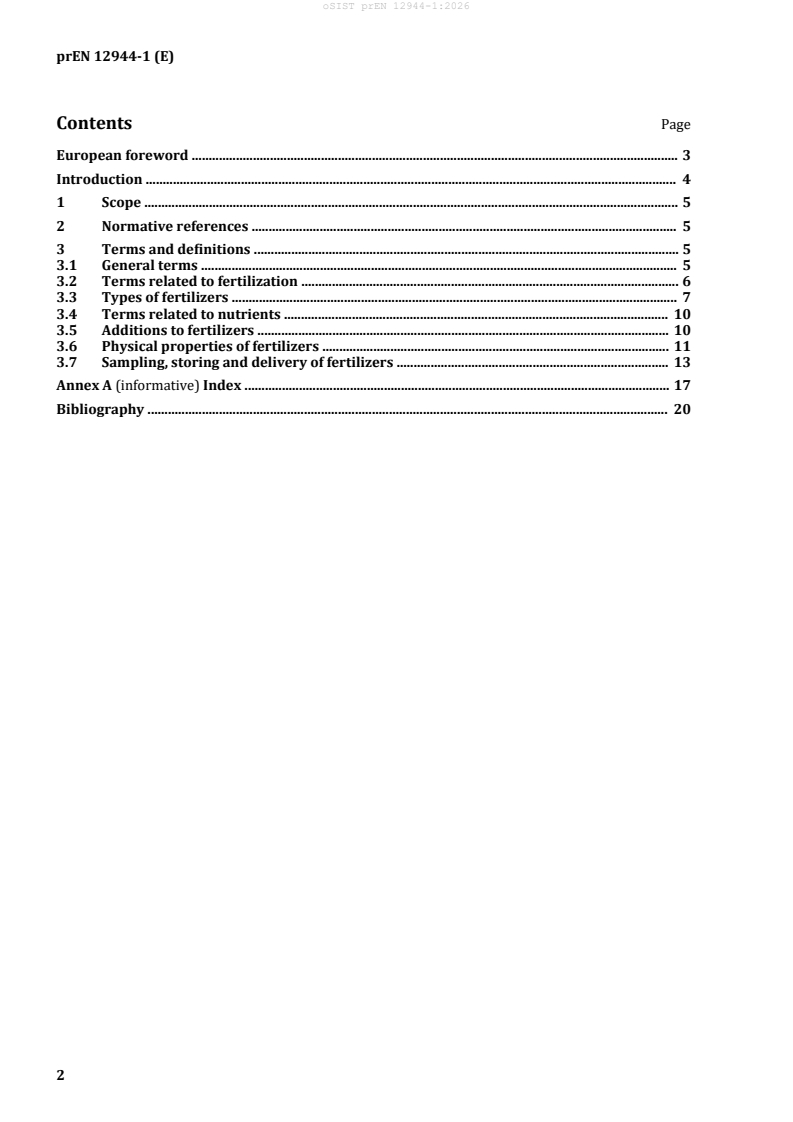
Contents
- Introduction
- 1 Scope
- 2 Normative references
- 3 Terms and definitions
- 3.1 General terms
- 3.1.1 fertilizer
- 3.1.2 fertilizing product
- 3.1.3 fertilizer unit
- 3.1.4 nutrient formula
- 3.1.5 declarable content
- 3.1.6 declaration
- 3.1.7 nutrient ratio
- 3.1.8 guarantee
- 3.1.9 liming material
- 3.2 Terms related to fertilization
- 3.2.1 fertilization
- 3.2.2 application
- 3.2.3 application rate
- 3.2.4 availability
- 3.2.5 soil fertility
- 3.2.6 solubility of a fertilizer nutrient
- 3.2.7 mineralization
- 3.3 Types of fertilizers
- 3.3.1 inorganic fertilizer
- 3.3.2 inorganic macronutrient fertilizer
- 3.3.3 organic fertilizer
- 3.3.3.1 organic nitrogenous fertilizer
- 3.3.3.2 synthetic organic nitrogenous fertilizer
- 3.3.4 organo-mineral fertilizer
- 3.3.5 mineral fertilizer
- 3.3.6 straight fertilizer
- 3.3.7 compound fertilizer
- 3.3.8 complex fertilizer
- 3.3.9 chelated fertilizer
- 3.3.10 chelating agent
- 3.3.11 complexing agent
- 3.3.12 fertilizing product blend
- 3.3.13 blended fertilizer
- 3.3.14 intermediate product
- 3.3.15 foliar fertilizer
- 3.3.16 slow-release fertilizer
- 3.3.17 controlled-release fertilizer
- 3.3.18 nitrophosphate fertilizer
- 3.4 Terms related to nutrients
- 3.4.1 plant nutrient
- 3.4.2 primary nutrient
- 3.4.3 secondary nutrient
- 3.4.4 macronutrient
- 3.4.5 micronutrient
- 3.4.6 non-nutrient element
- 3.5 Additions to fertilizers
- 3.5.1 additive
- 3.5.2 filler
- 3.5.3 inhibitor
- 3.5.4 urease inhibitor
- 3.5.5 nitrification inhibitor
- 3.5.6 denitrification inhibitor
- 3.6 Physical properties of fertilizers
- 3.6.1 solid form
- 3.6.2 liquid form
- 3.6.3 physical unit
- 3.6.4 granular fertilizer
- 3.6.5 granulation
- 3.6.6 prilled fertilizer
- 3.6.7 pelletized fertilizer
- 3.6.8 liquid fertilizer
- 3.6.9 solution fertilizer
- 3.6.10 suspension fertilizer
- 3.6.11 powdered fertilizer
- 3.6.12 coated fertilizer
- 3.6.13 particle size
- 3.6.14 particle size analysis by sieving
- 3.7 Sampling, storing and delivery of fertilizers
- 3.7.1 batch
- 3.7.2 sampling point
- 3.7.3 sampling unit
- 3.7.4 sub-sample
- 3.7.5 division
- 3.7.6 reduction
- 3.7.7 segment
Introduction
Fertilizers, liming materials and inhibitors are définéd in Regulation (EU) 2019/1009 [2]. Other vocabulary standards relating to soil improvers and growing media (CEN/TS 17732 [3]) and plant biostimulants (EN 17724 [4]) are available.
An index of all terms définéd in this part of the EN 12944 series is given in Annex A, Table A.1 in English, French and German.
oSIST prEN 12944-1:2026 prEN 12944-1 (E)
1 Scope
This document définés the general terms used in the production, sampling and marketing of fertilizers, liming materials and inhibitors.
2 Normative references
There are no normative references in this document.
3 Terms and definitions
For the purposes of this document, the following terms and définitiöns apply. ISO and IEC maintain terminology databases for use in standardization at the following addresses:
- ISO Online browsing platform: available at http://www.iso.org/obp
- IEC Electropedia: available at http://www.electropedia.org/
3.1 General terms
3.1.1 fertilizer
product the main function of which is to provide nutrients to plants or mushrooms Note 1 to entry: Based on Regulation (EU) 2019/1009, Annex I, Part II, PFC 1 [2].
3.1.2 fertilizing product
substance, mixture, micro-organism or any other material, applied or intended to be applied on plants or their rhizosphere or on mushrooms or their mycosphere, or intended to constitute the rhizosphere or mycosphere, either on its own or mixed with other material, for the purpose of providing the plants or mushrooms with nutrient or improving their nutrition éfficiéncy Note 1 to entry: Based on Regulation (EU) 2019/1009, Chapter 1, Article 2, point (1) [2].
3.1.3 fertilizer unit
unit mass of a fertilizer nutrient expressed in the form of the element or an oxide Note 1 to entry: The unit is generally the kilogram.
3.1.4 nutrient formula
mass fraction expressed as a percentage as element or oxide, in the order nitrogen: phosphorus:
potassium: secondary nutrients and micro-nutrients, of the respective content of these nutrients in a compound fertilizer Note 1 to entry: A zero may be used to indicate the absence of an element. [SOURCE: ISO 8157:2022 [5], 3.1.37 - mödifiéd: "primary" from "primary nutrient formula" removed and définitiön replaced with Note 1]
3.1.5 declarable content
that content of an element (or an oxide) which can be declared on a label or document associated with a fertilizing product [SOURCE: ISO 8157:2022 [5], 3.1.38 – mödifiéd: given changed to declared]
oSIST prEN 12944-1:2026 prEN 12944-1 (E)
3.1.6 declaration
statement of the nutrient content or other information [SOURCE: ISO 8157:2022 [5], 3.1.39]
3.1.7 nutrient ratio
ratio by mass of the primary nutrients in the fertilizer, expressed in the form of the element or an oxide, in the order of nitrogen, phosphorus and potassium Note 1 to entry: The ratio can be based on nitrogen as unity or on the nutrient with the lowest proportion. [SOURCE: ISO 8157:2022 [5], 3.1.43]
3.1.8 guarantee
guarantee of composition quantitative and/or qualitative characteristics with which a marketed product complies to satisfy contractual and/or legal requirements
3.1.9 liming material
agricultural lime mineral substances and mixtures whose main function is to correct soil acidity improving physical, chemical and biological soil properties and which contains either oxides, hydroxides, carbonates, or silicates of the nutrients calcium and/or magnesium Note 1 to entry: The terms “lime” and “liming soil amendment” are also used, but “liming material” is the preferred term.
[SOURCE: EN 12944-3:2025 [6], 3.1.20]
3.2 Terms related to fertilization
3.2.1 fertilization
aspects of the use of fertilizing products to improve crop growth and soil fertility and structure [SOURCE: ISO 8157:2022 [5], 3.1.29 – mödifiéd: Note 1 to entry removed]
3.2.2 application
general term for all processes of administering fertilizers, liming materials and inhibitors to a crop or soil or both Note 1 to entry: This term embraces broadcasting, spreading/spraying or dusting, as well as more spécific placement methods including injection into the soil and the combined drilling of seed and fertilizer. It may be broadened to cover nutrient film techniques (foliar application) and the addition of fertilizers to irrigation water (fertigation).
3.2.3 application rate
dose rate mass or volume of a fertilizer, liming material, inhibitor or nutrient applied to a unit area or the unit mass or unit volume of growth medium
oSIST prEN 12944-1:2026 prEN 12944-1 (E)
3.2.4 availability
extent to which fertilizer nutrients can be taken up by plants and mushrooms [SOURCE: ISO 8157:2022 [5], 3.1.61 – mödifiéd: mushrooms added]
3.2.5 soil fertility
ability of a soil to support and ensure plant growth [SOURCE: ISO 8157:2022 [5], 3.1.28]
3.2.6 solubility of a fertilizer nutrient
mass or volume of a given nutrient which is extracted by a spécific medium under spécifiéd conditions Note 1 to entry: Expressed as a percentage by mass or volume of the fertilizer. [SOURCE: ISO 8157:2022 [5], 3.1.33]
3.2.7 mineralization
microbial breakdown releasing nutrients from organic matter, making them available to plants and mushrooms for uptake
3.3 Types of fertilizers
3.3.1 inorganic fertilizer
fertilizer containing or releasing nutrients in a mineral form, other than an organic or organo-mineral fertilizer Note 1 to entry: The terms “mineral fertilizer” and “chemical fertilizer” are also used but “inorganic fertilizer” is preferred.
Note 2 to entry: An inorganic fertilizer can be labelled as mineral fertilizer if the inorganic fertilizer complies with Regulation (EU) 2019/1009, Annex III, Part II, PFC 1, point 4 [2]. Note 3 to entry: Based on Regulation (EU) 2019/1009, Annex I, Part II, PFC 1(C), point 1 [2].
3.3.2 inorganic macronutrient fertilizer
fertilizer aiming at providing plants or mushrooms with one or more primary macronutrients and/or secondary macronutrients Note 1 to entry: Primary macronutrients: nitrogen (N), phosphorus (P), potassium (K); secondary macronutrients:
calcium (Ca), magnesium (Mg), sodium (Na), sulphur (S).
Note 2 to entry: Based on Regulation (EU) 2019/1009, Annex I, Part II, PFC 1(C)(I) point 1 [2] [SOURCE: EN 17836:2024 [7], 3.5]
oSIST prEN 12944-1:2026 prEN 12944-1 (E)
3.3.3 organic fertilizer
fertilizer containing organic carbon and nutrients of solely biological origin Note 1 to entry: An organic fertilizer may contain peat, leonardite and lignite, but no other material, which is fossilized or embedded in geological formations.
Note 2 to entry: Based on Regulation (EU) 2019/1009, Annex I, Part II, PFC 1(A), point 1 [2].
3.3.3.1 organic nitrogenous fertilizer
organic fertilizer of biological origin in which the declarable nitrogen content is bonded directly to carbon and which can contain other elements, but which does not have a declarable phosphorus or potassium content [SOURCE: ISO 8157:2022 [5], 3.1.7 – mödifiéd: materials changed to organic fertilizer]
3.3.3.2 synthetic organic nitrogenous fertilizer
nitrogenous fertilizer in which the nitrogen is combined with carbon by industrial organic synthesis
3.3.4 organo-mineral fertilizer
fertilizer, which is a co-formulation of one or more inorganic fertilizer (3.3.1), and one or more materials containing organic carbon and nutrients of solely biological origin Note 1 to entry: An organo-mineral fertilizer may contain peat, leonardite and lignite, but no other material, which is fossilized or embedded in geological formations.
Note 2 to entry: Based on Regulation (EU) 2019/1009, Annex I, Part II, PFC 1(B), point 1 [2].
3.3.5 mineral fertilizer
inorganic fertilizer containing not more than 1 % by mass of organic carbon Note 1 to entry: This définitiön does not depict all legal requirements and is based on Regulation (EU) 2019/1009, Annex III, Part II, PFC 1, point 4 [2].
3.3.6 straight fertilizer
macronutrient fertilizer having a declared content of more than one primary macronutrient or more than one secondary macronutrient and no primary macronutrient or an inorganic micronutrient fertilizer having a declared content of more than one micronutrient Note 1 to entry: Based on Regulation (EU) 2019/1009, Annex I, Part II: PFC 1(C)(I)(a)(ii), point 1; PFC (C)(I)(b) (ii), point 1 and PFC 1(C)(II)(b), point 1 [2].
3.3.7 compound fertilizer
macronutrient fertilizer having a declared content of more than one primary macronutrient or more than one secondary macronutrient and no primary macronutrient or an inorganic micronutrient fertilizer having a declared content of more than one micronutrient Note 1 to entry: Based on Regulation (EU) 2019/1009, Annex I, Part II: PFC 1(C)(I)(a)(ii), point 1; PFC (C)(I)(b) (ii), point 1 and PFC 1(C)(II)(b), point 1 [2].
3.3.8 complex fertilizer
solid inorganic macronutrient fertilizer in which each physical unit contains all the declared nutrients in their declared content Note 1 to entry: Based on Regulation (EU) 2019/1009, Annex III, Part II, PFC 1(C)(I)(a)(ii), point 1 [2].
oSIST prEN 12944-1:2026 prEN 12944-1 (E)
3.3.9 chelated fertilizer
fertilizer in which one or more nutrients are bonded by chelating agents [SOURCE: ISO 8157:2022 [5], 3.1.27]
...