

FprEN 12944-2
(Main)Fertilizers, liming materials and inhibitors - Vocabulary - Part 2: Terms relating to fertilizers
- Abstract
This document defines terms relating to fertilizers.
- Status
- Not Published
- Publication Date
- 09-Feb-2027
- Technical Committee
- CEN/TC 260 - Fertilizers and liming materials
- Drafting Committee
- CEN/TC 260/WG 1 - Sampling
- Current Stage
- 5060 - Closure of Vote - Formal Approval
- Start Date
- 19-Nov-2026
- Due Date
- 18-Nov-2026
- Completion Date
- 18-Nov-2026

FprEN 12944-2 is a CEN draft European Standard that defines terms relating to fertilizers. It gives a common vocabulary for fertilizer products, nutrient forms, physical properties and safety-related concepts so that specifications, labels, test reports and product discussions use the same language.
What does FprEN 12944-2 specify?
FprEN 12944-2 specifies vocabulary for fertilizers only. It is part 2 of the EN 12944 series, which the foreword says also includes general terms and terms for liming materials.
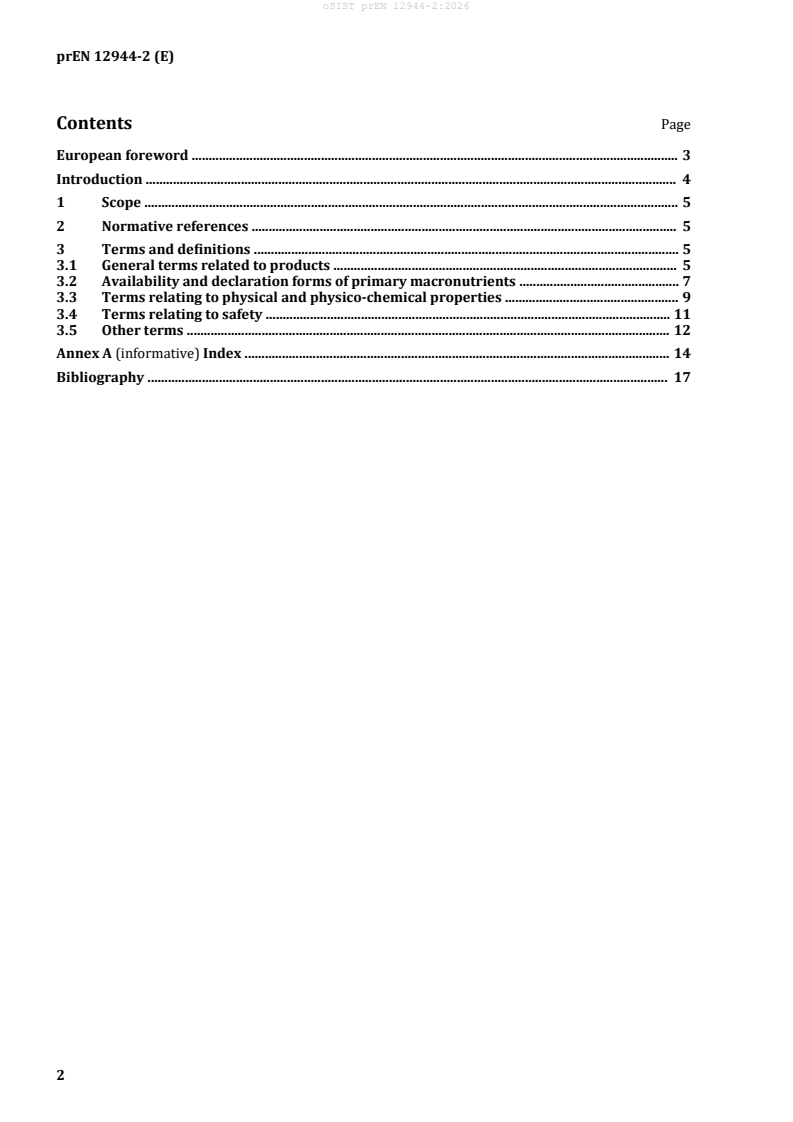
The document is organized as follows:
| Part of the document | What it contains |
|---|---|
| Clause 1 | Scope |
| Clause 2 | Normative references |
| Clause 3 | Terms and definitions, grouped into five subject areas |
| Annex A | Informative index of all terms in English, French and German |
| Bibliography | Related standards and regulation cited in the document |
Clause 3 is arranged by topic:
- general terms related to products
- availability and declaration forms of primary macronutrients
- physical and physico-chemical properties
- safety
- other terms
What are the key requirements of FprEN 12944-2?
FprEN 12944-2 is a terminology standard, so its main technical content is the set of defined terms and the way they are grouped. In practice, the standard tells users which words to use when describing fertilizer composition, performance, handling and safety.
Product and source terms
Clause 3.1 defines names for fertilizer materials such as basic slag, dried blood, bone meal, manure, slurry, urea formaldehyde, methylene urea, isobutylidene diurea, crotonylidene diurea and triazone. These definitions matter when writing product descriptions or comparing ingredients, because the terms distinguish origin, processing route and slow-release chemistry.
Nutrient declaration terms
Clause 3.2 defines the main nitrogen, phosphorus and potassium forms used in fertilizer declarations, including total nitrogen, ammoniacal nitrogen, nitric nitrogen, ureic nitrogen, cyanamide nitrogen, total phosphorus, water-soluble phosphorus, neutral ammonium citrate soluble phosphorus, formic acid soluble phosphorus, total potassium and water-soluble potassium. It also defines cold and hot water soluble or insoluble nitrogen fractions, which are used for urea formaldehyde and methylene urea products. This helps users state exactly which nutrient fraction is being measured or reported.
Physical and physico-chemical properties
Clause 3.3 defines properties such as density, loose and tapped bulk density, sieving, undersize, oversize, crushing strength, caking, anti-caking agent, saturation temperature, gel strength, pourability, sedimentation, flow rate, free flowing, segregation, sphericity, porosity, disintegrable rate and salt out temperature. These terms matter in storage, transport, packaging and quality control because they describe how a fertilizer behaves as a solid or liquid.
Safety-related terms
Clause 3.4 defines resistance to detonation, oxidizing solid, oxidizing liquid, GHS label, seedling emergence and growth, and self-sustaining decomposition. These terms are used when assessing hazard, labelling a product, or checking how a fertilizer may behave in use or under test conditions.
Other performance terms
Clause 3.5 defines free acidity, neutralizing value, vegetative vigour, moisture, essential water, water of crystallisation, water of constitution and longevity. These definitions support product characterization, especially where release behavior, acid-base effect or plant response are part of the specification.
What terms does FprEN 12944-2 define?
FprEN 12944-2 defines a shared vocabulary for fertilizer chemistry, physical behavior and safety.
- CWIN - cold water-insoluble nitrogen, the nitrogen fraction that does not dissolve under the stated cold conditions.
- HWSN only - the part of nitrogen soluble at hot conditions but not at cold conditions, used for slow-release fertilizer characterisation.
- GHS label - the hazard information label used on the immediate container or outer packaging of a hazardous product.
- Resistance to detonation - the ability of certain ammonium nitrate fertilizers to avoid detonation under the specified test circumstances.
- Neutralizing value - a measure of the lime-equivalent effect of a product, expressed against calcium oxide or an equivalent unit.
- Water of crystallisation - essential water held in a stable solid hydrate.
- Longevity - the period over which slowly available nutrients are released to plants.
Who uses FprEN 12944-2?
FprEN 12944-2 is used by fertilizer manufacturers, formulators, laboratories, quality managers, buyers, regulators and specification writers. It helps them describe materials consistently, interpret declarations correctly and communicate about physical or safety properties without ambiguity.
It is especially useful when:
- preparing product specifications and technical data sheets
- checking nutrient declarations and analytical reports
- describing granule behavior, flow, caking or density
- drafting safety and hazard communication for fertilizers
- comparing products that use slow-release nitrogen chemistry
What changed in FprEN 12944-2 from the previous edition?
FprEN 12944-2 replaces EN 12944-2:1999 and EN 12944-2:1999/AC:2000. The foreword says the definitions were reviewed, amended and extended in light of new legislation and other European and international standards.
The stated changes include:
- added terms for slow-release nitrogen products and nutrient fractions
- added terms for physical properties and safety, including density, disintegrable rate, salt out temperature, resistance to detonation, oxidizing solid, oxidizing liquid, GHS label, seedling emergence and growth, self-sustaining decomposition, free acidity, neutralizing value, vegetative vigour, essential water, water of crystallisation, water of constitution and longevity
- moved particle size analysis by sieving/granulometry by sieving to prEN 12944-1 rev
- deleted apparent density
Which standards are used with FprEN 12944-2?
Clause 2 lists no normative references. The document is used together with related texts named in the foreword, introduction and bibliography:
- EN 12944-1 - general terms in the same vocabulary series
- EN 12944-3:2025 - terms relating to liming materials
- EN 13535 - classification of fertilizers and liming materials
- Regulation (EU) 2019/1009 - EU fertilising product rules
- ISO 8157:2022 - source vocabulary for many of the definitions used here
What does the FprEN 12944-2 document contain?
FprEN 12944-2 contains a structured list of definitions, with notes and source attributions for many entries. The body is grouped by topic so users can find terms for product types, nutrient fractions, physical behavior, safety and other properties quickly.
Annex A is an informative index in English, French and German, which helps users locate each defined term by language. The bibliography points to the companion parts of EN 12944 and to external references that influenced the wording.
Relations
- Effective Date
- 25-Jun-2025
- Effective Date
- 18-Jan-2023
Frequently Asked Questions
FprEN 12944-2 is a draft published by the European Committee for Standardization (CEN). Its full title is "Fertilizers, liming materials and inhibitors - Vocabulary - Part 2: Terms relating to fertilizers". This standard covers: This document defines terms relating to fertilizers.
This document defines terms relating to fertilizers.
FprEN 12944-2 is classified under the following ICS (International Classification for Standards) categories: 01.040.65 - Agriculture (Vocabularies). The ICS classification helps identify the subject area and facilitates finding related standards.
FprEN 12944-2 has the following relationships with other standards: It is inter standard links to EN 12944-2:1999/AC:2000, EN 12944-2:1999. Understanding these relationships helps ensure you are using the most current and applicable version of the standard.
FprEN 12944-2 is associated with the following European legislation: EU Directives/Regulations: 2019/1009. When a standard is cited in the Official Journal of the European Union, products manufactured in conformity with it benefit from a presumption of conformity with the essential requirements of the corresponding EU directive or regulation.
FprEN 12944-2 is available in PDF format for immediate download after purchase. The document can be added to your cart and obtained through the secure checkout process. Digital delivery ensures instant access to the complete standard document.
Standards Content (Sample)
Contents
- Introduction
- 1 Scope
- 2 Normative references
- 3 Terms and definitions
- 3.1 General terms related to products
- 3.1.1 basic slag
- 3.1.2 dried blood
- 3.1.3 bone meal
- 3.1.4 dung
- 3.1.5 fish compost
- 3.1.6 fish meal
- 3.1.7 guano
- 3.1.8 leather waste
- 3.1.9 liquid manure
- 3.1.10 manure
- 3.1.11 meat meal
- 3.1.12 oil cake
- 3.1.13 peat
- 3.1.14 slurry
- 3.1.15 urea formaldehyde
- 3.1.16 methylene urea
- 3.1.17 isobutylidene diurea
- 3.1.18 crotonylidene diurea
- 3.1.19 triazone
- 3.1.20 urea condensate
- 3.2 Availability and declaration forms of primary macronutrients
- 3.2.1 cold water-insoluble nitrogen
- 3.2.2 cold water-soluble nitrogen
- 3.2.3 hot water-insoluble nitrogen
- 3.2.4 hot water-soluble nitrogen
- 3.2.5 hot water-soluble nitrogen only
- 3.2.6 total nitrogen
- 3.2.7 ammoniacal nitrogen
- 3.2.8 nitric nitrogen
- 3.2.9 ureic nitrogen
- 3.2.10 cyanamide nitrogen
- 3.2.11 total phosphorus
- 3.2.12 water-soluble phosphorus
- 3.2.13 neutral ammonium citrate soluble phosphorus
- 3.2.14 formic acid soluble phosphorus
- 3.2.15 total potassium
- 3.2.16 water-soluble potassium
- 3.3 Terms relating to physical and physico-chemical properties
- 3.3.1 density
- 3.3.2 bulk density
- 3.3.3 bulk density
- 3.3.4 sieving
- 3.3.5 undersize
- 3.3.6 oversize
- 3.3.7 crushing strength
- 3.3.8 caking
- 3.3.9 anti-caking agent
- 3.3.10 saturation temperature
- 3.3.11 gel strength
- 3.3.12 pourability
- 3.3.13 sedimentation
- 3.3.14 flow rate
- 3.3.15 free flowing
- 3.3.16 segregation
- 3.3.17 sphericity
- 3.3.18 porosity
- 3.3.19 disintegrable rate
- 3.3.20 salt out temperature
- 3.4 Terms relating to safety
- 3.4.1 resistance to detonation
- 3.4.2 oxidizing solid
- 3.4.3 oxidizing liquid
- 3.4.4 GHS label
- 3.4.5 seedling emergence and growth
- 3.4.6 self-sustaining decomposition
- 3.5 Other terms
- 3.5.1 free acidity
- 3.5.2 neutralizing value
- 3.5.3 vegetative vigour
- 3.5.4 moisture
- 3.5.5 essential water
- 3.5.6 water of crystallisation
- 3.5.7 water of constitution
- 3.5.8 longevity
- Annex A
Introduction
Fertilizers, liming materials and inhibitors are définéd in Regulation (EU) 2019/1009 [3]. An index of all terms définéd in this part of the EN 12944 series is given in Annex A, Table A.1 in English, French and German.
oSIST prEN 12944-2:2026 prEN 12944-2 (E)
1 Scope
This document définés terms relating to fertilizers.
2 Normative references
There are no normative references in this document.
3 Terms and definitions
For the purposes of this document, the following terms and définitions apply. ISO and IEC maintain terminology databases for use in standardization at the following addresses:
- ISO Online browsing platform: available at http://www.iso.org/obp
- IEC Electropedia: available at http://www.electropedia.org/
3.1 General terms related to products
3.1.1 basic slag
product obtained in iron-smelting by treatment of phosphorus-containing melts and with calcium silicophosphates as essential ingredients Note 1 to entry: The terms “Thomas phosphate” and “Thomas slag” are used in some countries to describe basic slag.
3.1.2 dried blood
blood meal blood which has been dried and to which no other material has been added
3.1.3 bone meal
degreased bone which may be degelatinized and which has been ground or crushed to pass a sieve of spécifiéd aperture size
3.1.4 dung
semi-solid excrements of animals used as fertilizers and/or soil improvers
3.1.5 fish compost
product obtained by composting fish and/or fish waste and to which no addition has been made Note 1 to entry: Fish waste also includes fish excrements.
3.1.6 fish meal
product obtained by drying and grinding fish and/or fish waste and to which no addition has been made
3.1.7 guano
excrement and remains of any bats or birds, except poultry, containing nitrogen, phosphorus and potassium, and to which no addition has been made [SOURCE: ISO 8157:2022 [4], 3.2.8.12 – modifiéd, term changed from bat guano or bird guano to guano]
oSIST prEN 12944-2:2026 prEN 12944-2 (E)
3.1.8 leather waste
waste in a form of pieces or powder resulting from the manufacture of leather goods
3.1.9 liquid manure
liquid arising from animal urine and litter flüids or from a dung heap
3.1.10 manure
excrement and/or urine of farmed animals other than farmed fish, with or without litter Note 1 to entry: Based on Regulation (EU) 2019/1009, Annex II, CMC 15 (2) (b) (viii) [3]
3.1.11 meat meal
product obtained by drying and grinding, or otherwise treating, flésh or flésh fibré and to which no addition has been made
3.1.12 oil cake
residue remaining after the removal of the oil from oilseeds
3.1.13 peat
form of humus, created out of residual matter from plants grown and decayed in almost permanently waterlogged conditions and which can contain a limited quantity of naturally occurring mineral material
3.1.14 slurry
semi-liquid éfflüént from livestock, consisting of urine and faeces, possibly diluted with water [SOURCE: ISO 8157:2022 [4], 3.2.8.24]
3.1.15 urea formaldehyde
UF slow-release nitrogenous fertilizer obtained by the reaction between urea and formaldehyde to produce molecular chains of general formula NH -CO-NH(CH NHCONH) H 2 2 n [SOURCE: ISO 8157:2022 [4], 3.2.8.26]
3.1.16 methylene urea
MU polymethylene urea slow-release nitrogenous fertilizer obtained by the reaction between urea and formaldehyde to produce oligomers or adducts of urea and formaldehyde Note 1 to entry: It is chiéfly composed of cold water soluble fraction from methylenediurea (MDU) and dimethylenetriurea (DMTU) hot water soluble fraction from trimethylenetetraurea (TMTU) and tetramethylenepentaurea (TMPU) and hot water insoluble fractions from longer chain oligomers. It is generally free of methylolureas and methylol ethers. It is a source of slowly available nitrogen. [SOURCE: ISO 8157:2022 [4], 3.2.8.26.1]
oSIST prEN 12944-2:2026 prEN 12944-2 (E)
3.1.17 isobutylidene diurea
IBDU slow-release nitrogenous fertilizer obtained by the reaction between urea and isobutyraldehyde Note 1 to entry: It is a source of slowly available nitrogen by virtue of particle size, solubility decreasing with increase in particle size.
[SOURCE: ISO 8157:2022 [4], 3.2.8.26.2]
3.1.18 crotonylidene diurea
CDU slow-release nitrogenous fertilizer obtained by the reaction between urea and crotonaldehyde Note 1 to entry: It is a source of slowly available nitrogen.
[SOURCE: ISO 8157:2022 [4], 3.2.8.26.3]
3.1.19 triazone
water soluble compound of formula C H N O [5-(N-methyl)-urea-1,3,5-triazin-2-one or 5- 5 11 5 2 methyleneureido-2-oxohexahydro-s triazine], produced by reaction of urea, formaldehyde, and ammonia Note 1 to entry: It is a source of slowly available nitrogen.
[SOURCE: ISO 8157:2022 [4], 3.2.8.26.9]
3.1.20 urea condensate
product of reaction between urea and aldehyde(s) that produces a slow-release nitrogenous fertilizer EXAMPLE Urea formaldehyde (UF), methylene urea (MU), crotonylidene diurea (CDU), isobutylidene diurea (IBDU), triazone.
[SOURCE: ISO 8157:2022 [4], 3.2.8.25]
3.2 Availability and declaration forms of primary macronutrients
3.2.1 cold water-insoluble nitrogen
CWIN insoluble nitrogen fractions in urea formaldehyde or methylene urea products that are insoluble in phosphate buffer solution (pH 7,5) or distilled water at 25 °C during a 15-min period [SOURCE: ISO 8157:2022 [4], 3.2.8.26.4]
3.2.2 cold water-soluble nitrogen
CWSN soluble nitrogen fraction in urea formaldehyde or methylene urea products that is soluble in phosphate buffer solution (pH 7,5) or distilled water at 25 °C during a 15-min period Note 1 to entry: CWSN equals to total nitrogen minus CWIN.
[SOURCE: ISO 8157:2022 [4], 3.2.8.26.5]
oSIST prEN 12944-2:2026 prEN 12944-2 (E)
3.2.3 hot water-insoluble nitrogen
HWIN insoluble nitrogen fraction in urea formaldehyde or methylene urea products that is insoluble in phosphate buffer solution (pH 7,5) at 100 °C during a 30-min period [SOURCE: ISO 8157:2022 [4], 3.2.8.26.6]
3.2.4 hot water-soluble nitrogen
HWXN soluble nitrogen fraction in urea formaldehyde or methylene urea products that is soluble in phosphate buffer solution (pH 7,5) at 100 °C during a 30-min period Note 1 to entry: HWSN equals to the total nitrogen minus HWIN. [SOURCE: ISO 8157:2022 [4], 3.2.8.26.7]
...