

EN 15242:2007
(Main)Ventilation for buildings - Calculation methods for the determination of air flow rates in buildings including infiltration
- Abstract
This European Standard describes the method to calculate the ventilation air flow rates for buildings to be used for applications such as energy calculations, heat and cooling load calculation, summer comfort and indoor air quality evaluation.
The ventilation and air tightness requirements (as IAQ, heating and cooling, safety, fire protection…) are not part of the standard.
For these different applications, the same iterative method is used but the input parameter should be selected according to the field of application. For specific applications a direct calculation is also defined in this standard. A simplified approach is also allowed at national level following prescribed rules of implementation.
The method is meant to be applied to:
- Mechanically ventilated building (mechanical exhaust, mechanical supply or balanced system).
- Passive ducts.
- Hybrid system switching between mechanical and natural modes.
- Windows opening by manual operation for airing or summer comfort issues.
Automatic windows (or openings) are not directly considered here.
Industry process ventilation is out of the scope.
Kitchens where cooking is for immediate use are part of the standards (including restaurants..)
Other kitchens are not part of the standard.
The standard is not directly applicable for buildings higher than 100 m and rooms where vertical air temperature difference is higher than 15K.
The results provided by the standard are the building envelope flows either through leakages or purpose provided openings and the air flows due to the ventilation system, taking into account the product and system characteristics.
- Status
- Withdrawn
- Publication Date
- 15-May-2007
- Withdrawal Date
- 06-Oct-2026
- Technical Committee
- CEN/TC 156 - Ventilation for buildings
- Drafting Committee
- CEN/TC 156/WG 7 - System performance
- Current Stage
- 9960 - Withdrawal effective - Withdrawal
- Start Date
- 14-Jun-2017
- Completion Date
- 07-Oct-2026

Relations
- Effective Date
- 08-Jun-2022
- Effective Date
- 28-Jan-2026
- Effective Date
- 28-Jan-2026
- Effective Date
- 28-Jan-2026
- Effective Date
- 28-Jan-2026
- Effective Date
- 28-Jan-2026
- Effective Date
- 28-Jan-2026
- Effective Date
- 28-Jan-2026
- Effective Date
- 28-Jan-2026
- Effective Date
- 28-Jan-2026
- Effective Date
- 28-Jan-2026
- Effective Date
- 28-Jan-2026
- Effective Date
- 28-Jan-2026
- Effective Date
- 28-Jan-2026
- Effective Date
- 28-Jan-2026
Get Certified
Connect with accredited certification bodies for this standard

DIBt (Deutsches Institut für Bautechnik)
German Institute for Building Technology.
DIN CERTCO
DIN Group product certification.

Aboma Certification B.V.
Specialized in construction, metal, and transport sectors.
Sponsored listings
Frequently Asked Questions
EN 15242:2007 is a standard published by the European Committee for Standardization (CEN). Its full title is "Ventilation for buildings - Calculation methods for the determination of air flow rates in buildings including infiltration". This standard covers: This European Standard describes the method to calculate the ventilation air flow rates for buildings to be used for applications such as energy calculations, heat and cooling load calculation, summer comfort and indoor air quality evaluation. The ventilation and air tightness requirements (as IAQ, heating and cooling, safety, fire protection…) are not part of the standard. For these different applications, the same iterative method is used but the input parameter should be selected according to the field of application. For specific applications a direct calculation is also defined in this standard. A simplified approach is also allowed at national level following prescribed rules of implementation. The method is meant to be applied to: - Mechanically ventilated building (mechanical exhaust, mechanical supply or balanced system). - Passive ducts. - Hybrid system switching between mechanical and natural modes. - Windows opening by manual operation for airing or summer comfort issues. Automatic windows (or openings) are not directly considered here. Industry process ventilation is out of the scope. Kitchens where cooking is for immediate use are part of the standards (including restaurants..) Other kitchens are not part of the standard. The standard is not directly applicable for buildings higher than 100 m and rooms where vertical air temperature difference is higher than 15K. The results provided by the standard are the building envelope flows either through leakages or purpose provided openings and the air flows due to the ventilation system, taking into account the product and system characteristics.
This European Standard describes the method to calculate the ventilation air flow rates for buildings to be used for applications such as energy calculations, heat and cooling load calculation, summer comfort and indoor air quality evaluation. The ventilation and air tightness requirements (as IAQ, heating and cooling, safety, fire protection…) are not part of the standard. For these different applications, the same iterative method is used but the input parameter should be selected according to the field of application. For specific applications a direct calculation is also defined in this standard. A simplified approach is also allowed at national level following prescribed rules of implementation. The method is meant to be applied to: - Mechanically ventilated building (mechanical exhaust, mechanical supply or balanced system). - Passive ducts. - Hybrid system switching between mechanical and natural modes. - Windows opening by manual operation for airing or summer comfort issues. Automatic windows (or openings) are not directly considered here. Industry process ventilation is out of the scope. Kitchens where cooking is for immediate use are part of the standards (including restaurants..) Other kitchens are not part of the standard. The standard is not directly applicable for buildings higher than 100 m and rooms where vertical air temperature difference is higher than 15K. The results provided by the standard are the building envelope flows either through leakages or purpose provided openings and the air flows due to the ventilation system, taking into account the product and system characteristics.
EN 15242:2007 is classified under the following ICS (International Classification for Standards) categories: 91.140.30 - Ventilation and air-conditioning systems. The ICS classification helps identify the subject area and facilitates finding related standards.
EN 15242:2007 has the following relationships with other standards: It is inter standard links to EN 16798-7:2017, EN ISO 52016-1:2017, EN 12237:2003, EN 16798-1:2019, EN 13141-5:2020, EN 12792:2003, EN 1886:2025, EN 16798-3:2025, EN 1507:2006, EN ISO 52017-1:2017, EN 14239:2004, CEN/TR 15232-2:2016, EN 15665:2009, EN 15232:2012, EN 15243:2007. Understanding these relationships helps ensure you are using the most current and applicable version of the standard.
EN 15242:2007 is associated with the following European legislation: EU Directives/Regulations: 305/2011, 89/106/EEC; Standardization Mandates: M/343. When a standard is cited in the Official Journal of the European Union, products manufactured in conformity with it benefit from a presumption of conformity with the essential requirements of the corresponding EU directive or regulation.
EN 15242:2007 is available in PDF format for immediate download after purchase. The document can be added to your cart and obtained through the secure checkout process. Digital delivery ensures instant access to the complete standard document.
Standards Content (Sample)
2003-01.Slovenski inštitut za standardizacijo. Razmnoževanje celote ali delov tega standarda ni dovoljeno.Ventilation for buildings - Calculation methods for the determination of air flow rates in buildings including infiltrationVentilation des bâtiments - Méthodes de calcul pour la détermination des débits d'air y compris les infiltrations dans les bâtimentsLüftung von Gebäuden - Berechnungsverfahren zur Bestimmung der Luftvolumenströme in Gebäuden einschließlich InfiltrationTa slovenski standard je istoveten z:EN 15242:2007SIST EN 15242:2007en91.140.30VLVWHPLVentilation and air-conditioningICS:SLOVENSKI
STANDARDSIST EN 15242:200701-november-2007
EUROPEAN STANDARDNORME EUROPÉENNEEUROPÄISCHE NORMEN 15242May 2007ICS 91.140.30 English VersionVentilation for buildings - Calculation methods for thedetermination of air flow rates in buildings including infiltrationVentilation des bâtiments - Méthodes de calcul pour ladétermination des débits d'air y compris les infiltrationsdans les bâtimentsLüftung von Gebäuden - Berechnungsverfahren zurBestimmung der Luftvolumenströme in Gebäudeneinschließlich InfiltrationThis European Standard was approved by CEN on 26 March 2007.CEN members are bound to comply with the CEN/CENELEC Internal Regulations which stipulate the conditions for giving this EuropeanStandard the status of a national standard without any alteration. Up-to-date lists and bibliographical references concerning such nationalstandards may be obtained on application to the CEN Management Centre or to any CEN member.This European Standard exists in three official versions (English, French, German). A version in any other language made by translationunder the responsibility of a CEN member into its own language and notified to the CEN Management Centre has the same status as theofficial versions.CEN members are the national standards bodies of Austria, Belgium, Bulgaria, Cyprus, Czech Republic, Denmark, Estonia, Finland,France, Germany, Greece, Hungary, Iceland, Ireland, Italy, Latvia, Lithuania, Luxembourg, Malta, Netherlands, Norway, Poland, Portugal,Romania, Slovakia, Slovenia, Spain, Sweden, Switzerland and United Kingdom.EUROPEAN COMMITTEE FOR STANDARDIZATIONCOMITÉ EUROPÉEN DE NORMALISATIONEUROPÄISCHES KOMITEE FÜR NORMUNGManagement Centre: rue de Stassart, 36
B-1050 Brussels© 2007 CENAll rights of exploitation in any form and by any means reservedworldwide for CEN national Members.Ref. No. EN 15242:2007: E
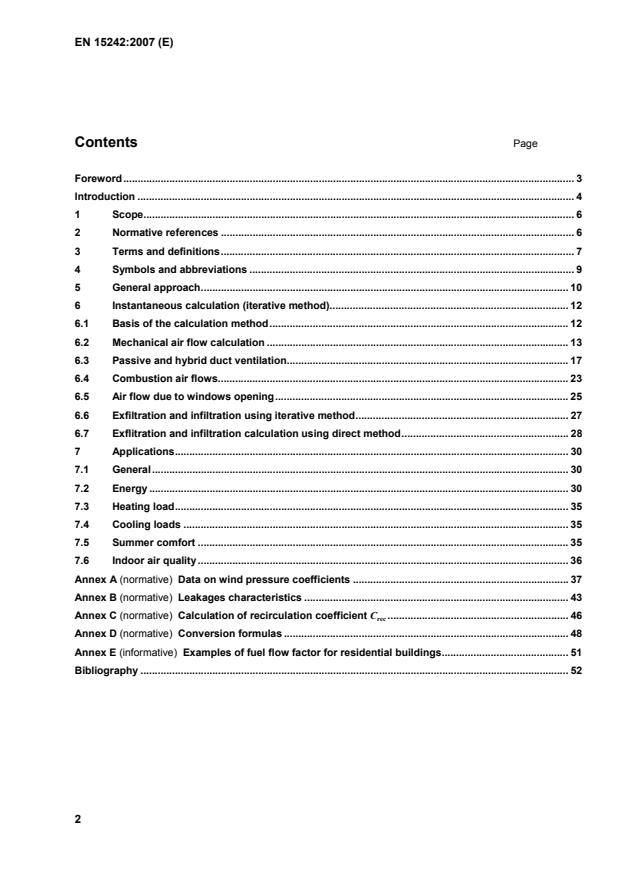
Data on wind pressure coefficients.37 Annex B (normative)
Leakages characteristics.43 Annex C (normative)
Calculation of recirculation coefficient Crec.46 Annex D (normative)
Conversion formulas.48 Annex E (informative)
Examples of fuel flow factor for residential buildings.51 Bibliography.52
Existing national regulations with or without reference to national standards, may restrict for the time being the implementation of the European Standards mentioned in this report. According to the CEN/CENELEC Internal Regulations, the national standards organizations of the following countries are bound to implement this European Standard: Austria, Belgium, Bulgaria, Cyprus, Czech Republic, Denmark, Estonia, Finland, France, Germany, Greece, Hungary, Iceland, Ireland, Italy, Latvia, Lithuania, Luxembourg, Malta, Netherlands, Norway, Poland, Portugal, Romania, Slovakia, Slovenia, Spain, Sweden, Switzerland and United Kingdom.
Figure 1 — scheme of relationship between standards Table 1 — Relationship between standards from To
Information transferred variables 15251 15243 Indoor climate requirements
Heating and cooling Set points
13779 15251 15242 Airflow requirement for comfort and health Required supply and exhaust Air flows 15242 15241 Air flows Air flows entering and leaving the building 15241 13792 Air flows Air flow for summer comfort calculation 15241 15203- 15315 ;15217 energy Energies per energy carrier for ventilation (fans, humidifying, precooling, pre heating), + heating and cooling for air systems 15241 13790 data for heating and cooling calculation Temperatures, humilities and flows of air entering the building
15243 15242 Data for air heating and cooling systems Required airflows when of use 15243 13790 data for building heating and cooling calculation Set point, emission efficiency, distribution recoverable losses, generation recoverable losses 13790 15243 Data for system calculation Required energy for generation EN titles are: prEN 15217 Energy performance of buildings — Methods for expressing energy performance and for energy certification of buildings prEN 15603 Energy performance of buildings - Overall energy use and definition of energy ratings prEN 15243 Ventilation for buildings — Calculation of room temperatures and of load and energy for buildings with room conditioning systems prEN ISO 13790 Thermal performance of buildings — Calculation of energy use for space heating and cooling (ISO/DIS 13790:2005) EN 15242 Ventilation for buildings — Calculation methods for the determination of air flow rates in buildings including infiltration EN 15241 Ventilation for buildings — Calculation methods for energy losses due to ventilation and infiltration in commercial buildings EN 13779 Ventilation for non-residential buildings — Performance requirements for ventilation and room-conditioning systems EN 13792 Colour coding of taps and valves for use in laboratories EN 15251 Indoor environmental input parameters for design and assessment of energy performance of buildings addressing indoor air quality, thermal environment, lighting and acoustics
The calculation of the airflows through the building envelope and the ventilation system for a given situation is first described (Clause 6). Applications depending on the intended uses are described in Clause 7. The target audience of this standard is policy makers in the building regulation sector, software developers of building simulation tools, industrial and engineering companies.
Mechanically ventilated building (mechanical exhaust, mechanical supply or balanced system).
Passive ducts. Hybrid system switching between mechanical and natural modes. Windows opening by manual operation for airing or summer comfort issues. Automatic windows (or openings) are not directly considered here. Industry process ventilation is out of the scope.
Kitchens where cooking is for immediate use are part of the standards (including restaurants.) Other kitchens are not part of the standard. The standard is not directly applicable for buildings higher than 100 m and rooms where vertical air temperature difference is higher than 15K.
The results provided by the standard are the building envelope flows either through leakages or purpose provided openings and the air flows due to the ventilation system, taking into account the product and system characteristics. 2 Normative references The following referenced documents are indispensable for the application of this document. For dated references, only the edition cited applies. For undated references, the latest edition of the referenced document (including any amendments) applies. EN 1507, Ventilation for buildings — Sheet metal air ducts with rectangular section — Requirements for strength and leakage EN 1886, Ventilation for buildings — Air handling units — Mechanical performance EN 12237, Ventilation for buildings — Ductwork — Strength and leakage of circular sheet metal ducts EN 12792:2003, Ventilation for buildings — Symbols, terminology and graphical symbols
3.10 shielding effect classified according to the relative height, width and distance of relevant obstacle(s) in relation to the building
3.11 natural duct ventilation system ventilation system where the air is moved by natural forces into the building through leakages (infiltration) and openings (ventilation), and leaves the building through leakages, openings, cowls or roof outlets including vertical ducts used for extraction 3.12 mechanical ventilation system ventilation system where the air is supplied or extracted from the building or both by a fan and using exhaust air terminal devices, ducts and roof /wall outlets NOTE In single exhaust mechanical systems, the air have entered the dwelling through externally mounted air transfer devices, windows and leakages 3.13 airing natural air change by window opening NOTE In this standard, only single sided ventilation effects are considered which means that the ventilation effect due to this window opening is considered to be independent of other open windows or additional ventilation system flows. 3.14 ventilation effectiveness relation between the pollution concentrations in the supply air, the extract air and the indoor air in the breathing zone (within the occupied zone). It is defined as SUPIDASUPETAvcccc−−=ε
where: εv
is the ventilation effectiveness
cETA
is the pollution concentration in the extract air
cIDA is the pollution concentration in the indoor air (breathing zone within the occupied zone)
cSUP
is the pollution concentration in the supply air NOTE 1 The ventilation effectiveness depends on the air distribution and the kind and location of the air pollution sources in the space. It may therefore have different values for different pollutants. If there is complete mixing of air and pollutants, the ventilation effectiveness is one. NOTE 2 Another term frequently used for the same concept is “contaminant removal effectiveness”. 3.15 hybrid ventilation hybrid ventilation switches from natural mode to mechanical mode depending on its control
4 Symbols and abbreviations Symbol Unit descriptionA m² area Asf ad Airtightness split factor (default value or actual) Cductleak ad Coefficient taking into account lost air due to duct leakages Cp ad wind pressure coefficient Crec ad Recirculation coefficient Csyst ad coefficient taking into account the component and system design tolerances Cuse ad Coefficient taking into account the switching on and off of fans Ccont ad coefficient depending on local air flow control irp Pa Internal reference pressure in the zone Osf
Opening split factor (default value or actual) qv(dP) curve or formulaairflow/pressure difference characteristic qv (dP) curve or formula partial air openings for altitude (z), orientation (or), tilt angle (Tilt) qv 4Pa,n or n50,n
L/s or m3/h external envelope airtightness expressed as an airflow for a given pressure difference, exponentqv 4Pa,n or n50,n L/s or m3/h partial air tightnesss for altitude (z), orientation (or), tilt angle (Tilt) qv-exh L/s or m3/hexhaust air flow according to EN 13779 (not extract) qv-exh -req L/s or m3/hrequired exhaust air flow
qv-sup L/s or m3/hSupply air flow Qv-sup-req L/s or m3/hrequired outdoor air flow θe °C external (outdoor) temperature θi °C internal (indoor) temperature ρair
kg/m3 Air volumetric mass
ρair ref kg/m3 Air volumetric mass at reference temperature T K Absolute temperature vmeteo m/s wind as defined by meteo at 10 m height vsite m/s wind at the building zo m depends on terrain class
5 General approach The air flows are calculated for a building, or a zone in a building. A building can be separated in different zones if: The different zones are related to different ventilation systems (e.g. one ventilation system is not connected to different zones). The zones can be considered as air flow independent (e.g. the air leakages between two adjacent zones are sufficiently low to be neglected, and there is no possibility of air transfer between two zones). The most physical way to do the calculation is to consider the air mass (dry air) flow rate balance. Nevertheless it is also allowed to consider the volume flow rate balance when possible.
Cases where using the mass flow rate is mandatory are: air heating systems, air conditioning systems. The formulas in Clause 6 and 7 are given for volume flow rates. The input data are the ventilation system air flows and the airflows vs pressure characteristics of openings (vents) and leakages.
Air entering the building/zone is counted positive (air leaving is counted negative). The general scheme is shown in Figure 2: 23415 Key 1
ventilation 4
leakage 2
window opening 5
internal reference pressure 3
opening
Figure 2 — General scheme of a building showing the different flows involved The resolution scheme is as follows: 1. Establish the formulas giving the different air flows for a given internal reference pressure 2. Calculate the internal reference pressure irp balancing air flows in and air flow out 3. Calculate the air flows for this internal reference pressure The internal partition of a building is based in general on the following:
i) divide the building between zones
Different zones are considered as having no, or negligible air flow between them ii) Describe each zone as sub zones connected to a common connection sub zone (in general it will be the circulations and hall spaces) if necessary (a zone can be also only one room) The general scheme (called afterwards the n+1 approach) is shown in Figure 3.
1 Key 1 map Figure 3 — General scheme for air flow pattern description
This scheme is a simplification of the more general one taking into account all possible connections. It can be furthermore simplified depending on the application (see application clauses). 6 Instantaneous calculation (iterative method) 6.1 Basis of the calculation method An iterative method is used to calculate the air handling unit air flow, and air flow through envelope leakages and openings for a given situation of: Outdoor climate (wind and temperature), Indoor climate (temperature), System running. This clause explains the different steps of calculation. 1. Calculation of mechanical ventilation
3. Calculation of infiltration/exfiltration 4. combustion air flow fire places both for residential and non residential if necessary. Combined exhaust for ventilation and heating appliance ? Laundry
5. Calculation of additional flow for window openings 6. Overall airflow 6.2 Mechanical air flow calculation 6.2.1 Introduction The ventilation is based on required air flow (either supplied or extract in each room) which is defined at national level, assuming in general perfect mixing of the air. To pass from these values to the central fan, the following coefficients (and impacts) shall be taken into account: 1) Cuse: coefficient corresponding to switching on (Cuse=1) or off (Cuse=0) the fan
2) 0v: local ventilation efficiency
3) Ccont: coefficient depending on local air flow control 4) Csyst: coefficient depending on inaccuracies of the components and system (adjustment…etc) 5) Cleak: due to duct and AHU leakages 6) Crec: recirculation coefficient, mainly for VAV system 6.2.2 Required air flow qv-sup-req and qv-exh -req For each room, qv -sup-req and qv-exh -req are respectively the air flow to be provided or exhausted according to the building design, and national regulations. 6.2.3 Cuse coefficient This coefficient simply describes the fact of switching on-off the fan (or eventually different level from design one).
It is related to health and energy issues, and to the building or room occupation and occupant behaviour. For health issues, and for building where ventilation can be stopped or reduced during unoccupied periods, it is recommended (and can be mandatory at national level), to start the ventilation before the start of the occupancy period in order to purge the building, and to keep it for some time and the beginning of the unoccupied period. For energy issues, it can be useful to keep the ventilation during unoccupied period (night cooling) if it is energy efficient.
6.2.4 Ventilation effectiveness 0v
It is related to the concentration in the extract air, and the one in the breathing zone.
For efficient system 0v can be higher than 1. In case of short circuit system 0v can be lower than 1.
The Ccont coefficient has to be calculated according to the control system efficiency and can be related to the overall room energy balance.
NOTE It could possibly vary with month, external conditions etc. 6.2.6 Csyst coefficient The Csyst coefficient ( ≥ 1 ) takes into account the accuracy of the system design in relationship with the component description. It expresses the fact that it is not possible to provide the exact required amount of air when this value is required as a minimum. 6.2.7 Duct leakagecoefficient Cductleak The air flow through the duct leakage is calculated 3600.65,0ductductvductleakdPKAq= qvductleak
(m3/h)
:
air through the duct leakages Aduct :
duct area in m2. Duct area shall be calculated according to EN 14239.
dPduct :
pressure difference between duct and ambient air in Pa – unless otherwise
specified, this is: In supply air ductwork:
the average between the pressure difference at the AHU outlet and the pressure difference right upstream of the air terminal device. In extract air ductwork:
the average between the pressure difference right downstream of the air terminal device and the pressure difference at the AHU inlet
K
airtightness of duct in m3/(s.m2) for 1 Pa – the duct leakage shall be determined according
to EN 12237 (circular ducts), EN 1507 (rectangular ducts)
The Cductleak coefficient is therefore calculated by vsystcontvreqvductleakductleakCCqqCε+=1 This equation can be applied either with qv-req equal to qv -sup-req or to qv -exh-req
vsystcontvreqvAHUleakAHUleakCCqqCε+=1 With
qv-AHUleak: airflow lost by the AHU determined according to EN 1886. 6.2.9 Indoor and outdoor leakage Coefficient If the AHU is situated indoor Cindoor leak = Cduct leak
CAHUleak Coutdoorleak = 1 If the AHU is situated outdoor
Cindoorleak = 1 + Rindoorduct (1- Cduct leak)
Coutdoorleak = 1 + (1- Cductleak )(1 – Rindorrduct)
CAHUleak With Rindoorduct = Aindoor duct / Aduct Aindoor duct = area of duct situated indoor
NOTE In dimensioning of fans and calculating the air flows through the fans, the air leakages of ducts and air handling units (sections downstream of supply air fans and upstream of the exhaust air fans in the AHU) should be added to the sum of air flows into/from the rooms. This because these leakages do not serve the ventilation needed for the targeted indoor air quality.
6.2.10 Recirculation Coefficient Crec The recirculation coefficient (≥ 1) is used mainly for VAV system with recirculation. It takes into account the need to supply more outdoor air than required. Annex C provides a calculation method for it. 6.2.11 Mechanical air flow to the zone qv supply qv extra The mechanical air flows supplied to or exhausted from the zone are calculated by
vrecindoorleakcontreqvvCCCqqε.supsup= vrecindoorleakcontvexhreqvexhCCCqqε.=
vrecleakcontreqvAHUvCCCqqε.supsup= vrecleakcontvexhreqvexhAHUCCCqqε.=
with Cleak = Cindoorleak+Coutdoor leak Two situations are taken into account depending on the position of the air handling unit in or out the heated/air conditioned area. For the ventilation calculation, it impacts only on the duct leakage effect but afterwards; it will have to be considered for heat losses. The different air flows to the AHU are shown in Figure 4. Case 2 corresponds to the situation when the AHU is in the conditioned area, case 1 when it is out of the conditioned area. This has to be taken into account for the whole calculation process.
Key 1
duct leakages 4
duct system 2
fan 5
building or zone case 1 3
ventilation plant 6
building or zone case 2
Figure 4 — Air flows to the Air Handling Unit 6.3 Passive and hybrid duct ventilation 6.3.1 General A ducted natural ventilation system is composed of 1. Air inlets,
2. Cowl, 3. Duct, 4. Air outlets The aim of the calculation is to calculate the air flow in the system taking into account outdoor and indoor conditions.
C (Vwindref,Vduct) = dP / pd where : pd = 0,5
Vwindref2 Vduct is the air velocity in the duct With no wind, the pressure loss through the cowl dPcowl is dPCowl (Vwind=0,Vduct) =0,5
Vduct2
For the reference wind Vwindref (in general 8m/s),
dPCowl (Vwindref,Vduct) =0,5
C(Vwindref,Vduct)
Vwindref² For any wind, it is possible to use the similitude law as follows: For a different wind speed Vwindact, the C coefficients remains the same if the Vduct if multiplied by Vwindact/Vwindref, which enables to calculate
C(Vwindact, Vduct Vwindact/Vwindref ) = C(Vwindref , Vduct) Example of application : Vwindref = 8 m/s Vduct = 2 m/s C(8,2) = -0,12 For a wind Vwindact = 4 m/s the corresponding Vduct is equal to 2 . 4/8 = 1m/s Which gives: C(4,1) = C(8,2) = -0,12 The corresponding dP is dPCowl = C(4,1) ½ ρ Vwindact²
On the other hand, for low wind speed and high duct air speed, the pressure drop is equal to the one given by the pressure loss coefficient. The methodology to be applied is than as follows: The actual wind speed Vwind is known. The similitude law can be applied until an air duct velocity Vduct1 with Vduct1 = Vductmax Vwind / 8 Where Vductmax is the maximum value of duct air velocity for the test 1) For air duct speeds lower then Vduct1, dPCowl is calculated by using the similitude law and by interpolation between the different points issued from the tests. 2) For air duct speeds higher than Vduct1, it is important to make a transition with the curve with no wind (if not, convergence issues can arise) by keeping a monotonous curve.
To do so it is recommended to search a point Vduct2 for which dPCowl(0, Vduct2) is higher than dPCowl (Vwind,Vduct1). This can be done by first trying Vduct2 = 2 Vduct1 then Vduct2 = 3 Vduct1 …. For Vduct 2, dPcowl2 is calculated using dPCowl(0, Vduct2)… 3) for Vduct between Vduct1 and Vduct 2, the curve is a linear interpolation between the two points. 4) for Vduct higher than Vduct 2 : the curve is the dPCowl(0, Vduct) one.
Vduct (m/s) 3
dP V wind = 8 m/s (from test) Y
dP curve for V wind = 4 m/s 4
dP V wind = 4 from test at V wind
= 8 m/s 1
Vduct 1 5
dP final 2
Vduct 2 6
dP for V wind = 0
Figure 5 — dPcowl curve for V wind = 4 m/s
Key 1
roof outlet or cowl 5
Cp roof 2
height above rooflevel 6
roof slope 3
Cp cowl 7
passive duct 4
Cp height
Figure 6 — Cowl or outlet Cp impacts 6.3.2.4.2 Calculation method
The pressure taken at the roof outlet or cowl Ccowltot is a function of Cpcowl, corresponding to a free wind condition, and Cproof if the cowl is close to the roof. Where:
is the pressure coefficient at roof level taking into account the height of the cowl above the roof level.
Cproof0 is the pressure coefficient close to the roof dCpheight is a correction coefficient for the height above roof level Cpcowl
is the value calculated from 6.3.2 Depending on the cowl position Cp effect of the roof can differ a lot. Designers have then to make assumptions for design and dimensioning. The Cproof has then to be defined at national level taking into account rules of installation. If nothing is defined, Cproof is taken to 0.
3 Examples of values for Cproof and Cpheight Figure 7 provides examples of values for Cproof.
YX-0.6-0.4-0.200.20.40.61530456075090 Key X
roof slope in ° Y
Cproof
Figure 7 — Cp roof Table 2 provides examples of dCpheight values. Table 2 — Examples of dCpheight values Above roof height of the roof outlet in m dCpheight < 0,5 m - 0,0 0,5 –1,0 m - 0,1 > 1 m - 0,2
6.4 Combustion air flows The additional flow from outside needed for the operation of the combustion appliance qv-comb shall be calculated from the following: hfffasvcombPFFq.6,3= (14) if the appliance is on With:
qvcomb (m3/h) : additional combustion flow Fas
(ad.): appliance system factor Phfi
(kW) : appliance heating fuel input power
Fff
(l/(s.kW) : fuel flow factor
and qv comb
= 0, if the appliance is off The appliance system factor takes account of whether the combustion air flow is separated from the room or not, and uses values given in Table 3. The fuel flow factor depends on the specific air flow per fuel type required for the combustion process (air flow normalized to room temperature condition) and uses values given by national standards or values given in Annex E. For the case “Appliance off”, the flue shall be considered as vertical shaft. NOTE The reference temperature for qv comb is the zone temperature.
supply situation Flue gas exhaust situation Typical combustion appliance system Appliance system factor Fas Combustion air is taken
Flue gases are exhausted
• Kitchen stove
0 from room air into room • Gas appliance
according to CEN/TR 1749
Combustion air is taken Flue gases are exhausted • Open fire place 1 from room air into separate duct • Gas appliance
according to CEN/TR 1749
Combustion air is taken Flue gases are exhausted • Specific gas appliance See note from room air in duct simultaneously with
mechanical ventilation
exhaust air
Combustion air is Flue gases are exhausted • Gas appliance 0 delivered directly from into a separate duct
according to CEN/TR 1749
outside in a separate
Type C (room air
duct, sealed from room
sealed systems)
air
• Closed fire place
(wood, coal or
wood/coal-effect gas fire)
NOTE Considered as a mechanical extraction system, but with variable air flow, depending of both the exhaust and the combustion appliance.
6.5 Air flow due to windows opening 6.5.1 Airing 6.5.1.1 Airflow calculation For single side impact, the airflow is calculated by
qvairing = 3.6 . 500 Aow V 0,5
V =
Ct + Cw . Vmet 2 + Cst . Hwindow . abs ( θi - θe ) with: Qv (m3/h):
air flow
Aow(m2)
window opening area Ct =0,01
takes into account wind turbulence Cw= 0,001 takes into account wind speed Cst= 0,0035 takes into account stack effect Hwindow (m) is the free area height of the window Vmet (m/s) meteorological wind speed at 10 m height Ti :
room air temperature Te :
outdoor air temperature. For bottom hung window, the ratio of the flow through the opened area and the totally opened window is assumed to be only depending on the opening angle α and independent on the ratio of the height to the width of the window. Aow = Ck(α) Aw Where Aw is the window area is totally opened.
(14)
α [°] (X) Ck(α) [-] (Y)
0 0.00
5 0.09
10 0.17
15 0.25
20 0.33
25 0.39
30 0.46
45 0.62
60 0.74
90 0.90
180 1.00
YX00.10.20.30.40.50.60.70.80.910153045607590105120135150165180
Figure 8 — Ratio of the flow through a bottom hung window and the totally open window The approximation given applies to window sizes used for residential buildings, for windows with sill (not to windows with height close to full room height), and for height to width geometries of the tilted window section of approx 1:1 to 2:1. In the measurements, the variation of height/width ration resulted in flow variation of less than 1 % in relation to flow through the totally open window, this means that e.g. for 8° opening angle the error of the calculated flow is within 10 %. About the same error band applies in regard to temperature difference (which was in the range of 10 to 39 K in the measurements). 6.5.1.2 Simplified calculation When the indoor air quality only relies on windows opening, it is taken into account that the user behaviour leads to air flow rates higher than the required ones. The Cairing coefficient takes this point into account: qv-airing = Cairing . max (qv-sup-req , qv-exh -req) The Cairing takes into account the occupant opening efficiency regarding windows opening (but assuming the required air flow rates are fulfilled) but also the occupancy pattern of the room. This coefficient has to be defined at national level especially if a window opening is considered as a possible ventilation system alone. 6.5.2 Air flow for summer comfort Cross ventilation has to be taken into account, either with iterative method or direct to be defined.
Ropw = Ywind.Ytemp where
Ropw is the opening of the window in ratio of the maximum opening
Ywind is the factor for wind
Ytemp is the factor for outdoor temperature The factors are defined by
Ywind = 1-0,1 Vmet
Ytemp = e / 25 + 0,2 Ywind and Ytemp are limited to a minimum value of 0 and a maximum value of 1 Where:
Vmet (m/s) is the meteorological windspeed
e (°C) is the outdoor temperature The windows considered as possibly opened, as the time schedule for that, shall be defined at national level. 6.6 Exfiltration and infiltration using iterative method
6.6.1 Cp values
Cp values are determined according to orientation and height of the component, building and zone characteristics, shielding and building location. A procedure is defined in Annex A and specific applications are defined in the application clause. 6.6.2 Pressure difference for each external envelope component Each component is characterized by
its Cp value:
Ccomp
its height difference with the zone floor level hcomp For each component
dP comp = Pext comp – Pint comp with: −=erefecompsitecomprefaircompextTTghVCpp,2,,.5,0ρ
NOTE External pressure at the floor level is taken equal to 0. hcomp is the altitude difference between component and zone floor level g = 9,81 m/s2 ρair-ref =1,22 kg/m3
Tref = 283 K 6.6.3 Description of external envelope component Each external envelope component (leakage, air inlet …) is characterized by
qv-comp = fcomp ( dPcomp ) For leakages qv-leak =
Cleak . sign (dP) . IdPI 0,667 For air inlet qv-inlet = Cinlet . sign(dP) . IdPI 0,5 For air inlet or other purpose provided components, the equation can be replaced by a more accurate one, if the component is tested according to EN 13141-1 (air inlet).
6.6.4 Calculation of infiltred and exflitred air flows Solve the equation, qv-sup + qv-exh + Σ qv-comp + qv-passiveduct + qv-comb = 0
Where the unknown value is irp Once irp has been determined to solve this equation, calculate each individual value of qv-comp qv-inf = Σ qv-comp
for positive values of qv-comp qv-exh = Σ qv-comp
for negative values of qv-comp
6.7 Exflitration and infiltration calculation using direct method 6.7.1 General When it can be assumed that there is no interaction between the ventilation system and the leakages impact (e.g. mechanical system); a simplified approach can be used to calculate the exfiltered and unfiltered values as follows: passive ducts shall be calculated only with the iterative approach The direct method has the following steps:
qv-stack = 0,0146 Q4Pa ( hstack . abs (θe-θi)) 0,667 )
Conventional value of hstack is 70 % of the zone height Hz
qv-wind =
0,0769
Q4Pa
(dcp vsite 2 ) 0,667 Conventional value of dcp (Cp difference between windward and leeward sides) is 0,75
2. Calculate the resulting air flow
qv-sw = max(qv-stack, qv-wind) + 0,14
qv-stack . qv-wind / Q4Pa As a first approximation, the infiltred part qv-inf
is equal to the sum of qv-sw and the difference between supply and exhaust air flows (calculated without wind or stack effect). qv-inf = (max (0; - qv-diff )+ qv-sw
With qv-diff = qv-supply + qv-extr + qv-comb NOTE Air flows entering the zone are counted positive. This simplified approach does not take into account the fact that if there is a difference between supply and exhaust, the zone is underpressured or overpressured, which reduces the qv-sw value. The reduction of the infiltred air flows due to this phenomena
qv-infred can be estimated by: qv-infred = max(qv-sw,
[qv-stack . abs(qv-diff /2) + qv-wind . 2 abs(qv-diff) /3
)/( qv-stack+ qv-wind) ] ) qv-inf = max(0; qv-sw – qv_infred) 6.7.2 Determination of average flow values ()v
total
v
v tot,ssall states s qq f=⋅∑ (15) Where:
qv tot,s
is the air flow rate during state s fs
is the time proportion during which the state s is active (0 ≤ fs ≤ 1) Four hourly calculations, only one state is considered (e.g. one calculation each hour) For monthly calculation the minimum states to be considered are:
Occupied / Non occupied periods;
Five wind speed. NOTE Only one monthly average indoor outdoor temperature difference can be used. If set point during occupancy and non occupancy periods are known, it is advised to use theses values.
...