


EN 940:1997/AC:1997
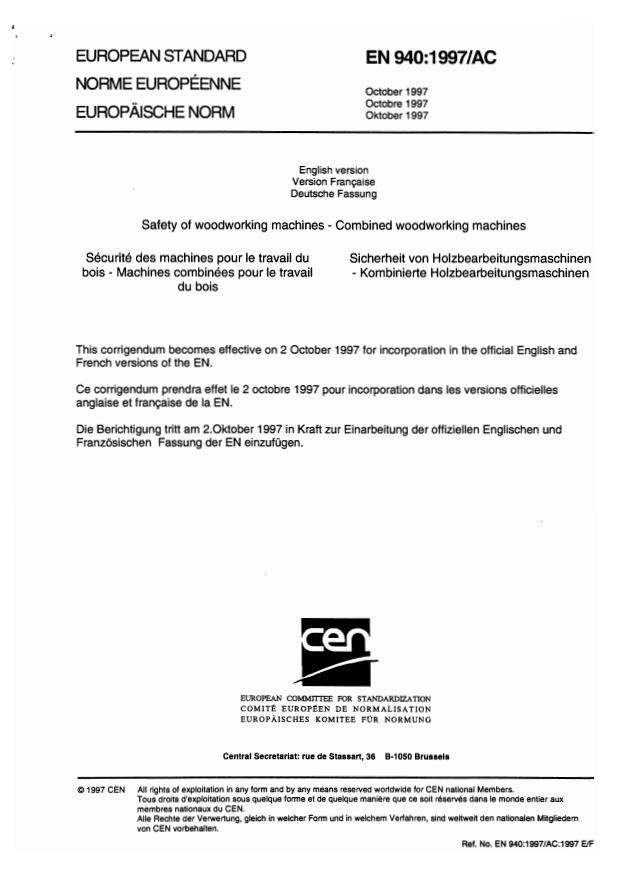
(Corrigendum)Safety of woodworking machines - Combined woodworking machines
Safety of woodworking machines - Combined woodworking machines
Sicherheit von Holzbearbeitungsmaschinen - Kombinierte Holzbearbeitungsmaschinen
Sécurité des machines pour le travail du bois - Machines combinées pour le travail du bois
Safety of woodworking machines - Combined woodworking machines Amendment AC
General Information
- Status
- Withdrawn
- Publication Date
- 01-Oct-1997
- Withdrawal Date
- 11-Aug-2009
- Technical Committee
- CEN/TC 142 - Woodworking machines - Safety
- Drafting Committee
- CEN/TC 142 - Woodworking machines - Safety
- Current Stage
- 9960 - Withdrawal effective - Withdrawal
- Start Date
- 12-Aug-2009
- Completion Date
- 12-Aug-2009
- Directive
- 98/37/EC - Machinery
Relations
- Effective Date
- 15-Aug-2009
- Effective Date
- 08-Jun-2022

Get Certified
Connect with accredited certification bodies for this standard

Gozdarski inštitut Slovenije
Slovenian Forestry Institute. Forest management certification support, timber testing.
Sponsored listings
Frequently Asked Questions
EN 940:1997/AC:1997 is a corrigendum published by the European Committee for Standardization (CEN). Its full title is "Safety of woodworking machines - Combined woodworking machines". This standard covers: Safety of woodworking machines - Combined woodworking machines
Safety of woodworking machines - Combined woodworking machines
EN 940:1997/AC:1997 is classified under the following ICS (International Classification for Standards) categories: 79.120.10 - Woodworking machines. The ICS classification helps identify the subject area and facilitates finding related standards.
EN 940:1997/AC:1997 has the following relationships with other standards: It is inter standard links to EN 940:2009, EN 940:1997. Understanding these relationships helps ensure you are using the most current and applicable version of the standard.
EN 940:1997/AC:1997 is associated with the following European legislation: EU Directives/Regulations: 98/37/EC; Standardization Mandates: M/079. When a standard is cited in the Official Journal of the European Union, products manufactured in conformity with it benefit from a presumption of conformity with the essential requirements of the corresponding EU directive or regulation.
EN 940:1997/AC:1997 is available in PDF format for immediate download after purchase. The document can be added to your cart and obtained through the secure checkout process. Digital delivery ensures instant access to the complete standard document.
Standards Content (Sample)
SLOVENSKI STANDARD
01-april-2000
Safety of woodworking machines - Combined woodworking machines Amendment
AC
Safety of woodworking machines - Combined woodworking machines
Sicherheit von Holzbearbeitungsmaschinen - Kombinierte Holzbearbeitungsmaschinen
Sécurité des machines pour le travail du bois - Machines comb
...
This May Also Interest You
1.1 This document specifies the safety requirements and measures for
— cold presses,
— hot presses,
— bending presses,
— edge/face gluing presses,
— membrane presses, and
— embossing presses,
where the pressing force is applied by hydraulic, pneumatic or electrical actuators pushing two flat or shaped surfaces against each other, capable of continuous production use, altogether referred to as “machines”.
This document deals with all significant hazards, hazardous situations and events as listed in Annex A, relevant to machines, when operated, adjusted and maintained as intended and under the conditions foreseen by the manufacturer, including reasonably foreseeable misuse. Also, transport, assembly, dismantling, disabling and scrapping phases are taken into account.
1.2 This document is applicable to machines fitted with one or more of the following devices or additional working units, whose hazards have been dealt with:
a) a device for hot gluing;
b) a device for high-frequency gluing in the frequency range from 1 MHz to 400 MHz;
c) a device for high-frequency shaping in the frequency range from 1 MHz to 400 MHz;
d) an automatic workpiece loading and unloading system;
e) an intermediate additional platen;
f) a workpiece extractor;
g) a horizontal pressing system;
h) split moveable platens.
1.3 The machines are designed to process workpieces consisting of:
a) solid wood;
b) materials with similar characteristics to wood (see ISO 19085-1:2021, 3.2), except those with light alloy laminates/edges/profiles for high-frequency presses;
c) wood-based material such as chipboard, fibreboard and plywood composed/laminated with steel sheets/edges/profiles, except for high-frequency presses;
d) honeycomb board;
e) composite boards made from the materials listed above.
1.4 This document does not deal with any hazards related to:
— specific devices that differ from the list above;
— hot fluid heating systems internal to the machine other than electrical;
— any hot fluid heating systems external to the machine;
— operation of taking intermediate platens out and in again;
— the combination of a single machine being used with any other machine (as part of a line).
1.5 This document is not applicable to:
— frame presses;
— membrane presses where the pressing force is applied by vacuum only;
— presses for producing chipboard, fibreboard, OSB;
— machines intended for use in potentially explosive atmosphere;
— machines manufactured before the date of publication of this document.
- Draft47 pagesEnglish languagee-Library read for×1 day
- 16-Dec-2025
- 13.110
- 79.120.10
- 2006/42/EC
- M/396
- CEN/TC 142
This document specifies the safety requirements and measures for multi-blade rip sawing machines with manual loading or unloading or both, capable of continuous production use, hereinafter referred to also as “machines”, designed to cut solid wood and materials with similar physical characteristics to wood.
This document deals with all significant hazards, hazardous situations and events as listed in Annex A, relevant to the machines, when operated, adjusted and maintained as intended and under the conditions foreseen by the manufacturer including reasonably foreseeable misuse. Transport, assembly, dismantling, disabling and scrapping phases are also taken into account.
This document does not deal with specific hazards related to the combination of single machines with any other machine as part of a line.
This document is not applicable to machines:
— intended for use in potentially explosive atmosphere;
— manufactured prior to its publication.
- Standard59 pagesEnglish languagee-Library read for×1 day
- 21-Oct-2025
- 13.110
- 79.120.10
- 2006/42/EC
- M/396
- CEN/TC 142
This document specifies the safety requirements and measures for manually loaded and unloaded
— single-end tenoning machines with a manual feed sliding table,
— single-end tenoning machines with a mechanical feed sliding table,
— single-end tenoning-profiling machines with mechanical feed,
— double-end tenoning-profiling machines with mechanical feed, also designed to be automatically either loaded or unloaded, or both, and
— angular systems for tenoning and profiling with mechanical feed
with maximum workpiece height capacity of 200 mm for single-end machines and 500 mm for double-end machines, capable of continuous production use, altogether referred to as “machines”.
This document deals with all significant hazards, hazardous situations and events as listed in Annex A, relevant to machines, when operated, adjusted and maintained as intended and under the conditions foreseen by the manufacturer including reasonably foreseeable misuse. Also, transport, assembly, dismantling, disabling and scrapping phases have been taken into account.
The machines are designed to process in one pass one end or two sides, either opposite or perpendicular to each other, of workpieces made of
a) solid wood, and
b) materials with similar physical characteristics to wood (see ISO 19085-1:2021, 3.2); and
c) only the machines with mechanical feed, made of
d) fibre-cement,
e) rock wool and glass wool,
f) gypsum,
g) plasterboard,
h) matrix engineered mineral boards, silicate boards and sulfate boards,
i) composite materials with core consisting of polyurethane or mineral material laminated with light alloy,
j) polymer-matrix composite materials and reinforced thermoplastic, thermoset and elastomeric materials,
k) aluminium light alloy profiles, and
l) composite boards made from the materials listed above.
This document is also applicable to machines fitted with one or more of the following devices or additional working units, whose hazards have been dealt with:
— sanding units;
— fixed or movable workpiece support;
— automatic tool changing;
— automatic workpiece returner;
— glass bead saw unit;
— hinge recessing unit;
— boring unit;
— dynamic processing unit;
— sawing unit installed out of the integral enclosure, between machine halves in double-end machines;
— foiling unit;
— coating unit;
— grooving unit with a milling tool installed out of the integral enclosure, between machine halves;
— brushing unit;
— gluing unit;
— sealing unit;
— dowels inserting unit;
— tongues inserting unit;
— inkjet marking unit;
— laser marking unit;
— labelling unit;
— workpiece back-up device (device that is either anti-chipping or anti-splintering, or both);
— quick tool changing system;
— post-formed edge pre-cutting unit;
— additional workpiece support (at either infeed or outfeed, or both);
— parallel infeed device on single-end machines;
— transversal infeed device on single-end machines;
— intermediate workpiece support on double-end machines;
— automatic infeed device;
— feed chain with dogs.
This document does not deal with any hazards related to:
a) systems for automatic loading and unloading of the workpiece to a single machine other than automatic workpiece returner;
b) single machine being used in combination with any other machine (as part
- Standard76 pagesEnglish languagee-Library read for×1 day
- 10-Dec-2024
- 13.110
- 79.120.10
- 2006/42/EC
- M/396
- CEN/TC 142
This document specifies the safety requirements and measures for circular saw benches with or without sliding table or demountable power feed unit or both and capable of continuous production use, also known as “table saws” (in the USA), hereinafter referred to also as “machines”.
The machines are designed to cut solid wood and material with similar physical characteristics to wood (see ISO 19085-1:2021, 3.2).
This document deals with all significant hazards, hazardous situations and events as listed in Annex A relevant to the machines when operated, adjusted and maintained as intended and under the conditions foreseen by the manufacturer; reasonably foreseeable misuse has been considered too. Transport, assembly, dismantling, disabling and scrapping phases have also been taken into account.
This document is also applicable to machines fitted with one or more of the following devices or working units, whose hazards have been dealt with:
— device for the main saw blade and scoring saw blade to be raised and lowered through the table;
— device to tilt the main saw blade and scoring saw blade for angled cutting;
— device for scoring;
— device for grooving with milling tool with a width not exceeding 20 mm in one pass;
— demountable power feed unit;
— additional manually operated sliding table;
— powered workpiece clamping device.
This document does not apply to:
a) machines intended for outdoor use on building sites;
NOTE Building site saws (contractor saws) are covered by the requirements of ISO 19085-10:2018.
b) handheld woodworking machines including any adaptation permitting their use in a different mode, i.e. bench mounting;
c) machines intended for use in a potentially explosive atmosphere;
d) machines manufactured prior to the publication of this document.
- Standard55 pagesEnglish languagee-Library read for×1 day
- 01-Oct-2024
- 13.110
- 79.120.10
- 2006/42/EC
- M/396
- CEN/TC 142
This document specifies the safety requirements and measures for manually loaded and unloaded vertical panel circular sawing machines (defined in 3.1) capable of continuous production use, with hand feed or integrated feed, hereinafter referred to also as “machines”.
This document deals with all significant hazards, hazardous situations and events, as listed in Annex A, relevant to the machines, when operated, adjusted and maintained as intended and under the conditions foreseen by the manufacturer, including reasonably foreseeable misuse. Transport, assembly, dismantling, disabling and scrapping phases are also taken into account.
This document is also applicable to machines fitted with one or more of the following devices/additional working units, whose hazards have been dealt with:
— an integrated feed device;
— a device for scoring;
— an angle cutting device;
— a middle support device;
— programmable end stops for parallel vertical cuts;
— a device for grooving with a milling tool with a cutting width not exceeding 27 mm;
— a panel pusher;
— a panel lowering device;
— stop devices for workpiece during horizontal cuts.
The machines are designed for cutting panels consisting of:
a) solid wood;
b) material with similar physical characteristics to wood (see ISO 19085-1:2021, 3.2);
c) composite materials with core consisting, for example, of polyurethane or mineral material laminated with light alloy;
d) polymer-matrix composite materials and reinforced thermoplastic/thermoset/elastomeric materials;
e) gypsum boards, gypsum bounded fibreboards;
f) honeycomb aluminium boards;
g) matrix engineered mineral boards, silicate boards;
h) aluminium light alloy plates;
i) composite boards made from the materials listed above.
This document does not apply to machines
— with pressure beam and saw unit mounted behind the workpiece support,
— where the guide rails on which the saw unit moves vertically are fixed on the machine frame and the horizontal cut can only be made by manually feeding the panel,
— designed to cut in vertical direction only,
— automatically performing two or more cutting cycles in sequence,
— intended for use in potentially explosive atmosphere, and
— manufactured prior to the publication of this document.
- Standard44 pagesEnglish languagee-Library read for×1 day
- 01-Oct-2024
- 13.110
- 79.120.10
- 2006/42/EC
- M/396
- CEN/TC 142
This document specifies the safety requirements and measures for combined woodworking machines (defined in 3.1), capable of continuous production use, with manual loading and unloading of the workpiece and hereinafter referred to also as “machines”.
The machines are designed to cut solid wood and material with similar physical characteristics to wood (see ISO 19085-1:2021, 3.2).
This document deals with all significant hazards, hazardous situations and events, listed in Annex A, relevant to the machines, when operated, adjusted and maintained as intended and under the conditions foreseen by the manufacturer; reasonably foreseeable misuse has been considered too. Transport, assembly, dismantling, disabling and scrapping phases have also been taken into account.
This document applies to machines also equipped with the devices or additional working units listed in the Scopes of ISO 19085-5:2024, ISO 19085-6:2024, ISO 19085-7:2024 and ISO 19085-9:2024.
This document does not apply to:
a) machines incorporating a planing unit and a mortising device only;
NOTE Machines incorporating a planing unit and a mortising device only are dealt with in ISO 19085-7:2024.
b) combined machines incorporating a band saw unit;
c) machines with a mortising unit with a separate drive other than the planing unit drive;
d) machines intended for use in potentially explosive atmosphere;
e) machines manufactured before the publication of this document.
- Standard39 pagesEnglish languagee-Library read for×1 day
- 01-Oct-2024
- 13.110
- 79.120.10
- 2006/42/EC
- M/396
- CEN/TC 142
This document specifies the safety requirements and measures for wide belt sanding machines (defined in 3.1) and for surface treating machines (defined in 3.2) capable of continuous production use, altogether referred to as “machines”.
This document deals with all significant hazards, hazardous situations and events, as listed in Annex A, relevant to the machines, when operated, adjusted and maintained as intended and under the conditions foreseen by the manufacturer, including reasonably foreseeable misuse. Transport, assembly, dismantling, disabling and scrapping phases are also taken into account.
This document is also applicable to machines fitted with one or more of the following devices/additional working units, whose hazards have been dealt with:
— transversal sanding unit;
— cleaning brushing unit;
— satining roller unit;
— disk brushing unit;
— texturing brushing roller unit;
— texturing brushing belt unit;
— cutterblock unit;
— texturing band saw unit;
— spiked roller unit;
— multi blade unit;
— conveyor directly controlled by the machine;
— additional workpiece vacuum clamping device;
— antistatic bar unit.
NOTE 1 An antistatic bar is a device that eliminates electrostatic charges on the workpiece to ease its subsequent cleaning from dust by airflow.
This document is also applicable to machines fitted with a laser engraving unit, but the specific hazards of this unit have not been dealt with.
The machines are designed to process workpieces with flat surface and even thickness, in shape of panels or beams or frames, consisting of:
a) solid wood;
b) material with similar physical characteristics to wood (see ISO 19085-1:2021, 3.2);
c) gypsum boards, gypsum bounded fibreboards;
d) composite materials with core consisting of, e.g. polyurethane or mineral material;
e) composite boards made from the materials listed above;
f) all materials listed above, already lacquered.
This document does not deal with hazards related to:
— specific devices other than those listed above;
— access through in-feed and out-feed openings of machines with a work piece height capacity greater than 700 mm;
— systems for powered loading or unloading, or both, of the workpiece to or from a single machine;
NOTE 2 Loading the machine manually includes manually placing the workpiece onto a conveyor directly controlled by the machine. Unloading the machine manually includes manually removing the workpiece from a conveyor directly controlled by the machine.
— out-feed workpieces on machines with feed speed higher than 60 m/min;
— interfacing of the machine with any other machine.
This document is not applicable to machines intended for use in a potentially explosive atmosphere and to machines manufactured prior to the date of its publication.
- Standard44 pagesEnglish languagee-Library read for×1 day
- 01-Oct-2024
- 13.110
- 79.120.10
- 2006/42/EC
- M/396
- CEN/TC 142
This document specifies the safety requirements and measures for
— surface planing machines, also called jointers,
— thickness planing machines, also called planers or single surface planers, and
— combined surface/thickness planing machines
with fixed cutter block position, with an integrated feed in thickness planing mode, with or without demountable power feed device in planing mode, with manual loading and/or unloading of the workpiece, and capable of continuous production use, altogether referred to as “machines”.
The machines are designed to cut solid wood and material with similar physical characteristics to wood (see ISO 19085-1:2021, 3.2).
This document deals with all significant hazards, hazardous situations and events as listed in Annex A relevant to the machines when operated, adjusted and maintained as intended and under the conditions foreseen by the manufacturer. Reasonably foreseeable misuse has been considered too. Transport, assembly, dismantling, disabling and scrapping phases have also been taken into account.
This document is also applicable to surface planing machines and combined surface/thickness planing machines fitted with an optional mortising device, whose hazards have been dealt with.
This document does not apply to:
a) machines with more than one cutter block;
b) machines with a mortising unit driven by a separate motor;
c) machines where the cutter block is adjustable for depth of cut setting in thickness planing mode;
d) machines where the conversion from planing to thickness planing mode or vice versa is achieved by mounting or demounting parts/units;
e) machines where surface planing and thickness planing can be performed at the same time;
f) machines intended for use in potentially explosive atmosphere;
g) machines manufactured prior to the publication of this document.
- Standard59 pagesEnglish languagee-Library read for×1 day
- 01-Oct-2024
- 13.110
- 79.120.10
- 2006/42/EC
- M/396
- CEN/TC 142
This document specifies the safety requirements and measures for dimension saws (defined in 3.1), capable of continuous production use and hereinafter referred to also as “machines”.
The machines are designed to cut solid wood and material with similar physical characteristics to wood.
This document deals with all significant hazards, hazardous situations and events, listed in Annex A, relevant to the machines, when operated, adjusted and maintained as intended and under the conditions foreseen by the manufacturer; reasonably foreseeable misuse has been considered too. Transport, assembly, dismantling, disabling and scrapping phases have also been taken into account.
This document is also applicable to machines fitted with one or more of the following devices/additional working units, whose hazards have been dealt with:
a) device to raise and lower the main saw blade and scoring saw blade;
b) device to tilt the main saw blade and scoring saw blade for angled cutting in one or both directions;
c) device for scoring;
d) device for grooving with milling tool with a width not exceeding 20 mm;
e) demountable power feed unit;
f) power-operated sliding table;
g) workpiece clamping.
This document is not applicable to machines intended for use in potentially explosive atmospheres or to machines manufactured prior to the date of its publication.
- Standard62 pagesEnglish languagee-Library read for×1 day
- 01-Oct-2024
- 13.110
- 79.120.10
- 2006/42/EC
- M/396
- CEN/TC 142
This document specifies the safety requirements and measures for single spindle vertical moulding machines (defined in 3.1), capable of continuous production use and hereinafter referred to also as “machines”.
The machines are designed to cut solid wood and material with similar physical characteristics to wood.
This document deals with all significant hazards, hazardous situations and events as listed in Annex A, relevant to the machines when they are operated, adjusted and maintained as intended and under the conditions foreseen by the manufacturer including reasonably foreseeable misuse. Transport, assembly, dismantling, disabling and scrapping phases have also been taken into account.
This document is also applicable to machines fitted with one or more of the following devices/additional working units, whose hazards have been dealt with:
a) device to adjust the arbor vertically;
b) device to tilt the arbor;
c) device to fit a manually operated tenoning sliding table;
d) glass bead saw unit;
e) adjustable table insert;
f) device for changing the direction of rotation of the spindle;
g) device for fixing shank mounted tools on the arbor;
h) interchangeable arbor;
i) quick tool/arbor change system;
j) demountable power feed unit;
k) support for the demountable power feed unit with power-driven adjustments.
This document does not apply to
— machines equipped with outboard bearings,
— machines equipped with powered movements of a front extension table and/or a tenoning sliding table.
This document is not applicable to machines intended for use in potentially explosive atmospheres or to machines manufactured prior to the date of its publication.
- Standard71 pagesEnglish languagee-Library read for×1 day
- 14-May-2024
- 13.110
- 79.120.10
- 2006/42/EC
- M/396
- CEN/TC 142
Questions, Comments and Discussion
Ask us and Technical Secretary will try to provide an answer. You can facilitate discussion about the standard in here.
Loading comments...