

EN 13747:2005+A1:2008
(Main + Amendment)Precast concrete products - Floor plates for floor systems
- Abstract
This European standard deals with the requirements, the basic performance criteria and evaluation of conformity for precast floor plates made of reinforced or prestressed normal weight concrete according to EN 1992 1 1:2004, used in conjunction with cast-in-situ concrete (topping) for the construction of composite floor slabs. Annex B gives different types of composite slabs made with floor plates.
These floor plates, with or without void formers, can include lattice girders or stiffening ribs incorporated during the precasting.
They shall be manufactured in factories by casting, slip forming or extrusion.
The products covered by this standard are intended to be used as part of structural floors in applications such as:
- floors and roofs of buildings (including industrial and storage buildings, public buildings as schools, hospitals, etc.);
- parking/circulation areas;
- cover for culverts;
- etc.
The products may be used in seismic areas provided they fulfil the requirements specific to this use.
This standard does not cover:
- reinforced and prestressed floor plates with a nominal thickness less than 40 mm;
- prestressed floor plates with a nominal thickness less than 50 mm without stiffening ribs or lattice girder;
- floor plates with a very smooth upper face, such as defined in 6.2.5 of EN 1992-1-1:2004.
- Status
- Withdrawn
- Publication Date
- 21-Oct-2008
- Withdrawal Date
- 23-Mar-2010
- Technical Committee
- CEN/TC 229 - Precast concrete products
- Current Stage
- 9960 - Withdrawal effective - Withdrawal
- Start Date
- 24-Mar-2010
- Completion Date
- 24-Mar-2010
89/106/EEC - Construction productsOJ Ref: C, C 152 OJ Date: 04-Jul-2009



Relations
- Effective Date
- 18-Jan-2023
- Effective Date
- 19-Jan-2023
- Effective Date
- 19-Jan-2023
- Effective Date
- 18-Jan-2023
Get Certified
Connect with accredited certification bodies for this standard

DIBt (Deutsches Institut für Bautechnik)
German Institute for Building Technology.
DIN CERTCO
DIN Group product certification.

Aboma Certification B.V.
Specialized in construction, metal, and transport sectors.
Sponsored listings
Frequently Asked Questions
EN 13747:2005+A1:2008 is a standard published by the European Committee for Standardization (CEN). Its full title is "Precast concrete products - Floor plates for floor systems". This standard covers: This European standard deals with the requirements, the basic performance criteria and evaluation of conformity for precast floor plates made of reinforced or prestressed normal weight concrete according to EN 1992 1 1:2004, used in conjunction with cast-in-situ concrete (topping) for the construction of composite floor slabs. Annex B gives different types of composite slabs made with floor plates. These floor plates, with or without void formers, can include lattice girders or stiffening ribs incorporated during the precasting. They shall be manufactured in factories by casting, slip forming or extrusion. The products covered by this standard are intended to be used as part of structural floors in applications such as: - floors and roofs of buildings (including industrial and storage buildings, public buildings as schools, hospitals, etc.); - parking/circulation areas; - cover for culverts; - etc. The products may be used in seismic areas provided they fulfil the requirements specific to this use. This standard does not cover: - reinforced and prestressed floor plates with a nominal thickness less than 40 mm; - prestressed floor plates with a nominal thickness less than 50 mm without stiffening ribs or lattice girder; - floor plates with a very smooth upper face, such as defined in 6.2.5 of EN 1992-1-1:2004.
This European standard deals with the requirements, the basic performance criteria and evaluation of conformity for precast floor plates made of reinforced or prestressed normal weight concrete according to EN 1992 1 1:2004, used in conjunction with cast-in-situ concrete (topping) for the construction of composite floor slabs. Annex B gives different types of composite slabs made with floor plates. These floor plates, with or without void formers, can include lattice girders or stiffening ribs incorporated during the precasting. They shall be manufactured in factories by casting, slip forming or extrusion. The products covered by this standard are intended to be used as part of structural floors in applications such as: - floors and roofs of buildings (including industrial and storage buildings, public buildings as schools, hospitals, etc.); - parking/circulation areas; - cover for culverts; - etc. The products may be used in seismic areas provided they fulfil the requirements specific to this use. This standard does not cover: - reinforced and prestressed floor plates with a nominal thickness less than 40 mm; - prestressed floor plates with a nominal thickness less than 50 mm without stiffening ribs or lattice girder; - floor plates with a very smooth upper face, such as defined in 6.2.5 of EN 1992-1-1:2004.
EN 13747:2005+A1:2008 is classified under the following ICS (International Classification for Standards) categories: 91.100.30 - Concrete and concrete products. The ICS classification helps identify the subject area and facilitates finding related standards.
EN 13747:2005+A1:2008 has the following relationships with other standards: It is inter standard links to EN 13747:2005+A2:2010, EN 13747:2005/AC:2006, EN 13747:2005, EN 13747:2005/prA1. Understanding these relationships helps ensure you are using the most current and applicable version of the standard.
EN 13747:2005+A1:2008 is associated with the following European legislation: EU Directives/Regulations: 305/2011, 89/106/EEC; Standardization Mandates: M/100. When a standard is cited in the Official Journal of the European Union, products manufactured in conformity with it benefit from a presumption of conformity with the essential requirements of the corresponding EU directive or regulation.
EN 13747:2005+A1:2008 is available in PDF format for immediate download after purchase. The document can be added to your cart and obtained through the secure checkout process. Digital delivery ensures instant access to the complete standard document.
Standards Content (Sample)
2003-01.Slovenski inštitut za standardizacijo. Razmnoževanje celote ali delov tega standarda ni dovoljeno.Betonfertigteile - Deckenplatten mit OrtbetonergänzungProduits préfabriqués en béton - Prédalles pour systèmes de planchersPrecast concrete products - Floor plates for floor systems91.100.30Beton in betonski izdelkiConcrete and concrete productsICS:Ta slovenski standard je istoveten z:EN 13747:2005+A1:2008SIST EN 13747:2005+A1:2009en,fr01-marec-2009SIST EN 13747:2005+A1:2009SLOVENSKI
STANDARDSIST EN 13747:2005/AC:2007SIST EN 13747:20051DGRPHãþD
EUROPEAN STANDARD NORME EUROPÉENNE EUROPÄISCHE NORM
EN 13747:2005+A1
October 2008 ICS 91.100.30 Supersedes EN 13747:2005English Version
Precast concrete products - Floor plates for floor systems
Produits préfabriqués en béton - Prédalles pour systèmes de planchers
Betonfertigteile - Deckenplatten mit Ortbetonergänzung This European Standard was approved by CEN on 17 February 2005 and includes Corrigendum 1 issued by CEN on 6 December 2006 and Amendment 1 approved by CEN 14 September 2008.
CEN members are bound to comply with the CEN/CENELEC Internal Regulations which stipulate the conditions for giving this European Standard the status of a national standard without any alteration. Up-to-date lists and bibliographical references concerning such national standards may be obtained on application to the CEN Management Centre or to any CEN member.
This European Standard exists in three official versions (English, French, German). A version in any other language made by translation under the responsibility of a CEN member into its own language and notified to the CEN Management Centre has the same status as the official versions.
CEN members are the national standards bodies of Austria, Belgium, Bulgaria, Cyprus, Czech Republic, Denmark, Estonia, Finland, France, Germany, Greece, Hungary, Iceland, Ireland, Italy, Latvia, Lithuania, Luxembourg, Malta, Netherlands, Norway, Poland, Portugal, Romania, Slovakia, Slovenia, Spain, Sweden, Switzerland and United Kingdom.
EUROPEAN COMMITTEE FOR STANDARDIZATION
COMITÉ EUROPÉEN DE NORMALISATION EUROPÄISCHES KOMITEE FÜR NORMUNG
Management Centre: rue de Stassart, 36
B-1050 Brussels © 2008 CEN All rights of exploitation in any form and by any means reserved worldwide for CEN national Members. Ref. No. EN 13747:2005+A1:2008: ESIST EN 13747:2005+A1:2009
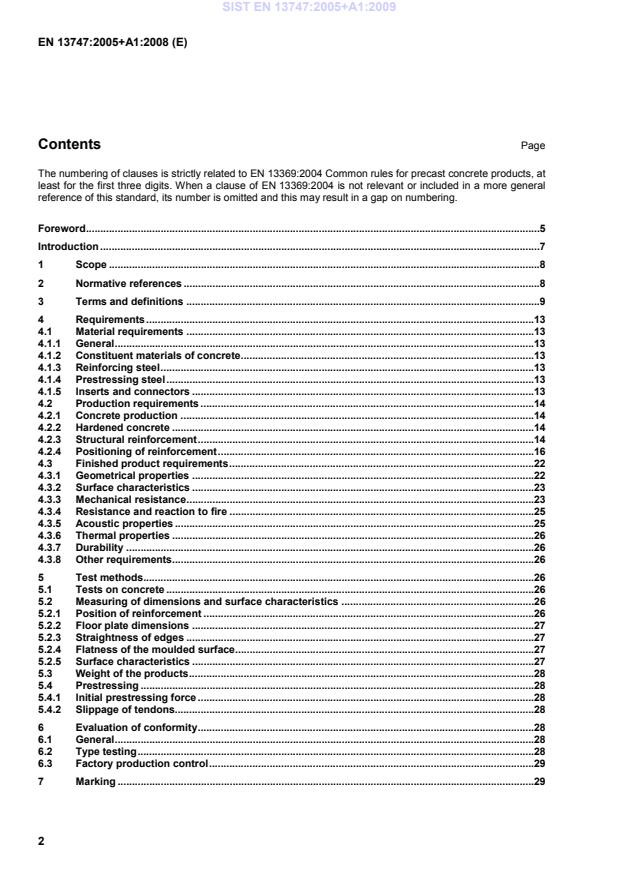
Inspection schemes.30 A.1 Process inspection.30 A.2 Finished product inspection.31 Annex B (informative)
Types of composite slabs.32 B.1 Scope.32 B.2 Different types of composite slabs.32 B.2.1 Solid composite slabs.32 B.2.2 Hollow composite slabs.32 B.3 Topping.33 Annex C (informative)
Stiffening ribs and void formers.34 C.1 Stiffening ribs.34 C.1.1 Nominal width of ribs.34 C.1.2 Nominal height of ribs.34 C.1.3 Nominal space between ribs.34 C.1.4 Distance between the edge of the floor plate and the centre line of the nearest rib.35 C.1.5 Specific case of reinforced floor plate with a single rib.35 C.2 Void formers.36 C.3 Additional examples of stiffening ribs and ball void formers.37 C.3.1 General.37 C.3.2 Dimensions.38 Annex D (informative)
Monolithism of composite slabs.40 D.1 General.40 D.2 Strength of connecting reinforcement.41 D.3 Anchorage of connecting reinforcement.41 Annex E (informative)
Detailing of support joints and anchorage of reinforcement of composite slabs.44 E.1 Scope.44 E.2 General.44 E.2.1 Effective support length.44 E.2.2 Types of connections.45 E.3 Anchorage of lower reinforcements of the composite slab.47 E.3.1 Anchorage on the end support.47 E.3.2 Anchorage in special cases.49 Annex F (informative)
Design of composite slab.53 F.1 General.53 F.2 Connections between adjacent floor plates.53 F.3 Bending ultimate limit state.55 F.4 Serviceability limit state.55 F.4.1 General.55 F.4.2 Serviceability limit state design of composite slab made of reinforced floor plate.56 F.4.3 Serviceability limit states design of composite slabs made of prestressed floor plates.59 F.5 Transverse bending design of composite slab.59 Annex G (informative)
Concrete strength at time of prestressing.61 G.1 General.61 G.1.1 Procedure.61 G.1.2 Interpretation of results.61 Annex H (informative)
Composite slabs with void formers.63 H.1 General.63 H.2 Material properties.63 H.2.1 Polystyrene/Air voids.63 H.2.2 Clay.63 H.3 Temperature profiles.64 H.4 Other items to be considered.64 Annex J (normative)
Testing to determine erection spans (type testing).65 SIST EN 13747:2005+A1:2009
Anchorage capacity of loops.71 Annex ZA (informative)
!Clauses of this European Standard addressing the provisions of the EU Construction Products Directive.74 ZA.1 Scope and relevant characteristics.74 ZA.2 Procedure for attestation of conformity of floor plates for floor systems.76 ZA.2.1 System of attestation of conformity.76 ZA.2.2 EC Certificate and Declaration of conformity.77 ZA.3 CE marking and labelling.78 ZA.3.1 General.78 ZA.3.2 Declaration of geometrical data and material properties (method 1).80 ZA.3.3 Declaration of product properties (method 2).82 ZA.3.4 Declaration of compliance with a given design specification provided by the client (method 3a).84 ZA.3.5 Declaration of compliance with a given design specification provided by the manufacturer according to the client's order (method 3b)".85
the main reinforcement of the composite slab 3.1.3 prestressed floor plate floor plate in which the prestressing steel constitutes all or part of the main reinforcement of the composite slab 3.1.4 floor plate with lattice girders floor plate in which continuous lattice girders are incorporated generally in the longitudinal direction (i.e. parallel to the span) to provide strength and rigidity for transient situations 3.1.5 floor plate with ribs floor plate in which continuous stiffening ribs are positioned generally in the longitudinal direction (i.e. parallel to the span) to provide strength and rigidity for transient situations 3.2 lattice girders two dimensional or three dimensional metallic structure comprising an upper chord, one or more lower chords and continuous or discontinuous diagonals which are welded or mechanically connected to the chords Figure 1 gives some examples of lattice girders.
a) continuous diagonals SIST EN 13747:2005+A1:2009
b) continuous diagonals with steel profile unfilled with concrete
c) discontinuous diagonals Figure 1 — Examples of lattice girders 3.3 stiffening rib continuous concrete profile formed on the upper surface of the floor plate during the precasting operation. It extends generally in the main direction of the floor plate. Figure 2 gives examples of different stiffening rib configurations
a)
rectangular ribs b)
T-section ribs Figure 2 — Examples of stiffening ribs 3.4 Dimensions 3.4.1 length, L dimension of the product in the main mechanical direction (i.e. supporting the
most important bending moment) 3.4.2 width, b dimension perpendicular to the length 3.4.3 thickness, hp nominal distance between the upper and the lower faces of the floor plate. Where the upper surface is uneven (see Figure 3) the distance should be measured to the mean plane of the surface SIST EN 13747:2005+A1:2009
Figure 3 — Thickness hp of a floor plate 3.4.4 edge side of the floor plate. A distinction is made between: supported edge: edge intended for connection to the support elements of the structure; lateral edge: edge between contiguous floor plates; free edge: edge left free after construction of the floor 3.4.5 upper face face of the floor plate when in its final position of use. It forms the interface with cast-in-situ topping above the floor plate 3.4.6 lower face visible face of the precast element in opposition to the upper face 3.5 Reinforcements 3.5.1 connecting reinforcement reinforcement anchored on both sides of the interface between the floor plate and the cast-in-situ concrete. It consists of the diagonals of the lattice girder, individual or continuous reinforcement in the form of loops, possibly with a longitudinal bar welded at the top and/or bottom (see Figure 4).
a) lattice girder b) loops Figure 4 — Examples of connecting reinforcement SIST EN 13747:2005+A1:2009
a) lattice girder b) loops Figure 5 — Examples of shear reinforcements 3.6 Void formers 3.6.1 void former element glued, connected or otherwise incorporated into the floor plate during or after precasting (see Figure 6), but before delivery. These elements are generally intended to decrease the weight of the floor
a) glued or connected b) incorporated Figure 6 — Void formers 3.6.2 non-structural void former void former that does not contribute to the mechanical strength of the composite slab 3.6.3 structural void former void former that, together with the cast-in-situ concrete, contributes to the mechanical strength of the composite slab 3.7 cast in unit unit incorporated into the floor plate during precasting, e.g. lifting inserts, junction or switch boxes, conduits, ducts, etc. SIST EN 13747:2005+A1:2009
Key dg = maximum aggregate size Ø = diameter of the bar NOTE For definition of ∅n see 8.9.1 of EN 1992-1-1:2004. Figure 7 — Minimum distances for good concreting and compaction SIST EN 13747:2005+A1:2009
a) loops without longitudinal bar b) loops with longitudinal bar
c) lattice girder with welded longitudinal bar™ Figure 8 — Protruding connecting reinforcement 4.2.4.1.2 Positioning of connecting reinforcement in the floor plate When the connecting reinforcement is made of continuous loops, the nominal distance between two adjacent reinforcement lines shall be no greater than 4 ht or 835 mm whichever is the lesser (see Figure 9). The distance between vertical legs of a same loop or of two adjacent loops shall be as follows: between the centre axes of two adjacent loops ≤ 300 mm; between the adjacent legs of two loops ≥ 30 mm. SIST EN 13747:2005+A1:2009
Key 1 shear force direction Figure 9 — Spacing of connecting reinforcement 4.2.4.1.3 Connection with the supporting structure Some typical construction details are indicated in Annex E. 4.2.4.1.4 Connection between adjacent floor plates Connection details shall be given in project specifications. Examples of reinforcement details between adjacent floor plates are shown in Annex F. 4.2.4.2 Particular requirements for positioning of lattice girders The positioning of lattice girders shall comply with the following requirements: 4.2.4.2.1 Distance between lattice girders The nominal distance between axis of lattice girders shall be such that (see Figure 10): a ≤ [835 or (15 hp + 125)] mm whichever is the lesser SIST EN 13747:2005+A1:2009
Figure 10 — Distance between axis of lattice girders 4.2.4.2.2 Distance between the outer lattice girder and the nearest edge of the floor plate The nominal distance between the centreline of the edge lattice girder and the nearest edge of the floor plate shall be such that (see Figure 11): a2 ≤ 0,5 [835 or (15 hp + 125)] mm whichever is the lesser
Figure 11 — Distance between the axis of the outer lattice girder and the nearest edge 4.2.4.2.3 Specific case of reinforced floor plate with a single lattice girder The nominal width of a reinforced floor plate with a single lattice girder shall be such that (see Figure 12): b ≤ 0,75 (15 hp + 125) mm or b ≤ 630 mm whichever is the lesser
Figure 12 — Case of a floor plate with a single lattice girder SIST EN 13747:2005+A1:2009
Figure 13 — Minimum embedment of lower chord of the lattice girder into the floor plate 4.2.4.2.5 Longitudinal positioning of lattice girder The nominal distance, lg, from the lower joint of the first diagonal to the nearest edge of the floor plate shall not be greater than 250 mm if this element should be a reinforced plate with lattice girder (see Figure 14). NOTE Short lattice girders which do not fit this requirement should be added (e.g. as bond reinforcement). Dimensions in millimetres
Figure 14 — Longitudinal positioning of lattice girders 4.2.4.3 Particular requirements for positioning of prestressing tendons 4.2.4.3.1 Positioning of prestressing tendons in the floor plates without ribs The pretensioned tendons shall be located on one or more layers according to the thickness of the floor plate. When the floor plate thickness is less than 60 mm the prestressing tendons should be located on one layer, situated close to the middle plane of the floor plate in order to avoid tensile stress in the concrete. SIST EN 13747:2005+A1:2009
or ∅, whichever is the largest; vertically: dg, 10 mm
or ∅ whichever is the largest. e) the nominal distance le, between the outer tendon edge and the nearest longitudinal edge of the floor plate shall be not lesser than 3 ∅ and not greater than 150 mm.
Figure 15 — Positioning of prestressing tendons in floor plate without ribs 4.2.4.3.2 Positioning of prestressing tendons in ribs When prestressing tendons are located in ribs and in the absence of specific justifications, the nominal concrete cover, c, defined as the distance of the prestressing tendon to the nearest edge of the rib shall comply with (see Figure 16): c ≥ (3 ∅ or 15 mm) whichever is the greater where ∅ is the greatest nominal diameter of tendons. SIST EN 13747:2005+A1:2009
Figure 16 — Positioning of prestressing tendons in ribs 4.3 Finished product requirements 4.3.1 Geometrical properties 4.3.1.1 Production tolerances 4.3.1.1.1 Dimensional tolerances The maximum deviations, measured in accordance with 5.2, on the speci
...