

prEN 10250-2
(Main)Open die steel forgings for general engineering purposes - Part 2: Non-alloy quality and special steels
- Abstract
This document specifies the technical delivery requirements for open die forgings, forged bars and products pre-forged and finished in ring rolling mills, manufactured from non-alloy quality and special steels and supplied in the normalized, normalized and tempered, quenched and tempered or annealed condition.
The majority of steels listed in this document, with properties in the quenched and tempered condition up to 160 mm thickness, are identical to steels specified in EN ISO 683-1 and EN ISO 683-2 and more extensive information on hardenability and technological properties is given in these standards.
General information on technical delivery conditions is given in EN 10021.
- Status
- Not Published
- Publication Date
- 06-Dec-2027
- Technical Committee
- CEN/TC 459/SC 11 - Steel castings and forgings
- Drafting Committee
- CEN/TC 459/SC 11/WG 2 - Steel forgings
- Current Stage
- 4060 - Closure of enquiry - Enquiry
- Start Date
- 03-Sep-2026
- Due Date
- 17-Nov-2026
- Completion Date
- 17-Nov-2026
prEN 10250-2 is a draft European Standard from CEN for open die steel forgings for general engineering purposes, Part 2 covering non-alloy quality and special steels. It specifies the technical delivery requirements for open die forgings, forged bars, and products pre-forged and finished in ring rolling mills, for suppliers, purchasers, and inspectors who need to order, test, or accept these products.
What does prEN 10250-2 specify?
prEN 10250-2 covers non-alloy quality and special steels supplied in the normalized, normalized and tempered, quenched and tempered, or annealed condition. It gives the delivery requirements for the product forms named in the scope and organizes them into clauses on composition, heat treatment, and mechanical properties, with one informative annex for heat treatment.
The document is structured as follows:
| Annex | What it covers |
|---|---|
| Annex A | Heat treatment, for guidance |
The scope also places the steels in context with EN ISO 683-1 and EN ISO 683-2, noting that many quenched and tempered grades up to 160 mm thickness are identical to grades in those standards. EN 10021 is named for general technical delivery conditions.
What are the key requirements of prEN 10250-2?
prEN 10250-2 sets chemical, heat-treatment, and mechanical-property requirements that change with steel grade and ruling section thickness. In practice, the buyer and manufacturer need to match the grade, the delivery condition, and the section size before accepting a forging.
Chemical composition and product analysis
The chemical composition shall be determined by cast analysis and must conform to Table 1. Product analysis is also controlled, and its permitted deviation from the cast analysis is taken from EN ISO 683-1. This matters because chemistry drives hardenability, strength, and the suitability of the forging for later heat treatment.
Table 1 lists the covered grades, including S235JR, S215G, S325G, C22 to C60 and their E grades, plus 28Mn6 and 20Mn5. The document also allows aluminium, titanium, vanadium, and niobium for grain size control, while other added elements need purchaser agreement. That means chemistry is not just checked on paper - it is part of the delivery agreement.
Heat treatment
Annex A gives heat-treatment guidance by steel grade. It covers normalizing, quenching, tempering, and the cooling media used for each grade, and it notes that a polymer solution may be used instead of oil. For the reader, this is the reference for setting the furnace route and quench practice for each steel designation.
Mechanical properties and testing
For forgings in the normalized, normalized and tempered, and quenched and tempered condition, test pieces shall be selected, prepared, and tested in accordance with EN 10250-1:2022, Clauses 11 and 12. The resulting properties shall meet Tables 2 and 3. The acceptance values depend on the ruling section thickness, so section size is part of the specification, not just geometry.
Tables 2 and 3 also distinguish longitudinal and transverse test directions, and some grades include impact-test requirements at -20 °C. In practice, this means the same steel can have different acceptance values depending on direction, thickness, and condition.
Annealed forgings
For steels C45, C55, and C60 in the annealed condition, representative forgings selected by agreement with the purchaser shall be Brinell hardness tested in designated positions using EN ISO 6506-1. The maximum hardness shall not exceed the limits in Table 4. This gives a simple acceptance route when the delivery condition is soft-annealed rather than strength-controlled.
What terms does prEN 10250-2 use?
- Cast analysis - the chemical analysis taken from the heat, used as the primary composition check for the steel.
- Product analysis - the chemical analysis of the finished product, used to confirm that the forging still matches the allowed composition window.
- Ruling section - the section thickness used to select the mechanical-property values in Tables 2 and 3.
- Brinell hardness (HB) - an indentation hardness value used here to accept annealed forgings.
- Longitudinal (l) - the test direction parallel to the main working direction of the forging.
- Transverse (tr) - the test direction across the main working direction of the forging.
Who uses prEN 10250-2?
Forge manufacturers and ring rolling mills use prEN 10250-2 to control chemistry, heat treatment, and testing before release. Purchasers, quality managers, and inspectors use it to specify the delivery condition, choose the right grade, and check acceptance results. Testing laboratories use it for the test direction, hardness method, and property tables that support certification and incoming inspection.
What changed in prEN 10250-2 from the previous edition?
prEN 10250-2 will supersede EN 10250-2:2022. The draft states these technical changes compared with the previous edition:
- updated normative references;
- corrected steel designations and steel numbers;
- modified mechanical values for some steel grades and their attributed wall thicknesses.
Which standards are used with prEN 10250-2?
- EN 10250-1:2022 - gives the general requirements for open die steel forgings, and the test-piece preparation and testing clauses referenced in this part.
- EN ISO 683-1:2018 - provides the product-analysis deviation limits and related steel-grade information used with the composition requirements.
- EN ISO 6506-1 - gives the Brinell hardness test method used for annealed forgings.
- EN 10021 - provides the general technical delivery conditions for steel products named in the scope.
- EN ISO 683-2 - is cited in the scope and bibliography as the companion source for alloy steels and additional hardenability and technological-property information.
- EN 10250-1, EN 10250-3, and EN 10250-4 - are the other parts of the EN 10250 series for general requirements, alloy special steels, and stainless steels.
What does the prEN 10250-2 document contain?
The document contains a grade-by-grade chemical composition table, mechanical-property tables split by heat-treatment condition and ruling section thickness, and a maximum-hardness table for annealed forgings. It also contains an informative annex with heat-treatment guidance, including quenching media and temperature ranges by steel designation. The tables are set up for ordering, mill certification, inspection, and acceptance of forged products.
Relations
- Effective Date
- 07-Apr-2025
Get Certified
Connect with accredited certification bodies for this standard

Element Materials Technology
Materials testing and product certification.

Inštitut za kovinske materiale in tehnologije
Institute of Metals and Technology. Materials testing, metallurgical analysis, NDT.
Sponsored listings
Frequently Asked Questions
prEN 10250-2 is a draft published by the European Committee for Standardization (CEN). Its full title is "Open die steel forgings for general engineering purposes - Part 2: Non-alloy quality and special steels". This standard covers: This document specifies the technical delivery requirements for open die forgings, forged bars and products pre-forged and finished in ring rolling mills, manufactured from non-alloy quality and special steels and supplied in the normalized, normalized and tempered, quenched and tempered or annealed condition. The majority of steels listed in this document, with properties in the quenched and tempered condition up to 160 mm thickness, are identical to steels specified in EN ISO 683-1 and EN ISO 683-2 and more extensive information on hardenability and technological properties is given in these standards. General information on technical delivery conditions is given in EN 10021.
This document specifies the technical delivery requirements for open die forgings, forged bars and products pre-forged and finished in ring rolling mills, manufactured from non-alloy quality and special steels and supplied in the normalized, normalized and tempered, quenched and tempered or annealed condition. The majority of steels listed in this document, with properties in the quenched and tempered condition up to 160 mm thickness, are identical to steels specified in EN ISO 683-1 and EN ISO 683-2 and more extensive information on hardenability and technological properties is given in these standards. General information on technical delivery conditions is given in EN 10021.
prEN 10250-2 is classified under the following ICS (International Classification for Standards) categories: 77.140.45 - Non-alloyed steels; 77.140.85 - Iron and steel forgings. The ICS classification helps identify the subject area and facilitates finding related standards.
prEN 10250-2 has the following relationships with other standards: It is inter standard links to EN 10250-2:2022. Understanding these relationships helps ensure you are using the most current and applicable version of the standard.
prEN 10250-2 is available in PDF format for immediate download after purchase. The document can be added to your cart and obtained through the secure checkout process. Digital delivery ensures instant access to the complete standard document.
Standards Content (Sample)
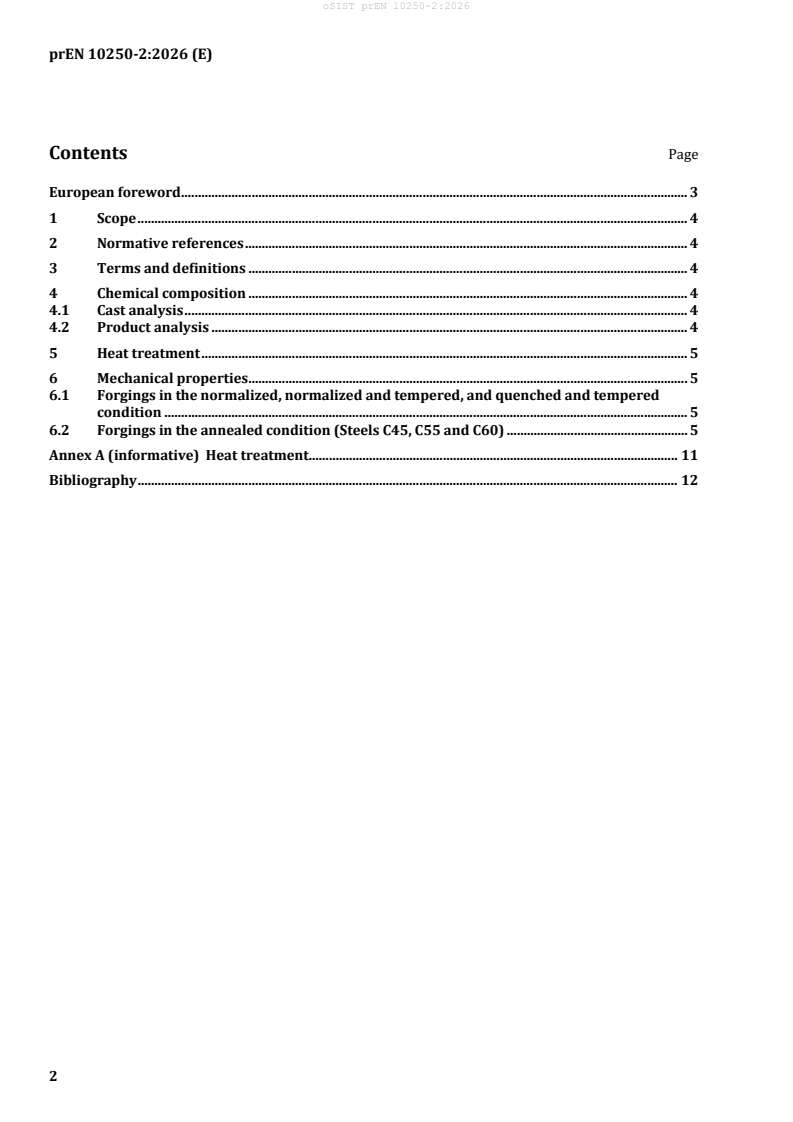
Contents
- 1 Scope
- 2 Normative references
- 3 Terms and definitions
- 4 Chemical composition
- 4.1 Cast analysis
- 4.2 Product analysis
- 5 Heat treatment
- 6 Mechanical properties
- 6.1 Forgings in the normalized, normalized and tempered, and quenched and tempered
- 6.2 Forgings in the annealed condition (Steels C45, C55 and C60)
- Annex A
- Bibliography
1 Scope
This document specifies the technical delivery requirements for open die forgings, forged bars and products pre-forged and finished in ring rolling mills, manufactured from non-alloy quality and special steels and supplied in the normalized, normalized and tempered, quenched and tempered or annealed condition.
The majority of steels listed in this document, with properties in the quenched and tempered condition up to 160 mm thickness, are identical to steels specified in EN ISO 683-1 and EN ISO 683-2 and more extensive information on hardenability and technological properties is given in these standards. General information on technical delivery conditions is given in EN 10021.
2 Normative references
The following documents are referred to in the text in such a way that some or all of their content constitutes requirements of this document. For dated references, only the edition cited applies. For undated references, the latest edition of the referenced document (including any amendments) applies. EN 10250-1:2022, Open die steel forgings for general engineering purposes - Part 1: General requirements EN ISO 683-1:2018, Heat-treatable steels, alloy steels and free-cutting steels - Part 1: Non-alloy steels for quenching and tempering (ISO 683-1:2016) EN ISO 6506-1, Metallic materials - Brinell hardness test - Part 1: Test method (ISO 6506-1)
3 Terms and definitions
No terms and definitions are listed in this document.
ISO and IEC maintain terminological databases for use in standardization at the following addresses:
- IEC Electropedia: available at https://www.electropedia.org/
- ISO Online browsing platform: available at https://www.iso.org/obp
4 Chemical composition
4.1 Cast analysis
The chemical composition of the steel shall be determined by cast analysis and shall conform to the analysis given in Table 1 (see EN 10250-1:2022, A.7 and A.8).
Measures should be taken to prevent the addition from the scrap, or other material used in the manufacture of the steel, of such elements which affect the hardenability, mechanical properties and applicability of the steel.
4.2 Product analysis
The product analysis shall not deviate from the specified cast analysis (see Table 1) by more than the values specified in EN ISO 683-1:2018, Table 4 (see EN 10250-1:2022, 9.2).
oSIST prEN 10250-2:2026 prEN 10250-2:2026 (E)
5 Heat treatment
Heat treatment details are given in Table A.1 for guidance.
6 Mechanical properties
6.1 Forgings in the normalized, normalized and tempered, and quenched and tempered
condition The mechanical properties determined on test pieces selected, prepared and tested in accordance with EN 10250-1:2022, Clauses 11 and 12 shall conform to the property requirements given in Tables 2 and 3, respectively.
6.2 Forgings in the annealed condition (Steels C45, C55 and C60)
Representative forgings selected by a method agreed with the purchaser shall be Brinell hardness tested in designated positions using techniques described in EN ISO 6506-1. The maximum hardness obtained shall not exceed those given for the steel in Table 4.
...