


EN ISO 13849-2:2003
(Main)Safety of machinery - Safety-related parts of control systems - Part 2: Validation (ISO 13849-2:2003)
Safety of machinery - Safety-related parts of control systems - Part 2: Validation (ISO 13849-2:2003)
This European Standard specifies the procedures and conditions to be followed for the validation by analysis and testing of: - the safety functions provided, and - the category achieved of the safety-related parts of the control system, using the design rationale provided by the designer, and in compliance with EN 954-1.
Sicherheit von Maschinen - Sicherheitsbezogene Teile von Steuerungen - Teil 2: Validierung (ISO 13849-2:2003)
Diese Europäische Norm legt die Vorgehensweisen und Bedingungen fest, die bei der Validierung durch Analyse und Prüfung zu befolgen sind, für die vorgesehenen Sicherheitsfunktionen und die ausgeführten Kategorien der sicherheitsbezogenen Teile von Steuerungen, bei Anwendung der durch den Konstrukteur vorgesehenen sinnvollen Gestaltung und in Übereinstimmung mit EN 954-1.
Sécurité des machines - Parties des systèmes de commande relatives à la sécurité - Partie 2: Validation (ISO 13849-2:2003)
La présente norme européenne spécifie les procédures et conditions à suivre pour la validation par analyse et essais: des fonctions de sécurité fournies et de la catégorie atteinte des parties de système de commande relatives à la sécurité en utilisant le raisonnement suivi lors de la conception fourni par le concepteur, conformément à l'EN 954-1.
Varnost strojev - Z varnostjo povezani deli krmilnih sistemov - 2. del: Potrjevanje (ISO 13849-2:2003)
General Information
- Status
- Withdrawn
- Publication Date
- 14-Aug-2003
- Withdrawal Date
- 10-Jun-2008
- Technical Committee
- CEN/TC 114 - Safety of machinery
- Drafting Committee
- CEN/TC 114/WG 6 - Safe control systems
- Current Stage
- 9960 - Withdrawal effective - Withdrawal
- Start Date
- 11-Jun-2008
- Completion Date
- 11-Jun-2008
- Directive
- 98/37/EC - Machinery
Relations
- Effective Date
- 22-Dec-2008
- Effective Date
- 09-Feb-2026
- Effective Date
- 09-Feb-2026
- Effective Date
- 09-Feb-2026
- Effective Date
- 09-Feb-2026
- Effective Date
- 28-Jan-2026
- Effective Date
- 28-Jan-2026

Get Certified
Connect with accredited certification bodies for this standard

NSF International
Global independent organization facilitating standards development and certification.

CIS Institut d.o.o.
Personal Protective Equipment (PPE) certification body. Notified Body NB-2890 for EU Regulation 2016/425 PPE.

Kiwa BDA Testing
Building and construction product certification.
Sponsored listings
Frequently Asked Questions
EN ISO 13849-2:2003 is a standard published by the European Committee for Standardization (CEN). Its full title is "Safety of machinery - Safety-related parts of control systems - Part 2: Validation (ISO 13849-2:2003)". This standard covers: This European Standard specifies the procedures and conditions to be followed for the validation by analysis and testing of: - the safety functions provided, and - the category achieved of the safety-related parts of the control system, using the design rationale provided by the designer, and in compliance with EN 954-1.
This European Standard specifies the procedures and conditions to be followed for the validation by analysis and testing of: - the safety functions provided, and - the category achieved of the safety-related parts of the control system, using the design rationale provided by the designer, and in compliance with EN 954-1.
EN ISO 13849-2:2003 is classified under the following ICS (International Classification for Standards) categories: 13.110 - Safety of machinery. The ICS classification helps identify the subject area and facilitates finding related standards.
EN ISO 13849-2:2003 has the following relationships with other standards: It is inter standard links to EN ISO 13849-2:2008, EN 61010-2-051:2015, EN 60519-1:2015, EN IEC 62933-5-1:2024, EN IEC 62046:2018, EN 280:2001+A2:2009, EN 1870-1:2007+A1:2009. Understanding these relationships helps ensure you are using the most current and applicable version of the standard.
EN ISO 13849-2:2003 is associated with the following European legislation: EU Directives/Regulations: 98/37/EC; Standardization Mandates: M/BC/CEN/88/13. When a standard is cited in the Official Journal of the European Union, products manufactured in conformity with it benefit from a presumption of conformity with the essential requirements of the corresponding EU directive or regulation.
EN ISO 13849-2:2003 is available in PDF format for immediate download after purchase. The document can be added to your cart and obtained through the secure checkout process. Digital delivery ensures instant access to the complete standard document.
Standards Content (Sample)
SLOVENSKI STANDARD
01-junij-2004
Varnost strojev - Z varnostjo povezani deli krmilnih sistemov - 2. del: Potrjevanje
(ISO 13849-2:2003)
Safety of machinery - Safety-related parts of control systems - Part 2: Validation (ISO
13849-2:2003)
Sicherheit von Maschinen - Sicherheitsbezogene Teile von Steuerungen - Teil 2:
Validierung (ISO 13849-2:2003)
Sécurité des machines - Parties des systemes de commande relatives a la sécurité -
Partie 2: Validation (ISO 13849-2:2003)
Ta slovenski standard je istoveten z: EN ISO 13849-2:2003
ICS:
13.110 Varnost strojev Safety of machinery
2003-01.Slovenski inštitut za standardizacijo. Razmnoževanje celote ali delov tega standarda ni dovoljeno.
EUROPEAN STANDARD
EN ISO 13849-2
NORME EUROPÉENNE
EUROPÄISCHE NORM
August 2003
ICS 13.110
English version
Safety of machinery - Safety-related parts of control systems -
Part 2: Validation (ISO 13849-2:2003)
Sécurité des machines - Parties des systèmes de Sicherheit von Maschinen - Sicherheitsbezogene Teile von
commande relatives à la sécurité - Partie 2: Validation (ISO Steuerungen - Teil 2: Validierung (ISO 13849-2:2003)
13849-2:2003)
This European Standard was approved by CEN on 10 April 2003.
CEN members are bound to comply with the CEN/CENELEC Internal Regulations which stipulate the conditions for giving this European
Standard the status of a national standard without any alteration. Up-to-date lists and bibliographical references concerning such national
standards may be obtained on application to the Management Centre or to any CEN member.
This European Standard exists in three official versions (English, French, German). A version in any other language made by translation
under the responsibility of a CEN member into its own language and notified to the Management Centre has the same status as the official
versions.
CEN members are the national standards bodies of Austria, Belgium, Czech Republic, Denmark, Finland, France, Germany, Greece,
Hungary, Iceland, Ireland, Italy, Luxembourg, Malta, Netherlands, Norway, Portugal, Slovakia, Spain, Sweden, Switzerland and United
Kingdom.
EUROPEAN COMMITTEE FOR STANDARDIZATION
COMITÉ EUROPÉEN DE NORMALISATION
EUROPÄISCHES KOMITEE FÜR NORMUNG
Management Centre: rue de Stassart, 36 B-1050 Brussels
© 2003 CEN All rights of exploitation in any form and by any means reserved Ref. No. EN ISO 13849-2:2003 E
worldwide for CEN national Members.
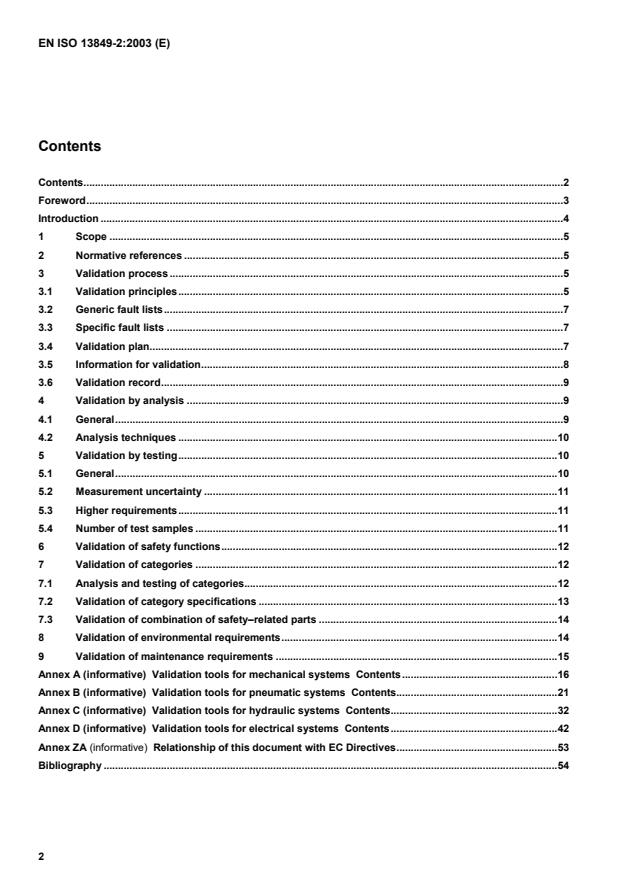
Contents
Contents.2
Foreword.3
Introduction .4
1 Scope .5
2 Normative references .5
3 Validation process .5
3.1 Validation principles.5
3.2 Generic fault lists.7
3.3 Specific fault lists .7
3.4 Validation plan.7
3.5 Information for validation.8
3.6 Validation record.9
4 Validation by analysis .9
4.1 General.9
4.2 Analysis techniques .10
5 Validation by testing.10
5.1 General.10
5.2 Measurement uncertainty .11
5.3 Higher requirements.11
5.4 Number of test samples .11
6 Validation of safety functions.12
7 Validation of categories .12
7.1 Analysis and testing of categories.12
7.2 Validation of category specifications .13
7.3 Validation of combination of safety–related parts .14
8 Validation of environmental requirements.14
9 Validation of maintenance requirements .15
Annex A (informative) Validation tools for mechanical systems Contents.16
Annex B (informative) Validation tools for pneumatic systems Contents.21
Annex C (informative) Validation tools for hydraulic systems Contents.32
Annex D (informative) Validation tools for electrical systems Contents.42
Annex ZA (informative) Relationship of this document with EC Directives.53
Bibliography .54
Foreword
This document EN ISO 13849-2:2003 has been prepared by Technical Committee CEN /TC 114, "Safety of
machinery", the secretariat of which is held by DIN in collaboration with Technical Committee ISO/TC 199 "Safety
of machinery".
This European Standard shall be given the status of a national standard, either by publication of an identical text or
by endorsement, at the latest by February 2004, and conflicting national standards shall be withdrawn at the latest
by February 2004.
This document has been prepared under a mandate given to CEN by the European Commission and the European
Free Trade Association and supports essential requirements of EC Directive(s).
For relationship with EC Directives, see informative annex ZA, which is an integral part of this document.
Annexes A to D are informative and structured as given in Table 1.
Table 1 — Structure of the clauses of annexes A to D
Annex Technology List of basic List of well- List of well- Fault lists and
safety tried safety tried fault
principles principles components exclusions
Clause
A Mechanical A.2 A.3 A.4 A.5
B Pneumatic B.2 B.3 B.4 B.5
C Hydraulic C.2 C.3 C.4 C.5
D Electrical (includes electronics) D.2 D.3 D.4 D.5
This document includes a Bibliography.
EN ISO 13849 consists of the following parts, under the general title "Safety of machinery – Safety-related parts of
control systems":
Part 1: General principles for design
Part 2: Validation
Part 100: Guidelines for the use and application of EN ISO 13849-1.
According to the CEN/CENELEC Internal Regulations, the national standards organizations of the following
countries are bound to implement this European Standard: Austria, Belgium, Czech Republic, Denmark, Finland,
France, Germany, Greece, Hungary, Iceland, Ireland, Italy, Luxembourg, Malta, Netherlands, Norway, Portugal,
Slovakia, Spain, Sweden, Switzerland and the United Kingdom.
Introduction
For the use in the European Union, this part of EN ISO 13849 has the status of a generic safety standard (type B1).
This European Standard specifies the validation process, including both analysis and testing, for the safety
functions and categories for the safety–related parts of control systems. Descriptions of the safety functions and
the requirements for the categories are given in EN 954-1 (ISO 13849-1) which deals with the general principles for
design. Some requirements for validation are general and some are specific to the technology used.
EN ISO 13849-2 also specifies the conditions under which the validation by testing of the safety-related parts of
control systems should be carried out.
EN 954-1 (ISO 13849-1) specifies the safety requirements and gives guidance on the principles for the design [see
EN 292-1:1991 (ISO/TR 12100:1992), 3.11] of the safety-related parts of control systems. For these parts it
specifies categories and describes the characteristics of their safety functions, regardless of the type of energy
used. Additional advice on EN 954-1 (ISO 13894-1) is given in CR 954-100 (ISO/TR 13849-100).
The achievement of the requirements can be validated by any combination of analysis (see clause 4) and testing
(see clause 5). The analysis should be started as early as possible within the design process.
1 Scope
This European Standard specifies the procedures and conditions to be followed for the validation by analysis and
testing of:
the safety functions provided, and
the category achieved
of the safety-related parts of the control system in compliance with EN 954-1 (ISO 13849-1), using the design
rationale provided by the designer.
This European Standard does not give complete validation requirements for programmable electronic systems and
therefore can require the use of other standards.
NOTE CEN/TC 114/WG 6 proposes to deal in more detail with the validation of programmable electronic systems in the
elaboration of the revision to EN 954-1 (ISO 13849-1). An application standard for machinery (draft IEC 62061), based on IEC
61508, is under preparation. Requirements for programmable electronic systems, including embedded software, are given in
IEC 61508.
2 Normative references
This European Standard incorporates by dated or undated reference, provisions from other publications. These
normative references are cited at the appropriate places in the text, and the publications are listed hereafter. For
dated references, subsequent amendments to or revisions of any of these publications apply to this European
Standard only when incorporated in it by amendment or revision. For undated references the latest edition of the
publication referred to applies (including amendments).
EN 292-1:1991 (ISO/TR 12100:1992), Safety of machinery — Basic concepts, general principles for design —
Part 1: Basic terminology, methodology.
EN 954-1:1996 (ISO 13849-1:1999), Safety of machinery — Safety-related parts of control systems — Part 1:
General principles for design.
3 Validation process
3.1 Validation principles
The purpose of the validation process is to confirm the specification and the conformity of the design of the safety-
related parts of the control system within the overall safety requirements specification of the machinery.
The validation shall demonstrate that each safety-related part meets the requirements of EN 954-1 (ISO 13849-1),
in particular:
the specified safety characteristics of the safety functions provided by that part, as set out in the design
rationale, and
the requirements of the specified category [see EN 954-1:1996 (ISO 13849-1:1999), clause 6].
Validation should be carried out by persons who are independent of the design of the safety-related part(s).
rd
NOTE Independent person does not necessarily mean that a 3 party test is required.
The degree of independence should reflect the safety performance of the safety-related part.
Validation consists of applying analysis (see clause 4) and, if necessary, executing tests (see clause 5) in
accordance with the validation plan. Figure 1 gives an overview of the validation process. The balance between the
analysis and/or testing depends on the technology.
The analysis should be started as early as possible and in parallel with the design process, so that problems can
be corrected early whilst they are still relatively easy to correct, i. e. during steps 3 and 4 of EN 954-1:1996
(ISO 13849-1:1999), 4.3. It can be necessary for some parts of the analysis to be delayed until the design is well
developed.
For large systems, due to the size, complexity or integrated form (with the machinery) of the control system, special
arrangements may be made for:
validation of the safety-related parts of the control system separately before integration including simulation of
the appropriate input and output signals;
validation of the effects of integrating safety-related parts into the remainder of the control system within the
context of its use in the machine.
Figure 1 — Overview of the validation process
3.2 Generic fault lists
The validation process involves consideration of behaviour of the safety-related part(s) of the control system for all
faults to be considered. A basis for fault consideration is given in the fault lists in the informative annexes (A.5, B.5,
C.5 and D.5) which are based on experience. The generic fault lists contain:
the components/elements to be included, e. g. conductors/cables (see D.5.2);
the faults to be taken into account, e. g. short circuits between conductors;
the permitted fault exclusions;
a remarks section giving the reasons for the fault exclusions.
Only permanent faults are taken into account.
3.3 Specific fault lists
A specific product-related fault list shall be generated as a reference document for the validation process of the
safety-related part(s). The list can be based on the appropriate generic list(s) found in the annex(es).
Where the specific product-related fault list is based on the generic list(s) it shall state:
the faults taken from the generic list(s) to be included;
any other relevant faults to be included but not given in the generic list (e. g. common mode faults);
the faults taken from the generic list(s) which may be excluded and can meet at least the criteria given in the
generic list(s) [see EN 954-1:1996 (ISO 13849-1:1999), 7.2];
and, exceptionally
any other relevant faults, from the generic list but not permitted for exclusion by the generic list(s), together
with a justification and a rationale for its exclusion [see EN 954-1:1996 (ISO 13849-1:1999), 7.2].
Where this list is not based on the generic list(s) the designer shall give the rationale for fault exclusions.
3.4 Validation plan
The validation plan shall identify and describe the requirements for carrying out the validation process of the
specified safety functions and their categories.
The validation plan shall also identify the means to be employed to validate the specified safety functions and
categories. It shall set out, where appropriate:
a) the identity of the specification documents;
b) the operational and environmental conditions;
c) the basic safety principles (see A.2, B.2, C.2 and D.2);
d) the well-tried safety principles (see A.3, B.3, C.3 and D.3);
e) the well-tried components (see A.4 and D.4);
f) the fault assumptions and fault exclusions to be considered e. g. from the informative fault lists in A.5, B.5, C.5
and D.5;
g) the analyses and tests to be applied.
Safety-related parts which have previously been validated to the same specification need only a reference to that
previous validation.
3.5 Information for validation
The information required for validation will vary with the technology used, the category(ies) to be demonstrated, the
design rationale of the system and the contribution of the safety-related parts of control systems to the reduction of
the risk. Documents containing sufficient information from the list below shall be included in the validation process
to demonstrate the category(ies) and the safety function(s) of the safety-related parts which have been achieved:
a) specification(s) of the expected performance, of the safety functions and categories;
b) drawings and specifications, e. g. for mechanical, hydraulic and pneumatic parts, printed circuit boards,
assembled boards, internal wiring, enclosure, materials, mounting;
c) block diagram(s) with functional description of the blocks;
d) circuit diagram(s) including interfaces/connections;
e) functional description of the circuit diagram(s);
f) time sequence diagram(s) for switching components, signals relevant for safety;
g) description of the relevant characteristics of components previously validated;
h) for other safety-related parts (excluding those listed in g)) component lists with item designations, rated values,
tolerances, relevant operating stresses, type designation, failure rate data and component manufacturer and
any other data relevant for safety;
i) analysis of all relevant faults (see also 3.2) listed e. g. in A.5, B.5, C.5 and D.5, including the justification of any
excluded faults;
j) an analysis of the influence of processed materials;
Category specific information in accordance with Table 2. Where software is relevant to the safety function(s), the
software documentation shall include:
1) a specification which is clear and unambiguous and states the safety performance the software is required
to achieve, and
2) evidence that the software is designed to achieve the required safety performance, and
3) details of tests (in particular test reports) carried out to prove that the required safety performance is
achieved.
Table 2 — Documentation requirements for categories
Documentation requirement Category for which
documentation is
required
B 1 234
Basic safety principles X X XXX
Expected operating stresses X X XXX
Influences of processed material X X XXX
Performance during other relevant external influences X X XXX
Well–tried components – X –––
Well–tried safety principles – X XXX
The check procedure of the safety function(s) – – X ––
Checking intervals, when specified – – X ––
Foreseeable, single faults considered in the design and the detection method used – – x XX
The common mode failures identified and how prevented – – – XX
The foreseeable, single faults excluded – – – XX
The faults to be detected – – x XX
The variety of accumulations of faults considered in the design – – – – X
How the safety function is maintained in the case of each of the fault(s) – – – XX
How the safety function is maintained for each of the combination(s) of faults – – – – X
NOTE The categories mentioned in Table 2 are those given in EN 954-1 (ISO 13849-1).
3.6 Validation record
Validation by analysis and testing shall be recorded. The record shall demonstrate the validation process of each of
the safety requirements. Cross–reference may be made to previous validation records, provided they are properly
identified.
For any safety–related part which has failed part of the validation process, the validation record shall describe the
part(s) of the validation tests and/or analysis which have been failed.
4 Validation by analysis
4.1 General
The validation of safety–related parts of control systems shall be carried out by analysis. Inputs to the analysis are:
the hazards identified during analysis at the machine [see EN 954-1:1996 (ISO 13849-1:1999), Figure 1];
the reliability [see EN 954-1:1996 (ISO 13849-1:1999), 4.2];
the system structure [see EN 954-1:1996 (ISO 13849-1:1999), 4.2];
the non–quantifiable, qualitative aspects which affect system behaviour [see EN 954-1:1996 (ISO 13849-
1:1999), 4.2];
deterministic arguments.
Validation of the safety functions by analysis rather than testing requires the formulation of deterministic
arguments. Deterministic arguments differ from other evidence in that they show that the required properties of the
system follow logically from a model of the system. Such arguments can be constructed on the basis of simple,
well–understood concepts, such as the correctness of a mechanical interlock.
NOTE A deterministic argument is an argument based on qualitative aspects (e. g. quality of manufacture, failure rates,
experience of use). This consideration is depending on the application. This and other factors can affect the deterministic
arguments.
4.2 Analysis techniques
The technique of analysis to be chosen depends upon the goal to be achieved. Two basic types of techniques
exist:
a) Top–down (deductive) techniques are suitable for determining the initiating events that can lead to identified
top events, and calculating the probability of top events from the probability of the initiating events. They can
also be used to investigate the consequences of identified multiple faults. Examples of top–down techniques
are Fault Tree Analysis (FTA – see IEC 61025) and Event Tree Analysis (ETA);
b) Bottom–up (inductive) techniques are suitable for investigating the consequence of identified single faults.
Examples of bottom–up techniques are Failure Modes and Effects Analysis (FMEA – see IEC 60812) and
Failure Modes, Effects and Criticality Analysis (FMECA).
More information on analysis methods is given in EN 1050:1996 (ISO 14121:1999), annex B.
5 Validation by testing
5.1 General
When validation by analysis is not sufficient to demonstrate the achievement of specified safety functions and
categories testing shall be carried out to complete the validation. Testing is always complementary to analysis and
is often necessary.
Validation tests shall be planned and implemented in a logical manner. In particular:
a) A test plan shall be produced prior to the starting of the test and shall include:
1) the test specifications;
2) the expected results of tests;
3) the chronology of the tests.
b) Test records shall be produced that include the following:
1) the name of the tester;
2) the environmental conditions (see clause 8);
3) the test procedures and equipment used;
4) the results of the test.
c) The test records shall be compared with the test plan to give assurance that the specified functional and
performance targets are achieved.
The test sample shall be operated as near as possible to its final operating configuration, i. e. with all peripheral
devices and covers attached.
Testing can be applied manually or automatically (e. g. by computer).
Where applied, validation of the safety functions by testing shall be carried out by applying inputs, in various
combinations, to the safety–related part of the control system. The corresponding outputs shall be compared to the
appropriate specified outputs.
It is recommended that the combination of these inputs be applied systematically to the control system and the
machine. An example of this logic is: power-on, start-up, operation, directional changes, restart-up. Where
necessary, an expanded range of input data shall be applied to take into account anomalous or unusual situations
to see how the safety-related parts of the control system respond. Such combinations of input data shall take into
account foreseeable incorrect operation(s).
The objectives of the test will be determined by the environmental conditions for that test. The conditions may be:
a) the environmental conditions of intended use, or
b) conditions at a particular rating, or
c) a given range of conditions if drift is expected.
NOTE The range of conditions which is considered stable and over which the tests are valid should be agreed between the
designer and the person(s) responsible for carrying out the tests and should be recorded.
5.2 Measurement uncertainty
The uncertainty of measurements during the validation by testing shall be appropriate to the test being carried out.
In general, these measurement uncertainties shall be within 5 K for temperature measurements and 5 % for the
following:
a) time measurements,
b) pressure measurements,
c) force measurements,
d) electrical measurements,
e) relative humidity measurements,
f) linear measurements.
Deviations from these measurement uncertainties shall be justified.
5.3 Higher requirements
If, according to the information in the accompanying documents the control system fulfils higher requirements than
the requirements according to this standard, the higher requirements shall apply.
NOTE Such higher requirements can apply if the control system has to withstand particularly adverse service conditions,
e. g. rough handling, humidity effects, hydrolysation, ambient temperature variations, effects of chemical agents, corrosion, high
strength of electromagnetic fields, for example due to close proximity of transmitters.
5.4 Number of test samples
Unless otherwise specified, the tests shall be made on a single production sample of the safety–related part(s)
which should withstand all the relevant tests.
Safety–related part(s) under test shall not be modified during the course of the tests.
Some tests can permanently change the performance of some components. Where the permanent change in the
components causes the safety–related part(s) to be outside its design specification a new sample(s) shall be used
for subsequent tests.
Where a particular test is destructive and equivalent results can be obtained by testing part of the safety-related
part(s) of the control system providing the safety function in isolation, a sample of that part may be used instead of
the whole safety-related part(s) for the purpose of obtaining the results of the test. This approach shall only be
applied where it has been shown by analysis that testing of the safety–related part(s) is sufficient to demonstrate its
safety performance of the whole safety-related part providing the safety function.
6 Validation of safety functions
An important step is the validation of the safety functions provided by the safety–related parts of the control system
for complete compliance with their specified characteristics. In the validation process it is important to check for
errors and particularly for omissions in the formulated specification, provided with the design rationale.
The aim of validation of the safety functions is to ascertain that the safety–related output signals are correct and
logically dependent on the input signals according to the specification. The validation should cover all normal and
foreseeable abnormal conditions in static and dynamic simulation.
The specified safety functions [in accordance with EN 954–1: 1996 (ISO 13849-1:1999), clause 5] shall be
validated in all operating modes of the machine. This means: validation shall be carried out to demonstrate correct
functionality
in different configurations sufficient to ensure that all safety–related outputs are realised over their complete
ranges. Tests (e. g. overload tests) may be necessary to validate the specified safety functions.
in response to foreseeable abnormal signal from any input source including power interruption and restoration.
NOTE Where appropriate combinations of different configurations should be considered.
7 Validation of categories
7.1 Analysis and testing of categories
The validation of categories shall demonstrate that their requirements are fulfilled. Principally, the following
methods are applicable:
an analysis from circuit diagrams (see clause 4);
tests on the actual circuit and fault simulation on actual components, particularly in areas of doubt, regarding
performance identified during the analysis (see clause 5);
a simulation of control system behaviour, e. g. by means of hardware and/or software models.
In some applications it may be necessary to divide the connected safety–related parts into several functional
groups and to submit these groups and their interfaces to fault simulation tests.
When carrying out validation by testing, the tests can include as appropriate:
fault injection tests into a production sample;
fault injection tests into a hardware model;
software simulation of faults;
subsystem failure, e. g. power supplies.
The precise instant at which a fault is injected into a system can be critical. The worst case effect of a fault injection
should be determined by analysis and, according to this analysis, the fault should be injected at the appropriate
critical time.
7.2 Validation of category specifications
7.2.1 Category B
The safety-related parts of control systems to category B shall be validated in accordance with basic safety
principles (see A.2, B.2, C.2 and D.2) by demonstrating that the specification, design, construction and choice of
components are in accordance with EN 954-1:1996 (ISO 13849-1:1999), 6.2.1. This shall be achieved by checking
that the safety-related part(s) of control systems are in accordance with its specification as provided in the
documents for validation (see 3.5). For the validation of environmental conditions see 5.1.
7.2.2 Category 1
Safety–related parts of control systems to category 1 shall be validated by demonstrating that:
a) they meet the requirements of category B;
b) components are well–tried (see A.4 and D.4) by meeting at least one of the following conditions:
1) they have been widely used with successful results in similar applications;
2) they have been made using principles which demonstrate their suitability and reliability for safety-related
applications;
c) well-tried safety principles (where applicable see A.3, B.3, C.3 and D.3) have been implemented correctly.
Where newly developed principles have been used then the following shall be validated:
1) how the expected modes of failure have been avoided;
2) how faults have been avoided or their probability has been reduced.
Relevant component standards may be used to demonstrate compliance with this subclause (see A.4 and D.4).
7.2.3 Category 2
Safety-related parts of control systems to category 2 shall be validated by demonstrating that:
a) they meet the requirements of category B;
b) the well–tried safety principles used (if applicable) meet the requirements of 7.2.2c);
c) the checking equipment detects all relevant faults applied one at a time during the checking process and
generates an appropriate control action which:
1) initiates a safe state, or when this is not possible,
2) provides a warning of the hazard;
d) the check(s) provided by checking equipment do not introduce an unsafe state;
e) the initiation of the check is carried out
1) at the machine start–up and prior to the initiation of an hazardous situation, and
2) periodically during operation if the risk assessment and the kind of operations show that it is necessary.
7.2.4 Category 3
Safety-related parts of control systems to category 3 shall be validated by demonstrating that:
a) they meet the requirements of category B;
b) the well–tried safety principles (if applicable) meet the requirements of 7.2.2 c);
c) a single fault does not lead to the loss of the safety function;
d) single faults (including common mode faults) are detected in accordance with the design rationale.
7.2.5 Category 4
Safety-related parts of control systems to category 4 shall be validated by demonstrating that:
a) they meet the requirements of category B;
b) the well–tried safety principles (if applicable) meet the requirements of 7.2.2 c);
c) a single fault (including common mode faults) does not lead to the loss of the safety function;
d) the single faults are detected at or before the next demand on the safety function.
e) if d) is not possible, an accumulation of faults does not lead to the loss of the safety function(s). The extent of
the accumulation of faults considered shall be in accordance with the design rationale.
7.3 Validation of combination of safety–related parts
Where the safety function is implemented by two or more safety-related parts, validation of the combination (by
analysis and, if necessary, by testing) shall be undertaken to establish that the combination achieves the
performance specified in the design. Existing recorded validation results of safety-related parts can be taken into
account.
8 Validation of environmental requirements
The performance specified in the design for the safety-related parts of the control system shall be validated with
respect to the environmental conditions specified for the control system.
Validation shall be carried out by analysis and, if necessary by testing. The extent of the analysis and of the testing
will depend upon the safety–related parts, the system in which they are installed, the technology used, and the
environmental condition(s) which is being validated. The use of operational reliability data on the system or its
components, or the confirmation of compliance to appropriate environmental standards (e. g. for waterproofing,
vibration protection) may assist this validation process.
Where applicable validation shall address:
expected mechanical stresses from shock, vibration, ingress of contaminants;
mechanical durability;
electrical ratings and power supplies;
climatic conditions (temperature and humidity);
electromagnetic compatibility (immunity).
When testing is necessary to determine compliance with the environmental requirements the procedures outlined
in the relevant standards shall be followed as far as required for the application.
After the completion of validation by testing the safety functions shall continue to be in accordance with the
specifications for the safety requirements, or the safety-related parts of the control system shall provide output(s)
for a safe state.
9 Validation of maintenance requirements
The validation process shall demonstrate that the maintenance requirements as specified in EN 954-1:1996
(ISO 13849-1:1999), clause 9, paragraph 2, have been implemented.
Annex A
(informative)
Validation tools for mechanical systems
Contents
Annex A (informative) Validation tools for mechanical systems.16
A.1 Introduction .16
A.2 List of basic safety principles.16
A.3 List of well-tried safety principles.17
A.4 List of well–tried components .18
A.5 Fault lists and fault exclusions.19
A.5.1 Introduction .19
A.5.2 Various mechanical devices, components and elements .19
A.5.3 Pressure coil springs .20
A.1 Introduction
When mechanical systems are used in conjunction with other technologies, then relevant tables for basic safety
and well–tried safety principles should also be taken into account. For further fault exclusions see 3.3.
A.2 List of basic safety principles
Table A.1 — Basic safety principles
Basic safety principles Remarks
Use of suitable materials and adequate Selection of material, manufacturing methods and treatment
manufacturing in relation to, e. g. stress, durability, elasticity, friction, wear,
corrosion, temperature.
Correct dimensioning and shaping Consider e. g. stress, strain, fatigue, surface roughness,
tolerances, sticking, manufacturing.
Proper selection, combination, arrangements, Apply manufacturer's application notes, e. g. catalogue
assembly and installation of components/system sheets, installation instructions, specifications, and use of
good engineering practice in similar components/systems.
Use of de–energisation principle The safe state is obtained by release of energy. See primary
action for stopping in EN 292–2:1991 (ISO/TR 12100-
2:1992), 3.7.1. Energy is supplied for starting the movement
of a mechanism. See primary action for starting in
EN 292–2:1991 (ISO/TR 12100-2:1992), 3.7.1.
Consider different modes, e. g. operation mode,
maintenance mode.
This principle shall not be used in special applications, e. g.
to keep energy for clamping devices.
Proper fastening For the application of screw locking consider manufacturer's
application notes.
Overloading can be avoided by applying adequate torque
loading technology
Table A.1 — Basic safety principles (continued)
Basic safety principles Remarks
Limitation of the generation and/or transmission of Examples are break pin, break plate, torque limiting clutch.
force and similar parameters
Limitation of range of environmental parameters Examples of parameters are temperature, humidity, pollution
at the installation place. See clause 8 and consider
manufacturer's application notes.
Limitation of speed and similar parameters Consider e. g. the speed, acceleration, deceleration required
by the application
Proper reaction time Consider e. g. spring tiredness, friction, lubrication,
temperature, inertia during acceleration and deceleration,
combination of tolerances.
Protection against unexpected start–up Consider unexpected start-up caused by stored energy and
after power "supply" restoration for different modes as
operation mode, maintenance mode etc.
Special equipment for release of stored energy may be
necessary.
Special applications, e. g. to keep energy for clamping
devices or ensure a position, need to be considered
separately.
Simplification Reduce the number of components in the safety-related
system.
Separation Separation of safety-related functions from other functions.
Proper lubrication —
Proper prevention of the ingress of fluids and dust Consider IP rating [see EN 60529 (IEC 60529)]
A.3 List of well-tried safety principles
Table A.2 — Well–tried safety principles
Well–tried safety principles Remarks
Use of carefully selected materials and Selection of suitable material, adequate manufacturing
manufacturing methods and treatments related to the application.
Use of components with oriented failure mode The predominant failure mode of a component is known in
advance and always the same, see EN 292-2:1991, (ISO/TR
12100-2:1992), 3.7.4.
Over–dimensioning/safety factor The safety factors are given in standards or by good
experience in safety-related applications.
Safe position The moving part of the component is held in one of the
possible positions by mechanical means (friction only is not
enough). Force is needed for changing the position.
Increased OFF force A safe position/state is obtained by an increased OFF force
in relation to ON force.
Carefully selection, combination, arrangement, —
assembly and installation of components/system
related to the application
Carefully selection of fastening related to the Avoid relying only on friction.
application
Table A.2 — Well–tried safety principles (continued)
Well–tried safety principles Remarks
Positive mechanical action Dependent operation (e. g. parallel operation) between parts
is obtained by positive mechanical link(s). Springs and similar
"flexible" elements should not be part of the link(s) [see
EN 292-2:1991 (ISO/TR 12100-2:1992), 3.5].
Multiple parts Reducing the effect of faults by multiplying parts, e. g. where
a fault of one spring (of many springs) does not lead to a
dangerous condition.
Use of well–tried spring A well–tried spring requires:
(see also Table A.3)
use of carefully selected materials, manufacturing
methods (e. g. presetting and cycling before use) and
treatments (e. g. rolling and shot–peening),
sufficient guidance of the spring, and
sufficient safety factor for fatigue stress (i. e. with high
probability a fracture will not occur).
Well–tried pressure coil springs may also be designed by:
use of carefully selected materials, manufacturing
methods (e. g. presetting and cycling before use) and
treatments (e. g. rolling and shot-peening),
sufficient guidance of the spring, and
clearance between the turns less than the wire diameter
when unloaded, and
sufficient force after a fracture(s) is maintained (i. e. a
fracture(s) will not lead to a dangerous condition).
Limited range of force and similar parameters Decide the necessary limitation in relation to the experience
and application. Examples for limitations are break pin, break
plate, torque limiting clutch.
Limited range of speed and similar parameters Decide the necessary limitation in relation to the experience
and application. Examples for limitations are centrifugal
governor; safe monitoring of speed or limited displacement.
Limited range of environmental parameters Decide the necessary limitations. Examples on parameters
are temperature, humidity, pollution at the installation. See
clause 8 and consider manufacturer's application notes.
Limited range of reaction time, limited hysteresis Decide the necessary limitations.
Consider e. g. spring tiredness, friction, lubrication,
temperature, inertia during acceleration and deceleration,
combination of tolerances.
A.4 List of well–tried components
Well–tried components for a safety–related application in the following list are based on the application of well–tried
safety principles and/or a standard for their particular applications.
A well–tried component for some applications can be inappropriate for other applications.
Table A.3 — Well–tried components
Well-tried Conditions for “well–tried” Standard or specification
components
Screw All factors influencing the screw connection a
...
Questions, Comments and Discussion
Ask us and Technical Secretary will try to provide an answer. You can facilitate discussion about the standard in here.
Loading comments...