

EN 1060-4:2004
(Main)Non-invasive sphygmomanometers - Part 4: Test procedures to determine the overall system accuracy of automated non-invasive sphygmomanometers
- Abstract
This document describes test procedures for investigations to determine the overall system accuracy of automated non-invasive sphygmomanometers, designed for the indirect measurement of blood pressure.
- Status
- Withdrawn
- Publication Date
- 28-Sep-2004
- Withdrawal Date
- 29-Apr-2014
- Technical Committee
- CEN/TC 205 - Non-active medical devices
- Drafting Committee
- CEN/TC 205/WG 10 - Non-invasive sphygmomanometers
- Current Stage
- 9960 - Withdrawal effective - Withdrawal
- Start Date
- 30-Apr-2014
- Completion Date
- 30-Apr-2014
- Directive
- 93/42/EEC - Medical devicesOJ Ref: C, C 16 OJ Date: 18-Jan-2011

Relations
- Effective Date
- 07-May-2014
- Effective Date
- 29-Apr-2026
- Effective Date
- 28-Jan-2026
- Effective Date
- 28-Jan-2026
- Effective Date
- 28-Jan-2026
- Effective Date
- 28-Jan-2026
Get Certified
Connect with accredited certification bodies for this standard

BSI Group
BSI (British Standards Institution) is the business standards company that helps organizations make excellence a habit.

TÜV Rheinland
TÜV Rheinland is a leading international provider of technical services.

TÜV SÜD
TÜV SÜD is a trusted partner of choice for safety, security and sustainability solutions.
Sponsored listings
Frequently Asked Questions
EN 1060-4:2004 is a standard published by the European Committee for Standardization (CEN). Its full title is "Non-invasive sphygmomanometers - Part 4: Test procedures to determine the overall system accuracy of automated non-invasive sphygmomanometers". This standard covers: This document describes test procedures for investigations to determine the overall system accuracy of automated non-invasive sphygmomanometers, designed for the indirect measurement of blood pressure.
This document describes test procedures for investigations to determine the overall system accuracy of automated non-invasive sphygmomanometers, designed for the indirect measurement of blood pressure.
EN 1060-4:2004 is classified under the following ICS (International Classification for Standards) categories: 11.040.55 - Diagnostic equipment. The ICS classification helps identify the subject area and facilitates finding related standards.
EN 1060-4:2004 has the following relationships with other standards: It is inter standard links to EN ISO 81060-2:2014, EN ISO 14155:2026, EN 1060-1:1995, EN ISO 81060-1:2012, EN ISO 14155:2020, EN 1060-3:1997. Understanding these relationships helps ensure you are using the most current and applicable version of the standard.
EN 1060-4:2004 is associated with the following European legislation: EU Directives/Regulations: 93/42/EEC; Standardization Mandates: M/023. When a standard is cited in the Official Journal of the European Union, products manufactured in conformity with it benefit from a presumption of conformity with the essential requirements of the corresponding EU directive or regulation.
EN 1060-4:2004 is available in PDF format for immediate download after purchase. The document can be added to your cart and obtained through the secure checkout process. Digital delivery ensures instant access to the complete standard document.
Standards Content (Sample)
2003-01.Slovenski inštitut za standardizacijo. Razmnoževanje celote ali delov tega standarda ni dovoljeno.Nichtinvasive Blutdruckmessgeräte - Teil 4: Prüfverfahren zur Bestimmung der Messgenauigkeit von automatischen nichtinvasiven BlutdruckmessgerätenTensiometres non invasifs - Partie 4 : Procédures pour déterminer la précision de l'ensemble du systeme des tensiometres non invasifs automatiquesNon-invasive sphygmomanometers - Part 4: Test procedures to determine the overall system accuracy of automated non-invasive sphygmomanometers11.040.55Diagnostic equipmentICS:Ta slovenski standard je istoveten z:EN 1060-4:2004SIST EN 1060-4:2005en01-marec-2005SIST EN 1060-4:2005SLOVENSKI
STANDARD
EUROPEAN STANDARDNORME EUROPÉENNEEUROPÄISCHE NORMEN 1060-4September 2004ICS 11.040.55 English versionNon-invasive sphygmomanometers - Part 4: Test procedures todetermine the overall system accuracy of automated non-invasive sphygmomanometersTensiomètres non invasifs - Partie 4 : Procédures pourdéterminer la précision de l'ensemble du système destensiomètres non invasifs automatiquesNichtinvasive Blutdruckmessgeräte - Teil 4: Prüfverfahrenzur Bestimmung der Messgenauigkeit von automatischennichtinvasiven BlutdruckmessgerätenThis European Standard was approved by CEN on 9 July 2004.CEN members are bound to comply with the CEN/CENELEC Internal Regulations which stipulate the conditions for giving this EuropeanStandard the status of a national standard without any alteration. Up-to-date lists and bibliographical references concerning such nationalstandards may be obtained on application to the Central Secretariat or to any CEN member.This European Standard exists in three official versions (English, French, German). A version in any other language made by translationunder the responsibility of a CEN member into its own language and notified to the Central Secretariat has the same status as the officialversions.CEN members are the national standards bodies of Austria, Belgium, Cyprus, Czech Republic, Denmark, Estonia, Finland, France,Germany, Greece, Hungary, Iceland, Ireland, Italy, Latvia, Lithuania, Luxembourg, Malta, Netherlands, Norway, Poland, Portugal, Slovakia,Slovenia, Spain, Sweden, Switzerland and United Kingdom.EUROPEAN COMMITTEE FOR STANDARDIZATIONCOMITÉ EUROPÉEN DE NORMALISATIONEUROPÄISCHES KOMITEE FÜR NORMUNGManagement Centre: rue de Stassart, 36
B-1050 Brussels© 2004 CENAll rights of exploitation in any form and by any means reservedworldwide for CEN national Members.Ref. No. EN 1060-4:2004: ESIST EN 1060-4:2005
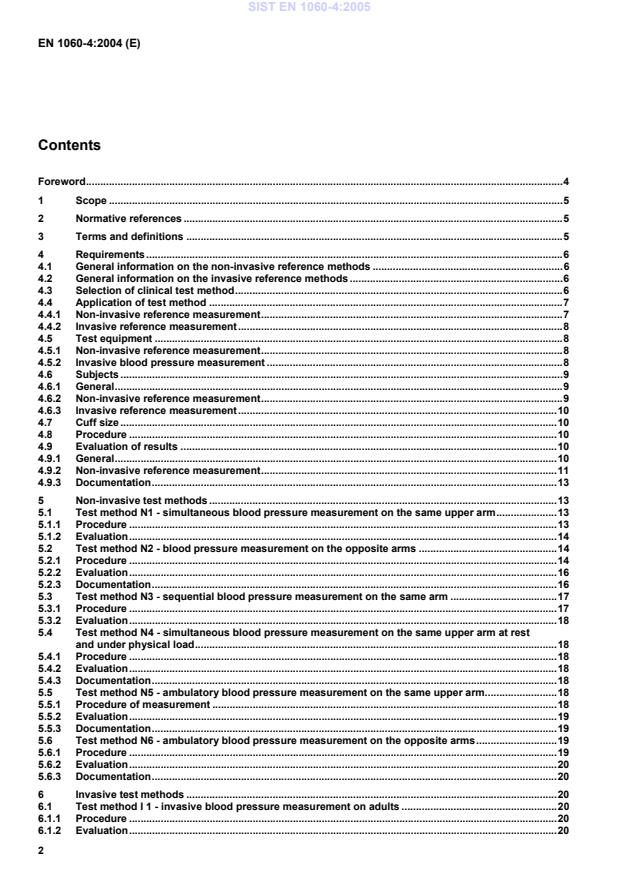
Example of a record of a clinical investigation according to method N1 or N3.24 Annex C (informative)
Summary of the WHO recommendations for auscultatory blood pressure measurement.27 Annex D (informative)
Observer training and assessment etc.28 Annex E (informative)
A–deviations.30 Annex ZA (informative)
Relationship between this European Standard and the
Essential Requirements of EU Directive 93/42/EC Medical Devices.31 Bibliography.32
This document includes a Bibliography. According to the CEN/CENELEC Internal Regulations, the national standards organizations of the following countries are bound to implement this European Standard: Austria, Belgium, Cyprus, Czech Republic, Denmark, Estonia, Finland, France, Germany, Greece, Hungary, Iceland, Ireland, Italy, Latvia, Lithuania, Luxembourg, Malta, Netherlands, Norway, Poland, Portugal, Slovakia, Slovenia, Spain, Sweden, Switzerland and United Kingdom. SIST EN 1060-4:2005
EN 1060-1:1995, Non-invasive sphygmomanometers – Part 1: General requirements. EN 1060-2, Non-invasive sphygmomanometers – Part 2: Supplementary requirements for mechanical sphygmomanometers. EN 1060-3:1997, Non-invasive sphygmomanometers - Part 3: Supplementary requirements for electro-mechanical blood pressure measuring systems. EN ISO 14155-1, Clinical investigation of medical devices for human subjects - Part 1: General requirements (ISO 14155-1:2003). EN ISO 14155-2, Clinical investigation of medical devices for human subjects - Part 2: Clinical investigation plans (ISO 14155-2:2003). 3 Terms and definitions For the purposes of this document, the terms and definitions given in EN 1060–1:1995 and EN 1060–3:1997 and the following apply. 3.1 neonatal mode mode, specified by the manufacturer of the sphygmomanometer for the measurement of neonates/infants 3.2 paired measurements parallel blood pressure measurements carried out by the observers and the device under test at the same arm at the same time or
on opposite arms at the same time or
at the same arm at different times or at one arm and another limb, at the same time or at different times. SIST EN 1060-4:2005
The calibrated reference manometers shall comply with the requirements of EN 1060-1 to EN 1060-3 but shall not exceed error limits of 1 mmHg (0,1 kPa) with dropping cuff pressure prior to the start of the clinical investigation. NOTE 2
The reference manometer should be calibrated before and after the clinical investigation. When the reference manometer is linked to the pneumatic system of the tested device (e.g. test method N2), an aneroid manometer should be used. Mercury manometer may alter pneumatic characteristics (resonant frequency, damping coefficient) and should not be used in this case. 4.2 General information on the invasive reference methods The clinical investigation shall be performed in accordance with EN ISO 14155–1 and EN ISO 14155–2. The invasive blood pressure measuring system consisting of catheter, pressure transducer, monitor and recording device shall be statically calibrated so that the indicated values do not deviate from the values indicated by the reference manometer (see 4.5.1.1 a) by more than ± 2 mmHg. Prior to and after each series of measurements the resonant frequency and damping coefficient of the system shall be determined [1]. Except for devices measuring in the neonatal mode, the comparison shall be carried out by invasive and non-invasive blood pressure measurement on the same arm. The simultaneous measurement on opposite arms is permissible if no lateral difference has been determined by additional measurements. NOTE Intra-arterial methods are invasive and should not be used for patients or subjects solely for the purpose of validating instrument performance, but conducted on clinical patients in whom an intra-arterial line has already been placed for reasons other than sphygmomanometer verification. 4.3 Selection of clinical test method The selection of the clinical test method is dependent on the measurement technique, the application of the sphygmomanometers to be tested and the intended application of the device and shall be in accordance with
Table 1. SIST EN 1060-4:2005
Clinical test method as a function of application
adults neonatal mode ergo.a ABPMb Continuous pressure drop or pressure drop in steps (upper arm measurement) ≤ 3 mmHg/s or
≤ 3 mmHg/pulsec
> 3 mmHg/s or > 3 mmHg/pulsec
N1/N2/N3N2/N3
- -
N4 -
N5/N6 N6 Measurement on other sites than the upper arm
N2/N3
Auscultatory measurement at the upper arm Measurement during inflation phase N2/N3 - - N6 Invasive measurement Measurement during the pressure drop or the inflation phase I 1 I 2 - - a Ergometry (measurement under physical load) b Ambulatory blood pressure measurement c For devices adapting to the pulse rate
4.4 Application of test method 4.4.1 Non-invasive reference measurement 4.4.1.1 Simultaneous blood pressure measurement on the same upper arm; also under physical load and ambulatory The test methods (N1, N4, N5) for the simultaneous blood pressure measurement on the same upper arm are suitable for sphygmomanometers operating with continuous pressure drop (rate of pressure drop ≤ 3 mmHg/s) and/or with pressure drop in steps (rate of pressure drop per step ≤ 3 mmHg) and/or with a pulse-controlled pressure drop (rate of pressure drop ≤ 3 mmHg per pulse) These values apply for the range of the systolic and diastolic blood pressures. 4.4.1.2 Simultaneous blood pressure measurement on opposite arms The test methods (N2 and N6) for the simultaneous blood pressure measurement are suitable for sphygmomanometers operating with continuous pressure drop and/or
with pressure drop in steps and/or with a pulse-controlled pressure drop. This test method is also suitable for sphygmomanometers measuring during the inflation phase or measuring on other sites then upper arm. SIST EN 1060-4:2005
with pressure drop in steps and/or with a pulse-controlled pressure drop and/or measuring on other sites than the upper arm. This test method is also suitable for sphygmomanometers measuring during the inflation phase. 4.4.2 Invasive reference measurement The test method (I1) is suitable for sphygmomanometers for measurement on adults. The test method (I2) is suitable for sphygmomanometers for measurement on
neonates and infants. 4.5 Test equipment 4.5.1 Non-invasive reference measurement
4.5.1.1 Simultaneous blood pressure measurement; also under physical load and ambulatory a) calibrated reference manometer(s) with error limit(s) of 1 mmHg (0,1 kPa); b) T-piece; c) hose; d) double stethoscope. 4.5.1.2 Opposite arm or sequential blood pressure measurement; also ambulatory a) calibrated reference manometer(s) with error limit(s) of 1 mmHg (0,1 kPa) b) double stethoscope and for method N2 additionally two stethoscopes; c) cuff(s). 4.5.2 Invasive blood pressure measurement
a) calibrated reference manometer with error limit of 1 mmHg (0,1 kPa); b) invasive blood pressure measuring system; c) device for the recording of the invasive blood pressure. SIST EN 1060-4:2005
between 50 % and 75 % shall have a circumference of the wrist, which lies within the upper half of the specified range of use of the cuff (if applicable); at least 10 % below 110 mmHg systolic blood pressure; at least 10 % above 160 mm Hg systolic blood pressure; at least 10 % below 70 mmHg diastolic blood pressure; at least 10 % above 100 mm Hg diastolic blood pressure.
The different blood pressure groups (see above) shall be classified in accordance with the first valid blood pressure reference measurements. 4.6.2 Non-invasive reference measurement
4.6.2.1 General A minimum of 3 measurements shall be carried out on each of at least 85 subjects.
4.6.2.2 Additional requirements for sphygmomanometers measuring under physical load At least 6 paired measurements shall be carried out on each of at least 85 subjects. As much as possible, female and male subjects shall be evenly distributed while at most 25 % shall originate from the field of sports medicine. The different blood pressure groups (see 4.6.1) shall be classified in accordance with the first valid blood pressure reference measurements at rest. 4.6.2.3 Additional requirements for ambulatory sphygmomanometers At least 6 paired measurements shall be carried out on each of at least 85 subjects. The different blood pressure groups (see 4.6.1) shall be classified in accordance with the first valid blood pressure reference measurements at rest. SIST EN 1060-4:2005
< 1000 at least 3 ≥ 1000
≤
at least 3 ≥ 2000
at least 3
4.7 Cuff size The cuff of the sphygmomanometer to be tested shall be selected and applied in accordance with the recommendations of the manufacturer (see 9.2 of EN 1060-1:1995).
The measurement shall cover all cuff sizes and applications in accordance with the intended use described in the accompanying document. 4.8 Procedure The investigation shall be carried out under normal conditions which shall be within the specifications given by the manufacturer in the instructions for use. References in the instructions for use to limitations of the application shall be taken into account. The blood pressure values shall be measured carefully without interruption of the measuring series for each subject, if possible. NOTE An initial measurement should be taken. It should not be included in the evaluation (see annex A). 4.9 Evaluation of results 4.9.1 General The results of the evaluation of all measurements shall be within the limits determined in 7.9 of EN 1060-3:1997. The first 3 valid paired measurements shall be used for the evaluation. SIST EN 1060-4:2005
4.9.2.1 Blood pressure measurement on the same arm (simultaneous or sequential) The evaluation of the test methods (N1, N 3 and N 5) shall be as follows: First, calculate the paired differences for all 255 (85x3) measurements in accordance with Equations (1) and (2). ∆pSYS = pSYSt – pSYSa (1) ∆pDIA = pDIAt – pDIAa (2) where pSYSt
is the systolic blood pressure value indicated by the sphygmomanometer under test; pSYSa
is the auscultatory mean systolic blood pressure value determined by the observers; pDIAt
is the diastolic blood pressure value indicated by the sphygmomanometer under test; pDIAa
is the auscultatory mean diastolic blood pressure value determined by the observers. The arithmetic mean values and the empirical standard deviations shall be calculated for the measurements at rest and under physical load/during exercise, if applicable. The mean values are
DIASYS,pp∆∆ and the related empirical standard deviations are s (∆pSYS), s (∆pDIA)
4.9.2.2 Blood pressure measurement on opposite arms (also ambulatory) To obtain correct result from the evaluation described below, compliance with 5.2.1.3 is required.
For the evaluation of the test methods (N2 and N6) six lateral differences ∆prl shall be determined separately for the systolic and diastolic blood pressure values as follows: ∆pSYSrl = pSYSr – pSYSl (3) ∆pDIArl = pDIAr – pDIAl (4) where pSYSr
is the systolic blood pressure value of
the right arm measured by the observer pSYSl
is the systolic blood pressure value of
the left arm measured by the observer pDIAr
is the diastolic blood pressure value of
the right arm measured by the observer pDIAl
is the diastolic blood pressure value of
the left arm measured by the observer SIST EN 1060-4:2005
rlDIAp∆≤ 15 mmHg.
and s (∆pSYSrl) ≤ 8 mmHg s (∆pDIArl) ≤ 8 mmHg The correction of the auscultatory reference blood pressure values (pSYSausc, PDIAa) of the paired measurement shall be calculated as follows: pSYSref = pSYSausc – rlSYSp (5) pDIAref = PDIAa – rlDIAp (6) where pSYSausc is the auscultatory mean systolic blood pressure value determined by the observers at the right arm PDIAa is the auscultatory mean diastolic blood pressure value determined by the observers at the right arm The arithmetic mean values and the empirical standard deviations shall be calculated for the measurements at rest and during exercise, if applicable. ∆pSYS = pSYSt – pSYSref (7) ∆pDIA = pDIAt – pDIAref (8) where pSYSt is the systolic blood pressure value indicated by the sphygmomanometer under test applied at the left arm; pDIAt is the diastolic blood pressure value indicated by the sphygmomanometer under test applied at the left arm; From these, the arithmetic mean values and the appertaining empirical standard deviations shall be calculated from the differences of the blood pressure values of all subjects and the measurements at rest and during exercise, if applicable.
DIASYS,pp∆∆ s (∆pSYS), s (∆pDIA)
Key 1 Tested device 2 Reference manometer 3 Double stethoscope Figure 1 — Schematic drawing of the simultaneous blood pressure measurement on the same arm at the same time At least three measurements shall be carried out on each of the 85 subjects. NOTE One reference manometer can be used, only if it is guaranteed that both observers can read the values without error (e.g. parallax error). Rapid deflation valves opening automatically shall only open when the diastolic blood pressure value has been determined by the observers. If necessary the sphygmomanometer shall be modified for the clinical investigation. 5.1.2 Evaluation In accordance with 4.9.2.1. 5.2 Test method N2 - blood pressure measurement on the opposite arms 5.2.1 Procedure 5.2.1.1 General At least two trained observers shall carry out the same number of measurements on at least 85 subjects. The comparison of the values measured by the sphygmomanometer to be tested with the blood pressure values determined auscultatorily can only be carried out by simultaneous measurement on opposite arms. Possible differences between the blood pressure values of the right and left arm (lateral difference) shall be take
...