

EN 3976:2006
(Main)Aerospace series - Titanium and titanium alloys - Test method - Chemical analysis for the determination of hydrogen content
- Abstract
This standard specifies the requirements for chemical analysis using Inert Gas Fusion Thermal Conductivity Method for the determination of the hydrogen content of titanium and titanium alloys for aerospace applications.
The method applies to hydrogen contents ranging from several micrograms per gram to several hundreds of micrograms per gram.
It shall be applied when referred to in the EN technical specification or material standard unless otherwise specified on the drawing, order or inspection schedule.
NOTE The absolute method not used in routine inspection is solid state hot extraction under vacuum followed by measurement of volume and pressure. Due to its complexity, it is only summarized in Annex A.
- Status
- Published
- Publication Date
- 19-Dec-2006
- Withdrawal Date
- 29-Jun-2007
- Technical Committee
- ASD-STAN - Aerospace
- Drafting Committee
- ASD-STAN/D 4 - Metallic
- Current Stage
- 9093 - Decision to confirm - Review Enquiry
- Start Date
- 01-Jun-2017
- Completion Date
- 07-Oct-2026

Overview
EN 3976:2006 is a CEN aerospace standard that specifies a chemical analysis method - the Inert Gas Fusion Thermal Conductivity Method - for determining hydrogen content in titanium and titanium alloys used in aerospace applications. The procedure covers hydrogen levels from several micrograms per gram up to several hundreds of micrograms per gram and is to be used when referenced by an EN technical specification, material standard, drawing or inspection schedule. An informative Annex A summarizes the non-routine absolute method (solid‑state hot extraction under vacuum).
Keywords: EN 3976:2006, titanium hydrogen analysis, inert gas fusion, thermal conductivity method, hydrogen content aerospace
Key topics and requirements
- Principle: Thermal decomposition of metallic hydrides in a graphite crucible; degassed hydrogen carried by inert gas to a thermal conductivity detector (catharometer) for quantitative measurement.
- Extraction modes:
- Method 1 (with flux): fusion around 1 800 °C, supporting gas nitrogen or argon; flux prevents nitride formation and improves extraction.
- Method 2 (without flux): fusion around 2 100 °C, supporting gas argon (to avoid nitrides).
- Equipment & gases: induction/resistance furnace, sample introduction device, gas sweep/separation systems, thermal conductivity cell; high-purity supporting gases (N2, Ar), calibration gases (H2, He).
- Calibration & reference materials: use of gas injection calibration and Certified Reference Materials (CRMs) traceable to SI units per ISO Guides 30/31/35. If helium calibration is used, apply the corrective coefficient k = 0.60 ± 0.01 to compensate detector sensitivity differences.
- Sampling & preparation: dry machining without lubricants; thorough solvent cleaning (e.g., carbon tetrachloride, diethyl ether, acetone); optional pickling with nitric/hydrofluoric acid mixtures (e.g., 4:1), rinsing and drying; typical sample mass ~250 mg (may vary by apparatus). Blank tests required.
- Reporting & units: results expressed as concentration per unit mass in microgram per gram (µg/g); testing personnel must be qualified and health/safety rules followed.
Applications and users
EN 3976:2006 is intended for:
- Aerospace materials laboratories performing incoming inspection, material certification, and quality control of titanium and titanium alloys.
- Manufacturers and suppliers of aerospace titanium components concerned with hydrogen monitoring to prevent embrittlement and performance degradation.
- Design, inspection and procurement engineers specifying acceptance criteria on drawings and orders.
- Certification bodies and test houses that require standardized, traceable hydrogen measurement procedures.
Practical uses include acceptance testing of raw stock and components, investigation of hydrogen-related failures, and process control for melting, forging and heat treatments.
Related standards
- EN 2003-10 - Sampling for determination of hydrogen content (titanium)
- EN 4258 - Organization of aerospace metallic material standards
- EN 4259 - Definition of general terms
- ISO Guide 30, ISO Guide 31, ISO Guide 35 - Reference material terminology and certification
For purchasers and labs, referencing EN 3976:2006 ensures consistent, traceable hydrogen analyses of titanium alloys used in critical aerospace applications.
Relations
- Effective Date
- 25-Aug-2026
- Effective Date
- 25-Aug-2026
- Refers
ISO Guide 35:2006 - Reference materials — General and statistical principles for certification - Effective Date
- 25-Aug-2026
- Effective Date
- 28-Jan-2026
- Effective Date
- 28-Jan-2026
- Effective Date
- 28-Jan-2026
- Effective Date
- 28-Jan-2026
- Effective Date
- 28-Jan-2026
- Effective Date
- 28-Jan-2026
- Effective Date
- 28-Jan-2026
- Effective Date
- 28-Jan-2026
- Effective Date
- 28-Jan-2026
- Effective Date
- 28-Jan-2026
- Effective Date
- 28-Jan-2026
- Effective Date
- 28-Jan-2026
Get Certified
Connect with accredited certification bodies for this standard

BUREAU VERITAS Certification Germany
Bureau Veritas certification in Germany.

Element Materials Technology
Materials testing and product certification.

AQMS Ltd.
AQMS provides ISO certification to SMEs across the UK.
Sponsored listings
Frequently Asked Questions
EN 3976:2006 is a standard published by the European Committee for Standardization (CEN). Its full title is "Aerospace series - Titanium and titanium alloys - Test method - Chemical analysis for the determination of hydrogen content". This standard covers: This standard specifies the requirements for chemical analysis using Inert Gas Fusion Thermal Conductivity Method for the determination of the hydrogen content of titanium and titanium alloys for aerospace applications. The method applies to hydrogen contents ranging from several micrograms per gram to several hundreds of micrograms per gram. It shall be applied when referred to in the EN technical specification or material standard unless otherwise specified on the drawing, order or inspection schedule. NOTE The absolute method not used in routine inspection is solid state hot extraction under vacuum followed by measurement of volume and pressure. Due to its complexity, it is only summarized in Annex A.
This standard specifies the requirements for chemical analysis using Inert Gas Fusion Thermal Conductivity Method for the determination of the hydrogen content of titanium and titanium alloys for aerospace applications. The method applies to hydrogen contents ranging from several micrograms per gram to several hundreds of micrograms per gram. It shall be applied when referred to in the EN technical specification or material standard unless otherwise specified on the drawing, order or inspection schedule. NOTE The absolute method not used in routine inspection is solid state hot extraction under vacuum followed by measurement of volume and pressure. Due to its complexity, it is only summarized in Annex A.
EN 3976:2006 is classified under the following ICS (International Classification for Standards) categories: 49.025.30 - Titanium. The ICS classification helps identify the subject area and facilitates finding related standards.
EN 3976:2006 has the following relationships with other standards: It is inter standard links to ISO Guide 31:2000, ISO Guide 30:1992, ISO Guide 35:2006, prEN ISO 17865, FprEN 13561 rev, EN 2003-010:2007, EN 4124:2003, EN 4258:2024, EN 4800-001:2010, EN 4800-004:2025, EN 4800-008:2010, EN 4800-002:2025, EN 4800-003:2010, EN 4800-002:2010, EN 4800-005:2010. Understanding these relationships helps ensure you are using the most current and applicable version of the standard.
EN 3976:2006 is available in PDF format for immediate download after purchase. The document can be added to your cart and obtained through the secure checkout process. Digital delivery ensures instant access to the complete standard document.
Standards Content (Sample)
2003-01.Slovenski inštitut za standardizacijo. Razmnoževanje celote ali delov tega standarda ni dovoljeno.Luft- und Raumfahrt - Titan und Titanlegierungen - Prüfverfahren - Chemische Analyse zur Bestimmung des WasserstoffgehaltesSérie aérospatiale - Titane et alliages de titane - Méthode d'essai - Analyse chimique pour détermination de la teneur en hydrogèneAerospace series - Titanium and titanium alloys - Test method - Chemical analysis for the determination of hydrogen content49.025.30TitanTitaniumICS:Ta slovenski standard je istoveten z:EN 3976:2006SIST EN 3976:2009en,de01-junij-2009SIST EN 3976:2009SLOVENSKI
STANDARD
EUROPEAN STANDARDNORME EUROPÉENNEEUROPÄISCHE NORMEN 3976December 2006ICS 49.025.30 English VersionAerospace series - Titanium and titanium alloys - Test method -Chemical analysis for the determination of hydrogen contentSérie aérospatiale - Titane et alliages de titane - Méthoded'essai - Analyse chimique pour détermination de la teneuren hydrogèneLuft- und Raumfahrt - Titan und Titanlegierungen -Versuchsmethode - Chemische Analyse zur Bestimmungdes WasserstoffanteilsThis European Standard was approved by CEN on 18 October 2006.CEN members are bound to comply with the CEN/CENELEC Internal Regulations which stipulate the conditions for giving this EuropeanStandard the status of a national standard without any alteration. Up-to-date lists and bibliographical references concerning such nationalstandards may be obtained on application to the Central Secretariat or to any CEN member.This European Standard exists in three official versions (English, French, German). A version in any other language made by translationunder the responsibility of a CEN member into its own language and notified to the Central Secretariat has the same status as the officialversions.CEN members are the national standards bodies of Austria, Belgium, Cyprus, Czech Republic, Denmark, Estonia, Finland, France,Germany, Greece, Hungary, Iceland, Ireland, Italy, Latvia, Lithuania, Luxembourg, Malta, Netherlands, Norway, Poland, Portugal, Romania,Slovakia, Slovenia, Spain, Sweden, Switzerland and United Kingdom.EUROPEAN COMMITTEE FOR STANDARDIZATIONCOMITÉ EUROPÉEN DE NORMALISATIONEUROPÄISCHES KOMITEE FÜR NORMUNGManagement Centre: rue de Stassart, 36
B-1050 Brussels© 2006 CENAll rights of exploitation in any form and by any means reservedworldwide for CEN national Members.Ref. No. EN 3976:2006: ESIST EN 3976:2009
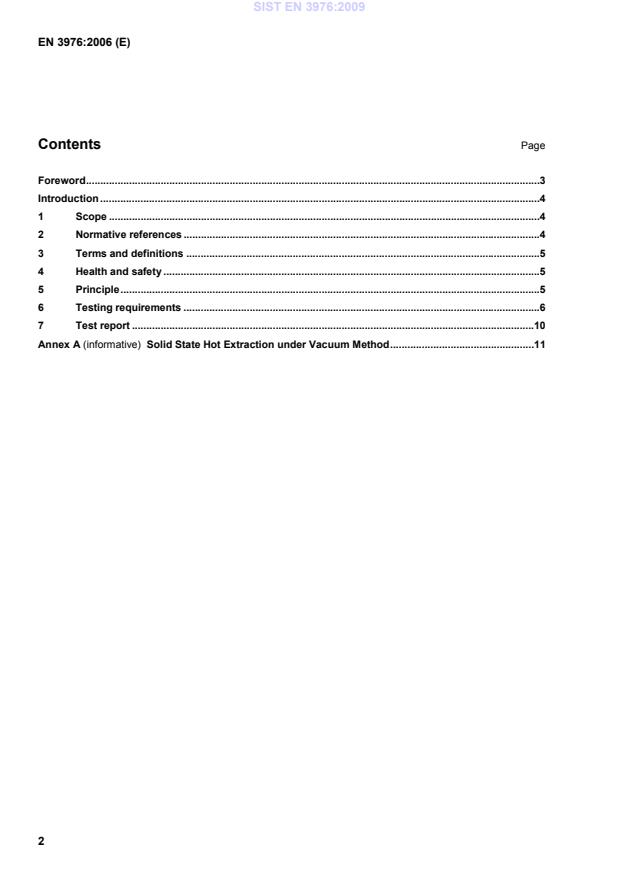
Solid State Hot Extraction under Vacuum Method.11
1) Published as ASD Prestandard at the date of publication of this standard. SIST EN 3976:2009
5.2 Method 1 The role of melting flux is to liquefy the mixture (thus facilitating the gas extraction) and to avoid an eventual formation of nitrides. Fusion is performed in a graphite crucible at a temperature of around 1 800 °C: either in a nitrogen supporting gas which allows the nitrogen in the sample to be disregarded with the carbon monoxide which, with the nitrogen, has a very small difference in conductivity. (The excess of carbon and the temperature at which melting is performed prevents any carbon dioxide from forming; it is necessary, however, to foresee a way of trapping small quantities of this gas eventually present by using, for example, a molecular sieve); or in an argon supporting gas which prevents nitrides forming and results in a better sensitivity since argon has a greater difference in conductivity compared to hydrogen. A separation of nitrogen and carbon oxides is necessary as well as, in the case of using a high frequency furnace, an adapted frequency to avoid discharges by ionization. SIST EN 3976:2009
ρ 20 = 1,38 g/ml Hydrofluoric acid
Aqueous solution at 40 %, ρ 20 = 1,13 g/ml 95 % or 96 % (v/v) ethanol Melting flux tin granules Absorbing reagents, separating columns as specified by the manufacturer of the equipment Carbon tetrachloride Diethyl oxide Acetone SIST EN 3976:2009
...