

EN 2003-010:2007
(Main)Aerospace series - Titanium and titanium alloys - Test methods - Part 010: Sampling for determination of hydrogen content
- Abstract
This standard specifies the location of the test pieces and the analysis samples used for the determination of hydrogen content in titanium and titanium alloys products.
- Status
- Published
- Publication Date
- 20-Mar-2007
- Withdrawal Date
- 29-Sep-2007
- Technical Committee
- ASD-STAN - Aerospace
- Drafting Committee
- ASD-STAN/D 4 - Metallic
- Current Stage
- 6060 - Definitive text made available (DAV) - Publishing
- Start Date
- 21-Mar-2007
- Completion Date
- 21-Mar-2007

Overview
EN 2003-010:2007 is a European standard part of the aerospace series focusing on titanium and titanium alloys. It specifies standardized test methods for sampling intended for the accurate determination of hydrogen content within titanium products. This standard ensures consistent sampling procedures, thereby providing reliable assessment of hydrogen levels-critical for aerospace material performance and safety.
This document is essential for manufacturers, quality control labs, and aerospace engineers involved in the production and testing of titanium alloys used in aerospace applications. It establishes clear guidelines on the location of test pieces and preparation of analysis samples to avoid contamination and assure representativity of the hydrogen content measurement.
Key Topics
Sampling Location Guidelines
The standard outlines precise locations from which test pieces should be extracted, considering the form of the titanium product: sheet, strip, plate, bar, forging stock, casting, and tubes. It emphasizes inclusion of the total thickness or at least one product surface because hydrogen tends to concentrate near surfaces.Test Piece Preparation
To avoid contamination, cutting tools must be clean and dry. Controlled use of abrasive wheels and cutting fluids is allowed only under strict conditions that do not influence hydrogen measurements.Analysis Sample Requirements
Analysis samples are taken from the test pieces and must typically have a mass under 1 gram. They must be thoroughly cleaned, degreased, and dried prior to analysis, ensuring the surface remains metallically clean for accurate hydrogen detection.Scope of Application
This is applicable to titanium and titanium alloy products in delivery condition unless otherwise agreed between manufacturer and purchaser.
Applications
Aerospace Industry
Ensures the integrity and safety of titanium components used in aircraft structures and engines by accurately determining internal hydrogen levels, which affect mechanical properties such as ductility and fatigue resistance.Quality Control and Inspection
Provides standardized sampling techniques critical for QC labs tasked with material certification and product acceptance, supporting compliance with aerospace specifications and reducing variability in hydrogen analysis results.Material Research and Development
Supports R&D activities where precise hydrogen measurement in titanium alloys influences the development of new grades and heat-treatment processes.Supply Chain Compliance
Enables raw material and component suppliers to meet customer-specific hydrogen content requirements, ensuring conformity and traceability in aerospace manufacturing.
Related Standards
EN 4258 – Aerospace series - Metallic materials - General organization of standardization.
Defines the overarching framework and linkage of standards like EN 2003-010 within aerospace metallic materials testing.Other EN series standards covering titanium alloys in aerospace may include test methods on mechanical properties, chemical composition, and non-destructive testing to be used complementary to hydrogen content determination.
Practical Value
EN 2003-010:2007 facilitates:
- Consistent and representative sampling leading to reliable hydrogen measurements.
- Minimized contamination risk during sample preparation, improving test accuracy.
- Clear guidance tailored to product forms, accounting for thickness and geometry differences.
- Enhanced material certification processes, vital for aerospace safety and performance.
This standard is indispensable for aerospace stakeholders aiming at high-quality titanium alloy products, helping mitigate risks associated with hydrogen embrittlement and maintaining compliance with international aerospace manufacturing standards.
Keywords
Titanium alloys, hydrogen content determination, aerospace standards, sampling methods, titanium test pieces, hydrogen analysis, titanium quality control, EN 2003-010, aerospace titanium testing, titanium alloy sampling.
Relations
- Effective Date
- 28-Jan-2026
- Effective Date
- 28-Jan-2026
- Effective Date
- 28-Jan-2026
- Effective Date
- 28-Jan-2026
Get Certified
Connect with accredited certification bodies for this standard

BUREAU VERITAS Certification Germany
Bureau Veritas certification in Germany.

Element Materials Technology
Materials testing and product certification.

AQMS Ltd.
AQMS provides ISO certification to SMEs across the UK.
Sponsored listings
Frequently Asked Questions
EN 2003-010:2007 is a standard published by the European Committee for Standardization (CEN). Its full title is "Aerospace series - Titanium and titanium alloys - Test methods - Part 010: Sampling for determination of hydrogen content". This standard covers: This standard specifies the location of the test pieces and the analysis samples used for the determination of hydrogen content in titanium and titanium alloys products.
This standard specifies the location of the test pieces and the analysis samples used for the determination of hydrogen content in titanium and titanium alloys products.
EN 2003-010:2007 is classified under the following ICS (International Classification for Standards) categories: 49.025.30 - Titanium. The ICS classification helps identify the subject area and facilitates finding related standards.
EN 2003-010:2007 has the following relationships with other standards: It is inter standard links to EN 4258:2024, EN 3976:2006, EN ISO 80601-2-12:2011, EN 746-2:2010. Understanding these relationships helps ensure you are using the most current and applicable version of the standard.
EN 2003-010:2007 is available in PDF format for immediate download after purchase. The document can be added to your cart and obtained through the secure checkout process. Digital delivery ensures instant access to the complete standard document.
Standards Content (Sample)
2003-01.Slovenski inštitut za standardizacijo. Razmnoževanje celote ali delov tega standarda ni dovoljeno.Luft- und Raumfahrt - Titan und Titanlegierungen - Prüfverfahren - Teil 010: Probenentnahme für die Bestimmung des WasserstoffgehaltesSérie aérospatiale - Titane et alliages de titane - Méthodes d'essais - Partie 010 : Échantillonnage pour la détermination de la teneur en hydrogèneAerospace series - Titanium and titanium alloys - Test methods - Part 010: Sampling for determination of hydrogen content49.025.30TitanTitaniumICS:Ta slovenski standard je istoveten z:EN 2003-010:2007SIST EN 2003-010:2009en,de01-maj-2009SIST EN 2003-010:2009SLOVENSKI
STANDARD
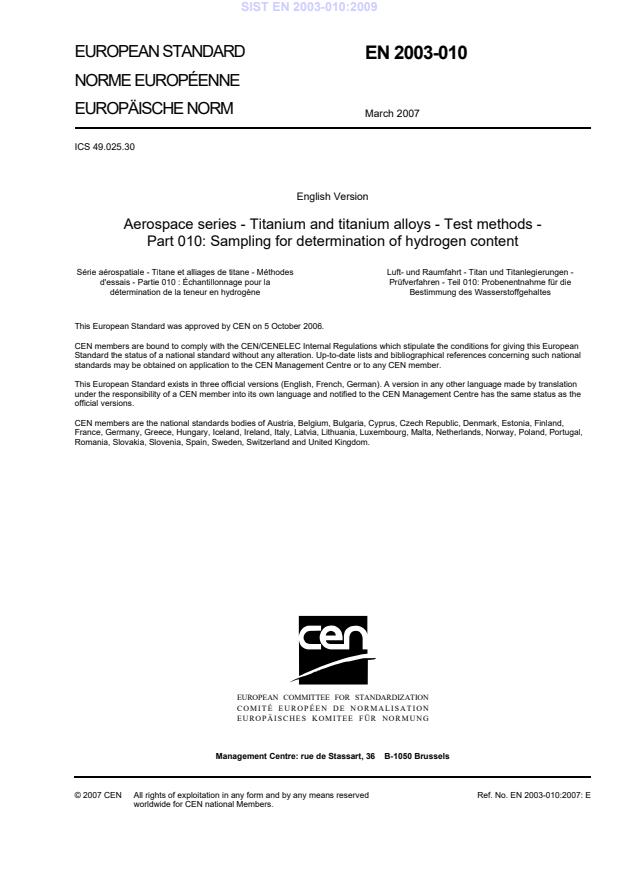
EUROPEAN STANDARDNORME EUROPÉENNEEUROPÄISCHE NORMEN 2003-010March 2007ICS 49.025.30 English VersionAerospace series - Titanium and titanium alloys - Test methods -Part 010: Sampling for determination of hydrogen contentSérie aérospatiale - Titane et alliages de titane - Méthodesd'essais - Partie 010 : Échantillonnage pour ladétermination de la teneur en hydrogèneLuft- und Raumfahrt - Titan und Titanlegierungen -Prüfverfahren - Teil 010: Probenentnahme für dieBestimmung des WasserstoffgehaltesThis European Standard was approved by CEN on 5 October 2006.CEN members are bound to comply with the CEN/CENELEC Internal Regulations which stipulate the conditions for giving this EuropeanStandard the status of a national standard without any alteration. Up-to-date lists and bibliographical references concerning such nationalstandards may be obtained on application to the CEN Management Centre or to any CEN member.This European Standard exists in three official versions (English, French, German). A version in any other language made by translationunder the responsibility of a CEN member into its own language and notified to the CEN Management Centre has the same status as theofficial versions.CEN members are the national standards bodies of Austria, Belgium, Bulgaria, Cyprus, Czech Republic, Denmark, Estonia, Finland,France, Germany, Greece, Hungary, Iceland, Ireland, Italy, Latvia, Lithuania, Luxembourg, Malta, Netherlands, Norway, Poland, Portugal,Romania, Slovakia, Slovenia, Spain, Sweden, Switzerland and United Kingdom.EUROPEAN COMMITTEE FOR STANDARDIZATIONCOMITÉ EUROPÉEN DE NORMALISATIONEUROPÄISCHES KOMITEE FÜR NORMUNGManagement Centre: rue de Stassart, 36
B-1050 Brussels© 2007 CENAll rights of exploitation in any form and by any means reservedworldwide for CEN national Members.Ref. No. EN 2003-010:2007: ESIST EN 2003-010:2009
...