EN 1128:1995
(Main)Cement-bonded particleboards - Determination of hard body impact resistance
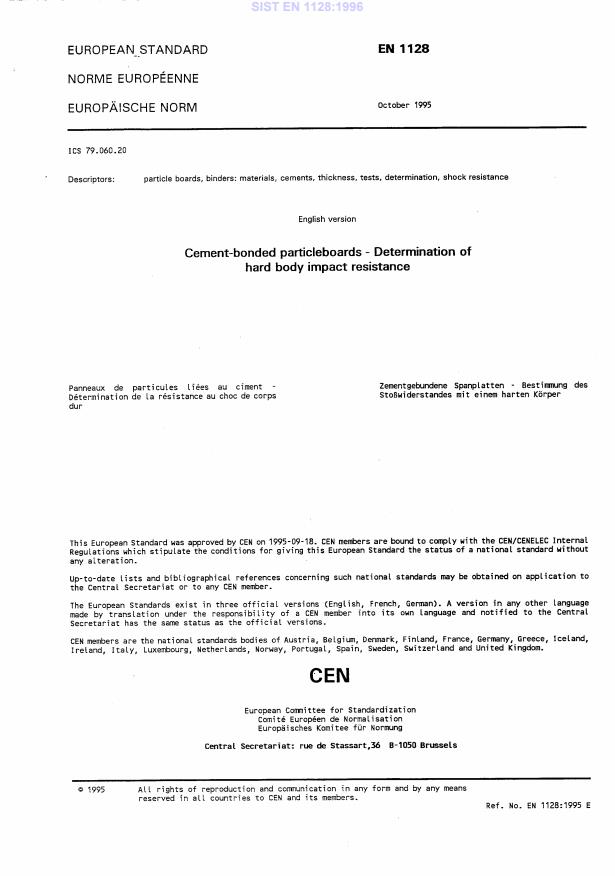
Cement-bonded particleboards - Determination of hard body impact resistance
This European Standard specifies a method of determining the hard body impact resistance of cement bonded particleboards with a nominal thickness equal to or greater than 9 mm.
Zementgebundene Spanplatten - Bestimmung des Stoßwiderstandes mit einem harten Körper
Diese Europäische Norm legt ein Verfahren zur Bestimmung des Widerstandes gegenüber Stoß mit einem harten Körper von zementgebundenen Spanplatten ab 9 mm Nenndicke fest.
Panneaux de particules liées au ciment - Détermination de la résistance au choc de corps dur
La présente norme européenne prescrit une méthode de détermination de la résistance au choc de corps dur des panneaux de particules liées au ciment d'épaisseur nominale égale ou supérieure à 9 mm.
Cementno vezane iverne plošče - Določanje odpornosti proti udarcu s trdim predmetom
General Information
- Status
- Published
- Publication Date
- 04-Oct-1995
- Withdrawal Date
- 29-Apr-1996
- Technical Committee
- CEN/TC 112 - Woodbased panels
- Drafting Committee
- CEN/TC 112/WG 6 - Cement-bonded particle boards
- Current Stage
- 9060 - Closure of 2 Year Review Enquiry - Review Enquiry
- Start Date
- 02-Dec-2025
- Completion Date
- 02-Dec-2025
- Directive
- 89/106/EEC - Construction products
Overview
EN 1128:1995 is a CEN (European) standard that specifies a test method for determining the hard body impact resistance of cement-bonded particleboards. The standard applies to boards with a nominal thickness of 9 mm or greater and defines how to assess resistance to localised impacts from a hard striker. EN 1128:1995 is used to characterise mechanical durability and to provide comparable data for quality control and product specification.
Key topics and technical requirements
- Scope and applicability: Applies specifically to cement-bonded particleboards (nominal thickness ≥ 9 mm).
- Specimen preparation and conditioning: The standard requires defined specimen preparation and environmental conditioning so results are repeatable and comparable.
- Test apparatus and striker: A hard-body striker and a defined support/fixture arrangement are required to deliver controlled impacts. The standard specifies the type of impact action and how the test is performed.
- Damage assessment and measurement: Test results are based on evaluation of impact damage (visual assessment and measured damage parameters). The standard sets out how to record and report damage.
- Reporting requirements: Test conditions, specimen details, test environment, observed damage and numerical results must be reported to allow comparison between products and laboratories.
- Repeatability and reproducibility considerations: Procedures for multiple specimens and reporting of statistical values are included so laboratories can assess consistency.
(Note: EN 1128:1995 defines the method and reporting; specific acceptance criteria for product performance are normally set by manufacturers, regulators or project specifications.)
Applications
- Manufacturer quality control: Routine production testing to monitor impact resistance during manufacturing of cement-bonded particleboards.
- Product development and R&D: Comparing formulations, densities or surface treatments to improve impact durability.
- Third‑party testing and certification: Independent laboratories use the standard for conformity assessment and material data sheets.
- Specification and procurement: Architects, engineers and buyers reference test data based on EN 1128 when specifying boards for floors, cladding, ceilings or other building elements where impact resistance is required.
- Regulatory compliance and building code support: Provides objective mechanical property data useful for compliance demonstrations.
Who uses this standard
- Board manufacturers and plant quality departments
- Independent testing laboratories and conformity assessment bodies
- Product certifiers and notified bodies
- Architects, structural engineers and specifiers evaluating material suitability
- Procurement specialists writing technical specifications
Related standards
- Other CEN/EN standards covering particleboard and fibreboard testing, mechanical properties and environmental conditioning are typically used alongside EN 1128 to provide a complete performance profile for cement-bonded particleboards.
Keywords: EN 1128:1995, cement-bonded particleboards, hard body impact resistance, impact test, CEN standard, material testing, quality control, building materials.
Frequently Asked Questions
EN 1128:1995 is a standard published by the European Committee for Standardization (CEN). Its full title is "Cement-bonded particleboards - Determination of hard body impact resistance". This standard covers: This European Standard specifies a method of determining the hard body impact resistance of cement bonded particleboards with a nominal thickness equal to or greater than 9 mm.
This European Standard specifies a method of determining the hard body impact resistance of cement bonded particleboards with a nominal thickness equal to or greater than 9 mm.
EN 1128:1995 is classified under the following ICS (International Classification for Standards) categories: 79.060.20 - Fibre and particle boards. The ICS classification helps identify the subject area and facilitates finding related standards.
EN 1128:1995 is associated with the following European legislation: EU Directives/Regulations: 305/2011, 89/106/EEC; Standardization Mandates: M/BC/CEN/87/10. When a standard is cited in the Official Journal of the European Union, products manufactured in conformity with it benefit from a presumption of conformity with the essential requirements of the corresponding EU directive or regulation.
You can purchase EN 1128:1995 directly from iTeh Standards. The document is available in PDF format and is delivered instantly after payment. Add the standard to your cart and complete the secure checkout process. iTeh Standards is an authorized distributor of CEN standards.
Standards Content (Sample)
2003-01.Slovenski inštitut za standardizacijo. Razmnoževanje celote ali delov tega standarda ni dovoljeno.SUHGPHWRPZementgebundene Spanplatten - Bestimmung des Stoßwiderstandes mit einem harten KörperPanneaux de particules liées au ciment - Détermination de la résistance au choc de corps durCement-bonded particleboards - Determination of hard body impa
...
Die Norm EN 1128:1995 beschreibt ein Verfahren zur Bestimmung des Widerstands von zementgebundenen Spanplatten gegen den Schlag von harten Körpern. Mit einem Fokus auf zementgebundene Holzwerkstoffe von mindestens 9 mm nomineller Dicke, ist diese Europäische Norm besonders relevant für Hersteller und Anwender in der Bauindustrie. Ein wesentlicher Stärke dieser Norm liegt in der klaren und präzisen Festlegung der Prüfmethoden, die eine konsistente und objektive Bewertung des Schlagwiderstands gewährleisten. Dies fördert nicht nur die Qualitätssicherung in der Produktion, sondern auch die Sicherheit der Endanwender, indem es sicherstellt, dass die Produkte den erforderlichen Sicherheitsstandards entsprechen. Darüber hinaus trägt die Norm zur Harmonisierung der Produktstandards innerhalb des europäischen Marktes bei, was den Austausch und die Akzeptanz von zementgebundenen Spanplatten in verschiedenen Ländern erleichtert. Die Relevanz der Norm zeigt sich auch darin, dass sie die Basis für die Entwicklung weiterer Normen und Standards im Bereich der Holzwerkstoffe bildet, und somit als Leitfaden für zukünftige Innovationen und Produktentwicklungen dient. Insgesamt bietet die EN 1128:1995 eine wertvolle Grundlage für die Bewertung der Schlagfestigkeit von zementgebundenen Spanplatten und stellt sicher, dass diese Produkte den hohen Anforderungen hinsichtlich Sicherheit und Leistung gerecht werden.
EN 1128:1995 표준은 시멘트 결합 입판(cement-bonded particleboards)의 경도 충격 저항을 측정하는 방법을 규정하고 있습니다. 이 표준은 두께가 9mm 이상인 입판에 적용되며, 시장에서 이 제품의 성능을 평가하는 데 중요한 기준을 제공합니다. 이 표준의 강점은 정확하고 일관된 시험 방법을 통해 다양한 제조업체와 제품을 비교할 수 있도록 해준다는 점입니다. 이는 소비자와 산업 사용자 모두에게 품질과 안전성을 보장하는데 기여하며, 시멘트 결합 입판의 신뢰성을 높이는 중요한 역할을 합니다. 또한 EN 1128:1995는 유럽 전역에서 통일된 기준으로 활용되기 때문에, 각국의 제조업체들이 자신의 제품을 국제적으로 경쟁력 있게 만들 수 있는 기회를 제공합니다. 이러한 점에서 표준은 글로벌 시장에서의 상호운용성을 높이는데 필수적입니다. 이 표준은 시멘트 결합 입판의 안정성과 내구성을 평가하는 데 있어 매우 중요한 역할을 하며, 건축 및 건설 분야에서 지속적으로 영향력을 발휘하고 있습니다. 표준 문서인 SIST EN 1128:1996은 이해하기 쉬운 형식으로 전문가와 사용자가 효율적으로 사용할 수 있도록 돕고, 실제 적용 사례를 통해 이론과 실무를 연결하는 데 기여합니다. 결론적으로, EN 1128:1995 표준은 시멘트 결합 입판의 성능을 보장하고 그 유용성을 극대화하기 위한 중요한 지침으로서의 역할을 다하고 있으며, 관련 산업에서의 필요성을 충족하고 있습니다.
標準文書SIST EN 1128:1996は、セメント結合パーティクルボードのハードボディ衝撃耐性を測定する方法を規定しており、厚さが9mm以上のボードを対象としています。この標準は、セメント結合パーティクルボードの性能評価において不可欠な手段を提供し、特に建設業界においてその重要性が高まっています。 この標準の強みは、具体的な試験方法と評価基準を明確に示していることです。これにより、異なる製造者や製品間での比較が容易になり、消費者にとっての信頼性を向上させています。また、EU圏内での流通を促進し、製品の標準化を通じて市場の競争を健全に保つ役割も果たしています。 標準の関連性は、建材の安全性と性能がますます重視される現在の市場において、一層顕著です。高いハードボディ衝撃耐性を持つセメント結合パーティクルボードは、構造物の耐用年数や安全性を向上させることが期待されており、この標準はその基準を提供します。したがって、EN 1128:1995は、業界のニーズに応えるための重要な指針であり、建築・建設分野での信頼性のある製品選定に貢献しています。
The EN 1128:1995 standard provides a crucial methodology for assessing the hard body impact resistance of cement-bonded particleboards, specifically those with a nominal thickness of 9 mm or more. This standard is particularly robust in its applicability, addressing the needs of manufacturers and users of cement-bonded particleboards, guiding them in evaluating the durability and performance of their products under impact stress. One of the notable strengths of this standard lies in its clear and comprehensive testing procedures, which ensure consistent results across various applications. By defining precise parameters for testing, EN 1128:1995 enhances the ability of manufacturers to produce high-quality cement-bonded particleboards that meet safety and performance expectations. This is especially relevant in sectors where material resilience is critical, such as construction, furniture manufacturing, and other industrial applications. Furthermore, the standard's focus on hard body impact resistance aligns well with the increasing demand for materials that can withstand physical stressors while maintaining integrity. In a market that prioritizes durability and sustainability, this specification serves as a valuable tool for product differentiation and compliance with safety regulations. Overall, EN 1128:1995 encapsulates essential criteria for the evaluation of cement-bonded particleboards, ensuring that manufacturers can effectively communicate their product's impact resistance capabilities, thereby facilitating informed decision-making among consumers and industry stakeholders.
La norme EN 1128:1995, intitulée "Ciments liés aux panneaux de particules - Détermination de la résistance à l'impact d'un corps dur", est un document essentiel qui précise une méthode standardisée pour évaluer la résistance à l'impact des panneaux de particules ciment-bondés d'une épaisseur nominale d'au moins 9 mm. L'un des principaux atouts de cette norme est son approche méthodique qui garantit des résultats fiables et reproductibles. En définissant clairement le processus de testing, la norme EN 1128:1995 permet aux fabricants et aux utilisateurs d'évaluer de manière précise la durabilité et la robustesse des panneaux de particules ciment-bondés. Cela est particulièrement pertinent dans des contextes où la sécurité et la longévité des matériaux sont primordiales, telles que dans la construction et les aménagements intérieurs. En outre, la pertinence de cette norme va au-delà de la simple évaluation de la résistance à l'impact. Elle joue un rôle crucial dans l'harmonisation des standards au sein des pays européens, facilitant ainsi le commerce et l'évaluation des matériaux conformément aux exigences de performance reconnues à l'échelle européenne. La norme EN 1128:1995 se distingue également par sa capacité à évoluer avec les progrès technologiques et les besoins changeants de l'industrie. Ce dynamisme assure que les pratiques recommandées restent actuelles et efficaces, contribuant ainsi à la sécurité et à la satisfaction des consommateurs. En résumé, la norme SIST EN 1128:1996 représente un cadre indispensable pour toute entreprise souhaitant garantir la qualité et la performance de ses panneaux de particules ciment-bondés, en assurant une évaluation rigoureuse de leur résistance à l'impact.


Questions, Comments and Discussion
Ask us and Technical Secretary will try to provide an answer. You can facilitate discussion about the standard in here.
Loading comments...