


EN 13718-1:2014+A1:2020
(Main + Amendment)Medical vehicles and their equipment - Air ambulances - Part 1: Requirements for medical devices used in air ambulances
General Information
- Abstract
This European Standard specifies general requirements for medical devices carried in air ambulances and used therein and outside hospitals and clinics in situations where the ambient conditions can differ from normal indoor conditions. This European Standard does not cover the requirements for approval and registration of the vehicle and the training of the staff which is the responsibility of the authority/authorities in the country where the ambulance is to be registered.
- Status
- Published
- Publication Date
- 24-Mar-2020
- Withdrawal Date
- 30-Oct-2020
- Technical Committee
- CEN/TC 239 - Rescue systems
- Drafting Committee
- CEN/TC 239 - Rescue systems
- Current Stage
- 9092 - Decision on results of review/2YR ENQ - revise - Review Enquiry
- Start Date
- 24-Feb-2025
- Completion Date
- 16-Sep-2026
- Directive
- Not Harmonized93/42/EEC - Medical devicesOJ Ref: L, L 129 OJ Date: 15-Apr-2021
Buy Documents




Overview
EN 13718-1:2014+A1:2020 is a CEN European Standard that sets general requirements for medical devices carried and used in air ambulances. It defines minimum requirements for interfaces, interoperability and device performance where ambient conditions differ from normal clinical environments - for example during flight, vibration, variable atmospheric pressure, temperature and humidity changes. The standard supplements other medical-device standards and supports conformity with the Medical Devices Directive (MDD) through its informative Annex ZA. It does not cover vehicle approval/registration or staff training.
Key topics and requirements
The standard focuses on practical, safety-oriented requirements for equipment used in air ambulances, including:
- Patient and personnel safety - risk management and safety protections consistent with medical device essential requirements.
- User interface and markings - durable markings, colour coding and usable controls under variable conditions.
- Environmental performance - functional temperature ranges, humidity, vibration, shock, free-fall and variable atmospheric pressure considerations for devices used in flight.
- Electrically-powered medical devices - requirements for devices with 12 V DC, 24 V DC and 230 V AC inputs, short-time voltage drops, internal power sources and electromagnetic compatibility.
- Medical gas supply - requirements covering leakage, pressure regulators, flow metering, cylinder valves and low-pressure hose assemblies.
- Mechanical strength and fixation - vibration, bumps, free-fall testing and secure fixation methods for devices inside air ambulances.
- Fire resistance - fire safety expectations for equipment used in aircraft patient compartments.
- Information from manufacturers - documentation, labeling and instructions relevant to air-ambulance use.
- Test methods - defined test conditions and procedures (references include RTCA DO-160G and relevant EN/ISO test standards).
Applications and users
EN 13718-1 is intended for anyone responsible for safe selection, manufacture, procurement or certification of medical equipment used in air ambulance operations:
- Medical device manufacturers designing equipment for pre-hospital and aeromedical use
- Air ambulance operators and clinical teams specifying equipment for rotorcraft and fixed-wing patient transport
- Procurement officers and hospital transport services integrating devices for inter-facility transfer
- Regulators and conformity assessors evaluating device suitability under airborne environmental conditions
Practical benefits include improved interoperability, reduced in-flight device failures, clearer user information and safer patient care during aeromedical transport.
Related standards
- EN 13718-2 (Air ambulance operational and technical requirements)
- EN 60601-1 (medical electrical equipment - basic safety)
- EN ISO 14971 (risk management for medical devices)
- RTCA DO-160G (environmental conditions for airborne equipment)
- EN/ISO standards for medical gas fittings, regulators and hose assemblies
Keywords: EN 13718-1:2014+A1:2020, air ambulances, medical devices, CEN, interoperability, environmental testing, medical gas, electrically-powered devices, fixation, fire resistance.
Relations
- Effective Date
- 18-Jan-2023
- Effective Date
- 09-Jan-2019
- Effective Date
- 25-Aug-2026
- Effective Date
- 09-Feb-2026
- Effective Date
- 09-Feb-2026
- Effective Date
- 09-Feb-2026
- Effective Date
- 09-Feb-2026
- Effective Date
- 28-Jan-2026
- Effective Date
- 28-Jan-2026
- Effective Date
- 28-Jan-2026
- Effective Date
- 28-Jan-2026
- Effective Date
- 28-Jan-2026
- Refers
EN ISO 407:2004 - Small medical gas cylinders - Pin-index yoke-type valve connections (ISO 407:2004) - Effective Date
- 28-Jan-2026
- Effective Date
- 28-Jan-2026
- Effective Date
- 28-Jan-2026
Buy Documents
Get Certified
Connect with accredited certification bodies for this standard

BSI Group
BSI (British Standards Institution) is the business standards company that helps organizations make excellence a habit.

TÜV Rheinland
TÜV Rheinland is a leading international provider of technical services.

TÜV SÜD
TÜV SÜD is a trusted partner of choice for safety, security and sustainability solutions.
Sponsored listings
Frequently Asked Questions
EN 13718-1:2014+A1:2020 is a standard published by the European Committee for Standardization (CEN). Its full title is "Medical vehicles and their equipment - Air ambulances - Part 1: Requirements for medical devices used in air ambulances". This standard covers: This European Standard specifies general requirements for medical devices carried in air ambulances and used therein and outside hospitals and clinics in situations where the ambient conditions can differ from normal indoor conditions. This European Standard does not cover the requirements for approval and registration of the vehicle and the training of the staff which is the responsibility of the authority/authorities in the country where the ambulance is to be registered.
This European Standard specifies general requirements for medical devices carried in air ambulances and used therein and outside hospitals and clinics in situations where the ambient conditions can differ from normal indoor conditions. This European Standard does not cover the requirements for approval and registration of the vehicle and the training of the staff which is the responsibility of the authority/authorities in the country where the ambulance is to be registered.
EN 13718-1:2014+A1:2020 is classified under the following ICS (International Classification for Standards) categories: 11.040.01 - Medical equipment in general; 11.160 - First aid; 49.020 - Aircraft and space vehicles in general. The ICS classification helps identify the subject area and facilitates finding related standards.
EN 13718-1:2014+A1:2020 has the following relationships with other standards: It is inter standard links to EN 13718-1:2014, EN 13718-1:2014/FprA1, ISO 7000:2014, EN 60601-1:2006/A1:2013, EN 60068-2-31:2008, EN 60529:1991/A2:2013, EN 60601-1:2006, EN ISO 10297:2014/A1:2017, EN ISO 10297:2014, EN ISO 10524-3:2006/A1:2013, EN ISO 10524-1:2006, EN ISO 10524-3:2006, EN ISO 407:2004, EN 13718-2:2015+A1:2020, EN ISO 5359:2014. Understanding these relationships helps ensure you are using the most current and applicable version of the standard.
EN 13718-1:2014+A1:2020 is associated with the following European legislation: EU Directives/Regulations: 93/42/EEC; Standardization Mandates: M/023. When a standard is cited in the Official Journal of the European Union, products manufactured in conformity with it benefit from a presumption of conformity with the essential requirements of the corresponding EU directive or regulation.
EN 13718-1:2014+A1:2020 is available in PDF format for immediate download after purchase. The document can be added to your cart and obtained through the secure checkout process. Digital delivery ensures instant access to the complete standard document.
Standards Content (Sample)
SLOVENSKI STANDARD
01-maj-2020
Nadomešča:
SIST EN 13718-1:2015
Ambulantna vozila in njihova oprema - Ambulantna zračna vozila - 1. del: Zahteve
za medicinsko opremo, ki se uporablja v ambulantnih zračnih vozilih
Medical vehicles and their equipment - Air ambulances - Part 1: Requirements for
medical devices used in air ambulances
Medizinische Fahrzeuge und ihre Ausrüstung - Luftfahrzeuge zum Patiententransport -
Teil 1: Anforderungen an medizinische Geräte, die in Luftfahrzeugen zum
Patiententransport verwendet werden
Véhicules sanitaires et leurs équipements - Ambulances aériennes - Partie 1 : Exigences
pour les dispositifs médicaux utilisés dans les ambulances aériennes
Ta slovenski standard je istoveten z: EN 13718-1:2014+A1:2020
ICS:
11.160 Prva pomoč First aid
49.020 Letala in vesoljska vozila na Aircraft and space vehicles in
splošno general
2003-01.Slovenski inštitut za standardizacijo. Razmnoževanje celote ali delov tega standarda ni dovoljeno.
EN 13718-1:2014+A1
EUROPEAN STANDARD
NORME EUROPÉENNE
March 2020
EUROPÄISCHE NORM
ICS 11.040.01; 11.160; 49.020
English Version
Medical vehicles and their equipment - Air ambulances -
Part 1: Requirements for medical devices used in air
ambulances
Véhicules sanitaires et leur équipement - Ambulances Medizinische Fahrzeuge und ihre Ausrüstung -
aériennes - Partie 1: Exigences pour les dispositifs Luftfahrzeuge zum Patiententransport - Teil 1:
médicaux utilisés dans les ambulances aériennes Anforderungen an medizinische Geräte, die in
Luftfahrzeugen zum Patiententransport verwendet
werden
This European Standard was approved by CEN on 25 July 2014 and includes Amendment 1 approved by CEN on 16 December
2019.
CEN members are bound to comply with the CEN/CENELEC Internal Regulations which stipulate the conditions for giving this
European Standard the status of a national standard without any alteration. Up-to-date lists and bibliographical references
concerning such national standards may be obtained on application to the CEN-CENELEC Management Centre or to any CEN
member.
This European Standard exists in three official versions (English, French, German). A version in any other language made by
translation under the responsibility of a CEN member into its own language and notified to the CEN-CENELEC Management
Centre has the same status as the official versions.
CEN members are the national standards bodies of Austria, Belgium, Bulgaria, Croatia, Cyprus, Czech Republic, Denmark, Estonia,
Finland, France, Germany, Greece, Hungary, Iceland, Ireland, Italy, Latvia, Lithuania, Luxembourg, Malta, Netherlands, Norway,
Poland, Portugal, Republic of North Macedonia, Romania, Serbia, Slovakia, Slovenia, Spain, Sweden, Switzerland, Turkey and
United Kingdom.
EUROPEAN COMMITTEE FOR STANDARDIZATION
COMITÉ EUROPÉEN DE NORMALISATION
EUROPÄISCHES KOMITEE FÜR NORMUNG
CEN-CENELEC Management Centre: Rue de la Science 23, B-1040 Brussels
© 2020 CEN All rights of exploitation in any form and by any means reserved Ref. No. EN 13718-1:2014+A1:2020 E
worldwide for CEN national Members.
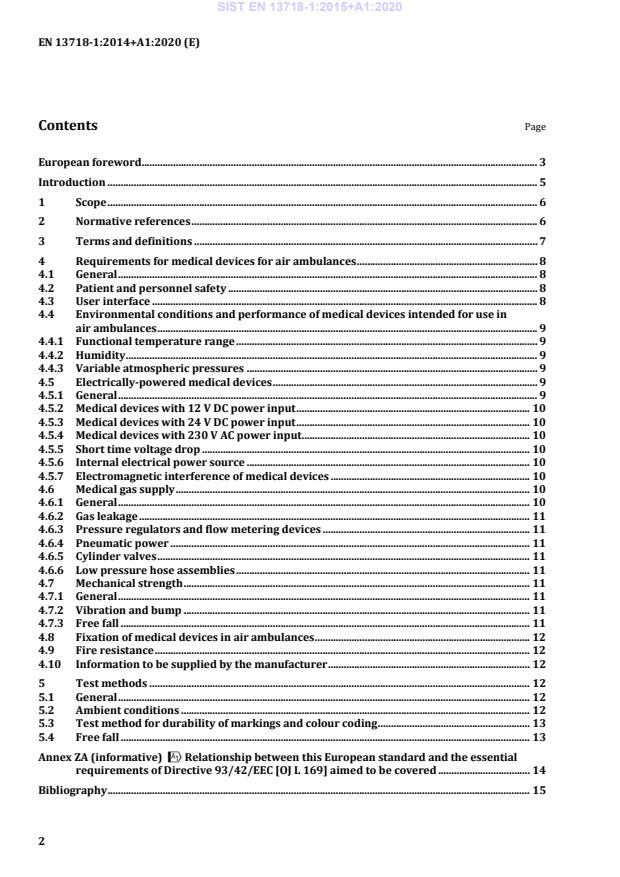
Contents Page
European foreword . 3
Introduction . 5
1 Scope . 6
2 Normative references . 6
3 Terms and definitions . 7
4 Requirements for medical devices for air ambulances . 8
4.1 General . 8
4.2 Patient and personnel safety . 8
4.3 User interface . 8
4.4 Environmental conditions and performance of medical devices intended for use in
air ambulances . 9
4.4.1 Functional temperature range . 9
4.4.2 Humidity . 9
4.4.3 Variable atmospheric pressures . 9
4.5 Electrically-powered medical devices . 9
4.5.1 General . 9
4.5.2 Medical devices with 12 V DC power input . 10
4.5.3 Medical devices with 24 V DC power input . 10
4.5.4 Medical devices with 230 V AC power input . 10
4.5.5 Short time voltage drop . 10
4.5.6 Internal electrical power source . 10
4.5.7 Electromagnetic interference of medical devices . 10
4.6 Medical gas supply . 10
4.6.1 General . 10
4.6.2 Gas leakage . 11
4.6.3 Pressure regulators and flow metering devices . 11
4.6.4 Pneumatic power . 11
4.6.5 Cylinder valves . 11
4.6.6 Low pressure hose assemblies . 11
4.7 Mechanical strength . 11
4.7.1 General . 11
4.7.2 Vibration and bump . 11
4.7.3 Free fall . 11
4.8 Fixation of medical devices in air ambulances . 12
4.9 Fire resistance . 12
4.10 Information to be supplied by the manufacturer . 12
5 Test methods . 12
5.1 General . 12
5.2 Ambient conditions . 12
5.3 Test method for durability of markings and colour coding . 13
5.4 Free fall . 13
Annex ZA (informative) !Relationship between this European standard and the essential
requirements of Directive 93/42/EEC [OJ L 169] aimed to be covered . 14
Bibliography . 15
European foreword
This document (EN 13718-1:2014+A1:2020) has been prepared by Technical Committee CEN/TC 239
“Rescue systems”, the secretariat of which is held by DIN.
This European Standard shall be given the status of a national standard, either by publication of an
identical text or by endorsement, at the latest by October 2020, and conflicting national standards shall
be withdrawn at the latest by October 2020.
Attention is drawn to the possibility that some of the elements of this document may be the subject of
patent rights. CEN shall not be held responsible for identifying any or all such patent rights.
This document includes Amendment 1 approved by CEN on 2019-12-16.
This document supersedes !EN 13718-1:2014."
The start and finish of text introduced or altered by amendment is indicated in the text by tags !".
This document has been prepared under a mandate given to CEN by the European Commission and the
European Free Trade Association, and supports essential requirements of EU Directive(s).
For relationship with EU Directive, see informative Annex ZA, which is an integral part of this
document.
EN 13718-1:2008 has been technically revised. The following points represent the most important
changes in the revision:
a) normative references were updated;
b) the following terms and definitions were deleted: 3.3 "HEMS flight", 3.4 "air ambulance flight", 3.5
"non-dedicated aircraft for patient transportation", 3.6 "HICAMS flight", 3.7 "fixed wing air
ambulance", 3.10 "interchangeability", 3.11 "flight crew", 3.12 "medical crew";
c) a new Subclause 4.5.4 "Medical devices with 230 V AC power input" was introduced;
d) Subclause 4.4.5 "Inverters" was deleted;
e) Subclause 4.5.4 "Pneumatic power supply" (now Subclause 4.6.4) was revised;
f) Subclause 4.8 "Fire resistance" (now Subclause 4.9) was revised;
g) unclear issues were clarified in this part of the standard and between the two parts of the standard
(requirements for patient's compartment illumination, respectively);
h) the standard was modified/integrated to meet the Medical Devices Directive 93/42/EEC
requirements.
EN 13718 consists of the following parts, under the general title: Medical vehicles and their equipment —
Air ambulances:
— Part 1: Requirements for medical devices used in air ambulances;
— Part 2: Operational and technical requirements for air ambulances.
According to the CEN-CENELEC Internal Regulations, the national standards organizations of the
following countries are bound to implement this European Standard: Austria, Belgium, Bulgaria,
Croatia, Cyprus, Czech Republic, Denmark, Estonia, Finland, France, Germany, Greece, Hungary, Iceland,
Ireland, Italy, Latvia, Lithuania, Luxembourg, Malta, Netherlands, Norway, Poland, Portugal, Republic of
North Macedonia, Romania, Slovakia, Slovenia, Spain, Sweden, Switzerland, Turkey and the United
Kingdom.
Introduction
This part of EN 13718 gives minimum requirements for interfaces and compatibility of medical devices
used in air ambulances. The standards work was called for by the EU Commission by a mandate from
the Medical Devices Directive (see Bibliography and Annex ZA).
This part of EN 13718 is supplementary to several other European Standards and gives requirements
for medical devices when used in situations where the ambient conditions differ from the normal
indoor conditions prevailing within the health care system. Several specific requirements are related to
the conditions prevailing in air ambulances. The requirements that are set are carefully selected to
ensure interoperability and continuous patient care.
The medical devices are being used by the services in air ambulances. Air ambulances carry medical
devices as well as medicinal products and rescue equipment to be used by medical personnel.
The medical devices need to conform to the applicable essential requirements in the Medical Devices
Directive. The essential requirements are listed in Annex I of the Medical Devices Directive (MDD).
Annex ZA lists the essential requirements that are addressed by the identified clauses of this European
Standard.
The environmental conditions for medical devices used in air ambulances are different from those
expected in a normal hospital environment. In particular, this implies environmental conditions such as
temperature and humidity, vibration and shock caused by movement of the air ambulances, variable
atmospheric pressures and electromagnetic disturbances between the air ambulances and the medical
device.
1 Scope
This European Standard specifies general requirements for medical devices carried in air ambulances
and used therein and outside hospitals and clinics in situations where the ambient conditions can differ
from normal indoor conditions.
This European Standard does not cover the requirements for approval and registration of the vehicle
and the training of the staff which is the responsibility of the authority/authorities in the country where
the ambulance is to be registered.
2 Normative references
!The following documents are referred to in the text in such a way that some or all of their content
constitutes requirements of this document. For dated references, only the edition cited applies. For
undated references, the latest edition of the referenced document (including any amendments)
applies."
!Deleted text"
!EN 13718-2:2015+A1:2020, Medical vehicles and their equipment — Air ambulances — Part 2:
Operational and technical requirements of air ambulances"
EN 60068-2-31:2008, Environmental testing - Part 2-31: Tests - Test Ec: Rough handling shocks, primarily
for equipment-type specimens
!EN 60529:1991/A2:2013, Degrees of protection provided by enclosures (IP Code) (IEC
60529:1989/A2:2013)"
!EN 60601-1:2006+Cor.:2010+A1:2013, Medical electrical equipment — Part 1: General requirements
for basic safety and essential performance (IEC 60601-1:2005+ Cor.:2006 + Cor.:2007 + A1:2012)"
EN ISO 407:2004, Small medical gas cylinders - Pin-index yoke-type valve connections (ISO 407:2004)
!EN ISO 5359:2014+A1:2017, Anaesthetic and respiratory equipment — Low-pressure hose
assemblies for use with medical gases (ISO 5359:2014+Amd 1:2017)"
!EN ISO 10297:2014+A1:2017, Gas cylinders — Cylinder valves — Specification and type testing
(ISO 10297:2014, Corrected Version 2014-11-01 + Amd.1:2017)"
EN ISO 10524-1:2006, Pressure regulators for use with medical gases — Part 1: Pressure regulators and
pressure regulators with flow-metering devices (ISO 10524-1:2006)
!EN ISO 10524-3:2006+Amd 1:2013, Pressure regulators for use with medical gases — Part 3:
Pressure regulators integrated with cylinder valves (ISO 10524-3:2005+A1:2013)"
EN ISO 14971:2012, Medical devices — Application of risk management to medical devices
(ISO 14971:2007, Corrected version 2007-10-01)
EN ISO 15002:2008, Flow-metering devices for connection to terminal units of medical gas pipeline
systems (ISO 15002:2008)
!Deleted text"
!ISO 7000:2014, Graphical symbols for use on equipment — Registered symbols"
1)
RTCA DO-160G:2010, Environmental Conditions and Test Procedures for Airborne Equipment
3 Terms and definitions
For the purposes of this document, the following terms and definitions apply.
!ISO and IEC maintain terminological databases for use in standardization at the following addresses:
• IEC Electropedia: available at http://www.electropedia.org/
• ISO Online browsing platform: available at http://www.iso.org/obp"
3.1
air ambulance
aircraft designed to be normally staffed by two medical personnel equipped and intended for the
transportation of at least one stretcher patient who will receive medical treatment during transport
3.2
interface
means or place of interaction between one or more of the medical devices, the ambient conditions, the
user, the patient, and when relevant, the various kinds of ambulances
3.3
interoperability
facility to connect various medical devices that are fixed to patients into connections of associated
medical devices including the possibility of connecting powered medical devices to various kinds of
ambulances
3.4
medical device
instrument, apparatus, appliance, material or other article, whether used alone or in combination,
including the software necessary for its proper application, intended by the manufacturer to be used for
human beings for the purpose of diagnosis, prevention, monitoring, treatment or alleviation of disease
and injury
3.5
portable
term referring to transportable equipment that, once installed and placed into service, is intended to be
moved from one location to another while being carried by one or more persons
Note 1 to entry: Equipment can refer to accessories or equipment parts.
Note 2 to entry: See the taxonomy in the rationale for Definition 3.63 in EN 60601-1:2006/A1:2013.
1) This document is a material copyrighted by RTCA, Inc. and used with permission:
RTCA, Inc.
1150 18th Street NW
Suite 910
Washington, DC 20036
(202) 833-9339
http://www.rtca.org/
It is available on the RTCA store: http://www.rtca.org/store_product.asp?prodid=770.
[SOURCE: EN 60601-1:2006/A1:2013, 3.85, modified — The wording of Note 2 to entry has been
slightly modified.]
4 Requirements for medical devices for air ambulances
4.1 General
The manufacturers of all medical devices intended to be used in air ambulances shall ensure that the
requirements of this standard are met.
4.2 Patient and personnel safety
Risks associated with medical devices shall be minimized, using risk management process in
accordance with EN ISO 14971:2012, taking account of the intended application of the devices and of
known and foreseeable hazards in both normal and fault conditions. When risk analyses are performed,
they shall reflect storage, installation, operation in normal use and maintenance according to the
instructions of the manufacturer and the ambient conditions of an air ambulance.
4.3 User interface
The user interface of the medical device shall be easy to use in an air ambulance.
NOTE 1 See !EN 62366-1:2015" and EN 60601–1–6:2010 for detailed information on how to design an
easy to use medical device.
A medical device designated as portable shall be:
— able to be carried inside and outside the aircraft;
— able to be carried by one person.
NOTE 2 See Directive 90/269/EEC for information.
The manufacturer of the medical device shall carry out a risk assessment of the manual handling of the
medical device inside and outside of an air ambulance.
NOTE 3 There are several accepted risk assessments methods to use e.g. Key Item Method (KIM), Manual
Handling Assessment Charts and EN 1005–2:2003+A1:2008.
Buttons, switches, indicators, controls etc. shall be accessible and readable under the intended
operational conditions.
NOTE 4 Intended operational conditions are described as requirements in !EN 13718-2:2015+A1:2020."
Medical devices with alarms and signals shall provide a clear visual signal under the intended
operational conditions.
!Deleted text"
Markings shall remain legible following the test in 5.3.
4.4 Environmental conditions and performance of medical devices intended for use i
...
SLOVENSKI STANDARD
01-maj-2020
Nadomešča:
SIST EN 13718-1:2015
Ambulantna vozila in njihova oprema - Ambulantna zračna vozila - 1. del: Zahteve
za medicinsko opremo, ki se uporablja v ambulantnih zračnih vozilih
Medical vehicles and their equipment - Air ambulances - Part 1: Requirements for
medical devices used in air ambulances
Medizinische Fahrzeuge und ihre Ausrüstung - Luftfahrzeuge zum Patiententransport -
Teil 1: Anforderungen an medizinische Geräte, die in Luftfahrzeugen zum
Patiententransport verwendet werden
Véhicules sanitaires et leurs équipements - Ambulances aériennes - Partie 1 : Exigences
pour les dispositifs médicaux utilisés dans les ambulances aériennes
Ta slovenski standard je istoveten z: EN 13718-1:2014+A1:2020
ICS:
11.160 Prva pomoč First aid
49.020 Letala in vesoljska vozila na Aircraft and space vehicles in
splošno general
2003-01.Slovenski inštitut za standardizacijo. Razmnoževanje celote ali delov tega standarda ni dovoljeno.
EN 13718-1:2014+A1
EUROPÄISCHE NORM
EUROPEAN STANDARD
März 2020
NORME EUROPÉENNE
ICS 11.040.01; 11.160; 49.020
Deutsche Fassung
Medizinische Fahrzeuge und ihre Ausrüstung - Luftfahrzeuge
zum Patiententransport - Teil 1: Anforderungen an
medizinische Geräte, die in Luftfahrzeugen zum
Patiententransport verwendet werden
Medical vehicles and their equipment - Air ambulances - Véhicules sanitaires et leurs équipements - Ambulances
Part 1: Requirements for medical devices used in air aériennes - Partie 1 : Exigences pour les dispositifs
ambulances médicaux utilisés dans les ambulances aériennes
Diese Europäische Norm wurde vom CEN am 25. Juli 2014 angenommen und schließt Änderung 1 ein, die am 16. Dezember 2019
vom CEN angenommen wurde.
Die CEN-Mitglieder sind gehalten, die CEN/CENELEC-Geschäftsordnung zu erfüllen, in der die Bedingungen festgelegt sind, unter
denen dieser Europäischen Norm ohne jede Änderung der Status einer nationalen Norm zu geben ist. Auf dem letzten Stand
befindliche Listen dieser nationalen Normen mit ihren bibliographischen Angaben sind beim CEN-CENELEC-Management-
Zentrum oder bei jedem CEN-Mitglied auf Anfrage erhältlich.
Diese Europäische Norm besteht in drei offiziellen Fassungen (Deutsch, Englisch, Französisch). Eine Fassung in einer anderen
Sprache, die von einem CEN-Mitglied in eigener Verantwortung durch Übersetzung in seine Landessprache gemacht und dem
Management-Zentrum mitgeteilt worden ist, hat den gleichen Status wie die offiziellen Fassungen.
CEN-Mitglieder sind die nationalen Normungsinstitute von Belgien, Bulgarien, Dänemark, Deutschland, Estland, Finnland,
Frankreich, Griechenland, Irland, Island, Italien, Kroatien, Lettland, Litauen, Luxemburg, Malta, den Niederlanden, Norwegen,
Österreich, Polen, Portugal, der Republik Nordmazedonien, Rumänien, Schweden, der Schweiz, Serbien, der Slowakei, Slowenien,
Spanien, der Tschechischen Republik, der Türkei, Ungarn, dem Vereinigten Königreich und Zypern.
EUROPÄISCHES KOMITEE FÜR NORMUNG
EUROPEAN COMMITTEE FOR STANDARDIZATION
COMITÉ EUROPÉEN DE NORMALISATION
CEN-CENELEC Management-Zentrum: Rue de la Science 23, B-1040 Brüssel
© 2020 CEN Alle Rechte der Verwertung, gleich in welcher Form und in welchem Ref. Nr. EN 13718-1:2014+A1:2020 D
Verfahren, sind weltweit den nationalen Mitgliedern von CEN
vorbehalten.
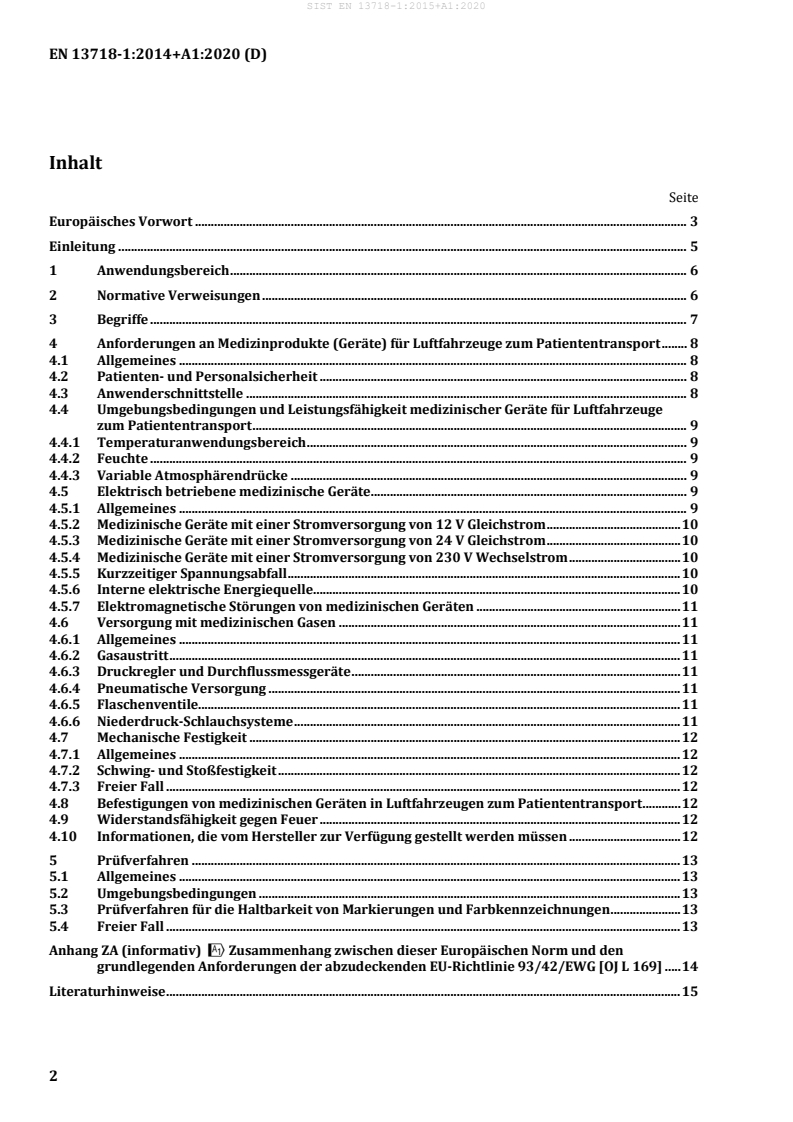
Inhalt
Seite
Europäisches Vorwort . 3
Einleitung . 5
1 Anwendungsbereich . 6
2 Normative Verweisungen . 6
3 Begriffe . 7
4 Anforderungen an Medizinprodukte (Geräte) für Luftfahrzeuge zum Patiententransport . 8
4.1 Allgemeines . 8
4.2 Patienten- und Personalsicherheit . 8
4.3 Anwenderschnittstelle . 8
4.4 Umgebungsbedingungen und Leistungsfähigkeit medizinischer Geräte für Luftfahrzeuge
zum Patiententransport . 9
4.4.1 Temperaturanwendungsbereich . 9
4.4.2 Feuchte . 9
4.4.3 Variable Atmosphärendrücke . 9
4.5 Elektrisch betriebene medizinische Geräte . 9
4.5.1 Allgemeines . 9
4.5.2 Medizinische Geräte mit einer Stromversorgung von 12 V Gleichstrom . 10
4.5.3 Medizinische Geräte mit einer Stromversorgung von 24 V Gleichstrom . 10
4.5.4 Medizinische Geräte mit einer Stromversorgung von 230 V Wechselstrom . 10
4.5.5 Kurzzeitiger Spannungsabfall . 10
4.5.6 Interne elektrische Energiequelle . 10
4.5.7 Elektromagnetische Störungen von medizinischen Geräten . 11
4.6 Versorgung mit medizinischen Gasen . 11
4.6.1 Allgemeines . 11
4.6.2 Gasaustritt . 11
4.6.3 Druckregler und Durchflussmessgeräte . 11
4.6.4 Pneumatische Versorgung . 11
4.6.5 Flaschenventile. 11
4.6.6 Niederdruck-Schlauchsysteme . 11
4.7 Mechanische Festigkeit . 12
4.7.1 Allgemeines . 12
4.7.2 Schwing- und Stoßfestigkeit . 12
4.7.3 Freier Fall . 12
4.8 Befestigungen von medizinischen Geräten in Luftfahrzeugen zum Patiententransport . 12
4.9 Widerstandsfähigkeit gegen Feuer . 12
4.10 Informationen, die vom Hersteller zur Verfügung gestellt werden müssen . 12
5 Prüfverfahren . 13
5.1 Allgemeines . 13
5.2 Umgebungsbedingungen . 13
5.3 Prüfverfahren für die Haltbarkeit von Markierungen und Farbkennzeichnungen . 13
5.4 Freier Fall . 13
Anhang ZA (informativ) !Zusammenhang zwischen dieser Europäischen Norm und den
grundlegenden Anforderungen der abzudeckenden EU-Richtlinie 93/42/EWG [OJ L 169] . 14
Literaturhinweise . 15
Europäisches Vorwort
Dieses Dokument (EN 13718-1:2014+A1:2020) wurde vom Technischen Komitee CEN/TC 239
„Rettungssysteme“ erarbeitet, dessen Sekretariat von DIN gehalten wird.
Diese Europäische Norm muss den Status einer nationalen Norm erhalten, entweder durch Veröffentlichung
eines identischen Textes oder durch Anerkennung bis Oktober 2020, und etwaige entgegenstehende
nationale Normen müssen bis Oktober 2020 zurückgezogen werden.
Es wird auf die Möglichkeit hingewiesen, dass einige Elemente dieses Dokuments Patentrechte berühren
können. CEN ist nicht dafür verantwortlich, einige oder alle diesbezüglichen Patentrechte zu identifizieren.
Dieses Dokument enthält die Änderung 1, angenommen von CEN am 2019-12-16.
Dieses Dokument ersetzt !EN 13718-1:2014".
Der Beginn und das Ende von neuem oder geändertem Text werden durch die Markierungen !"
angezeigt.
Dieses Dokument wurde im Rahmen eines Mandats erarbeitet, das die Europäische Kommission und die
Europäische Freihandelsassoziation CEN erteilt haben, und unterstützt grundlegende Anforderungen der
EU-Richtlinien.
Zum Zusammenhang mit EU-Richtlinien siehe informativen Anhang ZA, der Bestandteil dieses Dokuments
ist.
EN 13718-1:2008 wurde technisch überarbeitet. Die folgenden Punkte stellen die wesentlichen Änderungen
der überarbeiteten Fassung dar:
a) Normative Verweisungen wurden aktualisiert;
b) folgende Begriffe wurden gestrichen: 3.3 „Rettungstransporthubschrauber (RTH)-Einsatz“, 3.4 „Einsatz
mit einem Luftfahrzeug zum Patiententransport“, 3.5 „Luftfahrzeug, das nicht ausschließlich zum
Patiententransport vorgesehen ist“, 3.6 „Intensivtransporthubschrauber (ITH)-Einsatz“,
3.7 „Flächenflugzeug zum Patiententransport“, 3.10 „Austauschbarkeit“, 3.11 „Flugbesatzung“,
3.12 „medizinische Besatzung“;
c) neuer Abschnitt 4.5.4 „Medizinische Geräte mit einer Stromversorgung von 230 V Wechselstrom“
aufgenommen;
d) Abschnitt 4.4.5 „Gleichstrom-Wechselstrom-Konverter“ wurde gestrichen;
e) Abschnitt 4.5.4 (nun Abschnitt 4.6.4) „Pneumatische Versorgung“ wurde überarbeitet;
f) Abschnitt 4.8 (nun Abschnitt 4.9) „Widerstandsfähigkeit gegen Feuer“ wurde überarbeitet;
g) unklare Aspekte in diesem Teil der Norm und zwischen den beiden Teilen der Norm (jeweils bezüglich
der Anforderungen an die Beleuchtung im Krankenraum) wurden erläutert;
h) die Norm wurde modifiziert/integriert, um die Anforderungen der Medizinprodukterichtlinie
93/42/EWG zu erfüllen.
EN 13718 besteht aus folgenden Teilen, die unter dem allgemeinen Titel Medizinische Fahrzeuge und ihre
Ausrüstung — Luftfahrzeuge zum Patiententransport zusammengefasst sind:
Teil 1: Anforderungen an medizinische Geräte, die in Luftfahrzeugen zum Patiententransport verwendet
werden;
Teil 2: Operationelle und technische Anforderungen an Luftfahrzeuge zum Patiententransport.
Entsprechend der CEN-CENELEC-Geschäftsordnung sind die nationalen Normungsinstitute der folgenden
Länder gehalten, diese Europäische Norm zu übernehmen: Belgien, Bulgarien, Dänemark, Deutschland, die
Republik Nordmazedonien, Estland, Finnland, Frankreich, Griechenland, Irland, Island, Italien, Kroatien,
Lettland, Litauen, Luxemburg, Malta, Niederlande, Norwegen, Österreich, Polen, Portugal, Rumänien,
Schweden, Schweiz, Serbien, Slowakei, Slowenien, Spanien, Tschechische Republik, Türkei, Ungarn,
Vereinigtes Königreich und Zypern.
Einleitung
Dieser Teil von EN 13718 legt die Mindestanforderungen an Schnittstellen und an die Kompatibilität für
Medizinprodukte (Geräte) fest, die in Luftfahrzeugen zum Patiententransport verwendet werden. Die
Erarbeitung der Norm entsprach einem Mandat der EU-Kommission, das sich aus der Richtlinie über
Medizinprodukte ableitet (siehe Literaturhinweise und Anhang ZA).
Dieser Teil von EN 13718 stellt eine Ergänzung zu mehreren anderen Europäischen Normen dar und legt
Anforderungen an Medizinprodukte (Geräte) fest, die in Situationen angewendet werden, deren
Umgebungsbedingungen sich von den normalen Bedingungen in Gebäuden unterscheiden, die im
Gesundheitswesen vorwiegend bestehen. Mehrere spezifische Anforderungen betreffen die Bedingungen,
die vorwiegend in Luftfahrzeugen zum Patiententransport vorliegen. Die festgelegten Anforderungen
wurden sorgfältig ausgewählt, damit Produktkompatibilität und die kontinuierliche Patientenbetreuung
sichergestellt werden.
Die Medizinprodukte (Geräte) werden bei der Versorgung in Luftfahrzeugen zum Patiententransport
angewendet. Luftfahrzeuge zum Patiententransport sind mit medizinischen Geräten, Medizinprodukten und
Rettungsmittel zur Verwendung durch medizinisches Personal ausgestattet.
Die Medizinprodukte (Geräte) müssen den maßgeblichen grundlegenden Anforderungen der
Medizinprodukterichtlinie entsprechen. Die grundlegenden Anforderungen sind in Anhang I zur
Medizinprodukterichtlinie aufgeführt. In Anhang ZA sind im Zusammenhang mit dieser Norm stehende,
grundlegende Anforderungen angegeben, die in bestimmten Abschnitten dieser Europäischen Norm
behandelt werden.
Die Umgebungsbedingungen für Medizinprodukte (Geräte), die in Luftfahrzeugen zum Patiententransport
verwendet werden, unterscheiden sich von denen, die in einer üblichen Krankenhausumgebung erwartet
werden. Das betrifft besonders Umgebungsbedingungen wie Temperatur und Feuchtigkeit, Schwingungen
und Stöße, verursacht durch die Bewegung des Luftfahrzeugs zum Patiententransport, den Wechsel des
Luftdrucks und elektromagnetische Störwirkungen zwischen dem Luftfahrzeug zum Patiententransport und
den Medizinprodukten (Geräten).
1 Anwendungsbereich
Diese Europäische Norm legt allgemein gültige Leistungsanforderungen an Medizinprodukte (Geräte) fest,
die in Luftfahrzeugen zum Patiententransport mitgeführt und in diesen sowie außerhalb von
Krankenhäusern und Kliniken in Situationen verwendet werden, in denen die Umgebungsbedingungen von
den normalen Bedingungen in Gebäuden abweichen können.
Diese Europäische Norm enthält keine Anforderungen zur Abnahme und Registrierung von den
Luftfahrzeugen und an die Ausbildung des Personals, die in der Zuständigkeit der Behörde(n) des Landes
liegt, in dem das Luftfahrzeug registriert ist.
2 Normative Verweisungen
!Die folgenden Dokumente werden im Text in solcher Weise in Bezug genommen, dass einige Teile davon
oder ihr gesamter Inhalt Anforderungen des vorliegenden Dokuments darstellen. Bei datierten
Verweisungen gilt nur die in Bezug genommene Ausgabe. Bei undatierten Verweisungen gilt die letzte
Ausgabe des in Bezug genommenen Dokuments (einschließlich aller Änderungen)."
!gestrichener Text"
!EN 13718-2:2015+A1:2020, Medizinische Fahrzeuge und ihre Ausrüstung — Luftfahrzeuge zum
Patiententransport — Teil 2: Operationelle und technische Anforderungen an Luftfahrzeuge zum
Patiententransport"
EN 60068-2-31:2008, Umgebungseinflüsse — Teil 2-31: Prüfverfahren — Prüfung Ec: Schocks durch raue
Handhabung, vornehmlich für Geräte
!EN 60529:1991/A2:2013, Schutzarten durch Gehäuse (IP-Code) (IEC 60529:1989/A2:2013) "
!EN 60601-1:2006+Cor.:2010+A1:2013, Medizinische elektrische Geräte — Teil 1: Allgemeine Festlegungen
für die Sicherheit einschließlich der wesentlichen Leistungsmerkmale, (IEC 60601-1:2005 + Cor.:2006 +
Cor.:2007 + A1:2012)"
EN ISO 407:2004, Kleine Gasflaschen für die medizinische Anwendung — Ventilseitenstutzen mit
Anschlussbügel nach dem PIN-Index-System (ISO 407:2004)
!EN ISO 5359:2014+A1:2017, Anästhesie- und Beatmungsgeräte — Niederdruck-Schlauchleitungssysteme
zur Verwendung mit medizinischen Gasen (ISO 5359:2014+Amd.1:2017)"
!EN ISO 10297:2014+A1:2017, Gasflaschen — Flaschenventile — Spezifikation und Baumusterprüfungen
(ISO 10297:2014, korrigierte Fassung 2014-11-01 + Amd.1:2017)"
EN ISO 10524-1:2006, Druckminderer zur Verwendung mit medizinischen Gasen — Teil 1: Druckminderer und
Druckminderer mit Durchflussmessgeräten (ISO 10524-1:2006)
!EN ISO 10524-3:2006+Amd 1:2013, Druckminderer zur Verwendung mit medizinischen Gasen — Teil 3:
Druckminderer in Flaschenventilen (ISO 10524-3:2005+A1:2013)"
EN ISO 14971:2012, Medizinprodukte — Anwendung des Risikomanagements auf Medizinprodukte
(ISO 14971:2007, korrigierte Fassung 2007-10-01)
EN ISO 15002:2008, Durchflussmesseinrichtungen zum Anschluss an Entnahmestellen von
Rohrleitungssystemen für medizinische Gase (ISO 15002:2008)
!gestrichener Text"
!ISO 7000:2014, Graphical symbols for use on equipment — Registered symbols"
RTCA DO-160G:2010, Environmental Conditions and Test Procedures for Airborne Equipment
1 Die Urheberrechte dieses Dokuments unterliegt der RTCA und wird mit Genehmigung verwendet:
3 Begriffe
Für die Anwendung dieses Dokuments gelten die folgenden Begriffe.
!ISO und IEC stellen terminologische Datenbanken für die Verwendung in der Normung unter den
folgenden Adressen bereit:
IEC Electropedia: verfügbar unter http://www.electropedia.org/
ISO Online Browsing Platform: verfügbar unter http://www.iso.org/obp"
3.1
Luftfahrzeug zum Patiententransport
Flugzeug, das üblicherweise mit zwei medizinisch ausgebildeten Personen besetzt ist, und dafür ausgerüstet
und vorgesehen ist, mindestens einen liegenden Patienten zu transportieren, der während des Transports
medizinisch versorgt wird
3.2
Schnittstelle
Mittel oder Ort der Wechselbeziehungen zwischen einem oder mehreren Medizinprodukt(en) (Gerät(en)),
den Umgebungsbedingungen, dem Anwender, dem Patienten und, wenn zutreffend, den verschiedenen
Arten von Patiententransportmitteln
3.3
Produktkompatibilität
Möglichkeit des Anschlusses verschiedener an Patienten befestigter Medizinprodukte (Geräte) an
entsprechenden Anschlussvorrichtungen dazugehöriger Medizinprodukte (Geräte), einschließlich der
Möglichkeit des Anschlusses elektronischer Medizinprodukte in unterschiedlichen Arten von
Rettungsdienstfahrzeugen
3.4
Medizinprodukt (Gerät)
Instrument, Apparat, Vorrichtung, Material oder anderer Gegenstand, einzeln oder gemeinsam verwendet,
und einschließlich der für die ordnungsgemäße Anwendung des Medizinprodukts erforderlichen Software,
die vom Hersteller zur Anwendung am Menschen zum Zweck der Diagnose, Prävention, Überwachung,
Behandlung oder Linderung von Krankheiten und Verletzungen bestimmt ist
3.5
tragbar
Eigenschaft in Bezug auf ein ortsveränderliches Gerät, das, nachdem es installiert und in Betrieb genommen
wurde, dazu bestimmt ist, von einer oder mehreren Personen von einem Ort zu einem anderen getragen zu
werden
Anmerkung 1 zum Begriff: Gerät kann sich beziehen auf Zubehör oder auf Geräteteile.
Anmerkung 2 zum Begriff: Siehe die Systematik in der Begründung für den Begriff 3.63 in
EN 60601-1:2006/A1:2013.
RTCA, Inc
1150 18th Street NW
Suite 910
Washington, DC 20036
(202) 833-9339
http://www.rtca.org/
Es ist bei RTCA unter http://www.rtca.org/store_product.asp?prodid=770 erhältlich.
[QUELLE: EN 60601-1:2006/A1:2013, 3.85, modifiziert – Wortlaut der Anmerkung 2 zum Begriff wurde
etwas angepasst.]
4 Anforderungen an Medizinprodukte (Geräte) für Luftfahrzeuge zum
Patiententransport
4.1 Allgemeines
Die Hersteller aller Medizinprodukte (Geräte), die für die Anwendung in Luftfahrzeugen zum
Patiententransport vorgesehen sind, müssen sicherstellen, dass die Anforderungen dieser Norm erfüllt sind.
4.2 Patienten- und Personalsicherheit
Risiken in Verbindung mit Medizinprodukten (Geräten) müssen, unter Anwendung des Risiko-
managementprozesses in Übereinstimmung mit EN ISO 14971:2012 unter Berücksichtigung der
beabsichtigten Verwendung der Produkte und bezogen auf bekannte und vorhersehbare Sicherheitsrisiken
unter normalen und fehlerhaften Bedingungen, reduziert sein. Wenn Risikoanalysen ausgeführt werden,
müssen diese die Lagerung, die Installation, den bestimmungsgemäßen Gebrauch und die Wartung
entsprechend den Anweisungen des Herstellers und die Umgebungsbedingungen eines Luftfahrzeugs
berücksichtigen.
4.3 Anwenderschnittstelle
Die Anwenderschnittstelle des medizinischen Gerätes muss beim Einsatz in einem Luftfahrzeug zum
Patiententransport leicht zu bedienen sein.
ANMERKUNG 1 Siehe !EN 62366-1:2015" und EN 60601-1-6:2010 mit detaillierten Informationen zur
Konstruktion eines leicht zu bedienenden medizinischen Gerätes.
Ein medizinisches Gerät wird als tragbar bezeichnet, wenn es:
innerhalb und außerhalb des Luftfahrzeugs tragbar ist;
von einer Person tragbar ist.
ANMERKUNG 2 Zur Information siehe Richtlinie 90/269/EWG.
Der Hersteller des medizinischen Gerätes muss eine Risikobewertung der manuellen Handhabung des
medizinischen Gerätes innerhalb und außerhalb des Luftfahrzeugs zum Patiententransport durchführen.
ANMERKUNG 3 Es gibt verschiedene anwendbare Risikobewertungsmethoden, z. B. die Leitmerkmal-Methode (en:
Key Item Method, KIM), Manuelle Handhabung Bewertungstabellen und EN 1005-2:2003+A1:2008.
Stellknöpfe, Schalter, Anzeigegeräte, Steuergeräte usw. müssen unter allen vorgesehenen Betriebs-
bedingungen zugänglich und ablesbar sein.
ANMERKUNG 4 Vorgesehene Betriebsbedingungen werden als Anforderungen in !EN 13718-2:2015+A1:2020"
beschrieben.
Medizinische Geräte mit Warn- und Signalanzeigen müssen unter den vorgesehenen Betriebsbedingungen
ein deutliches optisches Signal abgeben.
!gestrichener Text"
Nach Prüfung wie in 5.3 müssen die Kennzeichnungen lesbar bleiben.
4.4 Umgebungsbedingungen und Leistungsfähigkeit medizinischer Geräte für Luftfahrzeuge
...