

CEN/TR 15367-1:2020
(Main)Petroleum products - Guidelines for good housekeeping - Part 1: Automotive diesel fuels
- Abstract
This document provides general guidance on diesel fuel housekeeping. It does not pre-empt national or local regulations but addresses the issues of contamination by water, sediment, inorganic contaminants, or microbial growth that may occur in the supply chain during manufacture, blending, storage and transportation. It does not address contamination by other fuel products nor does it address possible contamination by water or sediment that may occur on-board vehicles. An informative note on vehicle factors is presented in Annex A, however
- Status
- Published
- Publication Date
- 25-Feb-2020
- Technical Committee
- CEN/TC 19 - Petroleum products, lubricants and related products
- Drafting Committee
- CEN/TC 19/WG 24 - Specification for automotive diesel
- Current Stage
- 6060 - Definitive text made available (DAV) - Publishing
- Start Date
- 26-Feb-2020
- Due Date
- 23-Sep-2020
- Completion Date
- 26-Feb-2020

Overview
CEN/TR 15367-1:2020 - "Petroleum products - Guidelines for good housekeeping - Part 1: Automotive diesel fuels" - is a CEN Technical Report that gives practical guidance to maintain diesel fuel quality through the supply chain. It updates and supersedes the 2014 edition and specifically adds guidance on hard abrasive particles that can damage modern high‑pressure common‑rail fuel injection systems. The report focuses on contamination risks (water, sediment, inorganic contaminants, microbial growth) during manufacture, blending, storage and transport. It does not replace national/local regulations and does not cover on‑board vehicle water/sediment contamination (Annex A provides vehicle factors as informative).
Key Topics
- Contamination types: Water (dissolved, emulsified, free), sediment (organic and inorganic), abrasive particles (<4 µm), metal ions (e.g., sodium, zinc, copper, lead), and microbiological contamination.
- Abrasive particle risk: New emphasis on hard particulates that abrade injector components and cause engine failures; gravimetric total contamination tests (EN 12662) may not detect these particles.
- Housekeeping guidelines: Principles for operations, hardware, and maintenance across refineries, terminals, transport, and filling stations; recommends Total Quality Assurance methods to define procedures.
- Water management: Tank inspections, draining free water and dealing with emulsions to limit corrosion and microbial growth.
- Biofuel considerations: Handling and testing guidance for fuels containing FAME (biodiesel), which can increase water emulsions and microbial risk.
- Annexes: Annex A (vehicle factors), Annex B (particulate measurement and abrasive particle guidance), Annex C (after‑market additives); references to EN 590 and other CEN reports.
Applications
CEN/TR 15367-1:2020 is designed for practical use by stakeholders across the diesel fuel supply chain:
- Refinery and blending operators - to control contamination during production and blending.
- Terminal and storage managers - for tank hygiene, sampling, draining water bottoms, and particulate control.
- Transport operators and logistics - to minimize ingress and cross‑contamination during pipeline, tanker and transfer operations.
- Filling station owners and maintenance teams - to reduce dispenser failures and filter blockages from sediment or biological growth.
- Fuel quality and QA personnel - to develop procedures based on Total Quality Assurance and to select appropriate sampling/testing strategies.
- Fleet managers and OEMs - to understand supply‑side risks that impact engine durability and warranty issues.
Related Standards
- EN 590 - Automotive fuels - Diesel - Requirements and test methods (referenced normative standard).
- CEN/TR 15367 Parts 2 & 3 - Part 2 covers petrol fuels; Part 3 covers prevention of cross‑contamination.
- CEN/TR 16680 - (referenced for sodium and deposit issues).
Use CEN/TR 15367-1:2020 as a practical reference to implement effective diesel fuel housekeeping, reduce contamination risks, and protect modern diesel engines from wear and operational failure.
Relations
- Effective Date
- 06-Mar-2019
- Effective Date
- 28-Jan-2026
Get Certified
Connect with accredited certification bodies for this standard

BSI Group
BSI (British Standards Institution) is the business standards company that helps organizations make excellence a habit.

Bureau Veritas
Bureau Veritas is a world leader in laboratory testing, inspection and certification services.

DNV
DNV is an independent assurance and risk management provider.
Sponsored listings
Frequently Asked Questions
CEN/TR 15367-1:2020 is a technical report published by the European Committee for Standardization (CEN). Its full title is "Petroleum products - Guidelines for good housekeeping - Part 1: Automotive diesel fuels". This standard covers: This document provides general guidance on diesel fuel housekeeping. It does not pre-empt national or local regulations but addresses the issues of contamination by water, sediment, inorganic contaminants, or microbial growth that may occur in the supply chain during manufacture, blending, storage and transportation. It does not address contamination by other fuel products nor does it address possible contamination by water or sediment that may occur on-board vehicles. An informative note on vehicle factors is presented in Annex A, however
This document provides general guidance on diesel fuel housekeeping. It does not pre-empt national or local regulations but addresses the issues of contamination by water, sediment, inorganic contaminants, or microbial growth that may occur in the supply chain during manufacture, blending, storage and transportation. It does not address contamination by other fuel products nor does it address possible contamination by water or sediment that may occur on-board vehicles. An informative note on vehicle factors is presented in Annex A, however
CEN/TR 15367-1:2020 is classified under the following ICS (International Classification for Standards) categories: 03.100.50 - Production. Production management; 75.160.20 - Liquid fuels; 75.200 - Petroleum products and natural gas handling equipment. The ICS classification helps identify the subject area and facilitates finding related standards.
CEN/TR 15367-1:2020 has the following relationships with other standards: It is inter standard links to CEN/TR 15367-1:2014, EN 590:2025. Understanding these relationships helps ensure you are using the most current and applicable version of the standard.
CEN/TR 15367-1:2020 is available in PDF format for immediate download after purchase. The document can be added to your cart and obtained through the secure checkout process. Digital delivery ensures instant access to the complete standard document.
Standards Content (Sample)
SLOVENSKI STANDARD
01-maj-2020
Nadomešča:
SIST-TP CEN/TR 15367-1:2014
Naftni proizvodi - Smernice za skrbno ravnanje in skladiščenje - 1. del: Dizelsko
gorivo za motorna vozila
Petroleum products - Guidelines for good housekeeping - Part 1: Automotive diesel fuels
Mineralölerzeugnisse - Leitfaden für eine gute Systemwartung - Teil 1: Dieselkraftstoffe
für Kraftfahrzeuge
Produits pétroliers - Guide pour une bonne maîtrise de la qualité du produit - Partie 1:
Carburants diesels pour automobiles (gazoles)
Ta slovenski standard je istoveten z: CEN/TR 15367-1:2020
ICS:
75.160.20 Tekoča goriva Liquid fuels
75.200 Oprema za skladiščenje Petroleum products and
nafte, naftnih proizvodov in natural gas handling
zemeljskega plina equipment
2003-01.Slovenski inštitut za standardizacijo. Razmnoževanje celote ali delov tega standarda ni dovoljeno.
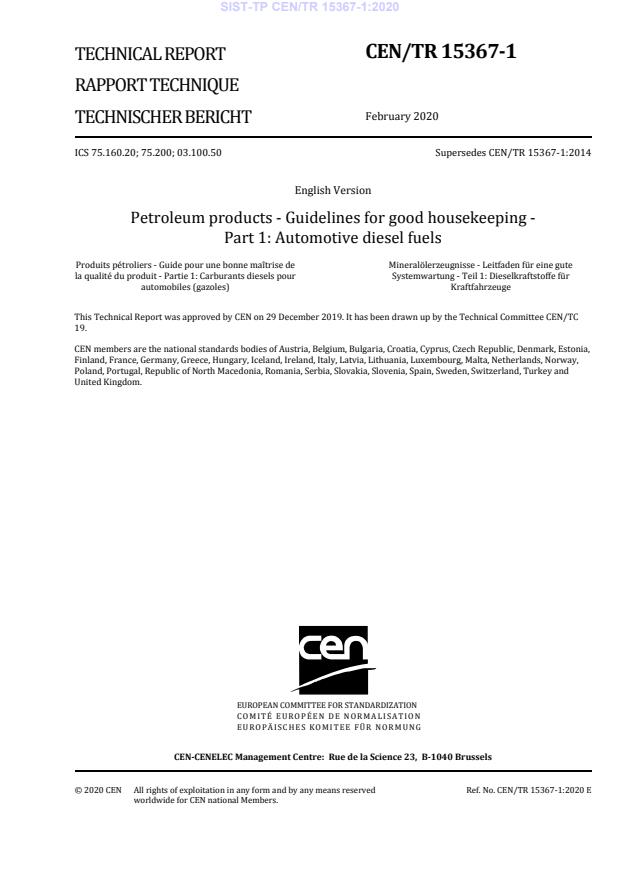
CEN/TR 15367-1
TECHNICAL REPORT
RAPPORT TECHNIQUE
February 2020
TECHNISCHER BERICHT
ICS 75.160.20; 75.200; 03.100.50 Supersedes CEN/TR 15367-1:2014
English Version
Petroleum products - Guidelines for good housekeeping -
Part 1: Automotive diesel fuels
Produits pétroliers - Guide pour une bonne maîtrise de Mineralölerzeugnisse - Leitfaden für eine gute
la qualité du produit - Partie 1: Carburants diesels pour Systemwartung - Teil 1: Dieselkraftstoffe für
automobiles (gazoles) Kraftfahrzeuge
This Technical Report was approved by CEN on 29 December 2019. It has been drawn up by the Technical Committee CEN/TC
19.
CEN members are the national standards bodies of Austria, Belgium, Bulgaria, Croatia, Cyprus, Czech Republic, Denmark, Estonia,
Finland, France, Germany, Greece, Hungary, Iceland, Ireland, Italy, Latvia, Lithuania, Luxembourg, Malta, Netherlands, Norway,
Poland, Portugal, Republic of North Macedonia, Romania, Serbia, Slovakia, Slovenia, Spain, Sweden, Switzerland, Turkey and
United Kingdom.
EUROPEAN COMMITTEE FOR STANDARDIZATION
COMITÉ EUROPÉEN DE NORMALISATION
EUROPÄISCHES KOMITEE FÜR NORMUNG
CEN-CENELEC Management Centre: Rue de la Science 23, B-1040 Brussels
© 2020 CEN All rights of exploitation in any form and by any means reserved Ref. No. CEN/TR 15367-1:2020 E
worldwide for CEN national Members.
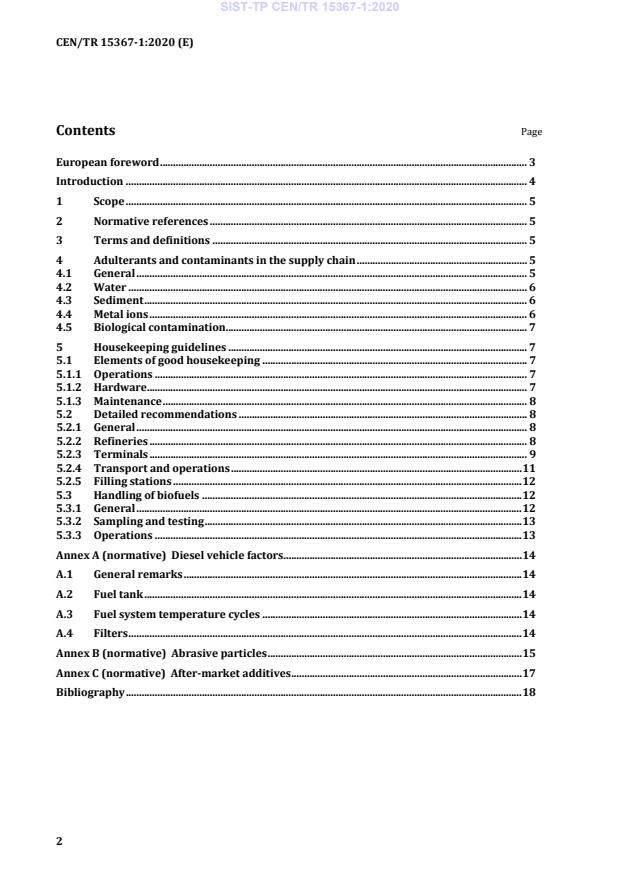
Contents Page
European foreword . 3
Introduction . 4
1 Scope . 5
2 Normative references . 5
3 Terms and definitions . 5
4 Adulterants and contaminants in the supply chain . 5
4.1 General . 5
4.2 Water . 6
4.3 Sediment . 6
4.4 Metal ions . 6
4.5 Biological contamination . 7
5 Housekeeping guidelines . 7
5.1 Elements of good housekeeping . 7
5.1.1 Operations . 7
5.1.2 Hardware . 7
5.1.3 Maintenance . 8
5.2 Detailed recommendations . 8
5.2.1 General . 8
5.2.2 Refineries . 8
5.2.3 Terminals . 9
5.2.4 Transport and operations . 11
5.2.5 Filling stations . 12
5.3 Handling of biofuels . 12
5.3.1 General . 12
5.3.2 Sampling and testing . 13
5.3.3 Operations . 13
Annex A (normative) Diesel vehicle factors . 14
A.1 General remarks . 14
A.2 Fuel tank . 14
A.3 Fuel system temperature cycles . 14
A.4 Filters . 14
Annex B (normative) Abrasive particles . 15
Annex C (normative) After-market additives . 17
Bibliography . 18
European foreword
This document (CEN/TR 15367-1:2020) has been prepared by Technical Committee CEN/TC 19
“Gaseous and liquid fuels, lubricants and related products of petroleum, synthetic and biological
origin”, the secretariat of which is held by NEN.
Attention is drawn to the possibility that some of the elements of this document may be the subject
of patent rights. CEN shall not be held responsible for identifying any or all such patent rights.
This document supersedes CEN/TR 15367-1:2014.
The update to this document primarily addresses quality issues that can be associated with hard
abrasive particles in diesel fuel that can cause wear damage to high pressure common rail fuel
injection systems.
CEN/TR 15367 consists of the following parts, under the general title Petroleum products -
Guidelines for good housekeeping:
— Part 1: Automotive diesel fuels
— Part 2: Automotive petrol fuels
— Part 3: Prevention of cross-contamination
This part of this standard describes the distribution of automotive fuels in general and diesel in
specific detail. Part 2 was subsequently published to provide guidance on petrol distribution and
specifically to address ethanol issues. Finally, Part 3 was published to provide additional guidance
on preventing cross-contamination of fuel products in common supply and distribution systems.
For further information on the relationship between and the history behind each of the parts, see
the Introduction to this document.
Introduction
During its meeting held in Cannes on June 27 2003, WG 24 “Specification for Automotive diesel”
decided that a guidance document on good housekeeping could be instrumental in preventing
potential motoring problems caused by contamination in the supply chain. This was endorsed by
CEN/TC 19 resolution 24.5 and resulted in an effective publication of the first Technical Report in
March 2006.
Subsequently at the CEN/TC 19/WG 24 meeting on 18 October, 2017 in Zurich, Switzerland there
were technical presentations describing serious wear and damage problems in modern high
pressure diesel vehicle fuel injection systems in Northern Germany and the South East of the United
Kingdom. A CEN task force was formed in January 2018 to investigate these wear and damage
issues.
Investigations by that CEN/TC 19/WG 24 Abrasive Particles task force have shown internal damage
to fuel injector moving parts, internal valves and pressure relief valves causing internal injector
leakage, engine malfunction indicator light illumination, poor engine operation and in some cases
complete engine shutdown [9]. The damage is believed to be caused by hard particulates in the
diesel fuel abrading moving components.
This guidance document has been updated to reflect the abrasive particle contamination issue.
When a similar guideline for petrol was being drafted, it was decided to link these two. The best
option was to publish them as separate parts of the same CEN document, which is achieved by
revising the original CEN/TR 15367:2006 Petroleum products — Automotive Diesel Fuels — Guide
for good housekeeping as part 1. Apart from some harmonization of wording no changes have been
incorporated.
Two additional reports have now been published in this series regarding Automotive Petrol Fuels
(Part 2) and the Prevention of Cross Contamination (Part 3).The work on these three documents
has been carried out with support from CONCAWE and other stakeholders.
Automotive fuel specifications generally apply at the point of delivery to the customer. To ensure
the quality at this point, the best practice is to make sure that the product meets specification when
it is dispatched from the refinery and to have systems in place to ensure that it cannot go off-
specification on its way to the customer. There will be more than one method or procedure to
handle many of the potential contamination issues throughout the distribution chain, thus the
advice in this document outlines principles to apply, but does not specify the precise detail of the
methods to be adopted in all cases. Nevertheless, it is strongly recommended that all the
procedures or measures to be applied along the distribution chain should be defined using a Total
Quality Assurance methodology.
1 Scope
This document provides general guidance on diesel fuel housekeeping to ensure appropriate
cleanliness and to prevent onward distribution of contaminants.
It does not pre-empt national or local regulations but addresses the issues of contamination by
water, sediment, inorganic contaminants, or microbial growth that may occur in the supply chain
during manufacture, blending, storage and transportation. It does not address contamination by
other fuel products nor does it address possible contamination by water or sediment that may
occur on-board vehicles. Information on vehicle factors is presented in Annex A, however.
2 Normative references
The following documents are referred to in the text in such a way that some or all of their content
constitutes requirements of this document. For dated references, only the edition cited applies. For
undated references, the latest edition of the referenced document (including any amendments)
applies.
EN 590, Automotive fuels - Diesel - Requirements and test methods
3 Terms and definitions
For the purposes of this document, the following terms and definitions apply.
ISO and IEC maintain terminological databases for use in standardization at the following
addresses:
• IEC Electropedia: available at http://www.electropedia.org/
• ISO Online browsing platform: available at http://www.iso.org/obp
3.1
supply chain
process consisting of the following four parts:
— refineries,
— terminals (storage and blending sites),
— filling stations (including retail and industrial customer sites), and
— transportation from refineries to terminals, terminals to terminals and from terminals to filling
stations.
Note 1 to entry: Information on additives beyond the supply chain is given in Annex C.
4 Adulterants and contaminants in the supply chain
4.1 General
EN 590 requires that “Diesel fuel shall be free from any adulterant or contaminant that may render
the fuel unacceptable for use in diesel engine vehicles”. This subclause describes some of the more
common causes
Impacted by EN 590:2013+A1:2017.
4.2 Water
Water may be picked up by the diesel fuel product at various stages of the supply chain and can be
present either as free or dissolved water or as an emulsion with small droplets of water suspended
in fuel. The presence of FAME can increase fuel/water emulsions. The presence of free water can
be a contributory cause of corrosion and biological contamination. Entry points for water include:
a) dissolved or emulsified water can occur during diesel fuel or FAME manufacturing.
Dissolved or emulsified water can remain suspended in fuel or may separate and become free
water further along the supply chain depending on the composition of the fuel and storage
conditions. Cooling of the fuel blend can cause the dissolved water to coalesce and separate
from the fuel;
b) free water can occur due to ingress or leaks as a result of, for example, heavy rainfall or
through cracks in equipment;
c) water vapour (humid air) can enter storage tanks through air vents followed by cooling or
condensation on tank walls or vehicle tanks;
Because it is virtually impossible to stop water from entering the supply chain, proper water
management is essential. Tank inspections should routinely look for free water at the bottom of
storage tanks.
Free water, along with emulsified fuel, should be drained to ensure that the remaining fuel is clear
and bright and free of extraneous material.
4.3 Sediment
Sediment may be due to inorganic or organic contaminants in the fuel. Inorganic contaminants can
consist of rust, dirt, dust, corrosion products, and trace materials retained from fuel and FAME
production. Organic contaminants can consist of oxidation products, biological growth, and trace
materials from fuel and FAME production. Sediments may form over a long period of time under
storage conditions.
The Abrasive Particles task force investigations have shown that hard < 4µm sediment particles
can cause serious abrasive wear to modern diesel vehicle high pressure fuel injection systems. Soft
particles such as those typically found in FAME do not appear to cause abrasive wear.
[20]
The total contamination test (EN 12662 ) does not provide protection against abrasive particle
erosion issues since it is a gravimetric test that is unable to distinguish very small, hard particles
with sufficient resolution. As such it does not guarantee product quality with respect to the abrasive
particle failure-mode.
Guidance on particulate measurement and levels is found in Annex B.
For more information on preventing contamination by water or sediment that may occur in the
supply chain or for avoiding cross contamination, it is advisable to evaluate the ‘good
housekeeping’ practices recommended in CEN/TR 15367 3 and to check the report on the
investigation regarding internal diesel injector sticking deposits mechanisms [1].
4.4 Metal ions
Sodium at trace levels in diesel fuel has been found to cause deposit problems in some types of
diesel fuel injectors resulting in engine failures. Trace sodium can originate from many sources,
cannot be easily controlled or corrected in a multi-product distribution system, and cannot be
routinely measured at historical concentrations except in a very well-equipped analytical
laboratory. Due diligence is therefore advised for ensuring the integrity of vehicle fuel systems by
controlling potential sources of sodium and other deposit-forming materials in fuel. Potential
sources for sodium in diesel fuel are pipeline corrosion inhibitors, refinery process additives,
import terminal or refinery salt driers, refinery processing units, biodiesel blending, contamination
from sea water due to logistics systems or airborne sodium in coastal locations (sea salt). See for
[1]
more detail CEN/TR 16680 . There are currently no known or intended limits for sodium
concentrations in diesel fuel.
Other metal ions of concern are zinc, copper and lead. Zinc has a tendency to accumulate in spray-
holes and contributes to nozzle coking. Lead is attacked by fuel acids and forms voluminous soap
precipitates. Copper is known to catalytically accelerate fuel oxidation.
4.5 Biological contamination
Biological contamination can result from the action of microorganisms, such as bacteria, fungi, and
yeasts, which are ubiquitous in the environment. Microbes can bloom whenever there is a source
of water, air (oxygen), and fuel (as food). The presence of FAME in fuel can encourage growth. As a
result, biological contamination is more common in diesel fuels containing FAME than in gasoline
containing bio-products.
Biological contamination can lead to bio-derived films and sediments in storage tanks, pipelines,
and filters, potentially causing serious operational problems including filter-blocking and fuel
dispenser malfunctions. Microbiological growth can also lead to corrosion which can become a
source of hard particles generation.
While good housekeeping, including the elimination of water bottoms in tanks, reduces biological
growth, severely contaminated tanks may require more severe treatment, including biocide
additives.
5 Housekeeping guidelines
5.1 Elements of good housekeeping
5.1.1 Operations
Proper attention to detail during all operating activities from product manufacturing to final
delivery is essential to guarantee product quality. Operating procedures should be in place covering
receipt, delivery, sampling, inspection, testing, and tank draining. These procedures should be
reviewed and updated as required, when product quality changes are taking place as a result of
new regulations or the introduction of new fuel types.
It is essential that personnel involved at each step in fuel transfers, both company employees and
contractors, are properly trained so that they are aware of and understand the importance of
applying and continuously improving operating procedures.
Diesel products should not be transported or stored in systems used intermittently for black oil
products due to the impact on product quality. Robust quality control needs to be in place to detect
and prevent contamination. If the use of chemicals is considered anywhere in the supply chain for
housekeeping purposes (e.g. corrosion protection or biological remediation) the potential impact
on fuel quality and performance should be investigated thoroughly. Non-chemical solutions are
generally preferred.
5.1.2 Hardware
The age and design of existing hardware along the supply chain vary widely and yet it is possible
to control product quality properly with differently engineered installations. Quality control,
however, is much easier if hardware is first designed with the intention to facilitate good
housekeeping as described in the following sections.
5.1.3 Maintenance
No matter how well designed an installation may be, equipment faults and deterioration and
corrosion of hardware can develop over time if the equipment is not inspected and properly
maintained. Inadequate maintenance can eventually affect the ability of the operator to maintain
product quality at the required level.
5.2 Detailed recommendations
5.2.1 General
Recommendations in this section are divided into four sections covering various elements related
to refineries, terminals, filling stations and transportation. This guidance represents current
industry best practices but is largely based on experience of handling diesel fuels.
5.2.2 Refineries
5.2.2.1 Testing
Batches of diesel fuel should first be visually assessed for clear and bright appearance with no free
water and free from visible sediment. When testing for visual appearance [10], the prevailing
ambient temperature should be considered. Alternative methods such as online haze meters may
be used. The product shall meet the water content and total contamination requirements of EN 590.
When a sample is not visually acceptable, the product should be isolated and analysed to quantify
the problem. Analysis at this point enables any issues to be resolved at the refinery and avoid the
problem becoming more widespread.
Product imports at refineries should be tested using the same procedures recommended for
terminals (see 5.2.3). Batches that are delivered by barge or by sea-going vessels or pipeline should
receive special attention to ensure that they conform to quality specifications. Test records and
retained samples should be kept for a sufficient period to cover market needs.
5.2.2.2 Sampling
Upper, middle and lower samples should be taken from fixed off-take storage tanks for visual
assessment and analysis. All three samples should be examined for visual appearance in addition
to any other tests to confirm the product is not layered. Composite samples may be used for the
other routine specification tests.
No special requirements are specified with respect to settling time, after blending and before
sampling. If product samples do not satisfy the visual appearance, water content or sediment tests,
allowing time for settling is one measure that can be employed to bring the product on
specification. It should be noted, however, that settling time alone is unlikely to alleviate sediment
particles in the low µm size range as well as high water contents in diesel fuels, in particular those
containing FAME. Water can remain dispersed in the fuel increasing the potential for water
accumulation or biological contamination problems elsewhere in the supply chain.
5.2.2.3 Operations
Although some storage tanks have floating off-take points, most have fixed off-take points so that
procedures to avoid build-up of water bottoms are essential. Most storage tanks are flat bottomed,
although they can be in a cone-up or cone-down configuration. Procedures to control water build-
up (e.g. by regularly checking for water bottoms and draining off water as required) should be
established based on local experience with the particular tank configuration, fuel production
process and local climate. Water bottom checks should be carried out frequently and tanks should
ideally be checked both before and after the receipt of new product. These procedures should
ensure that water and sediments are not carried forward to the next stage of the supply chain.
Diesel tanks should also be checked periodically for biological contamination and there should be
a procedure in place to deal with such contamination if it is detected. Once established, biological
growth can be difficult to rectify – prevention is better than a cure and is best achieved by good
water management.
5.2.2.4 Hardware requirements
New tanks should be designed to optimize water draw-off capability and be fitted with anti-swirl
systems to minimize mixing of tank bottoms during filling.
They should also have convenient facilities for taking three samples:
— upper sample at one-sixth of the depth of liquid below the maximum level;
— middle sample halfway down the depth of the liquid;
— lower sample at approximately one-sixth up from the bottom level representing the product
which will be drawn out of the off take system. The precise height for the lower sample should
be based on details of tank confi
...