

FprEN 18279
(Main)Soil improvers and growing media - Enumeration of enterococci
- Abstract
This document specifies a method for the enumeration of enterococci in soil improvers and growing media. This document is applicable to material in solid form (including pre-shaped growing media) and liquid form.
This document is applicable to fertilizing product blends, where a blend is a mix of two or more fertilizing products belonging to the categories of fertilizers, liming material, soil improvers, growing media, inhibitors and plant biostimulants, and where soil improvers and/or growing media comprise the highest percentage in the blend by mass or volume, or in the case of liquid form by dry mass. If soil improvers and/or growing media are not the components with the highest percentage in the blend, the European Standard relevant to the component with the highest percentage in the blend applies. In case a blend is composed of fertilizing products in equal quantity, the user of the standard decides which standard to apply.
NOTE 1 A soil improver or a growing medium consists of a single bulky (volume-building) component or a mix of bulky (volume-building) components (for example peat, wood fibres, coconut coir, compost, expanded perlite).
NOTE 2 This method has been validated in an interlaboratory study with specific products (peat, biowaste compost, green compost and solid digestate) that were present on the market during the study (Annex C).
- Status
- Not Published
- Publication Date
- 14-Feb-2027
- Technical Committee
- CEN/TC 223 - Soil improvers and growing media
- Drafting Committee
- CEN/TC 223/WG 5 - Microbiology
- Current Stage
- 5020 - Submission to Vote - Formal Approval
- Start Date
- 17-Sep-2026
- Due Date
- 29-Jan-2026
- Completion Date
- 17-Sep-2026
- Mandate
- M/XXX - M/XXX
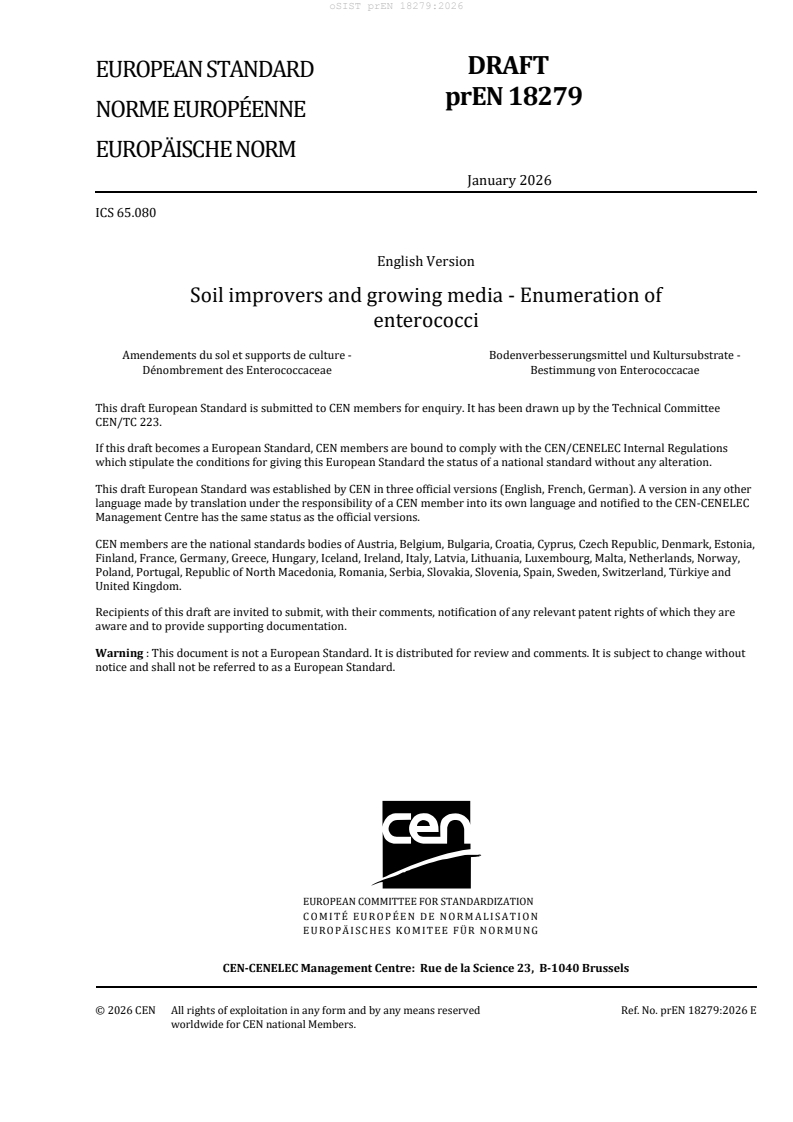

FprEN 18279 is a draft European Standard from CEN for the enumeration of enterococci in soil improvers and growing media. It specifies a culture-based laboratory method for solid and liquid materials, including certain fertilizing product blends when soil improvers and/or growing media are the main component. The method is used to support hygienic control and sanitation checks during manufacture.
What does FprEN 18279 specify?
FprEN 18279 specifies how to count enterococci in soil improvers and growing media by culturing the sample on selective media, then confirming presumptive colonies on a second medium when needed. It applies to materials in solid form, including pre-shaped growing media, and to liquid form.
The scope also covers fertilizing product blends made from two or more fertilizing products in which soil improvers and/or growing media have the highest percentage by mass or volume, or by dry mass for liquid form. If another component has the highest percentage, the standard for that component applies instead. If the blend contains equal quantities, the user chooses the applicable standard.
| Annex | What it covers |
|---|---|
| Annex A | Flow diagram of the procedure |
| Annex B | Composition and preparation of culture media and reagents |
| Annex C | Performance characteristics from an interlaboratory study |
| Annex D | Alternative methods for transferring colonies from Slanetz-Bartley agar to Bile Esculin Azide agar |
Clause 1 sets the scope, Clause 2 lists the normative references, Clause 3 gives the terms and definitions, Clauses 4 to 10 describe the principle, media, equipment, sampling, procedure and calculation, and Clauses 11 to 13 cover validation, reporting and quality assurance.
What are the key requirements of FprEN 18279?
FprEN 18279 is built around a two-step microbiological count: first grow presumptive enterococci on Slanetz-Bartley agar, then confirm them on Bile Esculin Azide (BEA) agar when the count reaches the confirmation threshold. In practice, the user needs to control sampling, sample preparation, incubation, colony selection and reporting so that the result is traceable and repeatable.
Sampling and sample preparation
Sampling is outside the method itself. FprEN 18279 points to EN 12579 for sampling soil improvers and growing media, and to prEN 13040-2 for preparation of the test sample and the initial suspension.
This matters because the laboratory result is only meaningful if the received sample is representative and has not been altered during transport or storage. The method also says the interval between preparing the initial suspension and inoculating the plates shall not exceed 45 min.
Plating and incubation
FprEN 18279 requires 0.1 ml of each appropriate dilution to be spread on Slanetz-Bartley agar. The inoculated plates are incubated upside down at 37 °C for 46 h ± 2 h.
For enumeration, the document expects one plate per dilution with at least two successive dilutions, and two plates per dilution are recommended. If only one dilution is used, two plates are required to improve reliability. For low counts, the method recommends increasing the number of plates so that at least 0.1 g of test portion is distributed on the plates.
Counting and confirmation
FprEN 18279 counts only typical colonies on Slanetz-Bartley agar. These are described as dark red, maroon or pink colonies with a size in the stated range, and atypical colonies are ignored. Plates with fewer than 150 typical colonies and fewer than 300 total colonies are used for enumeration.
If the presumptive count is above the relevant limit value, the selected colonies are transferred to preheated BEA agar and incubated at 44 °C. Typical confirmed colonies are brown to black after esculin hydrolysis. If no blackening appears after 2 h, incubation can continue up to 20 h.
Confirmation options
FprEN 18279 requires at least five colonies of each colony type from each countable plate to be transferred for confirmation, or all colonies if fewer than five are present. The document also allows alternative confirmation methods, such as commercial biochemical test kits, serological tests, PCR analysis or MALDI-TOF, provided they give the same results as the specified method.
Annex D describes two practical transfer options for high colony numbers: a membrane filter method and a stamp method. These help confirm all presumptive colonies when the plate is crowded.
Result calculation and reporting
FprEN 18279 calculates the result as colony-forming units (CFU) per gram or per millilitre. The calculation uses counts from one or two successive dilutions, and when confirmation is required, the confirmed proportion is applied to the total colony count.
Special cases, such as no colonies or too many colonies, are handled according to EN ISO 7218. The test report has to identify the method used, the sampling method, the test portion, any deviations or unusual operating conditions, the result in 1 g or 1 ml, and the test dates.
Validation and quality assurance
FprEN 18279 states that the method was validated in accordance with ISO 5725-5, and Annex C gives the performance characteristics from an interlaboratory study. The laboratory is also expected to run a quality control system, including positive controls, negative controls and blanks.
This matters in practice because the method is intended for routine laboratory work where consistency between runs and between laboratories is important. The document also links culture media performance testing to EN ISO 11133.
What terms does FprEN 18279 define?
- Presumptive enterococci are bacteria that reduce 2,3,5-triphenyltetrazolium chloride on Slanetz-Bartley agar under the specified conditions, so they are the first colonies counted before confirmation.
- Enterococci are bacteria that both reduce 2,3,5-triphenyltetrazolium chloride on Slanetz-Bartley agar and hydrolyse esculin on BEA agar at 44 °C, producing blackening of the medium.
- Enumeration of enterococci means determining the number of CFU per gram, per millilitre or per sample device using the method in this document.
- Colony-forming units (CFU) are the reporting unit used for the final result, representing viable colonies recovered from the test portion.
- Slanetz-Bartley agar is the selective medium used for the initial culture and presumptive count.
- Bile Esculin Azide (BEA) agar is the confirmation medium used to verify enterococci by esculin hydrolysis.
- 2,3,5-triphenyltetrazolium chloride (TTC) is the indicator added to Slanetz-Bartley agar that helps show presumptive colonies by their colour.
Who uses FprEN 18279?
FprEN 18279 is used by microbiology laboratories, quality control laboratories and contract testing labs that examine soil improvers, growing media and fertilizing product blends. It is relevant to manufacturers who need to monitor hygiene during production, and to buyers or quality managers who need laboratory evidence for product checks.
The document is also useful where enterococci are used as indicator germs for faecal contamination and as a parameter for judging the sanitation process in manufacturing. In practice, users apply it for routine counting, confirmation of suspect colonies, and reporting results in a form suitable for technical files or compliance records.
Which standards are used with FprEN 18279?
- EN 12579 - gives the sampling method for soil improvers and growing media.
- prEN 13040-2 - gives sample preparation for microbiological examination and the preparation of the initial suspension and dilutions.
- prEN 17732 - provides terminology for soil improvers and growing media.
- EN ISO 7218 - gives the general microbiology laboratory requirements and guidance used for equipment, practice and special counting cases.
- EN ISO 11133 - supports preparation, storage and performance testing of culture media and reagents.
- EN ISO 7899-2 and ISO/CD 21722 - are named as the basis for the method.
- ISO 5725-5, ISO 5725-6 and ISO 13528 - support the validation and statistical treatment of the interlaboratory study.
What does the FprEN 18279 document contain?
FprEN 18279 contains the full laboratory procedure, including the principle, the media and reagents, the equipment list, the sampling link, the preparation of the test sample, the inoculation and incubation steps, the confirmation steps and the calculation of results. It also includes a test-report checklist and quality assurance guidance.
Annex B gives the media recipes and preparation instructions for Slanetz-Bartley agar, TTC solution, BEA agar and the catalase reagent. Annex C presents the interlaboratory study and the performance characteristics for the matrices tested. Annex D explains two alternative transfer methods that help when many colonies need confirmation.
Get Certified
Connect with accredited certification bodies for this standard

Control Union Certifications
Global certification for agriculture and sustainability.

ECOCERT
Organic and sustainability certification.

FSC International
Forest Stewardship Council certification.
Sponsored listings
Frequently Asked Questions
FprEN 18279 is a draft published by the European Committee for Standardization (CEN). Its full title is "Soil improvers and growing media - Enumeration of enterococci". This standard covers: This document specifies a method for the enumeration of enterococci in soil improvers and growing media. This document is applicable to material in solid form (including pre-shaped growing media) and liquid form. This document is applicable to fertilizing product blends, where a blend is a mix of two or more fertilizing products belonging to the categories of fertilizers, liming material, soil improvers, growing media, inhibitors and plant biostimulants, and where soil improvers and/or growing media comprise the highest percentage in the blend by mass or volume, or in the case of liquid form by dry mass. If soil improvers and/or growing media are not the components with the highest percentage in the blend, the European Standard relevant to the component with the highest percentage in the blend applies. In case a blend is composed of fertilizing products in equal quantity, the user of the standard decides which standard to apply. NOTE 1 A soil improver or a growing medium consists of a single bulky (volume-building) component or a mix of bulky (volume-building) components (for example peat, wood fibres, coconut coir, compost, expanded perlite). NOTE 2 This method has been validated in an interlaboratory study with specific products (peat, biowaste compost, green compost and solid digestate) that were present on the market during the study (Annex C).
This document specifies a method for the enumeration of enterococci in soil improvers and growing media. This document is applicable to material in solid form (including pre-shaped growing media) and liquid form. This document is applicable to fertilizing product blends, where a blend is a mix of two or more fertilizing products belonging to the categories of fertilizers, liming material, soil improvers, growing media, inhibitors and plant biostimulants, and where soil improvers and/or growing media comprise the highest percentage in the blend by mass or volume, or in the case of liquid form by dry mass. If soil improvers and/or growing media are not the components with the highest percentage in the blend, the European Standard relevant to the component with the highest percentage in the blend applies. In case a blend is composed of fertilizing products in equal quantity, the user of the standard decides which standard to apply. NOTE 1 A soil improver or a growing medium consists of a single bulky (volume-building) component or a mix of bulky (volume-building) components (for example peat, wood fibres, coconut coir, compost, expanded perlite). NOTE 2 This method has been validated in an interlaboratory study with specific products (peat, biowaste compost, green compost and solid digestate) that were present on the market during the study (Annex C).
FprEN 18279 is classified under the following ICS (International Classification for Standards) categories: 65.080 - Fertilizers. The ICS classification helps identify the subject area and facilitates finding related standards.
FprEN 18279 is associated with the following European legislation: EU Directives/Regulations: 2003/2003, 2019/1009; Standardization Mandates: M/564, M/564 AMD 1, M/564 AMD 2, M/588, M/XXX. When a standard is cited in the Official Journal of the European Union, products manufactured in conformity with it benefit from a presumption of conformity with the essential requirements of the corresponding EU directive or regulation.
FprEN 18279 is available in PDF format for immediate download after purchase. The document can be added to your cart and obtained through the secure checkout process. Digital delivery ensures instant access to the complete standard document.
Standards Content (Sample)
SLOVENSKI STANDARD
oSIST prEN 18279:2026
01-januar-2026
Izboljševalci tal in rastni substrati - Ugotavljanje števila enterokokov
Soil improvers and growing media - Enumeration of enterococci
Bodenverbesserungsmittel und Kultursubstrate - Bestimmung von Enterococcacae
Amendements du sol et supports de culture - Dénombrement des Enterococcaceae
Ta slovenski standard je istoveten z: prEN 18279
ICS:
65.080 Gnojila Fertilizers
oSIST prEN 18279:2026 en,fr,de
2003-01.Slovenski inštitut za standardizacijo. Razmnoževanje celote ali delov tega standarda ni dovoljeno.
oSIST prEN 18279:2026
oSIST prEN 18279:2026
DRAFT
EUROPEAN STANDARD
prEN 18279
NORME EUROPÉENNE
EUROPÄISCHE NORM
January 2026
ICS 65.080
English Version
Soil improvers and growing media - Enumeration of
enterococci
Amendements du sol et supports de culture - Bodenverbesserungsmittel und Kultursubstrate -
Dénombrement des Enterococcaceae Bestimmung von Enterococcacae
This draft European Standard is submitted to CEN members for enquiry. It has been drawn up by the Technical Committee
CEN/TC 223.
If this draft becomes a European Standard, CEN members are bound to comply with the CEN/CENELEC Internal Regulations
which stipulate the conditions for giving this European Standard the status of a national standard without any alteration.
This draft European Standard was established by CEN in three official versions (English, French, German). A version in any other
language made by translation under the responsibility of a CEN member into its own language and notified to the CEN-CENELEC
Management Centre has the same status as the official versions.
CEN members are the national standards bodies of Austria, Belgium, Bulgaria, Croatia, Cyprus, Czech Republic, Denmark, Estonia,
Finland, France, Germany, Greece, Hungary, Iceland, Ireland, Italy, Latvia, Lithuania, Luxembourg, Malta, Netherlands, Norway,
Poland, Portugal, Republic of North Macedonia, Romania, Serbia, Slovakia, Slovenia, Spain, Sweden, Switzerland, Türkiye and
United Kingdom.
Recipients of this draft are invited to submit, with their comments, notification of any relevant patent rights of which they are
aware and to provide supporting documentation.
Warning : This document is not a European Standard. It is distributed for review and comments. It is subject to change without
notice and shall not be referred to as a European Standard.
EUROPEAN COMMITTEE FOR STANDARDIZATION
COMITÉ EUROPÉEN DE NORMALISATION
EUROPÄISCHES KOMITEE FÜR NORMUNG
CEN-CENELEC Management Centre: Rue de la Science 23, B-1040 Brussels
© 2026 CEN All rights of exploitation in any form and by any means reserved Ref. No. prEN 18279:2026 E
worldwide for CEN national Members.
oSIST prEN 18279:2026
prEN 18279:2026 (E)
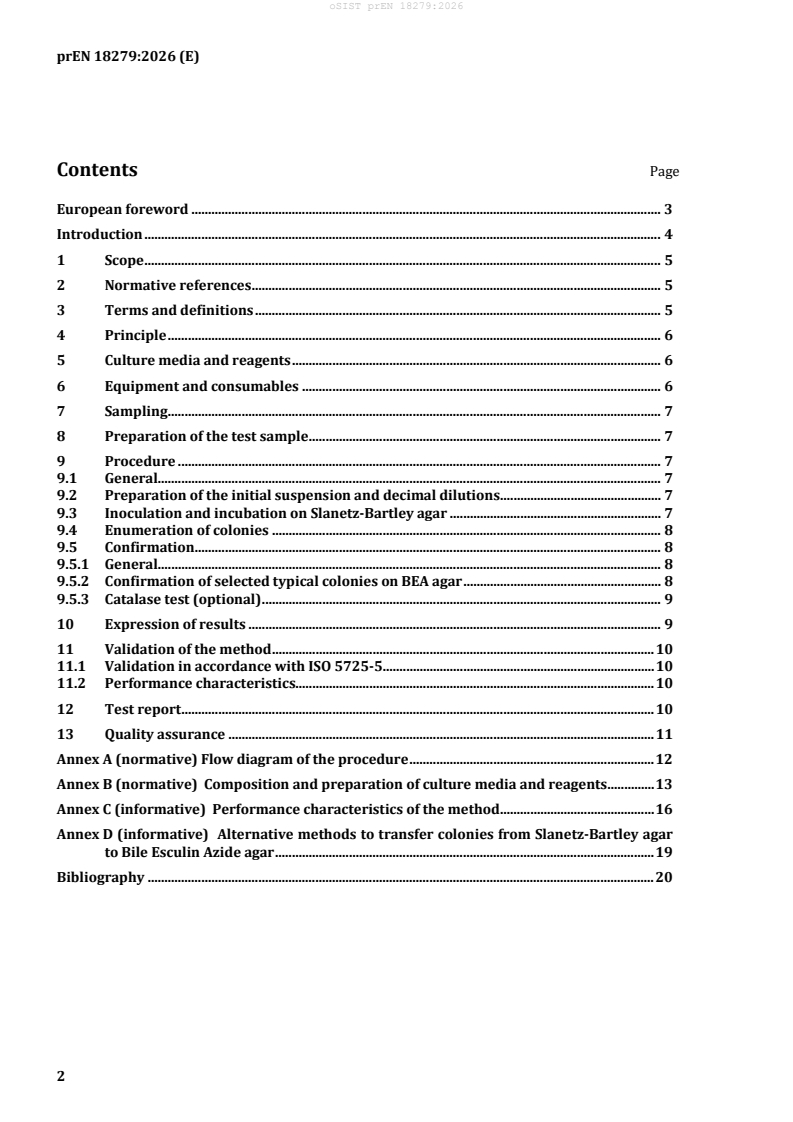
Contents Page
European foreword . 3
Introduction . 4
1 Scope . 5
2 Normative references . 5
3 Terms and definitions . 5
4 Principle . 6
5 Culture media and reagents . 6
6 Equipment and consumables . 6
7 Sampling . 7
8 Preparation of the test sample . 7
9 Procedure . 7
9.1 General. 7
9.2 Preparation of the initial suspension and decimal dilutions . 7
9.3 Inoculation and incubation on Slanetz-Bartley agar . 7
9.4 Enumeration of colonies . 8
9.5 Confirmation . 8
9.5.1 General. 8
9.5.2 Confirmation of selected typical colonies on BEA agar . 8
9.5.3 Catalase test (optional) . 9
10 Expression of results . 9
11 Validation of the method . 10
11.1 Validation in accordance with ISO 5725-5. 10
11.2 Performance characteristics. 10
12 Test report . 10
13 Quality assurance . 11
Annex A (normative) Flow diagram of the procedure . 12
Annex B (normative) Composition and preparation of culture media and reagents . 13
Annex C (informative) Performance characteristics of the method . 16
Annex D (informative) Alternative methods to transfer colonies from Slanetz-Bartley agar
to Bile Esculin Azide agar . 19
Bibliography . 20
oSIST prEN 18279:2026
prEN 18279:2026 (E)
European foreword
This document (prEN 18279:2026) has been prepared by Technical Committee CEN/TC 223 “Soil
improvers and growing media”, the secretariat of which is held by NEN.
This document is currently submitted to the CEN Enquiry.
This document has been prepared under a mandate given to CEN by the European Commission and the
European Free Trade Association.
oSIST prEN 18279:2026
prEN 18279:2026 (E)
Introduction
This document has been developed to enumerate enterococci in soil improvers and growing media in
order to control certain imposed hygienic requirements. The method described in this document is based
on EN ISO 7899-2 and ISO/CD 21722.
Enterococci are considered indicator germs for faecal contamination (intestinal enterococci).
Consequently, they can be used as a parameter to evaluate the sanitation process during the
manufacturing process of soil improvers or growing media. The presence or absence of enterococci does
not reflect the presence or absence of other pathogens in the material tested.
Enterococci include several species of the genus Enterococcus. These bacteria occur ubiquitously in the
environment (water, soil), in animals and in humans (in the normal intestinal flora).
WARNING — In order to safeguard the health of laboratory personnel, it is essential that tests for the
enumeration of enterococci are only undertaken in properly equipped laboratories, under the control of
a skilled microbiologist, and that great care is taken in the disposal of all incubated materials. Persons
using this document should be familiar with normal laboratory practice. This document does not purport
to address all of the safety aspects, if any, associated with its use. It is the responsibility of the user to
establish appropriate safety and health practices.
oSIST prEN 18279:2026
prEN 18279:2026 (E)
1 Scope
This document specifies a method for the enumeration of enterococci in soil improvers and growing
media. This document is applicable to material in solid form (including pre-shaped growing media) and
liquid form.
This document is applicable to fertilizing product blends, where a blend is a mix of two or more fertilising
products belonging to the categories of fertilizers, liming material, soil improvers, growing media,
inhibitors and plant biostimulants, and where soil improvers and/or growing media comprise the highest
percentage in the blend by mass or volume, or in the case of liquid form by dry mass. If soil improvers
and/or growing media do not comprise the highest percentage in the blend, the European Standard for
the highest percentage in the blend applies. In case a blend is composed of fertilising products in equal
quantity, the user of the standard decides which standard to apply.
NOTE 1 A soil improver or a growing medium consists of a single bulky (volume-building) component or a mix
of bulky (volume-building) components (for example peat, wood fibres, coconut coir, compost, expanded perlite).
NOTE 2 This method has been validated in an interlaboratory study with specific products that were present on
the market during the study (Annex C).
2 Normative references
The following documents are referred to in the text in such a way that some or all of their content
constitutes requirements of this document. For dated references, only the edition cited applies. For
undated references, the latest edition of the referenced document (including any amendments) applies.
EN 12579, Soil improvers and growing media - Sampling
prEN 13040-2, Soil improvers and growing media — Sample preparation — Part 2: Sample preparation
for microbiological examination
prEN 17732, Soil improvers and growing media — Terminology
EN ISO 7218, Microbiology of the food chain - General requirements and guidance for microbiological
examinations (ISO 7218)
3 Terms and definitions
For the purposes of this document, the terms and definitions given in prEN 17732, prEN 13040-2 and the
following apply.
ISO and IEC maintain terminology databases for use in standardization at the following addresses:
— ISO Online browsing platform: available at https://www.iso.org/obp/
— IEC Electropedia: available at https://www.electropedia.org/
3.1
presumptive enterococci
bacteria which are able to reduce 2,3,5-triphenyltetrazolium chloride to formazan on the surface of a
selective culture medium containing sodium azide (Slanetz-Bartley agar) under the conditions specified
in this document
Under preparation. Stage at time of publication: prEN 13040-2:2025.
Under preparation. Stage at time of publication: prEN 17732:2025.
oSIST prEN 18279:2026
prEN 18279:2026 (E)
3.2
enterococci
bacteria which are able to reduce 2,3,5-triphenyltetrazolium chloride to formazan on the surface of a
selective culture medium containing sodium azide (Slanetz-Bartley agar) and to hydrolyse esculin at
44 °C ± 1 °C on a medium containing bile salts (Bile Esculin Azide agar), resulting in blackening of the
medium under the conditions specified in this document
3.3
enumeration of enterococci
determination of the number of colony-forming units (CFU) of enterococci per gram or per millilitre of
product or per sample device, when the analysis and calculation is carried out in accordance with this
document
4 Principle
The initial suspension and/or aliquots of appropriate dilutions are used to inoculate Slanetz-Bartley agar
plates through spread plating, which are incubated at 37 °C for 46 h. After incubation, presumptive
enterococci colonies are enumerated. If the number of presumptive enterococci colonies isolated on
Slanetz-Bartley agar exceeds a limit value, these are confirmed by inoculation on pre-heated plates of Bile
Esculin Azide (BEA) agar, which are incubated at 44 °C for 2 h to detect blackening of the agar medium.
If no blackening occurs, the plates are incubated again at 44 °C for up to 20 h.
5 Culture media and reagents
Follow current laboratory practices in accordance with standards comparable to EN ISO 7218. The
composition of culture media and reagents and their preparation are specified in Annex B. For
performance testing of culture media, it is advised to follow the procedures of EN ISO 11133.
6 Equipment and consumables
Disposable equipment is an acceptable alternative to reusable glassware if it has suitable specifications.
The usual microbiological laboratory equipment (see EN ISO 7218) and, in particular, the following shall
be used.
6.1 Equipment for dry sterilization (oven) and/or wet sterilization (autoclave).
6.2 Incubator(s), capable of maintaining a temperature of 37 °C ± 1 °C, 44 °C ± 1 °C and/or a range of
47 °C to 50 °C.
6.3 Scales, of the required range and accuracy for the different products to be weighed.
6.4 Water bath, capable of maintaining temperatures of 47 °C to 50 °C.
6.5 Cooling unit, adjustable at 5 °C ± 3 °C.
6.6 pH-meter, capable of reading to the nearest 0,1 pH unit at 20 °C to 25 °C.
6.7 Sterile loops, of 10 μl volume (approximate diameter 3 mm) and of 1μl volume, inoculating
needles, inoculating wires.
6.8 Sterile spreaders (hockey-stick type),or spatulas or a spiral plater with a sanitized
dispensing system or disposable one–way micro syringes.
oSIST prEN 18279:2026
prEN 18279:2026 (E)
6.9 Sterile membrane filters or sterile stamp pads, to transfer colonies onto the confirmation
medium.
6.10 Sterile tubes, bottles or flasks, with caps and of appropriate capacity.
6.11 Graduated pipettes or automatic pipettes and sterile tips, with wide opening if necessary, of
nominal capacities of 0,1 ml, 1 ml and 10 ml.
6.12 Sterile Petri dishes, with a diameter of approximately 90 mm or a diameter of approximately
140 mm (optional).
6.13 Tweezers.
7 Sampling
Sampling is not part of the method specified in this document. Follow EN 12579 dealing with soil
improvers and growing media. It is important that the laboratory receives a sample that is representative
of the product under consideration. The sample should not have been damaged or changed during
transport or storage.
8 Preparation of the test sample
Prepare the test sample from the laboratory sample in accordance with prEN 13040-2. If there is no
specific International Standard available, it is recommended that the parties concerned come to an
agreement on this subject.
9 Procedure
9.1 General
The procedure as given in Annex A shall be followed.
The time elapsing between the start of the preparation of the initial suspension and the moment when
the plates are inoculated shall not exceed 45 min.
9.2 Preparation of the initial suspension and decimal dilutions
Preparation of the initial suspension and further decimal dilutions shall be performed according to
prEN 13040-2.
Aliquots of the initial suspension should only be used for cultivation if no toxic or inhibiting substances
are expected in the sample. For blended products with high amounts of minerals, it is recommended to
−2
use aliquots from the first dilution (10 ) and higher. Liquid materials may be used undiluted for
cultivation if they do not contain any toxic or inhibiting substances.
9.3 Inoculation and incubation on Slanetz-Bartley agar
Using a sterile pipette or a micropipette (6.11), 0,1 ml of each appropriate dilution shall be transferred
onto (a) Slanetz-Bartley agar plate(s) (B.2).
The plates with the selective media shall be allowed to reach room temperature if they were stored at
5 °C (6.5). If necessary, dry the surface of the plates before use.
If necessary, the inoculation procedure may be repeated with further decimal dilutions, using a new
sterile pipette for each dilution.
Spiral plating may be used following EN ISO 7218 and manufacturer instructions.
oSIST prEN 18279:2026
prEN 18279:2026 (E)
For enumeration, one plate per dilution shall be used with at least two successive dilutions. To improve
the reliability of the results, two plates per dilution are recommended.
If only one dilution is used, then two plates of this dilution shall be used to improve reliability of the
results.
For laboratories that do not operate under quality assurance principles, two plates per dilution shall be
used to improve reliability of the results.
Where greater dilutions are made and low counts are expected, the number of inoculated plates for
enumeration tests should be increased to ensure that an inoculation volume corresponding to at least
0,1 g of the test portion is distributed on the plates. If the colony counts expected from the first dilution
−2
are ≤ 10, it is recommended to add 1 ml of the first dilution (10 ) to one Petri dish with a diameter of
140 mm or to use three Petri dishes with a diameter of 90 mm to make the counting result statistically
more stable.
The inoculated Slanetz-Bartley agar plates shall be incubated upside down in an incubator (6.2) set at
37 °C for 46 h ± 2 h.
9.4 Enumeration of colonies
After incubation, all plates (9.3) showing less than 150 typical colonies and less than 300 total (typical
and atypical) colonies shall be used for the enumeration. Atypical colonies shall not be considered for the
enumeration.
Typical formazan-positive enterococci colonies on Slanetz-Bartley agar are dark red, maroon or pink in
colour (either in the centre and surrounded by a narrow colourless zone, or throughout the colony), with
a variation in diameter from 0,3 mm to 2 mm.
Typical colonies on Slanetz-Bartley agar (B.2) are expressed as “presumptive enterococci” (3.1).
If there are no typical colonies on Slanetz-Bartley agar (B.2), the negative result should refer to
“enterococci” (3.2) and not to “presumptive enterococci” (3.1).
9.5 Confirmation
9.5.1 General
If the calculated number of presumptive enterococci (3.1) colonies is above a given limit value (for
example, the limit values given for soil improvers and growing
...