

EN ISO 20344:2004
(Main)Personal protective equipment - Test methods for footwear (ISO 20344:2004)
- Abstract
ISO 20344:2004 specifies methods for testing footwear designed as personal protective equipment.
- Status
- Withdrawn
- Publication Date
- 31-Jul-2004
- Withdrawal Date
- 30-Nov-2011
- Technical Committee
- CEN/TC 161 - Foot and leg protectors
- Drafting Committee
- CEN/TC 161 - Foot and leg protectors
- Current Stage
- 9960 - Withdrawal effective - Withdrawal
- Start Date
- 01-Dec-2011
- Completion Date
- 01-Dec-2011
89/686/EEC - Personal protective equipment (PPE)OJ Ref: C 247, C 3, C 306, C 91 OJ Date: 06-Oct-2005



Relations
- Effective Date
- 22-Dec-2008
- Effective Date
- 22-Dec-2008
- Effective Date
- 22-Dec-2008
- Effective Date
- 22-Dec-2008
- Replaced By
EN ISO 20344:2011 - Personal protective equipment - Test methods for footwear (ISO 20344:2011) - Effective Date
- 22-Dec-2008
- Effective Date
- 28-Jan-2026
- Effective Date
- 28-Jan-2026
- Referred By
EN ISO 17249:2004 - Safety footwear with resistance to chain saw cutting - (ISO 17249:2004) - Effective Date
- 28-Jan-2026
- Referred By
EN ISO 17249:2013 - Safety footwear with resistance to chain saw cutting (ISO 17249:2013) - Effective Date
- 28-Jan-2026
- Effective Date
- 28-Jan-2026
- Referred By
EN 13634:2010 - Protective footwear for motorcycle riders - Requirements and test methods - Effective Date
- 28-Jan-2026
- Effective Date
- 28-Jan-2026
- Referred By
EN 13832-1:2006 - Footwear protecting against chemicals - Part 1: Terminology and test methods - Effective Date
- 28-Jan-2026
- Effective Date
- 12-Feb-2026
- Effective Date
- 08-Jun-2022
Get Certified
Connect with accredited certification bodies for this standard

CIS Institut d.o.o.
Personal Protective Equipment (PPE) certification body. Notified Body NB-2890 for EU Regulation 2016/425 PPE.

Kiwa BDA Testing
Building and construction product certification.
Kmetijski inštitut Slovenije
Agricultural Institute of Slovenia. Soil testing, plant health, agricultural product analysis.
Sponsored listings
Frequently Asked Questions
EN ISO 20344:2004 is a standard published by the European Committee for Standardization (CEN). Its full title is "Personal protective equipment - Test methods for footwear (ISO 20344:2004)". This standard covers: ISO 20344:2004 specifies methods for testing footwear designed as personal protective equipment.
ISO 20344:2004 specifies methods for testing footwear designed as personal protective equipment.
EN ISO 20344:2004 is classified under the following ICS (International Classification for Standards) categories: 13.340.50 - Leg and foot protection. The ICS classification helps identify the subject area and facilitates finding related standards.
EN ISO 20344:2004 has the following relationships with other standards: It is inter standard links to EN 344:1992/AC:1993, EN 344-2:1996, EN 344:1992, EN 344:1992/A1:1997, EN ISO 20344:2011, EN 659:2003+A1:2008, EN 13832-2:2006, EN ISO 17249:2004, EN ISO 17249:2013, EN 13832-3:2006, EN 13634:2010, EN ISO 20346:2004, EN 13832-1:2006, ISO 20344:2004, EN ISO 20344:2004/A1:2007. Understanding these relationships helps ensure you are using the most current and applicable version of the standard.
EN ISO 20344:2004 is associated with the following European legislation: EU Directives/Regulations: 2014/90/EU, 89/686/EEC, 93/68/EEC, 93/95/EEC, 96/58/EC, 96/98/EC; Standardization Mandates: M/031. When a standard is cited in the Official Journal of the European Union, products manufactured in conformity with it benefit from a presumption of conformity with the essential requirements of the corresponding EU directive or regulation.
EN ISO 20344:2004 is available in PDF format for immediate download after purchase. The document can be added to your cart and obtained through the secure checkout process. Digital delivery ensures instant access to the complete standard document.
Standards Content (Sample)
SLOVENSKI STANDARD
01-oktober-2004
Osebna varovalna oprema - Metode preskušanja obutve (ISO 20344:2004)
Personal protective equipment - Test methods for footwear (ISO 20344:2004)
Persönliche Schutzausrüstung - Prüfverfahren für Schuhe (ISO 20344:2004)
Equipement de protection individuelle - Méthodes d'essai pour les chaussures (ISO
20344:2004)
Ta slovenski standard je istoveten z: EN ISO 20344:2004
ICS:
13.340.50 Varovanje nog in stopal Leg and foot protection
2003-01.Slovenski inštitut za standardizacijo. Razmnoževanje celote ali delov tega standarda ni dovoljeno.
EUROPEAN STANDARD
EN ISO 20344
NORME EUROPÉENNE
EUROPÄISCHE NORM
August 2004
ICS 13.340.50 Supersedes EN 344:1992, EN 344-2:1996
English version
Personal protective equipment - Test methods for footwear
(ISO 20344:2004)
Equipement de protection individuelle - Méthodes d'essai Persönliche Schutzausrüstung - Prüfverfahren für Schuhe
pour les chaussures (ISO 20344:2004) (ISO 20344:2004)
This European Standard was approved by CEN on 2 January 2004.
CEN members are bound to comply with the CEN/CENELEC Internal Regulations which stipulate the conditions for giving this European
Standard the status of a national standard without any alteration. Up-to-date lists and bibliographical references concerning such national
standards may be obtained on application to the Central Secretariat or to any CEN member.
This European Standard exists in three official versions (English, French, German). A version in any other language made by translation
under the responsibility of a CEN member into its own language and notified to the Central Secretariat has the same status as the official
versions.
CEN members are the national standards bodies of Austria, Belgium, Cyprus, Czech Republic, Denmark, Estonia, Finland, France,
Germany, Greece, Hungary, Iceland, Ireland, Italy, Latvia, Lithuania, Luxembourg, Malta, Netherlands, Norway, Poland, Portugal, Slovakia,
Slovenia, Spain, Sweden, Switzerland and United Kingdom.
EUROPEAN COMMITTEE FOR STANDARDIZATION
COMITÉ EUROPÉEN DE NORMALISATION
EUROPÄISCHES KOMITEE FÜR NORMUNG
Management Centre: rue de Stassart, 36 B-1050 Brussels
© 2004 CEN All rights of exploitation in any form and by any means reserved Ref. No. EN ISO 20344:2004: E
worldwide for CEN national Members.
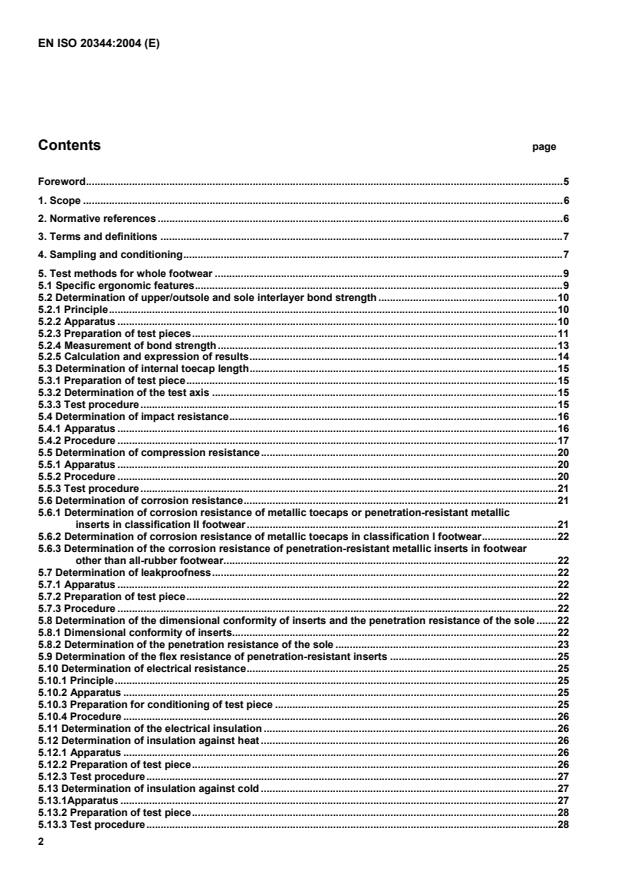
Contents page
Foreword.5
1. Scope .6
2. Normative references .6
3. Terms and definitions .7
4. Sampling and conditioning.7
5. Test methods for whole footwear .9
5.1 Specific ergonomic features.9
5.2 Determination of upper/outsole and sole interlayer bond strength .10
5.2.1 Principle.10
5.2.2 Apparatus .10
5.2.3 Preparation of test pieces.11
5.2.4 Measurement of bond strength.13
5.2.5 Calculation and expression of results.14
5.3 Determination of internal toecap length.15
5.3.1 Preparation of test piece.15
5.3.2 Determination of the test axis .15
5.3.3 Test procedure.15
5.4 Determination of impact resistance.16
5.4.1 Apparatus .16
5.4.2 Procedure .17
5.5 Determination of compression resistance.20
5.5.1 Apparatus .20
5.5.2 Procedure .20
5.5.3 Test procedure.21
5.6 Determination of corrosion resistance.21
5.6.1 Determination of corrosion resistance of metallic toecaps or penetration-resistant metallic
inserts in classification II footwear.21
5.6.2 Determination of corrosion resistance of metallic toecaps in classification I footwear.22
5.6.3 Determination of the corrosion resistance of penetration-resistant metallic inserts in footwear
other than all-rubber footwear.22
5.7 Determination of leakproofness.22
5.7.1 Apparatus .22
5.7.2 Preparation of test piece.22
5.7.3 Procedure .22
5.8 Determination of the dimensional conformity of inserts and the penetration resistance of the sole .22
5.8.1 Dimensional conformity of inserts.22
5.8.2 Determination of the penetration resistance of the sole .23
5.9 Determination of the flex resistance of penetration-resistant inserts .25
5.10 Determination of electrical resistance.25
5.10.1 Principle.25
5.10.2 Apparatus .25
5.10.3 Preparation for conditioning of test piece .25
5.10.4 Procedure .26
5.11 Determination of the electrical insulation .26
5.12 Determination of insulation against heat .26
5.12.1 Apparatus .26
5.12.2 Preparation of test piece.26
5.12.3 Test procedure.27
5.13 Determination of insulation against cold .27
5.13.1Apparatus .27
5.13.2 Preparation of test piece.28
5.13.3 Test procedure.28
5.14 Determination of energy absorption of seat region.29
5.14.1 Apparatus .29
5.14.2 Procedure .30
5.15 Determination of resistance to water for whole footwear .31
5.15.1 Trough test .31
5.15.2 Machine method .32
5.15.2.1 Principle.32
5.15.2.2 Apparatus .32
5.16 Determination of impact resistance of metatarsal protective device .38
5.16.1 Apparatus .38
5.16.2 Preparation of test piece.41
5.16.3 Procedure .41
5.16.4 Test results.42
5.17 Determination of the shock absorption capacity of ankle protection materials incorporated into
the upper .42
5.17.1 Principle.42
5.17.2 Apparatus .43
5.17.2.5 Templates .44
5.17.2.6 Sampling.44
5.17.3 Preparation of test pieces.45
5.17.4 Conditioning.45
5.17.5 Procedure .45
5.17.6 Test report .45
6. Test methods for upper, lining and tongue .46
6.1 Determination of thickness of upper .46
6.2 Measurement of the height of the upper.46
6.2.1 Preparation of test piece.46
6.2.2 Measurement.46
6.3 Determination of tear strength of upper, lining and/or tongue.46
6.4 Determination of the tensile properties of upper material .47
6.5 Determination of upper flexing resistance.47
6.6 Determination of water vapour permeability .47
6.6.1 Principle.47
6.6.2 Apparatus .47
6.6.3 Preparation of test piece.50
6.6.4 Test procedure.51
6.6.5 Calculation and expression of results.52
6.7 Determination of water vapour absorption.52
6.7.1 Principle.52
6.7.2 Apparatus .52
6.7.3 Preparation of test piece.53
6.7.4 Test procedure.53
6.7.5 Calculation and expression of results.54
6.8 Determination of water vapour coefficient.54
6.9 Determination of pH value .54
6.10 Determination of resistance to hydrolysis of upper .54
6.11 Determination of chromium VI content .54
6.11.1 Principle.54
6.11.2 Chemicals.55
6.11.3 Apparatus .55
6.11.4 Procedure .56
6.11.5 Determination of the recovery rate.57
6.11.6 Calculation and expression of results.58
6.11.7. Test report .59
6.12 Determination of abrasion resistance of lining and insock .59
6.12.1 Principle.59
6.12.2 Apparatus .59
6.12.3 Atmosphere for testing .60
6.12.4 Preparation of test pieces and materials .60
6.12.5 Procedure .60
6.12.6 Method of assessment.61
6.13 Determination of water penetration and water absorption for upper.61
6.13.1 Principle.61
6.13.2 Apparatus .62
6.13.3 Preparation of test piece.62
6.13.4 Procedure .62
6.13.5 Calculation and expression of results.63
6.14 Determination of resistance of upper to cutting .63
6.14.1 Preparation of test piece.63
6.14.2 Procedure .63
7. Test methods for insole and insock .63
7.1 Determination of insole thickness .63
7.2 Determination of water absorption and desorption of insole and insock .63
7.2.1 Principle.63
7.2.2. Apparatus .64
7.2.3 Sampling and conditioning.65
7.2.4 Procedure .65
7.2.5 Expression of results .65
7.2.6 Test report .66
7.3 Determination of abrasion resistance of insole .66
7.3.1 Principle.66
7.3.2 Apparatus .66
7.3.3 Preparation of test piece.67
7.3.4 Preparation of abradant pads.67
7.3.5 Procedure .67
7.3.6 Method of assessment .67
8 Test methods for outsole.68
8.1 Determination of outsole thickness.68
8.1.1 Determination of conformity of the cleated area.68
8.1.2 Outsole thickness.68
8.2 Determination of tear strength of outsole.68
8.3 Determination of outsole abrasion resistance .69
8.4 Determination of flexing resistance of outsole .69
8.4.1 Rigidity test .69
8.4.2 Flexing test.71
8.5 Determination of resistance to hydrolysis of outsole.74
8.6 Determination of resistance to fuel oil .74
8.6.1 General method.74
8.6.2 Method for outsole materials which shrink or become hardened.74
8.7 Determination of resistance to hot contact .74
8.7.1 Apparatus .74
8.7.2 Preparation of test specimen .76
8.7.3 Procedure .77
8.7.4 Method of assessment .77
Annex ZA (Informative) Clauses of this European Standard addressing essential requirements or
other provisions of EU directives .78
Annex ZB (normative) Corresponding International and European Standards for which equivalents
are not given in the text .79
Foreword
This document (EN ISO 20344:2004) has been prepared by CEN /TC 161, "Foot and leg protectors", the
secretariat of which is held by BSI in collaboration with ISO/TC 94 "Personal safety - Protective clothing and
equipment".
This European Standard shall be given the status of a national standard, either by publication of an identical text or
by endorsement, at the latest by February 2005, and conflicting national standards shall be withdrawn at the latest
by August 2005.
This document supersedes EN 344:1992 and EN 344-2: 1996.
This document has been prepared under a mandate given to CEN by the European Commission and the European
Free Trade Association, and supports essential requirements of EU Directive(s).
For relationship with EU Directive(s), see informative annex ZA, which is an integral part of this document.
According to the CEN/CENELEC Internal Regulations, the national standards organizations of the following
countries are bound to implement this European Standard: Austria, Belgium, Cyprus, Czech Republic, Denmark,
Estonia, Finland, France, Germany, Greece, Hungary, Iceland, Ireland, Italy, Latvia, Lithuania, Luxembourg, Malta,
Netherlands, Norway, Poland, Portugal, Slovakia, Slovenia, Spain, Sweden, Switzerland and United Kingdom
1. Scope
This Standard specifies methods for testing footwear designed as personal protective equipment.
2. Normative references
The following referenced documents are indispensable for the application of this document. For dated references,
only the edition cited applies. For undated references, the latest edition of the referenced document (including any
amendments) applies.
EN 388:1994, Protective gloves against mechanical risks
EN 12568:1998, Foot and leg protectors — Requirements and test methods for toecaps and metal penetration
resistant inserts
EN 50321:1999, Electrically insulating footwear for working on low voltage installations
EN ISO 868, Plastics and ebonite — Determination of indentation hardness by means of a durometer (Shore
hardness) (ISO 868:2003)
EN ISO 3696, Water for analytical laboratory use – Specification and test methods (ISO 3696:1987)
EN ISO 3376:2002, Leather — Physical and mechanical tests - Determination of tensile strength and percentage
extension (ISO 3376:2002)
EN ISO 3377-2, Leather - Physical and mechanical tests - Determination of tear load (ISO 3377-2: 2002)
EN ISO 4044, Leather — Preparation of chemical test samples (ISO 4044:1977)
EN ISO 4045, Leather — determination of pH (ISO 4045:1977)
EN ISO 4674-1:2003, Rubber- or plastics-coated fabrics - Determination of tear resistance - Part 1: Constant rate
of tear methods (ISO 4674-1:2003)
EN ISO 17249:2004, Safety footwear with resistance to chain saw cutting (ISO 17249: 2004)
EN ISO 20345, Personal protective equipment - Safety footwear (ISO 20345:2004)
EN ISO 20346, Personal protective equipment - Protective footwear (ISO 20346:2004)
EN ISO 20347, Personal protective equimpent - Occupational footwear (ISO 20347:2004)
ISO 34-1:1994, Rubber, vulcanised or thermoplastic — Determination of tear strength — Part 1 : Trouser, angle
and crescent test pieces
ISO 1817:1999, Rubber, vulcanised — Determination of the effect of liquids
ISO 2023:1994, Rubber footwear - Lined industrial vulcanized rubber boots - Specification
ISO 3290, Rolling bearings — Balls — Dimensions and tolerances
ISO 4643:1992, Moulded plastic footwear — Lined or unlined poly(vinyl chloride) boots for general industrial use —
Specification
ISO 4648:1991, Rubber, vulcanized or thermoplastic — Determination of dimensions of test pieces and products
for test purposes
ISO 4649:2002, Rubber, vulcanized or thermoplastic — Determination of abrasion resistance using a rotating
cylindrical drum device
ISO 5423:1992, Moulded plastic footwear — Lined or unlined polyurethane boots for general industrial use —
Specification
3. Terms and definitions
For the purposes of this standard, the terms and definitions given in EN ISO 20345, EN ISO 20346 and
EN ISO 20347 shall apply.
4. Sampling and conditioning
The minimum numbers of samples to be tested in order to check compliance with the requirements specified in
EN ISO 20345, EN ISO 20346, EN ISO 20347 and any specific job related footwear standards (e.g. EN ISO 17249
footwear with resistance to chain saw cutting), together with the minimum number of test pieces taken from each
sample, shall be in accordance with Table 1.
Table 1 — Minimum number of samples and test specimens or test pieces and their origin
Property under test
Number of
test Test only on
Clause Number of
pieces the final
reference samples
B : basic requirement
from each footwear
sample
A : additional requirement
3 pairs from 3
Specific ergonomic features B 5.1 1 pair yes
different sizes
1 from each of
Upper/outsole and sole interlayer bond strength B 5.2 1 yes
3 sizes
1 pair from
Internal toecap length B 5.3 1 pair yes
each of 3 sizes
1 pair from
Impact resistance B 5.4 1 pair yes
each of 3 sizes
1 pair from
Compression resistance B 5.5 1 pair yes
each of 3 sizes
No for
classification I
Corrosion resistance of metallic toecaps or 2 from different
B 5.6 1
penetration-resistant metallic inserts sizes
Yes for
classification II
2 from different
Leakproofness B 5.7 1 yes
sizes
Dimensional conformity and penetration resistance 1 pair from
A 5.8 1 pair yes
of inserts each of 3 sizes
5. Whole
1 pair from
footwear Flex resistance of penetration-resistant insert A 5.9 1 pair no
each of 3 sizes
1 pair from
Electrical resistance A 5.10 1 pair yes
each of 3 sizes
1 pair from
Electrical insulation A 5.11 1 pair yes
each of 3 sizes
2 from different
Insulation against heat A 5.12 1 yes
sizes
2 from different
Insulation against cold A 5.13 1 yes
sizes
1 pair from
Energy absorption of seat region A 5.14 1 pair yes
each of 3 sizes
3 pairs
Water resistance A 5.15 (minimum 2 1 pair yes
different sizes)
1 pair from
Impact resistance metatarsal protective device A 5.16 1 pair yes
each of 3 sizes
1 pair from
Ankle protection A 5.17 1 pair yes
each of 3 sizes
Table 1 (continued)— Minimum number of samples and test specimens or test pieces and their origin
Property under test
Number of
Test only on
Clause Number of test pieces
the final
reference samples from each
footwear
B : basic requirement sample
1 from each of
Thickness B 6.1 3 yes
3sizes
1 from each of
Height of the upper B 6.2 3 yes
3sizes
1 from each of
Tear strength B 6.3 3 yes
3sizes
1 from each of
Tensile properties B 6.4 3 yes
3sizes
1 from each of
Flexing resistance B 6.5 1 yes
3sizes
1 from each of
Water vapour permeability B 6.6 1 yes
6.
3sizes
Upper
1 from each of
Water vapour absorption B 6.7 1 yes
3sizes
Lining
1 from each of
Water vapour coefficient B 6.8 1 yes
And
3 sizes
Tongue
pH value B 6.9 1 2 no
1 from each of
Hydrolysis B 6.10 1 yes
3sizes
Chromium VI content B 6.11 1 2 no
Abrasion resistance of lining B 6.12 3 4 no
Water penetration and water absorption A 6.13 3 1 no
Cut resistance A 6.14 3 4 yes
a
Thickness of insole B 7.1 1 no
pH value B 6.9 1 2 no
7.
a
Water absorption and desorption B 7.2 1 no
Insole and
a
Abrasion resistance of insole B 7.3 1 no
Insock
Chromium VI content B 6.11 1 2 no
Abrasion resistance of insock B 6.12 3 4 no
1 from each of
Thickness B 8.1 1 yes
3sizes
1 from each of
Tear strength B 8.2 1 yes
3sizes
1 from each of
Abrasion resistance B 8.3 1 yes
3sizes
8.
1 from each of
Flexing resistance B 8.4 1 yes
Outsole 3sizes
1 from each of
Hydrolysis B 8.5 1 yes
3sizes
1 from each of
Resistance to fuel oil B 8.6 1 yes
3sizes
1 from each of
Resistance to hot contact A 8.7 1 yes
3sizes
a
if the samples are taken from the footwear use 3 different sizes
Wherever possible and necessary to ensure the essential safety requirements, test pieces shall be taken from the
whole footwear. This paragraph is applicable for all the table 1.
NOTE If it is not possible to obtain a large enough test piece from the footwear, then a sample of the material
from which the component has been manufactured may be used instead and this should be noted in the
test report.
Where samples are required from each of three sizes, these shall comprise the largest, the smallest and a middle
size of the footwear under test.
All test pieces shall be conditioned in a standard atmosphere of (23°± 2) °C and (50 ± 5)% r.h. for a minimum of
48 h before testing, unless otherwise stated in the test method.
The maximum time which shall elapse between removal from the conditioning atmosphere and the start of testing
shall not be greater than 10 min, unless otherwise stated in the test method.
Each individual test piece shall satisfy the specified requirement, unless otherwise stated in the test method.
The uncertainty of measurement for each test method described in the present standard shall be assessed. One of
the two following approaches shall be used:
a statistical method, e.g. that given in ISO 5725-2;
a mathematical method, e.g. that given in ENV 13005.
5. Test methods for whole footwear
5.1 Specific ergonomic features
The specific ergonomic features of the footwear shall be assessed by examining the footwear using wear trials on 3
wearers with appropriate foot sizes.
During the trials the wearers wearing each pair of the correctly fitting footwear will simulate typical tasks likely to be
undertaken in general use.
These tasks are :
• walk normally for 5 min at a speed of approx. 6 km/h.
• climb and descend (17 ± 3) stairs for 1 min
• kneel / crouch down, see figure 1
Note : This degree of shoe flexion will not be achieved for all types of footwear (for example footwear with a steel midsole)
Figure 1 - Position to adopt during the kneel / crouch down test
After having completed all tasks, each wearer shall fill in the questionnaire given in table 2.
Table 2 : Questionnaire for the assessment of ergonomic features
Is the inside surface of the footwear free from rough, sharp or hard areas that
1. YES NO
caused you irritation or injury?
Are there no pinch points caused by the toecap or the edge covering of the
2 YES NO
toecap ?
Is the footwear free of features that you consider to make wearing the footwear
3. YES NO
hazardous ?
4. Can the fastening be adequately adjusted ? (if necessary) YES NO
Can the following activities be performed without problems :
walking YES NO
5.
Climbing stairs YES NO
Kneeling / crouching down YES NO
5.2 Determination of upper/outsole and sole interlayer bond strength
5.2.1 Principle
The force required to separate the upper from the outsole or to separate adjacent layers of the outsole or to cause
tear failure of the upper or the sole is measured.
NOTE In all cases the objective should be to test the bond strength nearest to the edge of the assembly. The test
need not be carried out when the bond has been made by grindery (using, for example, nails or screws) or
stitching.
5.2.2 Apparatus
Tensile machine, with a means of continuously recording load, with a jaw separation rate of (100 ± 20) mm/min
and a force range of 0 N to 600 N. The machine shall be fitted with either pincers or flat jaws (depending on the
construction of the test sample see 5.2.4), (27,5 ± 2,5) mm wide, capable of firmly gripping the test pieces.
5.2.3 Preparation of test pieces
5.2.3.1 Sole/upper bond strength: construction type a (see figure 2)
Take a test piece from either the inner or the outer joint region.
Make cuts at X-X and Y-Y at right angles to the edge of the sole, insole or outsole to produce a test piece about
25 mm wide. The length of the upper and sole shall be about 15 mm measured from the feather line (see figure 3).
Remove the insole.
5.2.3.2 Sole/upper bond strength: construction types b, c, d and e (see figure 2)
Take a test piece from either the inner or outer joint region.
Cut the upper and sole at X-X and Y-Y to produce a test piece with a width of about 10 mm and a length of not less
than 50 mm. Remove the insole.
Separate the upper from the sole for a length of about 10 mm by inserting a hot knife in the adhesive layer (see
figure 4).
NOTE It is considered that a construction is c or d when the distance from X-X to the upper face of the insole is at
least 8 mm.
5.2.3.3 Interlayer bond strength: construction types f and g (see figure 2)
Take a test piece from either the inner or the outer joint region.
Remove the upper by cutting along the feather line at X-X. Remove the insole if present. Cut a strip parallel to and
including the sole edge at Y-Y to produce a test piece about 15 mm wide and at least 50 mm long.
Separate the sole layers for a length of about 10 mm by inserting a hot knife into the adhesive layer (see figure 4).
XX
Y
Y
X
X
a) b)
Y
Y
XX
XX
Y
Y
Y
Y
c) d)
X Y
X Y
X
X
Y
e) f) Y
X Y
X
Y
g)
Type a: Conventional lasting, Cemented or moulded outsole having an extended range
Type b: Conventional lasting, Close trimmed outsole
Type c: Conventional lasting, Direct injected or vulcanised outsole or cemented dished outsole
Type d: Strobel stitched, Cemented dished outsole or direct injected or vulcanised outsole
Type e: Conventional lasting or Strobel stitched with rubber mudguard and cemented outsole
Type f: Machine sewn or welted where the outsole is bonded to the throughsole
Type g: Multilayered sole, e.g. moulded-on sole, a moulded unit or a built unit
Figure 2 — Types of construction showing position for preparation of the
test piece for bond strength
1 Insole (removed) Dimensions are in mm
2 Feather line
3 Outsole
Figure 3 - Cross section of test piece
Figure 4 - Prepared test piece
5.2.4 Measurement of bond strength
Before carrying out the test, measure the width of the test piece to the nearest mm at several points using a
calibrated steel rule and calculate the average value to the nearest mm. Then measure the bond strength on a
minimum length of 30 mm in one of the following ways:
a) For sole/upper bond strength: Construction type a. Clamp the test piece into the jaws of the tensile machine,
using a pincer jaw to grip the short edge of the sole (see figure 5), and record the load/deformation graph (see
figure 6) at a separation speed of (100 ± 20) mm/min.
b) For sole/upper bond strength: Construction types b, c, d and e and sole interlayer bond strength: construction
types f and g: Clamp the separated ends of the test piece in the flat jaws and record the load/deformation
graph (see figure 6) at a jaw separation speed of (100 ± 20) mm/min.
1 Pincer jaw for sole edge
2 Upper
3 Sole
Figure 5 — Pincer jaw showing position of test piece
1 Peeling force in Newtons
2 Average
3 Deformation
Figure 6 — Example of load/deformation graph
5.2.5 Calculation and expression of results
Determine, from the load/deformation graph, the average peeling load in Newtons and divide by the average width
(calculated in 5.2.4) to give the bond strength in N/mm.
5.3 Determination of internal toecap length
5.3.1 Preparation of test piece
Carefully extract the toecaps from an untested pair of footwear and remove all foreign materials adhering to them,
or take a new pair of identical toecaps.
NOTE Preconditioning of the test piece is unnecessary.
5.3.2 Determination of the test axis
Position the left toecap with its rear edge in line with a base line and draw its outline. Repeat the exercise with the
right toecap of the pair. Position the outlines in such a manner that the outlines at both the toe end of the toecaps
and the base lines coincide (see figure 7
...