

EN 13832-1:2006
(Main)Footwear protecting against chemicals - Part 1: Terminology and test methods
General Information
- Abstract
This European Standard specifies test methods for the determination of degradation, permeation and penetration resistance of footwear by chemicals and defines the terms to be used.
This standard allows a comparison to be made of the resistance of footwear against selected chemicals under laboratory conditions.
- Status
- Withdrawn
- Publication Date
- 29-Aug-2006
- Withdrawal Date
- 29-Sep-2026
- Technical Committee
- CEN/TC 161 - Foot and leg protectors
- Current Stage
- 9960 - Withdrawal effective - Withdrawal
- Start Date
- 10-Oct-2018
- Completion Date
- 30-Sep-2026
89/686/EEC - Personal protective equipment (PPE)OJ Ref: C, C 205 OJ Date: 09-Jul-2011


Relations
- Replaced By
EN 13832-1:2018 - Footwear protecting against chemicals - Part 1: Terminology and test methods - Effective Date
- 17-Oct-2018
- Effective Date
- 25-Aug-2026
- Effective Date
- 28-Jan-2026
- Refers
EN ISO 20344:2004 - Personal protective equipment - Test methods for footwear (ISO 20344:2004) - Effective Date
- 28-Jan-2026
- Effective Date
- 28-Jan-2026
- Effective Date
- 28-Jan-2026
- Effective Date
- 28-Jan-2026
Get Certified
Connect with accredited certification bodies for this standard

CIS Institut d.o.o.
Personal Protective Equipment (PPE) certification body. Notified Body NB-2890 for EU Regulation 2016/425 PPE.

Kiwa BDA Testing
Building and construction product certification.
Kmetijski inštitut Slovenije
Agricultural Institute of Slovenia. Soil testing, plant health, agricultural product analysis.
Sponsored listings
Frequently Asked Questions
EN 13832-1:2006 is a standard published by the European Committee for Standardization (CEN). Its full title is "Footwear protecting against chemicals - Part 1: Terminology and test methods". This standard covers: This European Standard specifies test methods for the determination of degradation, permeation and penetration resistance of footwear by chemicals and defines the terms to be used. This standard allows a comparison to be made of the resistance of footwear against selected chemicals under laboratory conditions.
This European Standard specifies test methods for the determination of degradation, permeation and penetration resistance of footwear by chemicals and defines the terms to be used. This standard allows a comparison to be made of the resistance of footwear against selected chemicals under laboratory conditions.
EN 13832-1:2006 is classified under the following ICS (International Classification for Standards) categories: 13.340.50 - Leg and foot protection. The ICS classification helps identify the subject area and facilitates finding related standards.
EN 13832-1:2006 has the following relationships with other standards: It is inter standard links to EN 13832-1:2018, ISO 23529:2004, EN ISO 868:2003, EN ISO 20344:2004, EN 4159:2011, EN 13832-2:2006, EN 13832-3:2006. Understanding these relationships helps ensure you are using the most current and applicable version of the standard.
EN 13832-1:2006 is associated with the following European legislation: EU Directives/Regulations: 2016/425, 89/686/EEC, 93/68/EEC, 93/95/EEC, 96/58/EC; Standardization Mandates: M/031. When a standard is cited in the Official Journal of the European Union, products manufactured in conformity with it benefit from a presumption of conformity with the essential requirements of the corresponding EU directive or regulation.
EN 13832-1:2006 is available in PDF format for immediate download after purchase. The document can be added to your cart and obtained through the secure checkout process. Digital delivery ensures instant access to the complete standard document.
Standards Content (Sample)
2003-01.Slovenski inštitut za standardizacijo. Razmnoževanje celote ali delov tega standarda ni dovoljeno.Footwear protecting against chemicals - Part 1: Terminology and test methodsObutev za varovanje pred kemikalijami - 1. del: Izrazje in preskusne metodeChaussures protégeant contre les produits chimiques - Partie 1: Terminologie et méthodes d'essaiSchuhe zum Schutz gegen Chemikalien - Teil 1: Terminologie und PrüfungTa slovenski standard je istoveten z:EN 13832-1:2006SIST EN 13832-1:2006en13.340.50Protective footwearICS:SLOVENSKI
STANDARDSIST EN 13832-1:200601-december-2006
EUROPEAN STANDARDNORME EUROPÉENNEEUROPÄISCHE NORMEN 13832-1August 2006ICS 13.340.50 English VersionFootwear protecting against chemicals - Part 1: Terminology andtest methodsChaussures protégeant contre les produits chimiques -Partie 1: Terminologie et méthodes d'essaiSchuhe zum Schutz gegen Chemikalien - Teil 1:Terminologie und PrüfungThis European Standard was approved by CEN on 1 August 2006.CEN members are bound to comply with the CEN/CENELEC Internal Regulations which stipulate the conditions for giving this EuropeanStandard the status of a national standard without any alteration. Up-to-date lists and bibliographical references concerning such nationalstandards may be obtained on application to the Central Secretariat or to any CEN member.This European Standard exists in three official versions (English, French, German). A version in any other language made by translationunder the responsibility of a CEN member into its own language and notified to the Central Secretariat has the same status as the officialversions.CEN members are the national standards bodies of Austria, Belgium, Cyprus, Czech Republic, Denmark, Estonia, Finland, France,Germany, Greece, Hungary, Iceland, Ireland, Italy, Latvia, Lithuania, Luxembourg, Malta, Netherlands, Norway, Poland, Portugal, Romania,Slovakia, Slovenia, Spain, Sweden, Switzerland and United Kingdom.EUROPEAN COMMITTEE FOR STANDARDIZATIONCOMITÉ EUROPÉEN DE NORMALISATIONEUROPÄISCHES KOMITEE FÜR NORMUNGManagement Centre: rue de Stassart, 36
B-1050 Brussels© 2006 CENAll rights of exploitation in any form and by any means reservedworldwide for CEN national Members.Ref. No. EN 13832-1:2006: E
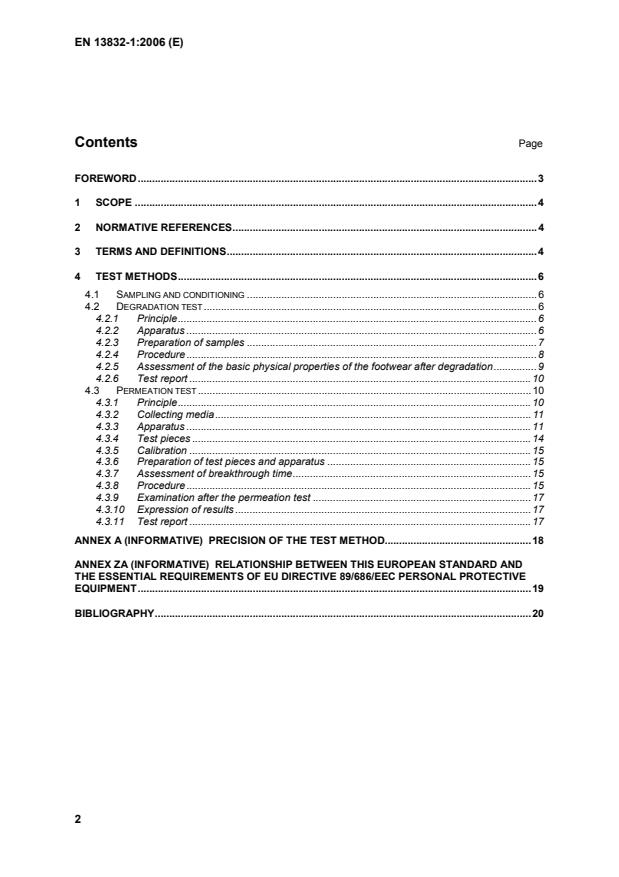
PRECISION OF THE TEST METHOD.18 ANNEX ZA (INFORMATIVE)
RELATIONSHIP BETWEEN THIS EUROPEAN STANDARD AND THE ESSENTIAL REQUIREMENTS OF EU DIRECTIVE 89/686/EEC PERSONAL PROTECTIVE EQUIPMENT.19 BIBLIOGRAPHY.20
EN 13832, Footwear protecting against chemicals, is published in three parts Part 1: Terminology and test methods Part 2: Requirements for footwear resistant to chemicals under laboratory conditions Part 3: Requirements for footwear highly resistant to chemicals under laboratory conditions It has been assumed in the drafting of this standard that the execution of its provisions is entrusted to appropriately qualified and experienced people for whose guidance it has been prepared and that appropriate precautions will be taken to avoid injury to health and contamination of the environment. According to the CEN/CENELEC Internal Regulations, the national standards organizations of the following countries are bound to implement this European Standard: Austria, Belgium, Cyprus, Czech Republic, Denmark, Estonia, Finland, France, Germany, Greece, Hungary, Iceland, Ireland, Italy, Latvia, Lithuania, Luxembourg, Malta, Netherlands, Norway, Poland, Portugal, Romania, Slovakia, Slovenia, Spain, Sweden, Switzerland and United Kingdom.
Normative references The following referenced documents are indispensable for the application of this document. For dated references, only the edition cited applies. For undated references, the latest edition of the referenced document (including any amendments) applies. EN ISO 868, Plastics and ebonite - Determination of indentation hardness by means of a durometer (Shore hardness) (ISO 868:2003) EN ISO 20344: 2004, Personal protective equipment - Test methods for footwear (ISO 20344:2004) ISO 23529, Rubber - General procedures for preparing and conditioning test pieces for physical test methods 3 Terms and definitions For the purposes of this document, the following terms and definitions apply. 3.1 footwear material material or combination of materials used in footwear for the purpose of isolating the feet and legs from direct contact with chemicals
3.2 degradation deleterious change in one or more properties of a footwear material due to contact with a chemical
NOTE These changes may include, e.g. flaking, swelling, disintegration, embrittlement, discoloration, dimensions, appearance, hardening and softening. 3.3 penetration movement of a chemical through porous materials, seams, pinholes, or other imperfections in a footwear material at a non-molecular level 3.4 permeation process by which a chemical moves through a footwear material at a molecular level NOTE Permeation involves the following: • absorption of molecules of the chemical into the contacted (outside) surface of a material; • diffusion of the absorbed molecules into the material; • desorption of the molecules from the opposite (inside) surface of the material. 3.5 test chemical chemical or mixture of chemicals that is used to determine the breakthrough time under the laboratory test conditions. The chemical will be one that can cause adverse effects to the human body by contact with the skin.
any material or combination of materials used in footwear for the purpose of isolating the feet or feet and legs from direct contact with a chemical.
NOTE
This footwear (classification II, see Clause 4 of EN 13832-3: 2006)
• conforms to EN 13832-3 • has been tested with at least three chemicals under laboratory conditions 3.9 collecting medium medium in which the test chemical is freely soluble to saturation mass or volume fraction greater than 0,5 % 3.10 delay time time between actual arrival of the test chemical on the collecting side of the specimen and the analytical instrumentation registering a response to it 3.11 permeation rate mass of test chemical permeating the footwear per unit area per unit time (µg.cm-2.min-1) 3.12 closed loop breakthrough detection system in which the collecting medium is recirculated through the sampling compartment of the cell test NOTE Closed loop systems are not used with gaseous collecting media. 3.13 open loop breakthrough detection system in which the collecting medium passes through the sampling compartment of the cell test without recirculation NOTE Open loop systems may be used with either liquid or gaseous collecting media. 3.14 shrinkage reduction in one or more linear dimensions of a test piece of greater than 0,5 % as a result of degradation 3.15 growth increase in one or more linear dimensions of a test piece of greater than 12 % as a result of degradation
EN 13832-1: 2006, 4.2 1 pair 2 discs yes Permeation test
EN 13832-1: 2006, 4.3 1 pair 2 discs yes 4.2 Degradation test 4.2.1 Principle The basic physical properties of the footwear component (upper and sole) are checked before and after contact with chemicals. 4.2.2 Apparatus 4.2.2.1 Degradation cell The apparatus shall be suitable for holding the test piece. A suitable apparatus is illustrated in Figure 1 and comprises a base-plate (5) and an open-ended cylindrical chamber (4) that is held tightly against the test piece (6) by the wing nuts (1) mounted on the bolts (2).
NOTE A hole of diameter approximately 50 mm may be made in the base-plate for the examination of the surface not in contact with the liquid.
During the test, the opening in the top of the chamber shall be closed by a close-fitting plug (3). 4.2.2.2 Miscellaneous a) wash flask, for example a Becher glass b) absorbent paper or lint free textile fabric
Dimensions in millimetres 3211245620 ±150100Key 1 Wing nut 2 Bolt 3 Close-fitting plug to seal the hole in top of the chamber 4 Open-ended cylindrical chamber 5 Base plate 6 Test piece
Figure 1 — Example of vessel for degradation resistance of footwear components
4.2.3 Preparation of samples If it is impossible to take the sample from the footwear, it may be taken from raw material representative of the shoe. The test piece for the upper shall consist of a disc of diameter (120 ± 10) mm, taken from the footwear (see Figure 2) or from the material intended for use in constructing the footwear. The lining shall be removed. NOTE During removal of the lining as small an amount as possible of polymeric material should be removed. For the sole, a disc of diameter (120 ± 10) mm shall be taken from the fore part of the sole. Discs with a thickness of (2,5 ± 0,1) mm shall be prepared according to the following steps: a) Remove the sole tread by splitting. b) Obtain the thickness of (2,5 ± 0,1) mm by removing the interior material. Except for the necessary handling during preparation, the surface in contact with the chemical shall be tested without any mechanical treatment. If there is seam in the sample upper, it shall be tested.
1 Key 1
Area for taking samples Figure 2 c) - Sole or insole
Figure 2 — Area for sampling of footwear
4.2.4 Procedure 4.2.4.1 Preliminary measurements For footwear in rubber material, measure the elongation at break according to EN ISO 20344:2004, 6.4 before degradation. Before chemical degradation the tests given in Table 2 shall be performed.
Table 2 — Tests for basic properties of the sole and the upper before degradation Sole Upper 1st test 2nd test 1st test 2nd test Tear resistance EN ISO 20344: 2004, 8.2 Hardness EN ISO 868 Tear resistance EN ISO 20344: 2004, 6.3 Elongation at break
EN ISO 20344: 2004, 6.4 (not applicable for leather upper)
In addition, perform these measurements on all the test pieces. a) For the upper: weigh the test piece to the nearest milligram (mass Mu1).
b) For the sole: weigh the test piece to the nearest milligram (mass Ms1) and measure the hardness in accordance with EN ISO 868. 4.2.4.2 Degradation Place the test piece in the apparatus as indicated in Figure 1. The outer part shall be in contact with the chemical. Fill the chamber of the apparatus with the liquid chemical chosen for the test to a depth of approximately 15 mm and insert the plug (3). Maintain the apparatus for (23 ± 1) h either at a temperature of (23 ± 2) °C or at another temperature. In the latter case, report the temperature in the test report. Remove the liquid and release the test piece. Any surplus liquid should be removed from the surface of the test piece. 4.2.4.3 Measurements after degradation Wash the test piece with a large amount of water using a wash flask and dry the test piece by wiping with absorbent paper or a textile fabric that does not deposit lint. At the temperature of (23 ± 2) °C, in a maximum time of 30 min: a) for the upper: weigh the test piece to the nearest milligram (mass Mu2); b) for the sole: weigh the test piece to the nearest milligram (mass Ms2) and measure the hardness in accordance with EN ISO 868. Retain the degraded discs for use in the subsequent tests, as given in 4.2.5. Start the tests given in 4.2.5 immediately and complete the entire sequence of tests within the two hours of completing this degradation test. Samples that are too strongly affected by the degradation test do not need to be tested in accordance with 4.2.5. For example, when the samples: • have holes; • are swollen and distorted; • become brittle. 4.2.5 Assessment of the basic physical properties of the footwear after degradation 4.2.5.1 Preparation of samples As quickly as possible after completing the measurements in 4.2.4.3, cut the test pieces for the physical tests as defined in Figure 3 from the discs that have been tested in accordance with 4.2.4.
Diameter of the disc (120
± 10) mm Key 1 Tear 2 Tensile properties 3 Longitudinal axis of the sole
Figure 3 — Test pieces for the physical test from the discs after degradation 4.2.5.2 Test of the basic properties after degradation The basic properties of the sole and the upper after degradation shall be tested as defined in Table 2. 4.2.6 Test report The test report should include the following information: a) full description of the sample and its origin; b) compound details, cure time and temperature where appropriate; c) full description of the chemicals used in the degradation test; d) appearance of the test piece after the degradation test (e.g. cracking, mass changes, delamination) and the appearance of the test liquid (e.g. discoloration); e) give the masses, Mu1 and Mu2 and Ms1 and Ms2; f) results of the tests given in 4.2.5; g) number of this European Standard, i.e. EN 138
...