Clinical thermometers - Part 3: Performance of compact electrical thermometers (non-predictive and predictive) with maximum device

This Part of EN 12470 specifies the performance requirements for compact clinical electrical thermometers with maximum device (non-predictive and predictive).
This European Standard applies to devices that, when taking temperatures, are powered by an internal power supply and that provide a digital indication of temperature.
This European Standard does not apply to clinical electrical thermometers for continuous measurement and thermometers intended to measure skin temperature.

Medizinische Thermometer - Teil 3: Elektrische (extrapolierende und nicht extrapolierende) Kompaktthermometer mit Maximumvorrichtung

Dieser Teil von EN 12470 legt die Leistungsanforderungen für medizinische elektrische (extrapolierende und
nicht extrapolierende) Kompaktthermometer mit Maximumvorrichtung fest.
Diese Europäische Norm gilt für Geräte, die während der Temperaturmessung durch eine interne Stromquelle
versorgt werden und eine digitale Temperaturanzeige liefern.
Diese Europäische Norm gilt nicht für elektrische medizinische Thermometer zur kontinuierlichen Messung
und für Thermometer zur Messung der Hauttemperatur.

Thermomètres médicaux - Partie 3: Performances des thermomètres électriques compacts (à comparaison et à extrapolation) avec dispositif maximum

La présente partie de l'EN 12470 spécifie les exigences de performance relatives aux thermomètres médicaux
électriques compacts avec dispositif à maximum (à comparaison et à extrapolation).
La présente norme européenne s'applique aux dispositifs qui, lors du mesurage des températures, sont alimentés
par une source d'énergie interne, et qui donnent une indication numérique de la température.
La présente norme européenne ne s'applique pas aux thermomètres médicaux électriques de mesurage continu ni
aux thermomètres destinés à mesurer la température de la peau.

Klinični termometri - 3. del: Delovanje zaprtih trdnih električnih termometrov (brez umerjanja ali z njim)

General Information

Status
Withdrawn
Publication Date
16-Jun-2009
Withdrawal Date
16-Oct-2012
Current Stage
9960 - Withdrawal effective - Withdrawal
Start Date
17-Oct-2012
Completion Date
17-Oct-2012

Relations

Standard
EN 12470-3:2000+A1:2009
English language
20 pages
sale 10% off
Preview
sale 10% off
Preview
e-Library read for
1 day

Frequently Asked Questions

EN 12470-3:2000+A1:2009 is a standard published by the European Committee for Standardization (CEN). Its full title is "Clinical thermometers - Part 3: Performance of compact electrical thermometers (non-predictive and predictive) with maximum device". This standard covers: This Part of EN 12470 specifies the performance requirements for compact clinical electrical thermometers with maximum device (non-predictive and predictive). This European Standard applies to devices that, when taking temperatures, are powered by an internal power supply and that provide a digital indication of temperature. This European Standard does not apply to clinical electrical thermometers for continuous measurement and thermometers intended to measure skin temperature.

This Part of EN 12470 specifies the performance requirements for compact clinical electrical thermometers with maximum device (non-predictive and predictive). This European Standard applies to devices that, when taking temperatures, are powered by an internal power supply and that provide a digital indication of temperature. This European Standard does not apply to clinical electrical thermometers for continuous measurement and thermometers intended to measure skin temperature.

EN 12470-3:2000+A1:2009 is classified under the following ICS (International Classification for Standards) categories: 17.200.20 - Temperature-measuring instruments. The ICS classification helps identify the subject area and facilitates finding related standards.

EN 12470-3:2000+A1:2009 has the following relationships with other standards: It is inter standard links to EN 12470-3:2000, EN 12470-3:2000/prA1, EN ISO 80601-2-56:2012. Understanding these relationships helps ensure you are using the most current and applicable version of the standard.

EN 12470-3:2000+A1:2009 is associated with the following European legislation: EU Directives/Regulations: 2007/47/EC, 93/42/EEC; Standardization Mandates: M/023. When a standard is cited in the Official Journal of the European Union, products manufactured in conformity with it benefit from a presumption of conformity with the essential requirements of the corresponding EU directive or regulation.

You can purchase EN 12470-3:2000+A1:2009 directly from iTeh Standards. The document is available in PDF format and is delivered instantly after payment. Add the standard to your cart and complete the secure checkout process. iTeh Standards is an authorized distributor of CEN standards.

Standards Content (Sample)


2003-01.Slovenski inštitut za standardizacijo. Razmnoževanje celote ali delov tega standarda ni dovoljeno.Medizinische Thermometer - Teil 3: Elektrische (extrapolierende und nicht extrapolierende) Kompaktthermometer mit MaximumvorrichtungThermomètres médicaux - Partie 3: Performances des thermomètres électriques compacts (à comparaison et à extrapolation) avec dispositif maximumClinical thermometers - Part 3: Performance of compact electrical thermometers (non-predictive and predictive) with maximum device17.200.20Instrumenti za merjenje temperatureTemperature-measuring instrumentsICS:Ta slovenski standard je istoveten z:EN 12470-3:2000+A1:2009SIST EN 12470-3:2000+A1:2009en,fr,de01-oktober-2009SIST EN 12470-3:2000+A1:2009SLOVENSKI
STANDARD
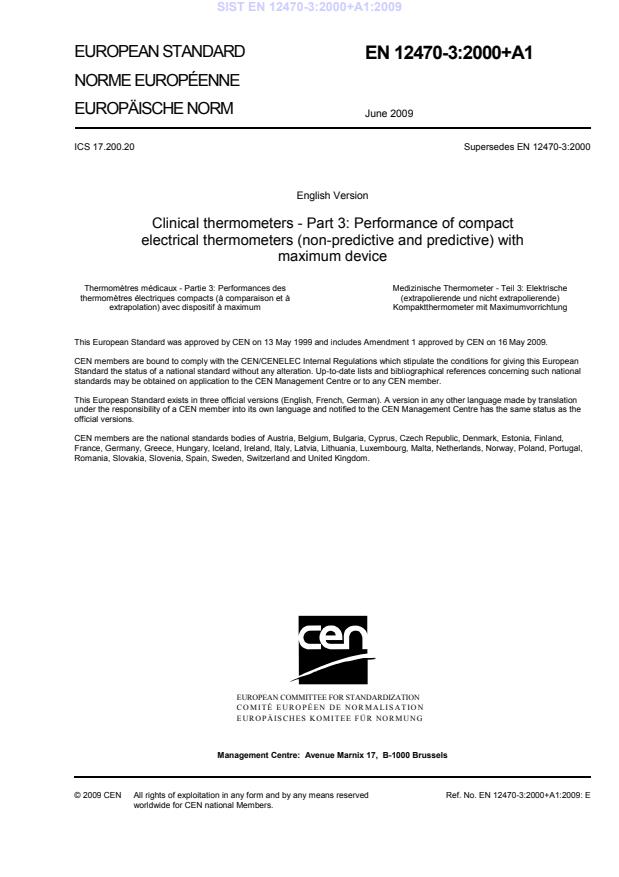
EUROPEAN STANDARD NORME EUROPÉENNE EUROPÄISCHE NORM
EN 12470-3:2000+A1
June 2009 ICS 17.200.20 Supersedes EN 12470-3:2000English Version
Clinical thermometers - Part 3: Performance of compact electrical thermometers (non-predictive and predictive) with maximum device
Thermomètres médicaux - Partie 3: Performances des thermomètres électriques compacts (à comparaison et à extrapolation) avec dispositif à maximum
Medizinische Thermometer - Teil 3: Elektrische (extrapolierende und nicht extrapolierende) Kompaktthermometer mit Maximumvorrichtung This European Standard was approved by CEN on 13 May 1999 and includes Amendment 1 approved by CEN on 16 May 2009.
CEN members are bound to comply with the CEN/CENELEC Internal Regulations which stipulate the conditions for giving this European Standard the status of a national standard without any alteration. Up-to-date lists and bibliographical references concerning such national standards may be obtained on application to the CEN Management Centre or to any CEN member.
This European Standard exists in three official versions (English, French, German). A version in any other language made by translation under the responsibility of a CEN member into its own language and notified to the CEN Management Centre has the same status as the official versions.
CEN members are the national standards bodies of Austria, Belgium, Bulgaria, Cyprus, Czech Republic, Denmark, Estonia, Finland, France, Germany, Greece, Hungary, Iceland, Ireland, Italy, Latvia, Lithuania, Luxembourg, Malta, Netherlands, Norway, Poland, Portugal, Romania, Slovakia, Slovenia, Spain, Sweden, Switzerland and United Kingdom.
EUROPEAN COMMITTEE FOR STANDARDIZATION
COMITÉ EUROPÉEN DE NORMALISATION EUROPÄISCHES KOMITEE FÜR NORMUNG
Management Centre:
Avenue Marnix 17,
B-1000 Brussels © 2009 CEN All rights of exploitation in any form and by any means reserved worldwide for CEN national Members. Ref. No. EN 12470-3:2000+A1:2009: ESIST EN 12470-3:2000+A1:2009

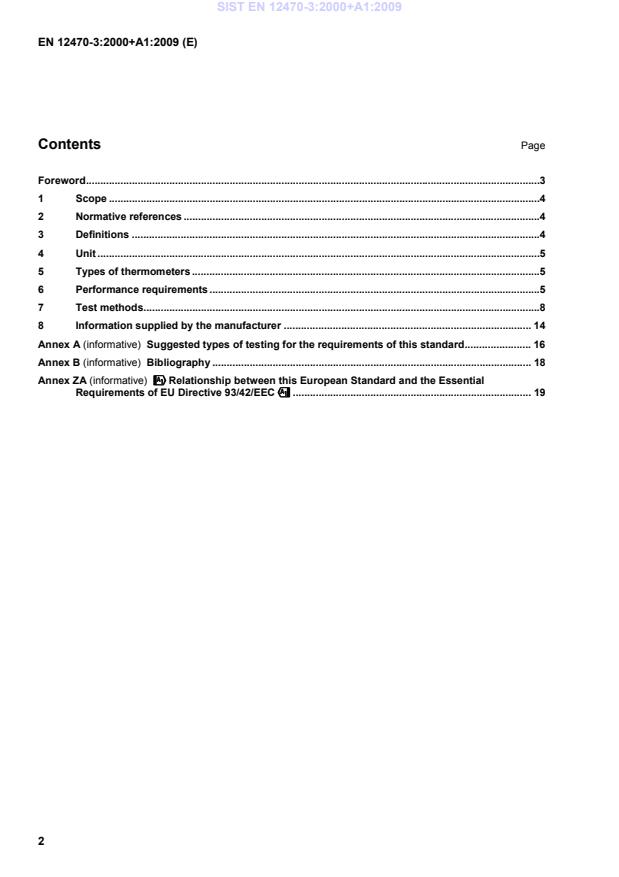
Suggested types of testing for the requirements of this standard . 16Annex B (informative)
Bibliography . 18Annex ZA (informative)
!!!!Relationship between this European Standard and the Essential Requirements of EU Directive 93/42/EEC"""" . 19 SIST EN 12470-3:2000+A1:2009

This European Standard applies to clinical thermometers which are used for measuring the body temperature of humans. EN 12470 consists of the following Parts under the general title “Clinical thermometers”: Part 1: Metallic liquid-in-glass thermometers with maximum device Part 2: Phase change-type (dot matrix) thermometers Part 3: Performance of compact electrical thermometers (non-predictive and predictive) with maximum device Part 4: Performance of electrical thermometers for continuous measurements Part 5: Performance of infra-red ear thermometers (with maximum device) Annexes A, B and ZA are informative. According to the CEN/CENELEC Internal Regulations, the national standards organizations of the following countries are bound to implement this European Standard: Austria, Belgium, Bulgaria, Cyprus, Czech Republic, Denmark, Estonia, Finland, France, Germany, Greece, Hungary, Iceland, Ireland, Italy, Latvia, Lithuania, Luxembourg, Malta, Netherlands, Norway, Poland, Portugal, Romania, Slovakia, Slovenia, Spain, Sweden, Switzerland and United Kingdom. SIST EN 12470-3:2000+A1:2009
...

Questions, Comments and Discussion

Ask us and Technical Secretary will try to provide an answer. You can facilitate discussion about the standard in here.

Loading comments...

The EN 12470-3:2000+A1:2009 standard provides a comprehensive set of performance requirements specifically tailored for compact clinical electrical thermometers featuring maximum devices, both non-predictive and predictive. This standard delineates the scope of applicable devices, focusing on those powered by an internal battery or power source that yield a digital temperature reading. The inclusion of both non-predictive and predictive thermometer types demonstrates the standard's versatility in addressing a broad range of clinical needs. One of the key strengths of this standard lies in its meticulous specification of performance criteria, which ensures that users can trust the accuracy and reliability of these clinical thermometers. By detailing the necessary performance benchmarks, EN 12470-3 enhances the quality assurance processes within medical settings, promoting safe and effective temperature measurements. This is particularly crucial in healthcare environments where precise temperature readings are essential for diagnosis and treatment. Moreover, the standard effectively excludes certain categories of thermometers, such as those used for continuous temperature measurement and devices intended solely for skin temperature measurement. This targeted approach helps avoid ambiguity in application and enforces a focused standardization process, allowing manufacturers and healthcare professionals to align their practices with the specific requirements set forth. The relevance of EN 12470-3 extends beyond conformity and regulatory compliance; it plays a vital role in supporting manufacturers in the development and refinement of their clinical thermometer models. By adhering to this standard, manufacturers can ensure that their products are consistent with best practices in medical technology, potentially enhancing marketability and consumer trust. Overall, the EN 12470-3:2000+A1:2009 standard is an essential document that underpins the performance of compact electrical thermometers in clinical settings. Its clear scope, robust performance criteria, and exclusion of irrelevant devices collectively reinforce its importance in both the manufacturing process and the broader healthcare landscape, making it a critical reference for stakeholders in this field.

SIST EN 12470-3:2000+A1:2009 표준은 최대 장치를 갖춘 컴팩트 전기 체온계(비예측 및 예측)의 성능 요구 사항을 명확히 규정하고 있다. 이 표준의 주요 범위는 내부 전원을 사용하여 온도를 측정하며 디지털 온도 표시를 제공하는 장치에 적용된다. 특히, 이 표준은 의료 환경에서의 신뢰할 수 있는 온도 측정을 위한 중요한 기초를 제공하여 임상적 응용에서의 유용성을 높인다. 이 표준의 강점은 여러 가지가 있으며, 첫째로, 전기 체온계의 품질과 정확성을 보장하기 위해 필요한 성능 기준들을 명확하게 설정하고 있다는 점이다. 비예측 및 예측 체온계를 모두 포함함으로써, 다양한 사용자의 요구를 충족시킬 수 있는 포괄적인 접근 방식을 취하고 있다. 또한, 디지털 표시 장치가 필수적이라는 점을 강조하여 최신의 기술적 요구 사항을 반영하는 점도 주목할 만하다. 마지막으로, SIST EN 12470-3:2000+A1:2009 표준은 지속적인 측정이나 피부 온도 측정과는 별개로, 전기 체온계의 특정한 성격을 반영하므로 산업 내에서의 적용 범위를 명확히 하고 있다. 이러한 점들은 의료기기 제조사들이 품질 관리를 강화하고, 소비자에게 보다 신뢰성 있는 제품을 제공하는 데 기여할 것으로 기대된다. 표준화 문서는 건강 관리 분야에서 컴팩트 전기 체온계의 성능 강화와 개선을 위한 중요한 지침이 될 것이다.

EN 12470-3:2000+A1:2009は、コンパクトな電気体温計の性能要件を規定している重要な標準です。この標準は、温度測定の際に内部電源を使用し、デジタルで温度を表示するデバイスに適用されます。特に、非予測型および予測型の最大デバイスに焦点を当てています。 この標準の範囲は明確であり、対象となるデバイスの特性をしっかりと定義しています。臨床現場における安全性と信頼性を確保するために、性能要件は詳細に設定されており、ユーザーが安心して使用できる基盤を提供しています。 EN 12470-3の強みは、電気体温計の非予測型および予測型の設計および製造において明確なガイドラインを示している点です。この標準に基づくことで、メーカーは製品の品質を保証し、使用者には一貫した性能を提供することが可能です。また、この標準は、ユーザーが臨床での温度測定において期待できる精度と信頼性を維持するために不可欠です。 さらに、この標準は、温度測定のデジタル表示における要件を規定しているため、現代の医療環境において関連性が高いと言えます。医療従事者や患者にとって信頼性が求められる場面で、EN 12470-3は有用な基準となります。 しかし、持続的な測定や皮膚温度の測定を目的とした体温計には適用されないため、その点も理解しておく必要があります。この明確な適用範囲により、臨床現場で必要とされる異なる測定ニーズに対処するための他の標準やガイドラインと組み合わせて使用することが重要です。

Die Norm EN 12470-3:2000+A1:2009 beschreibt die Leistungsanforderungen für kompakte klinische elektrische Thermometer mit maximalem Gerät, sowohl nicht-prädiktiv als auch prädiktiv. Sie richtet sich an Geräte, die mit einer internen Stromversorgung betrieben werden und eine digitale Temperaturanzeige bieten. Diese spezifischen Vorgaben gewährleisten, dass die Thermometer eine zuverlässige und präzise Temperaturmessung ermöglichen, was im klinischen Alltag von entscheidender Bedeutung ist. Ein besonderes Augenmerk liegt auf der Differenzierung zwischen prädiktiven und nicht-prädiktiven Thermometern. Die Norm ermöglicht es, die jeweiligen Anforderungen an die Leistung zu standardisieren und sorgt somit für eine klare Vergleichbarkeit zwischen den verschiedenen Geräten auf dem Markt. Diese Struktur sorgt für Vertrauen in die Messergebnisse und fördert die Sicherheit im Umgang mit klinischen Thermometern. Die Relevanz dieser Norm ist unbestreitbar, da sie sicherstellt, dass die Thermometer nicht nur leistungsfähig, sondern auch benutzerfreundlich sind. Die klare Definition der Anforderungen trägt dazu bei, dass die Geräte eine schnelle und genaue Temperaturmessung liefern, was für die Diagnose und Behandlung von Patienten von zentraler Bedeutung ist. Die Norm schließt explizit klinische elektrische Thermometer für die kontinuierliche Messung sowie Thermometer, die zur Messung der Hauttemperatur bestimmt sind, aus. Dies führt zu einer Fokussierung auf Geräte, die speziell für die Anwendung in der klinischen Umgebung konzipiert sind, und hilft somit, eine Überfluss an nicht relevanten Informationen zu vermeiden. Insgesamt zeigt die EN 12470-3:2000+A1:2009 Stärke durch ihre präzise Definition der Leistungsanforderungen für kompakte elektrische Thermometer, was zu einer Verbesserung der Qualität der thermometrischen Messungen in der klinischen Praxis führt. Diese Standardisierung ist entscheidend für die Gewährleistung einer hohen Patientensicherheit und für die Förderung der Effizienz im medizinischen Sektor.

La norme SIST EN 12470-3:2000+A1:2009 établit des exigences de performance précises pour les thermomètres cliniques électriques compacts équipés d'un dispositif à maximum, qu'ils soient non prédictifs ou prédictifs. Le champ d'application de cette norme européenne est crucial, car il englobe des appareils conçus pour mesurer la température, alimentés par une source d'énergie interne, et fournissant une indication numérique de la température. Cela inclut des appareils largement utilisés dans les milieux cliniques, où la précision et la fiabilité des mesures sont essentielles. Parmi les points forts de cette norme, on note sa capacité à définir des critères clairs et mesurables permettant d'assurer la performance et la sécurité des thermomètres cliniques. En établissant des performances standards, la norme aide les fabricants à développer des produits conformes qui répondent aux attentes des professionnels de la santé et des patients. De plus, la norme ne s'applique pas aux thermomètres destinés à la mesure continue ou à la mesure de la température cutanée, ce qui en renforce la pertinence en ciblant uniquement les thermomètres électriques compacts à maximum. Cela permet de limiter le champ d'application à des dispositifs spécifiques, garantissant ainsi un niveau de précision et de fiabilité requis dans les situations cliniques. En somme, la norme SIST EN 12470-3:2000+A1:2009 est essentielle pour garantir que les accessoires médicaux utilisés pour la mesure de la température clinique respectent des standards élevés de performance, rendant son adoption pertinente et bénéfique pour le secteur de la santé.