


prEN 6104
(Main)Aerospace series - Rivets, solid, in aluminium or aluminium alloy - Inch series - Technical specification
Aerospace series - Rivets, solid, in aluminium or aluminium alloy - Inch series - Technical specification
This document defines the characteristics and quality assurance requirements for solid rivets and slugs made in aluminium or aluminium alloys, inch series, for aerospace application. Following aluminium alloys are covered by this specification: 1050A-H14, 2017A-T42, 2117-T42, 5056A-H32 and 7050-T73.
Luft- und Raumfahrt - Vollniete aus Aluminium oder Aluminiumlegierung - Zoll-Reihe - Technische Lieferbedingung
Série Aérospatiale - Rivets pleins en aluminium ou en alliage d’aluminium - Série en inches - Spécification technique
Le présent document spécifie les caractéristiques et les exigences d’assurance qualité pour les pastilles et rivets pleins en aluminium ou en alliages d’aluminium, série en inches, pour les applications aérospatiales. Les alliages d’aluminium suivants sont couverts par la présente spécification : 1050A-H14, 2017A-T42, 2117-T42, 5056A-H32 et 7050-T73.
Aeronavtika - Trde kovice iz aluminija ali aluminijeve zlitine - Palčna serija - Tehnična specifikacija
General Information
- Status
- Not Published
- Publication Date
- 16-Aug-2026
- Technical Committee
- ASD-STAN - Aerospace
- Drafting Committee
- ASD-STAN/D 3/S 2 - Fasteners
- Current Stage
- 4599 - Dispatch of FV draft to CMC - Finalization for Vote
- Start Date
- 12-Jan-2026
- Completion Date
- 12-Jan-2026
Overview
prEN 6104 (Draft) - Aerospace series: Solid rivets in aluminium or aluminium alloys (inch series) - is a CEN/ASD‑STAN technical specification that defines the material, dimensional, manufacturing and quality assurance requirements for solid aluminium rivets and slugs used in aerospace applications. The specification covers rivets produced from the following alloys: 1050A‑H14, 2017A‑T42, 2117‑T42, 5056A‑H32 and 7050‑T73 and applies to inch‑series parts. Note: this document is published as a draft for enquiry (prEN 6104).
Key topics and technical requirements
- Scope & materials: Lists accepted aluminium alloys and requires conformity with the referenced product material standard.
- Dimensions & head control: Dimensional inspections using digital optical measuring instruments; head protrusion “P” measured per NAS9800 with projection (×25) as reference in disputes.
- Heat treatment & metallurgy: Heat treatment must follow SAE AMS2770; tests include microexamination (≥100×), hydrogen porosity/eutectic checks (≥500×) and checks for intergranular corrosion sensitivity.
- Mechanical & electrical tests: Tensile testing per EN 2002‑001; for 7050‑T73 includes electrical conductivity per ASTM B193 with target ≥23.2 MS/m (IACS ≥40%). Conductivity between 22.0–23.19 MS/m imposes yield‑strength limits (≤482 MPa); conductivity <22.0 MS/m is unacceptable.
- Quality assurance & manufacturer approval: Manufacturers must be an approved aerospace production organization with a documented quality management system (e.g., EN 9100 or equivalent). Approval is granted by Certification Authorities or their representatives.
- Acceptance inspection & sampling: Batch definitions, sampling plans and AQL‑based lot acceptance use ISO 2859‑1. Acceptance inspections, destructive/non‑destructive tests and re‑sampling rules are described.
- Statistical process control (SPC): SPC may replace final sampling when justified and validated using ISO/TR 13425 and ISO 7870 series control‑chart practices.
Applications and users
- Primary users: Aircraft OEMs, aerospace fastener manufacturers, procurement and quality engineers, NDT labs and regulatory/approval bodies.
- Practical use: Ensures consistent performance of aluminium solid rivets in airframe assemblies, structural repairs, and OEM manufacturing where inch‑series rivets are specified. Guides supplier qualification, incoming inspection, lot acceptance and process control for rivet production.
Related standards
- EN 2002‑001 (tensile testing)
- ISO 2859‑1 (sampling by AQL)
- ISO 7870 series (control charts)
- SAE AMS2770 (heat treatment)
- NAS9800 (head protrusion gaging)
- ASTM G110 (intergranular corrosion test) and ASTM B193 (conductivity)
Keywords: prEN 6104, aerospace rivets, solid rivets, aluminium alloy rivets, inch series, quality assurance, heat treatment, acceptance inspection, SPC.

Get Certified
Connect with accredited certification bodies for this standard

DEKRA North America
DEKRA certification services in North America.

Eagle Registrations Inc.
American certification body for aerospace and defense.

Element Materials Technology
Materials testing and product certification.
Sponsored listings
Frequently Asked Questions
prEN 6104 is a draft published by the European Committee for Standardization (CEN). Its full title is "Aerospace series - Rivets, solid, in aluminium or aluminium alloy - Inch series - Technical specification". This standard covers: This document defines the characteristics and quality assurance requirements for solid rivets and slugs made in aluminium or aluminium alloys, inch series, for aerospace application. Following aluminium alloys are covered by this specification: 1050A-H14, 2017A-T42, 2117-T42, 5056A-H32 and 7050-T73.
This document defines the characteristics and quality assurance requirements for solid rivets and slugs made in aluminium or aluminium alloys, inch series, for aerospace application. Following aluminium alloys are covered by this specification: 1050A-H14, 2017A-T42, 2117-T42, 5056A-H32 and 7050-T73.
prEN 6104 is classified under the following ICS (International Classification for Standards) categories: 49.030.60 - Rivets. The ICS classification helps identify the subject area and facilitates finding related standards.
prEN 6104 is available in PDF format for immediate download after purchase. The document can be added to your cart and obtained through the secure checkout process. Digital delivery ensures instant access to the complete standard document.
Standards Content (Sample)
SLOVENSKI STANDARD
01-januar-2025
Aeronavtika - Trde kovice iz aluminija ali aluminijeve zlitine - Palčna serija -
Tehnična specifikacija
Aerospace series - Rivets, solid, in aluminium or aluminium alloy - Inch series -
Technical specification
Luft- und Raumfahrt - Vollniete aus Aluminium oder Aluminiumlegierung - Zoll-Reihe -
Technische Lieferbedingung
Série aérospatiale - Rivets ordinaires en aluminium ou en alliage d´aluminium - Série en
inches - Spécification technique
Ta slovenski standard je istoveten z: prEN 6104
ICS:
49.025.20 Aluminij Aluminium
49.030.60 Kovice Rivets
77.150.10 Aluminijski izdelki Aluminium products
2003-01.Slovenski inštitut za standardizacijo. Razmnoževanje celote ali delov tega standarda ni dovoljeno.
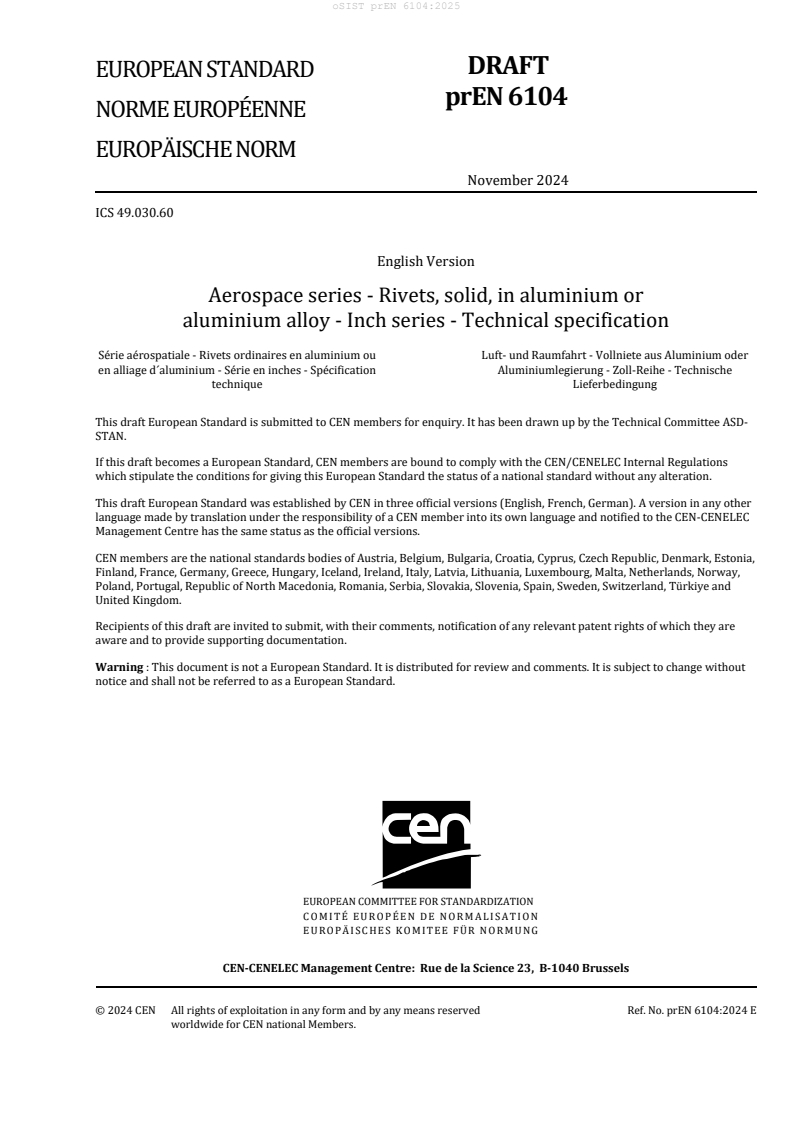
DRAFT
EUROPEAN STANDARD
NORME EUROPÉENNE
EUROPÄISCHE NORM
November 2024
ICS 49.030.60
English Version
Aerospace series - Rivets, solid, in aluminium or
aluminium alloy - Inch series - Technical specification
Série aérospatiale - Rivets ordinaires en aluminium ou Luft- und Raumfahrt - Vollniete aus Aluminium oder
en alliage d´aluminium - Série en inches - Spécification Aluminiumlegierung - Zoll-Reihe - Technische
technique Lieferbedingung
This draft European Standard is submitted to CEN members for enquiry. It has been drawn up by the Technical Committee ASD-
STAN.
If this draft becomes a European Standard, CEN members are bound to comply with the CEN/CENELEC Internal Regulations
which stipulate the conditions for giving this European Standard the status of a national standard without any alteration.
This draft European Standard was established by CEN in three official versions (English, French, German). A version in any other
language made by translation under the responsibility of a CEN member into its own language and notified to the CEN-CENELEC
Management Centre has the same status as the official versions.
CEN members are the national standards bodies of Austria, Belgium, Bulgaria, Croatia, Cyprus, Czech Republic, Denmark, Estonia,
Finland, France, Germany, Greece, Hungary, Iceland, Ireland, Italy, Latvia, Lithuania, Luxembourg, Malta, Netherlands, Norway,
Poland, Portugal, Republic of North Macedonia, Romania, Serbia, Slovakia, Slovenia, Spain, Sweden, Switzerland, Türkiye and
United Kingdom.
Recipients of this draft are invited to submit, with their comments, notification of any relevant patent rights of which they are
aware and to provide supporting documentation.
Warning : This document is not a European Standard. It is distributed for review and comments. It is subject to change without
notice and shall not be referred to as a European Standard.
EUROPEAN COMMITTEE FOR STANDARDIZATION
COMITÉ EUROPÉEN DE NORMALISATION
EUROPÄISCHES KOMITEE FÜR NORMUNG
CEN-CENELEC Management Centre: Rue de la Science 23, B-1040 Brussels
© 2024 CEN All rights of exploitation in any form and by any means reserved Ref. No. prEN 6104:2024 E
worldwide for CEN national Members.
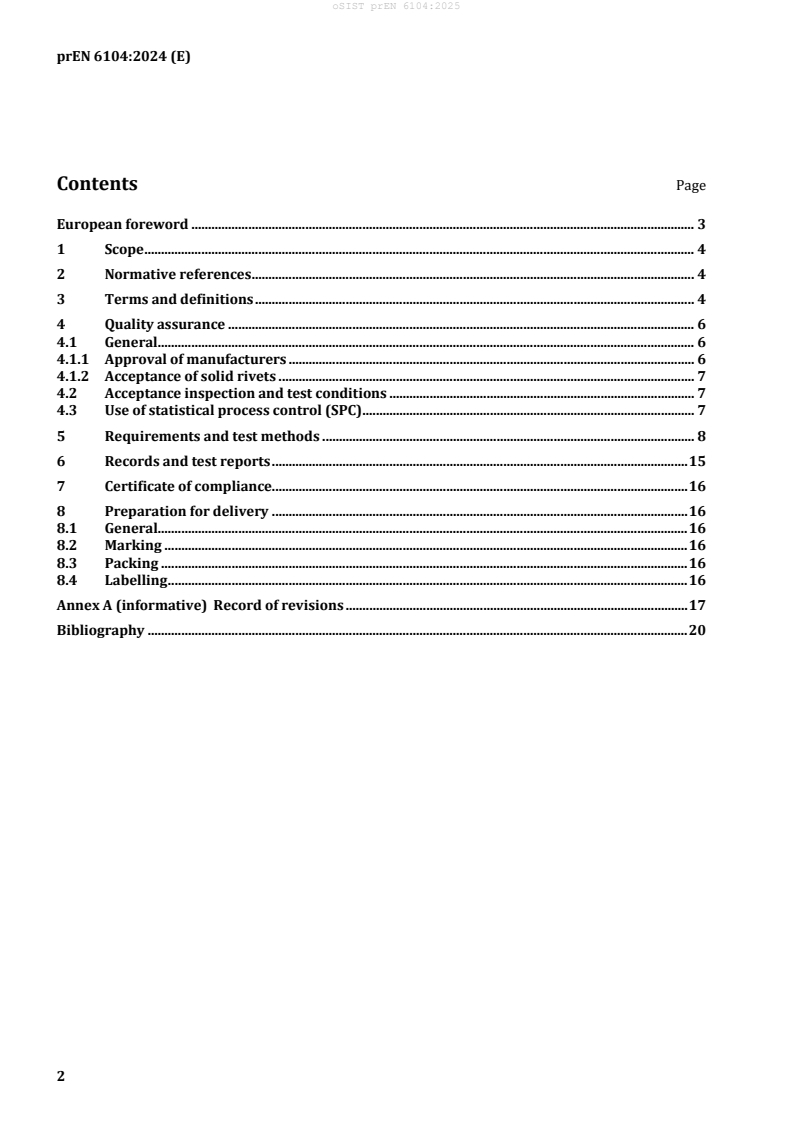
Contents Page
European foreword . 3
1 Scope . 4
2 Normative references . 4
3 Terms and definitions . 4
4 Quality assurance . 6
4.1 General. 6
4.1.1 Approval of manufacturers . 6
4.1.2 Acceptance of solid rivets . 7
4.2 Acceptance inspection and test conditions . 7
4.3 Use of statistical process control (SPC) . 7
5 Requirements and test methods . 8
6 Records and test reports . 15
7 Certificate of compliance. 16
8 Preparation for delivery . 16
8.1 General. 16
8.2 Marking . 16
8.3 Packing . 16
8.4 Labelling . 16
Annex A (informative) Record of revisions . 17
Bibliography . 20
European foreword
This document (prEN 6104:2024) has been prepared by ASD-STAN.
After enquiries and votes carried out in accordance with the rules of this Association, this document has
received the approval of the National Associations and the Official Services of the member countries of
ASD-STAN, prior to its presentation to CEN.
This document is currently submitted to the CEN Enquiry.
1 Scope
This document defines the characteristics and quality assurance requirements for solid rivets and slugs
made in aluminium or aluminium alloys, inch series, for aerospace application. Following aluminium
alloys are covered by this specification: 1050A-H14, 2017A-T42, 2117-T42, 5056A-H32 and 7050-T73.
2 Normative references
The following documents are referred to in the text in such a way that some or all of their content
constitutes requirements of this document. For dated references, only the edition cited applies. For
undated references, the latest edition of the referenced document (including any amendments) applies.
EN 2002-001, Aerospace series — Metallic materials — Test methods — Part 1: Tensile testing at ambient
temperature
ISO 2859-1, Sampling procedures for inspection by attributes — Part 1: Sampling schemes indexed by
acceptance quality limit (AQL) for lot-by-lot inspection
ISO 7870-1, Control charts — Part 1: General guidelines
ISO 7870-2, Control charts — Part 2: Shewhart control charts
ISO 7870-3, Control charts — Part 3: Acceptance control charts
NAS9800 , Head protrusion gaging, 100 ° flush head fasteners, gage block, gage diameters, and stylus
SAE AMS2770 , Heat treatment of wrought aluminum alloy parts
3 Terms and definitions
For the purposes of this document, the following terms and definitions apply.
ISO and IEC maintain terminology databases for use in standardization at the following addresses:
— ISO Online browsing platform: available at https://www.iso.org/obp
— IEC Electropedia: available at https://www.electropedia.org/
3.1
batches
quantity of finished rivets, manufactured using the same process, from a single material cast (single heat
of alloy), having the same standard number, diameter and length code, heat treated together to the same
specified condition and produced as one continuous run
3.2
rivet wire sample
length of wire, sampled at each end of the coil used for the manufacture of rivets of the batch
Note 1 to entry: The rivet wire samples undergo the same heat treatments as the rivets of the batch, at the same
time.
1 Published by Aerospace Industries Association (AIA), available at: https://www.aia-aerospace.org/.
2 Published by: Society of Automotive Engineers (SAE), available at: https://www.sae.org/.
3.3
rivet sample
rivet sampled at random from the batch
3.4
crack
rupture in the material, which may extend in any direction and which may be intercrystalline or
transcrystalline in character
3.5
seam
longitudinal open surface defect
3.6
lap
surface defect caused by folding over metal fins or sharp corners and then forming them into the surface
3.7
cold shut
doubling over of metal, this may occur during the cold heading operation
3.8
double ring
the discontinuity is wide but shallow and open to the surface at both ends of the discontinuity
3.9
pit
small cavity in a metal surface caused by non-uniform electro deposition or by corrosion
3.10
inclusion
non-metallic particles originating from the aluminium alloy making process
Note 1 to entry: They can exist as discrete particles or strings of particles extending in a longitudinal direction.
3.11
material separation
any loss of material from preformed head induced by installation of the rivet
3.12
defect
non-fulfilment of a requirement related to an intended or specified use
3.13
major defect
defect that is likely to result in a failure or to reduce materially the usability of the considered product for
its intended purpose
3.14
minor defect
defect that is not likely to reduce materially the usability of the considered product for its intended
purpose, or that represents a departure from established specification having little bearing on the
effective use or operation of this product
3.15
hydrogen porosity (high temperature oxidation)
racks and fixtures used shall be constructed to preclude entrapment of water
Note 1 to entry: Ammonium fluorborate or equivalent can be used in air furnace as necessary.
3.16
blistering
defect in the metal on or near the surface, resulting from expansion of gas or entrapped lubricant from
forging process in a sub-surface zone
3.17
eutectic melting
mixture of different phases with eutectic composition, which melts below the solidus temperature of the
alloy
Note 1 to entry: Eutectic melting is characterised by small rosettes in the microstructure or by outlined grain
boundaries, particularly at triple intersections. It can occur when raw material is not homogenized or worked
properly
3.18
intergranular corrosion
selective corrosion attack along grain boundaries or closely adjacent regions without appreciable attack
of the grains
3.19
sampling plan
plan according to which one or more samples are taken from a batch in order to do acceptance tests to
demonstrate conformity of the batch
3.20
acceptable quality level
AQL
maximum percent defective (or the maximum number of defects per hundred units) that, for purposes of
sampling inspection, can be considered satisfactory as a process average
Note 1 to entry: Variant: quality level, which in a sampling plan corresponds to a specified but relatively high
probability of acceptance.
4 Quality assurance
4.1 General
4.1.1 Approval of manufacturers
The manufacturer’s operations shall be an approved production organization for aerospace products and
shall demonstrate that it has implemented and is able to maintain a quality management system (e.g.
according to EN 9100 or an equivalent aerospace accepted and established quality management system).
The purpose of these procedures is to ensure that a manufacturer has a quality management system in
place and is capable of continuous production of solid rivets complying with the specified quality
requirements.
The Certification Authorities, or their appointed representative, who may be the prime contractor, shall
grant the approval of the manufacturer.
4.1.2 Acceptance of solid rivets
The purpose of acceptance inspection and tests of a solid rivet is to check, as simply as possible, using a
method which is inexpensive but the most representative of the actual conditions of use, with the
uncertainty inherent in statistical sampling, that the solid rivets satisfy the requirements of this
document.
Acceptance inspections and tests shall be carried out by the manufacturer, or under his responsibility.
The manufacturer is responsible for the quality of the solid rivets manufactured to this specification and
adherence to this specification.
4.2 Acceptance inspection and test conditions
Acceptance inspections and tests (requirements, methods, numbers of solid rivets) are specified in
Table 1. They shall be carried out on each batch. Solid rivets shall be selected from the batch to be tested
by random sampling.
Each solid rivet may be submitted to several inspections or tests, provided that none of its characteristics
has been altered during any of these inspections or tests.
The solid rivets to be subjected to destructive inspections or tests may be those on which non-destructive
inspections or tests have been carried out.
In this case, the attribute(s), which caused the rejection, shall be verified using a sample of twice the
normal size with the same AQL.
On demand of procurement quality department the sampling can be increased from normal control to
reinforced control or vice versa.
If the reason for rejection results from the operating method, the test apparatus or from faulty heat
treatment which can be rectified in a satisfactory manner, the tests may be repeated after elimination of
the cause, provided that any surface treatment be removed prior to heat treatment, without being
detrimental to rivet final use. A note to this effect shall be added to the corresponding inspection
documents.
Unless otherwise specified, the test temperature shall be the ambient temperature.
4.3 Use of statistical process control (SPC)
When a characteristic is obtained by a controlled statistical process, the manufacturer has the possibility,
in order to declare conformity of the characteristic, of refraining from the final systematic sampling
provided for in this document, if they are capable of formally justifying this choice by using
ISO/TR 13425 and the standards quoted in it as a basis.
This justification shall include the following phases:
— analysis of the product’s key characteristics;
— analysis of the risks for each implemented process;
— determination of the parameters and/or characteristics to be respected under SPC;
— determination of the capabilities of each process;
— drawing up an inspection plan and integration in the manufacturing process;
— drawing up of routes and control charts (in accordance with ISO 7870-1, ISO 7870-2, ISO 7870-3);
— use of control charts for data consolidation;
— determination of the time schedule for the internal audits to be run and the control to be carried out
to ensure reliability of the device.
To be usable in production, this process should have been validated beforehand by the qualifying body,
either during the qualification phase, or afterwards by analysing the results of the controlled statistical
process versus the qualification inspections as requested in Clause 5.
5 Requirements and test methods
Technical requirements and test methods shall be in accordance with Table 1.
Table 1 —Technical requirements and test methods
Classification of
Clause Characteristic Requirements Inspections and test methods defects and
sampling
5.1 Material In accordance with the product See material standard.
standard
5.2 Dimensions In accordance with the product All dimensional features may be Table 2
standard inspected with digital optical
measuring instruments, having a
The head protrusion “P” shall be
precision level equal to or better
measured in accordance with
than conventional measurement
NAS9800.
tools.
Alternative measurement methods
Selection of measuring
need to be agreed with the
equipment shall be based on the
customer.
required precision suited to the
characteristic and relevant
to
...
Questions, Comments and Discussion
Ask us and Technical Secretary will try to provide an answer. You can facilitate discussion about the standard in here.
Loading comments...