


FprEN 18168
(Main)Ambient air - Biomonitoring with higher plants - Method of the standardised rye-grass exposure
Ambient air - Biomonitoring with higher plants - Method of the standardised rye-grass exposure
This document gives guidance on the procedure for the bioaccumulation of substances liable to cause atmospheric pollution. This is done by using the grass species Lolium multiflorum ssp. italicum designated hereafter as Italian rye-grass. It is an active biomonitoring approach insofar as the plants used are first cultivated in set conditions before being exposed at the monitoring locations in the field. The plants then record any pollution events that occur while they are being exposed, allowing such events to be accurately dated.
The document specifies a method for identification and localization of one or more single pollution sources and the tracking of their "plume" on a local or regional scale. The method described also offers a tool to monitor sites in the long term by the repeated application of a clearly defined procedure and to describe the local or regional air pollution situation.
The method described in this document is applicable to solid and gaseous substances deposited on plants, where they can accumulate on their surface or in their tissues. These substances include sulphur, chloride, fluoride and especially metals as well as low volatile organic and halo-organic compounds such as polycyclic aromatic hydrocarbons (PAH), polychlorinated biphenyls (PCB), polybrominated diphenyl ethers (PBDE), polychlorinated dibenzo dioxins (PCDD) and polychlorinated dibenzo furans (PCDF). It is as well possible to verify pesticides which are used in plant protection products. The range of potential substances can be expanded according to the task at hand and the capabilities of conducting trace analyses and assessment.
The method described in this document allows spatial and temporal comparisons and allows for screening, thus providing a first indication of risk. The results of grass culture studies can suggest risks to biota (e.g. via the food chain) which require further investigation.
The method described in this document does not replace physico-chemical methods of direct measurement or modelling of air pollutants and cannot be replaced by them for its part; it complements them by indicating biological effects.
Potential areas of deployment are:
- Permit procedures related to air pollution legislation;
- Preservation of evidence related to the code for protection from pollution;
- Monitoring of emission sources and performance control;
- Assessment of local-scale emission transport;
- Evidence of causation, e.g. related to environmental liability;
- Air quality maintenance plans/strategies;
- Long-term monitoring of ecological effects of atmospheric depositions;
- Detection and assessment of local, regional, and countrywide effects of atmospheric depositions;
- Assessment of risks for humans and/or animals via the food chain.
This document is of interest to those involved in environmental monitoring.
Außenluft - Biomonitoring mit Höheren Pflanzen - Verfahren der standardisierten Weidelgras-Exposition
Dieses Dokument gilt für die Verwendung des Grases Lolium multiflorum ssp. italicum - nachfolgend als Italienisches Raygras bezeichnet - für die Bioakkumulation von Substanzen, die Luftverunreinigungen verursachen. Es handelt sich insofern um ein aktives Biomonitoringverfahren, da die verwendeten Pflanzen vor der Exposition an den Monitoringmesspunkten im Freiland zunächst unter vorgegebenen Bedingungen kultiviert werden. Die Pflanzen erfassen dann jegliche Verschmutzungsereignisse, die während ihrer Exposition auftreten, so dass solche Vorfälle genau datiert werden können.
Das in diesem Dokument beschriebene Verfahren kann für die Ermittlung und Lokalisierung von einer oder mehreren Quellen von Schadstoffen sowie für die Nachverfolgung ihrer Schadstofffahne auf lokaler oder regionaler Ebene verwendet werden. Es ist zudem ein Instrument zur langfristigen Überwachung von Standorten durch wiederholte Anwendung eines klar definierten Verfahrens sowie zur Beschreibung der lokalen oder regionalen Luftverschmutzungslage.
Das Verfahren ist für feste und gasförmige Substanzen anwendbar, die sich auf der Oberfläche von Pflanzen oder in deren Gewebestrukturen ablagern. Zu diesen Substanzen zählen Schwefel, Chlorid, Fluorid und insbesondere Metalle sowie langlebige organische und halogenierte organische Verbindungen wie polyzyklische aromatische Kohlenwasserstoffe (PAH), polychlorierte Biphenyle (PCB), polybromierte Diphenylether (PBDE), polychlorierte Dibenzodioxine (PCDD) und polychlorierte Dibenzofurane (PCDF). Auch in Pflanzenschutzprodukten verwendete Pestizide können damit nachgewiesen werden. Das Spektrum an potenziell nachweisbaren Substanzen kann je nach anstehender Aufgabe und den Fähigkeiten zur Durchführung von Spurenanalysen und Beurteilungen ausgeweitet werden.
Das in diesem Dokument beschriebene Verfahren ermöglicht räumliche und zeitliche Vergleiche sowie Screening zur Erkennung erster Anzeichen eines Risikos. Die Ergebnisse der Untersuchungen an Graskulturen können auf Risiken für Biota hinweisen (z. B. über die Nahrungskette), die eine weitere Untersuchung erfordern.
Das in diesem Dokument beschriebene Verfahren ersetzt physikalisch-chemische Verfahren zur direkten Messung oder die Modellierung von Luftschadstoffen nicht und kann im Gegenzug nicht durch sie ersetzt werden; es stellt vielmehr eine Ergänzung dieser Verfahren dar, indem es die biologischen Auswirkungen anzeigt.
Potenzielle Einsatzgebiete sind:
- Genehmigungsverfahren mit Bezug zur Gesetzgebung zu Luftverschmutzung;
- Beweissicherungsverfahren im Immissionsschutz;
- Überwachung von Emissionsquellen und Erfolgskontrolle;
- Beurteilung des Transports von Emissionen auf lokaler Ebene;
- Ursachenklärung, z. B. im Zusammenhang mit Umwelthaftungsregelungen;
- Luftreinhaltepläne/-strategien;
- Dauerbeobachtung der Umweltauswirkungen von atmosphärischer Immission;
- Erkennung und Beurteilung der lokalen, regionalen und landesweiten Auswirkungen von atmosphärischer Immission;
- Beurteilung der Risiken für Menschen und/oder Tiere über die Nahrungskette.
Dieses Dokument richtet sich an Akteurinnen und Akteure im Umweltmonitoring.
Air ambiant - Biosurveillance à l’aide de plantes supérieures - Méthode de l’exposition normalisée de ray-grass
Le présent document s’applique à l’utilisation de la variété de graminées Lolium multiflorum ssp. italicum, dénommée ci-après ray-grass italien, en vue de l’étude de la bioaccumulation de substances caractérisant une pollution atmosphérique. Il s’agit d’une approche de biosurveillance active dans le sens où les organismes végétaux employés sont au préalable cultivés dans des conditions définies avant d’être exposés sur les sites de surveillance sur le terrain. Les plantes témoignent alors des évènements de pollution qui ont pu avoir lieu durant leur phase d’exposition, ce qui permet de dater avec précision ces événements.
La méthode décrite dans le présent document peut être appliquée pour l’identification et la localisation d’une ou plusieurs de sources ponctuelles de pollution et le suivi de leur « panache » à l’échelle locale ou régionale. Elle offre également un moyen de surveiller des sites sur le long terme par la répétition d’une procédure clairement définie et de décrire la situation locale ou régionale en matière de pollution atmosphérique.
La méthode s’applique aux substances gazeuses et solides qui se sont déposées sur les plantes, lesquelles peuvent accumuler les substances à leur surface ou dans leurs tissus. Ces substances incluent le soufre, les chlorures, les fluorures et en particulier les métaux, ainsi que les composés organiques et organohalogénés peu volatils tels que les hydrocarbures aromatiques polycycliques (HAP), les polychlorobinphényles (PCB), les polybromodiphényléthers (PBDE), les polychlorodibenzo-dioxines (PCDD) et les polychlorodibenzofuranes (PCDF). Il est également possible de contrôler la présence des pesticides utilisés dans les produits phytosanitaires. La gamme de substances potentielles peut être élargie en fonction de la tâche à accomplir et de la capacité à mener des analyses et une évaluation des substances à l’état de traces.
La méthode décrite dans le présent document permet d’effectuer des comparaisons spatiales et temporelles et permet une recherche à large spectre des polluants, fournissant ainsi une première indication d’un risque. Les résultats des études de plants de ray-grass peuvent indiquer des risques pour le biote (par exemple, via la chaîne alimentaire) qui exigent de mener des études complémentaires.
La méthode décrite dans le présent document ne remplace pas les méthodes physico-chimiques de mesurage direct, ni la modélisation des polluants atmosphériques et ne peut pas non plus être remplacée par celles-ci ; elle les complète en indiquant des effets biologiques.
Les domaines potentiels de déploiement sont :
- les processus d’autorisation en lien avec la réglementation en matière de pollution atmosphérique ;
- la préservation de preuves en lien avec le code de protection contre la pollution ;
- la surveillance des sources d’émission et le contrôle des performances ;
- l’évaluation du transport d’émissions polluantes à l’échelle locale ;
- les preuves de causalité, par exemple en lien avec la responsabilité environnementale ;
- les plans/stratégies de préservation de la qualité de l’air ;
- la surveillance sur le long terme des effets écologiques des dépôts atmosphériques ;
- la détection et l’évaluation des effets des dépôts atmosphériques à l’échelle locale, régionale et nationale ;
- l’évaluation des risques pour les êtres humains et/ou les animaux via la chaîne alimentaire.
Le présent document est destiné à tous les acteurs impliqués dans la surveillance environnementale.
Zunanji zrak - Biomonitoring z višjimi rastlinami - Metoda standardizirane izpostavljenosti ljuljke
General Information
- Status
- Not Published
- Publication Date
- 07-Apr-2026
- Technical Committee
- CEN/TC 264 - Air quality
- Drafting Committee
- CEN/TC 264/WG 30 - Biomonitoring methods with flowering plants
- Current Stage
- 5060 - Closure of Vote - Formal Approval
- Start Date
- 22-Jan-2026
- Due Date
- 15-Jun-2026
- Completion Date
- 22-Jan-2026
Overview
FprEN 18168 - Ambient air: Biomonitoring with higher plants - Method of the standardised rye‑grass exposure (CEN) defines a reproducible, active biomonitoring method using Italian rye‑grass (Lolium multiflorum ssp. italicum). The standard covers cultivation, field exposure, sampling, sample handling and data reporting to assess bioaccumulation of atmospheric pollutants. It is intended to detect, date and map local and regional pollutant plumes and to provide biologically integrated evidence of air pollution that complements physico‑chemical monitoring and modelling.
Key topics and technical requirements
- Test organism and cultivation: Use of Italian rye‑grass grown under standardised substrate, fertiliser and water conditions to reduce confounding factors.
- Exposure procedure: Deployment of prepared grass cultures in the field using defined exposure devices and locations to capture deposition from solid and gaseous sources.
- Target substances: Applicable to metals (e.g., lead, cadmium), sulphur, chloride, fluoride and low‑volatile organic and halo‑organic compounds such as PAHs, PCBs, PBDEs, PCDD/PCDF and certain pesticides.
- Sampling & sample handling: Procedures for representative sampling, transport, preparation and storage prior to chemical analysis.
- Data handling & reporting: Study design options, performance characteristics, spatial/temporal comparison methods and documentation templates for consistent interpretation.
- Quality assurance: Requirements for control of plant material, exposure site suitability, sample quantity and analytical quality control.
- Assessment: Use of reference data, threshold considerations and interpretation guidance to screen for environmental risk and suggest follow‑up investigations.
Practical applications
- Permit assessments and regulatory compliance related to air pollution permits and IPPC/IED procedures.
- Source identification and plume tracking for industrial emissions and local emission transport studies.
- Long‑term ecological monitoring and air quality maintenance plans.
- Forensic evidence collection, environmental liability cases and preservation of proof following pollution incidents.
- Screening assessments for risks to biota and potential food‑chain transfer that may trigger further toxicological or ecological studies.
Who should use this standard
- Environmental monitoring agencies and air quality professionals
- Regulatory authorities and permitting bodies
- Environmental consultants and forensic investigators
- Research institutions conducting bioaccumulation and deposition studies
- Laboratories performing trace analyses of metals and persistent organics
Related standards and context
FprEN 18168 complements physico‑chemical ambient air methods (e.g., Directive 2008/50/EC related monitoring frameworks) and builds on existing national methods (historical VDI grass culture standards). It is intended as a standardized biomonitoring tool to integrate biological effect evidence into air quality management.

Get Certified
Connect with accredited certification bodies for this standard

NSF International
Global independent organization facilitating standards development and certification.

CIS Institut d.o.o.
Personal Protective Equipment (PPE) certification body. Notified Body NB-2890 for EU Regulation 2016/425 PPE.

Kiwa BDA Testing
Building and construction product certification.
Sponsored listings
Frequently Asked Questions
FprEN 18168 is a draft published by the European Committee for Standardization (CEN). Its full title is "Ambient air - Biomonitoring with higher plants - Method of the standardised rye-grass exposure". This standard covers: This document gives guidance on the procedure for the bioaccumulation of substances liable to cause atmospheric pollution. This is done by using the grass species Lolium multiflorum ssp. italicum designated hereafter as Italian rye-grass. It is an active biomonitoring approach insofar as the plants used are first cultivated in set conditions before being exposed at the monitoring locations in the field. The plants then record any pollution events that occur while they are being exposed, allowing such events to be accurately dated. The document specifies a method for identification and localization of one or more single pollution sources and the tracking of their "plume" on a local or regional scale. The method described also offers a tool to monitor sites in the long term by the repeated application of a clearly defined procedure and to describe the local or regional air pollution situation. The method described in this document is applicable to solid and gaseous substances deposited on plants, where they can accumulate on their surface or in their tissues. These substances include sulphur, chloride, fluoride and especially metals as well as low volatile organic and halo-organic compounds such as polycyclic aromatic hydrocarbons (PAH), polychlorinated biphenyls (PCB), polybrominated diphenyl ethers (PBDE), polychlorinated dibenzo dioxins (PCDD) and polychlorinated dibenzo furans (PCDF). It is as well possible to verify pesticides which are used in plant protection products. The range of potential substances can be expanded according to the task at hand and the capabilities of conducting trace analyses and assessment. The method described in this document allows spatial and temporal comparisons and allows for screening, thus providing a first indication of risk. The results of grass culture studies can suggest risks to biota (e.g. via the food chain) which require further investigation. The method described in this document does not replace physico-chemical methods of direct measurement or modelling of air pollutants and cannot be replaced by them for its part; it complements them by indicating biological effects. Potential areas of deployment are: - Permit procedures related to air pollution legislation; - Preservation of evidence related to the code for protection from pollution; - Monitoring of emission sources and performance control; - Assessment of local-scale emission transport; - Evidence of causation, e.g. related to environmental liability; - Air quality maintenance plans/strategies; - Long-term monitoring of ecological effects of atmospheric depositions; - Detection and assessment of local, regional, and countrywide effects of atmospheric depositions; - Assessment of risks for humans and/or animals via the food chain. This document is of interest to those involved in environmental monitoring.
This document gives guidance on the procedure for the bioaccumulation of substances liable to cause atmospheric pollution. This is done by using the grass species Lolium multiflorum ssp. italicum designated hereafter as Italian rye-grass. It is an active biomonitoring approach insofar as the plants used are first cultivated in set conditions before being exposed at the monitoring locations in the field. The plants then record any pollution events that occur while they are being exposed, allowing such events to be accurately dated. The document specifies a method for identification and localization of one or more single pollution sources and the tracking of their "plume" on a local or regional scale. The method described also offers a tool to monitor sites in the long term by the repeated application of a clearly defined procedure and to describe the local or regional air pollution situation. The method described in this document is applicable to solid and gaseous substances deposited on plants, where they can accumulate on their surface or in their tissues. These substances include sulphur, chloride, fluoride and especially metals as well as low volatile organic and halo-organic compounds such as polycyclic aromatic hydrocarbons (PAH), polychlorinated biphenyls (PCB), polybrominated diphenyl ethers (PBDE), polychlorinated dibenzo dioxins (PCDD) and polychlorinated dibenzo furans (PCDF). It is as well possible to verify pesticides which are used in plant protection products. The range of potential substances can be expanded according to the task at hand and the capabilities of conducting trace analyses and assessment. The method described in this document allows spatial and temporal comparisons and allows for screening, thus providing a first indication of risk. The results of grass culture studies can suggest risks to biota (e.g. via the food chain) which require further investigation. The method described in this document does not replace physico-chemical methods of direct measurement or modelling of air pollutants and cannot be replaced by them for its part; it complements them by indicating biological effects. Potential areas of deployment are: - Permit procedures related to air pollution legislation; - Preservation of evidence related to the code for protection from pollution; - Monitoring of emission sources and performance control; - Assessment of local-scale emission transport; - Evidence of causation, e.g. related to environmental liability; - Air quality maintenance plans/strategies; - Long-term monitoring of ecological effects of atmospheric depositions; - Detection and assessment of local, regional, and countrywide effects of atmospheric depositions; - Assessment of risks for humans and/or animals via the food chain. This document is of interest to those involved in environmental monitoring.
FprEN 18168 is classified under the following ICS (International Classification for Standards) categories: 13.040.20 - Ambient atmospheres. The ICS classification helps identify the subject area and facilitates finding related standards.
FprEN 18168 is available in PDF format for immediate download after purchase. The document can be added to your cart and obtained through the secure checkout process. Digital delivery ensures instant access to the complete standard document.
Standards Content (Sample)
SLOVENSKI STANDARD
oSIST prEN 18168:2025
01-april-2025
Zunanji zrak - Biomonitoring z višjimi rastlinami - Metoda standardizirane
izpostavljenosti trave
Ambient air - Biomonitoring with higher plants - Method of the standardised grass
exposure
Außenluft - Biomonitoring mit Höheren Pflanzen - Verfahren der standardisierten
Graskultur
Air ambiant - Biosurveillance végétale - Méthode de la culture standardisée de ray-grass
Ta slovenski standard je istoveten z: prEN 18168
ICS:
13.040.20 Kakovost okoljskega zraka Ambient atmospheres
oSIST prEN 18168:2025 en,fr,de
2003-01.Slovenski inštitut za standardizacijo. Razmnoževanje celote ali delov tega standarda ni dovoljeno.
oSIST prEN 18168:2025
oSIST prEN 18168:2025
DRAFT
EUROPEAN STANDARD
prEN 18168
NORME EUROPÉENNE
EUROPÄISCHE NORM
February 2025
ICS 13.040.20
English Version
Ambient air - Biomonitoring with higher plants - Method
of the standardised grass exposure
Air ambiant - Biosurveillance végétale - Méthode de la Außenluft - Biomonitoring mit Höheren Pflanzen -
culture standardisée de ray-grass Verfahren der standardisierten Graskultur
This draft European Standard is submitted to CEN members for enquiry. It has been drawn up by the Technical Committee
CEN/TC 264.
If this draft becomes a European Standard, CEN members are bound to comply with the CEN/CENELEC Internal Regulations
which stipulate the conditions for giving this European Standard the status of a national standard without any alteration.
This draft European Standard was established by CEN in three official versions (English, French, German). A version in any other
language made by translation under the responsibility of a CEN member into its own language and notified to the CEN-CENELEC
Management Centre has the same status as the official versions.
CEN members are the national standards bodies of Austria, Belgium, Bulgaria, Croatia, Cyprus, Czech Republic, Denmark, Estonia,
Finland, France, Germany, Greece, Hungary, Iceland, Ireland, Italy, Latvia, Lithuania, Luxembourg, Malta, Netherlands, Norway,
Poland, Portugal, Republic of North Macedonia, Romania, Serbia, Slovakia, Slovenia, Spain, Sweden, Switzerland, Türkiye and
United Kingdom.
Recipients of this draft are invited to submit, with their comments, notification of any relevant patent rights of which they are
aware and to provide supporting documentation.
Warning : This document is not a European Standard. It is distributed for review and comments. It is subject to change without
notice and shall not be referred to as a European Standard.
EUROPEAN COMMITTEE FOR STANDARDIZATION
COMITÉ EUROPÉEN DE NORMALISATION
EUROPÄISCHES KOMITEE FÜR NORMUNG
CEN-CENELEC Management Centre: Rue de la Science 23, B-1040 Brussels
© 2025 CEN All rights of exploitation in any form and by any means reserved Ref. No. prEN 18168:2025 E
worldwide for CEN national Members.
oSIST prEN 18168:2025
prEN 18168:2025 (E)
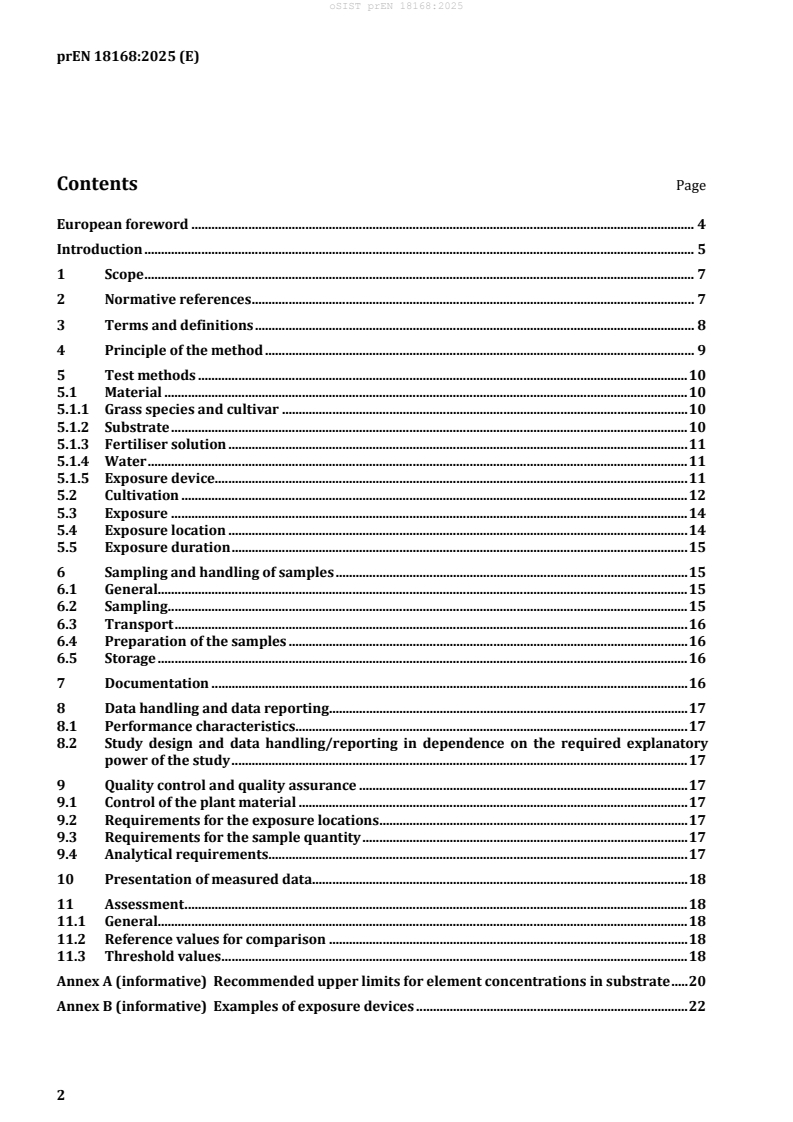
Contents Page
European foreword . 4
Introduction . 5
1 Scope . 7
2 Normative references . 7
3 Terms and definitions . 8
4 Principle of the method . 9
5 Test methods . 10
5.1 Material . 10
5.1.1 Grass species and cultivar . 10
5.1.2 Substrate . 10
5.1.3 Fertiliser solution . 11
5.1.4 Water . 11
5.1.5 Exposure device. 11
5.2 Cultivation . 12
5.3 Exposure . 14
5.4 Exposure location . 14
5.5 Exposure duration . 15
6 Sampling and handling of samples . 15
6.1 General. 15
6.2 Sampling . 15
6.3 Transport . 16
6.4 Preparation of the samples . 16
6.5 Storage . 16
7 Documentation . 16
8 Data handling and data reporting . 17
8.1 Performance characteristics. 17
8.2 Study design and data handling/reporting in dependence on the required explanatory
power of the study . 17
9 Quality control and quality assurance . 17
9.1 Control of the plant material . 17
9.2 Requirements for the exposure locations . 17
9.3 Requirements for the sample quantity . 17
9.4 Analytical requirements. 17
10 Presentation of measured data . 18
11 Assessment . 18
11.1 General. 18
11.2 Reference values for comparison . 18
11.3 Threshold values . 18
Annex A (informative) Recommended upper limits for element concentrations in substrate . 20
Annex B (informative) Examples of exposure devices . 22
oSIST prEN 18168:2025
prEN 18168:2025 (E)
Annex C (informative) Plates: cultivation and sampling . 26
Annex D (informative) Sample preparation (before analysis) . 27
Annex E (informative) Examples of protocols for documentation . 28
Annex F (informative) Study design, data analysis and interpretation . 30
Annex G (informative) Reference data . 35
Bibliography . 40
oSIST prEN 18168:2025
prEN 18168:2025 (E)
European foreword
This document (prEN 18168:2025) has been prepared by Technical Committee CEN/TC 264 “Air
Quality”, the secretariat of which is held by DIN.
This document is currently submitted to the CEN Enquiry.
oSIST prEN 18168:2025
prEN 18168:2025 (E)
Introduction
The impact of air pollution is of growing importance worldwide. Local and regional assessment is
necessary as a first step to collect fundamental information, which can be used to avoid, prevent, and
minimize harmful effects on human health and the environment as a whole. Biomonitoring can serve as
a tool for such a purpose. As the effects on indicator organisms are a time-integrated result of complex
influences combining both air quality and local climatic conditions, this holistic biological approach is
considered particularly close to human and environmental health end points and thus is relevant to air
quality management.
It is important to emphasize that biomonitoring data are completely different from those obtained
through physico-chemical measurements (ambient concentrations and deposition) and computer
modelling (emissions data). Biomonitoring provides evidence of the effects that airborne pollutants have
on organisms. As such it reveals biologically relevant, field-based, time- and space-integrated indications
of environmental health as a whole. Legislation states that there should be no harmful environmental
effects from air pollution. Only by investigating the effects at the biological level can this requirement be
met. The application of biomonitoring in air quality and environmental management requires rigorous
standards and a recognized regime so that it can be evaluated in the same way as physico-chemical
measurements and modelling in pollution management.
Biomonitoring is the traditional way through which environmental changes have been detected
historically. Various standard works on biomonitoring provide an overview of the state of the science at
the time, e.g. [1; 2; 3]. The first investigations of passive biomonitoring are documented in the middle of
the 19th century: By monitoring the development of epiphytic lichens it was discovered that the lichens
were damaged during the polluted period in winter and recovered and showed strong growth in summer
[4]. These observations identified lichens as important bioindicators. Later investigations also dealt with
bioaccumulators. An active biomonitoring procedure with bush beans was first initiated in 1899 [5].
Biomonitoring and EU-legislation
Biomonitoring methods in terrestrial environments respond to a variety of requirements and objectives
of EU environmental policy primarily in the fields of air quality (Directive 2008/50/EC on ambient air,
[6]), integrated pollution prevention and control (IPPC; Directive 2010/75/EU, [7]) and conservation
(92/43/EEC on the Conservation of Natural Habitats and of Wild Fauna and Flora, [8]). The topics food
chain [9] and animal feed [10; 11; 12] are alluded to as well.
For air quality in Europe, the legislator requires adequate monitoring of air quality, including pollution
deposition as well as avoidance, prevention, or reduction of harmful effects. Biomonitoring methods
appertain to the scope of short-term and long-term air quality assessment.
Directive 2004/107/EC of 15 December 2004 relating to arsenic, cadmium, mercury, nickel, and
polycyclic aromatic hydrocarbons in ambient air [13] states that “the use of bio indicators may be
considered where regional patterns of the impact on ecosystems are to be assessed”.
Concerning IPPC from industrial installations, the permit procedure includes two particular
environmental conditions for setting adequate emission limit values. The asserted concepts of “effects”
and “sensitivity of the local environment” open a broad field for biomonitoring methods, in relation to
the general impact on air quality and the deposition of operational-specific pollutants. The basic
properties of biomonitoring methods can be used advantageously for various applications such as
reference inventories prior to the start of a new installation, the mapping of the potential pollution
reception areas and (long-term) monitoring of the impact caused by industrial activity. The
environmental inspection of installations demands the examination of the full range of environmental
effects. For the public authority, biomonitoring data contribute to the decision-making process, e.g.
concerning the question of tolerance of impacts at the local scale.
The Habitats Directive [8] requires competent authorities to consider or review planning permission and
other activities affecting a site designated at the European level where the integrity of the site could be
oSIST prEN 18168:2025
prEN 18168:2025 (E)
adversely affected. The Directive also provides for the control of potentially damaging operations,
whereby consent may only be granted once it has been shown through appropriate assessment that the
proposed operation will not adversely affect the integrity of the site. The responsibility lies with the
applicant to demonstrate that there is no adverse effect on such a conservation area. For this purpose,
biomonitoring is well suited as a non-intrusive form of environmental assessment.
As an important element within its integrated environmental policy, in 2003 the European Commission
adopted a European Environment and Health Strategy [14] with the overall aim of reducing diseases
caused by environmental factors in Europe. In chapter 5 of this document, it is stated that the “community
approach entails the collection and linking of data on environmental pollutants in all the different
environmental compartments (including the cycle of pollutants) and in the whole ecosystem (bio-
indicators) to health data (epidemiological, toxicological, morbidity)”. The European Environment and
Health Action Plan 2004-2010 [15] which followed the adoption of this strategy focuses on human
biomonitoring, but emphasizes the need to “develop integrated monitoring of the environment, including
food, to allow the determination of relevant human exposure“.
Development of the standardized grass culture
The method of standardized grass cultures can be used to detect air pollution induced accumulation of
inorganic and organic substances in plants. It allows for the determination of the temporal and spatial
distribution of pollution and the assessment of risks to plants, animals, and humans. This document
standardises the method and minimizes confounding impacts of factors which affect the uptake of
pollutants into the standardized grass cultures.
The methodology was originally developed in the Ruhr area in Germany in the late 1960s [16; 17] to
determine the burden of fluorides, lead, cadmium, and zinc pollution in a heavily industrialized and
densely populated region. In 1978, VDI 3792-1 [18] was published which described the cultivation of
grass cultures and the standardized set up of plant containers in the field. In 1982 and 1985 additional
VDI standards on the determination of fluorides and lead concentrations in grass cultures followed [19;
20]. In 2003, the standard series on grass culture was completely revised and consolidated in VDI 3957-
2 (current version see [21]). The current version also includes persistent organic and inorganic
compounds.
Meanwhile, the feasibility of the original method has been tested and approved in eight European
countries within the European network for the assessment of air quality by the use of bioindicator plants
[22]. The results of this EU project confirm that the method can be applied across large climatic gradients
and that it is well suited for comparison of air pollution effects in different countries [23]. Based on these
experiences, the grass culture method has also been adopted as a standard in France [24]. The present
document is primarily based on the above-mentioned national standards and it has been jointly edited
by experts from seven European countries.
oSIST prEN 18168:2025
prEN 18168:2025 (E)
1 Scope
This document applies to the use of the grass Lolium multiflorum ssp. italicum designated hereafter as
Italian ryegrass for the bioaccumulation of substances liable to cause atmospheric pollution. It is an active
biomonitoring approach insofar as the plants used are first cultivated in set conditions before being
exposed at the monitoring locations in the field. The plants then record any pollution events that occur
while they are being exposed, allowing such events to be accurately dated.
The method described in this document can be applied for identification and localization of one or more
single pollution sources and the tracking of their “plume” on a local or regional scale. It also offers a tool
to monitor sites in the long term by the repeated application of a clearly defined procedure and to
describe the local or regional air pollution situation.
The method applies to solid and gaseous substances deposited on plants, where they may accumulate on
their surface or in their tissues. These substances include sulphur, chloride, fluoride and especially metals
as well as low volatile organic and halo-organic compounds such as polycyclic aromatic hydrocarbons
(PAH), polychlorinated biphenyls (PCB), polybrominated diphenyl ethers (PBDE), polychlorinated
dibenzo dioxins (PCDD) and polychlorinated dibenzo furans (PCDF). It is as well possible to verify
pesticides which are used in plant protection products. The range of potential substances may be
expanded according to the task at hand and the capabilities of conducting trace analyses and assessment.
The method described in this document allows spatial and temporal comparisons and allows for
screening, thus providing a first indication of risk. The results of grass culture studies can suggest risks
to biota (e.g. via the food chain) which require further investigation.
The method described in this document does not replace physico-chemical methods of direct
measurement or modelling of air pollutants and cannot be replaced by them for its part; it complements
them by indicating biological effects.
Potential areas of deployment are:
• Permit procedures related to air pollution legislation;
• Preservation of evidence related to the code for protection from pollution;
• Monitoring of emission sources and performance control;
• Assessment of local-scale emission transport;
• Evidence of causation, e.g. related to environmental liability;
• Air quality maintenance plans/strategies;
• Long-term monitoring of ecological effects of atmospheric depositions;
• Detection and assessment of local, regional, and countrywide effects of atmospheric depositions;
• Assessment of risks for humans and/or animals via the food chain.
This document is of interest to those involved in environmental monitoring.
2 Normative references
There are no normative references in this document.
oSIST prEN 18168:2025
prEN 18168:2025 (E)
3 Terms and definitions
For the purposes of this document, the following terms and definitions apply.
ISO and IEC maintain terminological databases for use in standardization at the following addresses:
• IEC Electropedia: available at https://www.electropedia.org/
• ISO Online browsing platform: available at https://www.iso.org/obp
3.1
biomonitoring
use of biological systems (organisms and organism communities) to monitor environmental change over
space and/or time
Note 1 to entry: Biological systems can be further considered as bioindicators.
Note 2 to entry: Active biomonitoring refers to deliberate field exposure following a standardized methodology;
passive biomonitoring refers to in situ-sampling and/or observation of selected bioindicators currently or
previously present in the environment.
[SOURCE: EN 16789:2016 [25], definition 2.1]
3.2
bioindicator
organism or a part of it or an organism community (biocoenosis) which documents environmental
impacts
Note 1 to entry: It encompasses bioaccumulators and response indicators.
[SOURCE: EN 16789:2016 [25], definition 2.2]
3.3
bioaccumulator
organism which can indicate environmental conditions and their modification by accumulating
substances present in the environment (air, water, or soil) at the surface and/or internally
[SOURCE: EN 16789:2016 [25], definition 2.3]
3.4
response indicator (or effect indicator)
organism which can indicate environmental conditions and their modification by either showing specific
symptoms (molecular, biochemical, cellular, physiological, anatomical, or morphological) or by its
presence/absence in the ecosystem
[SOURCE: EN 16789:2016 [25], definition 2.4]
3.5
blank sample
sample of grass taken from pots prior to the exposure in the field
3.6
greenhouse control
sample of grass kept in the greenhouse, taken from pots at the end of each exposure phase
oSIST prEN 18168:2025
prEN 18168:2025 (E)
3.7
background level
concentration of a substance in samples exposed and/or collected in a part of the study area, where no
emission source has a local influence
Note 1 to entry: To help characterize the background deposition either measured or modelled data can be used.
Note 2 to entry: Emission sources might be industry, households, agriculture, or transport.
3.8
effect
response of organisms or a set of organisms (biocoenosis) to physical and chemical conditions of the
environment
Note 1 to entry: That includes changes in the chemical composition of the bioindicator.
3.9
study area
geographical area considered by the study
Note 1 to entry: It shall be described in detail in terms of extent, land use classification and altitudinal range.
[SOURCE: EN 16789:2016 [25], definition 2.7]
4 Principle of the method
Standardized grass cultures are cultures of Italian ryegrass in plant pots, which are exposed to ambient
air in an investigation area, and which can accumulate chemical compounds from the atmosphere. Each
culture is exposed for a certain period and is subsequently analysed for deposited substance
accumulation. In each study period or growing season several grass cultures are sequentially exposed at
each location so that the temporal sequence of the pollution load can be determined, and the results can
be verified statistically. The ability of grass cultures to accumulate inorganic and organic pollutants (e.g.
heavy metals, fluorides, polycyclic aromatic hydrocarbons, and dioxins) was proven in numerous studies
[24; 26; 27; 28; 29; 30; 31; 32; 33; 34; 35].
As grass cultures grow their leaf surface area and biomass will change. In addition, varying climatic
conditions can affect growth and surface properties. These influence their ability to accumulate
substances from the air, while the concentration of absorbed compounds is diluted by the growth. There
are also processes by which substances are removed (e.g. abrasion, volatilisation). The proximity of a
pollution event to the sampling date will have an important influence on the concentration recorded in
the plant material, thus an event occurring just before harvest will produce a stronger signal than the one
occurring just after the start of exposure. Through repeated exposure of grass cultures on one location it
is possible to get temporally integrated information on the pollution effects over the course of a study
period.
The use of grass cultures in active monitoring has the following advantages over passive monitoring using
plants growing in situ:
• it is easier to identify pollutant accumulation in grass cultures than in plants growing in situ, because
the initial concentrations at the start of exposure are known;
• because of the standardization, grass cultures are at the same stage of development and have the
same conditions (genetic composition, soil, nutrient and water supply) at all locations; therefore,
results from different locations can be compared optimally;
oSIST prEN 18168:2025
prEN 18168:2025 (E)
• a possible pollution effect can be assigned to a certain time period accurately;
• the monitoring locations can be chosen freely;
• due to the higher accumulation potential of the grass culture compared to grassland vegetation, the
standardized grass culture is an early-warning indicator.
The use of grass cultures as biomonitors depends critically on whether they represent accumulations in
other plants. In the case of various heavy metals and fluorides a very close positive correlation has been
found between pollution-induced accumulation in grass cultures and plants growing in situ (e.g.
vegetables) [36; 37; 38; 39]. The ratio will vary according to the situation and the vegetation type but
increased concentrations in the grass culture can indicate a potential risk.
In contrast to physico-chemical measurements of pollution concentrations or deposition rates,
standardized grass cultures as representatives of the protected resource vegetation detect the portion of
air pollutants absorbed or adsorbed by the plants. This makes the effect caused by pollutants directly
assessable. In addition, there are lipophilic organic substances that can accumulate in the plant but are
much more difficult to measure using physico-chemical methods such as bulk samplers. Just as for the
vegetation at a location, the portion of pollutants causing an effect depends strongly, amongst others, on
weather conditions, which are not reflected in physico-chemical measurements. Therefore, there is
usually no direct relationship to results from measurements of pollution concentrations and deposition
rates [40; 41; 42; 43].
5 Test methods
5.1 Material
5.1.1 Grass species and cultivar
Italian ryegrass (Lolium multiflorum Lam. ssp. italicum) shall be used for the method described. For the
choice of a specific cultivar, the following prerequisites shall be fulfilled:
• adapted to the local climate situation;
• admitted in the respective country;
• suitable biomass, but not fast-growing;
• short-growing.
Once a cultivar has been chosen, it shall be used continuously to ensure comparability.
Examples of cultivars tested and regularly used:
• in Austria: cultivar “Gemini”;
• in France: cultivar “Bio Mowestra”;
• in Germany: cultivars “Balance” and “Gemini”.
For annual exposure periods, the grass seeds shall be from a single batch of the same origin or brand.
5.1.2 Substrate
Care should be taken to use a standardized soil mixture as substrate for the grass cultures which is
available in a large area (e.g. nationally) so that the same substrate can be used in other programmes. It
oSIST prEN 18168:2025
prEN 18168:2025 (E)
is important that the substrate is unfertilised. Attention should also be paid to the pH value, which should
range between 5.5 and 7.
Within one study project, a homogeneous substrate (if necessary, by mixing substrate from different
suppliers) should be used for one growing period. Before starting the cultivation, a representative sample
of the substrate should be analysed for contents of elements and can be compared to the recommended
thresholds in Annex A.
5.1.3 Fertiliser solution
To provide fertiliser for the grass cultures a solution of laboratory chemicals (analytical or at least
technical grade) is used. It shall be ensured that no heavy metals in readily available form are introduced
into the substrate. The fertiliser solution contains 5,8 g KH PO , 8,5 g KNO and 5,3 g NH NO per litre
2 4 3 4 3
deionised water.
5.1.4 Water
For watering the plants, drinking water quality is sufficient. If drinking water quality cannot be complied
with, deionised water shall be used.
NOTE Directive (EU) 2020/2184 [44] relates to the quality of drinking water.
5.1.5 Exposure device
The exposure device consists of the following parts:
• plant pot (Figure 1), commercial version, volume 1 l to 2 l, diameter of substrate surface (2 cm below
pot rim) 12 ± 1 cm, provided with at least four drillings for at least two wicks or blotting strips; pot
height at least 10 cm (at least 8 cm below substrate surface); material: polypropylene or polyethylene
especially when inorganic compounds are analysed.
NOTE 1 Plastic pots made of other materials than the ones mentioned can interfere with the study results due to
high concentrations of heavy metals.
• two wicks made of textile band made of polyester fibre (thickness 0,4 mm; width to be cut at about
30 mm) or glass fibre (Ø 6 mm or 8 mm; to be handled only when wet)
• weather-proof, opaque water reservoir, of sufficient volume; the material used shall not leak
substances that influence the results
NOTE 2 An outer layer can be necessary for the water reservoir to protect it from external influences, especially
extreme weather such as prolonged direct sunlight. For example, a reflecting coating can be helpful to avoid
overheating.
One should be aware that mosquitos might use the water reservoir as habitat for reproduction. In this
case, biological control should be applied, e.g. Bacillus thuringiensis.
NOTE 3 Regarding biological control methods, local or national regulations can apply.
oSIST prEN 18168:2025
prEN 18168:2025 (E)
Dimensions in centimetres
Figure 1 — Plant pot
Before beginning a project, the material of the suction wicks shall be tested whether substances leak from
them that might impair the results of the exposure.
The plant pots are put into water reservoirs (see Annex B). The water is supplied to the plant by wicks,
which hang from the plant pots into the water reservoir. The shape of the water reservoir is of no
importance to the results of the grass cultures, but its height should not exceed 50 cm as otherwise the
absorption capacity of the wicks will not suffice. The smaller the volume, the more refilling might be
necessary depending on the weather conditions.
5.2 Cultivation
Aim of the cultivation is a healthy, densely grown grass culture. The grass culture is cultivated in the pots
used later for exposure in a greenhouse with as little influence of pollutants as possible. The temperature
requirements of Italian ryegrass are low [45], but it shall be ensured that the temperature in the
greenhouse is not ≤ 12°C during daytime. The development of grass cultures ready for exposure takes
about six weeks. Depending on the geographical location, the greenhouse can remain unheated, i.e. it can
be run as a cold house or open greenhouse. During cultivation the following procedures have turned out
to be effective (see Annex C for additional information).
Sowing and cultivation are carried out in the following steps:
• The entire amount of soil needed for a series of grass cultures has to be brought together and
homogenized by mixing thoroughly before it is distributed into the plant pots (if necessary, it can be
moistened so it mixes easily).
• For each exposure period, the substrate volume is collected and if necessary moistened (optimal
water content: 45 % to 55 %) and the pH is controlled (optimal pH value: 5.5 to 7).
• About 10 % more grass cultures than needed for the exposure should be cultivated so that weakly
growing cultures can be replaced and to ensure the homogeneity of the cultivation batch.
• Before filling the plant pots with soil, the ends of two well-moistened wicks are put through the holes
in the bottom so that their middle is inside the pot and they run parallel. The length of the wicks is
such that their ends reach the bottom of the water reservoir.
• The pots are filled up to the top rim loosely with substrate; the wicks are held so that their middle is
situated in the substrate at approx. 2/3 of the pot height. It is important that the substrate quantities
oSIST prEN 18168:2025
prEN 18168:2025 (E)
in all pots are as similar as possible. Afterwards the substrate is compressed and levelled with a
wooden disk so that the substrate surface is about 2 cm below the rim of the pot.
• Fertiliser solution is applied equally across the substrate surface. 50 ml of fertilising solution are
applied to each culture; after the solution has been absorbed, 50 ml of water are added.
• In each pot, the seeds of Italian ryegrass are sown evenly on the substrate and covered with a thin,
about 3 mm thick layer of the standard soil, which then is compressed lightly with the wooden disk.
Subsequently, water is sprayed on the soil substrate until the surface layer is well moistened.
• For a sowing area with a diameter of 12 cm, a seed rate between 0,5 g seed and 0,6 g seed is
recommended.
• The germination rate shall be tested prior the seeding once a year and the seeding rate shall be
adjusted accordingly. Variation in the seeding rate in the range of ± 15 % will be compensated for
completely by e.g. tilling.
• If the germination capacity of the seeds is lower than 80 %, the amount of seed needs to be increased
proportionally.
• Then the plant pots are placed in water filled tubs so that the cultures are supplied with water by
means of their wicks. However, care shall be taken that the surface of the cultures does not dry off
during germination. To prevent this, they can be sprayed with drinking water. Covering with foil also
prevents drying of the cultures and, moreover, protects them against cooling down. During this time,
the cultures are also sensitive to overheating, which is avoided best by light-sensitive (external)
greenhouse shades. During cultivation, the positioning of the pots in the greenhouse should be
rotated at weekly intervals.
• The following fertilisation scheme shall be used:
At each fertilisation, (50 ± 5 ml)/100 cm substrate area shall be applied equally.
1st application immediately before sowing (see above);
2nd application after the second cut;
3rd application after the fourth cut (at the start of exposure).
Three applications usually are sufficient for an appropriate growth of the grass culture. In order to
increase biomass, a fourth application might be given in the third week of exposure. In that case, a
possible dilution effect of already accumulated pollutants has to be taken into account.
• During cultivation in the greenhouse, the grass is cut back to 4 cm each time it reaches a height of
10 cm, in order to promote dense growth. Normally this correlates with an interval of seven days.
While doing so it should be ensured that no grass clippings remain in the cultures.
• In order to adapt to outside conditions, the plants should be hardened outside under a transparent
roof (protection against precipitation) for one week before exposure. This period is integrated in the
cultivation period of five to six weeks.
• Directly before the exposure, the grass is once more cut back to 4 cm. Ceramic scissors are
recommended to avoid iron, nickel, and chromium contamination.
If fungal growth shows on the substrate, the relative humidity of the air above the cultures shall be
reduced (by increased ventilation) and (or) the grass kept short. Further plant protection measures in
the form of the application of fungicides should not be implemented.
oSIST prEN 18168:2025
prEN 18168:2025 (E)
5.3 Exposure
To determine the effects of trace element deposition, one culture per location and exposure is sufficient.
However, to prevent losses due to any field problems it is strongly recommended to expose three or four
pots. The number of pots is also dependant on the statistical design of the study.
For the investigation of organic pollutant accumulation, a relatively large sample biomass is generally
needed. In this case, preferably a higher number of pots (five or six) is used.
The diameter of the plant pot influences the surface of the plant canopy and thus the uptake of pollutants
from the air. This shall be considered when assessing the results.
In order to standardize the exposure of the grass cultures to air flow as much as possible, the cultures are
set up so that the top of the pot is 1,5 m above ground.
To erect the exposure container in the field, water pipes (3/4”) with fitted steel baskets can be used
(Annex B). The exposure supports shall be designed in order not to impede the air circulation at plant
level. They shall be identical in all the exposure locations and their constituents shall not contaminate the
sample.
5.4 Exposure location
The airflow around an exposed grass culture and the structure of the exposure location are important
criteria for the suitability of the establishment of the system. For regional monitoring programmes, the
exposure locations should be representative of their surroundings (e.g. land use, vegetation types,
topography). In a source-related investigation, the exposure locations should give information about the
pollution load at a certain distance and direction from the given source. In the first case, the wind flow
towards the plants shall be typical for the environment, in the second case it shall be as comparable as
possible at all exposure locations [46].
Independent of the measurement strategy, the following general criteria shall be considered for the
selection of the exposure locations:
• the exposure location shall not impede the deposition of pollutants;
• the bioindicator should not be negatively influenced by external factors.
In particular, the grass cultures:
• should be set up on non-sealed surfaces (e.g. grassland);
• should be located at least double the distance of the height of the closest vertical structure (edge of
trees, buildings, etc.);
• should not be shaded for major portions of the day;
• should not be placed in locations where wind is funnelled (canyon effect between buildings);
• should not be placed in locations where the topography is untypical (slopes, depressions);
• shall not be placed close to power cables or pylons;
• shall not be under direct influence of polluting sources other than the studied source (e.g. next to
parking lots, unsurfaced roads, and fireplaces);
• should be protected against vandalism and animals.
oSIST prEN 18168:2025
prEN 18168:2025 (E)
5.5 Exposure duration
The grass cultures are exposed in the investigation area for 28 ± 2 days, then the samples are taken, and
the cultures discarded. The exposures begin in springtime when growth starts, so that at each exposure
location depending on the climate conditions five or more exposures can be carried out in one vegetation
period.
If the temporal resolution of the pollution effects into 28-day periods is not sufficient, the grass cultures
can be exposed in overlapping exposure periods, e.g. at 14-day intervals (see Figure 2). The exposure
duration of 28 days has still to be kept.
Key
a 1st period
b 2nd period
c 3rd period
d 4th period
e 5th period
f 6th period
g 7th period
Figure 2 — Exposure time of the grass culture in overlapping periods; each period covers 28
days
6 Sampling and handling of samples
6.1 General
6.2 to 6.5 describe technical aspects of sampling and handling of samples. Specific issues relevant for
quality control and quality assurance are described in Clause 9.
6.2 Sampling
For sampling, the cultures are held tilted at an angle. The grass is cut with scissors 4 cm above the
substrate level. To facilitate this operation and make it more reproducible, a 4 cm high plastic cylinder
with a diameter equal to the inside diameter of the pot can be placed on the ground as a guide. The grass
is dropped directly into the sample container or a clean funnel or onto a clean surface, from which the
sample can be transferred into the sample container. In the case of chromium- or nickel-analysis ceramic
scissors should be used. The scissors shall be washed with water and wiped with disposable paper towel
in-between single pots. Cutting should be carried out at the exposure location to avoid contamination. If
this is not possible (e.g. due to adverse weather such as precipitation, strong winds), the grass cultures
may be transported in a closed vehicle and sampled jointly in a suitable place (under a roof). Accidental
contamination (also cross-contamination between grass cultures of different locations) or loss of
accumulated substances shall be prevented during transport.
A sample may comprise the biomass of one or more pots according to the sampling strategy chosen by
the operator. Only pots should be harvested that did not suffer from drying out, resulting in dead plants,
or that are visually contaminated by bird excrements.
oSIST prEN 18168:2025
prEN 18168:2025 (E)
The samples shall not be cleaned or washed. Hand-contact with the samples shall be avoided. No
substrate should be allowed to get into the samples or sample containers.
For storing the samples, containers shall be used whose materials do not interfere with the intended
analyses.
For the analysis of organic compounds or mercury the samples are transferred into glass or metal
containers. The containers, including the lids, should be pre-cleaned with acetone (analytical grade).
Alternatively, it is also possible to wrap the samples in cleaned aluminium foil or lab aluminium foil.
Plastic containers are unsuitable except for samples for mercury, since their walls can absorb
accumulated organic compounds. If plastic lids are used for the sample containers, in the case of samples
for organic compounds they shall be covered by aluminium foil to prevent their contact with the sample.
6.3 Transport
The time between sampling and further processing shall be as short as possible. Samples for organic
compounds shall be
...
Questions, Comments and Discussion
Ask us and Technical Secretary will try to provide an answer. You can facilitate discussion about the standard in here.
Loading comments...