

EN 15182-1:2007
(Main)Hand-held branchpipes for fire service use - Part 1: Common requirements
- Abstract
This part of this European Standard applies to hand-held branchpipes. It deals with:
safety requirements;
performance requirements;
test methods;
classification and designation;
instructions for use and maintenance;
marking.
This standard should be read in conjunction with parts 2, 3 or 4.
This standard does not apply to branchpipes covered by EN 671, foam branchpipes, powder branchpipes, or branchpipes with a maximum working pressure above 40 bar.
NOTE 1 The Working Group has thoroughly addressed and discussed the issue of electrical safety in relation to using water branchpipes. However, an electrical test is not incorporated into this standard as international experience, as well as research (NFPA handbook, French research, etc) have shown that any "artificial" or "laboratory style" testing will not take into account poor visibility and other conditions present on any fireground, nor the problem of estimating distances under these conditions. The end user should be advised (through the operating instructions, see 8.1) that when fighting fires in or near electrical installations, the power should be cut off as soon as possible. Also, maintain a maximum possible safety distance (at least 1 m up to 1 000 V) and use a spray jet with a minimum spray angle of 30 °.
NOTE 2 Reaction forces should be taken into consideration before choosing and operating branchpipes.
- Status
- Withdrawn
- Publication Date
- 13-Feb-2007
- Withdrawal Date
- 03-Nov-2009
- Technical Committee
- CEN/TC 192 - Fire service equipment
- Drafting Committee
- CEN/TC 192 - Fire service equipment
- Current Stage
- 9960 - Withdrawal effective - Withdrawal
- Start Date
- 04-Nov-2009
- Completion Date
- 04-Nov-2009

Relations
- Merged Into
EN 15182-1:2007+A1:2009 - Hand-held branchpipes for fire service use - Part 1: Common requirements - Effective Date
- 18-Jan-2023
- Effective Date
- 28-Jan-2026
- Effective Date
- 28-Jan-2026
- Effective Date
- 28-Jan-2026
Get Certified
Connect with accredited certification bodies for this standard

CIS Institut d.o.o.
Personal Protective Equipment (PPE) certification body. Notified Body NB-2890 for EU Regulation 2016/425 PPE.

Kiwa BDA Testing
Building and construction product certification.
Kmetijski inštitut Slovenije
Agricultural Institute of Slovenia. Soil testing, plant health, agricultural product analysis.
Sponsored listings
Frequently Asked Questions
EN 15182-1:2007 is a standard published by the European Committee for Standardization (CEN). Its full title is "Hand-held branchpipes for fire service use - Part 1: Common requirements". This standard covers: This part of this European Standard applies to hand-held branchpipes. It deals with: safety requirements; performance requirements; test methods; classification and designation; instructions for use and maintenance; marking. This standard should be read in conjunction with parts 2, 3 or 4. This standard does not apply to branchpipes covered by EN 671, foam branchpipes, powder branchpipes, or branchpipes with a maximum working pressure above 40 bar. NOTE 1 The Working Group has thoroughly addressed and discussed the issue of electrical safety in relation to using water branchpipes. However, an electrical test is not incorporated into this standard as international experience, as well as research (NFPA handbook, French research, etc) have shown that any "artificial" or "laboratory style" testing will not take into account poor visibility and other conditions present on any fireground, nor the problem of estimating distances under these conditions. The end user should be advised (through the operating instructions, see 8.1) that when fighting fires in or near electrical installations, the power should be cut off as soon as possible. Also, maintain a maximum possible safety distance (at least 1 m up to 1 000 V) and use a spray jet with a minimum spray angle of 30 °. NOTE 2 Reaction forces should be taken into consideration before choosing and operating branchpipes.
This part of this European Standard applies to hand-held branchpipes. It deals with: safety requirements; performance requirements; test methods; classification and designation; instructions for use and maintenance; marking. This standard should be read in conjunction with parts 2, 3 or 4. This standard does not apply to branchpipes covered by EN 671, foam branchpipes, powder branchpipes, or branchpipes with a maximum working pressure above 40 bar. NOTE 1 The Working Group has thoroughly addressed and discussed the issue of electrical safety in relation to using water branchpipes. However, an electrical test is not incorporated into this standard as international experience, as well as research (NFPA handbook, French research, etc) have shown that any "artificial" or "laboratory style" testing will not take into account poor visibility and other conditions present on any fireground, nor the problem of estimating distances under these conditions. The end user should be advised (through the operating instructions, see 8.1) that when fighting fires in or near electrical installations, the power should be cut off as soon as possible. Also, maintain a maximum possible safety distance (at least 1 m up to 1 000 V) and use a spray jet with a minimum spray angle of 30 °. NOTE 2 Reaction forces should be taken into consideration before choosing and operating branchpipes.
EN 15182-1:2007 is classified under the following ICS (International Classification for Standards) categories: 13.220.10 - Fire-fighting. The ICS classification helps identify the subject area and facilitates finding related standards.
EN 15182-1:2007 has the following relationships with other standards: It is inter standard links to EN 15182-1:2007+A1:2009, EN 15182-4:2007+A1:2009, EN 15182-2:2007+A1:2009, EN 15182-3:2007+A1:2009. Understanding these relationships helps ensure you are using the most current and applicable version of the standard.
EN 15182-1:2007 is available in PDF format for immediate download after purchase. The document can be added to your cart and obtained through the secure checkout process. Digital delivery ensures instant access to the complete standard document.
Standards Content (Sample)
2003-01.Slovenski inštitut za standardizacijo. Razmnoževanje celote ali delov tega standarda ni dovoljeno.Hand-held branchpipes for fire service use - Part 1: Common requirementsLances a main destinées aux services d'incendie et de secours - Partie 1 : Prescriptions communesStrahlrohre für die Brandbekämpfung - Teil 1: Allgemeine AnforderungenTa slovenski standard je istoveten z:EN 15182-1:2007SIST EN 15182-1:2007en;fr;de13.220.10Gašenje požaraFire-fightingICS:SLOVENSKI
STANDARDSIST EN 15182-1:200701-julij-2007
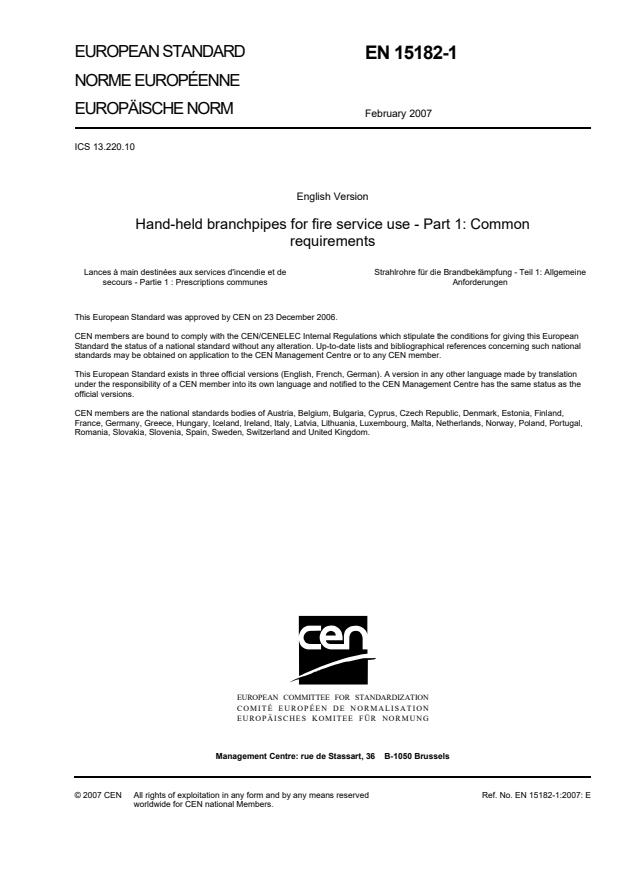
EUROPEAN STANDARDNORME EUROPÉENNEEUROPÄISCHE NORMEN 15182-1February 2007ICS 13.220.10 English VersionHand-held branchpipes for fire service use - Part 1: CommonrequirementsLances à main destinées aux services d'incendie et desecours - Partie 1 : Prescriptions communesStrahlrohre für die Brandbekämpfung - Teil 1: AllgemeineAnforderungenThis European Standard was approved by CEN on 23 December 2006.CEN members are bound to comply with the CEN/CENELEC Internal Regulations which stipulate the conditions for giving this EuropeanStandard the status of a national standard without any alteration. Up-to-date lists and bibliographical references concerning such nationalstandards may be obtained on application to the CEN Management Centre or to any CEN member.This European Standard exists in three official versions (English, French, German). A version in any other language made by translationunder the responsibility of a CEN member into its own language and notified to the CEN Management Centre has the same status as theofficial versions.CEN members are the national standards bodies of Austria, Belgium, Bulgaria, Cyprus, Czech Republic, Denmark, Estonia, Finland,France, Germany, Greece, Hungary, Iceland, Ireland, Italy, Latvia, Lithuania, Luxembourg, Malta, Netherlands, Norway, Poland, Portugal,Romania, Slovakia, Slovenia, Spain, Sweden, Switzerland and United Kingdom.EUROPEAN COMMITTEE FOR STANDARDIZATIONCOMITÉ EUROPÉEN DE NORMALISATIONEUROPÄISCHES KOMITEE FÜR NORMUNGManagement Centre: rue de Stassart, 36
B-1050 Brussels© 2007 CENAll rights of exploitation in any form and by any means reservedworldwide for CEN national Members.Ref. No. EN 15182-1:2007: E
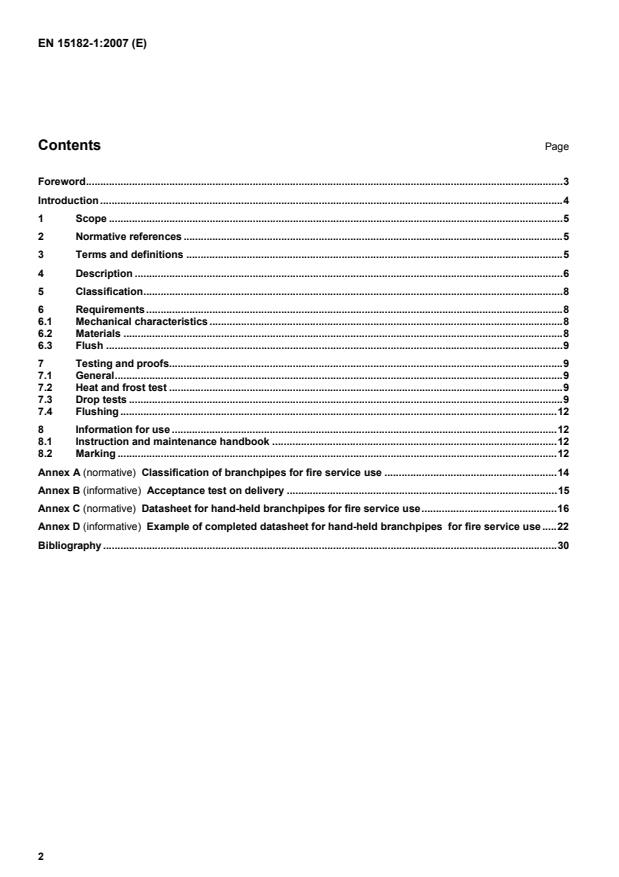
Classification of branchpipes for fire service use.14 Annex B (informative)
Acceptance test on delivery.15 Annex C (normative)
Datasheet for hand-held branchpipes for fire service use.16 Annex D (informative)
Example of completed datasheet for hand-held branchpipes
for fire service use.22 Bibliography.30
Its purpose is not to define a specific branchpipe design but to help the user in understanding and choosing the correct equipment.
1 Scope This part of this European Standard applies to hand-held branchpipes. It deals with: safety requirements; performance requirements; test methods; classification and designation; instructions for use and maintenance; marking. This standard should be read in conjunction with parts 2, 3 or 4. This standard does not apply to branchpipes covered by EN 671, foam branchpipes, powder branchpipes, or branchpipes with a maximum working pressure above 40 bar. NOTE 1 The Working Group has thoroughly addressed and discussed the issue of electrical safety in relation to using water branchpipes. However, an electrical test is not incorporated into this standard as international experience, as well as research (NFPA handbook, French research, etc) have shown that any "artificial" or "laboratory style" testing will not take into account poor visibility and other conditions present on any fireground, nor the problem of estimating distances under these conditions. The end user should be advised (through the operating instructions, see 8.1) that when fighting fires in or near electrical installations, the power should be cut off as soon as possible. Also, maintain a maximum possible safety distance (at least 1 m up to 1 000 V) and use a spray jet with a minimum spray angle of 30 °. NOTE 2 Reaction forces should be taken into consideration before choosing and operating branchpipes. 2 Normative references The following referenced documents are indispensable for the application of this document. For dated references, only the edition cited applies. For undated references, the latest edition of the referenced document (including any amendments) applies. EN 15182-2, Hand-held branchpipes for fire service use – Part 2: Combination branchpipes PN 16 EN 15182-3, Hand-held branchpipes for fire service use – Part 3: Smooth bore jet and/or one fixed spray jet angle branchpipes PN 16 EN 15182-4, Hand-held branchpipes for fire service use – Part 4: High pressure branchpipes PN 40 3 Terms and definitions For the purposes of this document, the following terms and definitions apply. 3.1 branchpipe combination of components that connects to a water supply via a hose and coupling and projects water according to the operators requirements 3.2 nozzle component of a branchpipe that controls the water flow rate and/or pattern
NOTE 1 Pressures expressed in bars are measured at the inlet of the branchpipe. NOTE 2 1 bar = 0,1 MPa (105 Pa). 3.3.1 reference pressure pR standard working pressure used to run hydraulic tests 3.3.2 median pressure pm for type 4 branchpipes, average pressure of the pressure control range NOTE Type 4 branchpipes are defined in EN 15182-2 and Annex A. 3.3.3 nominal pressure pN maximum working pressure 3.3.4 test pressure pt static pressure used for leakage tests 3.3.5 burst pressure pB static pressure used for burst test 3.4 jet
3.4.1 straight jet jet having the maximum throw and mechanical effect 3.4.2 spray jet any jet different to the straight jet 3.5
flush position allowing the branchpipe to clear debris 4 Description A hand-held branchpipe is comprised of at least the following components (see Figure 1): fitting system; gripping device; open and shut-off device (e.g. operated by a valve handle, a lever or a trigger); NOTE 1 An open and shut-off device can also be accommodated in a twist shut-off nozzle.
Key 1 nozzle 2 valve handle 3 handhold 4 rotating operating element 5 lever 6 trigger Figure 1 — Components of a hand-held branchpipe shown without fitting systems
...